 Скачать презентацию Phy 100 Heat transport Three basic forms of
fb36ba67b78c7e9a7c8ecafd61eb23e7.ppt
- Количество слайдов: 13



Phy 100: Heat transport Three basic forms of thermal heat transport 1) Conduction (review and applications); 2) Convection; 3) Radiation.
House heating 1) Understand different forms of heat transfer; 2) Learn to estimate gas bills of a house in winters; 3) Address the issue of energy saving in a scientific way i) use insulation materials with lower thermal conductivity; ii) how much energy and money (!) one saves by having house temperatures a few degrees lower ?
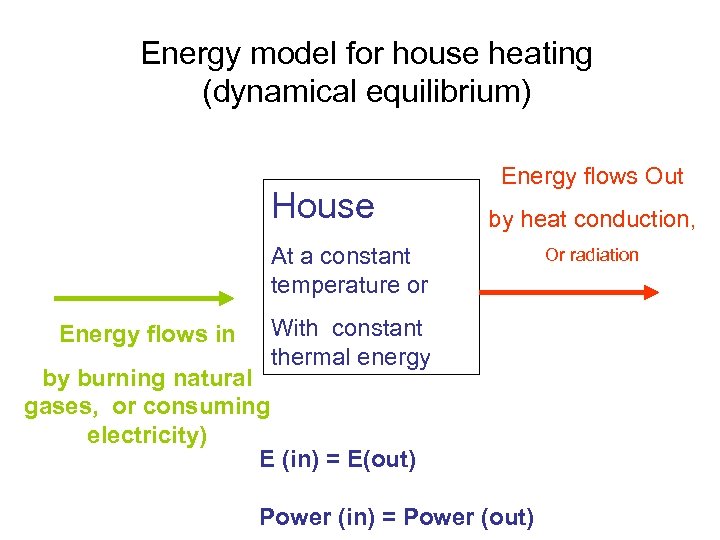
Energy model for house heating (dynamical equilibrium) House Energy flows Out by heat conduction, At a constant temperature or Energy flows in With constant thermal energy by burning natural gases, or consuming electricity) E (in) = E(out) Power (in) = Power (out) Or radiation
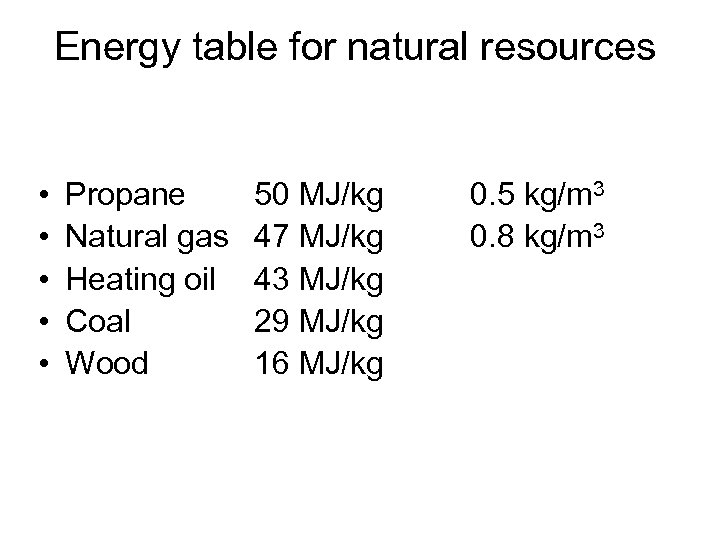
Energy table for natural resources • • • Propane Natural gas Heating oil Coal Wood 50 MJ/kg 47 MJ/kg 43 MJ/kg 29 MJ/kg 16 MJ/kg 0. 5 kg/m 3 0. 8 kg/m 3
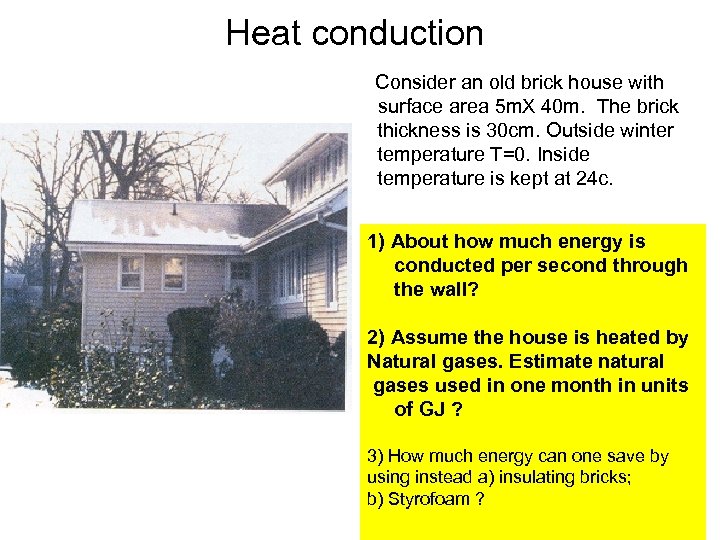
Heat conduction Consider an old brick house with surface area 5 m. X 40 m. The brick thickness is 30 cm. Outside winter temperature T=0. Inside temperature is kept at 24 c. 1) About how much energy is conducted per second through the wall? 2) Assume the house is heated by Natural gases. Estimate natural gases used in one month in units of GJ ? 3) How much energy can one save by using instead a) insulating bricks; b) Styrofoam ?
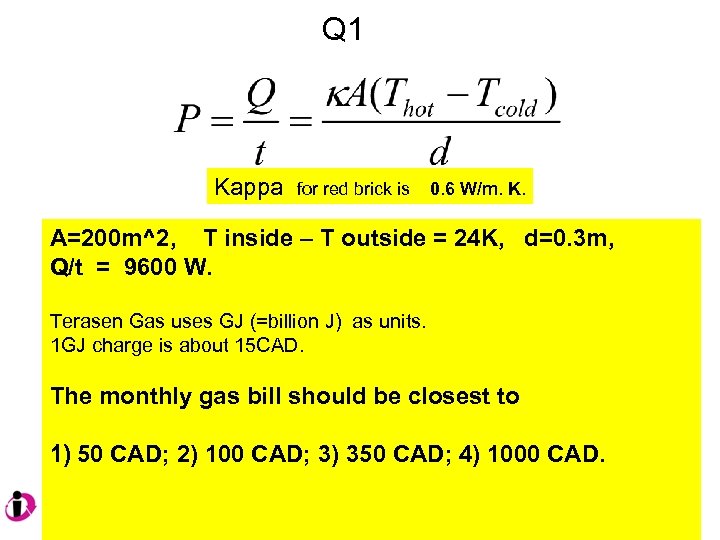
Q 1 Kappa for red brick is 0. 6 W/m. K. A=200 m^2, T inside – T outside = 24 K, d=0. 3 m, Q/t = 9600 W. Terasen Gas uses GJ (=billion J) as units. 1 GJ charge is about 15 CAD. The monthly gas bill should be closest to 1) 50 CAD; 2) 100 CAD; 3) 350 CAD; 4) 1000 CAD.
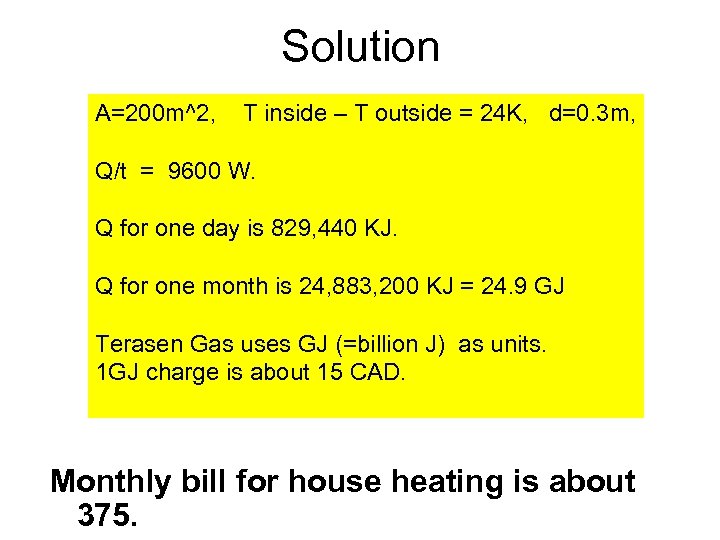
Solution A=200 m^2, T inside – T outside = 24 K, d=0. 3 m, Q/t = 9600 W. Q for one day is 829, 440 KJ. Q for one month is 24, 883, 200 KJ = 24. 9 GJ Terasen Gas uses GJ (=billion J) as units. 1 GJ charge is about 15 CAD. Monthly bill for house heating is about 375.
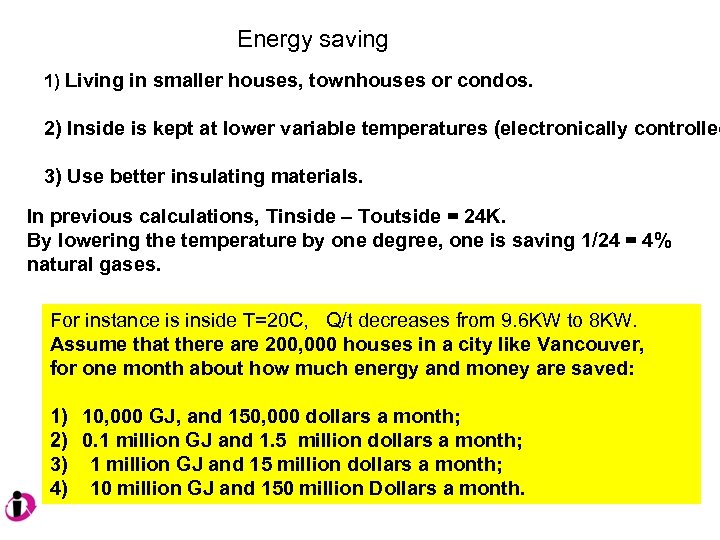
Energy saving 1) Living in smaller houses, townhouses or condos. 2) Inside is kept at lower variable temperatures (electronically controlled 3) Use better insulating materials. In previous calculations, Tinside – Toutside = 24 K. By lowering the temperature by one degree, one is saving 1/24 = 4% natural gases. For instance is inside T=20 C, Q/t decreases from 9. 6 KW to 8 KW. Assume that there are 200, 000 houses in a city like Vancouver, for one month about how much energy and money are saved: 1) 10, 000 GJ, and 150, 000 dollars a month; 2) 0. 1 million GJ and 1. 5 million dollars a month; 3) 1 million GJ and 15 million dollars a month; 4) 10 million GJ and 150 million Dollars a month.
Solution For instance inside T=20 C, Q/t decreases from 9. 6 KW to 8 KW. For one month, Q decreases from 24. 9 GJ to 20. 7 GJ. You are saving 4. 2 GJ, emitting less heat into the air and saving about 60 CAD. For Vancouver with 200, 000 houses, we are talking about saving energy of 0. 8 million GJ and 12 million Dollars a month !!!
Q 3 In an average house, total power of light blubs is 1 k. W and lights are on for about 8 hours a day. 1 million GJ is equivalent to the electricity consumed by a city of 200, 000 houses for interior lights for 1) One day; 2) two weeks; 3) Half year; 4) five years.
Solution Every day each house consumes about 28. 8 million J. 200, 000 houses consume about 5760 GJ a day. 1 million GJ - 173 days about half year.
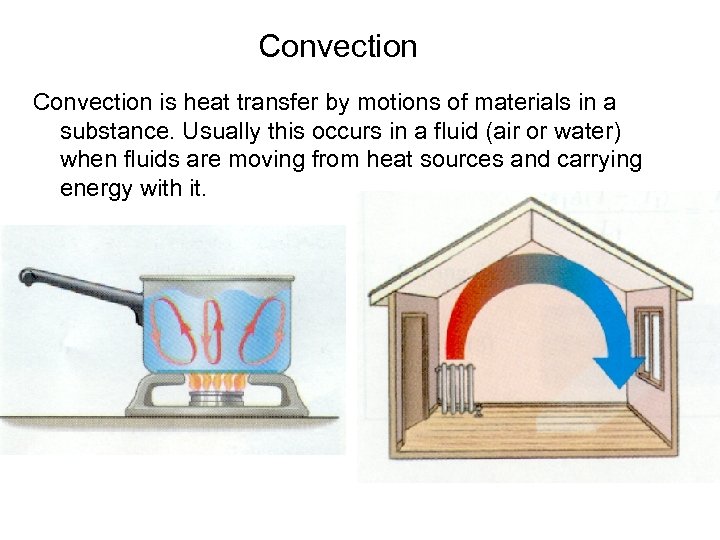
Convection is heat transfer by motions of materials in a substance. Usually this occurs in a fluid (air or water) when fluids are moving from heat sources and carrying energy with it.
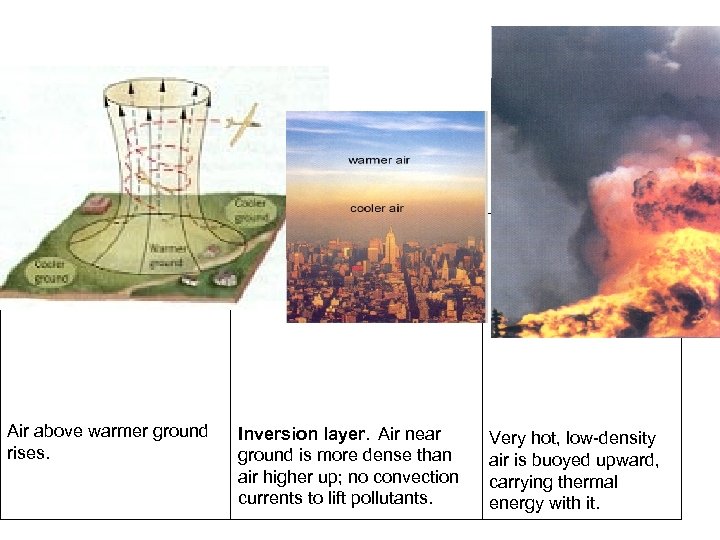
Natural Convection Air above warmer ground rises. Inversion layer. Air near ground is more dense than air higher up; no convection currents to lift pollutants. Very hot, low-density air is buoyed upward, carrying thermal energy with it.
Скачать презентацию Phy 100 Heat transport Three basic forms of
fb36ba67b78c7e9a7c8ecafd61eb23e7.ppt