


 Скачать презентацию Phraseology Lecture 10 1 What s a
Копия Lecture 9-10 Phraseology.ppt
- Количество слайдов: 10
 Phraseology Lecture 10.
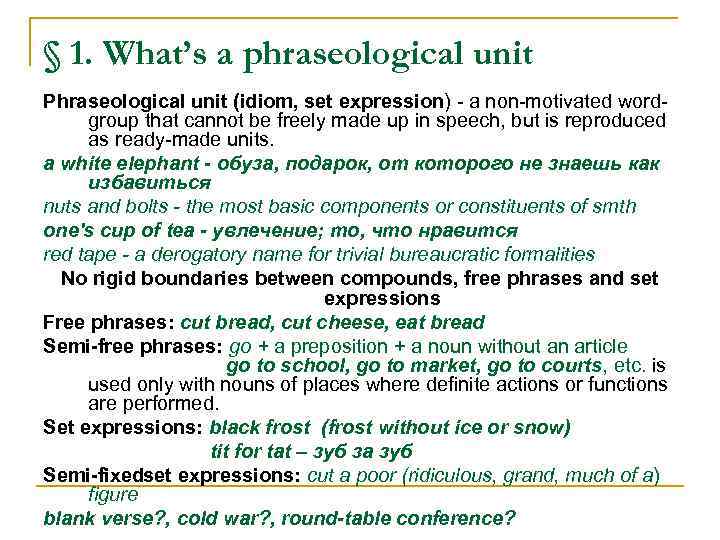 § 1. What’s a phraseological unit Phraseological unit (idiom, set expression) - a non-motivated wordgroup that cannot be freely made up in speech, but is reproduced as ready-made units. a white elephant обуза, подарок, от которого не знаешь как избавиться nuts and bolts - the most basic components or constituents of smth one's cup of tea - увлечение; то, что нравится red tape - a derogatory name for trivial bureaucratic formalities No rigid boundaries between compounds, free phrases and set expressions Free phrases: cut bread, cut cheese, eat bread Semi free phrases: go + a preposition + a noun without an article go to school, go to market, go to courts, etc. is used only with nouns of places where definite actions or functions are performed. Set expressions: black frost (frost without ice or snow) tit for tat – зуб за зуб Semi fixedset expressions: cut a poor (ridiculous, grand, much of a) figure blank verse? , cold war? , round-table conference?
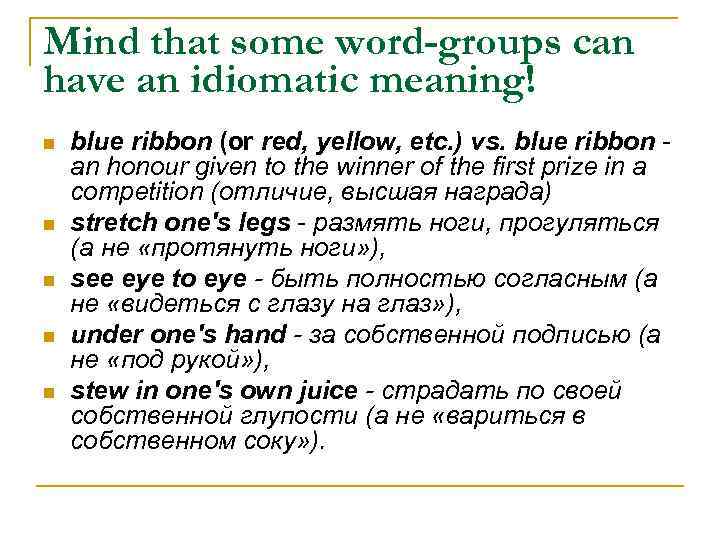 Mind that some word-groups can have an idiomatic meaning! n n n blue ribbon (or red, yellow, etc. ) vs. blue ribbon an honour given to the winner of the first prize in a competition (отличие, высшая награда) stretch one's legs - размять ноги, прогуляться (а не «протянуть ноги» ), see eye to eye - быть полностью согласным (а не «видеться с глазу на глаз» ), under one's hand - за собственной подписью (а не «под рукой» ), stew in one's own juice - страдать по своей собственной глупости (а не «вариться в собственном соку» ).
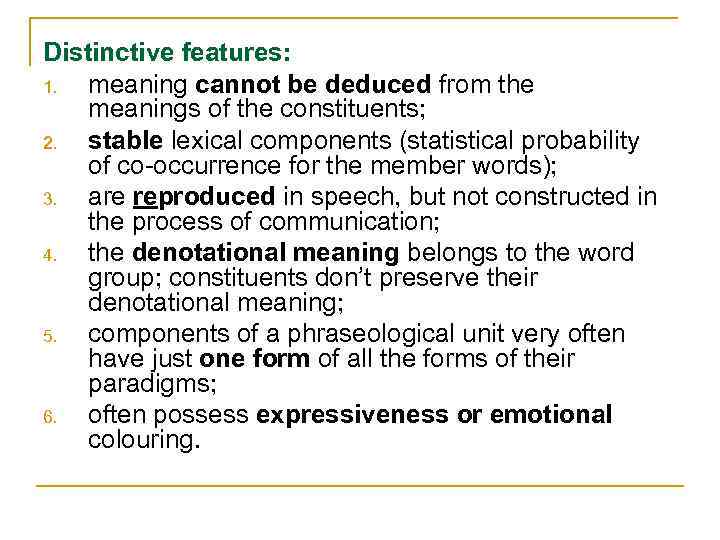 Distinctive features: 1. meaning cannot be deduced from the meanings of the constituents; 2. stable lexical components (statistical probability of co-occurrence for the member words); 3. are reproduced in speech, but not constructed in the process of communication; 4. the denotational meaning belongs to the word group; constituents don’t preserve their denotational meaning; 5. components of a phraseological unit very often have just one form of all the forms of their paradigms; 6. often possess expressiveness or emotional colouring.
 Semantic classification of phraseological units (V. V. Vinogradov) According to the degree of motivation: n phraseological fusions are units the meaning of which cannot be deduced from the meanings of their component parts (unmotivated units) red tape - bureaucratic methods a mare's nest n phraseological unities are expressions in which the meaning of the whole is based on the metaphorically /metonimically transferred meanings of the components to show one's teeth (to be unfriendly), to stand to one's guns (to refuse to change one's opinion) n phraseological combinations are traditional word groups. The components are limited in the ability to combine with other words by some linguistic factors. to break news, to meet the demands, to take a liking to
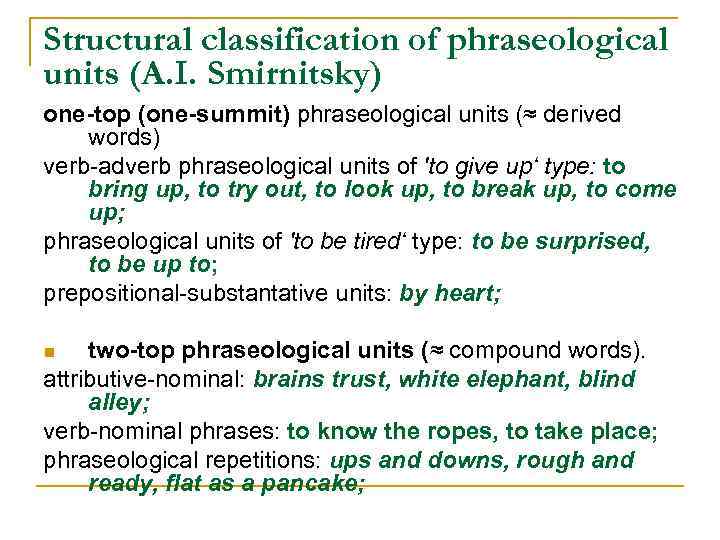 Structural classification of phraseological units (A. I. Smirnitsky) one top (one summit) phraseological units (≈ derived words) verb-adverb phraseological units of 'to give up‘ type: to bring up, to try out, to look up, to break up, to come up; phraseological units of 'to be tired‘ type: to be surprised, to be up to; prepositional-substantative units: by heart; two top phraseological units (≈ compound words). attributive-nominal: brains trust, white elephant, blind alley; verb-nominal phrases: to know the ropes, to take place; phraseological repetitions: ups and downs, rough and ready, flat as a pancake; n
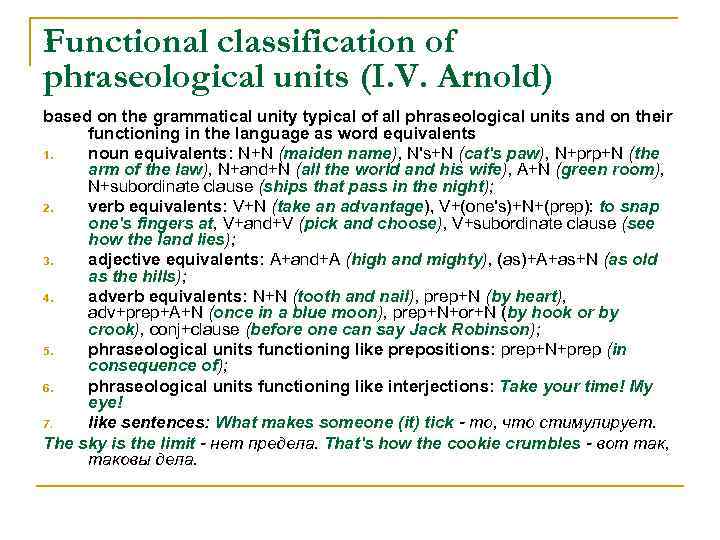 Functional classification of phraseological units (I. V. Arnold) based on the grammatical unity typical of all phraseological units and on their functioning in the language as word equivalents 1. noun equivalents: N+N (maiden name), N's+N (cat's paw), N+prp+N (the arm of the law), N+and+N (all the world and his wife), A+N (green room), N+subordinate clause (ships that pass in the night); 2. verb equivalents: V+N (take an advantage), V+(one's)+N+(prep): to snap one's fingers at, V+and+V (pick and choose), V+subordinate clause (see how the land lies); 3. adjective equivalents: A+and+A (high and mighty), (as)+A+as+N (as old as the hills); 4. adverb equivalents: N+N (tooth and nail), prep+N (by heart), adv+prep+A+N (once in a blue moon), prep+N+or+N (by hook or by crook), conj+clause (before one can say Jack Robinson); 5. phraseological units functioning like prepositions: prep+N+prep (in consequence of); 6. phraseological units functioning like interjections: Take your time! My eye! 7. like sentences: What makes someone (it) tick - то, что стимулирует. The sky is the limit - нет предела. That's how the cookie crumbles - вот так, таковы дела.
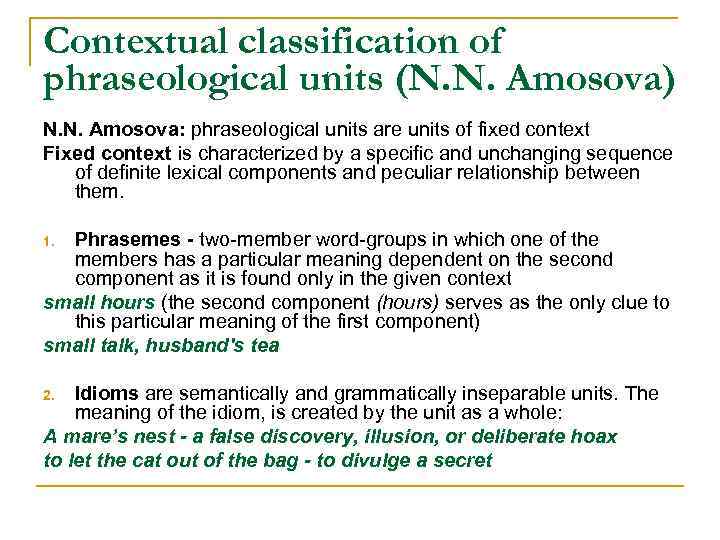 Contextual classification of phraseological units (N. N. Amosova) N. N. Amosova: phraseological units are units of fixed context Fixed context is characterized by a specific and unchanging sequence of definite lexical components and peculiar relationship between them. Phrasemes two-member word-groups in which one of the members has a particular meaning dependent on the second component as it is found only in the given context small hours (the second component (hours) serves as the оnlу clue to this particular meaning of the first component) small talk, husband's tea 1. Idioms are semantically and grammatically inseparable units. The meaning of the idiom, is created by the unit as a whole: A mare’s nest - a false discovery, illusion, or deliberate hoax to let the cat out of the bag - to divulge a secret 2.
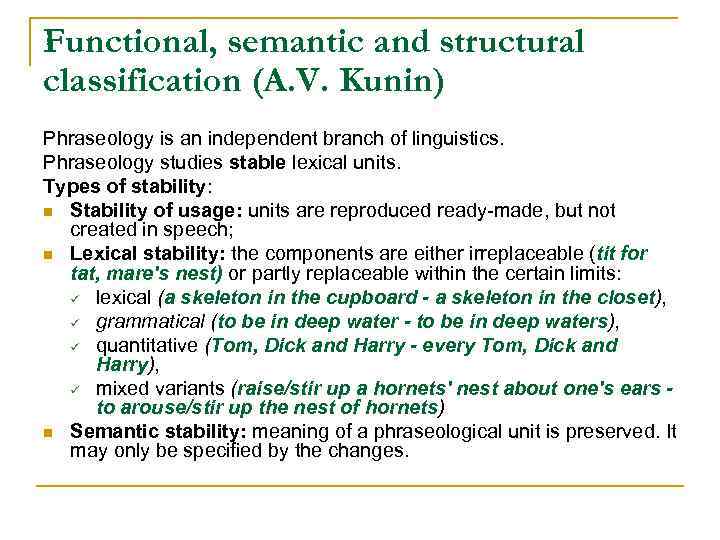 Functional, semantic and structural classification (A. V. Kunin) Phraseology is an independent branch of linguistics. Phraseology studies stable lexical units. Types of stability: n Stability of usage: units are reproduced ready-made, but not created in speech; n Lexical stability: the components are either irreplaceable (tit for tat, mare's nest) or partly replaceable within the certain limits: ü lexical (a skeleton in the cupboard - a skeleton in the closet), ü grammatical (to be in deep water - to be in deep waters), ü quantitative (Tom, Dick and Harry - every Tom, Dick and Harry), ü mixed variants (raise/stir up a hornets' nest about one's ears to arouse/stir up the nest of hornets) n Semantic stability: meaning of a phraseological unit is preserved. It may only be specified by the changes.
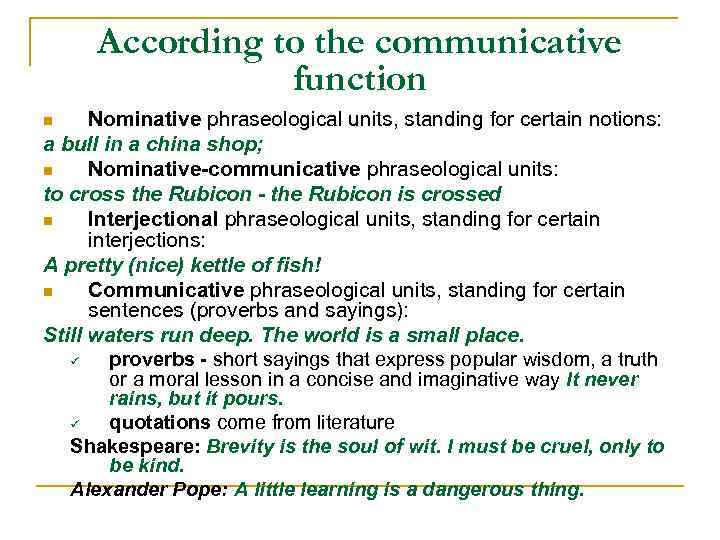 According to the communicative function Nominative phraseological units, standing for certain notions: a bull in a china shop; n Nominative communicative phraseological units: to cross the Rubicon - the Rubicon is crossed n Interjectional phraseological units, standing for certain interjections: A pretty (nice) kettle of fish! n Communicative phraseological units, standing for certain sentences (proverbs and sayings): Still waters run deep. The world is a small place. ü proverbs short sayings that express popular wisdom, a truth or a moral lesson in a concise and imaginative way It never rains, but it pours. ü quotations come from literature Shakespeare: Brevity is the soul of wit. I must be cruel, only to be kind. Alexander Pope: A little learning is a dangerous thing. n