


 Скачать презентацию PHOTOSYNTHESIS Using light to make food PHOTOSYNTHESIS
e9e647385899666fbeb570bf546fff53.ppt
- Количество слайдов: 39
 PHOTOSYNTHESIS Using light to make food
 PHOTOSYNTHESIS • Autotrophs are the producers of the biosphere – Plants are autotrophs • Producing their own food and sustaining themselves without eating other organisms • What are we? • We are heterotrophs
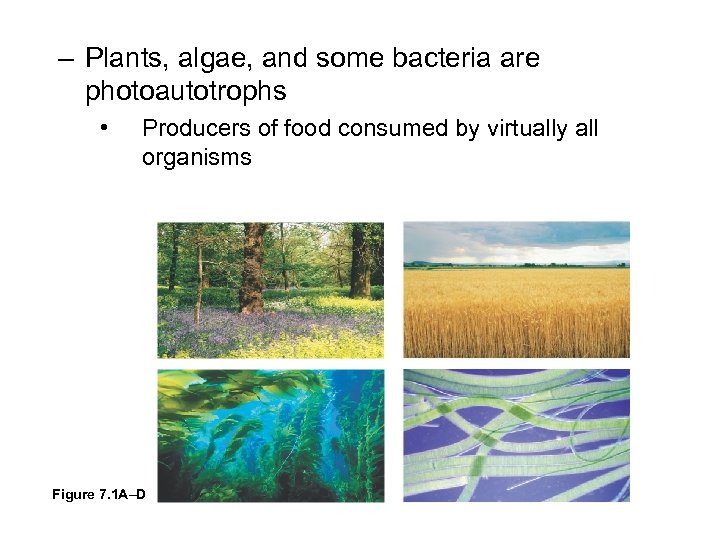 – Plants, algae, and some bacteria are photoautotrophs • Producers of food consumed by virtually all organisms Figure 7. 1 A–D
 • PLANTS USE ENERGY FROM THE SUN TO TRANSFORM CO 2 AND WATER INTO ENERGY RICH CARBOHYDRATES(glucose). • Plants are AUTOTROPHS : make their own food • Plants supply all the energy (food) for life on earth and the oxygen that most organisms need
 How old is photosynthesis? How important is it? • Evidence of photosynthesis exists in rocks 3. 5 billion years old. • Photosynthesis is the largest biochemical process on earth. Importance? • Photosynthesis supplies OXYGEN to earth atmosphere and FOOD to all organisms
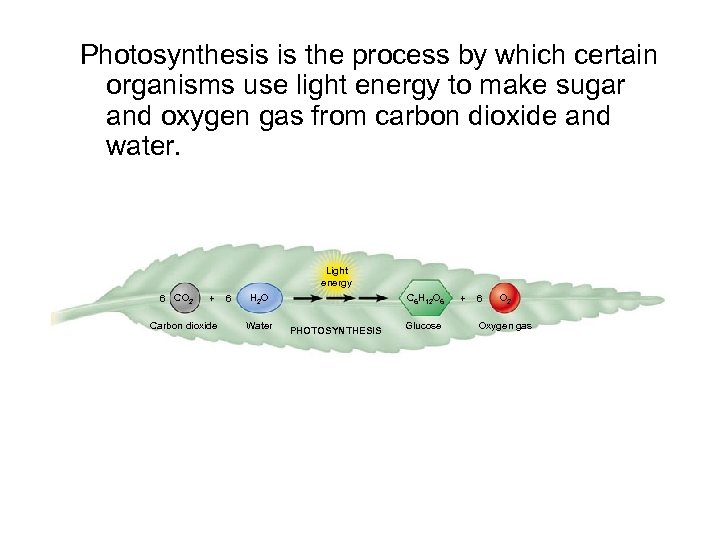 Photosynthesis is the process by which certain organisms use light energy to make sugar and oxygen gas from carbon dioxide and water. Light energy 6 CO 2 + Carbon dioxide 6 H 2 O Water C 6 H 12 O 6 PHOTOSYNTHESIS Glucose + 6 O 2 Oxygen gas
 Where in the plant does photosynthesis occur? In the CHLOROPLAST. The leaf is a food factory. The light trapping pigments are inside the chloroplasts embedded in the thylakoid membranes. • STOMATA or STOMA are openings on the leaf surface through which CO 2 and O 2 as well as water vapor go in and out of leaves.
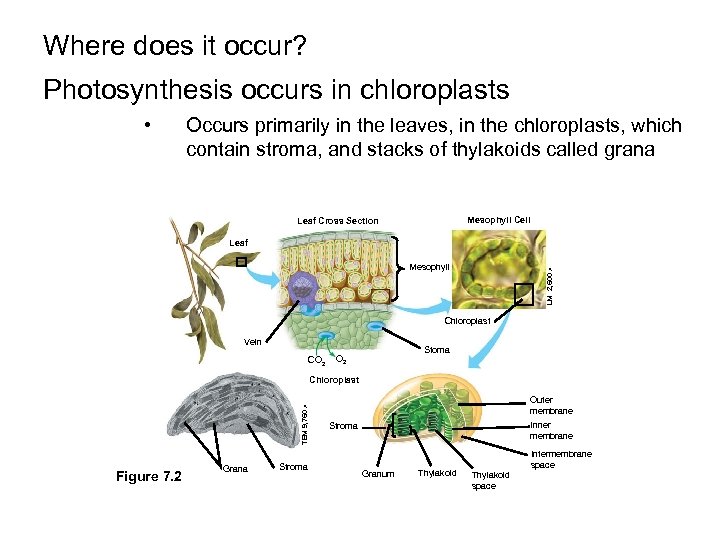 Where does it occur? Photosynthesis occurs in chloroplasts • Occurs primarily in the leaves, in the chloroplasts, which contain stroma, and stacks of thylakoids called grana Mesophyll Cell Leaf Cross Section Leaf LM 2, 600 Mesophyll Chloroplast Vein CO 2 Stoma O 2 TEM 9, 750 Chloroplast Figure 7. 2 Grana Stroma Outer membrane Inner membrane Stroma Granum Thylakoid Intermembrane space Thylakoid space
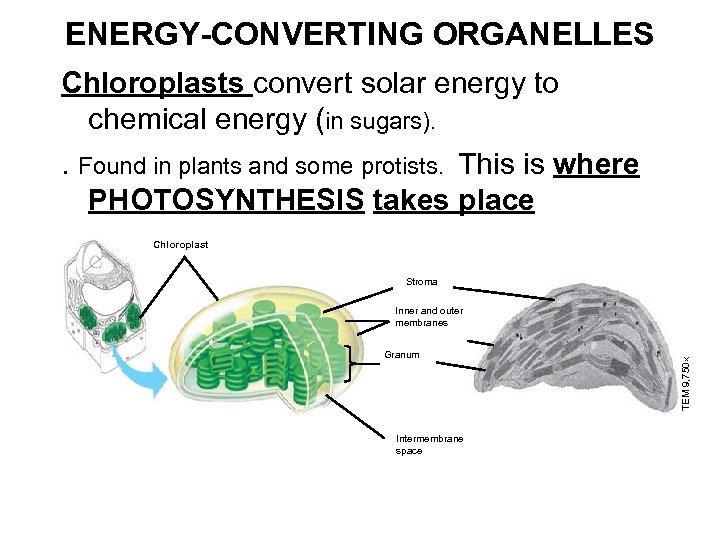 ENERGY-CONVERTING ORGANELLES Chloroplasts conver t solar energy to chemical energy (in sugars). . Found in plants and some protists. This is where PHOTOSYNTHESIS takes place Chloroplast Stroma Granum Intermembrane space TEM 9, 750 Inner and outer membranes
 Sites to check: • http: //www. mhhe. com/biosci/esp/2001_gbio/folder_str ucture/ce/m 6/s 1/index. htm • http: //www. tvdsb. on. ca/westmin/science/Biology 12/Me tabolic%20 Processes/stoma. htm • http: //www. tvdsb. on. ca/westmin/science/Biology 12/Me tabolic%20 Processes/chloro. htm • http: //www. mhhe. com/biosci/esp/2001_gbio/folder_str ucture/ce/m 6/s 3/index. htm
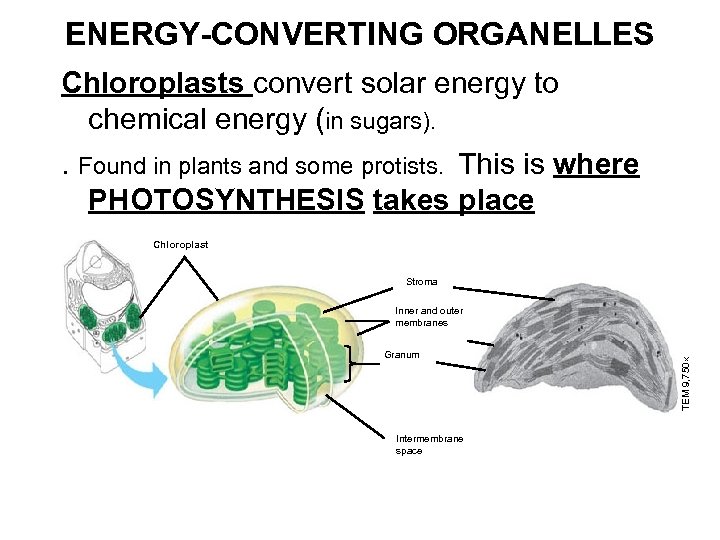 ENERGY-CONVERTING ORGANELLES Chloroplasts conver t solar energy to chemical energy (in sugars). . Found in plants and some protists. This is where PHOTOSYNTHESIS takes place Chloroplast Stroma Granum Intermembrane space TEM 9, 750 Inner and outer membranes
 Thylakoids • Thylakoids are membranes that look like green flattened sacs stacked upon each other. • Granum is a stack of these sacs • The STROMA is the fluid between the membranes.
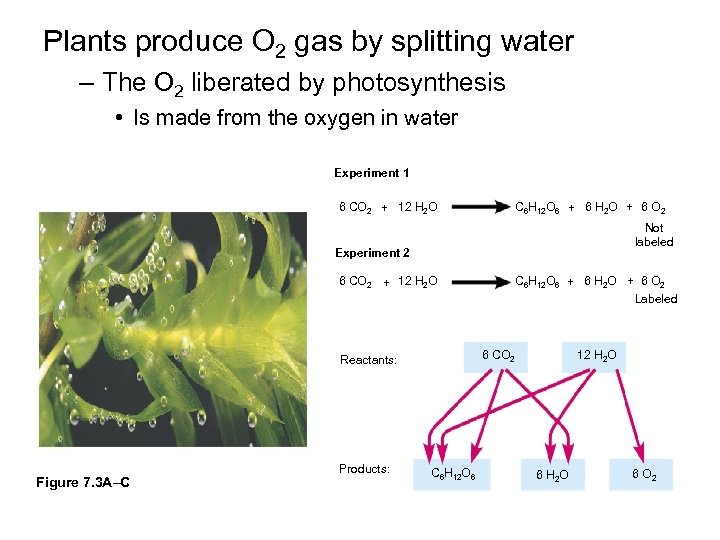 Plants produce O 2 gas by splitting water – The O 2 liberated by photosynthesis • Is made from the oxygen in water Experiment 1 6 CO 2 + 12 H 2 O C 6 H 12 O 6 + 6 H 2 O + 6 O 2 Not labeled Experiment 2 6 CO 2 Reactants: Figure 7. 3 A–C C 6 H 12 O 6 + 6 H 2 O + 6 O 2 Labeled + 12 H 2 O Products: C 6 H 12 O 6 12 H 2 O 6 O 2
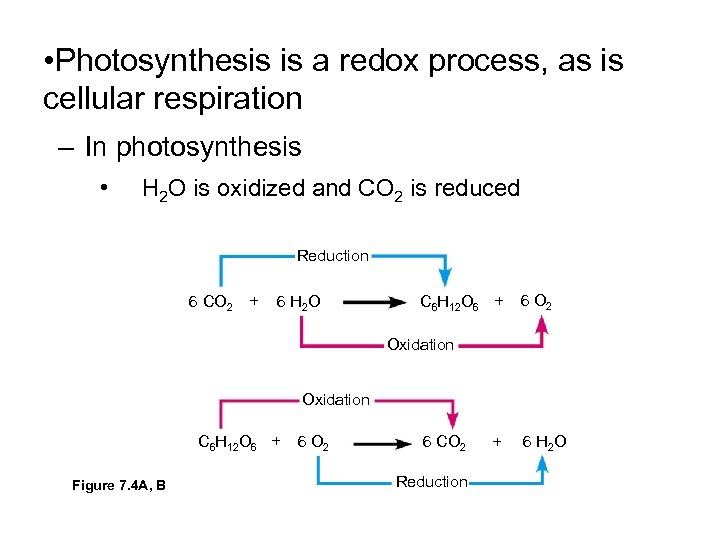 • Photosynthesis is a redox process, as is cellular respiration – In photosynthesis • H 2 O is oxidized and CO 2 is reduced Reduction 6 CO 2 6 H 2 O C 6 H 12 O 6 6 O 2 6 H 2 O Oxidation C 6 H 12 O 6 Figure 7. 4 A, B 6 O 2 6 CO 2 Reduction
 PHOTONS AND PIGMENTS • PHOTONS are packets of light energy • Light: electromagnetic energy waves that travel in waves of different lengths • PIGMENTS are molecules that absorb light energy (photons) • CHLOROPHYLL is the main pigment in plants. Absorbs the blue and red portions of the visible light spectrum and scatters or reflects back the green wave length. This is why plants look green. • CAROTENOIDS reflect the reds and yellows
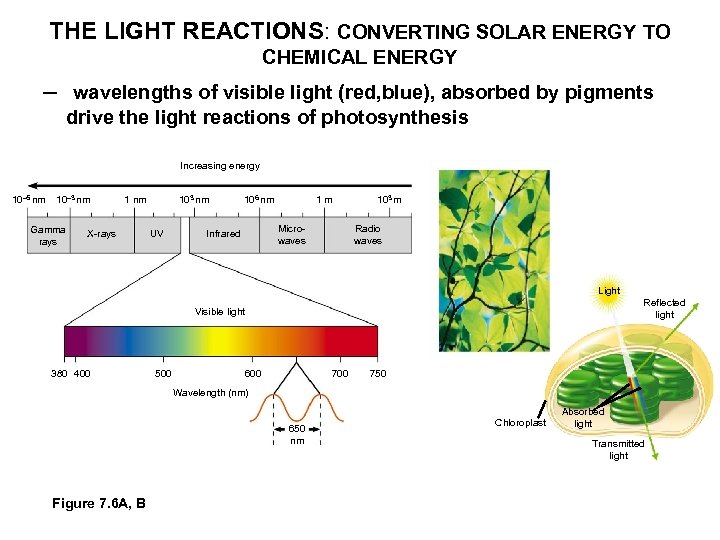 THE LIGHT REACTIONS: CONVERTING SOLAR ENERGY TO CHEMICAL ENERGY – wavelengths of visible light (red, blue), absorbed by pigments drive the light reactions of photosynthesis Increasing energy 10– 5 nm 10– 3 nm Gamma rays 1 nm X-rays 103 nm UV 1 m 106 nm Microwaves Infrared 103 m Radio waves Light Reflected light Visible light 380 400 500 600 750 Wavelength (nm) 650 nm Figure 7. 6 A, B Chloroplast Absorbed light Transmitted light
 • Overview: Photosynthesis occurs in two stages linked by ATP and NADPH – The complete process of photosynthesis consists of two linked sets of reactions • • The Light Dependent Reactions and The Calvin Cycle (discovered by Calvin and Benson)
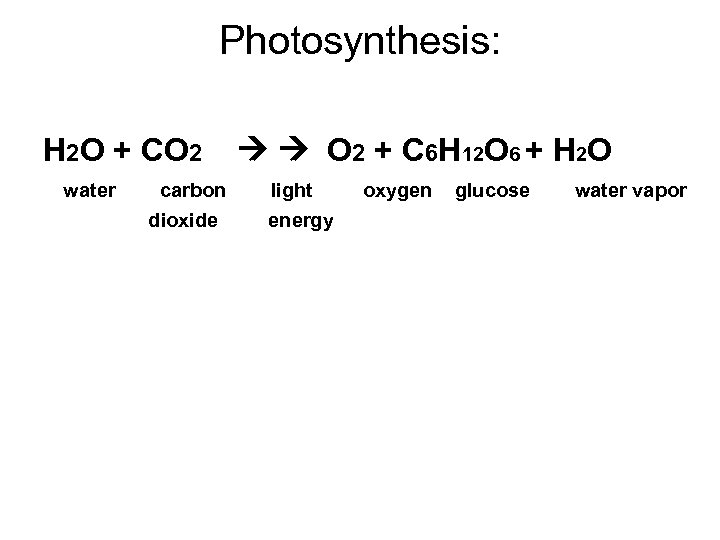 Photosynthesis: H 2 O + CO 2 water carbon dioxide O 2 + C 6 H 12 O 6 + H 2 O light energy oxygen glucose water vapor
 STEPS OF PHOTOSYNTHESIS • capture sun light • use light energy to make ATP • use ATP to make carbohydrate molecules from CO 2(carbon dioxide) and H 2 O (water)
 LIGHT DEPENDENT REACTIONS • is the first stage of photosynthesis. • It takes place in the thylakoid membranes. • Oxygen is released, Water molecules are split. Oxygen gas diffuses out • ATP and electrons are carried to the next stage. Electrons are used to make ATP.
 Light Dependent Reactions (In thylakoids of chloroplasts) • This is where light energy is converted to a form that can be used by plants to build Carbon compounds (sugars) • 1. The energy of sunlight hits the photosystems (cluster of pigment molecules) and excites chlorophyll (pigment) electrons to a higher energy state. Light energy is absorbed by the photosystems • 2. Water molecules split, oxygen is released. • Light energy is converted to chemical energy (ATP formation) • NADPH electron carrier take electrons from chlorophyll to the Calvin Cycle.
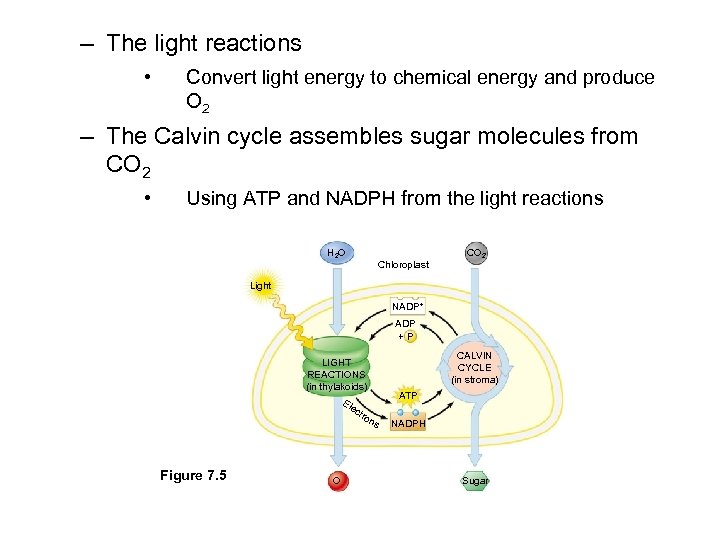 – The light reactions • Convert light energy to chemical energy and produce O 2 – The Calvin cycle assembles sugar molecules from CO 2 • Using ATP and NADPH from the light reactions H 2 O Chloroplast CO 2 Light NADP+ ADP +P CALVIN CYCLE (in stroma) LIGHT REACTIONS (in thylakoids) Ele ctr Figure 7. 5 O on ATP s NADPH Sugar
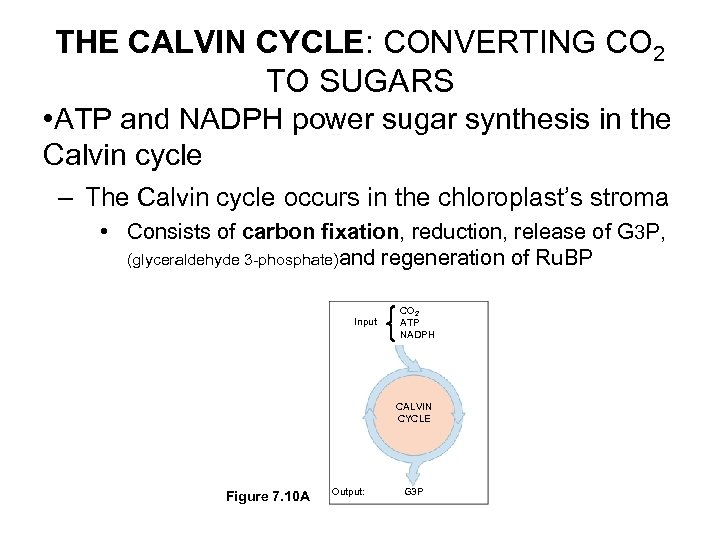 THE CALVIN CYCLE: CONVERTING CO 2 TO SUGARS • ATP and NADPH power sugar synthesis in the Calvin cycle – The Calvin cycle occurs in the chloroplast’s stroma • Consists of carbon fixation, reduction, release of G 3 P, (glyceraldehyde 3 -phosphate)and regeneration of Ru. BP Input CO 2 ATP NADPH CALVIN CYCLE Figure 7. 10 A Output: G 3 P
 LIGHT INDEPENDENT REACTIONSCALVIN CYCLE • (In stroma of chloroplasts ) This is a cyclic pathway where the final products are also the first reactants on the cycle • The Calvin Cycle uses the energy in ATP and NADPH to synthesize carbohydrates. • Carbon enters the cycle as a molecule of CO 2
 LIGHT INDEPENDENT REACTION or CALVIN CYCLE Takes place in the stroma of the chloroplasts. • This is the “synthesis” part of photosynthesis. Making food (glucose) and trapping CO 2 to incorporate carbon into living things.
 CALVIN CYCLE- making glucose • The energy from ATP and NADPH+ go into the bonds of a glucose molecule. • Electrons ( hydrogens) from the carrier molecule are put together with CO 2 to make glucose. • An enzyme called RUBISCO fixes the CO 2 ( from the air) by bringing together the CO 2 and the sugar.
 • • LIGHT INDEPENDENT REACTIONSCALVIN CYCLE Fixes Carbon (from CO 2) using the enzyme rubisco. This enzyme catalizes the binding of carbon from CO 2 to Ru. BP ( ribulose bisphosphate). This is how all carbon enters the world of life. Put together sugars using ATP and NADPH as energy sources. The final product is a three carbon sugar called G 3 P (glyceraldehyde 3 -phosphate) G 3 P is a sugar phosphate that can be modified to form glucose
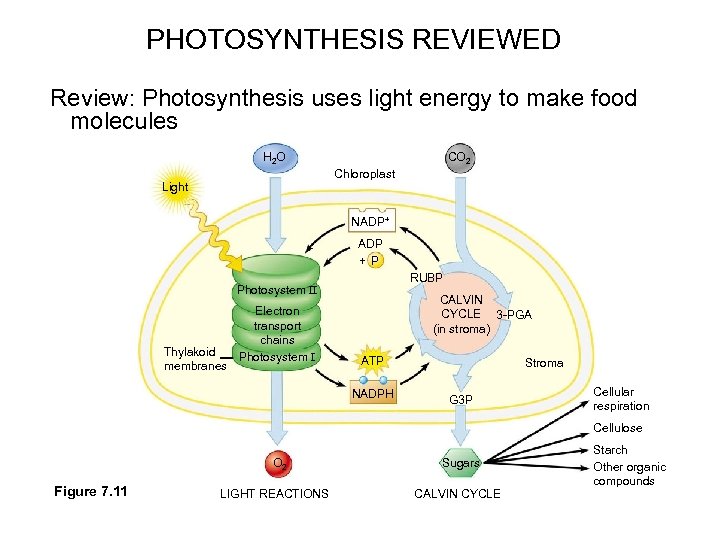 PHOTOSYNTHESIS REVIEWED Review: Photosynthesis uses light energy to make food molecules H 2 O CO 2 Chloroplast Light NADP+ ADP +P RUBP Photosystem II Thylakoid membranes Electron transport chains Photosystem I CALVIN CYCLE 3 -PGA (in stroma) ATP NADPH Stroma G 3 P Cellular respiration Cellulose O 2 Figure 7. 11 LIGHT REACTIONS Sugars CALVIN CYCLE Starch Other organic compounds
 C 3 PLANTS • Plants that use CO 2 directly from the air are called C 3 plants. Soybeans, oats wheat and rice are C 3 plants. • In hot dry weather these plants close their stomata ( pores in underside of leaves) to reduce water loss. Since no CO 2 can enter, the rate of photosynthesis is reduced and your crop productivity is poor.
 In C 3 plants a drop in CO 2 and rise in O 2 when stomata close on hot dry day divert the Calvin cycle to photorespiration ( Rubisco can bind oxygen in place of CO 2 as CO 2 becomes scarce. When Oxygen enters the Calvin cycle instead of CO 2 so it cannot produce sugars ) C 4 and CAM plants have special adaptations that save water
 CAM PLANTS • In hot and very dry climates. (deserts) • Examples: pineapple, cactus, orchids all the “succulent plants such as Aloe and Jade plants • When stoma opens to get CO 2 the water can get out. Survival depends on water retention. • Adaptation: Stoma is closed during the day and open at night. Co 2 is taken in at night and banked until the next day when it is given to the Calvin cycle to make carbohydrates. • The CO 2 taken in at night stays “banked” until the sun’s energy comes in the next day.
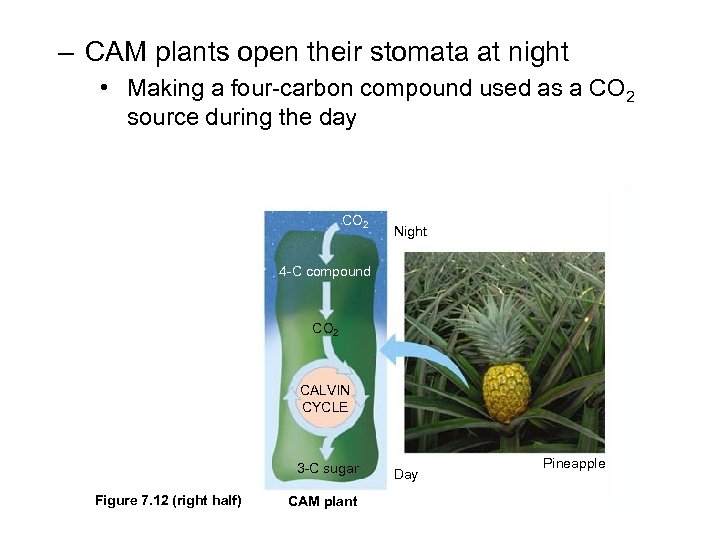 – CAM plants open their stomata at night • Making a four-carbon compound used as a CO 2 source during the day CO 2 Night 4 -C compound CO 2 CALVIN CYCLE 3 -C sugar Figure 7. 12 (right half) CAM plant Day Pineapple
 C 4 PLANTS • Have special adaptations to save water without shutting down photosynthesis • In hot climates. • Examples: grasses , corn, sugarcane • In hot climates the stoma closes to keep water in. It also keeps CO 2 out and oxygen builds up inside the leaves. Since there is not enough CO 2 the enzyme rubisco (that normally binds CO 2) binds oxygen and the plants would not grow well. • Adaptation : It continues to make sugars with closed stomata. How? These plants use a different enzyme to bind CO 2. This enzyme fix carbon twice to produce a 4 carbon compound which can then donate the C to the Calvin cycle
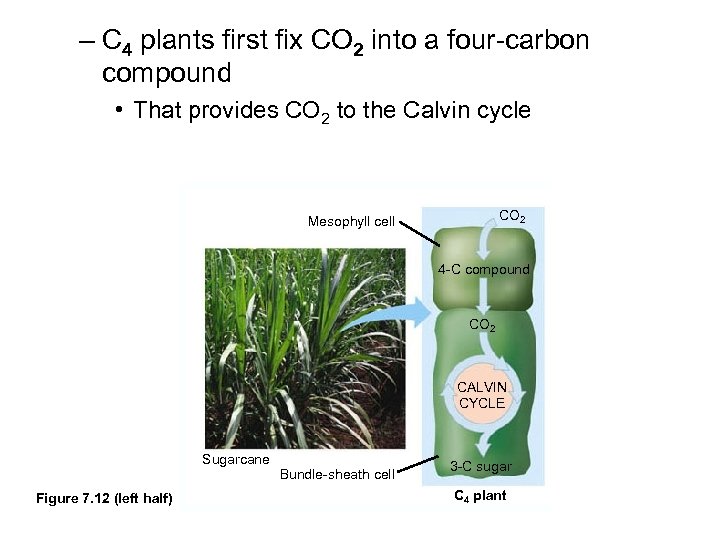 – C 4 plants first fix CO 2 into a four-carbon compound • That provides CO 2 to the Calvin cycle CO 2 Mesophyll cell 4 -C compound CO 2 CALVIN CYCLE Sugarcane Figure 7. 12 (left half) Bundle-sheath cell 3 -C sugar C 4 plant
 ENVIRONMENTAL IMPACT OF PHOTOSYNTHESIS • Food. Photosynthesis is the source of all the food that gives us energy ( from the sun) • Oxygen production • CO 2 is the gas plants use to make sugars. CO 2 in the atmosphere retains heat from the sun that would otherwise radiate back into space
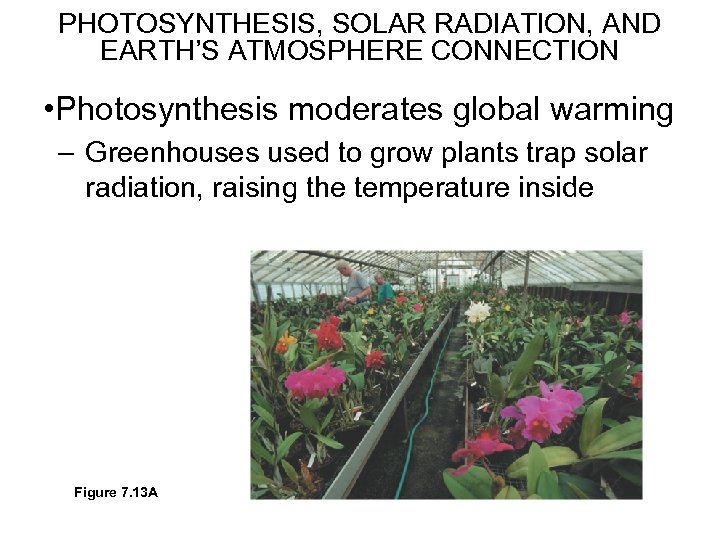 PHOTOSYNTHESIS, SOLAR RADIATION, AND EARTH’S ATMOSPHERE CONNECTION • Photosynthesis moderates global warming – Greenhouses used to grow plants trap solar radiation, raising the temperature inside Figure 7. 13 A
 Global warming and the Greenhouse effect • Global warming is the slow and steady rise in Earth surface temperatures. • Warming is caused by CO 2 and other greenhouse gases. • It is called the green house effect because CO 2 traps heat and keeps it warm near the earth surface. • When this occurs in moderation it is a good thing, otherwise the planet would be about 10 degrees colder all the time. The trouble is that we get overheating.
 What are greenhouse gases? • All the cars and industries that burn fossil fuel produce so much CO 2 that we now have 30% more than ever before. This causes global warming. • Some greenhouse gases are carbon dioxide CO 2, methane CH 4, water vapor and others • http: //www. net. org/globalwarming/sea_lev el/
 Web sites to check: • http: //www. fw. vt. edu/dendro/forestbiology/photos ynthesis. swf • http: //highered. mcgrawhill. com/sites/0072437316/student_view 0/chapter 10/ani mations. html • http: //www. sumanasinc. com/webcontent/anisam ples/majorsbiology/harvestinglight. swf