


 Скачать презентацию Photo Gerard Kuster Enschede The Netherlands www itc
46b2b5a46f62d0902ce0fd2e20e86c5e.ppt
- Количество слайдов: 56
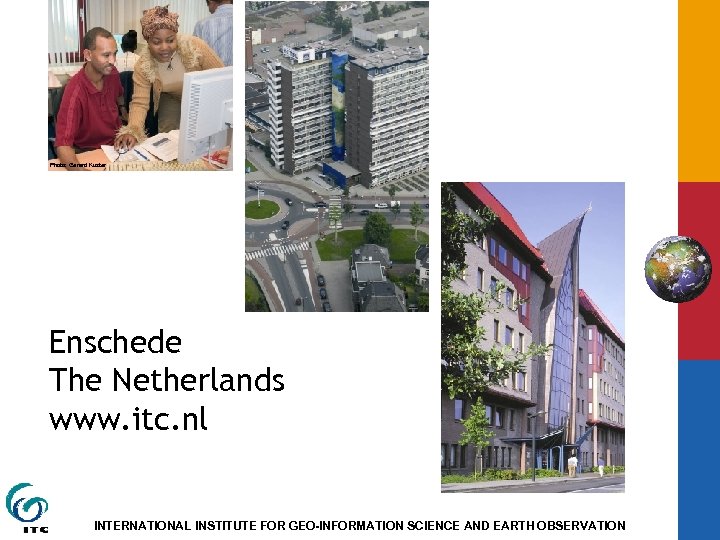 Photo: Gerard Kuster Enschede The Netherlands www. itc. nl INTERNATIONAL INSTITUTE FOR GEO-INFORMATION SCIENCE AND EARTH OBSERVATION
 Presentation content § What’s ITC all about § Knowledge field: Geo-information Science and earth observation § ITC’s core activities § Education § Research § Project services § Partnerships § Alumni Photo: Gerard Kuster
 What’s ITC all about? § Established in 1950 § Largest international institute for higher education in the Netherlands § Autonomous organisation § Under the aegis of the Minister for Development Cooperation and § the Ministry of Education, Culture and Science of the Netherlands
 Mission § Provide international education through knowledge exchange § Capacity building § Institutional development § For and in economically and technologically less developed countries
 Key figures § Staff § § staff core activities: 143 fte support staff core activities: 50 fte general support staff: 64 fte 26 nationalities § Students § 600 p/year § Ph. D researchers § 50 § Alumni § 17, 883 mid-career professionals § 169 countries
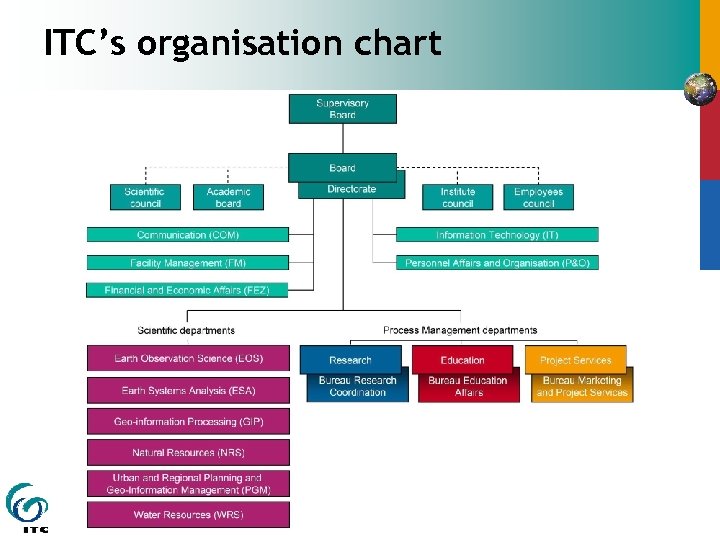 ITC’s organisation chart
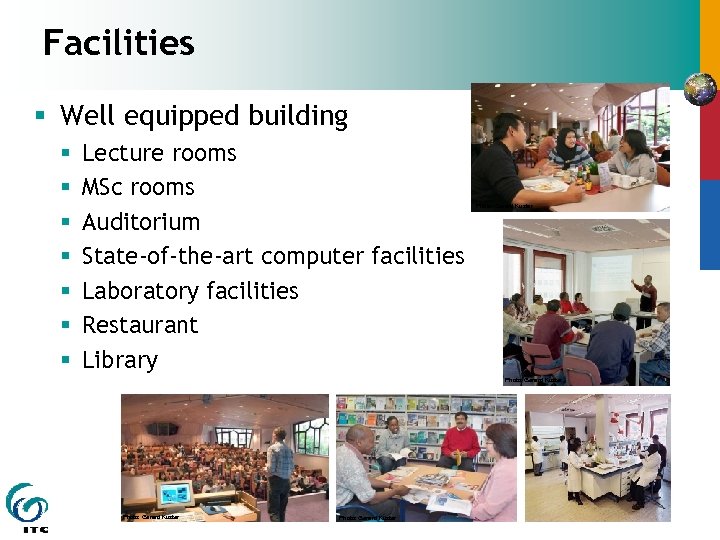 Facilities § Well equipped building § § § § Lecture rooms MSc rooms Auditorium State-of-the-art computer facilities Laboratory facilities Restaurant Library Photo: Gerard Kuster
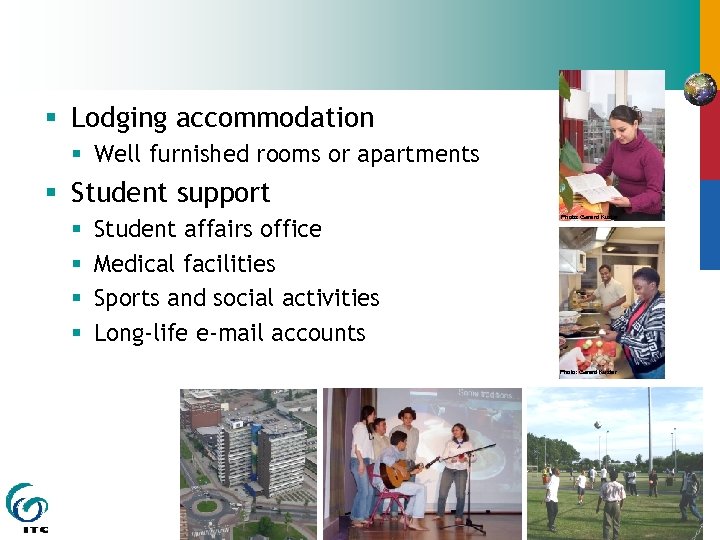 § Lodging accommodation § Well furnished rooms or apartments § Student support § § Student affairs office Medical facilities Sports and social activities Long-life e-mail accounts Photo: Gerard Kuster
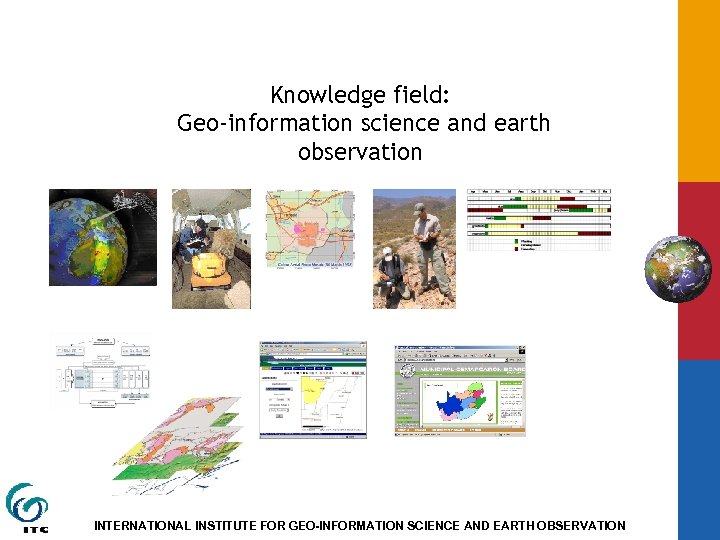 Knowledge field: Geo-information science and earth observation Tabular data Digital maps Satellite data Aerial data Field measurements Modelling Internet GIS Processing Synthesis Internet GIS INTERNATIONAL INSTITUTE FOR GEO-INFORMATION SCIENCE AND EARTH OBSERVATION
 Geo-information science and earth observation § Combination of tools and methods for the § collection § storage and § processing of geo-spatial data and for the dissemination and use of these data and of services based on these data
 § Focus on tools and methods and on application of these in: § § § § urban planning land administration disaster management strengthening civil society water management earth sciences environmental management and biodiversity food security
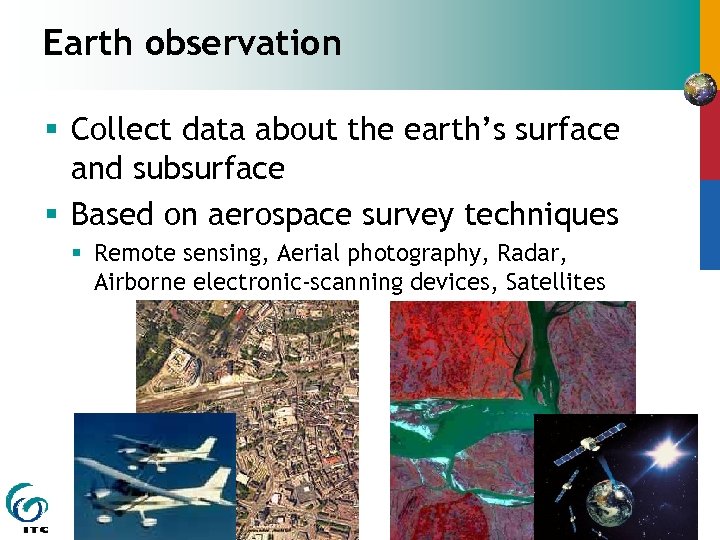 Earth observation § Collect data about the earth’s surface and subsurface § Based on aerospace survey techniques § Remote sensing, Aerial photography, Radar, Airborne electronic-scanning devices, Satellites
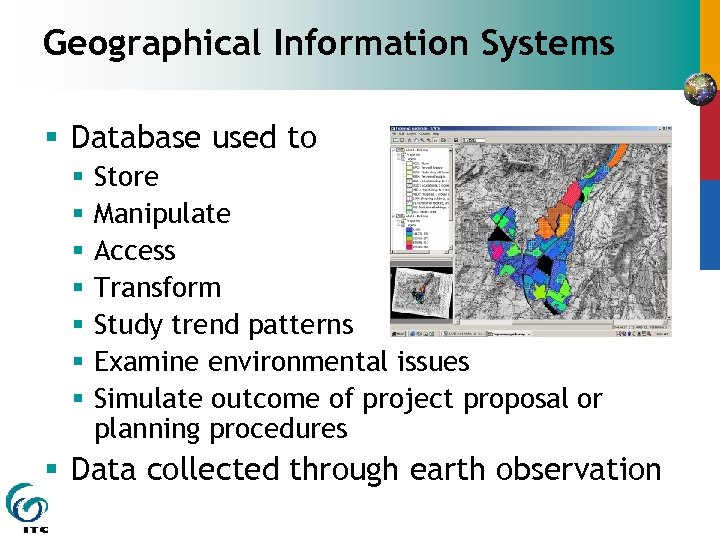 Geographical Information Systems § Database used to § § § § Store Manipulate Access Transform Study trend patterns Examine environmental issues Simulate outcome of project proposal or planning procedures § Data collected through earth observation
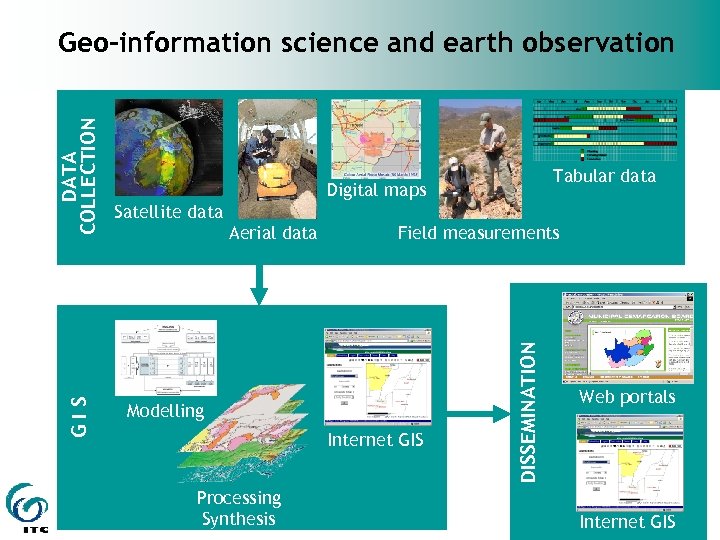 DATA COLLECTION Tabular data Digital maps Satellite data Aerial data Field measurements Modelling. I S ANALYSIS G Internet GIS Processing Synthesis DISSEMINATION GIS DATA COLLECTION Geo-information science and earth observation DATAportals Web & INFORMATION DISSEMINATION Internet GIS
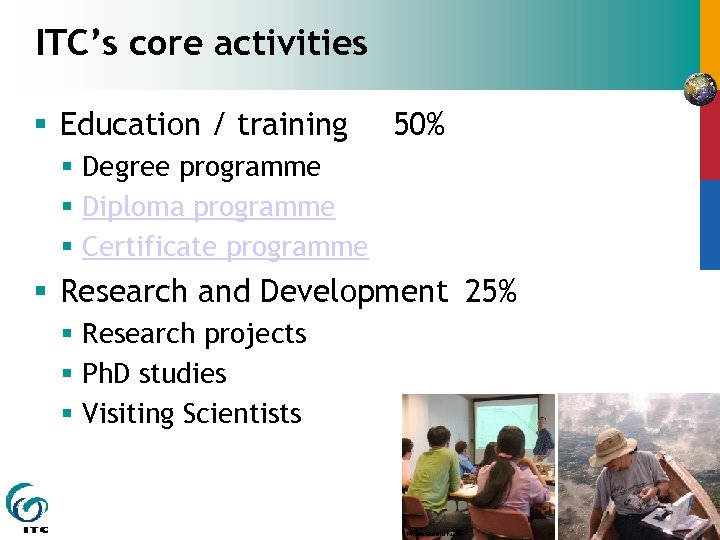 ITC’s core activities § Education / training 50% § Degree programme § Diploma programme § Certificate programme § Research and Development 25% § Research projects § Ph. D studies § Visiting Scientists Photo: Gerard Kuster
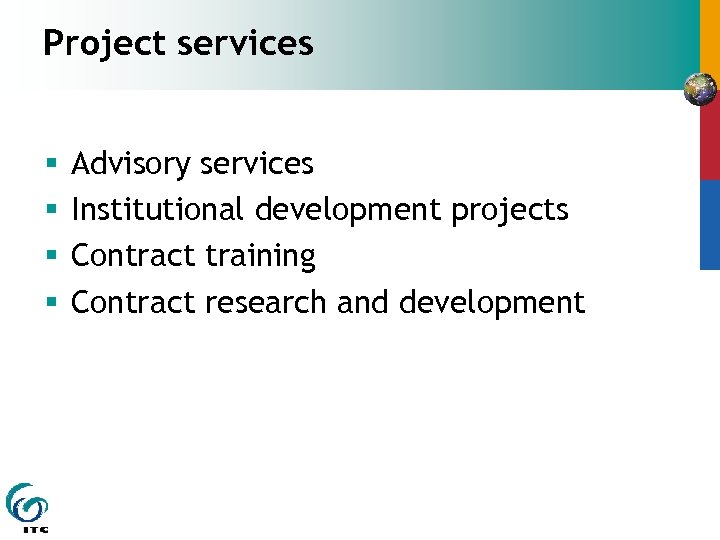
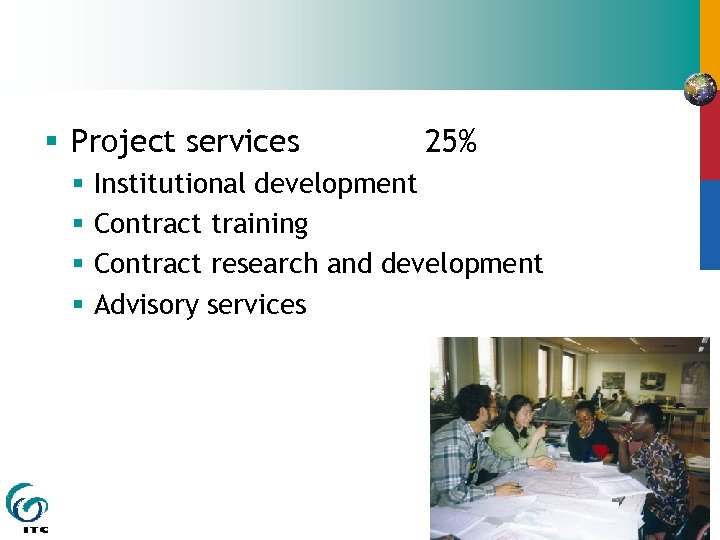 § Project services § § 25% Institutional development Contract training Contract research and development Advisory services
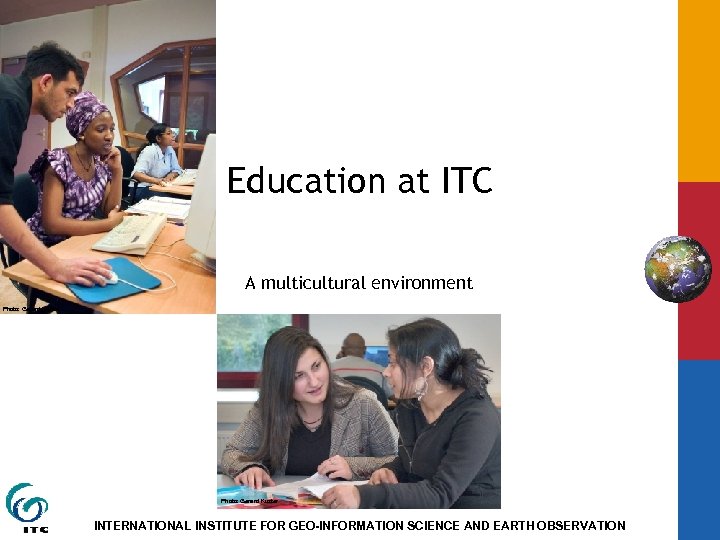 Education at ITC A multicultural environment Photo: Gerard Kuster INTERNATIONAL INSTITUTE FOR GEO-INFORMATION SCIENCE AND EARTH OBSERVATION
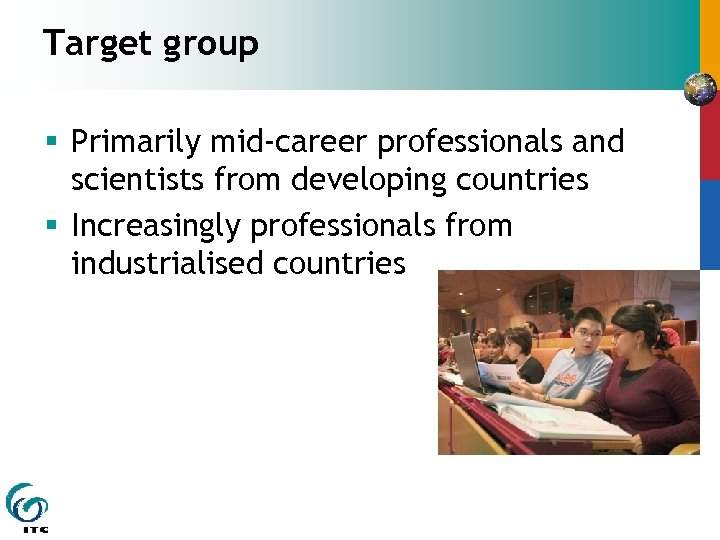 Target group § Primarily mid-career professionals and scientists from developing countries § Increasingly professionals from industrialised countries
 ITC’s programmes and duration Degree programme: § Master 12 months § Master of Science 18 months § Diploma programme: § Postgraduate diploma § Diploma 9 months Language of instruction is English
 § Certificate programme: - Short courses Modules Refresher courses (on–site) Tailor-made courses Distance courses Language of instruction is English 3, 6, 9 and 12 weeks 3 weeks 1 - 2 weeks 1 week – 8 months 6 weeks
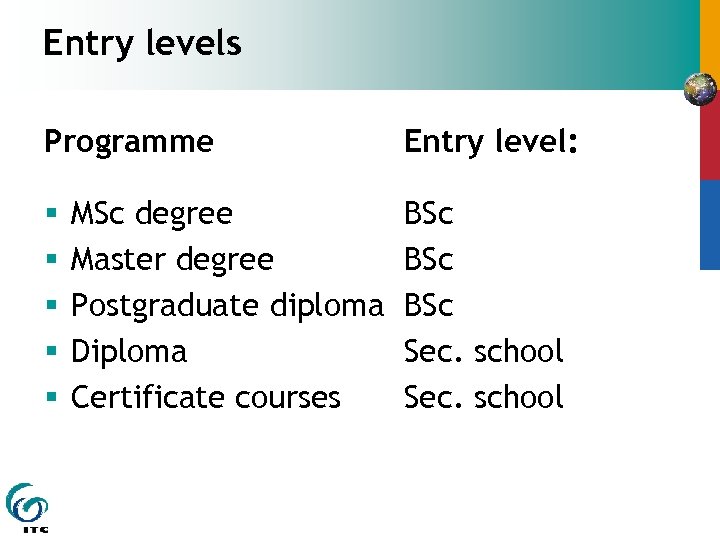 Entry levels Programme § § § MSc degree Master degree Postgraduate diploma Diploma Certificate courses Entry level: BSc BSc Sec. school
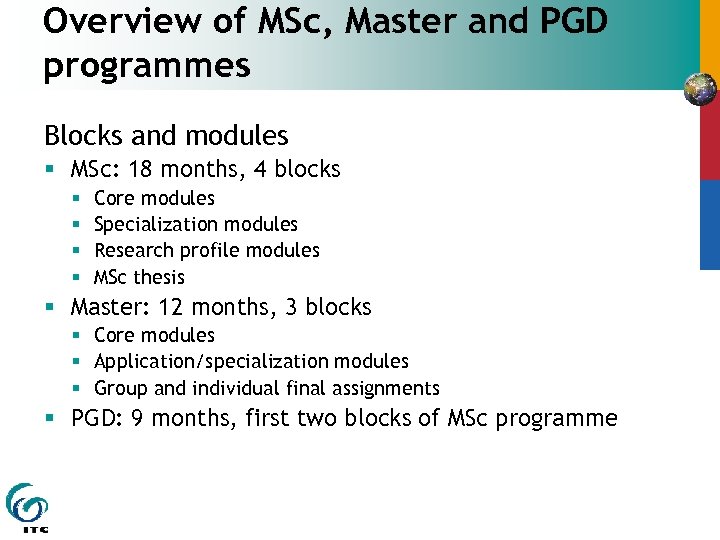 Overview of MSc, Master and PGD programmes Blocks and modules § MSc: 18 months, 4 blocks § § Core modules Specialization modules Research profile modules MSc thesis § Master: 12 months, 3 blocks § Core modules § Application/specialization modules § Group and individual final assignments § PGD: 9 months, first two blocks of MSc programme
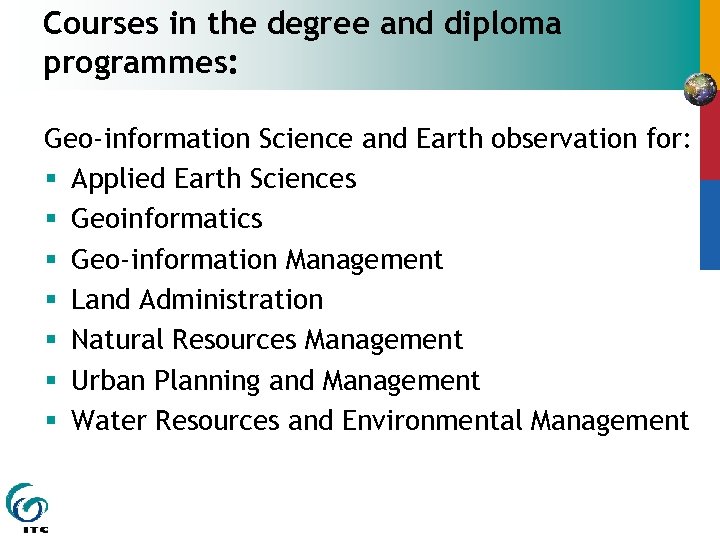 Courses in the degree and diploma programmes: Geo-information Science and Earth observation for: § Applied Earth Sciences § Geoinformatics § Geo-information Management § Land Administration § Natural Resources Management § Urban Planning and Management § Water Resources and Environmental Management
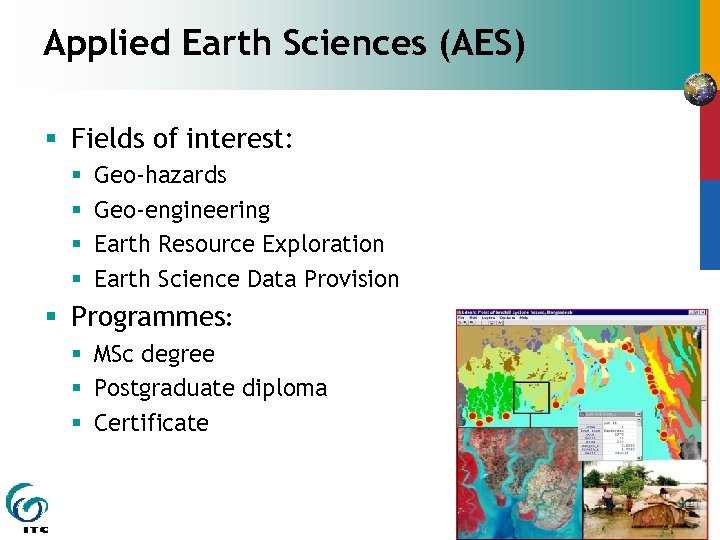 Applied Earth Sciences (AES) § Fields of interest: § § Geo-hazards Geo-engineering Earth Resource Exploration Earth Science Data Provision § Programmes: § MSc degree § Postgraduate diploma § Certificate
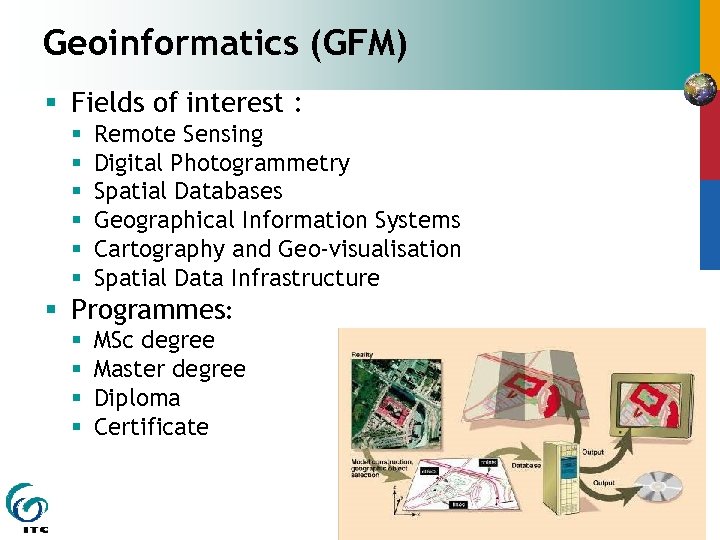 Geoinformatics (GFM) § Fields of interest : Remote Sensing Digital Photogrammetry Spatial Databases Geographical Information Systems Cartography and Geo-visualisation Spatial Data Infrastructure § Programmes: § MSc degree § Master degree § Diploma § Certificate § § §
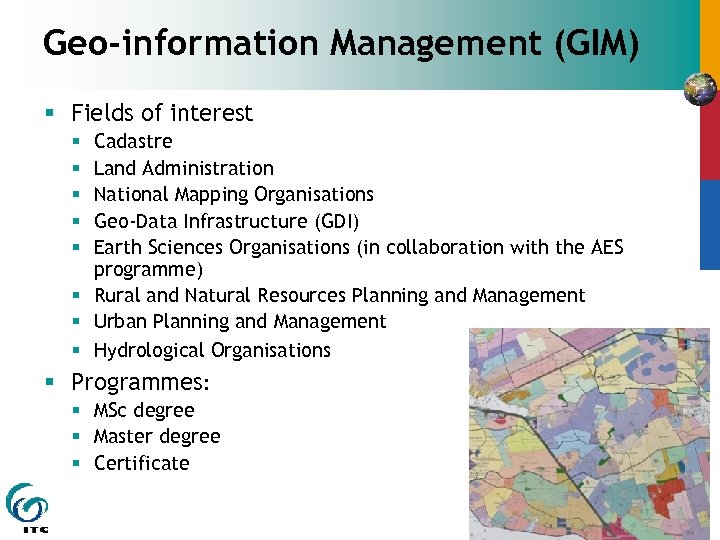 Geo-information Management (GIM) § Fields of interest Cadastre Land Administration National Mapping Organisations Geo-Data Infrastructure (GDI) Earth Sciences Organisations (in collaboration with the AES programme) § Rural and Natural Resources Planning and Management § Urban Planning and Management § Hydrological Organisations § § § Programmes: § MSc degree § Master degree § Certificate
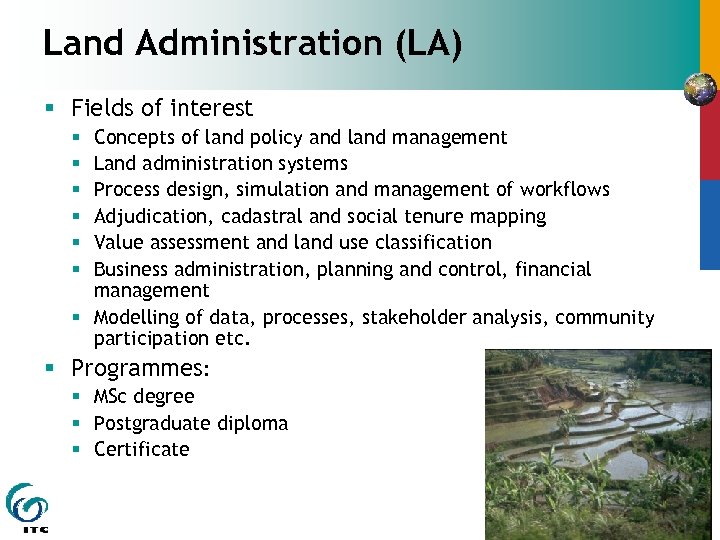 Land Administration (LA) § Fields of interest Concepts of land policy and land management Land administration systems Process design, simulation and management of workflows Adjudication, cadastral and social tenure mapping Value assessment and land use classification Business administration, planning and control, financial management § Modelling of data, processes, stakeholder analysis, community participation etc. § § § § Programmes: § MSc degree § Postgraduate diploma § Certificate
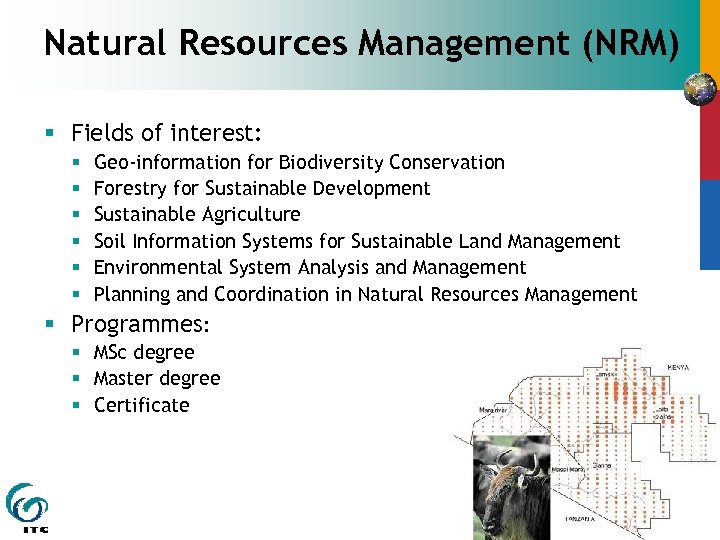 Natural Resources Management (NRM) § Fields of interest: § § § Geo-information for Biodiversity Conservation Forestry for Sustainable Development Sustainable Agriculture Soil Information Systems for Sustainable Land Management Environmental System Analysis and Management Planning and Coordination in Natural Resources Management § Programmes: § MSc degree § Master degree § Certificate
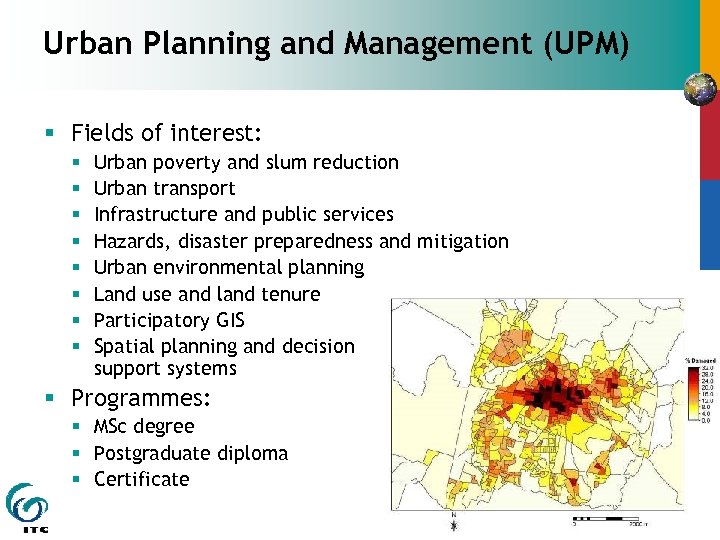 Urban Planning and Management (UPM) § Fields of interest: § § § § Urban poverty and slum reduction Urban transport Infrastructure and public services Hazards, disaster preparedness and mitigation Urban environmental planning Land use and land tenure Participatory GIS Spatial planning and decision support systems § Programmes: § MSc degree § Postgraduate diploma § Certificate
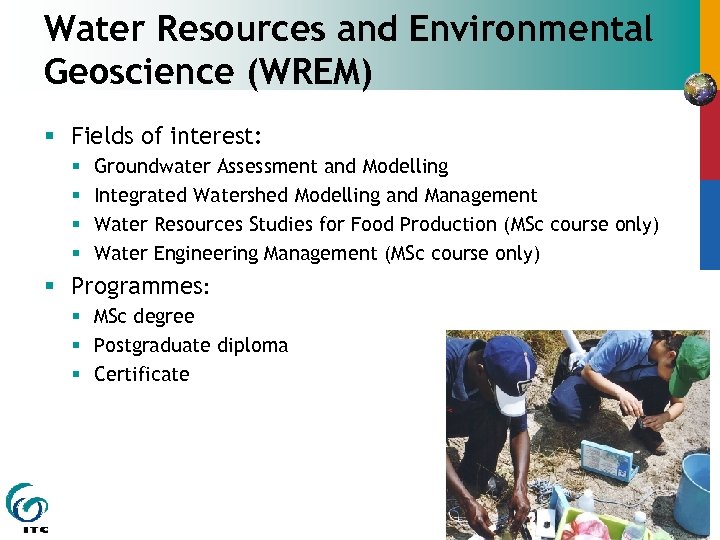 Water Resources and Environmental Geoscience (WREM) § Fields of interest: § § Groundwater Assessment and Modelling Integrated Watershed Modelling and Management Water Resources Studies for Food Production (MSc course only) Water Engineering Management (MSc course only) § Programmes: § MSc degree § Postgraduate diploma § Certificate
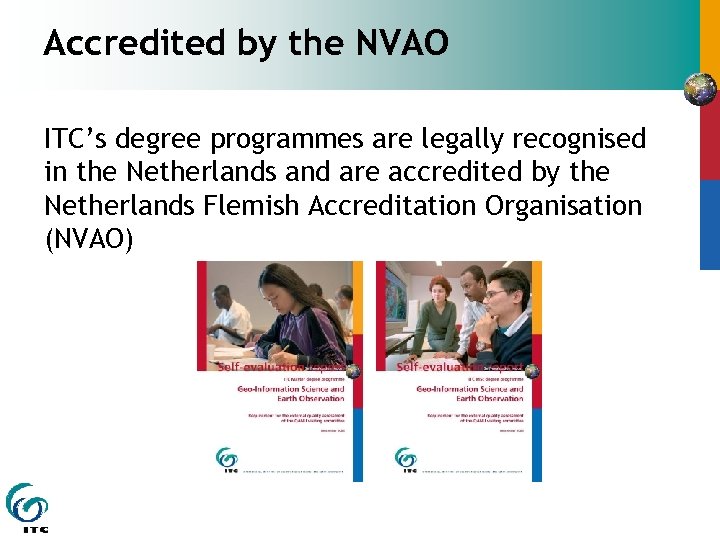 Accredited by the NVAO ITC’s degree programmes are legally recognised in the Netherlands and are accredited by the Netherlands Flemish Accreditation Organisation (NVAO)
 Joint courses § To address the increasing demand for flexibility in academic degree courses, ITC has entered into partnership with reputable qualified educational organisations in several countries. § Target 2010: § 20 locations § 350 students / 3, 500 student months
 Education partnerships § Outside Europe § Already implemented in Bolivia, China, the Philippines, India, Iran, Nigeria, Ghana, Tanzania and Mexico § With European institutes § Two MSc programmes have been implemented: § GEM: with Southhampton University(UK), Lund University(Sweden) and Warsaw University(Poland) Supported by the EU Erasmus Mundus programme § GIMA: with Delft University of Technology, Utrecht University and Wageningen University and Research Centre
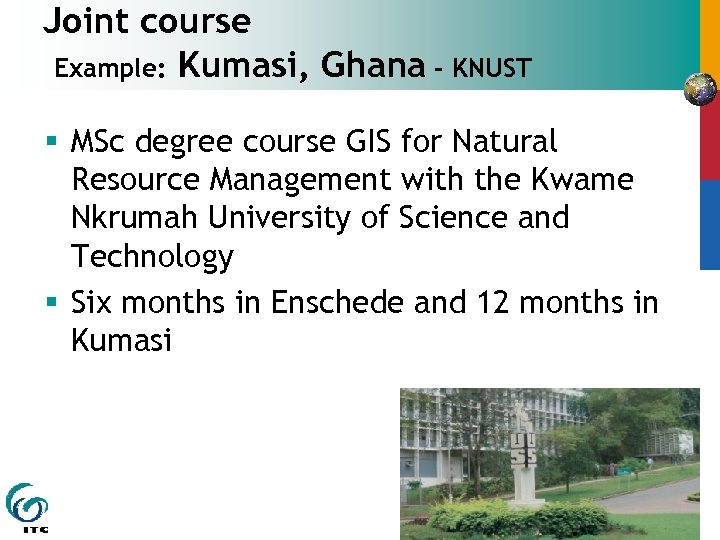 Joint course Example: Kumasi, Ghana – KNUST § MSc degree course GIS for Natural Resource Management with the Kwame Nkrumah University of Science and Technology § Six months in Enschede and 12 months in Kumasi
 Seeking the source Fellowships § Netherlands Fellowship Programme § European Union: Erasmus Mundus § European Union: Alβan programme § United Nations agencies § Joint Japan World Bank Scholarship Programme § International Fellowships Programme Ford Foundation § The Huygens Programme § STUNED Scholarship Programme
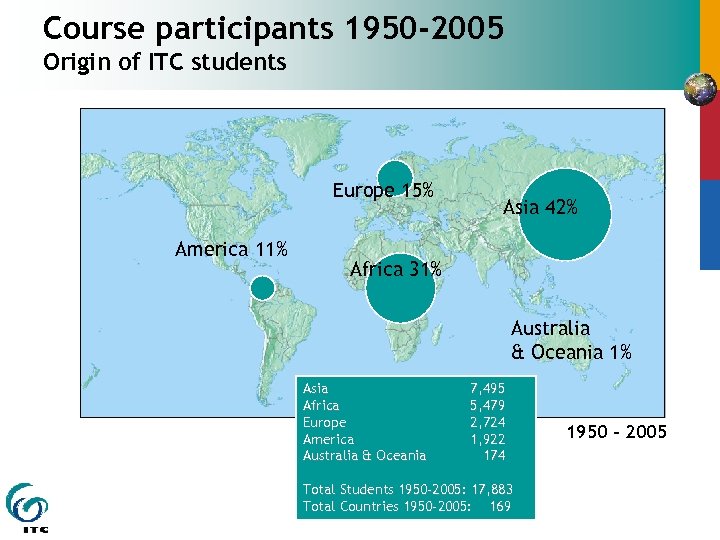 Course participants 1950 -2005 Origin of ITC students Europe 15% America 11% Asia 42% Africa 31% Australia & Oceania 1% Asia Africa Europe America Australia & Oceania 7, 495 5, 479 2, 724 1, 922 174 Total Students 1950 -2005: 17, 883 Total Countries 1950 -2005: 169 1950 - 2005
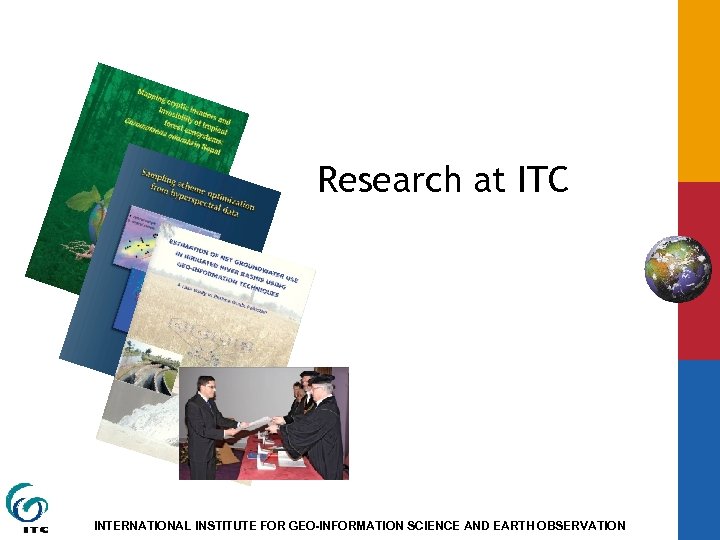 Research at ITC INTERNATIONAL INSTITUTE FOR GEO-INFORMATION SCIENCE AND EARTH OBSERVATION
 Research Objective: § Discovery of new knowledge, support highquality education and capacity building Through: § Research programme § Graduate (Ph. D) programme § Visiting scientists § Joint research partnership agreements
 Research spearheads § Geo-information science and earth observation for § § § strengthening civil society multifunctional use of space natural disasters and environment food and water security monitoring global change
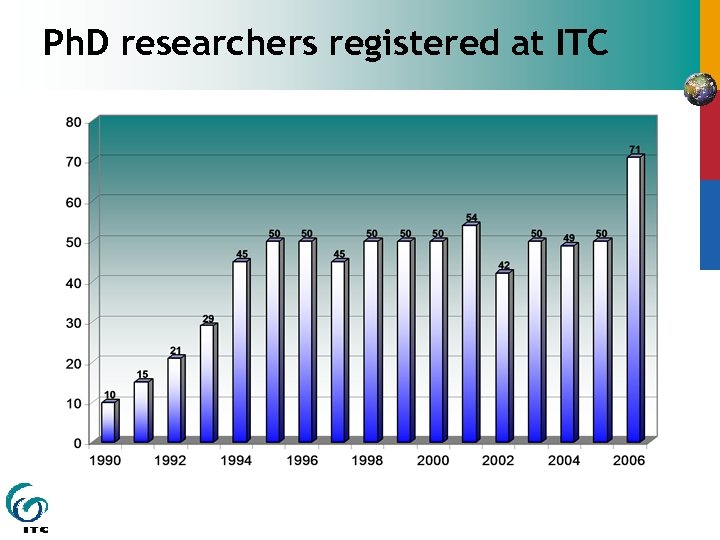 Ph. D researchers registered at ITC
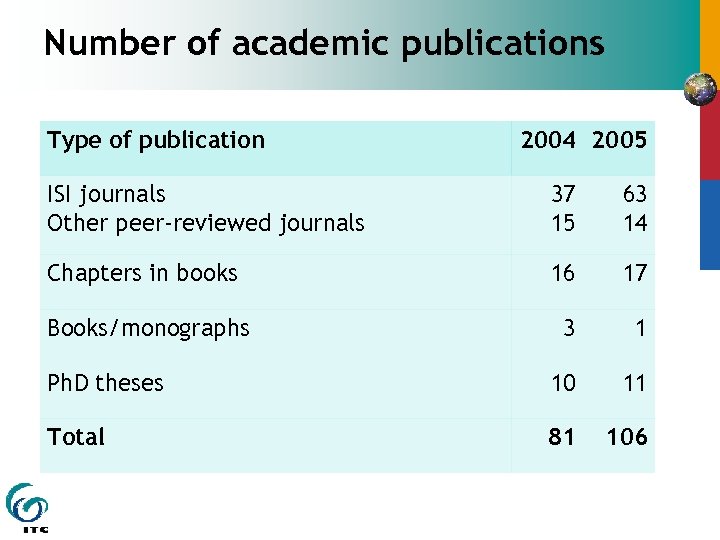 Number of academic publications Type of publication 2004 2005 ISI journals Other peer-reviewed journals 37 15 63 14 Chapters in books 16 17 Books/monographs 3 1 Ph. D theses 10 11 Total 81 106
 Project services at ITC INTERNATIONAL INSTITUTE FOR GEO-INFORMATION SCIENCE AND EARTH OBSERVATION
 Project services § § Advisory services Institutional development projects Contract training Contract research and development
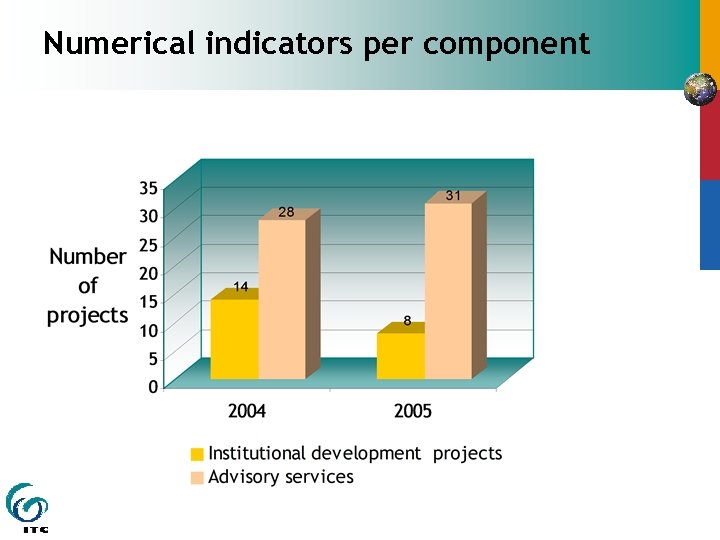 Numerical indicators per component
 Land Administration Project Guatemala § Development of teaching and research capacities in Land Administration with the Faculty of Agronomy (FAUSAC), University of San Carlos, Guatemala § In partnership with Kadaster, DHV and Maastricht School of Management
 Land Administration project § First phase is 3 years, started in 2004 § Co-funded by Netherlands Program for Institutional Strengthening (NPT) § Activities focus at: § Training of trainers § Development of graduate program in Land Administration at FAUSAC § Improvement of library and computer facilities § Development of research program
 Partnerships § in the framework of institutional development § to address the increasing demand for flexibility in academic degree courses § with research partners who contribute complementary scientific expertise
 Education partnerships § Outside Europe § Already implemented in Bolivia, China, the Philippines, India, Iran, Nigeria, Ghana, Tanzania, Mexico, Kenya and Indonesia § With European institutes § Two MSc programmes have been implemented: § GEM: with Southhampton University(UK), Lund University(Sweden) and Warsaw University(Poland) Supported by the EU Erasmus Mundus programme § GIMA: with Delft University of Technology, Utrecht Univeristy and Wageningen University and Research Centre
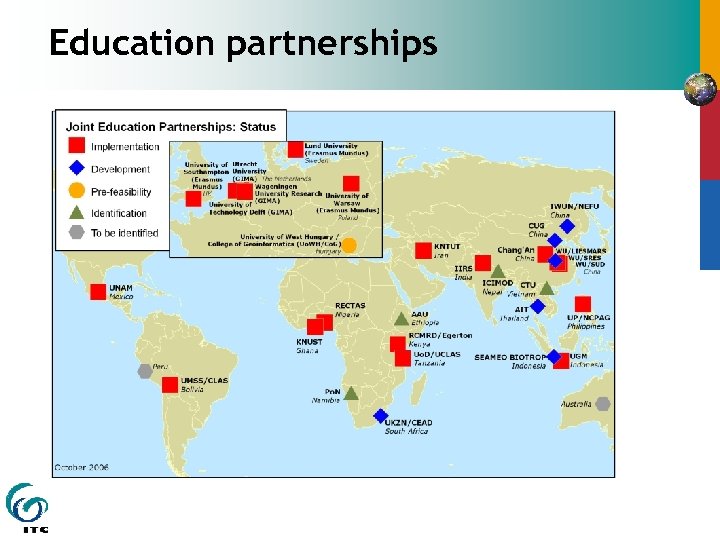 Education partnerships
 GI-NET § The establishment of a network of international partners called the “Geo. Information Network for Education and Training” § The network is active in research and development, as well as in education, training and advisory services.
 ITC and United Nations University § The UNU and ITC entered into an agreement appointing ITC as an Associated Institution of the UNU § UNU-ITC Cooperation is directed at developing and carrying out a joint programme on Capacity Building in Disaster Management and in Land Administration § Programme activities are accommodated in two schools: § School for Disaster Geo-Information Management (DGIM) § School for Land Administration Studies
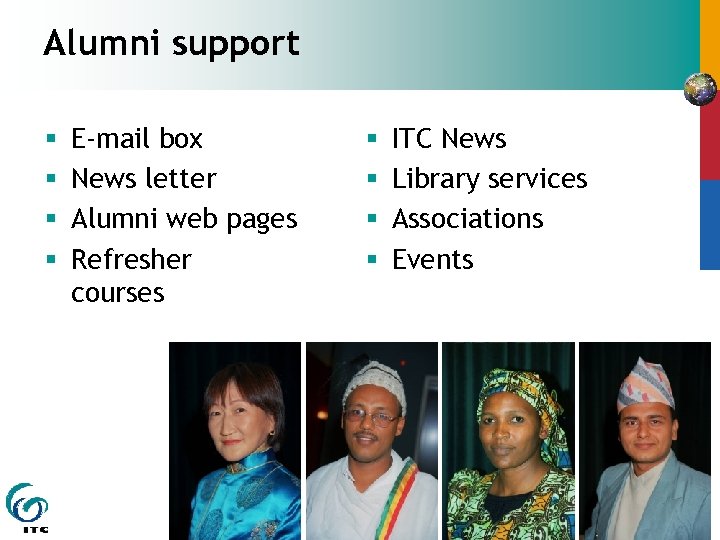 Alumni support § § E-mail box News letter Alumni web pages Refresher courses § § ITC News Library services Associations Events
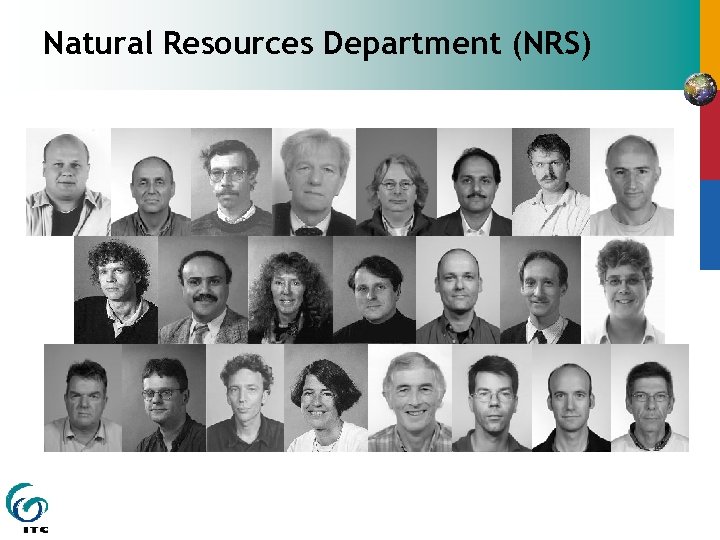 Natural Resources Department (NRS)
 Extensions to the IDV by NRS/Unidata § Generic satellite imagery functions: § Satellite-sun-terrain triangulations functions § Atmospheric correction functions § Surface temperature under clouds § Near real-time food production level estimation at regional scale: § Numerical crop growth simulation module as “jython display contol” § See http: //adde. itc. nl for JAVA Docs and JAVA Webstart links to the ITC-IDV
 Extensions to Mc. IDAS by NRS/Unidata § Compress data at server side to limit storage requirements § Allows serving of wavelet compressed Meteosat Second Generation § Allow png-compressed Mc. IDAS AREAs to be served through ADDE
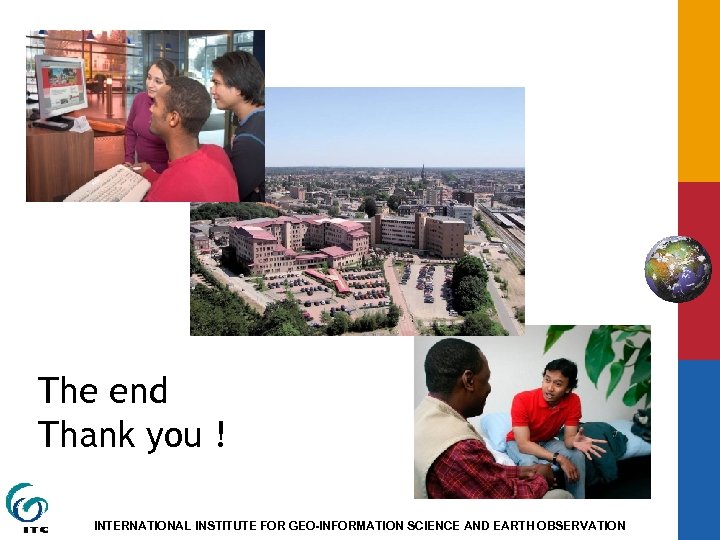 The end Thank you ! INTERNATIONAL INSTITUTE FOR GEO-INFORMATION SCIENCE AND EARTH OBSERVATION