


 Скачать презентацию PHOTETICS WHAT IS IT Phonetics is
Photetics BELOVA K..pptx
- Количество слайдов: 24
 PHOTETICS
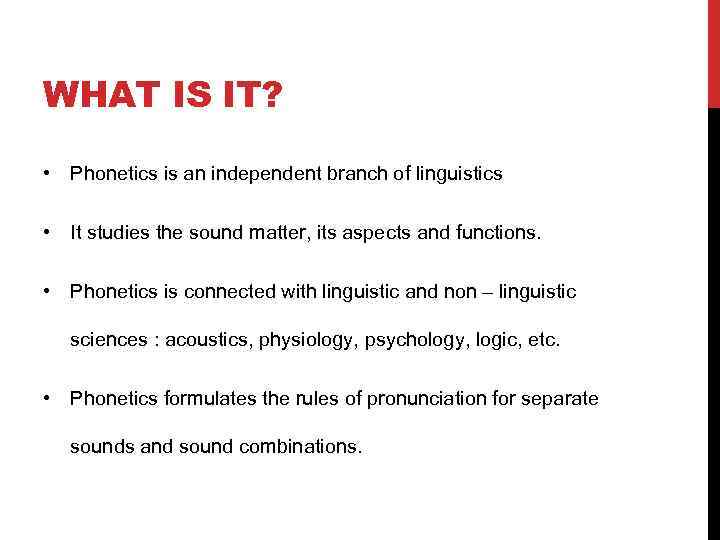 WHAT IS IT? • Phonetics is an independent branch of linguistics • It studies the sound matter, its aspects and functions. • Phonetics is connected with linguistic and non – linguistic sciences : acoustics, physiology, psychology, logic, etc. • Phonetics formulates the rules of pronunciation for separate sounds and sound combinations.
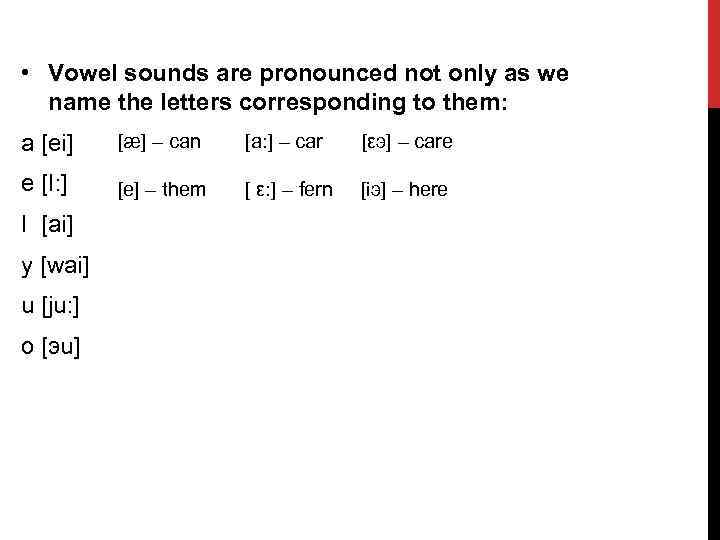 • Vowel sounds are pronounced not only as we name the letters corresponding to them: a [ei] [æ] – can [a: ] – car [εэ] – care e [I: ] [e] – them [ ε: ] – fern [iэ] – here I [ai] y [wai] u [ju: ] o [эu]
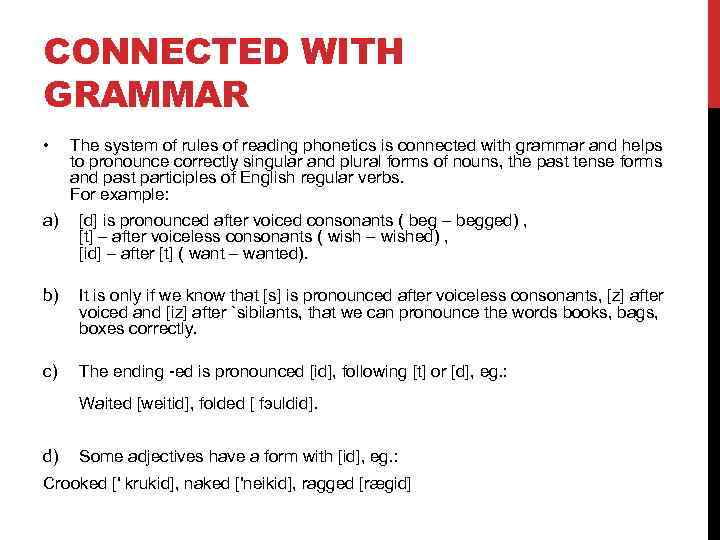 CONNECTED WITH GRAMMAR • The system of rules of reading phonetics is connected with grammar and helps to pronounce correctly singular and plural forms of nouns, the past tense forms and past participles of English regular verbs. For example: a) [d] is pronounced after voiced consonants ( beg – begged) , [t] – after voiceless consonants ( wish – wished) , [id] – after [t] ( want – wanted). b) It is only if we know that [s] is pronounced after voiceless consonants, [z] after voiced and [iz] after `sibilants, that we can pronounce the words books, bags, boxes correctly. c) The ending -ed is pronounced [id], following [t] or [d], eg. : Waited [weitid], folded [ fэuldid]. d) Some adjectives have a form with [id], eg. : Crooked [' krukid], naked ['neikid], ragged [rægid]
![SOUND INTERCHANGE • The interchange of [f-v], [s-z], [θ- ] helps to differentiate singular](https://present5.com/presentation/7253940_444823669/image-5.jpg "SOUND INTERCHANGE • The interchange of [f-v], [s-z], [θ- ] helps to differentiate singular") SOUND INTERCHANGE • The interchange of [f-v], [s-z], [θ- ] helps to differentiate singular and plural forms of such nouns as : calf – calves [f-v], leaf – leaves [f-v], house – houses [s-z].
SOUND INTERCHANGE • The interchange of [f-v], [s-z], [θ- ] helps to differentiate singular and plural forms of such nouns as : calf – calves [f-v], leaf – leaves [f-v], house – houses [s-z].
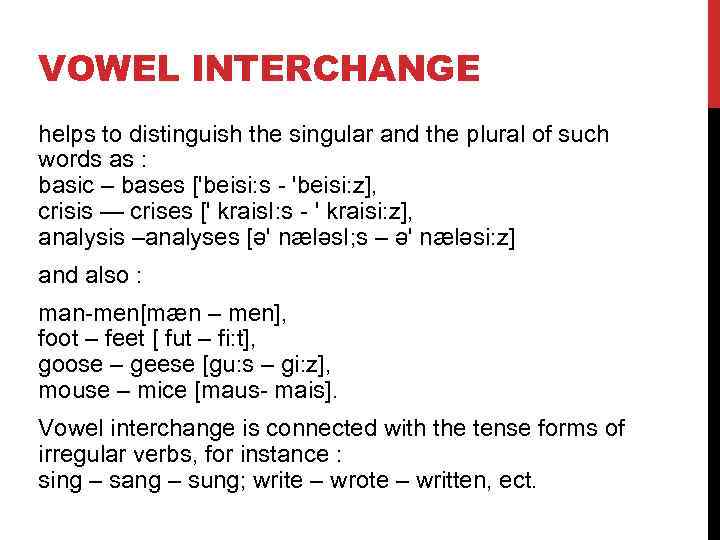 VOWEL INTERCHANGE helps to distinguish the singular and the plural of such words as : basic – bases ['beisi: s - 'beisi: z], crisis — crises [' krais. I: s - ' kraisi: z], analysis –analyses [ə' næləs. I; s – ə' næləsi: z] and also : man-men[mæn – men], foot – feet [ fut – fi: t], goose – geese [gu: s – gi: z], mouse – mice [maus- mais]. Vowel interchange is connected with the tense forms of irregular verbs, for instance : sing – sang – sung; write – wrote – written, ect.
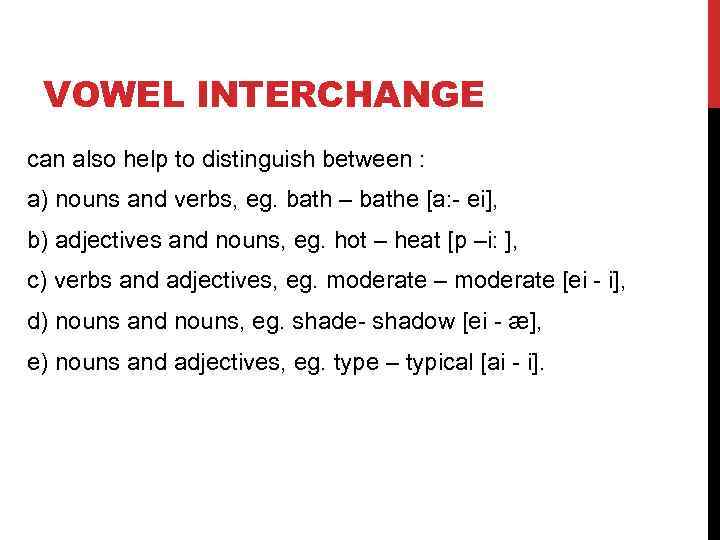 VOWEL INTERCHANGE can also help to distinguish between : a) nouns and verbs, eg. bath – bathe [a: - ei], b) adjectives and nouns, eg. hot – heat [p –i: ], c) verbs and adjectives, eg. moderate – moderate [ei - i], d) nouns and nouns, eg. shade- shadow [ei - æ], e) nouns and adjectives, eg. type – typical [ai - i].
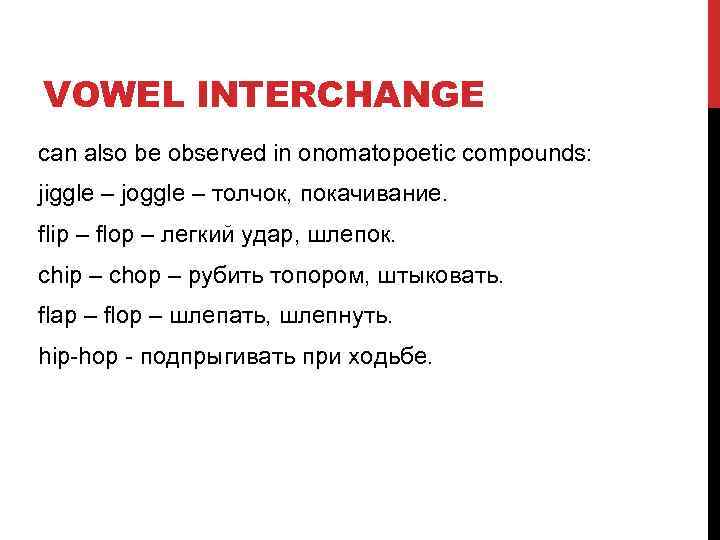 VOWEL INTERCHANGE can also be observed in onomatopoetic compounds: jiggle – joggle – толчок, покачивание. flip – flop – легкий удар, шлепок. chip – chop – рубить топором, штыковать. flap – flop – шлепать, шлепнуть. hip-hop - подпрыгивать при ходьбе.
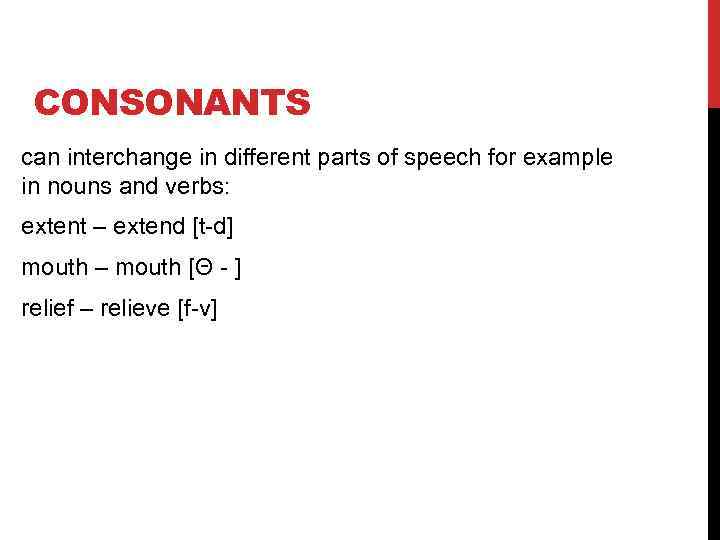 CONSONANTS can interchange in different parts of speech for example in nouns and verbs: extent – extend [t-d] mouth – mouth [Θ - ] relief – relieve [f-v]
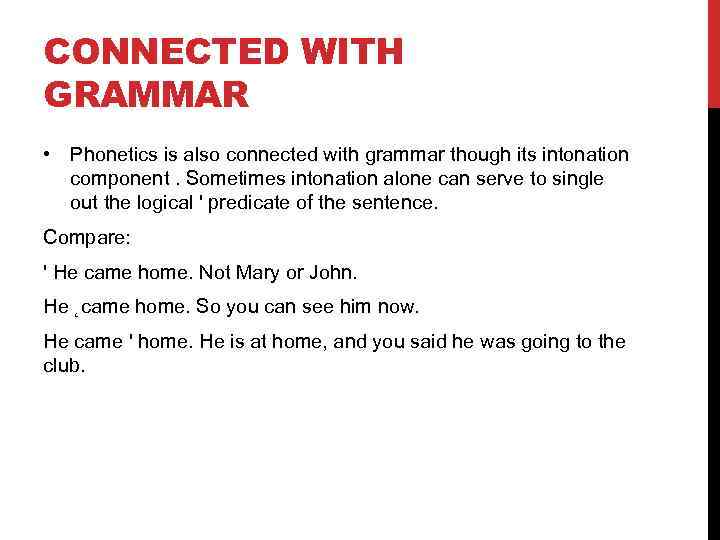 CONNECTED WITH GRAMMAR • Phonetics is also connected with grammar though its intonation component. Sometimes intonation alone can serve to single out the logical ' predicate of the sentence. Compare: ' He came home. Not Mary or John. He ˛came home. So you can see him now. He came ' home. He is at home, and you said he was going to the club.
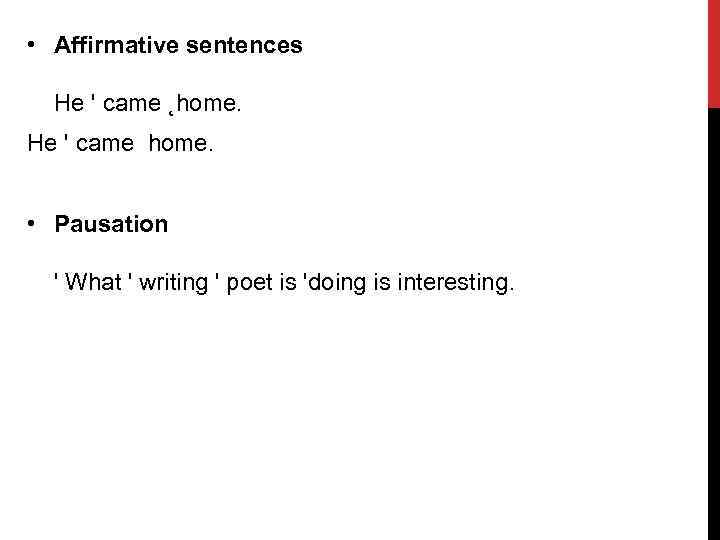 • Affirmative sentences He ' came ˛home. He ' came home. • Pausation ' What ' writing ' poet is 'doing is interesting.
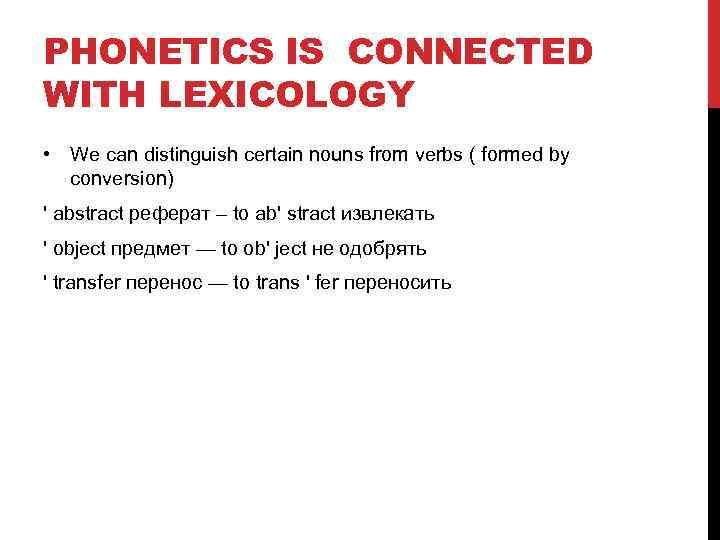 PHONETICS IS CONNECTED WITH LEXICOLOGY • We can distinguish certain nouns from verbs ( formed by conversion) ' abstract реферат – to ab' stract извлекать ' object предмет — to ob' ject не одобрять ' transfer перенос — to trans ' fer переносить
![HOMOGRAPHS bow [bəu] лук — bow [bau] поклон lead [li: d] руководство — lead](https://present5.com/presentation/7253940_444823669/image-13.jpg "HOMOGRAPHS bow [bəu] лук — bow [bau] поклон lead [li: d] руководство — lead") HOMOGRAPHS bow [bəu] лук — bow [bau] поклон lead [li: d] руководство — lead [led] свинец row [rəu] ряд — row [rau] шум sewer [səuə] швея — sewer [sjuəu] сточная труба tear [tεə] разрыв — tear [tiə] слеза wind [wind] ветер — wind [waind] виток • Due to the position of word accent we can distinguish between homonymous word and word groups, eg: ' blackbird дрозд - 'black ` bird черная птица
HOMOGRAPHS bow [bəu] лук — bow [bau] поклон lead [li: d] руководство — lead [led] свинец row [rəu] ряд — row [rau] шум sewer [səuə] швея — sewer [sjuəu] сточная труба tear [tεə] разрыв — tear [tiə] слеза wind [wind] ветер — wind [waind] виток • Due to the position of word accent we can distinguish between homonymous word and word groups, eg: ' blackbird дрозд - 'black ` bird черная птица
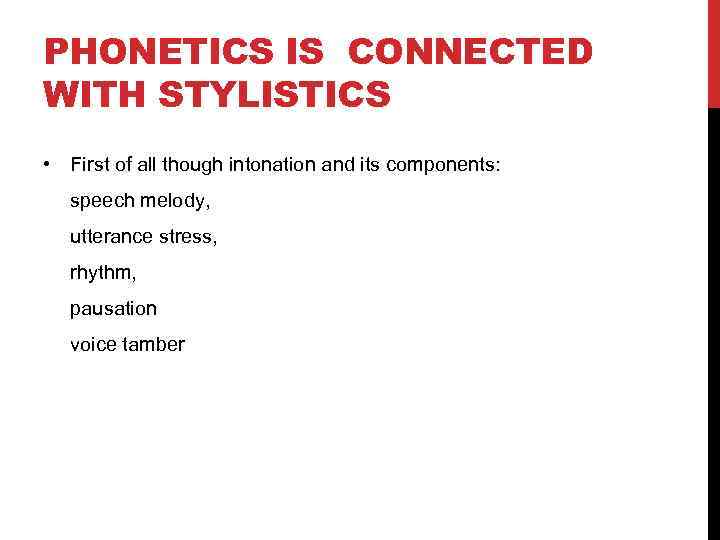 PHONETICS IS CONNECTED WITH STYLISTICS • First of all though intonation and its components: speech melody, utterance stress, rhythm, pausation voice tamber
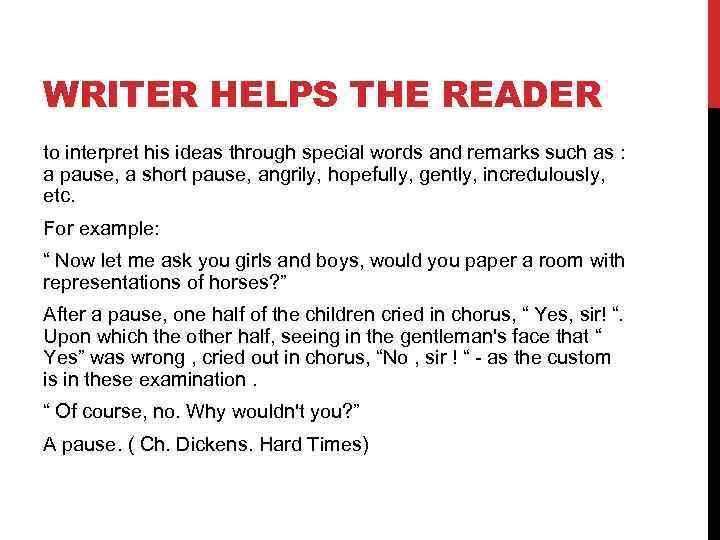 WRITER HELPS THE READER to interpret his ideas through special words and remarks such as : a pause, a short pause, angrily, hopefully, gently, incredulously, etc. For example: “ Now let me ask you girls and boys, would you paper a room with representations of horses? ” After a pause, one half of the children cried in chorus, “ Yes, sir! “. Upon which the other half, seeing in the gentleman's face that “ Yes” was wrong , cried out in chorus, “No , sir ! “ - as the custom is in these examination. “ Of course, no. Why wouldn't you? ” A pause. ( Ch. Dickens. Hard Times)
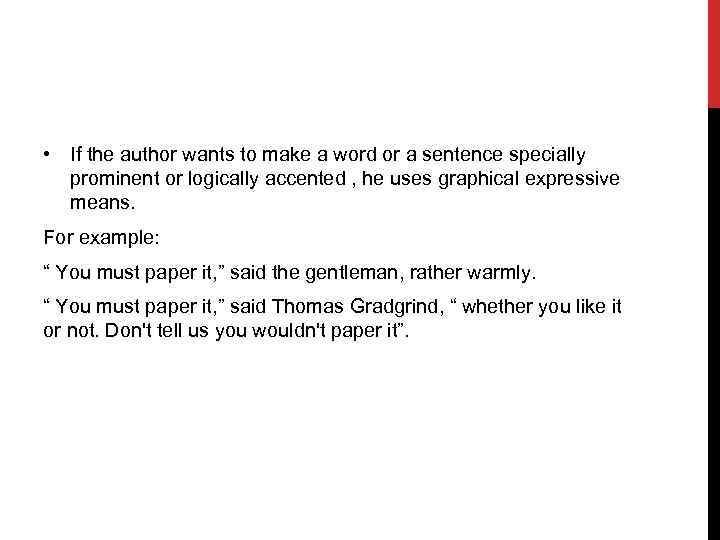 • If the author wants to make a word or a sentence specially prominent or logically accented , he uses graphical expressive means. For example: “ You must paper it, ” said the gentleman, rather warmly. “ You must paper it, ” said Thomas Gradgrind, “ whether you like it or not. Don't tell us you wouldn't paper it”.
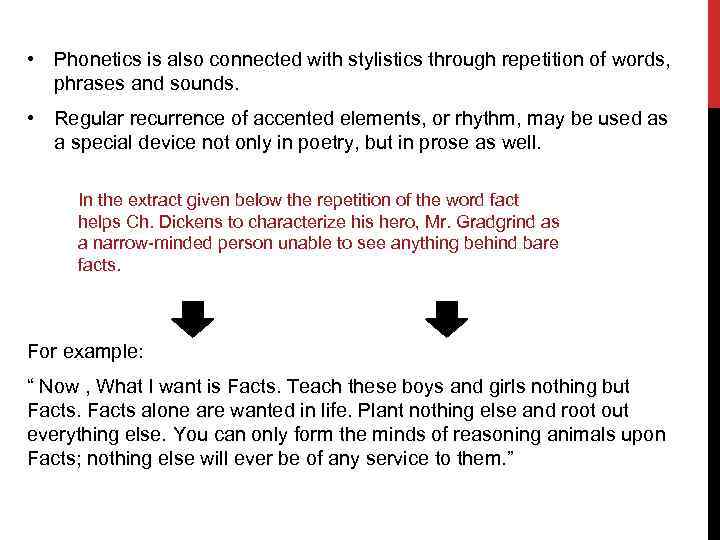 • Phonetics is also connected with stylistics through repetition of words, phrases and sounds. • Regular recurrence of accented elements, or rhythm, may be used as a special device not only in poetry, but in prose as well. In the extract given below the repetition of the word fact helps Ch. Dickens to characterize his hero, Mr. Gradgrind as a narrow-minded person unable to see anything behind bare facts. For example: “ Now , What I want is Facts. Teach these boys and girls nothing but Facts alone are wanted in life. Plant nothing else and root out everything else. You can only form the minds of reasoning animals upon Facts; nothing else will ever be of any service to them. ”
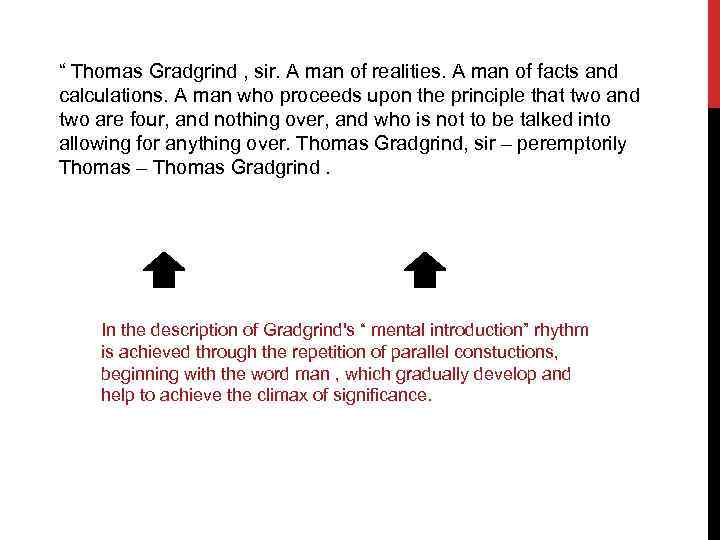 “ Thomas Gradgrind , sir. A man of realities. A man of facts and calculations. A man who proceeds upon the principle that two and two are four, and nothing over, and who is not to be talked into allowing for anything over. Thomas Gradgrind, sir – peremptorily Thomas – Thomas Gradgrind. In the description of Gradgrind's “ mental introduction” rhythm is achieved through the repetition of parallel constuctions, beginning with the word man , which gradually develop and help to achieve the climax of significance.
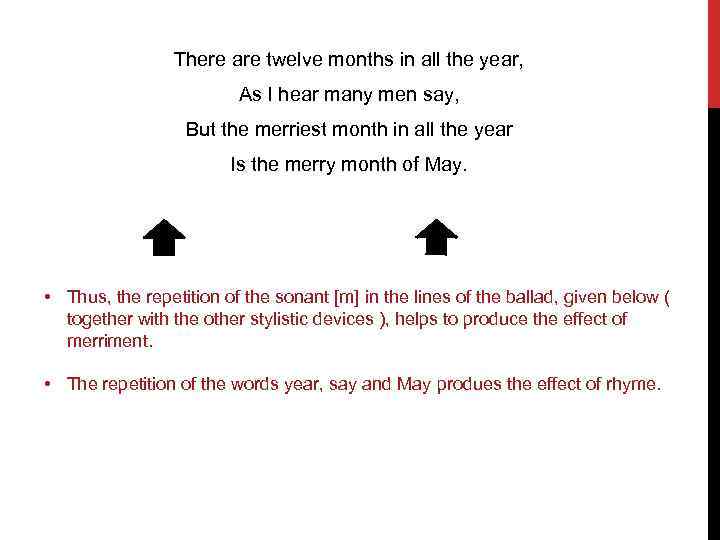 There are twelve months in all the year, As I hear many men say, But the merriest month in all the year Is the merry month of May. • Thus, the repetition of the sonant [m] in the lines of the ballad, given below ( together with the other stylistic devices ), helps to produce the effect of merriment. • The repetition of the words year, say and May produes the effect of rhyme.
 ONOMATOPOEIA a combination of sounds which imitate sounds produced in nature, is one more stylistic device which can serve as an example of the connection between phonetics and stylistics. E. g. : tinkle, jinkle, clink, ting, chink; chatter, jabber, clatter, babble ; chirp, cheep, twitter, chirrup ; clap, dab, smack; crash, bang.
 • The study of phonetic phenomena from the stylistic point of view is phonostylistics. It is connected with a number of linguistic and non – linguistic disciplines, such as: paralinguistics, psychology, psycholinguistics, sociology, sociolinguistics, dialectology, literary criticism , aesthetics, information theory, etc.
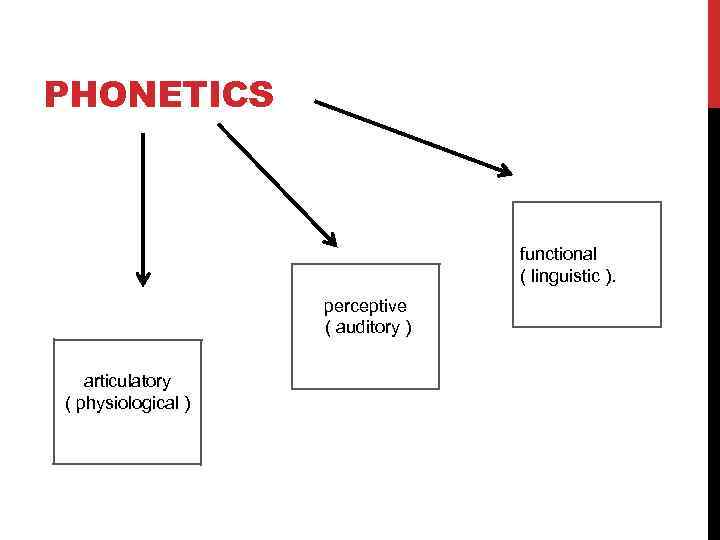 PHONETICS functional ( linguistic ). perceptive ( auditory ) physiological ) articulatory ( physiological )
 ARTICULATORY AND PERCEPTIVE, ACOUSTIC, FUNCTIONAL. 1. Articulatory and perceptive investigation of speech sounds is done on the basis of a good knowledge of the voice and sound producing mechanisms , their structure, work and perceptive ( auditory ) effects, that is – physiology and psychology. 2. Acoustic properties of sounds, that is , quantity , or length, tamber, intensity, pitch, temporal factor are investigated by the acoustic and auditory branch of phonetics. 3. The phonological or functional properties of phonemes, syllables, accent and intonation are investigated by means of special linguistic methods, which help to interpret them as socially significant elements.
 THEORETICAL AND PRACTICAL SIGNIFICANCE • Theoretical significance of phonetics is connected with the further development of the problem of the synchronic study and description of the phonetic system of a national language, the comparative analysis and description of different languages and the study of the correspondences between them, the diachronic description of successive changes in the phonetic system of a language or different languages. • Practical significance of phonetics is connected with teaching foreign languages. Practical phonetics is applied in methods of speech correction, teaching deaf – mutes , film doubling, transliteration, radio and telephone.