 Скачать презентацию Phonics Meeting for Parents Thursday 11 th December
b71fba45920599e9fe02daf86b00dcd0.ppt
- Количество слайдов: 26



Phonics Meeting for Parents Thursday 11 th December

Some Definitions A Phoneme This is the smallest unit of sound in a word. How many phonemes can you hear in cat?
A grapheme These are the letters that represent the phoneme. Children need to practise recognising the grapheme and saying the phoneme that it represents. The grapheme could be 1 letter, 2 letters or more! t ai igh
• A phoneme you hear • A grapheme you see A word always has the same number of phonemes and graphemes!
Taught through Letters and Sounds Phase 1 Acorn ◦ To distinguish between sounds and become familiar with rhyme, rhythm and alliteration. Phase 2 Acorn ◦ To introduce 19 grapheme-phoneme correspondences. Phase 3 Acorn/Beech ◦ To teach one grapheme for each of the 44 phonemes in order to spell simple regular words. Phase 4 Beech ◦ To read and spell words containing adjacent consonants. Phase 5 Beech/Chestnut ◦ To teach alternative pronunciations for graphemes and alternative spellings for phonemes. Phase 6 Chestnut ◦ To develop their skill and automaticity in reading and writing.
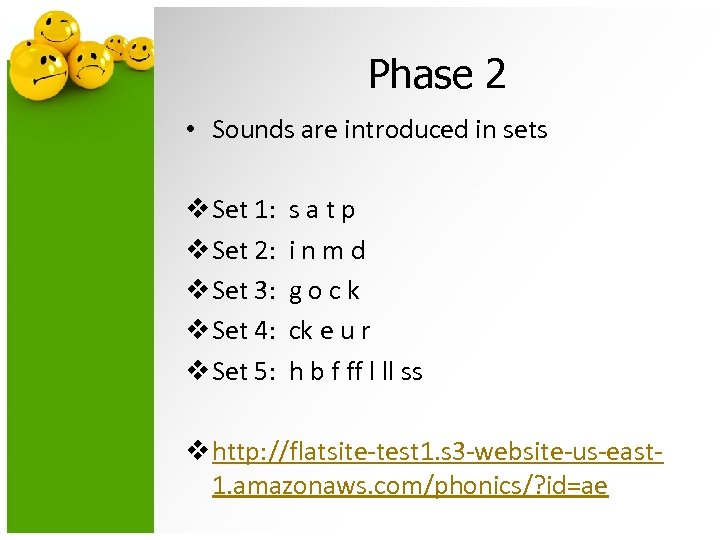
Phase 2 • Sounds are introduced in sets v Set 1: s a t p v Set 2: i n m d v Set 3: g o c k v Set 4: ck e u r v Set 5: h b f ff l ll ss v http: //flatsite-test 1. s 3 -website-us-east 1. amazonaws. com/phonics/? id=ae
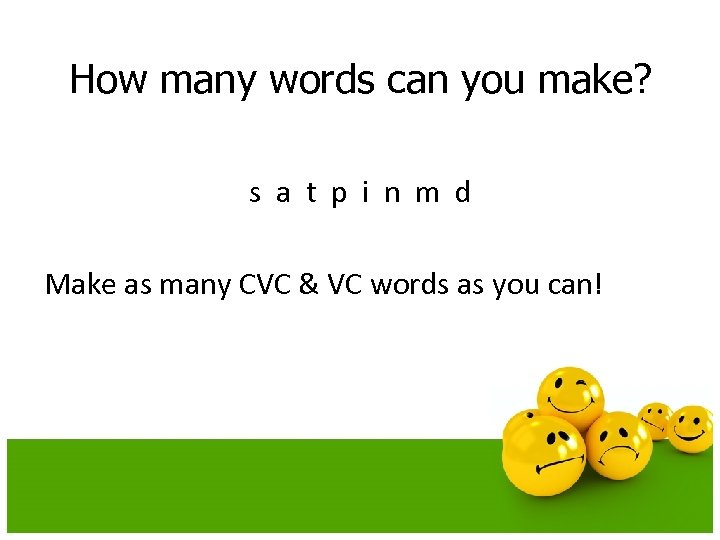
How many words can you make? s a t p i n m d Make as many CVC & VC words as you can!
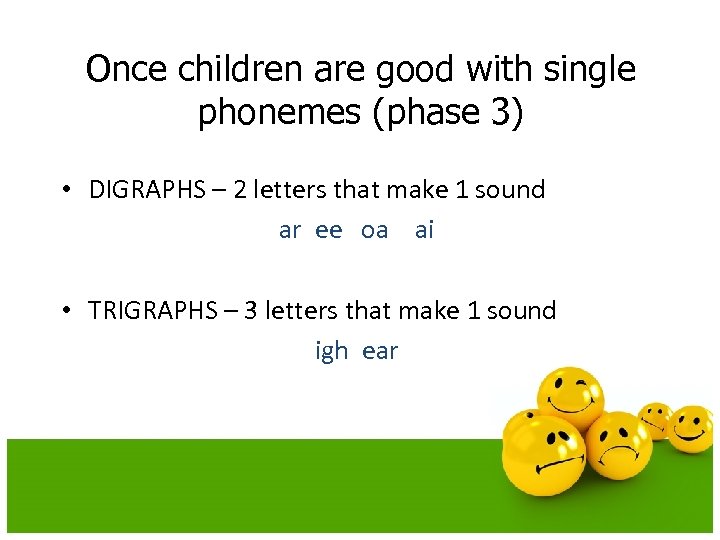
Once children are good with single phonemes (phase 3) • DIGRAPHS – 2 letters that make 1 sound ar ee oa ai • TRIGRAPHS – 3 letters that make 1 sound igh ear
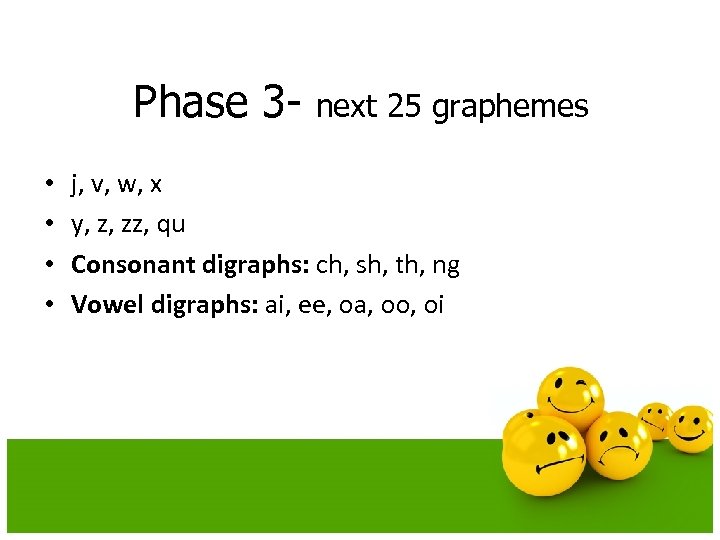
Phase 3 • • next 25 graphemes j, v, w, x y, z, zz, qu Consonant digraphs: ch, sh, th, ng Vowel digraphs: ai, ee, oa, oo, oi

Ways to practice at home • http: //www. ictgames. com/phoneme. Pop. LS_v 2. html • Flash cards • http: //www. ictgames. com/poop. Deck. Pirates/index. html
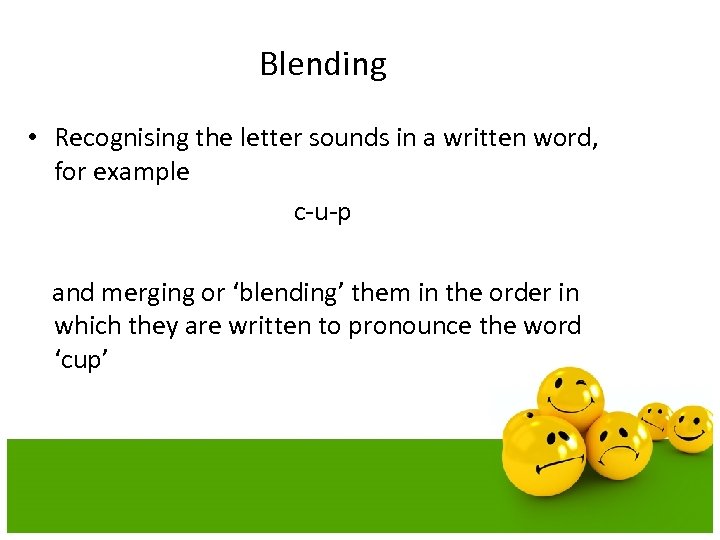
Blending • Recognising the letter sounds in a written word, for example c-u-p and merging or ‘blending’ them in the order in which they are written to pronounce the word ‘cup’
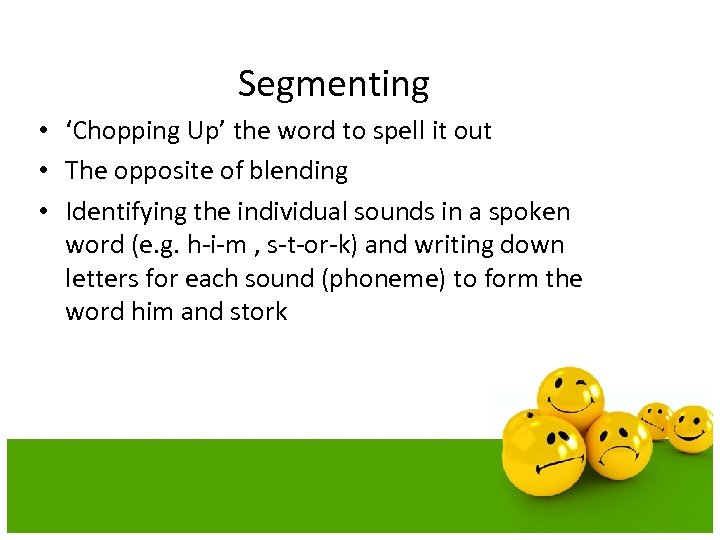
Segmenting • ‘Chopping Up’ the word to spell it out • The opposite of blending • Identifying the individual sounds in a spoken word (e. g. h-i-m , s-t-or-k) and writing down letters for each sound (phoneme) to form the word him and stork
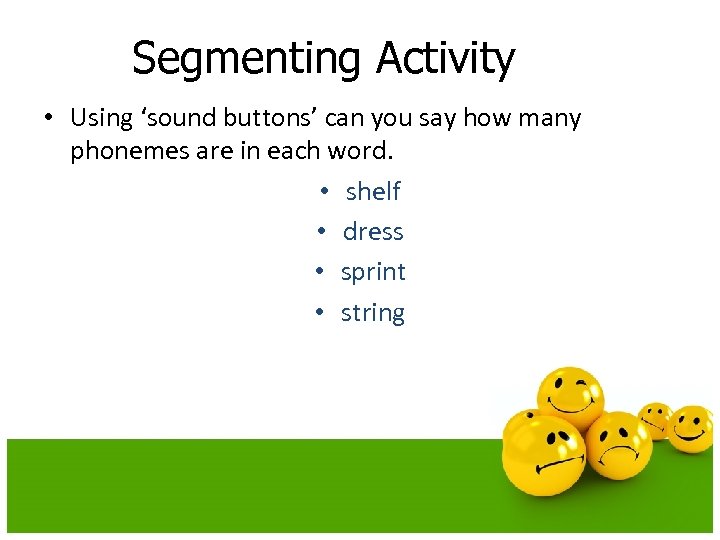
Segmenting Activity • Using ‘sound buttons’ can you say how many phonemes are in each word. • shelf • dress • sprint • string
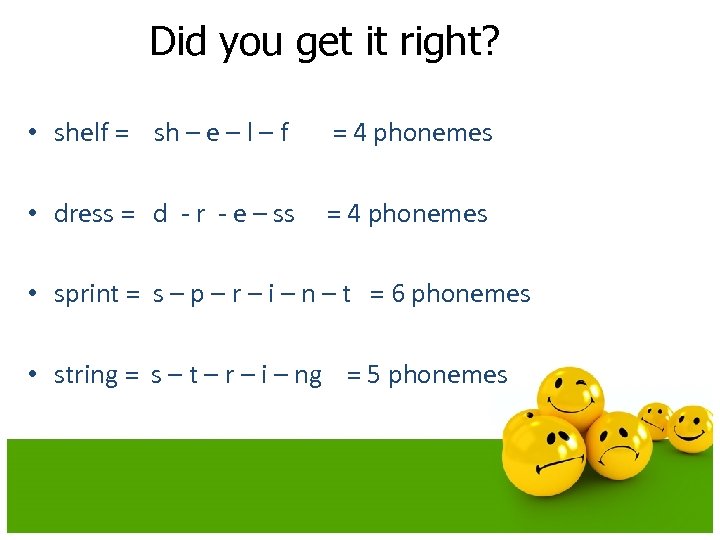
Did you get it right? • shelf = sh – e – l – f = 4 phonemes • dress = d - r - e – ss = 4 phonemes • sprint = s – p – r – i – n – t = 6 phonemes • string = s – t – r – i – ng = 5 phonemes
Phonics screening check • • https: //www. tes. co. uk/teaching-resource/Nonsense-Words-1 -6124820 Tests whether children can segment and blend the phonemes Useful tool not stressful for children http: //www. phonicsplay. co. uk/Buried. Treasure 2. html
Phase 4 • Children continue to practise previously learned graphemes and phonemes and learn how to read and write: • CVCC words: tent, damp, toast, chimp • For example, in the word ‘toast’, t = consonant, oa = vowel, s = consonant, t = consonant. and CCVC words: swim, plum, sport, cream, spoon • For example, in the word ‘cream’, c = consonant, r = consonant, ea = vowel, m = consonant. • They will be learning more tricky words and continuing to read and write sentences together. • Tricky words said, so, do, have, like, some, come, were, there, little, one, when, out, what
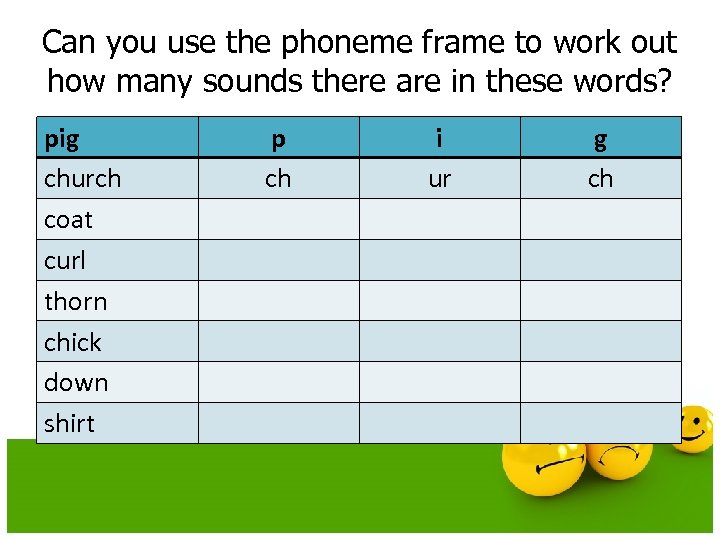
Can you use the phoneme frame to work out how many sounds there are in these words? pig church coat curl thorn chick down shirt p ch i ur g ch
Tricky Words • Words that are not phonically de-codeable e. g. was, the, I, said http: //www. oxfordowl. co. uk/for-home/readingsite/expert-help/phonics-made-easy http: //www. ictgames. com/dinosaurs. Eggs/ Phase 5 tricky words- could, colour in parts that can’t be sounded.
Moving onto the next phase • We assess whether children can read the sounds but also whether they are using the tricky words and the phonemes in their writing.
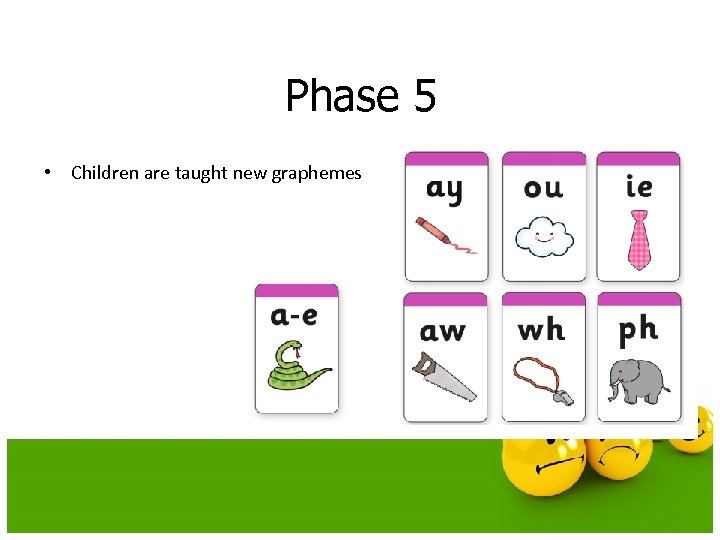
Phase 5 • Children are taught new graphemes
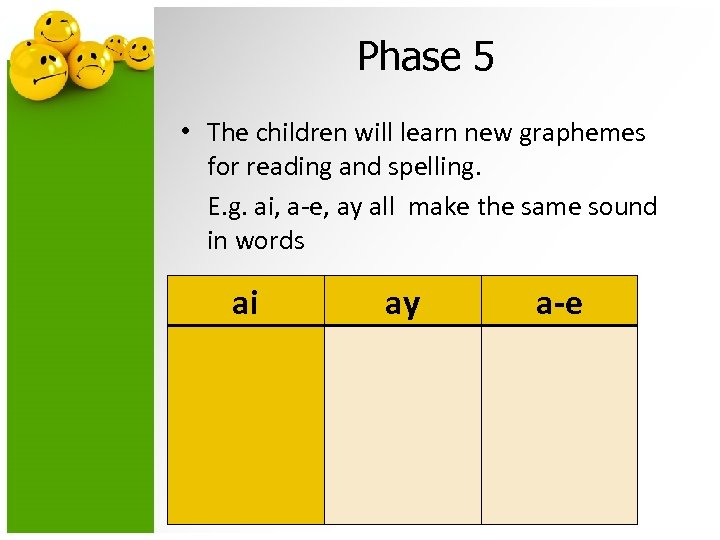
Phase 5 • The children will learn new graphemes for reading and spelling. E. g. ai, a-e, ay all make the same sound in words • ai words. ay a-e
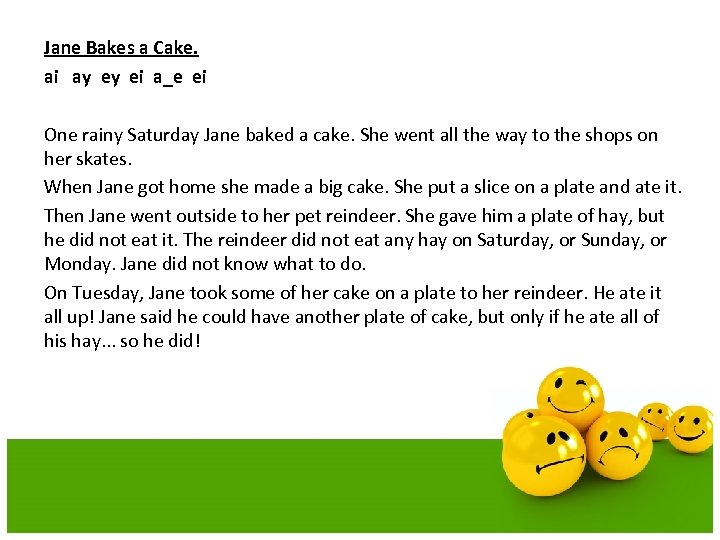
Jane Bakes a Cake. ai ay ey ei a_e ei One rainy Saturday Jane baked a cake. She went all the way to the shops on her skates. When Jane got home she made a big cake. She put a slice on a plate and ate it. Then Jane went outside to her pet reindeer. She gave him a plate of hay, but he did not eat it. The reindeer did not eat any hay on Saturday, or Sunday, or Monday. Jane did not know what to do. On Tuesday, Jane took some of her cake on a plate to her reindeer. He ate it all up! Jane said he could have another plate of cake, but only if he ate all of his hay. . . so he did!
Phase 6 • Recognising phonic irregularities and becoming more secure with less common grapheme – phoneme correspondences. • Applying phonic skills and knowledge to recognise and spell an increasing number of complex words. • Introducing and teaching the past tense • Investigating and learning how to add suffixes • Teaching spelling long words • Finding and learning the difficult bits in words
How can I help? • Play ‘I spy’ • Continue to play with magnetic letters, using some twographeme (letter) combinations, eg: r-ai-n = rain blending for reading rain = r-ai-n segmenting for spelling • Praise your child for trying out words • Look at tricky words • Play phonic games • Play pairs with words and pictures
REMEMBER: Phonics is not the only thing needed to become a fluent reader. • Please continue to read with your child each night and encourage them to: • Sound out • Re-read to check it makes sense. • Use pictures for clues. • Ask questions about the book. And most importantly ENJOY READING!
Have a go! Please feel free to have a go at some of the activities that your children enjoy in their phonic sessions and come and ask me any questions. Thankyou.
Скачать презентацию Phonics Meeting for Parents Thursday 11 th December
b71fba45920599e9fe02daf86b00dcd0.ppt