


 Скачать презентацию Phonation SPPA 4030 Speech Science 1 Topic
a5118dddf60d144d8b08edad0c9c3689.ppt
- Количество слайдов: 93
 Phonation SPPA 4030 Speech Science 1
 Topic Sequence • • • Anatomy review Achieving phonation Capturing glottal and vocal fold behavior Phonatory control parameters Lifecourse considerations Clinical considerations SPPA 4030 Speech Science 2
 Topic Sequence • Anatomy review SPPA 4030 Speech Science 3
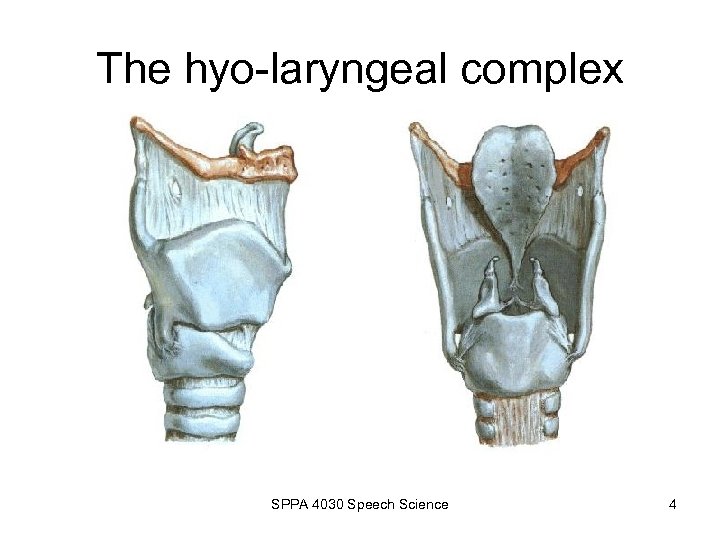 The hyo-laryngeal complex SPPA 4030 Speech Science 4
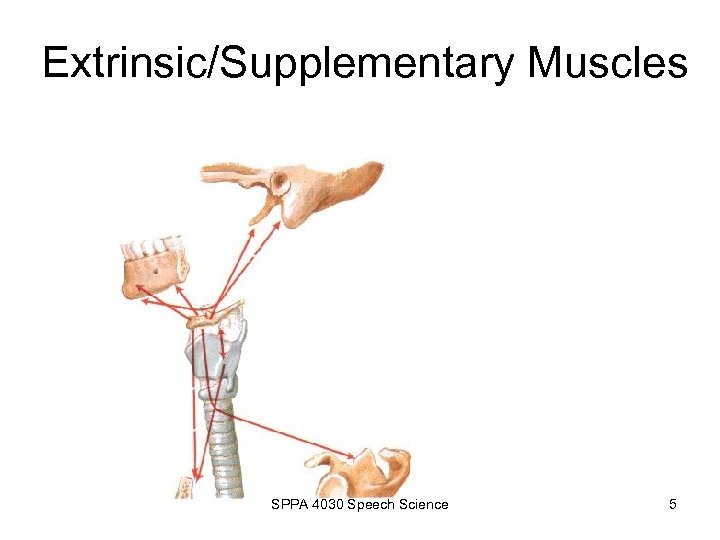 Extrinsic/Supplementary Muscles SPPA 4030 Speech Science 5
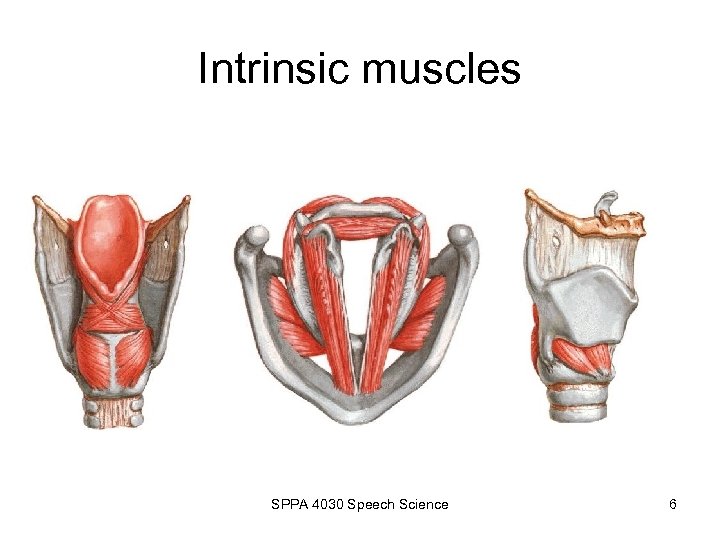 Intrinsic muscles SPPA 4030 Speech Science 6
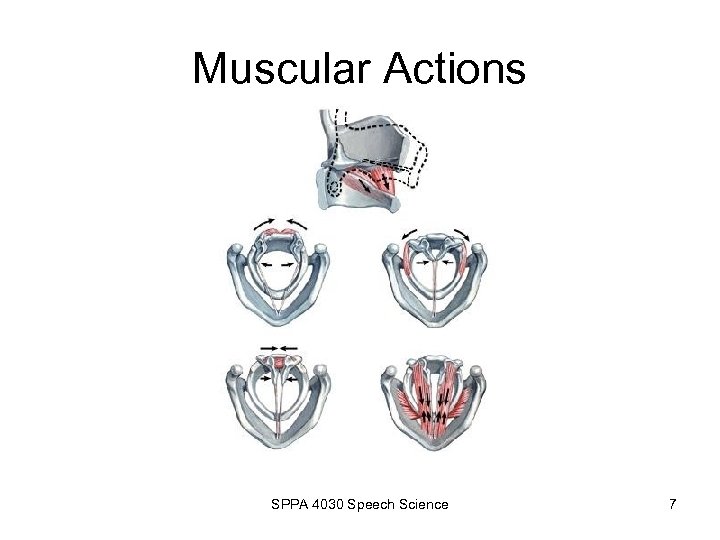 Muscular Actions SPPA 4030 Speech Science 7
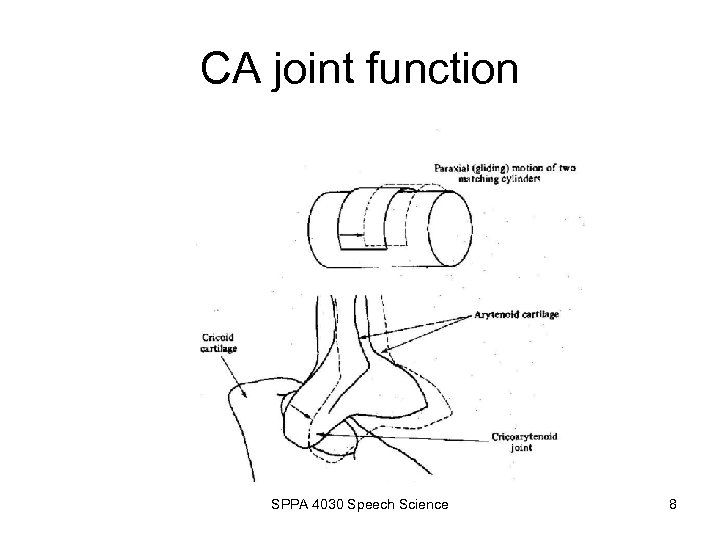 CA joint function SPPA 4030 Speech Science 8
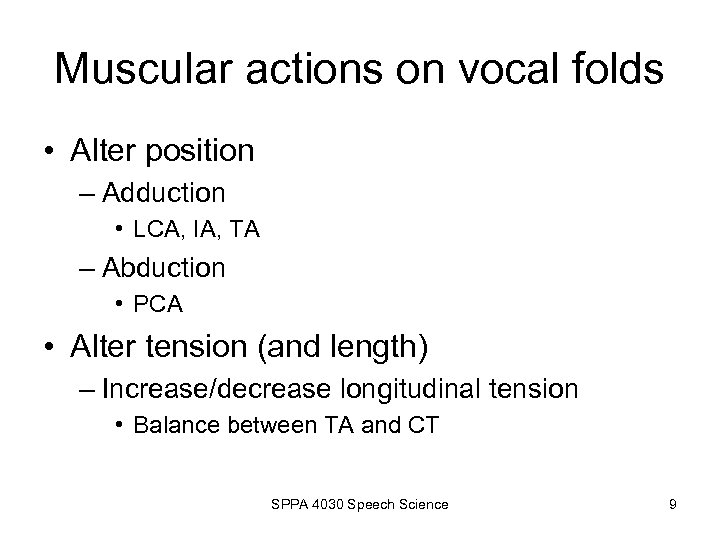 Muscular actions on vocal folds • Alter position – Adduction • LCA, IA, TA – Abduction • PCA • Alter tension (and length) – Increase/decrease longitudinal tension • Balance between TA and CT SPPA 4030 Speech Science 9
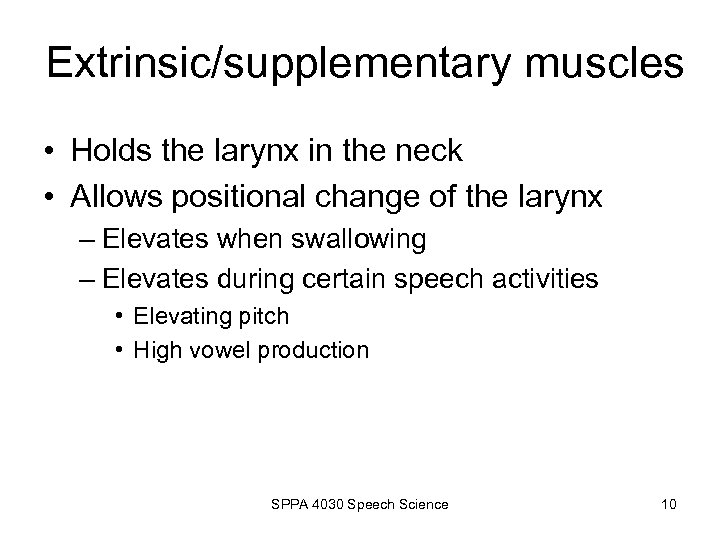 Extrinsic/supplementary muscles • Holds the larynx in the neck • Allows positional change of the larynx – Elevates when swallowing – Elevates during certain speech activities • Elevating pitch • High vowel production SPPA 4030 Speech Science 10
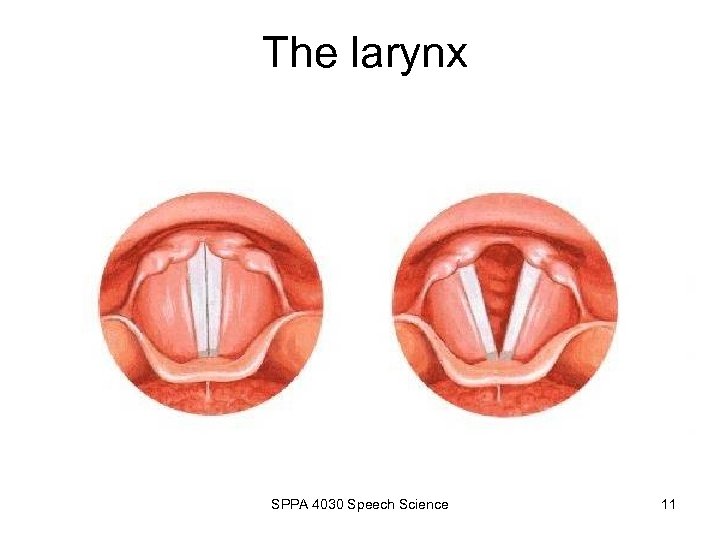 The larynx SPPA 4030 Speech Science 11
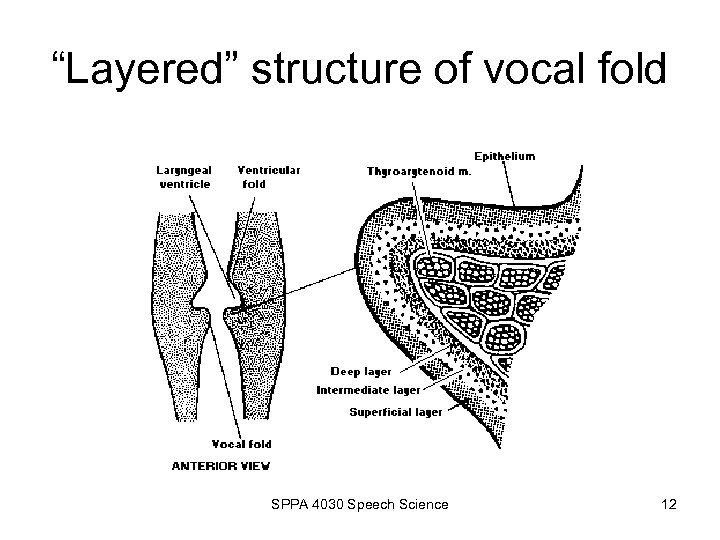 “Layered” structure of vocal fold SPPA 4030 Speech Science 12
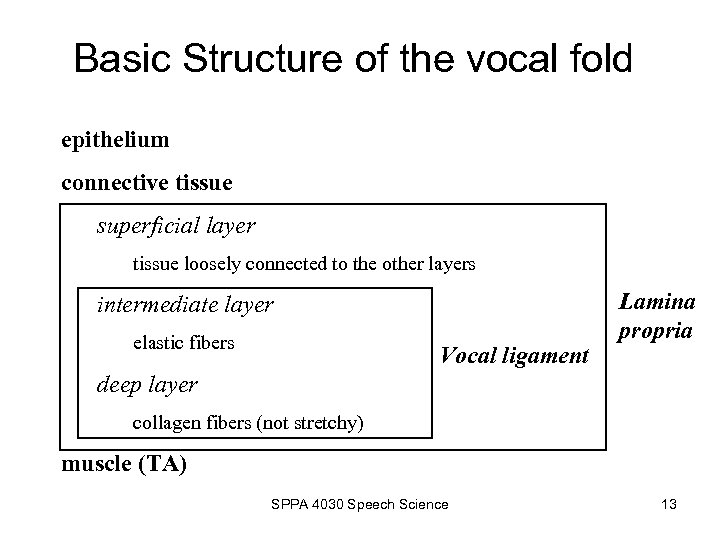 Basic Structure of the vocal fold epithelium connective tissue superficial layer tissue loosely connected to the other layers intermediate layer elastic fibers Vocal ligament Lamina propria deep layer collagen fibers (not stretchy) muscle (TA) SPPA 4030 Speech Science 13
 Topic Sequence • Anatomy review • Achieving phonation – Features of the mucosal wave – Two-mass model of phonation – More complex models of phonation SPPA 4030 Speech Science 14
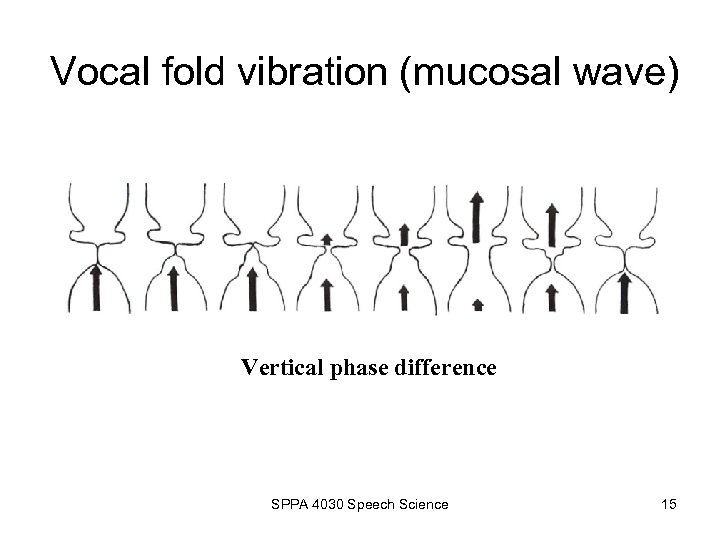 Vocal fold vibration (mucosal wave) Vertical phase difference SPPA 4030 Speech Science 15
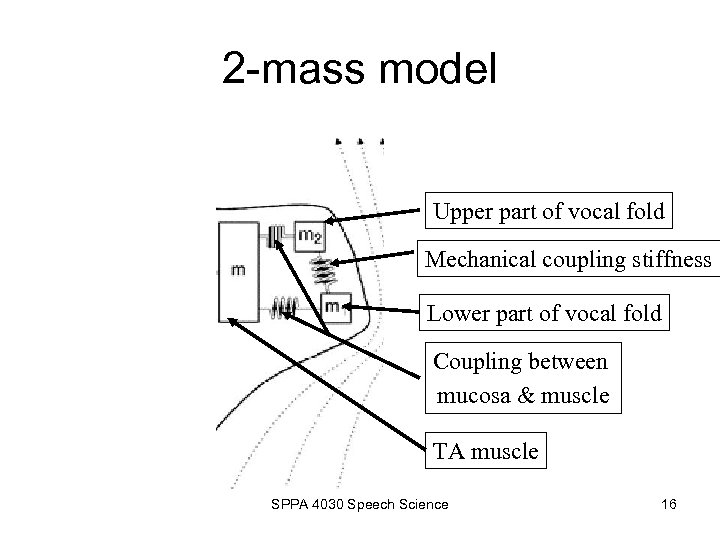 2 -mass model Upper part of vocal fold Mechanical coupling stiffness Lower part of vocal fold Coupling between mucosa & muscle TA muscle SPPA 4030 Speech Science 16
 Myoelastic aerodynamic theory of phonation Necessary & sufficient conditions for phonation 1. Adduction 2. Longitudinal tension 3. Aerodynamic pressures SPPA 4030 Speech Science 17
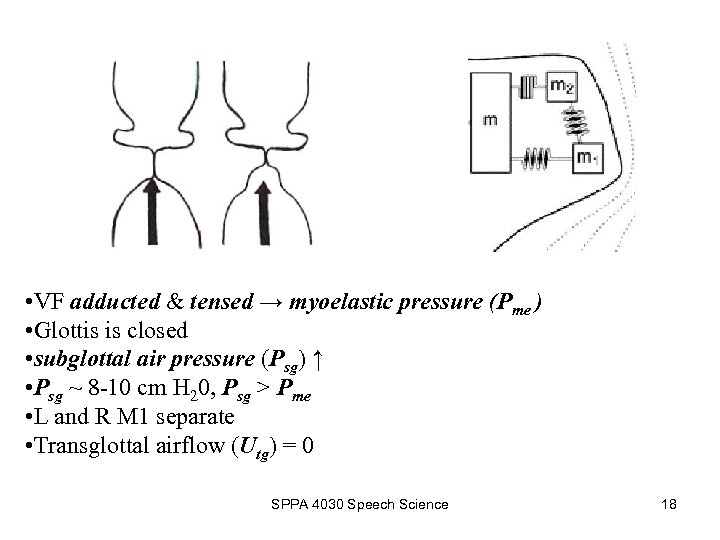 • VF adducted & tensed → myoelastic pressure (Pme ) • Glottis is closed • subglottal air pressure (Psg) ↑ • Psg ~ 8 -10 cm H 20, Psg > Pme • L and R M 1 separate • Transglottal airflow (Utg) = 0 SPPA 4030 Speech Science 18
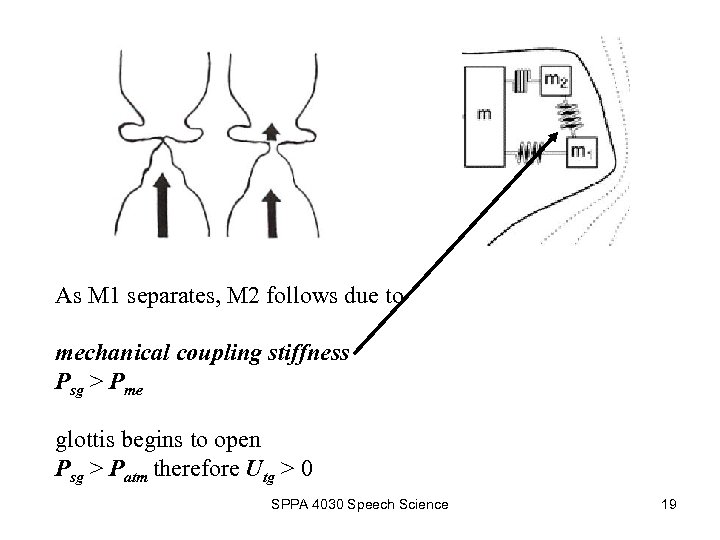 As M 1 separates, M 2 follows due to mechanical coupling stiffness Psg > Pme glottis begins to open Psg > Patm therefore Utg > 0 SPPA 4030 Speech Science 19
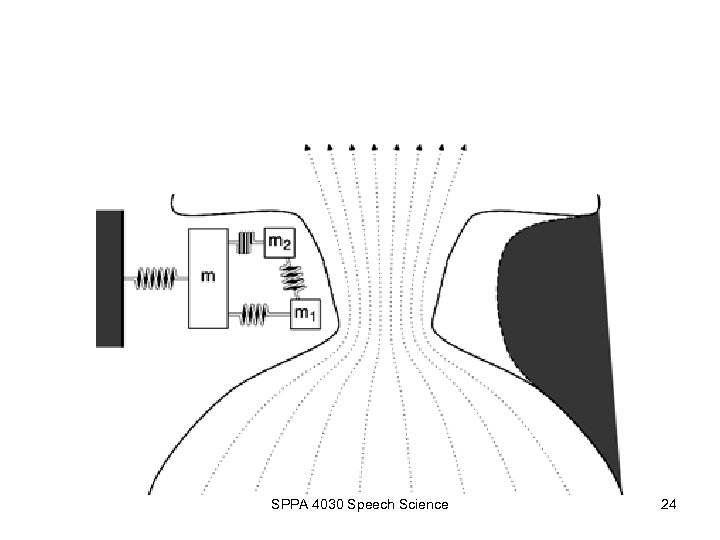
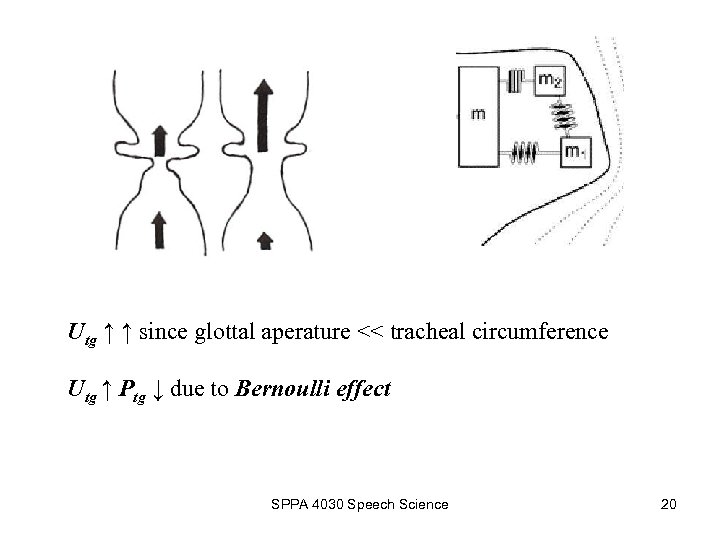 Utg ↑ ↑ since glottal aperature << tracheal circumference Utg ↑ Ptg ↓ due to Bernoulli effect SPPA 4030 Speech Science 20
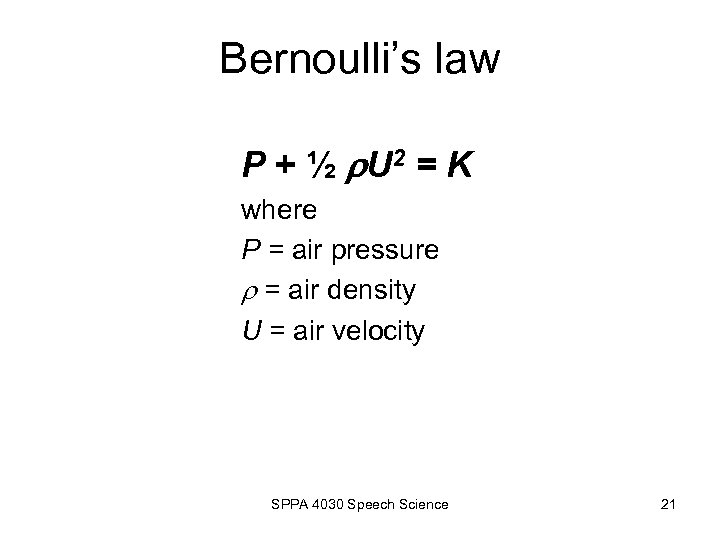 Bernoulli’s law P + ½ U 2 = K where P = air pressure = air density U = air velocity SPPA 4030 Speech Science 21
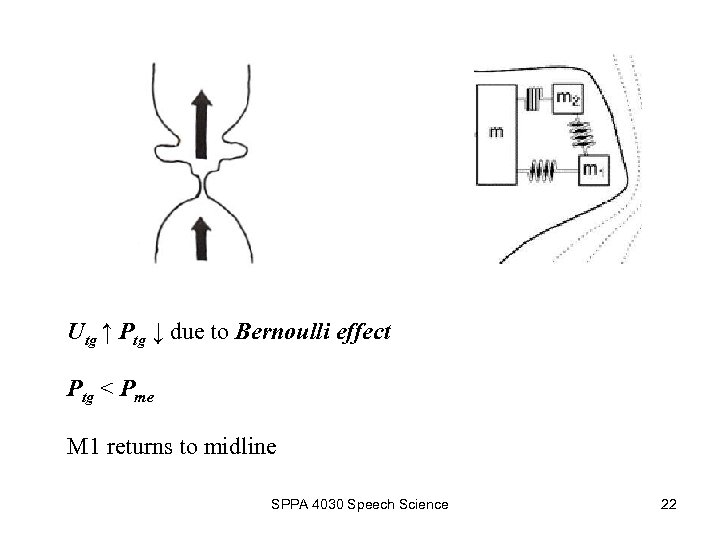 Utg ↑ Ptg ↓ due to Bernoulli effect Ptg < Pme M 1 returns to midline SPPA 4030 Speech Science 22
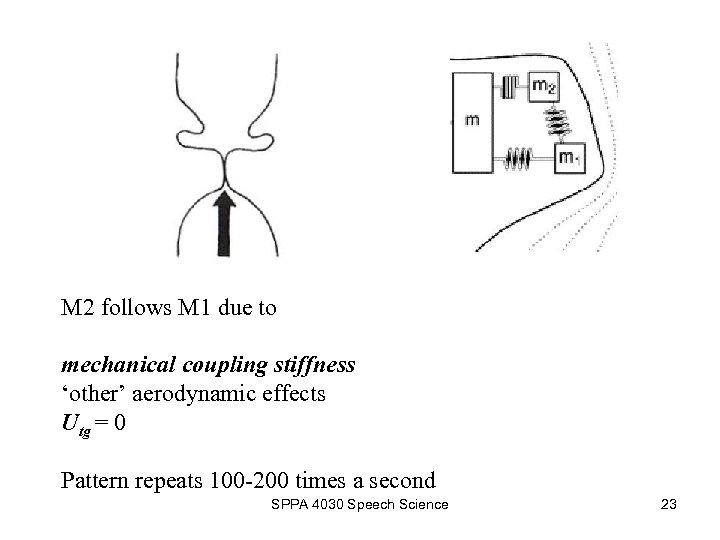 M 2 follows M 1 due to mechanical coupling stiffness ‘other’ aerodynamic effects Utg = 0 Pattern repeats 100 -200 times a second SPPA 4030 Speech Science 23
 SPPA 4030 Speech Science 24
 Limitations of this simple model • Actual VF movement is more complex • Vocal folds have length and vary in biomechanical properties along their length SPPA 4030 Speech Science 25
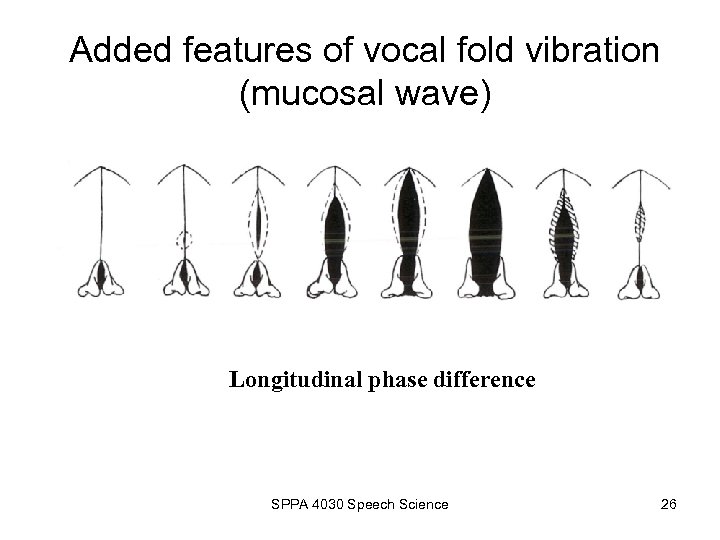 Added features of vocal fold vibration (mucosal wave) Longitudinal phase difference SPPA 4030 Speech Science 26
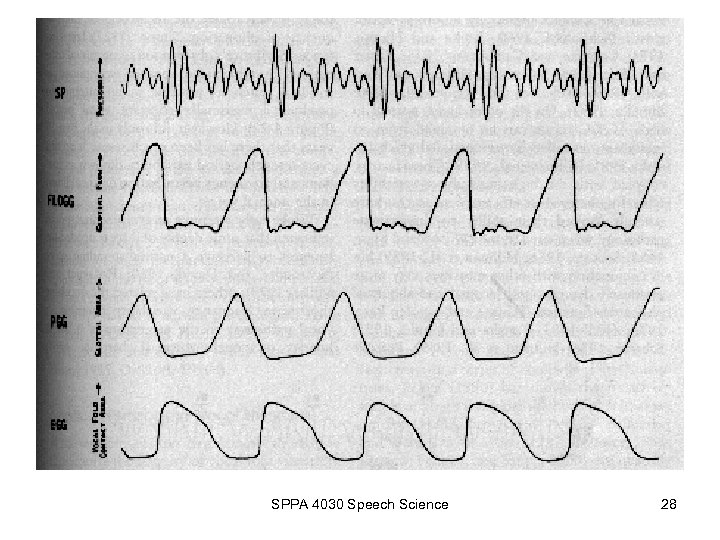
 Topic Sequence • Anatomy review • Achieving phonation • Capturing glottal and vocal fold behavior – Flow glottogram – Electroglottogram – Photoglottogram – Visualization: stroboscopy & high speed – Acoustic waveform analysis SPPA 4030 Speech Science 27
 SPPA 4030 Speech Science 28
 Topic Sequence • Anatomy review • Achieving phonation • Capturing glottal and vocal fold behavior – Photoglottogram – Visualization: stroboscopy & high speed – Flow glottogram – Electroglottogram – Acoustic waveform analysis SPPA 4030 Speech Science 29
 Estimating glottal area • Photoglottography (PGG) • Videolaryngoscopy – Stroboscopy – High speed video SPPA 4030 Speech Science 30
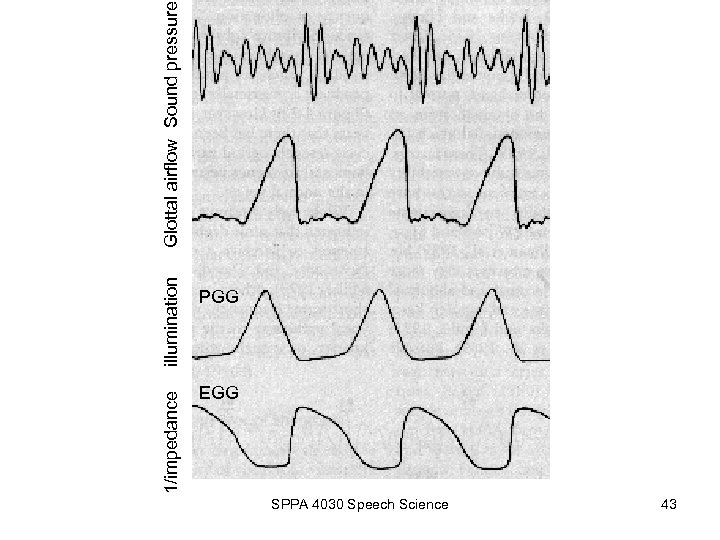
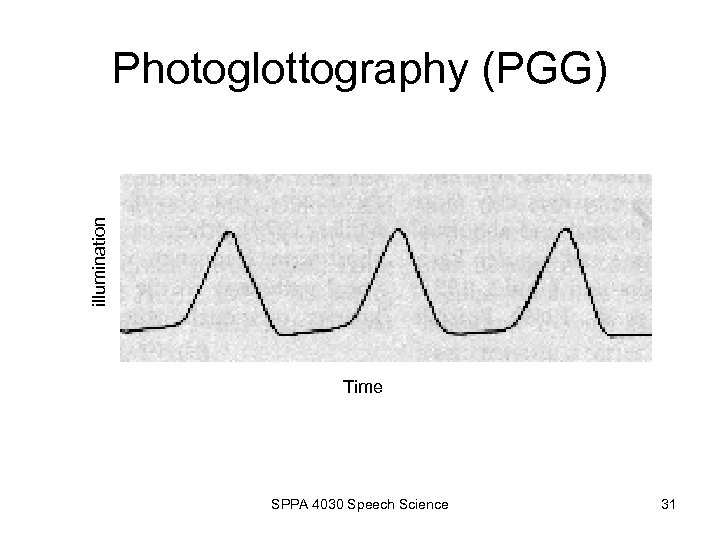 illumination Photoglottography (PGG) Time SPPA 4030 Speech Science 31
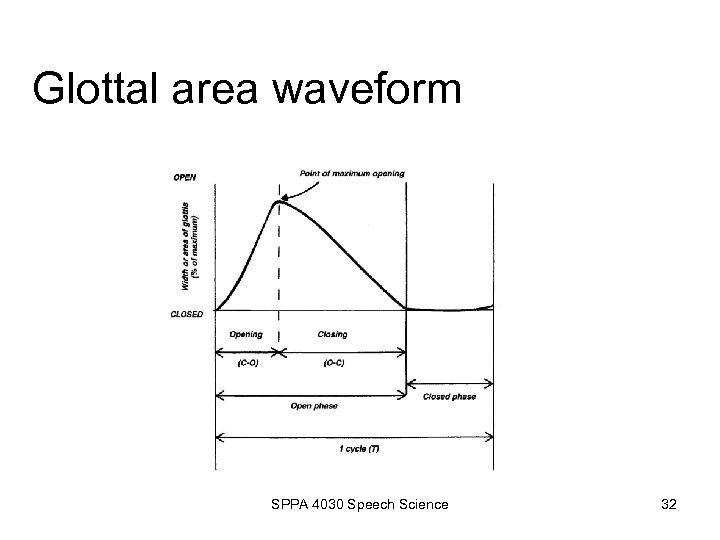 Glottal area waveform SPPA 4030 Speech Science 32
 Estimating degree of VF contact • Electroglottography (EGG) SPPA 4030 Speech Science 33
 Electroglottography (EGG) • Human tissue = conductor • Air: conductor • Electrodes placed on each side of thyroid lamina a high frequency, low current signal is passed between them • VF contact = impedance SPPA 4030 Speech Science 34
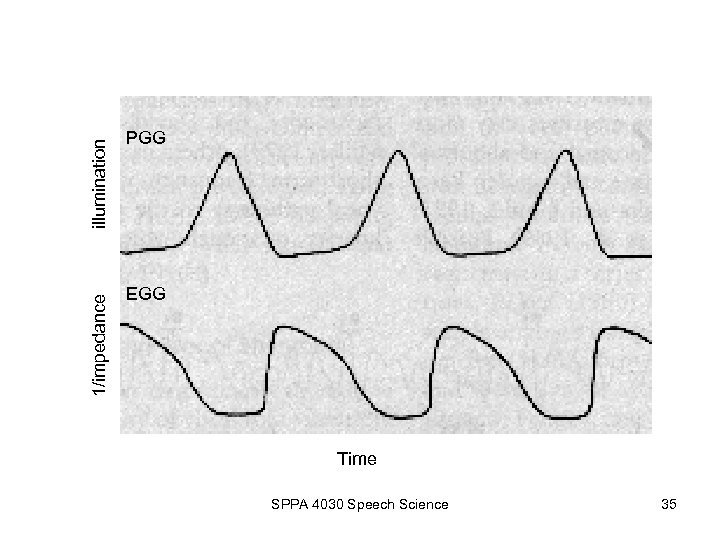 illumination 1/impedance PGG EGG Time SPPA 4030 Speech Science 35
 Estimating airflow (volume velocity) • Flow glottogram SPPA 4030 Speech Science 36
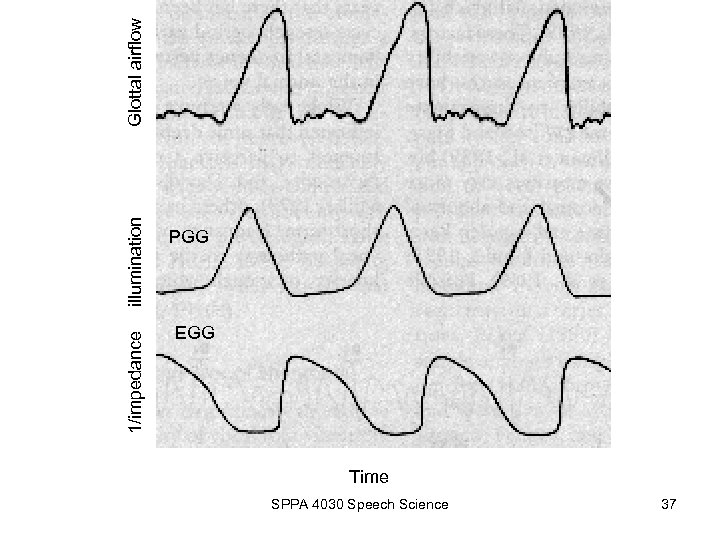 1/impedance illumination PGG EGG Time SPPA 4030 Speech Science 37 Glottal airflow
 Consequence of this vibration • Air disturbance is caused by the “slapping” together of the vocal folds • Sound energy is maximum at glottic closure • Given the complexity of the vibratory patterns of the vocal fold, the sound produced at the glottis is complex and periodic. SPPA 4030 Speech Science 38
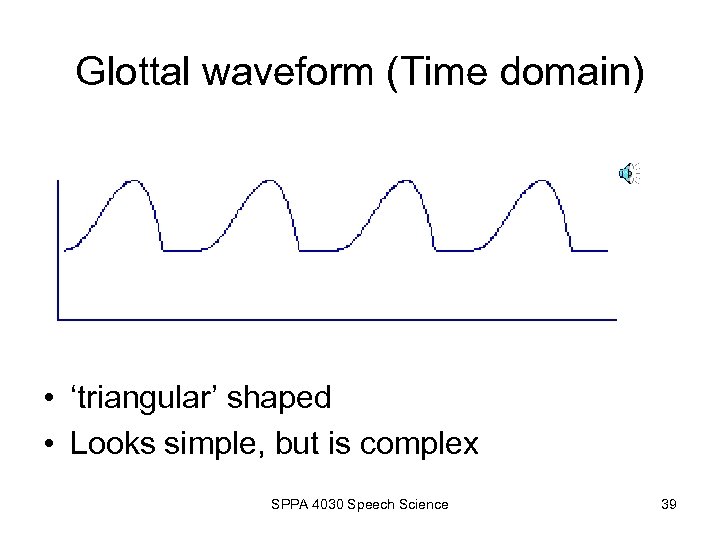 Glottal waveform (Time domain) • ‘triangular’ shaped • Looks simple, but is complex SPPA 4030 Speech Science 39
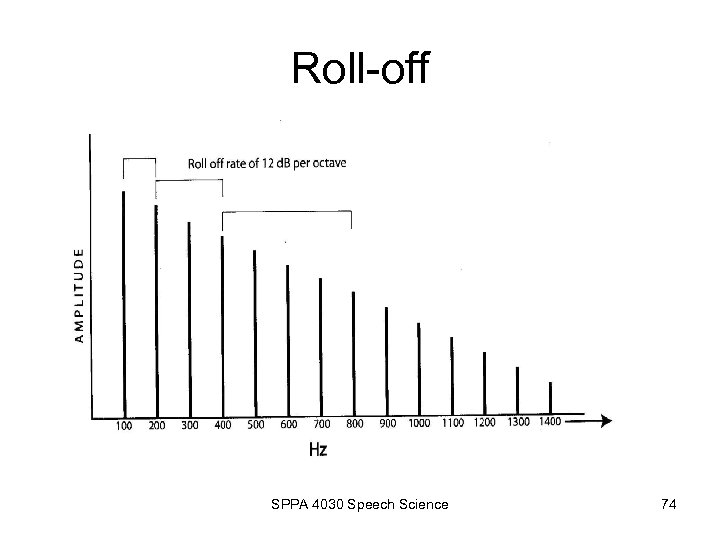
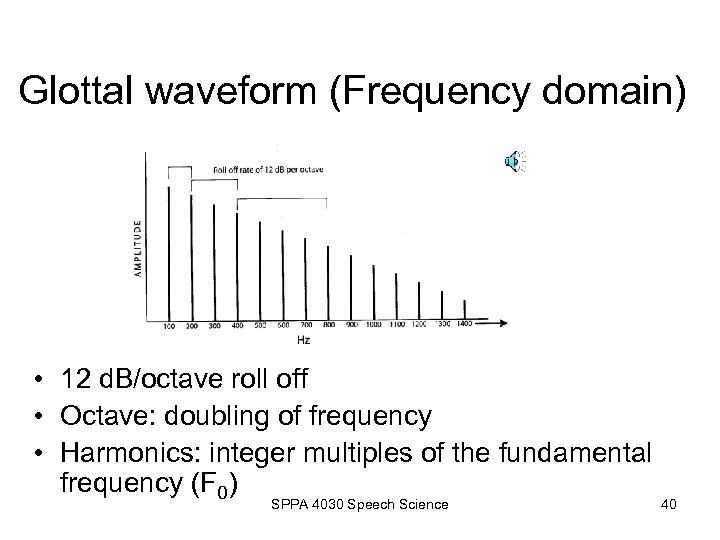 Glottal waveform (Frequency domain) • 12 d. B/octave roll off • Octave: doubling of frequency • Harmonics: integer multiples of the fundamental frequency (F 0) SPPA 4030 Speech Science 40
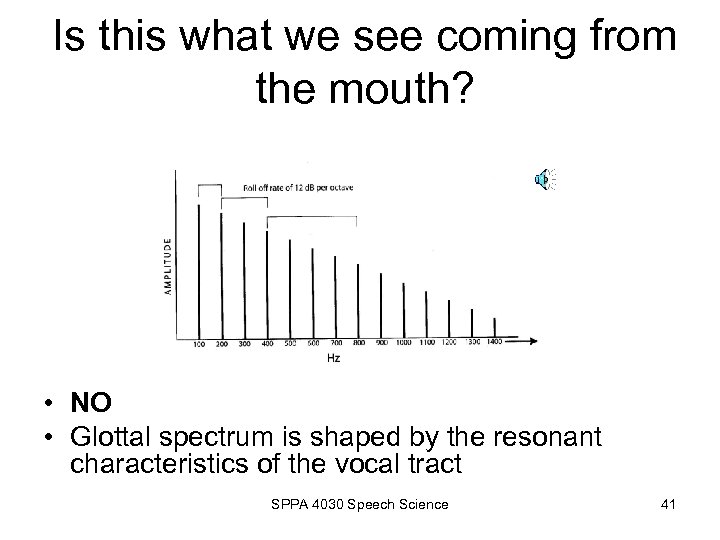 Is this what we see coming from the mouth? • NO • Glottal spectrum is shaped by the resonant characteristics of the vocal tract SPPA 4030 Speech Science 41
 Recall… • Air disturbance is caused by the “slapping” together of the vocal folds • Sound energy is maximum at glottic closure SPPA 4030 Speech Science 42
 1/impedance illumination PGG EGG SPPA 4030 Speech Science 43 Glottal airflow Sound pressure
 Pressures needed to initiate vibration • Phonation threshold pressure – Minimum pressure needed to set the vocal folds into vibration – 3 -6 cm water – ~3 for low Fo, 6 for higher Fo – Higher for louder speech SPPA 4030 Speech Science 44
 Topic Sequence • • Anatomy review Achieving phonation Capturing glottal and vocal fold behavior Phonatory control parameters – – – Fundamental frequency control Amplitude control Register control Phonatory quality control Phonation onset Articulatory control SPPA 4030 Speech Science 45
 Fundamental Frequency Control • Fundamental frequency (Fo) = reflects rate of vibratory cycle SPPA 4030 Speech Science 46
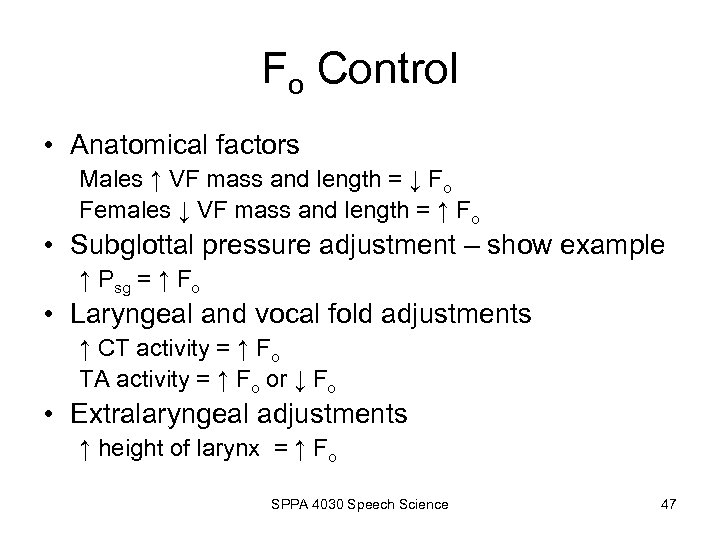 Fo Control • Anatomical factors Males ↑ VF mass and length = ↓ Fo Females ↓ VF mass and length = ↑ Fo • Subglottal pressure adjustment – show example ↑ Psg = ↑ Fo • Laryngeal and vocal fold adjustments ↑ CT activity = ↑ Fo TA activity = ↑ Fo or ↓ Fo • Extralaryngeal adjustments ↑ height of larynx = ↑ Fo SPPA 4030 Speech Science 47
 Fundamental Frequency Average F 0 • sustained vowels or spontaneous speech • For “connected” speech, it is called speaking fundamental frequency (SFF) • Typical or ‘normative’ values depend on gender and age SPPA 4030 Speech Science 48
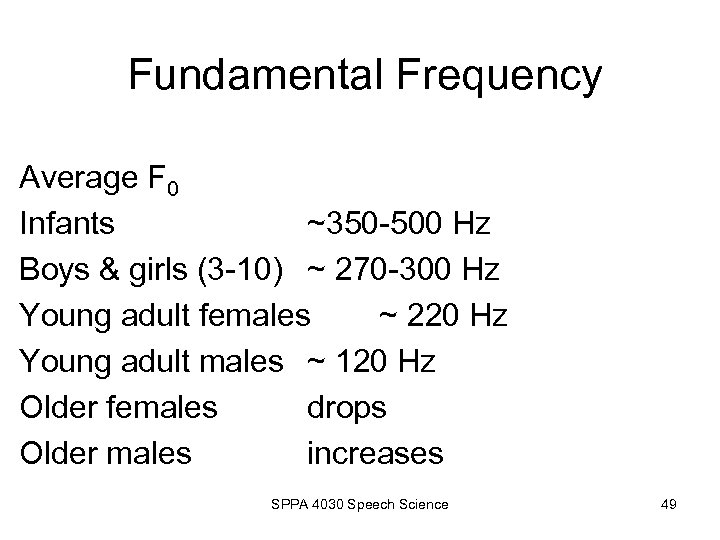 Fundamental Frequency Average F 0 Infants ~350 -500 Hz Boys & girls (3 -10) ~ 270 -300 Hz Young adult females ~ 220 Hz Young adult males ~ 120 Hz Older females drops Older males increases SPPA 4030 Speech Science 49
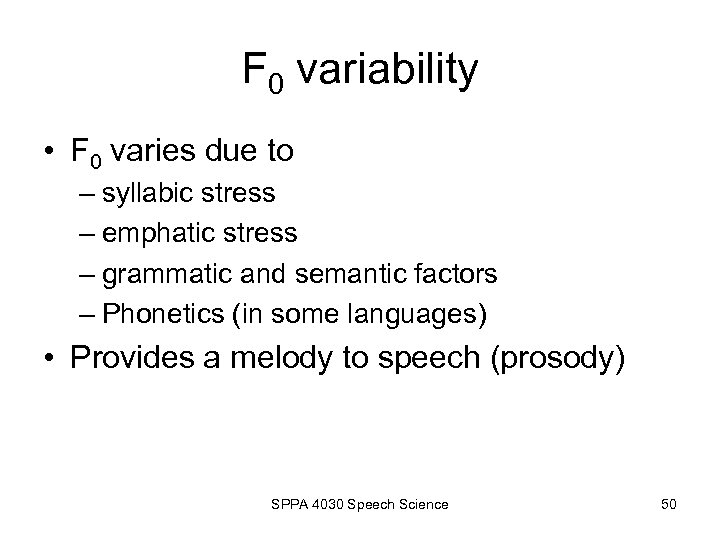 F 0 variability • F 0 varies due to – syllabic stress – emphatic stress – grammatic and semantic factors – Phonetics (in some languages) • Provides a melody to speech (prosody) SPPA 4030 Speech Science 50
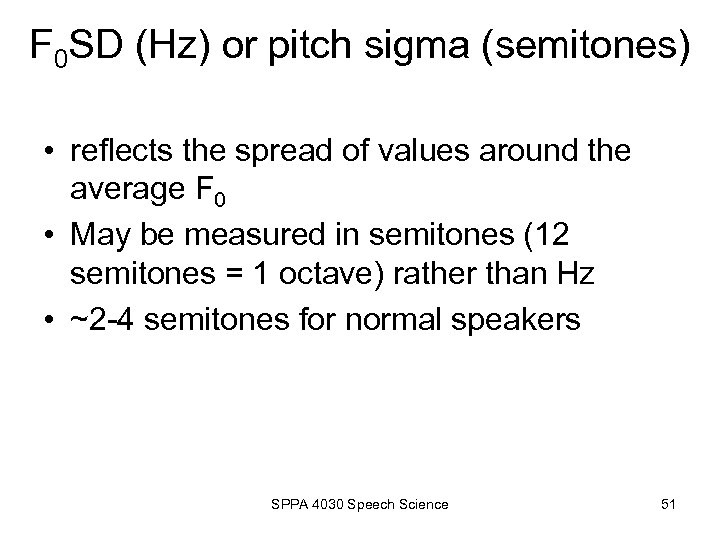 F 0 SD (Hz) or pitch sigma (semitones) • reflects the spread of values around the average F 0 • May be measured in semitones (12 semitones = 1 octave) rather than Hz • ~2 -4 semitones for normal speakers SPPA 4030 Speech Science 51
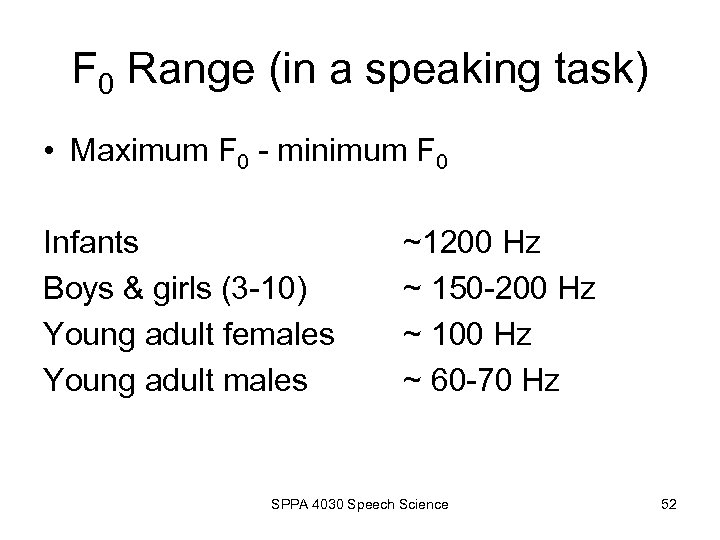 F 0 Range (in a speaking task) • Maximum F 0 - minimum F 0 Infants Boys & girls (3 -10) Young adult females Young adult males ~1200 Hz ~ 150 -200 Hz ~ 100 Hz ~ 60 -70 Hz SPPA 4030 Speech Science 52
 Maximum Phonational Frequency Range • • • Not measured during speech highest possible F 0 - lowest possible F 0 measured in Hz, semitones or octaves Males ~ 80 -700 Hz Females ~135 -1000 Hz 3 octaves often considered normal SPPA 4030 Speech Science 53
 Ways to measure fundamental frequency • Time domain vs. frequency domain • Manual vs. automated measurement SPPA 4030 Speech Science 54
 How do we measure Fo? • Computer-based acoustic analysis programs – e. g. tf 32!!, as well as many others • Electronic equipment specially designed to extract Fo and amplitude measure – e. g. Kay Elemetrics Visipitch SPPA 4030 Speech Science 55
 Topic Sequence • • Anatomy review Achieving phonation Capturing glottal and vocal fold behavior Phonatory control parameters – – – Fundamental frequency control Amplitude control Register control Phonatory quality control Phonation onset Articulatory control SPPA 4030 Speech Science 56
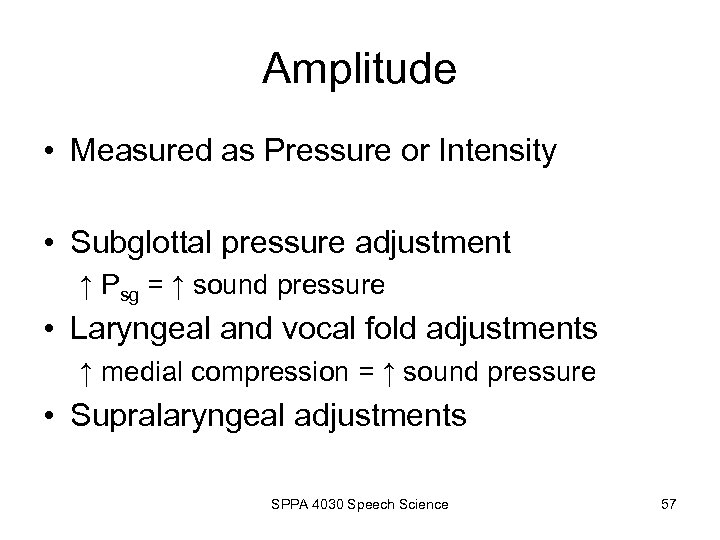 Amplitude • Measured as Pressure or Intensity • Subglottal pressure adjustment ↑ Psg = ↑ sound pressure • Laryngeal and vocal fold adjustments ↑ medial compression = ↑ sound pressure • Supralaryngeal adjustments SPPA 4030 Speech Science 57
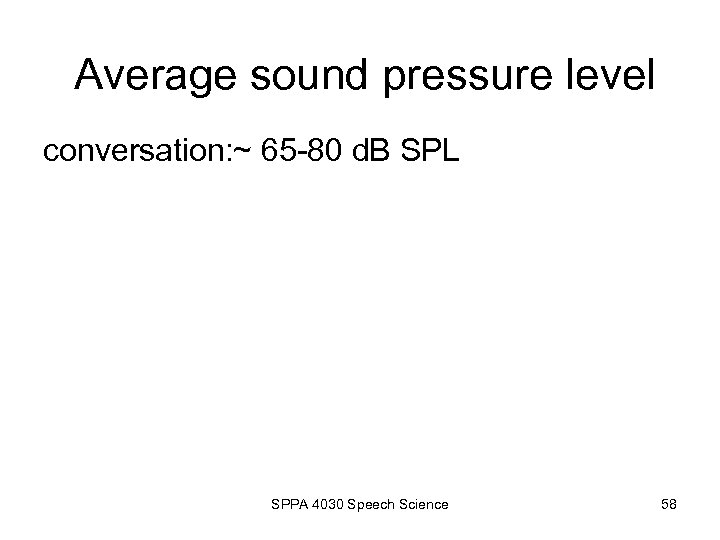 Average sound pressure level conversation: ~ 65 -80 d. B SPL SPPA 4030 Speech Science 58
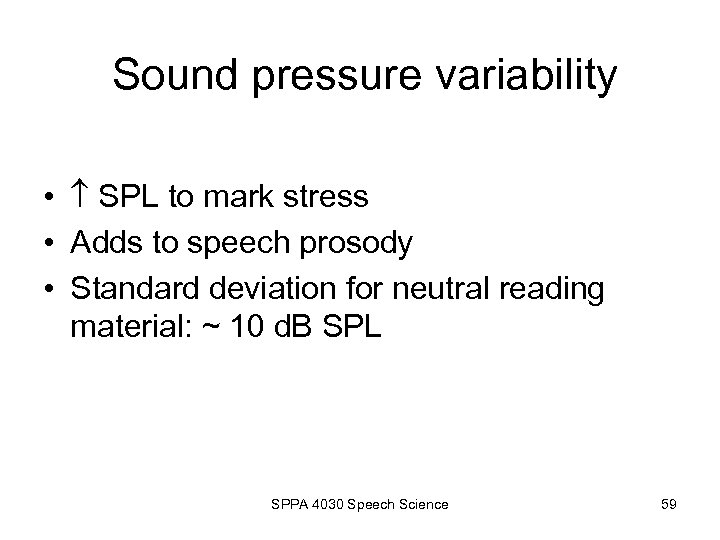 Sound pressure variability • SPL to mark stress • Adds to speech prosody • Standard deviation for neutral reading material: ~ 10 d. B SPL SPPA 4030 Speech Science 59
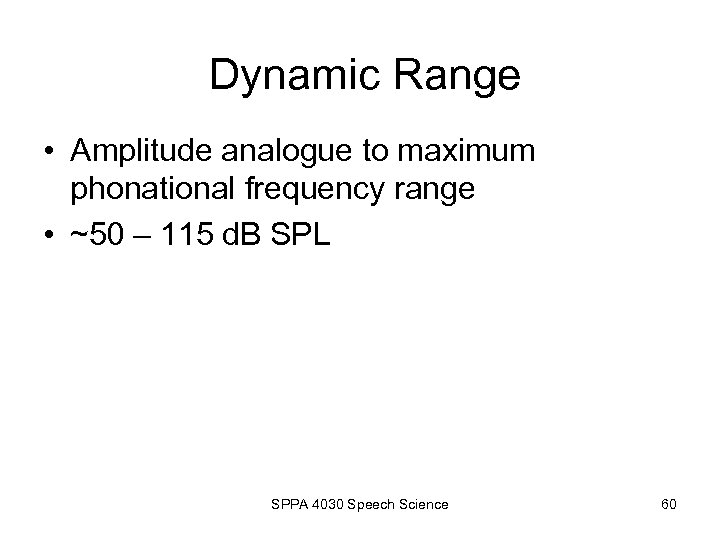 Dynamic Range • Amplitude analogue to maximum phonational frequency range • ~50 – 115 d. B SPL SPPA 4030 Speech Science 60
 How do we measure amplitude? • Computer-based acoustic analysis programs – e. g. tf 32!!, as well as many others • Electronic equipment specially designed to extract Fo and amplitude measure – e. g. Kay Elemetrics Visipitch • Sound level meter (amplitude only) • Old-fashioned equipment like an oscilloscope SPPA 4030 Speech Science 61
 Combining F 0 & Amplitude Voice Range Profile • Plots dynamic range as a function of phonation range SPPA 4030 Speech Science 62
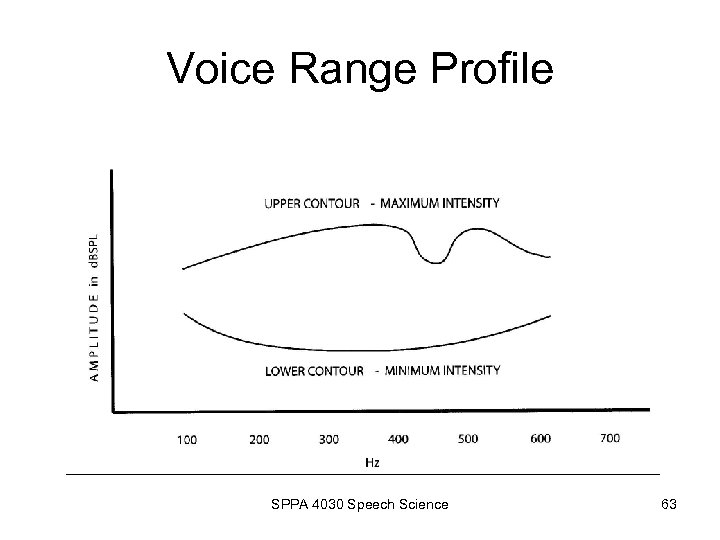 Voice Range Profile SPPA 4030 Speech Science 63
 Topic Sequence • • Anatomy review Achieving phonation Capturing glottal and vocal fold behavior Phonatory control parameters – – – Fundamental frequency control Amplitude control Register control Phonatory quality control Phonation onset Articulatory control SPPA 4030 Speech Science 64
 Vocal Register • Refers to a distinct mode of vibration According to Hollien… • Range of consecutive Fos produced with a distinct voice quality • Fo range should have minimal overlap with other registers SPPA 4030 Speech Science 65
 Vocal Register • Pulse register (a. k. a. vocal fry, glottal fry, creaky voice) • Modal register (a. k. a. chest register) • Falsetto register (a. k. a. loft register) SPPA 4030 Speech Science 66
 Vocal Registers Pulse (Glottal fry) – – – 30 -80 Hz, mean ~ 60 Hz Closed phase very long (90 % cycle) May see biphasic pattern of vibration (open, close a bit, open and close completely) Low subglottal pressure (2 cm water) Energy dies out over the course of a cycle so parts of the cycle has very little energy Hear each individual cycle SPPA 4030 Speech Science 67
 Vocal Registers Modal – – – VF are relatively short and thick Reduced VF stiffness Large amplitude of vibration Possesses a clear closed phase The result is a voice that is relatively loud and low in pitch Average values cited refer to modal register SPPA 4030 Speech Science 68
 Vocal Registers Falsetto – – – – 500 -1100 Hz (275 -600 Hz males) VF are relatively long and thin Increased VF stiffness Small amplitude of vibration Vibration less complex Incomplete closure (no closed phase) The result is a voice that is high in pitch SPPA 4030 Speech Science 69
 Topic Sequence • • Anatomy review Achieving phonation Capturing glottal and vocal fold behavior Phonatory control parameters – – – Fundamental frequency control Amplitude control Register control Phonatory quality control Phonation onset Articulatory control SPPA 4030 Speech Science 70
 Vocal Quality • Doesn’t have clear acoustic correlates like pitch and loudness • some acoustic measures that have potential to be helpful in characterizing voice qualities SPPA 4030 Speech Science 71
 Voice Quality Common Terms • Breathiness • Tense • Roughness • Strain • Hoarseness SPPA 4030 Speech Science 72
 Voice Quality Auditory Perceptual Descriptors • Breathiness – Audible air escape in the voice – Diminished or absent closed phase – Correlated with • high frequency noise • sharper harmonic roll-off • lower signal-to-noise ratio (SNR) SPPA 4030 Speech Science 73
 Roll-off SPPA 4030 Speech Science 74
 Signal (harmonic)-to-noise-ratio (SNR or HNR) • Glottal spectrum is not strictly periodic • Periodic component – Periodic cycling of vocal folds • Noise component – Aperiodicity in cycling – Air “leakage” (Additive noise) SPPA 4030 Speech Science 75
 Signal (harmonic)-to-noise-ratio (SNR or HNR) • ratio of signal amplitude to noise amplitude • SNR – Relatively more signal – Indicative of a normality • SNR – Relatively more noise – Indicative of disorder • Normative values depend on method of calculation • “normal” SNR ~ 15 SPPA 4030 Speech Science 76
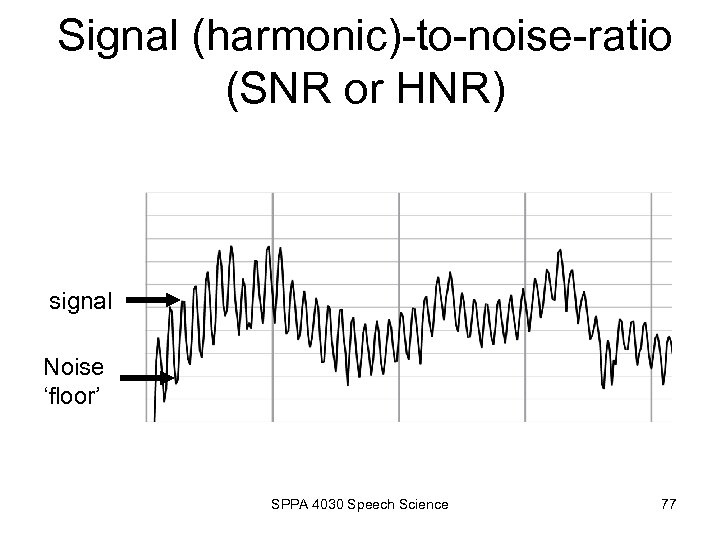 Signal (harmonic)-to-noise-ratio (SNR or HNR) signal Noise ‘floor’ SPPA 4030 Speech Science 77
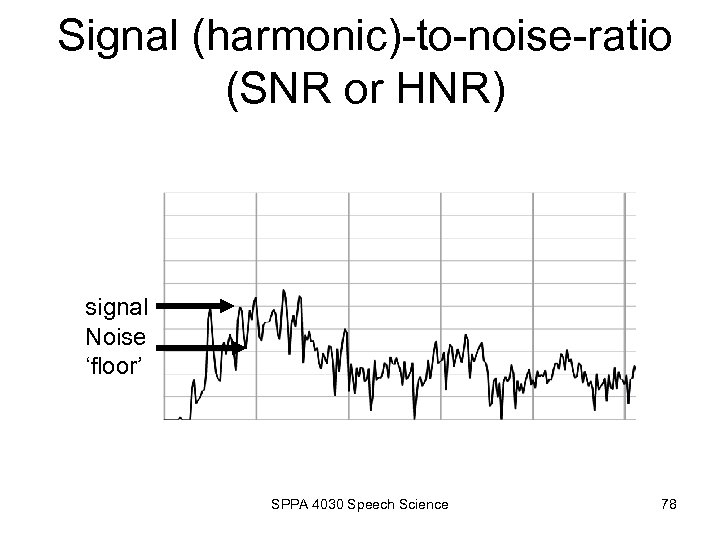 Signal (harmonic)-to-noise-ratio (SNR or HNR) signal Noise ‘floor’ SPPA 4030 Speech Science 78
 Voice Quality Auditory Perceptual Descriptors • Tense or Pressed – Perceptually contrasted with breathiness – Correlated • longer closed phase • Less harmonic roll off SPPA 4030 Speech Science 79
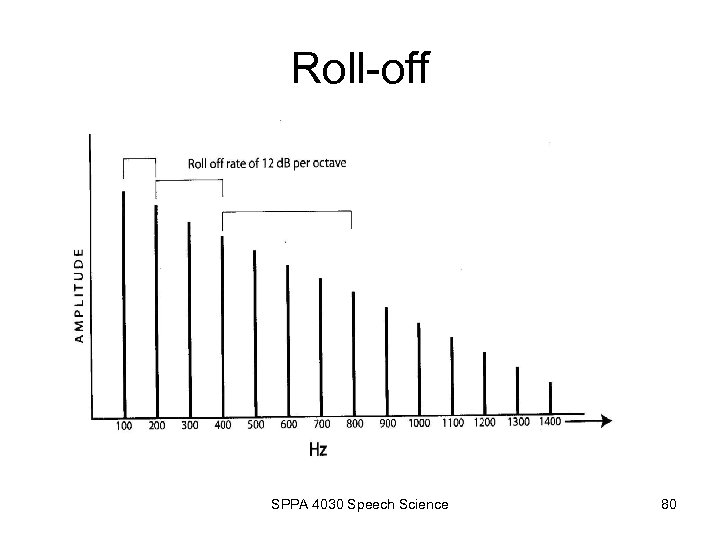 Roll-off SPPA 4030 Speech Science 80
 Voice Quality Auditory Perceptual Descriptors • Roughness – Perceived cycle-to-cycle variability in voice – Correlated with jitter (frequency perturbation) SPPA 4030 Speech Science 81
 Cycle to cycle variability in vibration • Vocal fold vibration not strictly periodic • ↓ frequency and amplitude fluctuations are normal • When variability is excessive, it sounds abnormal SPPA 4030 Speech Science 82
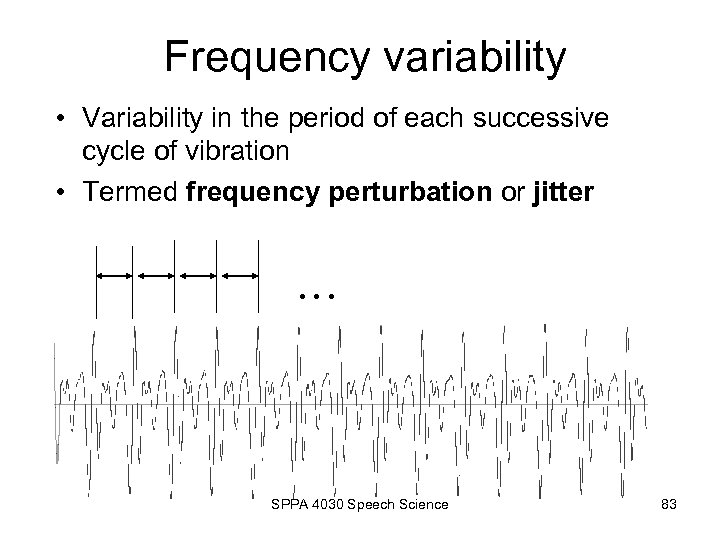 Frequency variability • Variability in the period of each successive cycle of vibration • Termed frequency perturbation or jitter … SPPA 4030 Speech Science 83
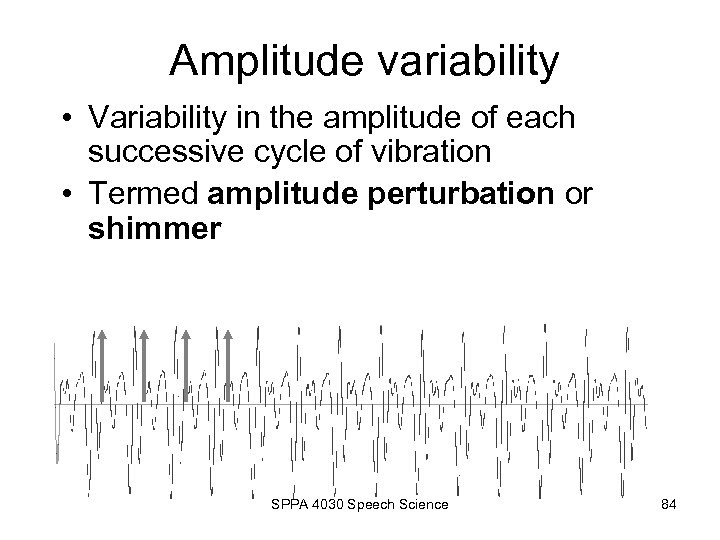 Amplitude variability • Variability in the amplitude of each successive cycle of vibration • Termed amplitude perturbation or shimmer SPPA 4030 Speech Science 84
 Sources of jitter and shimmer • Small structural asymmetries of the L and R vocal fold • “material” on the vocal folds (e. g. mucus) • Biomechanical events, such as raising/lowering the larynx in the neck • Small variations in tracheal pressures • “Bodily” events – system noise SPPA 4030 Speech Science 85
 Measuring jitter and shimmer • No standard measurement approach • Variability in how measures are is reported Jitter: typically reported as %, but can be msec • Normal ~ 0. 2 - 1% Shimmer: can be % or d. B • Normal ~ 0. 5 d. B SPPA 4030 Speech Science 86
 Jitter demo SPPA 4030 Speech Science 87
 Topic Sequence • • Anatomy review Achieving phonation Capturing glottal and vocal fold behavior Phonatory control parameters – – – Fundamental frequency control Amplitude control Register control Phonatory quality control Phonation onset Articulatory control SPPA 4030 Speech Science 88
 Phonatory onset • Timing of respiratory and phonatory activities – Simultaneous vocal attack – Hard glottal attack – Breathy attack SPPA 4030 Speech Science 89
 Topic Sequence • • Anatomy review Achieving phonation Capturing glottal and vocal fold behavior Phonatory control parameters – – – Fundamental frequency control Amplitude control Register control Phonatory quality control Phonation onset Articulatory control SPPA 4030 Speech Science 90
 One other important role of phonation • ITS ABSENCE • Many sounds are voiceless • Laryngeal devoicing gesture – Rapid abduction of vocal folds SPPA 4030 Speech Science 91
 Clinical Considerations • Abnormal voice: dysphonia • Factors underlying dysphonia – Disease to laryngeal tissue – Neurologic and neuromuscular disease – How the voice is used – Muscle tension – Psychological factors SPPA 4030 Speech Science 92
 Clinical Considerations • Can we phonate without our larynx? SPPA 4030 Speech Science 93