


 Скачать презентацию PHIL 1003 2008 -09 Communitarian philosophers
2bf04579bc7e1f0aa506fd391fe35b0c.ppt
- Количество слайдов: 31
 PHIL 1003 2008 -09

 Communitarian philosophers • Aristotle: – Polis regulates entire life of citizen, including entertainment; – For good of the whole. • Rousseau: – Rough equality is prerequisite to freedom; – Sovereign has right to demand anything required by “public utility, ” but nothing more (SC, II. 4. 4). • Marx: – Labour deserves just compensation; – Classes and inequality should disappear; – Bourgeois/capitalist property should become community property.
 Libertarian philosophers • Locke: – Gov’t guarantees private domain of life, liberty, and property; – labour confers title to property, but you may use another’s labour; – Infinite accumulation and inequality are acceptable, even morally good! • Mill: – only justification for “interfering with the liberty of action of any[one]…is self-protection” (9).
 Overview of M& E Marx and Engels • Are anti-libertarian; • Use labour theory of value; • Create a new communitarianism; – proletarian society – not a state: politics should disappear after the proletariat establishes its rule.
 Question • Marx talks about class struggle, in particular the tension between the proletariat (working class) and the bourgeoisie (capitalists). • Even though communism has failed, is Marx's take on class struggles still relevant in today's time? • What are the class struggles we see in our time (e. g. the widening income gap between the rich and the poor)?
 An Answer • Marx argued that the bourgeoisie always tried to rule over the proletariat, religion and moral sense are "created by man to control man" through socialization and upbringing. • Therefore, "Communism abolishes eternal truths; it abolishes all religion, and all morality". How far do you agree with this view?
 Who were Karl Marx and Friedrich Engels? Marx • B. 1818 • German, secular Jew • Thesis on ancient materialists, Democritus and Epicurus • Journalist • Studied England’s industrialization in detail • Many works: Kapital • Active in workers’ movement • d. 1883 Engels • German, b. 1820 • Son of an industrialist • Family owned factories in Manchester, England • Condition of the Working Class in England (1844) • Collaborated with Marx as writer and activist • Worked in family firm in Manchester • d. 1895.
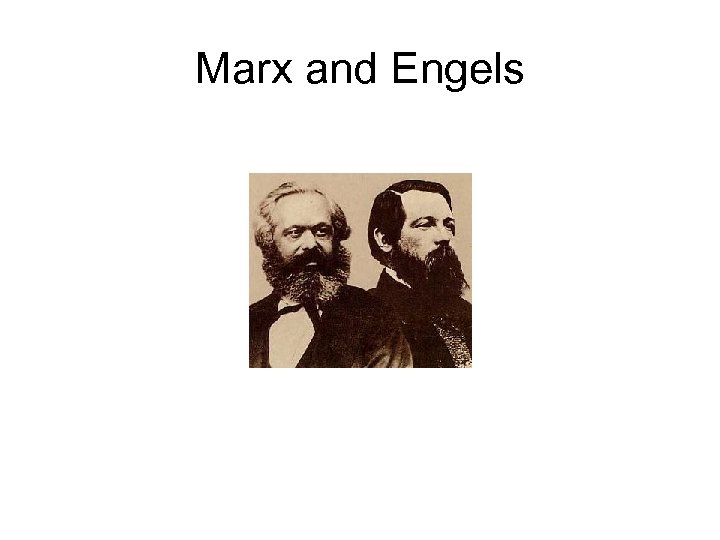 Marx and Engels
 How to read Marx and Engels’ work today? Without anachronistic assumptions. Their critique of capitalism may be valid even if communism has failed.
 • M & E materialize Hegelian idealism • Hegel: spirit = self-creative energy realizing itself in history through culture: – “self-conscious being by the process of knowing” (Tucker, p. xxi); – repeated overcoming of alienation of spirit from itself; – Spirit finally finds itself at peace, having achieved selfknowledge, whole of creation is spirit! • They use “transformational criticism” to invert Hegel: – Man is not self-alienated spirit (God); rather, God is selfalienated man (i. e. imaginary); – Man must reclaim his earthly reality!
 The Economy Capitalism NOT new: • existed in late Middle Ages: banks, trading companies, stock exchanges. Key development: Industrialization – since late 18 th cent. (also CO 2 build-up); – Marriage of capitalism with industrialization creates new mode of production: • unique in world history.
 Formation of the Proletariat (479 -80) • Alienated labour/de-skilling: – machine – division of labour – work “loses all charm” – wages decrease. • Monotonous, homogenized work: – female and child labour is used.
 Worker = Slave • Slave – of factory owner, bourgeois state and “other portions of the bourgeoisie”; – Proletariat increases, taking in other lower strata (e. g. former agricultural workers); – Conditions equalized; – Livelihood uncertain: • recurrent crises of over-production; • does current economic crisis fit Marx’s model?
 Engels’ analysis of industrialization • “The evolution of the modern system of manufacture has reached its climax in Manchester. It was in the South Lancashire cotton industry that water and steam power first replaced hand machines. It was here that such machines as the power-loom and the self-acting mule replaced the old hand-loom and spinning wheel. It is here that the division of labor has been pushed to its furthest limits. These three factors are the essence of modern industry. In all three of them the cotton industry was the pioneer and remains ahead in all branches of industry” (CWC, ch. 3).
 Engels’ description of class war • “Everywhere one finds on the one hand the most barbarous indifference and selfish egotism and on the other the most distressing scenes of misery and poverty. • Signs of social conflict are to be found everywhere. Everyone turns his house into a fortress to defend himself--under the protection of the law--from the depredations of his neighbors. • Class warfare is so open and shameless that it has to be seen to be believed. The observer of such an appalling state of affairs must shudder at the consequences of such feverish activity and can only marvel that so crazy a social and economic structure should survive at all” (CWC, ch. 3).
 Labour Theory of Value: Marx as Locke’s disciple • Locke: labour input confers property title – this can be labour of your employee. • Marx disagrees: – labour must be your own for it to confer ownership. • Labour of workers usurped by owners – Hence their rightful property is usurped; – By right, it should be returned to them.
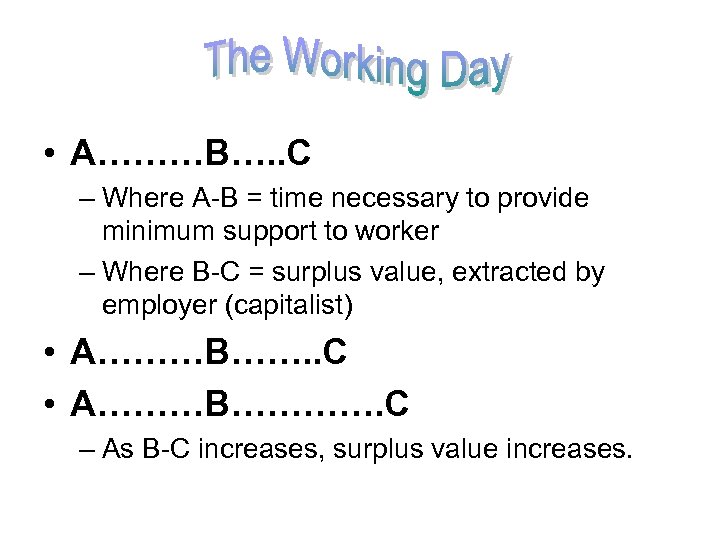 • A………B…. . C – Where A-B = time necessary to provide minimum support to worker – Where B-C = surplus value, extracted by employer (capitalist) • A………B……. . C • A………B…………. C – As B-C increases, surplus value increases.
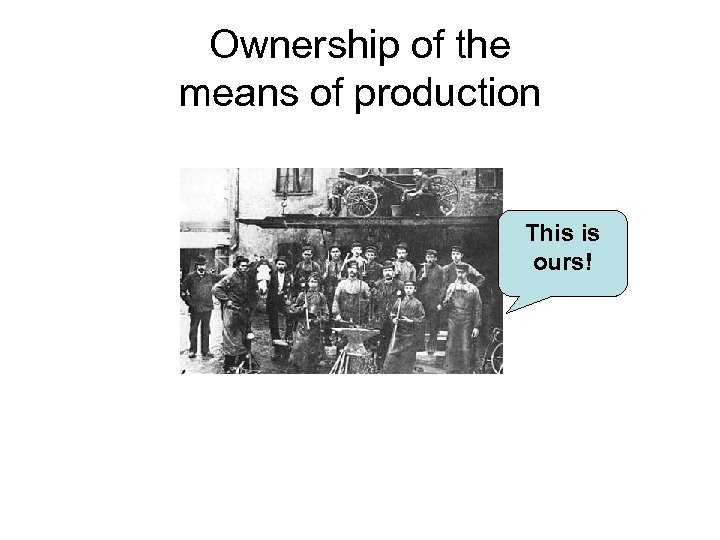 Ownership of the means of production This is ours!
 Human nature • Like Rousseau, M & E believe HN can be changed – Rousseau: social pact and legislator (II. 7) effect this change • Locke: – are we more industrious where there is property ? • M & E: we are what our conditions make us: – “…man’s consciousness, changes with every change in the conditions of his material existence” (489).
 The bourgeoisie is admirable • “The bourgeoisie, during its rule of scarce one hundred years, has created more massive and more colossal productive forces than have all preceding generations together. ” • “Subjection of Nature’s forces to man, machinery, application of chemistry to industry and agriculture, stream-navigation, railways, electric telegraphs…what earlier century had even a presentiment that such productive forces slumbered in the lap of social labour? ” (477).
 The sorcerer’s apprentice (478) • • • New industries/modes of production; New towns, entirely new populations; Subjection of East to West; World literature (477); Creation of proletariat; Family, nation undermined.
![• Cash nexus (475) • Freedom of commerce: – “…cheap prices…[batter] down all](https://present5.com/presentation/2bf04579bc7e1f0aa506fd391fe35b0c/image-27.jpg "• Cash nexus (475) • Freedom of commerce: – “…cheap prices…[batter] down all") • Cash nexus (475) • Freedom of commerce: – “…cheap prices…[batter] down all Chinese walls” – “compels…all nations…to adopt the bourgeois mode of production” (477). • Discovery of America; world market (475) – Mc. Donald’s, Benetton, Starbuck’s, Levi’s jeans. • Uniformity: – Mode of production: Nike, Adidas – Conditions of life: TV, electricity, b’fast cereal.
• Cash nexus (475) • Freedom of commerce: – “…cheap prices…[batter] down all Chinese walls” – “compels…all nations…to adopt the bourgeois mode of production” (477). • Discovery of America; world market (475) – Mc. Donald’s, Benetton, Starbuck’s, Levi’s jeans. • Uniformity: – Mode of production: Nike, Adidas – Conditions of life: TV, electricity, b’fast cereal.
 Key Economic Arguments • Recurrent world crises of over-production (478): – Products and productive forces destroyed; – Too much of everything. • Capital’s answer? – Labourer sinks lower and lower—a slave w/out adequate subsistence! (483) – Expanison requires conquest of new markets. • Seeds of bourgeoisie’s destruction therefore found within capitalist mode of production.
 Charges against Communism • Abolition of family: – Through public education; ending child labour. • Community of women: – has always existed; – bourgeois uses women of all classes (prostitution); – bourgeois marriage = sham. • Abolition of property: – 9/10 have none anyway. • Universal laziness will follow – what is the argument? (Hint: Locke, ch. 5) • Unpatriotic: – workers have no country: globalization abolishes national differences!
![Demands of the proletariat • Abolition of [private] property in land; rents go to](https://present5.com/presentation/2bf04579bc7e1f0aa506fd391fe35b0c/image-30.jpg "Demands of the proletariat • Abolition of [private] property in land; rents go to") Demands of the proletariat • Abolition of [private] property in land; rents go to public purposes (yes, public lands); • Heavy, progressive income tax (yes, in many states; but in HK? ) • Abolition of right of inheritance (yes, partially: death duties in many states) • Free education (yes) • Centralization of credit (central banks in some states, e. g. U. S. Federal Reserve, and EU) • Centralization of transport, communication (yes, in some states).
Demands of the proletariat • Abolition of [private] property in land; rents go to public purposes (yes, public lands); • Heavy, progressive income tax (yes, in many states; but in HK? ) • Abolition of right of inheritance (yes, partially: death duties in many states) • Free education (yes) • Centralization of credit (central banks in some states, e. g. U. S. Federal Reserve, and EU) • Centralization of transport, communication (yes, in some states).
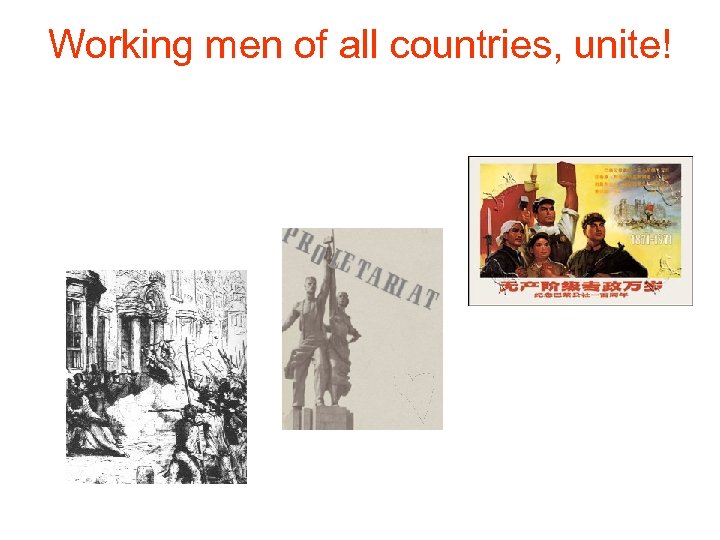 Working men of all countries, unite!