 Скачать презентацию Phi 4 13 The Largemouth Yellowfish Labeobarbus kimberleyensis
0d36cd740b3c9c305e41888c369412f1.ppt
- Количество слайдов: 17



Phi 4: 13 The Largemouth Yellowfish (Labeobarbus kimberleyensis) Largemouth Yellowfish Festiville Elgro Lodge 10 -05 -2007 By Gordon O’Brien
Phi 4: 13 • The Largemouth Yellowfish Introduction • What is a Largemouth Yellowfish? • How do they relate to other Yellowfish? • Where do they occur? • What habitats do they prefer vs. Habitats that they need? • What do they eat? • Where and how do they breed? • What do we use these fishes for? • How much do we know about these fishes? • Current research endeavours? • How can you help?
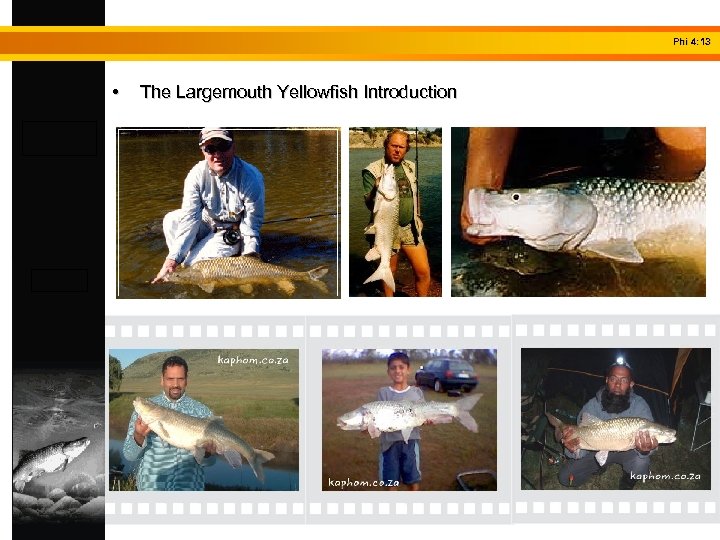
Phi 4: 13 • The Largemouth Yellowfish Introduction
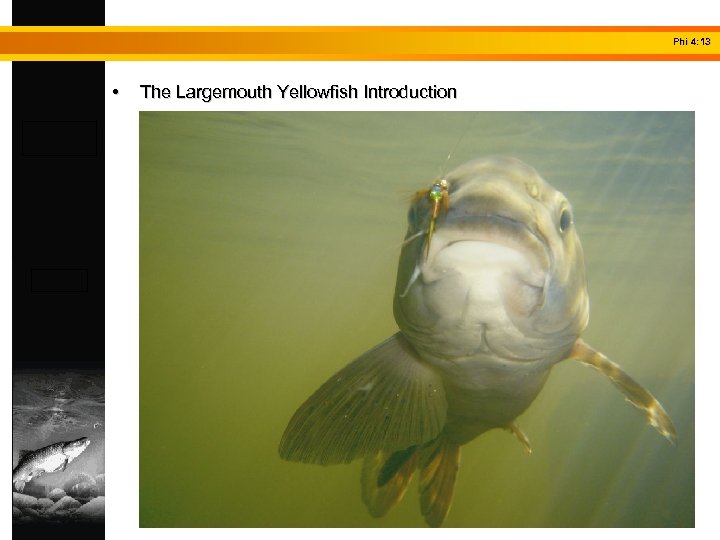
Phi 4: 13 • The Largemouth Yellowfish Introduction
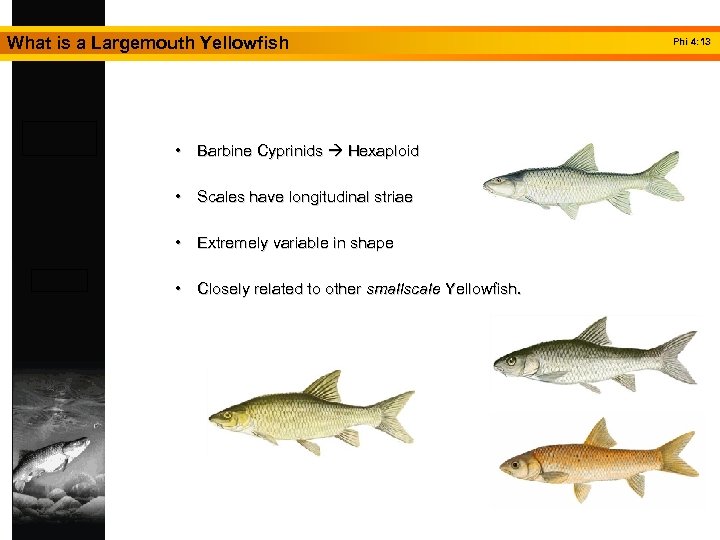
What is a Largemouth Yellowfish • Barbine Cyprinids Hexaploid • Scales have longitudinal striae • Extremely variable in shape • Closely related to other smallscale Yellowfish. Phi 4: 13
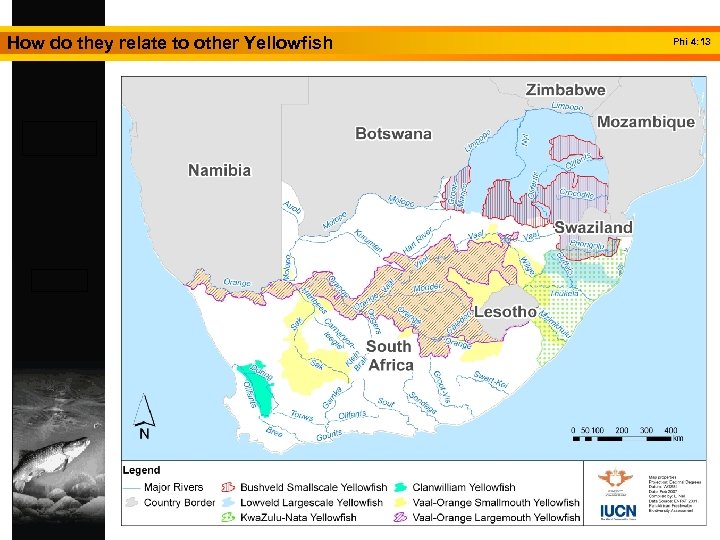
How do they relate to other Yellowfish Phi 4: 13
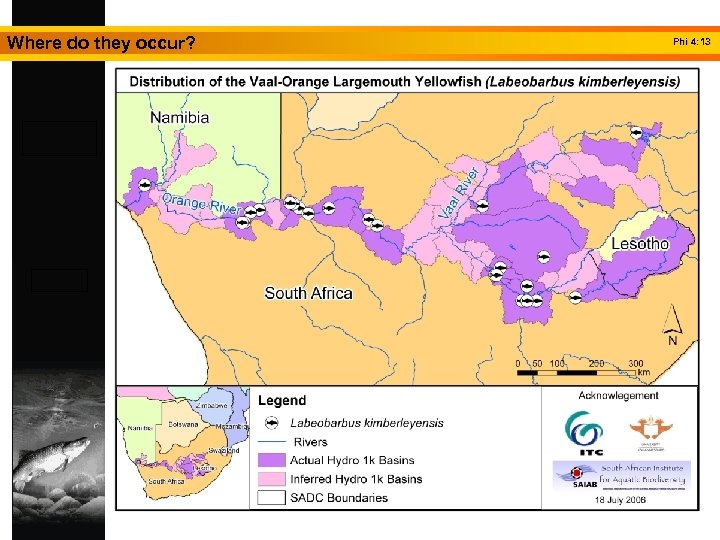
Where do they occur? Phi 4: 13
What habitats do they prefer vs. habitats they need. • Based on the life cycle: • Phi 4: 13 Juvenile stage: larva vs. fry • • Pools, backwater area’s etc dominating marginal vegetation. • • Fry – poor swimmers move out of current into sheltered waters away from predators. No indication of any shoaling tendencies. Adolescence: • • • Become superb swimmers – food requirements migrate. After a few months fingerlings begin to move into diverse habitats, adolescence considered to be opportunistic differ from Small mouth. Mature adult stage • Advanced predatory phase – habitat use may be driven by breeding requirements. • Bulking up phase – actively feed during warmer conditions in diverse habitats (temperatures relatively high) – Rapids to deep pools. • Winter maintenance phase – move into more stable deeper water. • Spawn in flowing water – possibly deep riffle/rapids. • Eggs have ability to ahead (weakly) to substrates double cell wall.
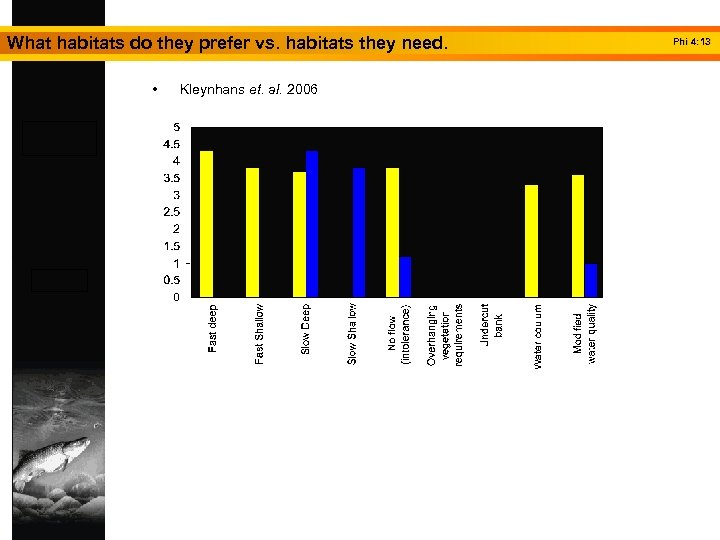
What habitats do they prefer vs. habitats they need. • Kleynhans et. al. 2006 Phi 4: 13
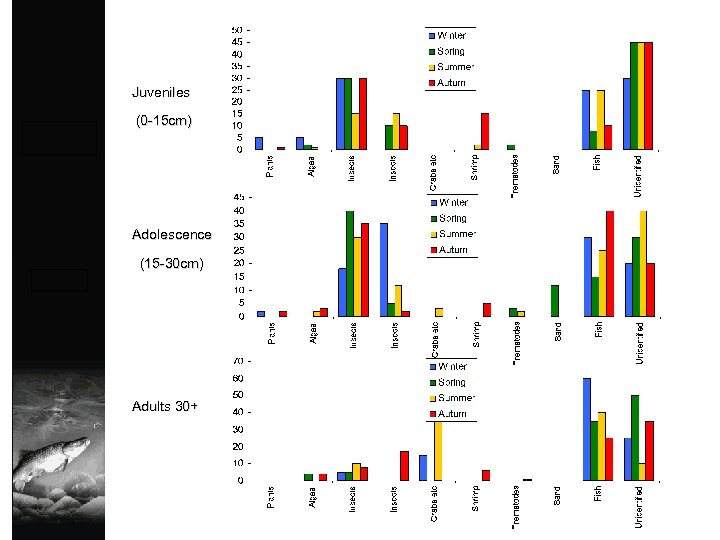
Juveniles (0 -15 cm) Adolescence (15 -30 cm) Adults 30+
2 4 6 8 10 12 14
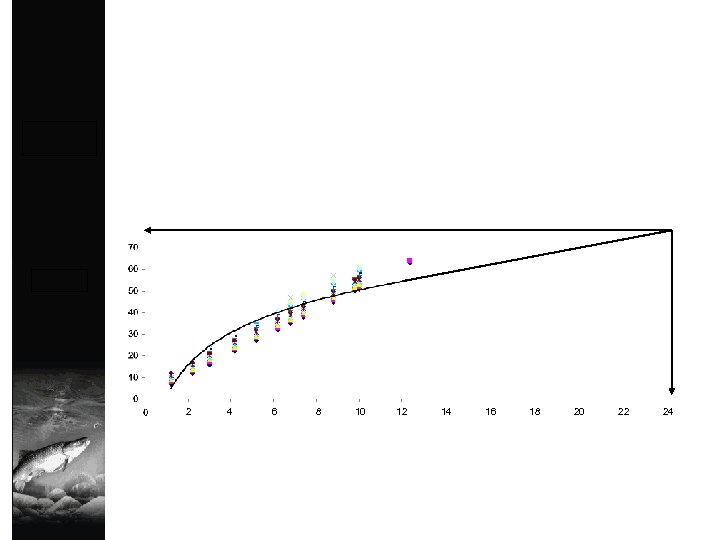
2 4 6 8 10 12 14 16 18 20 22 24
• The Largemouth Yellowfish Introduction
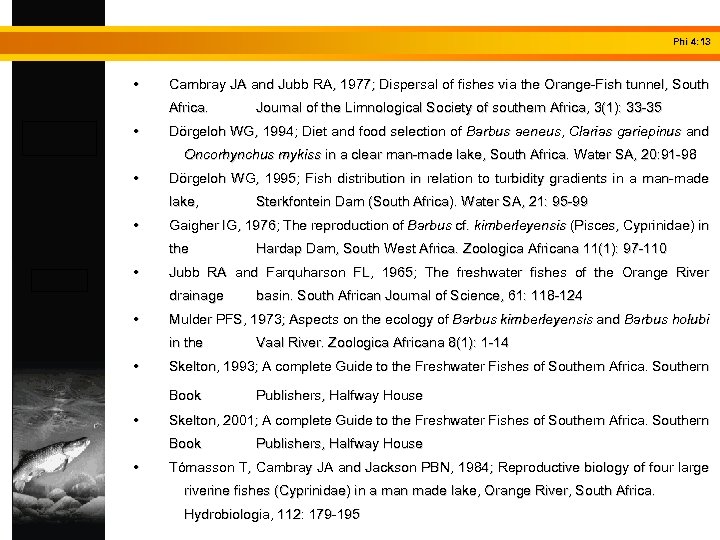
Phi 4: 13 • Cambray JA and Jubb RA, 1977; Dispersal of fishes via the Orange-Fish tunnel, South Africa. • Journal of the Limnological Society of southern Africa, 3(1): 33 -35 Dörgeloh WG, 1994; Diet and food selection of Barbus aeneus, Clarias gariepinus and Oncorhynchus mykiss in a clear man-made lake, South Africa. Water SA, 20: 91 -98 • Dörgeloh WG, 1995; Fish distribution in relation to turbidity gradients in a man-made lake, • Gaigher IG, 1976; The reproduction of Barbus cf. kimberleyensis (Pisces, Cyprinidae) in the • Publishers, Halfway House Skelton, 2001; A complete Guide to the Freshwater Fishes of Southern Africa. Southern Book • Vaal River. Zoologica Africana 8(1): 1 -14 Skelton, 1993; A complete Guide to the Freshwater Fishes of Southern Africa. Southern Book • basin. South African Journal of Science, 61: 118 -124 Mulder PFS, 1973; Aspects on the ecology of Barbus kimberleyensis and Barbus holubi in the • Hardap Dam, South West Africa. Zoologica Africana 11(1): 97 -110 Jubb RA and Farquharson FL, 1965; The freshwater fishes of the Orange River drainage • Sterkfontein Dam (South Africa). Water SA, 21: 95 -99 Publishers, Halfway House Tómasson T, Cambray JA and Jackson PBN, 1984; Reproductive biology of four large riverine fishes (Cyprinidae) in a man made lake, Orange River, South Africa. Hydrobiologia, 112: 179 -195
Phi 4: 13 • The Largemouth Yellowfish Introduction • What is a Largemouth Yellowfish? • How do they relate to other Yellowfish? • Where do they occur? • What habitats do they prefer vs. Habitats that they need? • What do they eat? • Where and how do they breed? • What do we use these fishes for? • How much do we know about these fishes? • Current research endeavours? • How can you help?

Phi 4: 13 The Largemouth Yellowfish (Labeobarbus kimberleyensis) THANK YOU 084 580 4161 econ@uj. ac. za
Скачать презентацию Phi 4 13 The Largemouth Yellowfish Labeobarbus kimberleyensis
0d36cd740b3c9c305e41888c369412f1.ppt