 Скачать презентацию Phenomenology by A Shutz Phenomenological Sociology is
Phenomenology_by_A.pptx
- Количество слайдов: 9



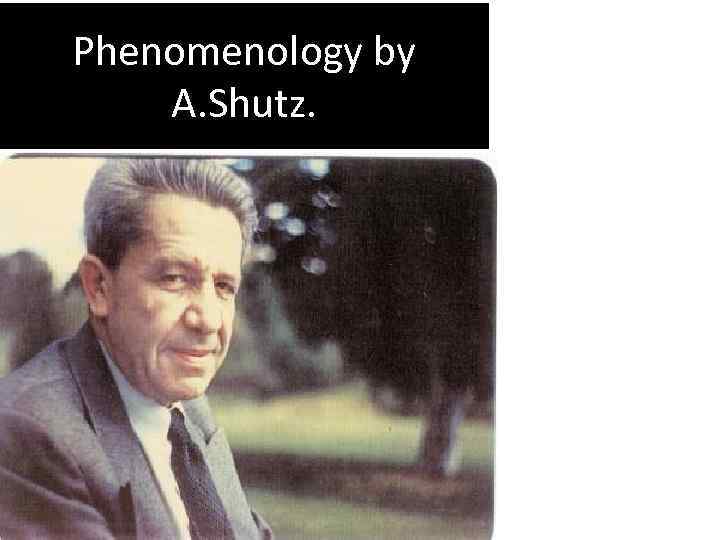
Phenomenology by A. Shutz.
Phenomenological Sociology is the study of the formal structures of concrete social existence as made available in and through the analytical description of acts of intentional consciousness. The object of such an analysis is the meaningful lived world of everyday life: the Lebenswelt, or "Lifeworld". The task of phenomenological sociology, like that of every other phenomenological investigation, is to account for, or describe, the formal structures of this object of investigation in terms of subjectivity, as an object-constituted-in-and-for-consciousness. That which makes such a description different from the "naive" subjective descriptions of the man in the street, or those of the traditional social scientist, both operating in the natural attitude of everyday life, is the utilizaton of phenomenological methods.
The leading exponent of Phenomenological Sociology was Alfred Schütz(1899– 1959). Schütz sought to provide a critical philosophical foundation for Max Weber's interpretive sociology / verstehende soziologie by applying methods and insights derived from the phenomenological philosophy of Edmund Husserl(1859– 1938) to the study of the social world. It is the building of this bridge between Husserlian phenomenology and Weberian sociology that serves as the starting point for contemporary phenomenological sociology. This does not mean, of course, that all versions of phenomenological sociology must be based on Weberian themes. In point of fact, there is some historical evidence [Dilthey's influence on Weber re: the former's theory of Weltanschauung, and Husserl's influence on Dilthey re: the former's theory of meaning] that would support the argument that elements of Weberian sociology are themselves based on certain phenomenological themes; especially in regard to theory of the intended meaning of an act, and ideas regarding theory and concept formation.
While Husserl's work was directed at establishing the formal structures of intentional consciousness, Schütz's work was directed at establishing the formal structures of what he termed the Lifeworld. Husserl's work was conducted as a transcendental phenomenology of consciousness. Schütz's work was conducted as a mundane phenomenology of the social world. The difference in their respective projects rests at the level of analysis, the objects taken as a topic of study, and the type of phenomenological reduction that is employed for the purposes of analysis.
Ultimately these two distinct phenomenological projects should be seen as complementary, with the structures of the latter dependent on the structures of the former. That is, valid phenomenological descriptions of the formal structures of the Life-world should be wholly consistent with the descriptions of the formal structures of intentional consciousness. It is from the latter that the former derives its validity, verifiability, and truth value. This is in keeping with Husserl's conception of phenomenology as "First Philosophy", the foundation, or ground, for both philosophy and all of the sciences.
The General Thesis of the Natural Attitude
The General Thesis of the Natural Attitude is the ideational foundation for the fact-world of our straightforward, common sense social experience. It unites the world of individual objects into a unified world of meaning, which we assume is shared by and all who share our culture (Schütz: 1962). It forms the underpinning for our thoughts and actions. It is the projected assumption, or belief, in a naturally occurring social world that is both factually objective in its existential status, and unquestioned in its "natural" appearance; social objects [persons, language, institutions, etc. ] have the same existential "thing" status as objects occurring in nature [rocks, trees, and animals, etc. ].
Although it is often referred to as the "General Thesis of the Natural Attitude", it is not a thesis in the formal sense of the term, but a nonthematic assumption, or belief, that underlies our sense of the objectivity and facticity of the world, and the objects appearing in this world. The facticity of this world of common sense is both unquestioned and virtually "unquestionable"; it is sanctionable as to its status as that which "is", and that which "everyone", or, at least, "any reasonable person", agrees to be the case with regard to the factual character of the world. As far as traditional social science is concerned, this taken-forgranted world of social facts is the starting and end point for any and all investigations of the social world. It provides the raw, observable, taken-for-granted "data" upon which the findings of the social sciences are idealized, conceptualized, and offered up for analysis and discourse. Within traditional social science, this "data" is formulated into a second order world of abstractions and idealizations constituted in accordance with these sciences' predetermined interpretive schemes (Husserl: 1989).
Schutz's phenomenological descriptions are made from within the phenomenoloigcal attitude, after the phenomenological reduction [epoche], which serves to suspend this assumption, or belief, and reveal the phenomena occurring within the natural attitude as objects-for-consciousness.
Скачать презентацию Phenomenology by A Shutz Phenomenological Sociology is
Phenomenology_by_A.pptx