


 Скачать презентацию PHENIX Spin Program recent results and prospects Kenneth
83d01c107626b5800a80e1911badc4d9.ppt
- Количество слайдов: 89
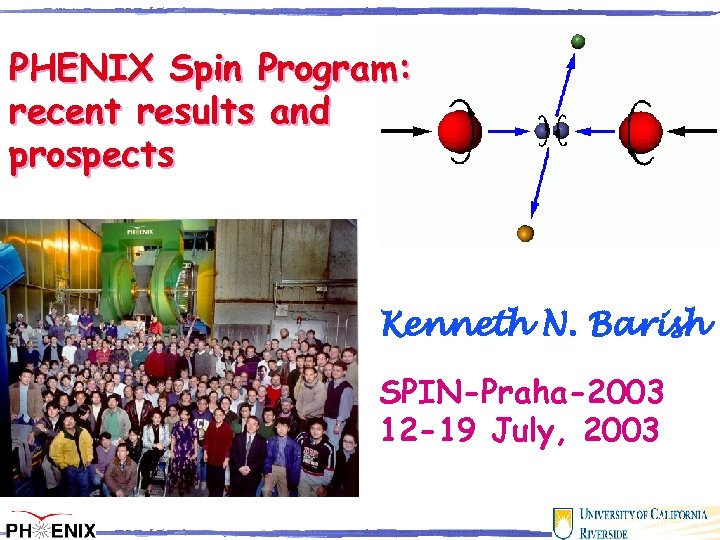 PHENIX Spin Program: recent results and prospects Kenneth N. Barish SPIN-Praha-2003 12 -19 July, 2003 K. Barish
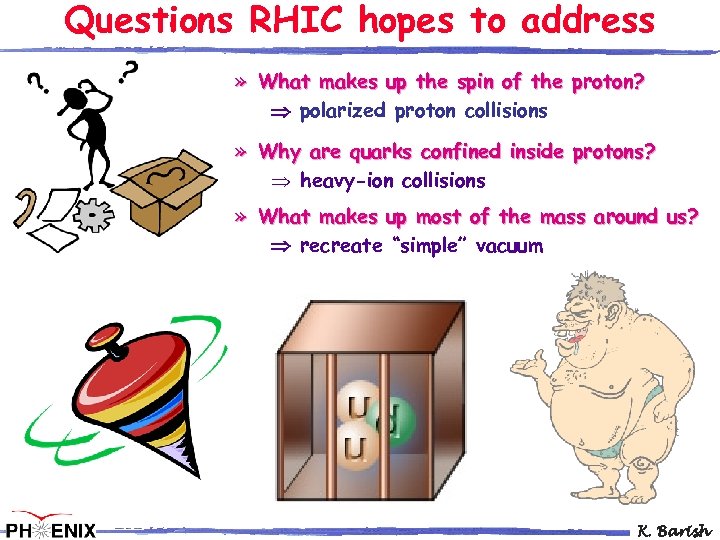 Questions RHIC hopes to address » What makes up the spin of the proton? Þ polarized proton collisions » Why are quarks confined inside protons? Þ heavy-ion collisions » What makes up most of the mass around us? Þ recreate “simple” vacuum K. Barish
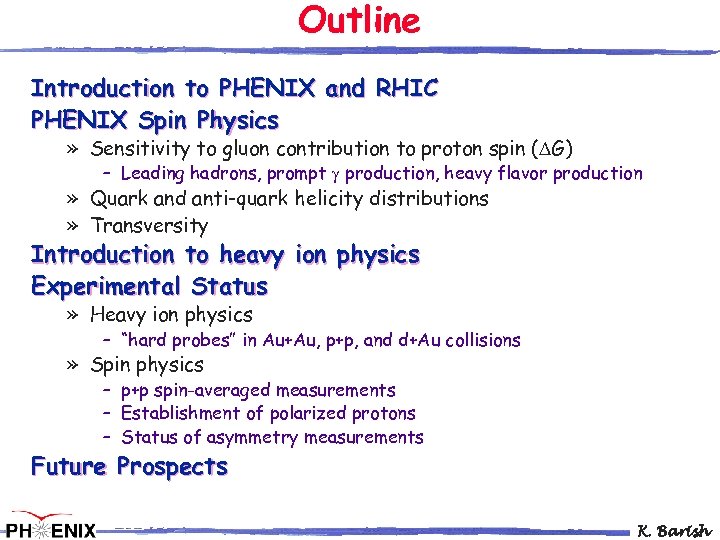 Outline Introduction to PHENIX and RHIC PHENIX Spin Physics » Sensitivity to gluon contribution to proton spin (DG) – Leading hadrons, prompt production, heavy flavor production » Quark and anti-quark helicity distributions » Transversity Introduction to heavy ion physics Experimental Status » Heavy ion physics – “hard probes” in Au+Au, p+p, and d+Au collisions » Spin physics – p+p spin-averaged measurements – Establishment of polarized protons – Status of asymmetry measurements Future Prospects K. Barish
 Brazil China University of São Paulo, São Paulo Academia Sinica, Taipei, Taiwan China Institute of Atomic Energy, Beijing Peking University, Beijing France LPC, University de Clermont-Ferrand, Clermont-Ferrand Dapnia, CEA Saclay, Gif-sur-Yvette IPN-Orsay, Universite Paris Sud, CNRS-IN 2 P 3, Orsay LLR, Ecòle Polytechnique, CNRS-IN 2 P 3, Palaiseau SUBATECH, Ecòle des Mines at Nantes, Nantes Germany University of Münster, Münster Hungary Central Research Institute for Physics (KFKI), Budapest Debrecen University, Debrecen Eötvös Loránd University (ELTE), Budapest India Banaras Hindu University, Banaras Bhabha Atomic Research Centre, Bombay Israel Weizmann Institute, Rehovot Japan Center for Nuclear Study, University of Tokyo, Tokyo Hiroshima University, Higashi-Hiroshima KEK, Institute for High Energy Physics, Tsukuba Kyoto University, Kyoto 12 Countries; 57 Institutions; 460 Participants Nagasaki Institute of Applied Science, Nagasaki RIKEN, Institute for Physical and Chemical Research, Wako RIKEN-BNL Research Center, Upton, NY USA Abilene Christian University, Abilene, TX Brookhaven National Laboratory, Upton, NY University of Tokyo, Bunkyo-ku, Tokyo University of California - Riverside, CA Tokyo Institute of Technology, Tokyo University of Tsukuba, Tsukuba University of Colorado, Boulder, CO Waseda University, Tokyo Columbia University, Nevis Laboratories, Irvington, NY S. Korea Cyclotron Application Laboratory, KAERI, Seoul Florida State University, Tallahassee, FL Kangnung National University, Kangnung Georgia State University, Atlanta, GA Korea University, Seoul University of Illinois Urbana Champaign, IL Myong Ji University, Yongin City Iowa State University and Ames Laboratory, Ames, IA System Electronics Laboratory, Seoul Nat. University, Seoul Los Alamos National Laboratory, Los Alamos, NM Yonsei University, Seoul Lawrence Livermore National Laboratory, Livermore, CA Russia Institute of High Energy Physics, Protovino University of New Mexico, Albuquerque, NM Joint Institute for Nuclear Research, Dubna New Mexico State University, Las Cruces, NM Kurchatov Institute, Moscow Dept. of Chemistry, Stony Brook Univ. , Stony Brook, NY PNPI, St. Petersburg Nuclear Physics Institute, St. Petersburg Dept. Phys. and Astronomy, Stony Brook Univ. , Stony Brook, NY St. Petersburg State Technical University, St. Petersburg Oak Ridge National Laboratory, Oak Ridge, TN Sweden Lund University, Lund University of Tennessee, Knoxville, TN Vanderbilt University, Nashville, TN K. Barish
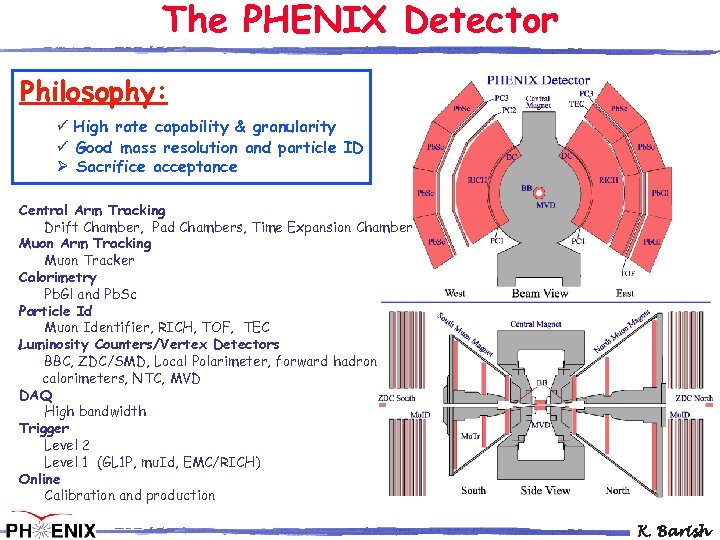 The PHENIX Detector Philosophy: ü High rate capability & granularity ü Good mass resolution and particle ID Ø Sacrifice acceptance Central Arm Tracking Drift Chamber, Pad Chambers, Time Expansion Chamber Muon Arm Tracking Muon Tracker Calorimetry Pb. Gl and Pb. Sc Particle Id Muon Identifier, RICH, TOF, TEC Luminosity Counters/Vertex Detectors BBC, ZDC/SMD, Local Polarimeter, forward hadron calorimeters, NTC, MVD DAQ High bandwidth Trigger Level 2 Level 1 (GL 1 P, mu. Id, EMC/RICH) Online Calibration and production K. Barish
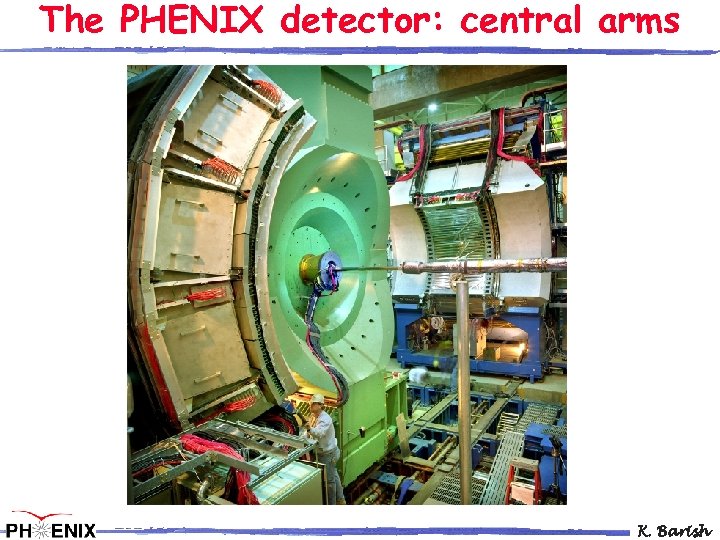 The PHENIX detector: central arms K. Barish
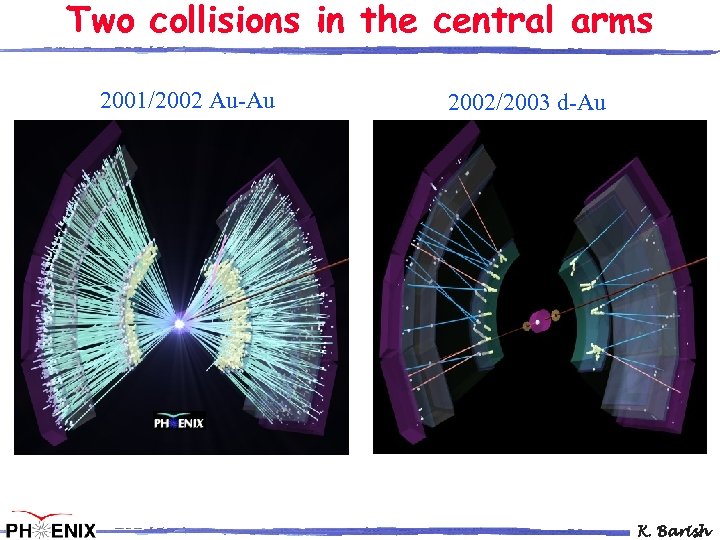 Two collisions in the central arms 2001/2002 Au-Au 2002/2003 d-Au K. Barish
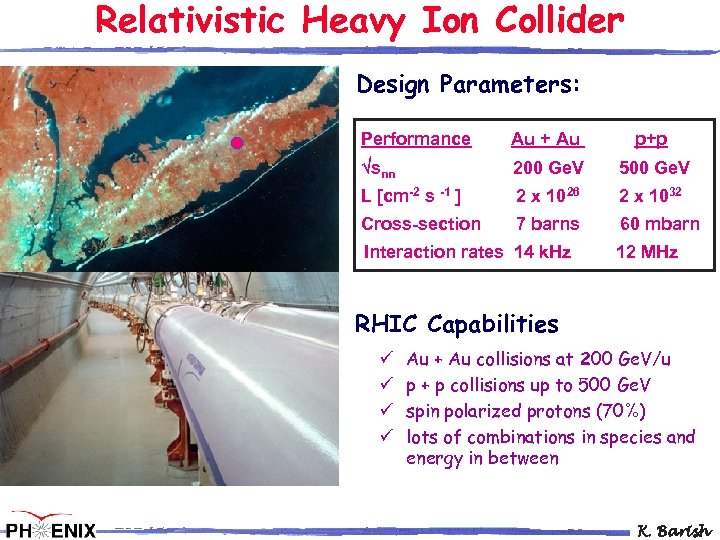 Relativistic Heavy Ion Collider Design Parameters: Performance Au + Au p+p snn 200 Ge. V 500 Ge. V L [cm-2 s -1 ] 2 x 1026 2 x 1032 Cross-section 7 barns 60 mbarn Interaction rates 14 k. Hz 12 MHz RHIC Capabilities ü ü Au + Au collisions at 200 Ge. V/u p + p collisions up to 500 Ge. V spin polarized protons (70%) lots of combinations in species and energy in between K. Barish
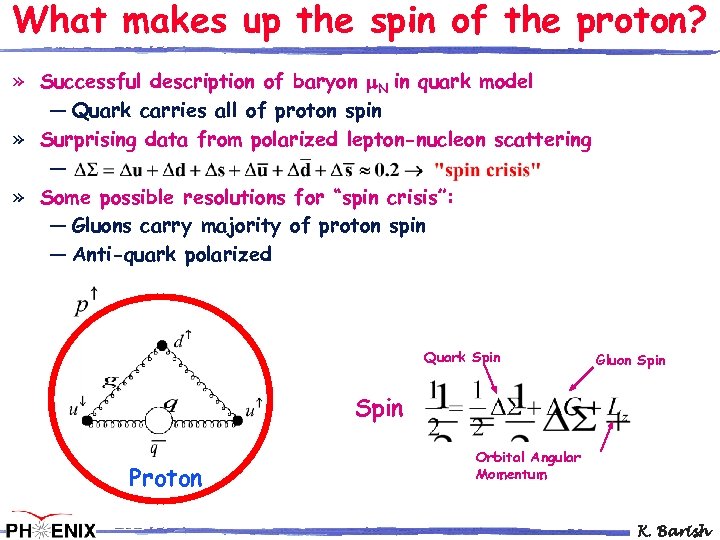 What makes up the spin of the proton? » Successful description of baryon m. N in quark model — Quark carries all of proton spin » Surprising data from polarized lepton-nucleon scattering — » Some possible resolutions for “spin crisis”: — Gluons carry majority of proton spin — Anti-quark polarized Quark Spin Gluon Spin Proton Orbital Angular Momentum K. Barish
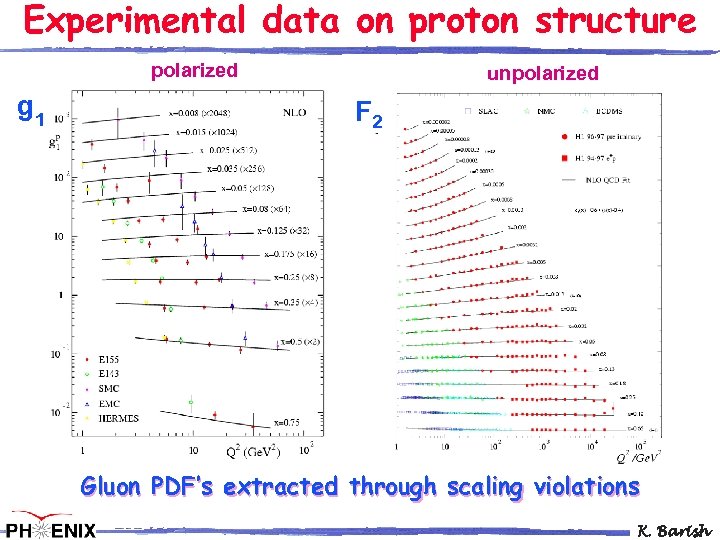 Experimental data on proton structure polarized g 1 unpolarized F 2 Gluon PDF’s extracted through scaling violations K. Barish
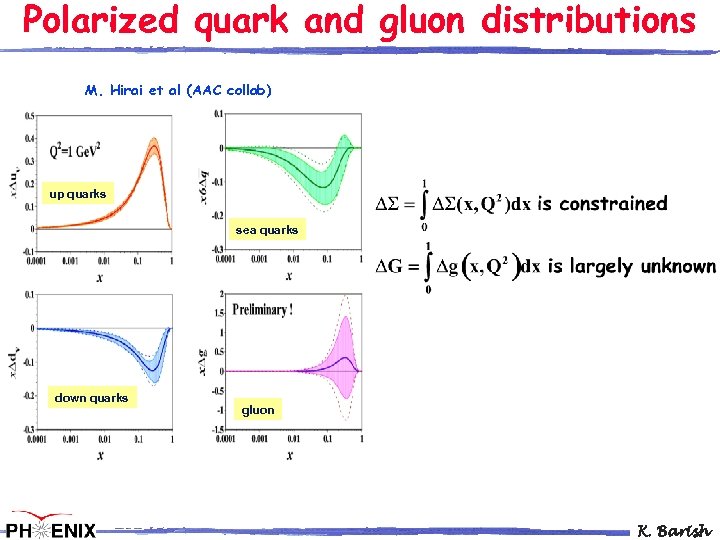 Polarized quark and gluon distributions M. Hirai et al (AAC collab) up quarks sea quarks down quarks gluon K. Barish
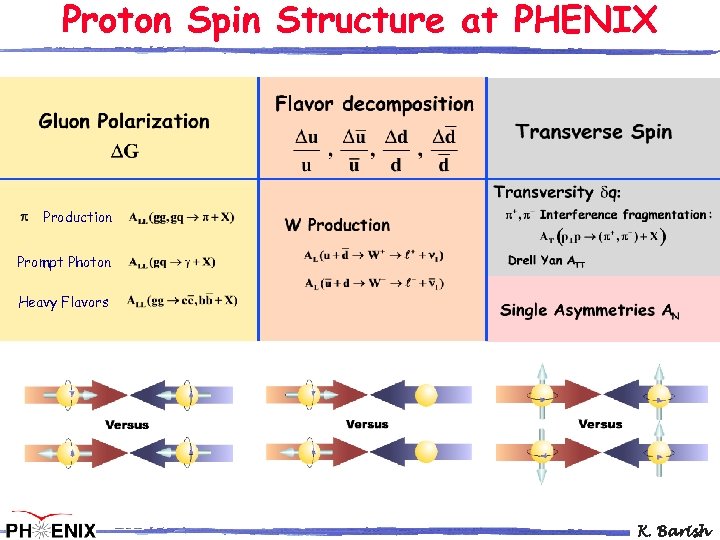 Proton Spin Structure at PHENIX Production Prompt Photon Heavy Flavors K. Barish
 DG with a Polarized Proton Collider K. Barish
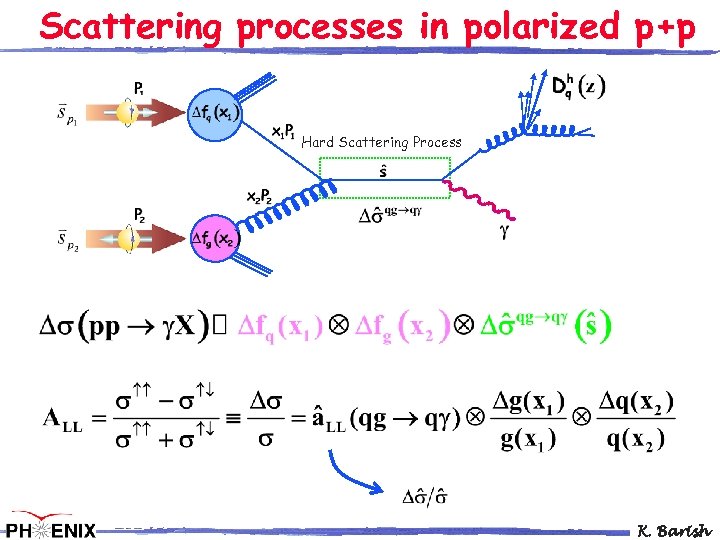 Scattering processes in polarized p+p Hard Scattering Process K. Barish
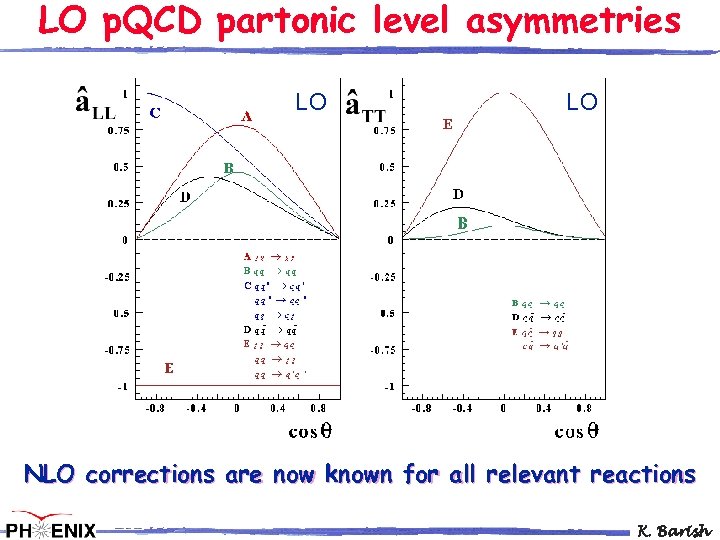 LO p. QCD partonic level asymmetries LO LO NLO corrections are now known for all relevant reactions K. Barish
 DG IN PHENIX (1) Leading Hadrons K. Barish
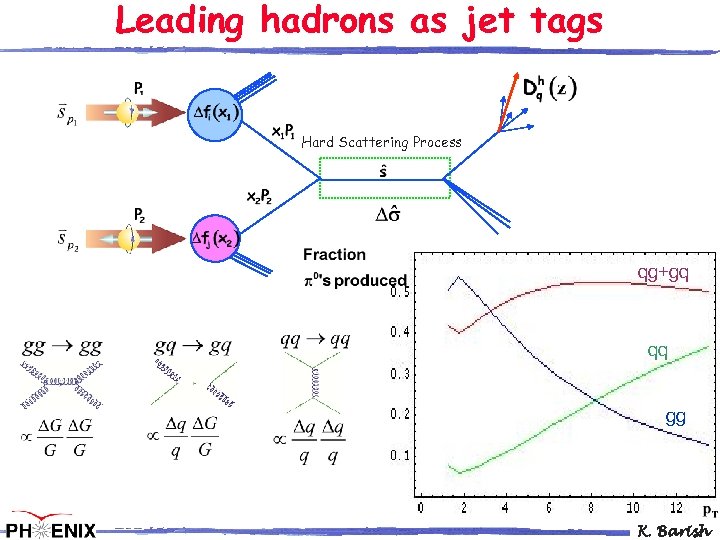 Leading hadrons as jet tags Hard Scattering Process qg+gq qq gg K. Barish
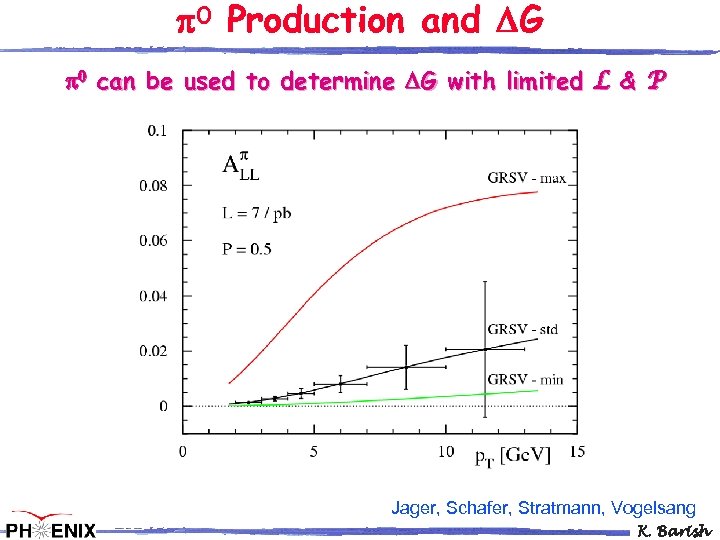 0 Production and DG 0 can be used to determine DG with limited L & P Jager, Schafer, Stratmann, Vogelsang K. Barish
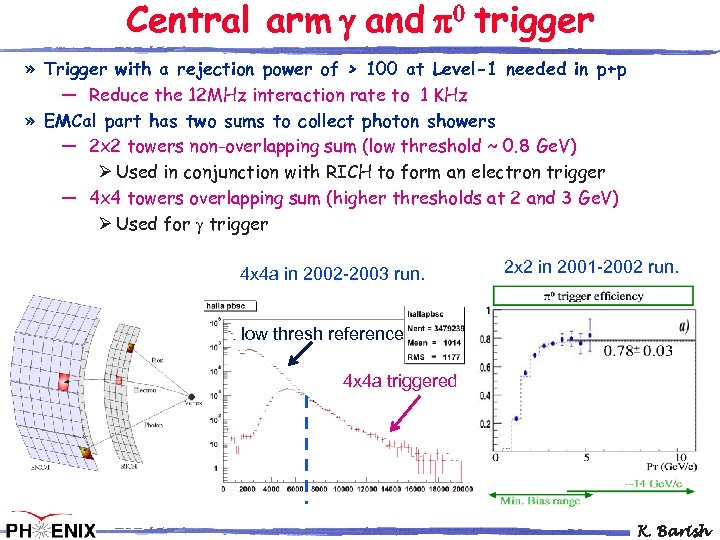 Central arm and 0 trigger » Trigger with a rejection power of > 100 at Level-1 needed in p+p — Reduce the 12 MHz interaction rate to 1 KHz » EMCal part has two sums to collect photon showers — 2 x 2 towers non-overlapping sum (low threshold ~ 0. 8 Ge. V) Ø Used in conjunction with RICH to form an electron trigger — 4 x 4 towers overlapping sum (higher thresholds at 2 and 3 Ge. V) Ø Used for trigger 4 x 4 a in 2002 -2003 run. 2 x 2 in 2001 -2002 run. low thresh reference 4 x 4 a triggered K. Barish
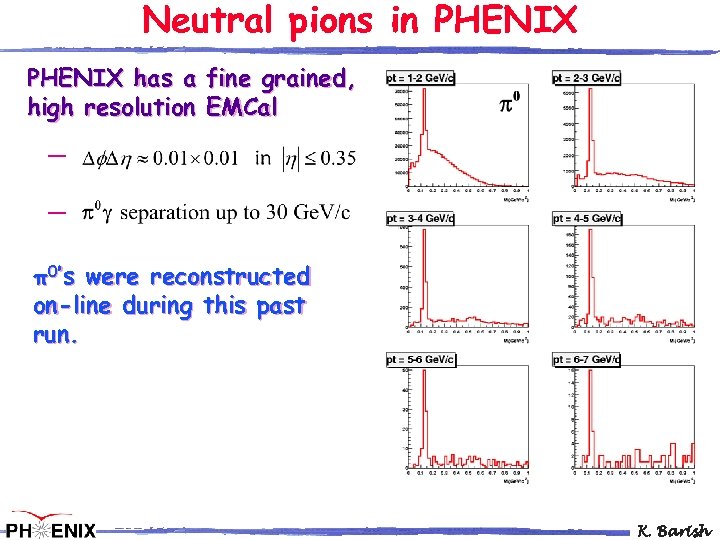 Neutral pions in PHENIX has a fine grained, high resolution EMCal π0’s were reconstructed on-line during this past run. K. Barish
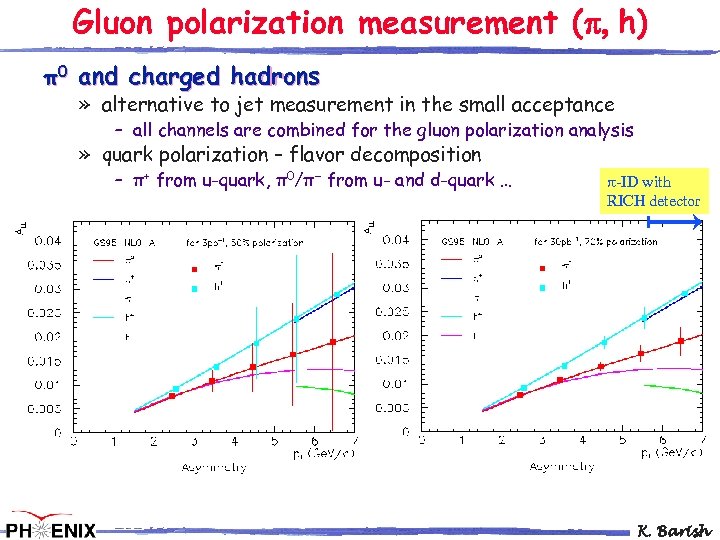 Gluon polarization measurement ( , h) π0 and charged hadrons » alternative to jet measurement in the small acceptance – all channels are combined for the gluon polarization analysis » quark polarization – flavor decomposition – π+ from u-quark, π0/π from u- and d-quark … -ID with RICH detector K. Barish
 DG IN PHENIX (2) Prompt Production K. Barish
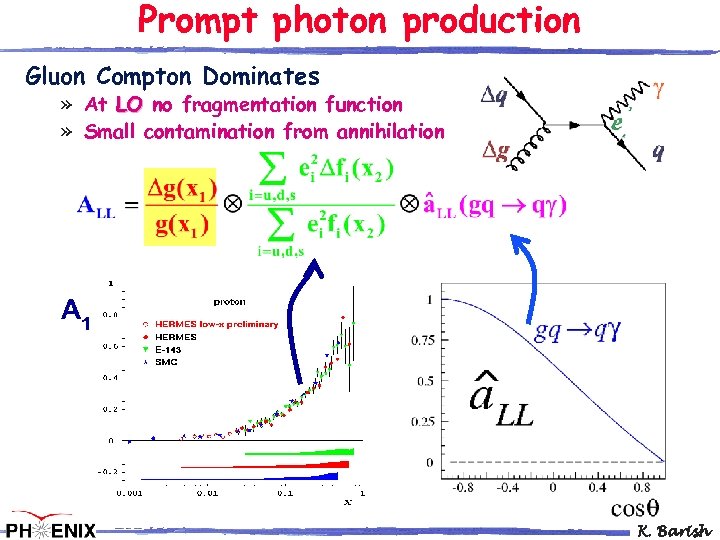 Prompt photon production Gluon Compton Dominates » At LO no fragmentation function » Small contamination from annihilation A 1 K. Barish
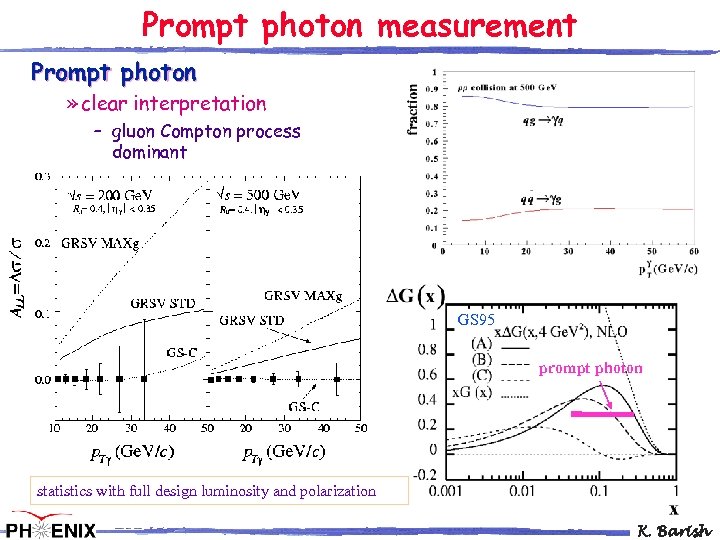 Prompt photon measurement Prompt photon » clear interpretation – gluon Compton process dominant GS 95 prompt photon statistics with full design luminosity and polarization K. Barish
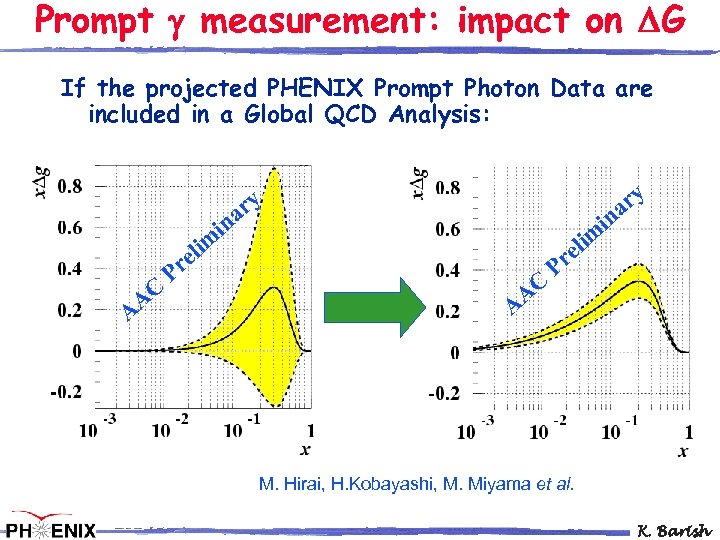 Prompt measurement: impact on DG If the projected PHENIX Prompt Photon Data are included in a Global QCD Analysis: ry a in lim y ar in lim e A AC Pr AC A re P M. Hirai, H. Kobayashi, M. Miyama et al. K. Barish
 DG IN PHENIX (3) Heavy Flavor Production K. Barish
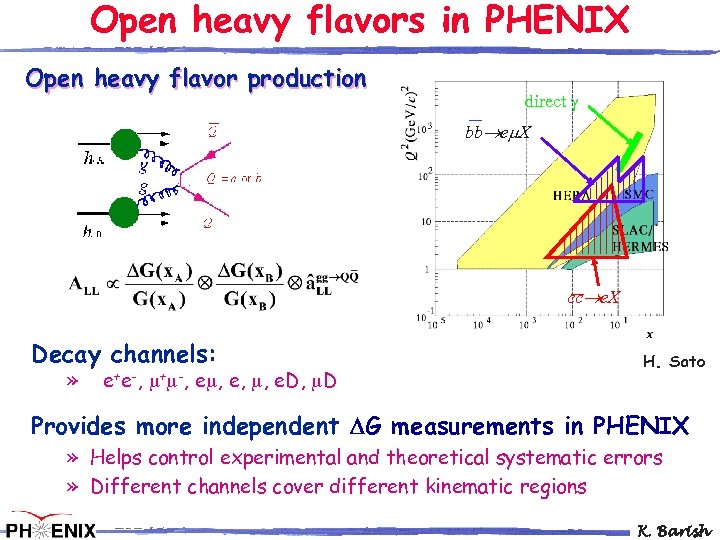 Open heavy flavors in PHENIX Open heavy flavor production direct bb e X cc e. X Decay channels: » e+e-, + -, e , e, , e. D, D H. Sato Provides more independent DG measurements in PHENIX » Helps control experimental and theoretical systematic errors » Different channels cover different kinematic regions K. Barish
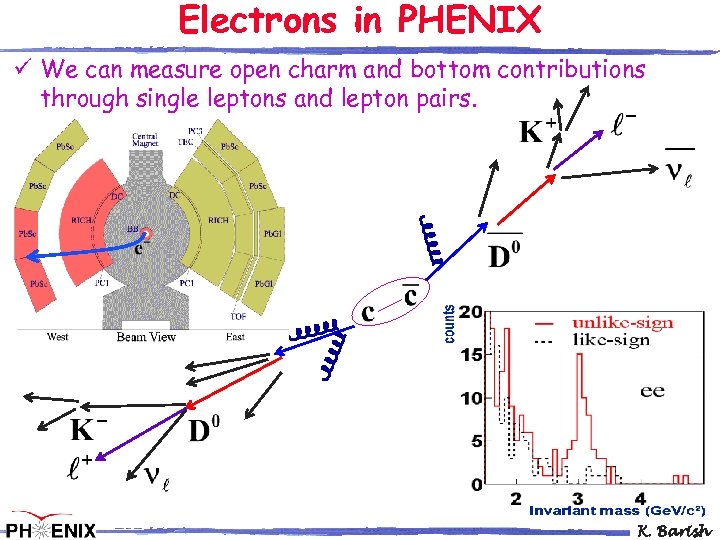 Electrons in PHENIX ü We can measure open charm and bottom contributions through single leptons and lepton pairs. K. Barish
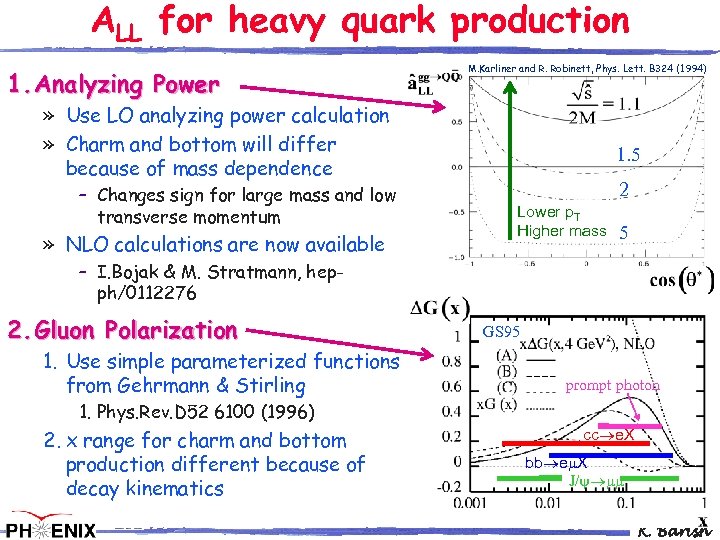 ALL for heavy quark production 1. Analyzing Power M. Karliner and R. Robinett, Phys. Lett. B 324 (1994) » Use LO analyzing power calculation » Charm and bottom will differ because of mass dependence – Changes sign for large mass and low transverse momentum » NLO calculations are now available 1. 5 2 Lower p. T Higher mass 5 – I. Bojak & M. Stratmann, hepph/0112276 2. Gluon Polarization 1. Use simple parameterized functions from Gehrmann & Stirling GS 95 prompt photon 1. Phys. Rev. D 52 6100 (1996) 2. x range for charm and bottom production different because of decay kinematics cc e. X bb e X J/ K. Barish
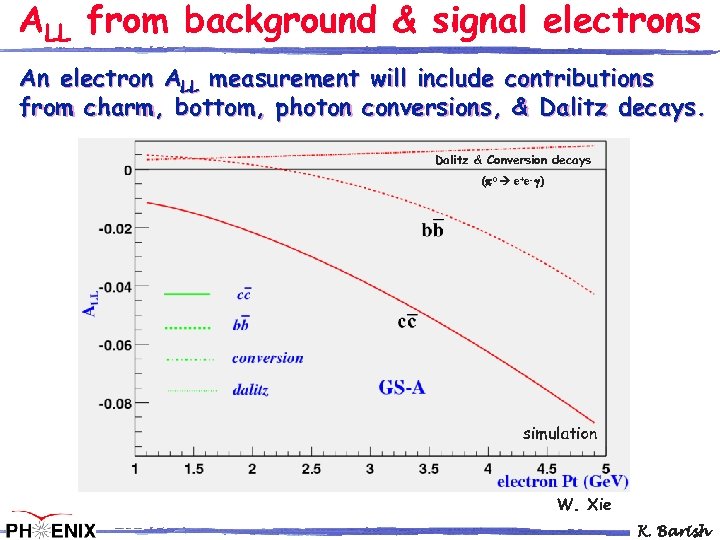 ALL from background & signal electrons An electron ALL measurement will include contributions from charm, bottom, photon conversions, & Dalitz decays. Dalitz & Conversion decays ( 0 e+e- ) simulation W. Xie K. Barish
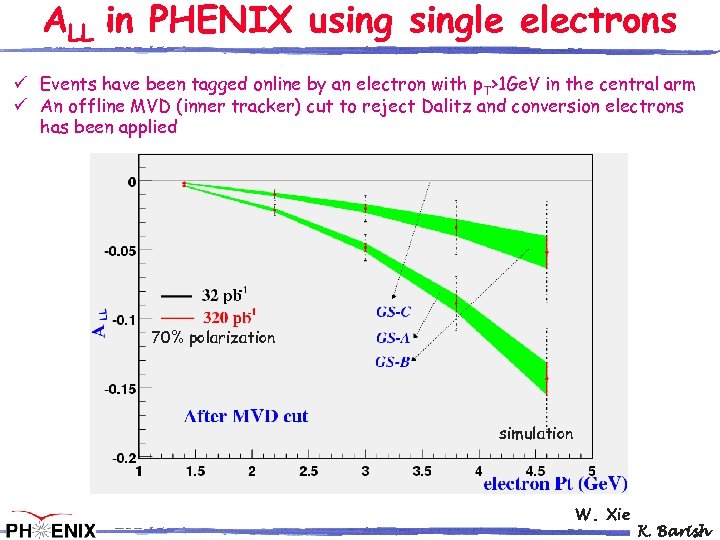 ALL in PHENIX usingle electrons ü Events have been tagged online by an electron with p. T>1 Ge. V in the central arm ü An offline MVD (inner tracker) cut to reject Dalitz and conversion electrons has been applied 70% polarization simulation W. Xie K. Barish
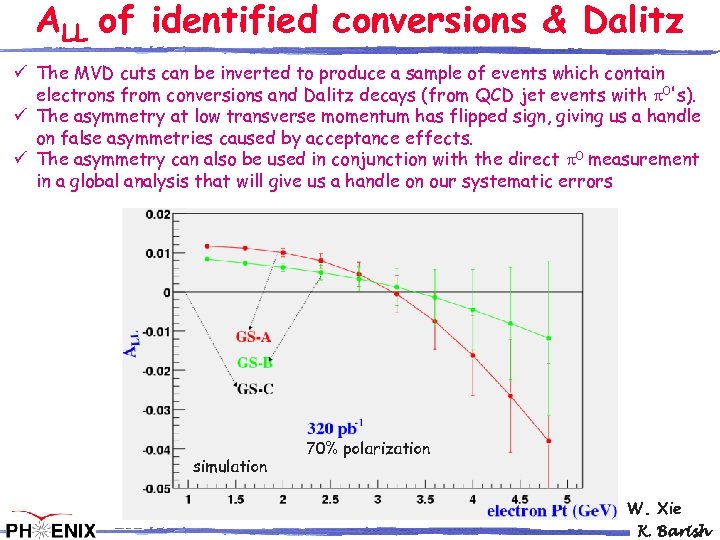 ALL of identified conversions & Dalitz ü The MVD cuts can be inverted to produce a sample of events which contain electrons from conversions and Dalitz decays (from QCD jet events with 0's). ü The asymmetry at low transverse momentum has flipped sign, giving us a handle on false asymmetries caused by acceptance effects. ü The asymmetry can also be used in conjunction with the direct 0 measurement in a global analysis that will give us a handle on our systematic errors simulation 70% polarization W. Xie K. Barish
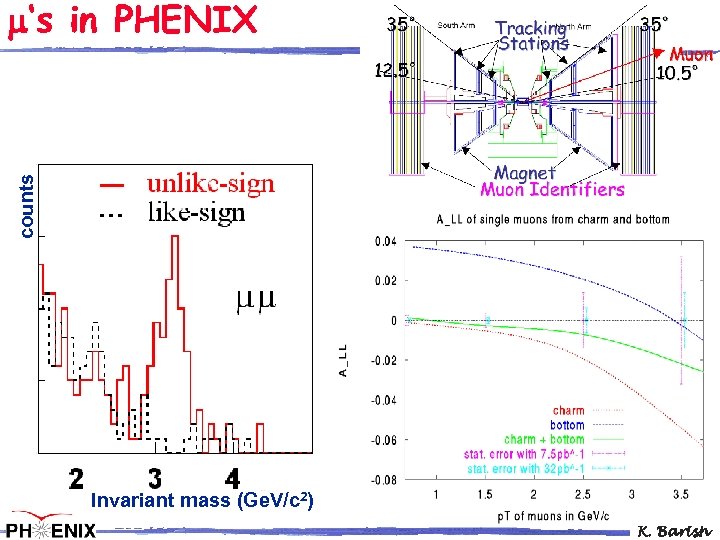 counts m‘s in PHENIX Invariant mass (Ge. V/c 2) K. Barish
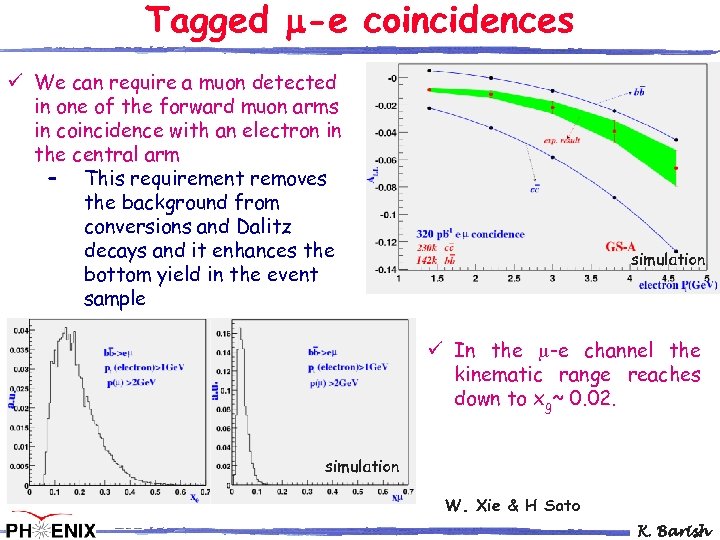 Tagged m-e coincidences ü We can require a muon detected in one of the forward muon arms in coincidence with an electron in the central arm – This requirement removes the background from conversions and Dalitz decays and it enhances the bottom yield in the event sample simulation ü In the -e channel the kinematic range reaches down to xg~ 0. 02. simulation W. Xie & H Sato K. Barish
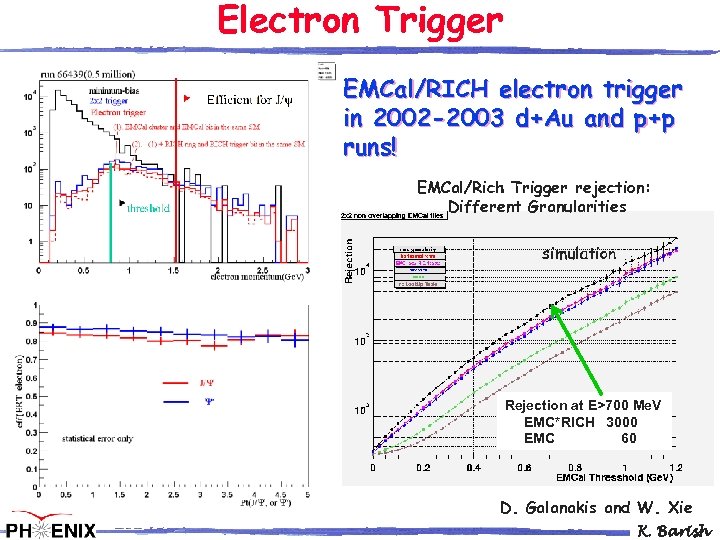 Electron Trigger EMCal/RICH electron trigger in 2002 -2003 d+Au and p+p runs! data EMCal/Rich Trigger rejection: Different Granularities simulation Rejection at E>700 Me. V EMC*RICH 3000 EMC 60 D. Galanakis and W. Xie K. Barish
 Antiquark helicity distributions in PHENIX K. Barish
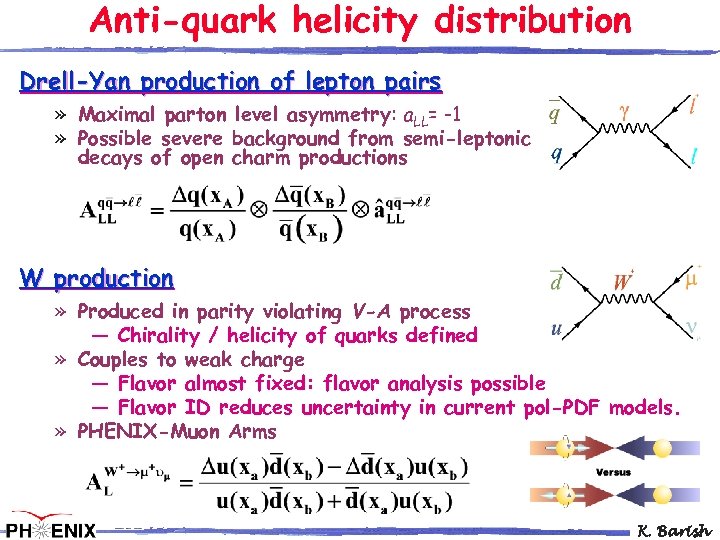 Anti-quark helicity distribution Drell-Yan production of lepton pairs » Maximal parton level asymmetry: a. LL= -1 » Possible severe background from semi-leptonic decays of open charm productions W production » Produced in parity violating V-A process — Chirality / helicity of quarks defined » Couples to weak charge — Flavor almost fixed: flavor analysis possible — Flavor ID reduces uncertainty in current pol-PDF models. » PHENIX-Muon Arms K. Barish
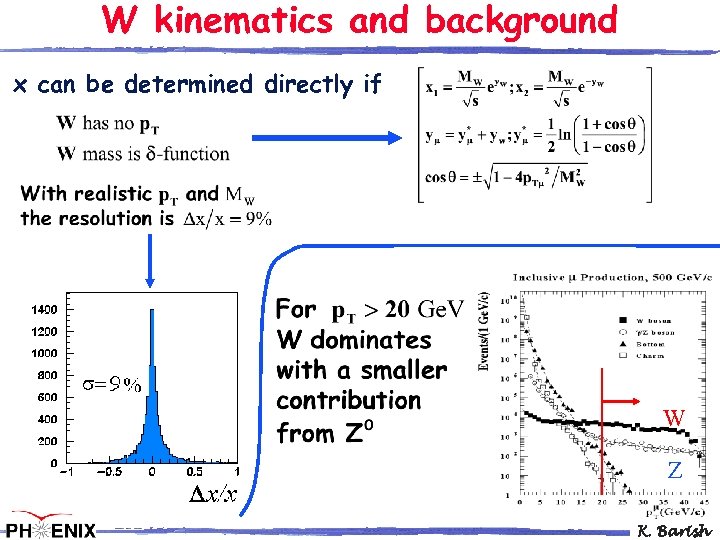 W kinematics and background x can be determined directly if W Z K. Barish
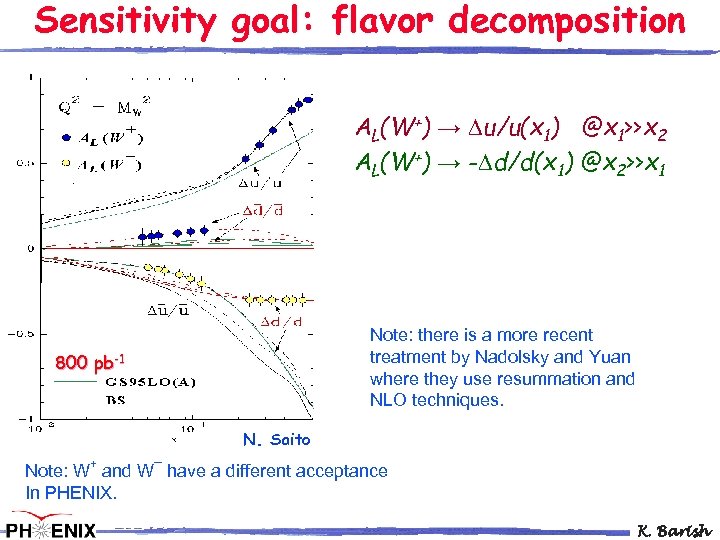 Sensitivity goal: flavor decomposition AL(W+) → Du/u(x 1) @x 1>>x 2 AL(W+) → -Dd/d(x 1) @x 2>>x 1 Note: there is a more recent treatment by Nadolsky and Yuan where they use resummation and NLO techniques. 800 pb-1 N. Saito -- Note: W+ and W have a different acceptance In PHENIX. K. Barish
 Transversity K. Barish
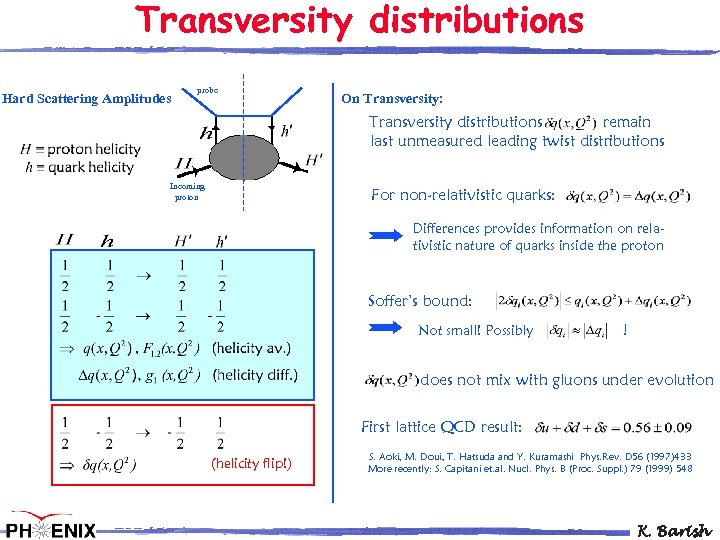 Transversity distributions Hard Scattering Amplitudes probe On Transversity: Transversity distributions remain last unmeasured leading twist distributions Incoming proton For non-relativistic quarks: Differences provides information on relativistic nature of quarks inside the proton Soffer’s bound: Not small! Possibly ! does not mix with gluons under evolution First lattice QCD result: (helicity flip!) S. Aoki, M. Doui, T. Hatsuda and Y. Kuramashi Phys. Rev. D 56 (1997)433 More recently: S. Capitani et. al. Nucl. Phys. B (Proc. Suppl. ) 79 (1999) 548 K. Barish
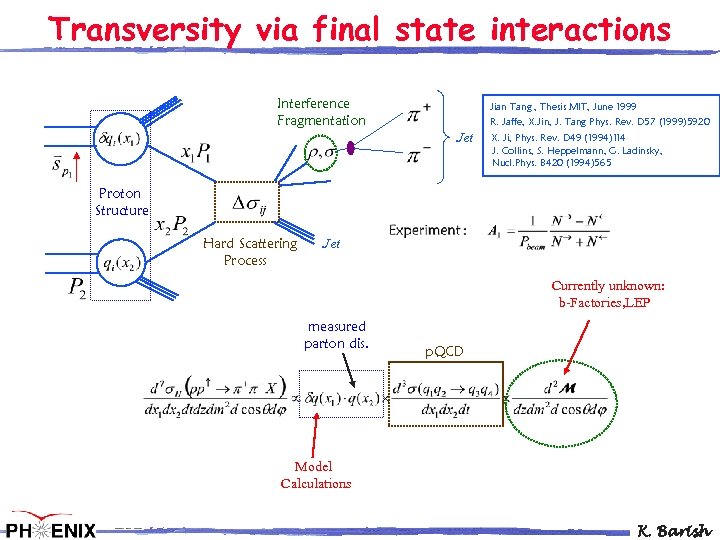 Transversity via final state interactions Interference Fragmentation Jian Tang , Thesis MIT, June 1999 R. Jaffe, X. Jin, J. Tang Phys. Rev. D 57 (1999)5920 Jet X. Ji, Phys. Rev. D 49 (1994)114 J. Collins, S. Heppelmann, G. Ladinsky, Nucl. Phys. B 420 (1994)565 Proton Structure Hard Scattering Process Jet Currently unknown: b-Factories, LEP measured parton dis. p. QCD Model Calculations K. Barish
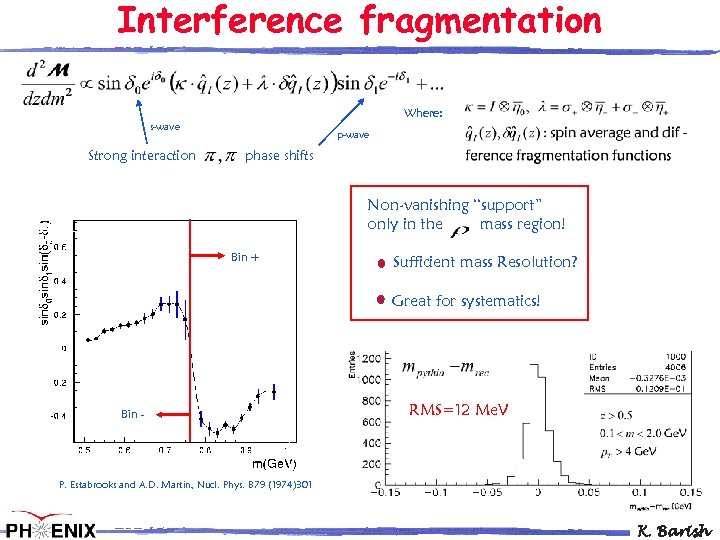 Interference fragmentation Where: s-wave Strong interaction p-wave phase shifts Non-vanishing “support” only in the mass region! Bin + Sufficient mass Resolution? Great for systematics! Bin - RMS=12 Me. V P. Estabrooks and A. D. Martin, Nucl. Phys. B 79 (1974)301 K. Barish
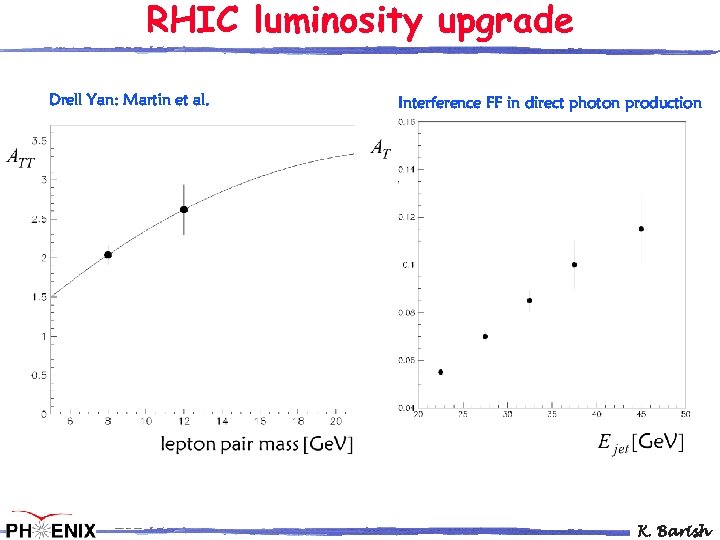
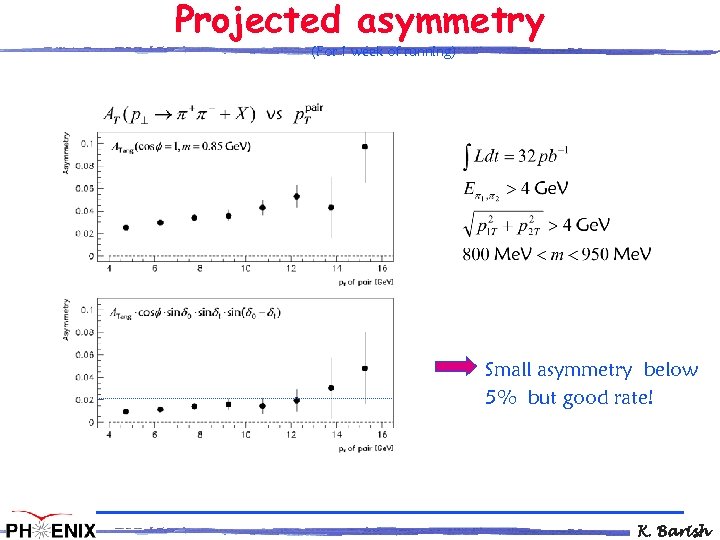 Projected asymmetry (For 1 week of running) Small asymmetry below 5% but good rate! K. Barish
 RHIC luminosity upgrade Drell Yan: Martin et al. Interference FF in direct photon production K. Barish
 Beyond the standard model K. Barish
 Searches for new physics Anomalous parity violation in jet production » Contact Interaction (Scale L) – RHIC Spin Reach L~3. 3 Te. V » New gauge boson Z’ K. Barish
 Introduction to heavy ion physics K. Barish
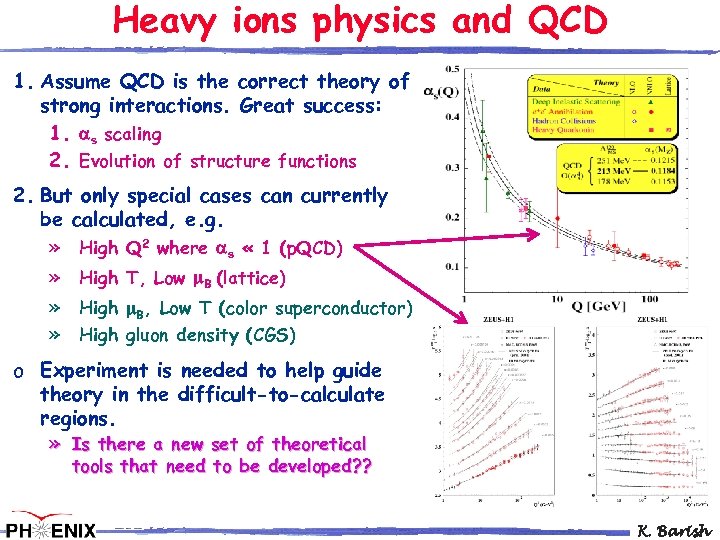 Heavy ions physics and QCD 1. Assume QCD is the correct theory of strong interactions. Great success: 1. as scaling 2. Evolution of structure functions 2. But only special cases can currently be calculated, e. g. » High Q 2 where as « 1 (p. QCD) » High T, Low m. B (lattice) » High m. B, Low T (color superconductor) » High gluon density (CGS) o Experiment is needed to help guide theory in the difficult-to-calculate regions. » Is there a new set of theoretical tools that need to be developed? ? K. Barish
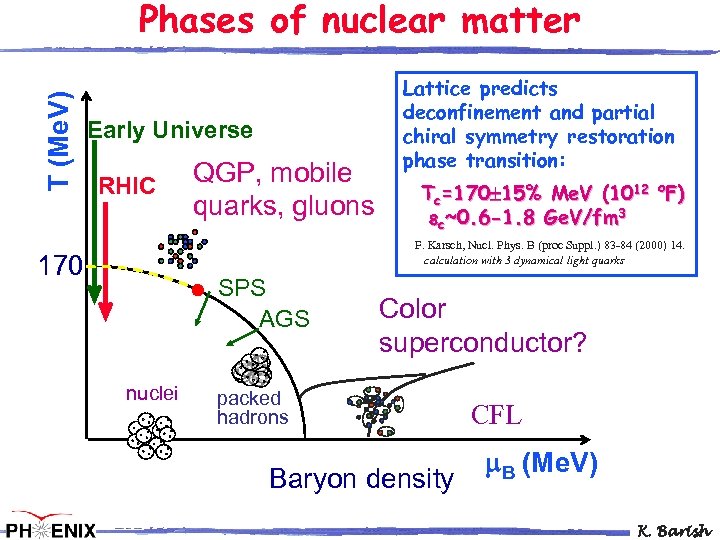 T (Me. V) Phases of nuclear matter Early Universe RHIC QGP, mobile quarks, gluons Lattice predicts deconfinement and partial chiral symmetry restoration phase transition: Tc=170± 15% Me. V (1012 o. F) ec~0. 6 -1. 8 Ge. V/fm 3 F. Karsch, Nucl. Phys. B (proc Suppl. ) 83 -84 (2000) 14. calculation with 3 dynamical light quarks 170 SPS AGS nuclei Color superconductor? packed hadrons Baryon density CFL m. B (Me. V) K. Barish
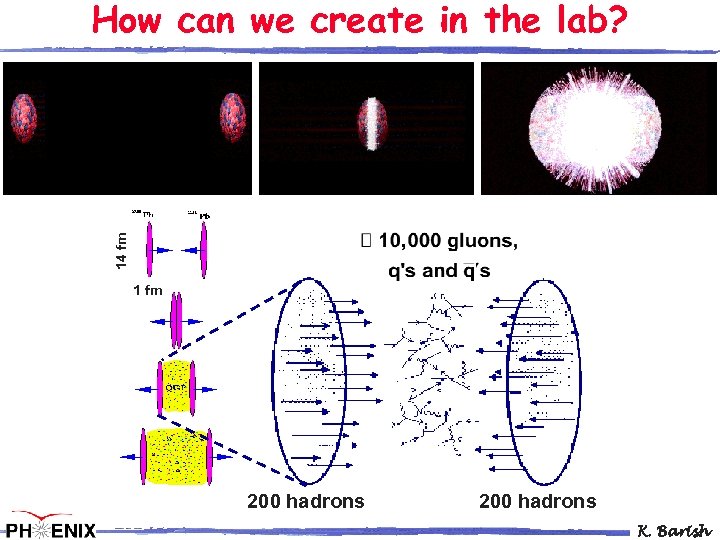
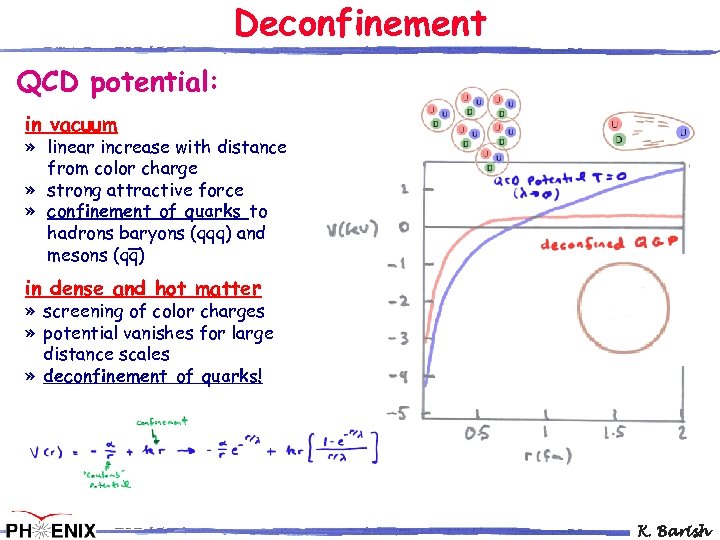 Deconfinement QCD potential: in vacuum » linear increase with distance from color charge » strong attractive force » confinement of quarks to hadrons baryons (qqq) and mesons (qq) in dense and hot matter » screening of color charges » potential vanishes for large distance scales » deconfinement of quarks! K. Barish
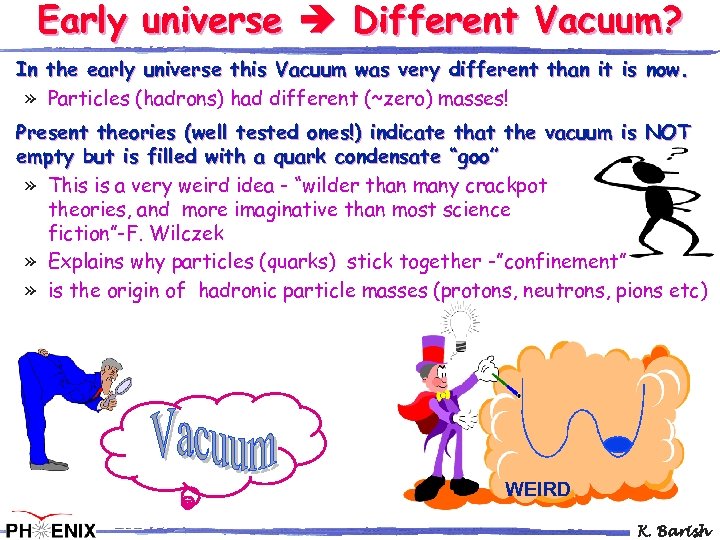 Early universe Different Vacuum? In the early universe this Vacuum was very different than it is now. » Particles (hadrons) had different (~zero) masses! Present theories (well tested ones!) indicate that the vacuum is NOT empty but is filled with a quark condensate “goo” » This is a very weird idea - “wilder than many crackpot theories, and more imaginative than most science fiction”-F. Wilczek » Explains why particles (quarks) stick together -”confinement” » is the origin of hadronic particle masses (protons, neutrons, pions etc) WEIRD K. Barish
 14 fm How can we create in the lab? 1 fm 200 hadrons K. Barish
 PHENIX experimental status K. Barish
 PHENIX Run History Year Species 01 2000 Au-Au 130 1. 0 mb-1 02 2001/2002 Au-Au 200 24 p-p 2000 p-p d-Au 200 mb-1 Ntot 10 M 170 M 0. 15 pb-1 200 P 3. 7 G 2. 74 nb-1 5. 5 G 0. 35 pb-1 6. 6 G ~15% ~27% 2002/2003 2001/2002 03 s 1/2 [Ge. V ] Ldt Run K. Barish
 Primary Heavy Ion results K. Barish
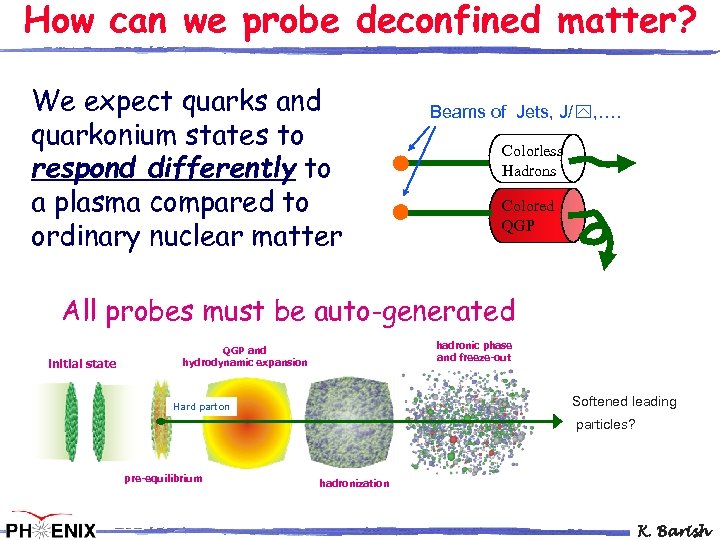 How can we probe deconfined matter? We expect quarks and quarkonium states to respond differently to a plasma compared to ordinary nuclear matter Beams of Jets, J/y, …. Colorless Hadrons Colored QGP All probes must be auto-generated initial state hadronic phase and freeze-out QGP and hydrodynamic expansion Softened leading Hard parton particles? pre-equilibrium hadronization K. Barish
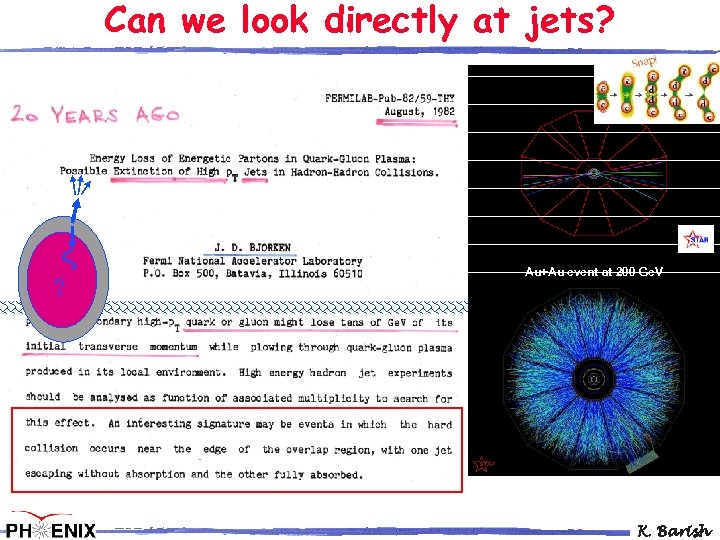 Can we look directly at jets? p+p dijet from 200 Ge. V run ? Au+Au event at 200 Ge. V K. Barish
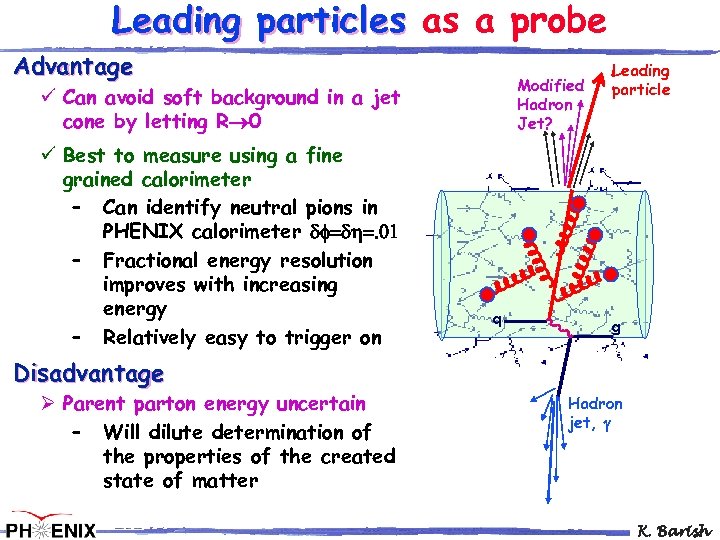 Leading particles as a probe Advantage Modified Hadron Jet? ü Can avoid soft background in a jet cone by letting R 0 ü Best to measure using a fine grained calorimeter – Can identify neutral pions in PHENIX calorimeter df=dh=. 01 – Fractional energy resolution improves with increasing energy – Relatively easy to trigger on q Leading particle g Disadvantage Ø Parent parton energy uncertain – Will dilute determination of the properties of the created state of matter Hadron jet, K. Barish
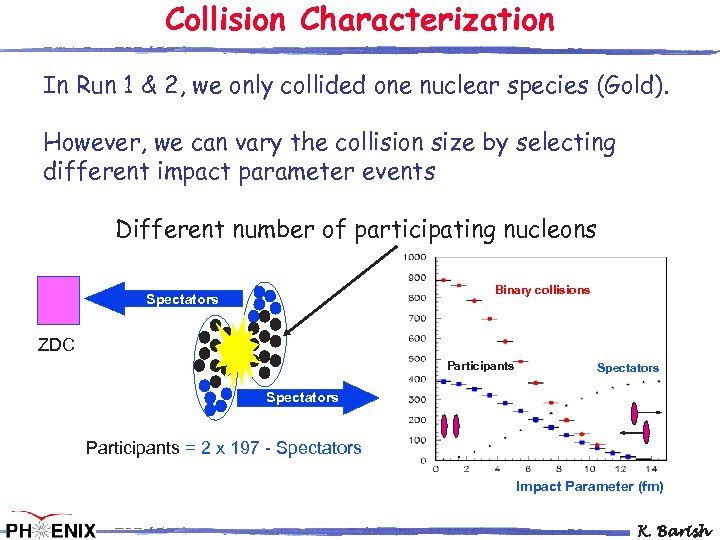 Collision Characterization In Run 1 & 2, we only collided one nuclear species (Gold). However, we can vary the collision size by selecting different impact parameter events Different number of participating nucleons Binary collisions Spectators ZDC Participants Spectators Participants = 2 x 197 - Spectators Impact Parameter (fm) K. Barish
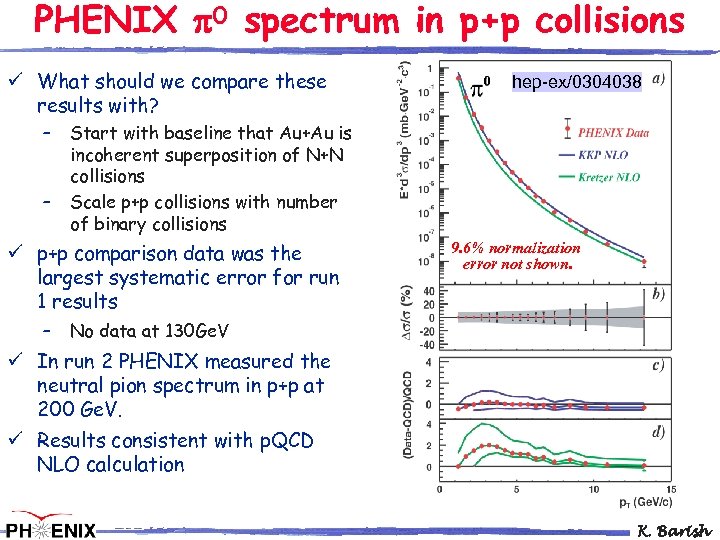 PHENIX 0 spectrum in p+p collisions ü What should we compare these results with? – – Start with baseline that Au+Au is incoherent superposition of N+N collisions Scale p+p collisions with number of binary collisions ü p+p comparison data was the largest systematic error for run 1 results – hep-ex/0304038 9. 6% normalization error not shown. No data at 130 Ge. V ü In run 2 PHENIX measured the neutral pion spectrum in p+p at 200 Ge. V. ü Results consistent with p. QCD NLO calculation K. Barish
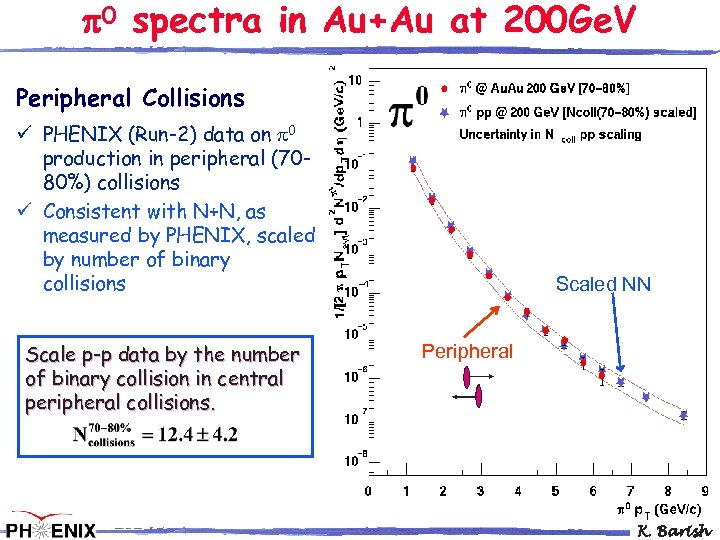 0 spectra in Au+Au at 200 Ge. V Peripheral Collisions ü PHENIX (Run-2) data on 0 production in peripheral (7080%) collisions ü Consistent with N+N, as measured by PHENIX, scaled by number of binary collisions Scale p-p data by the number of binary collision in central peripheral collisions. Scaled NN Peripheral K. Barish
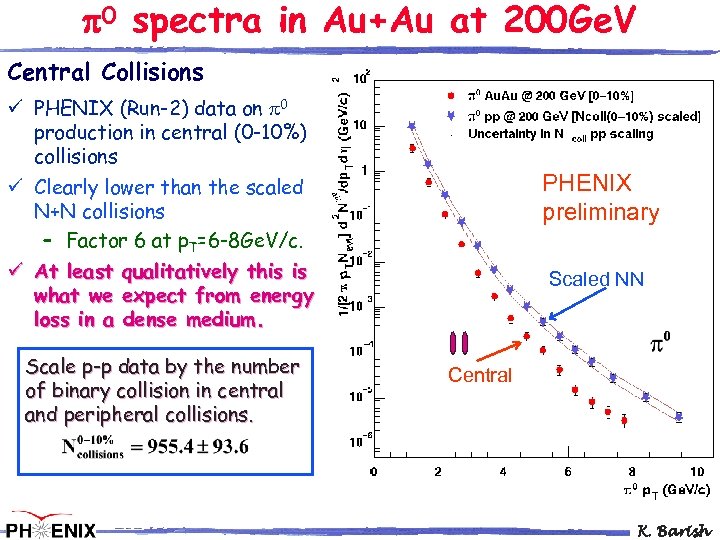 0 spectra in Au+Au at 200 Ge. V Central Collisions ü PHENIX (Run-2) data on 0 production in central (0 -10%) collisions PHENIX preliminary ü Clearly lower than the scaled N+N collisions – Factor 6 at p. T=6 -8 Ge. V/c. ü At least qualitatively this is what we expect from energy loss in a dense medium. Scale p-p data by the number of binary collision in central and peripheral collisions. Scaled NN Central K. Barish
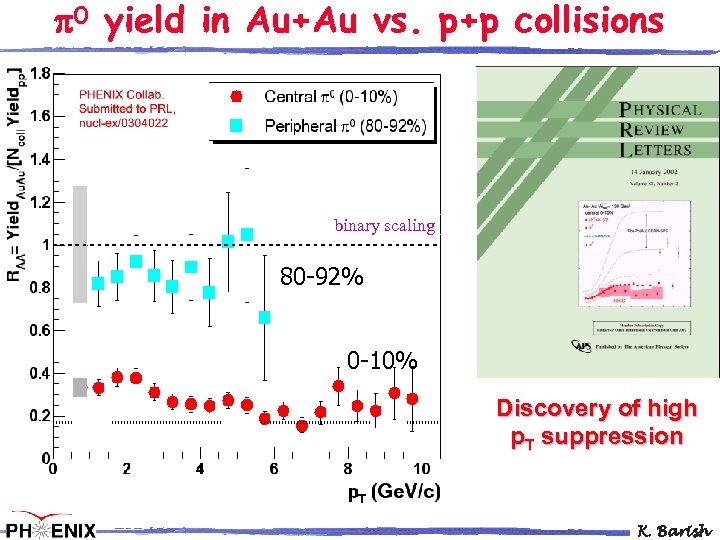 0 yield in Au+Au vs. p+p collisions binary scaling 80 -92% 0 -10% Discovery of high p. T suppression K. Barish
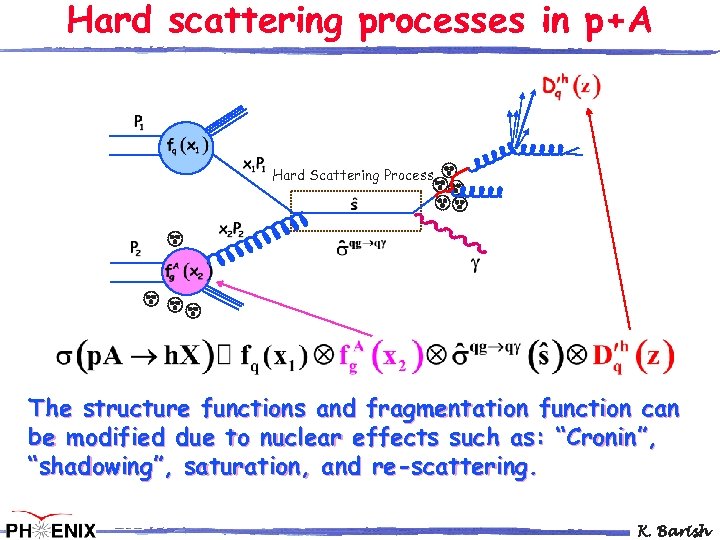 Hard scattering processes in p+A Hard Scattering Process The structure functions and fragmentation function can be modified due to nuclear effects such as: “Cronin”, “shadowing”, saturation, and re-scattering. K. Barish
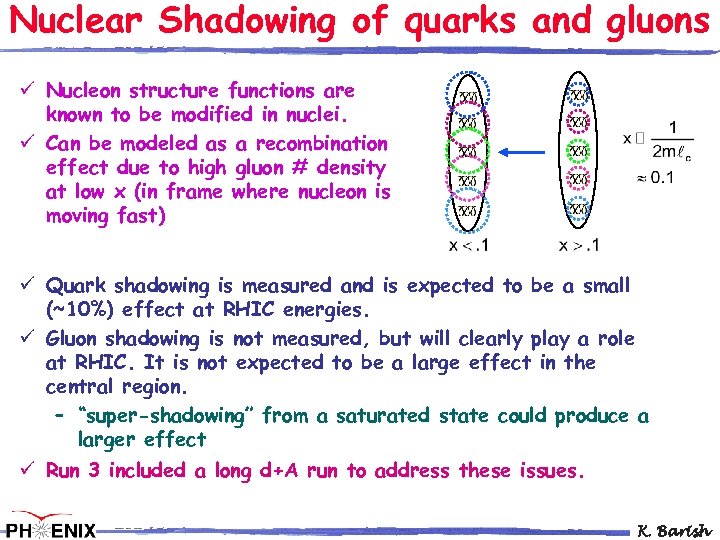 Nuclear Shadowing of quarks and gluons ü Nucleon structure functions are known to be modified in nuclei. ü Can be modeled as a recombination effect due to high gluon # density at low x (in frame where nucleon is moving fast) ü Quark shadowing is measured and is expected to be a small (~10%) effect at RHIC energies. ü Gluon shadowing is not measured, but will clearly play a role at RHIC. It is not expected to be a large effect in the central region. – “super-shadowing” from a saturated state could produce a larger effect ü Run 3 included a long d+A run to address these issues. K. Barish
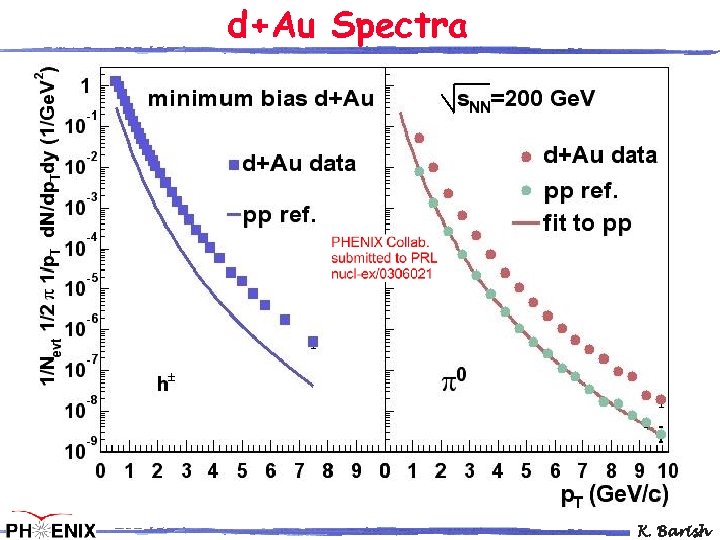 d+Au Spectra K. Barish
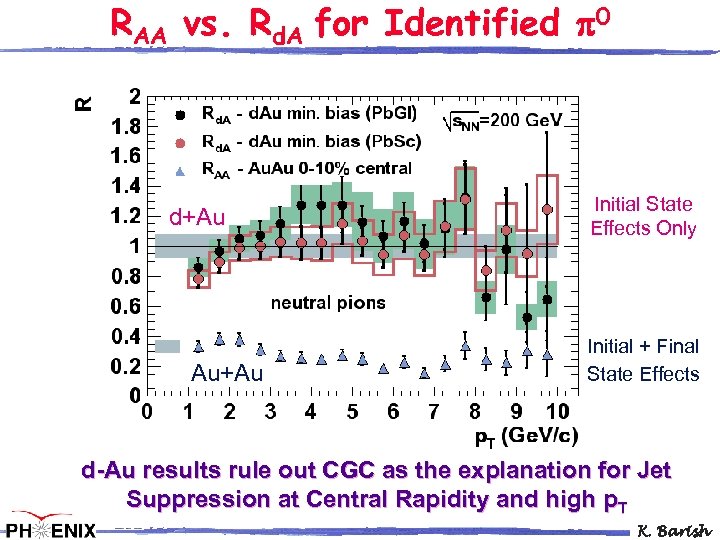 RAA vs. Rd. A for Identified 0 d+Au Au+Au Initial State Effects Only Initial + Final State Effects d-Au results rule out CGC as the explanation for Jet Suppression at Central Rapidity and high p. T K. Barish
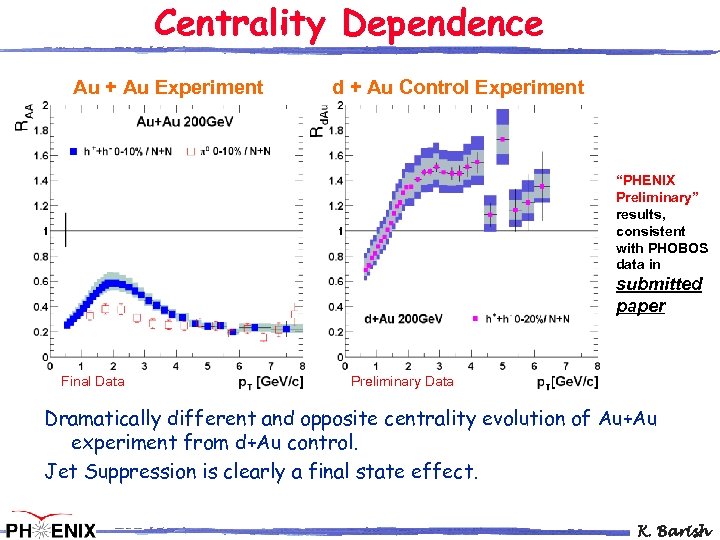 Centrality Dependence Au + Au Experiment d + Au Control Experiment “PHENIX Preliminary” results, consistent with PHOBOS data in submitted paper Final Data Preliminary Data Dramatically different and opposite centrality evolution of Au+Au experiment from d+Au control. Jet Suppression is clearly a final state effect. K. Barish
 First results from polarized proton running K. Barish
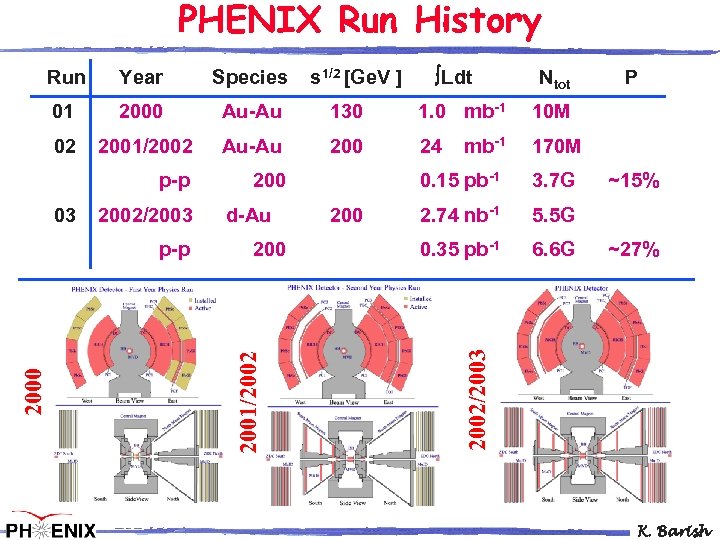
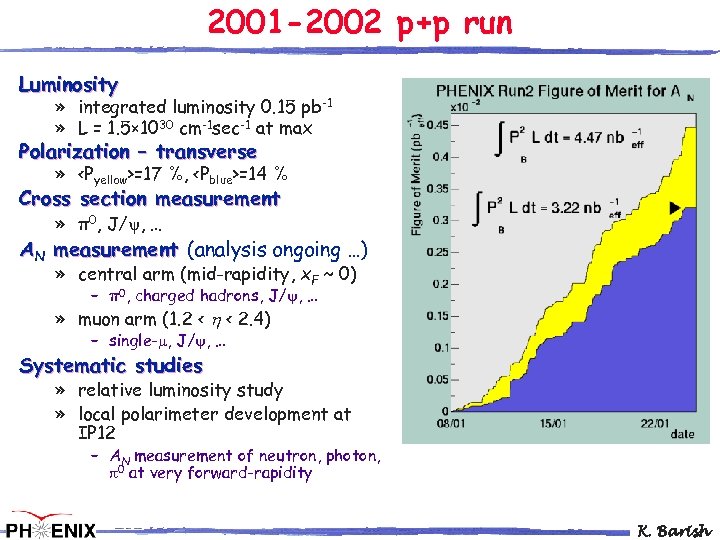 2001 -2002 p+p run Luminosity » integrated luminosity 0. 15 pb-1 » L = 1. 5× 1030 cm-1 sec-1 at max Polarization – transverse »
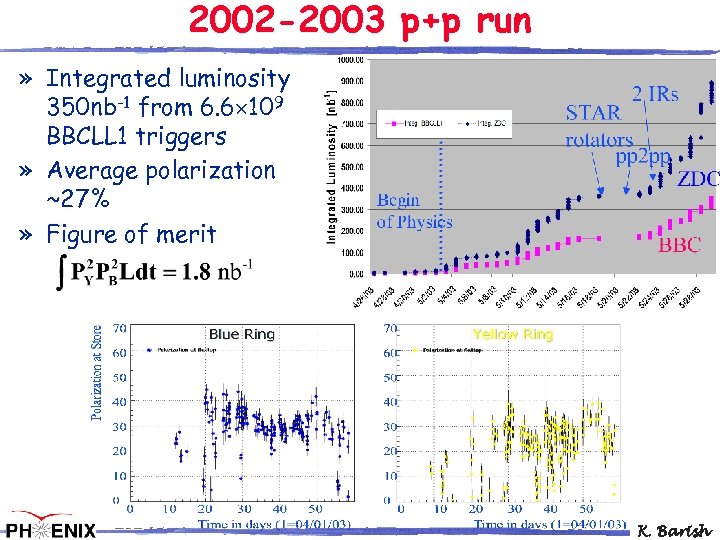 2002 -2003 p+p run » Integrated luminosity 350 nb-1 from 6. 6 109 BBCLL 1 triggers » Average polarization ~27% » Figure of merit K. Barish
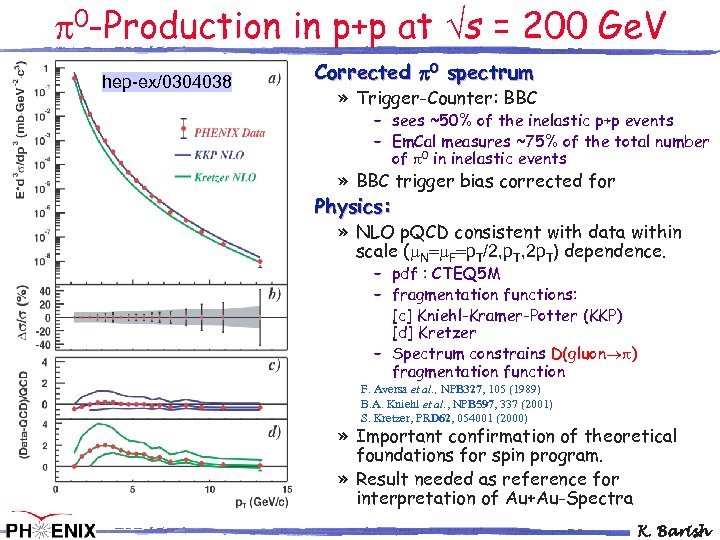 0 -Production in p+p at s = 200 Ge. V hep-ex/0304038 Corrected 0 spectrum » Trigger-Counter: BBC – sees ~50% of the inelastic p+p events – Em. Cal measures ~75% of the total number of 0 in inelastic events » BBC trigger bias corrected for Physics: » NLO p. QCD consistent with data within scale ( N= F=p. T/2, p. T, 2 p. T) dependence. – pdf : CTEQ 5 M – fragmentation functions: [c] Kniehl-Kramer-Potter (KKP) [d] Kretzer – Spectrum constrains D(gluon ) fragmentation function F. Aversa et al. , NPB 327, 105 (1989) B. A. Kniehl et al. , NPB 597, 337 (2001) S. Kretzer, PRD 62, 054001 (2000) » Important confirmation of theoretical foundations for spin program. » Result needed as reference for interpretation of Au+Au-Spectra K. Barish
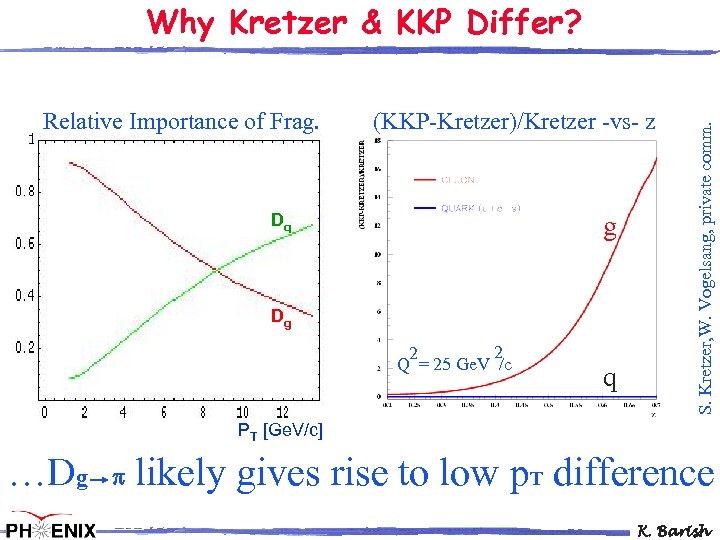 Relative Importance of Frag. (KKP-Kretzer)/Kretzer -vs- z g Dq Dg 2 2 Q = 25 Ge. V /c q S. Kretzer, W. Vogelsang, private comm. Why Kretzer & KKP Differ? PT [Ge. V/c] …Dg likely gives rise to low p. T difference K. Barish
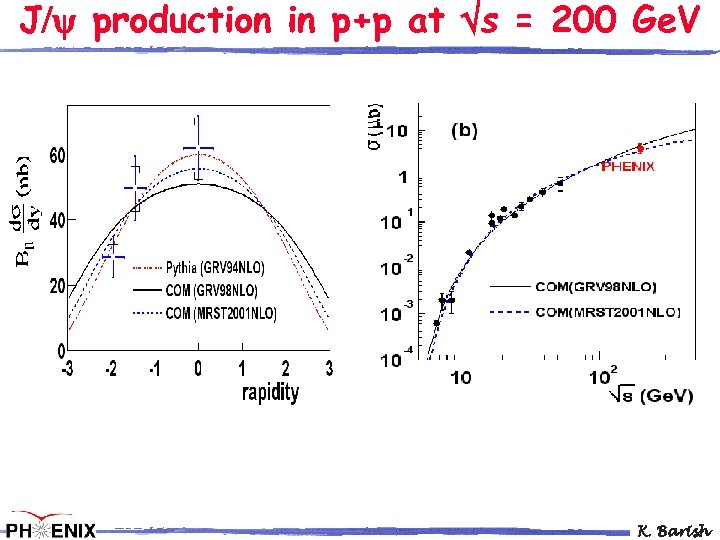 J/y production in p+p at s = 200 Ge. V K. Barish
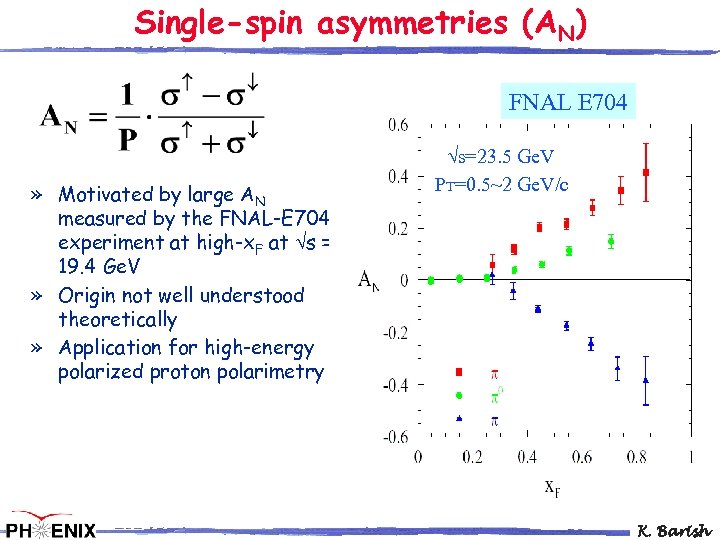 Single-spin asymmetries (AN) FNAL E 704 » Motivated by large AN measured by the FNAL-E 704 experiment at high-x. F at s = 19. 4 Ge. V » Origin not well understood theoretically » Application for high-energy polarized proton polarimetry s=23. 5 Ge. V PT=0. 5~2 Ge. V/c K. Barish
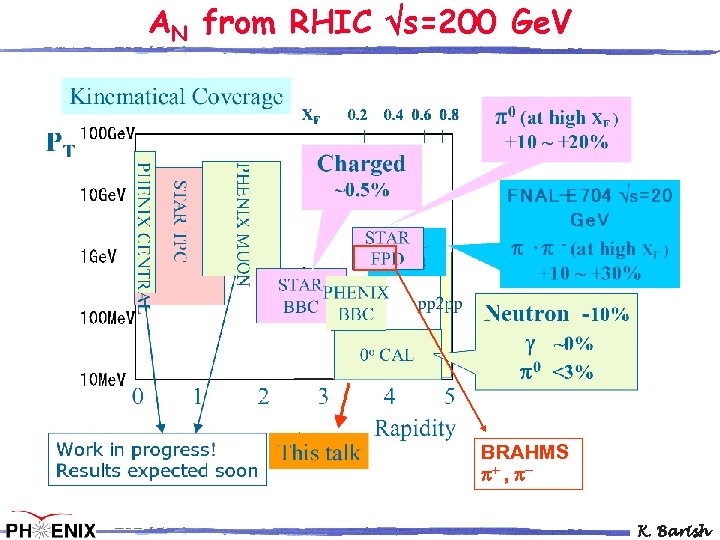 AN from RHIC s=200 Ge. V BRAHMS + , K. Barish
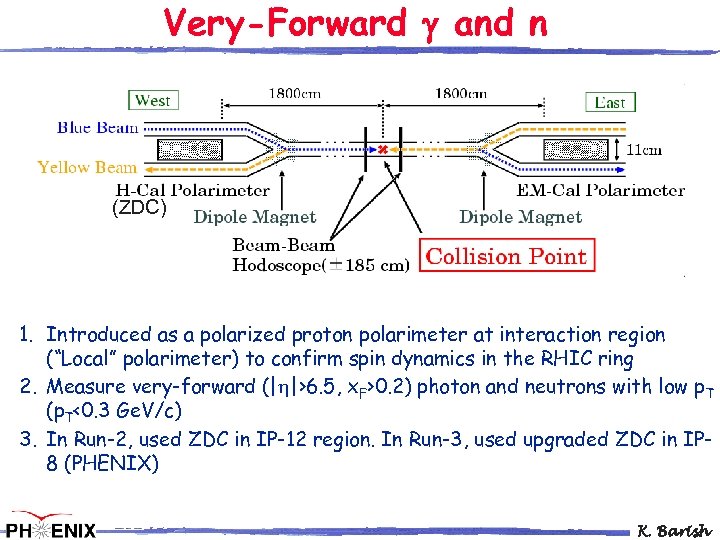 Very-Forward and n (ZDC) 1. Introduced as a polarized proton polarimeter at interaction region (“Local” polarimeter) to confirm spin dynamics in the RHIC ring 2. Measure very-forward (| |>6. 5, x. F>0. 2) photon and neutrons with low p. T (p. T<0. 3 Ge. V/c) 3. In Run-2, used ZDC in IP-12 region. In Run-3, used upgraded ZDC in IP 8 (PHENIX) K. Barish
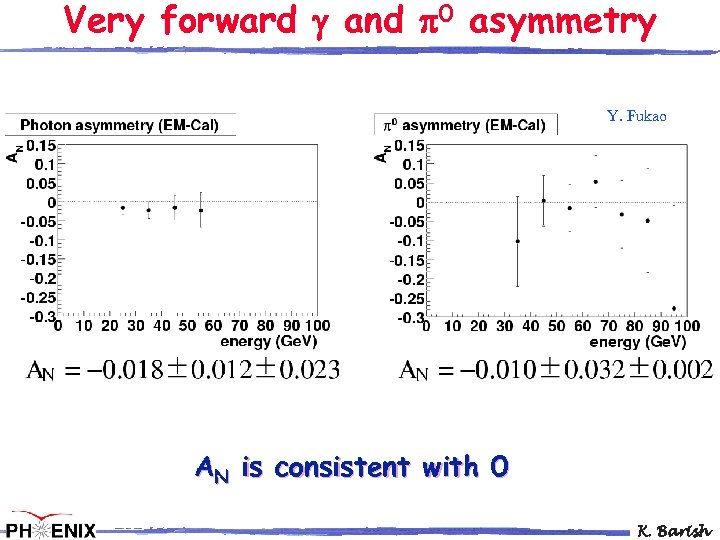 Very forward and 0 asymmetry Y. Fukao AN is consistent with 0 K. Barish
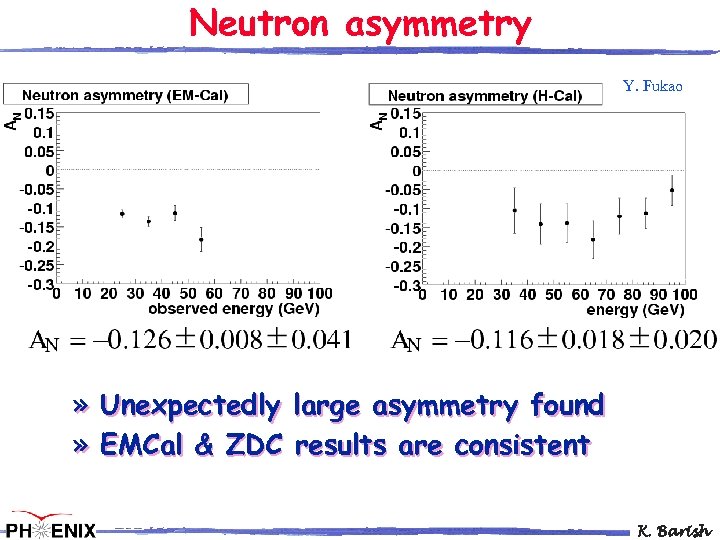 Neutron asymmetry Y. Fukao » Unexpectedly large asymmetry found » EMCal & ZDC results are consistent K. Barish
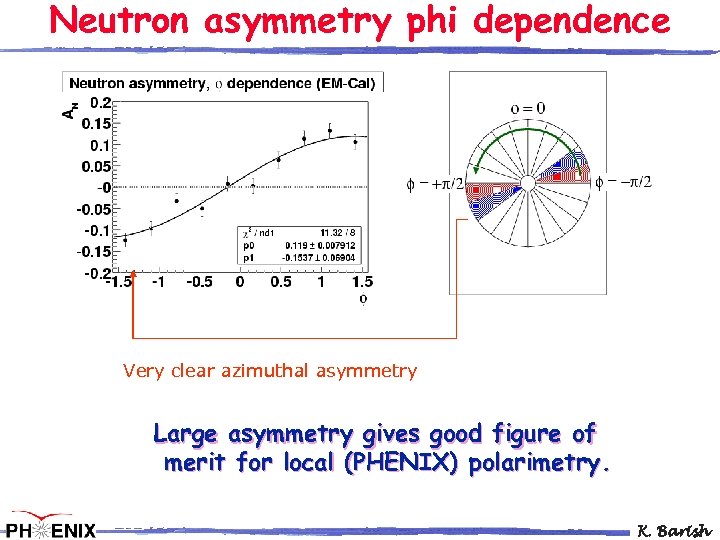 Neutron asymmetry phi dependence Very clear azimuthal asymmetry Large asymmetry gives good figure of merit for local (PHENIX) polarimetry. K. Barish
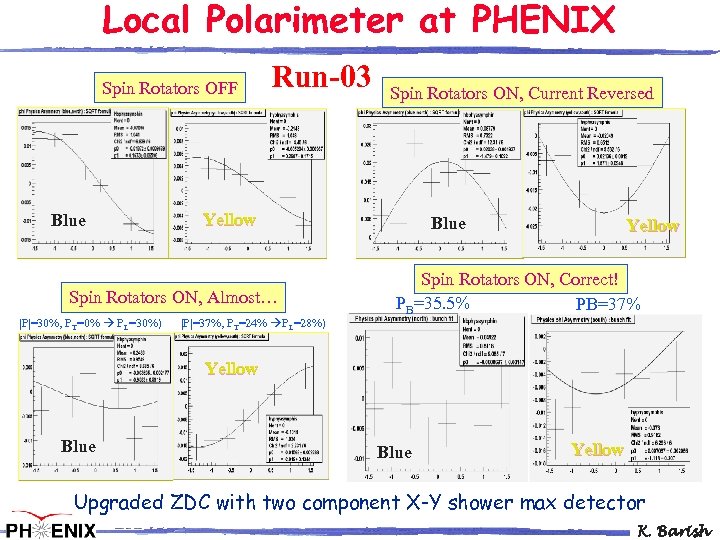 Local Polarimeter at PHENIX Spin Rotators OFF Blue Run-03 Yellow Spin Rotators ON, Almost… |P|=30%, PT=0% PL=30%) Spin Rotators ON, Current Reversed |P|=37%, PT=24% PL=28%) Blue Yellow Spin Rotators ON, Correct! PB=35. 5% PB=37% Yellow Blue Yellow Upgraded ZDC with two component X-Y shower max detector K. Barish
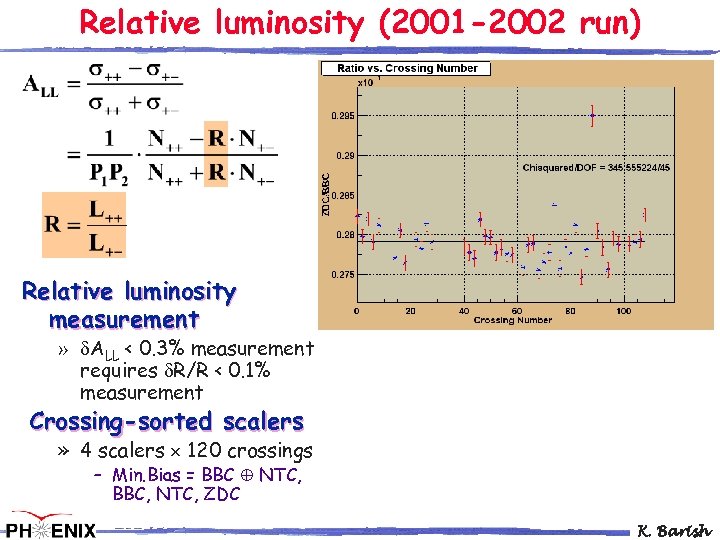 Relative luminosity (2001 -2002 run) Relative luminosity measurement » d. ALL < 0. 3% measurement requires d. R/R < 0. 1% measurement Crossing-sorted scalers » 4 scalers 120 crossings – Min. Bias = BBC NTC, BBC, NTC, ZDC K. Barish
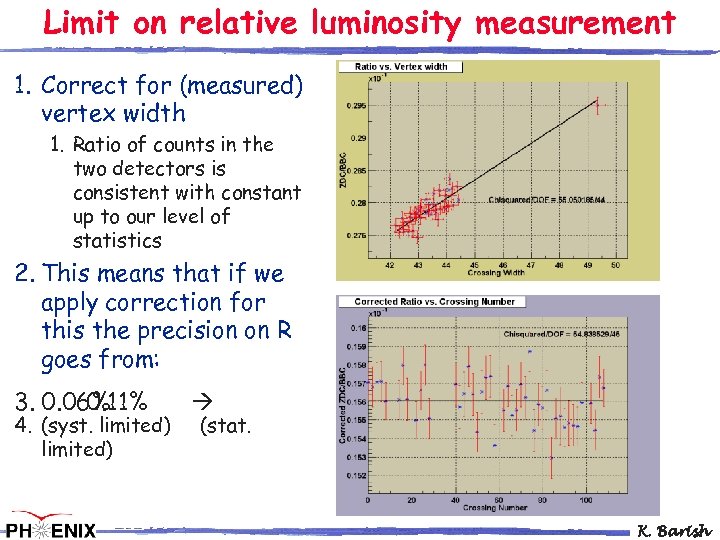 Limit on relative luminosity measurement 1. Correct for (measured) vertex width 1. Ratio of counts in the two detectors is consistent with constant up to our level of statistics 2. This means that if we apply correction for this the precision on R goes from: 3. 0. 06% 0. 11% 4. (syst. limited) (stat. K. Barish
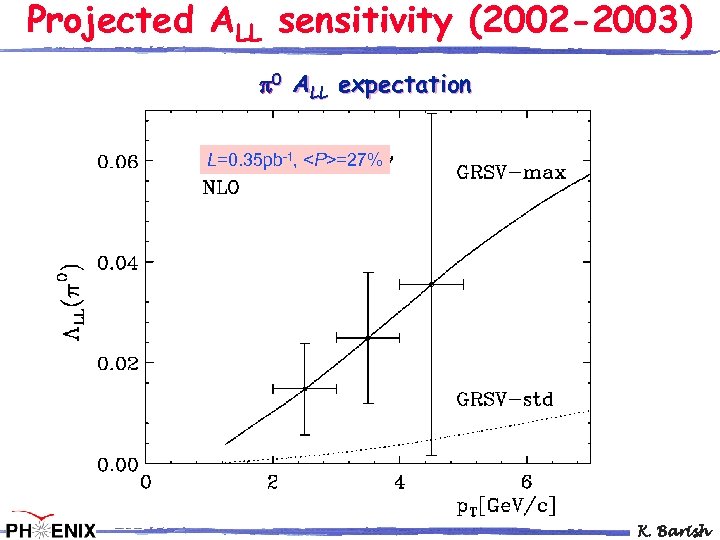 Projected ALL sensitivity (2002 -2003) 0 ALL expectation L=0. 35 pb-1,
=27% K. Barish
 Future Prospects K. Barish
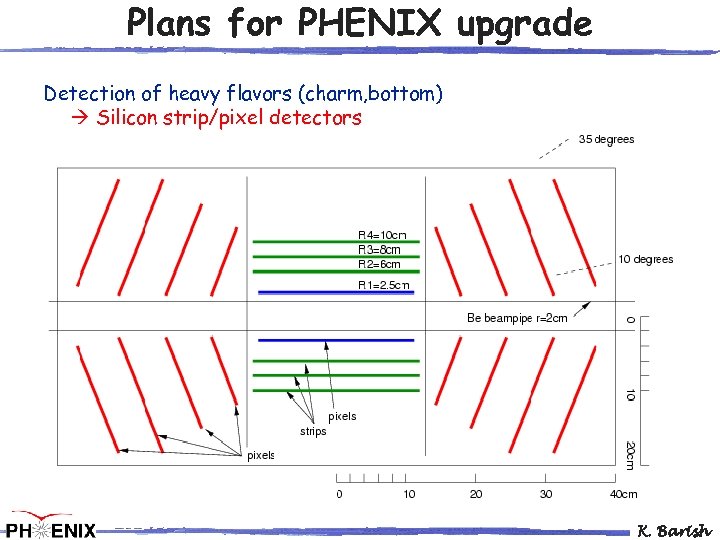 Plans for PHENIX upgrade Detection of heavy flavors (charm, bottom) Silicon strip/pixel detectors K. Barish
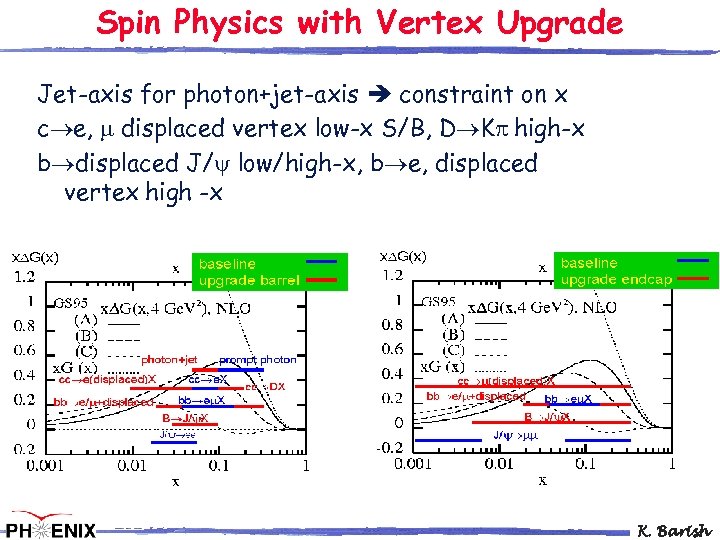 Spin Physics with Vertex Upgrade Jet-axis for photon+jet-axis constraint on x c e, displaced vertex low-x S/B, D K high-x b displaced J/ low/high-x, b e, displaced vertex high -x K. Barish
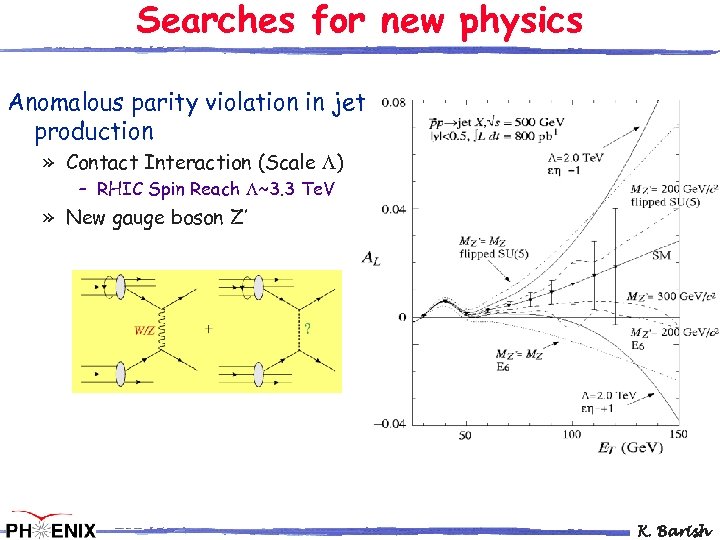
 Summary » PHENIX is well suited to the study of spin physics with a wide variety of probes. » DG with prompt , heavy flavor via electrons, light hadrons » Anti-quark helicity distribution via W decay » Transversity » Physics beyond the standard model » Run-02 gave us a baseline for transverse spin asymmetry and cross-sections. » In Run-03, we commissioned with longitudinal polarized protons (successful spin rotators) and took data for our first ALL measurements using 0. » We have studied our relative luminosity systematics and can make an ALL measurement that is statistics limited. » We have an upgrade plan that will give us the triggers and vertex information that we need for precise future measurements of DG, Dq and new physics at higher luminosity and energy. K. Barish