 Скачать презентацию PHENIX OVERVIEW W A Zajc Columbia University for
cc236719a7b9344142ce10b427ceb462.ppt
- Количество слайдов: 46



PHENIX OVERVIEW W. A. Zajc Columbia University for the PHENIX Collaboration Special thanks to J. Mitchell (BNL) for animations
Outline l Why Nuclear Physics? l Why RHIC? Why PHENIX? l l Where do we go from here? 2
Central Truths of Nuclear Physics l We are nothing We are dust l l We don’t matter 3
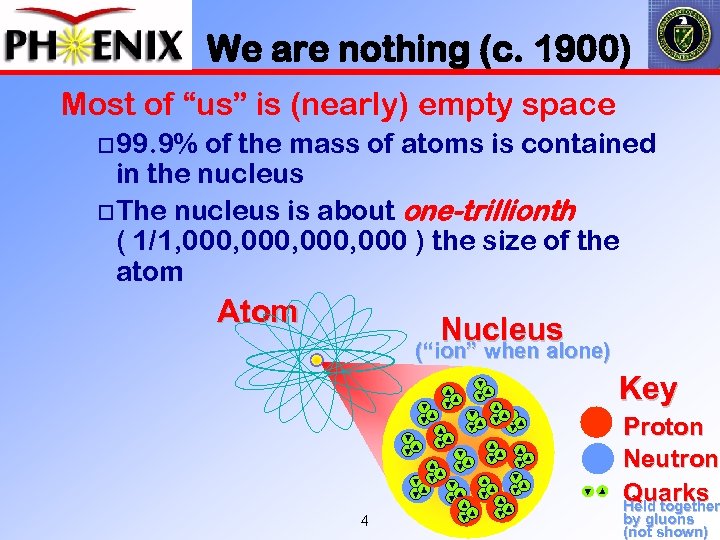
We are nothing (c. 1900) Most of “us” is (nearly) empty space 99. 9% of the mass of atoms is contained in the nucleus The nucleus is about one-trillionth ( 1/1, 000, 000 ) the size of the atom Atom Nucleus (“ion” when alone) Key 4 Proton Neutron Quarks Held together by gluons (not shown)
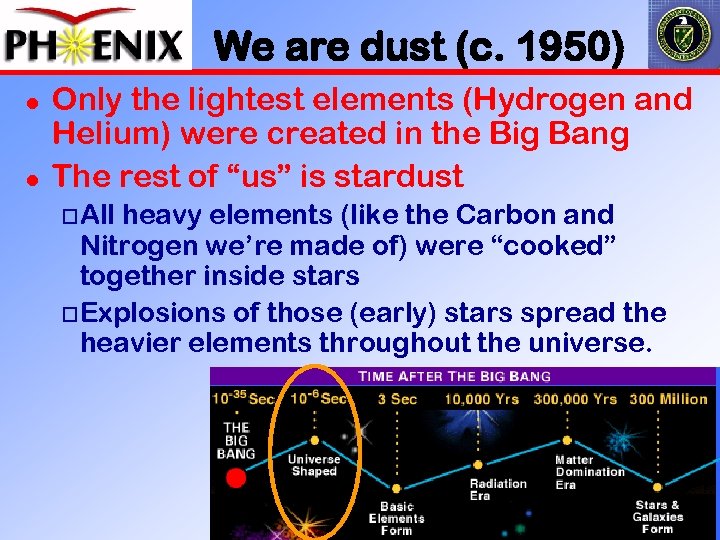
We are dust (c. 1950) l l Only the lightest elements (Hydrogen and Helium) were created in the Big Bang The rest of “us” is stardust All heavy elements (like the Carbon and Nitrogen we’re made of) were “cooked” together inside stars Explosions of those (early) stars spread the heavier elements throughout the universe. 5
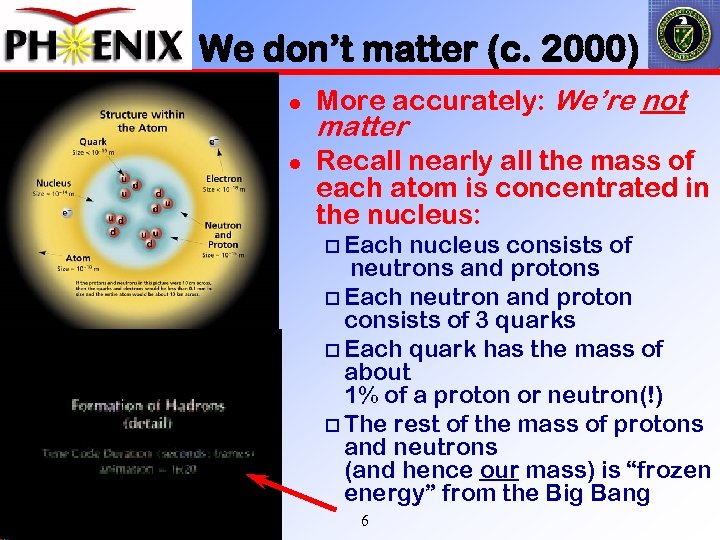
We don’t matter (c. 2000) l l More accurately: We’re not matter Recall nearly all the mass of each atom is concentrated in the nucleus: Each nucleus consists of neutrons and protons Each neutron and proton consists of 3 quarks Each quark has the mass of about 1% of a proton or neutron(!) The rest of the mass of protons and neutrons (and hence our mass) is “frozen energy” from the Big Bang 6
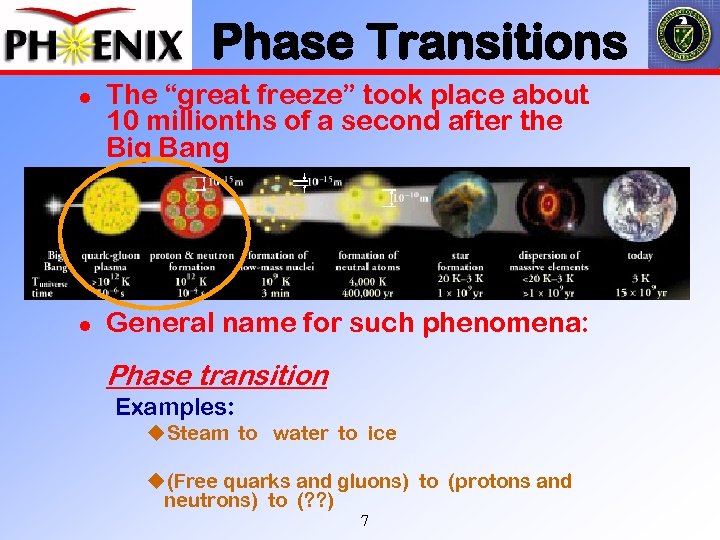
Phase Transitions l The “great freeze” took place about 10 millionths of a second after the Big Bang l General name for such phenomena: Phase transition Examples: u. Steam to water to ice u(Free quarks and gluons) to (protons and neutrons) to (? ? ) 7
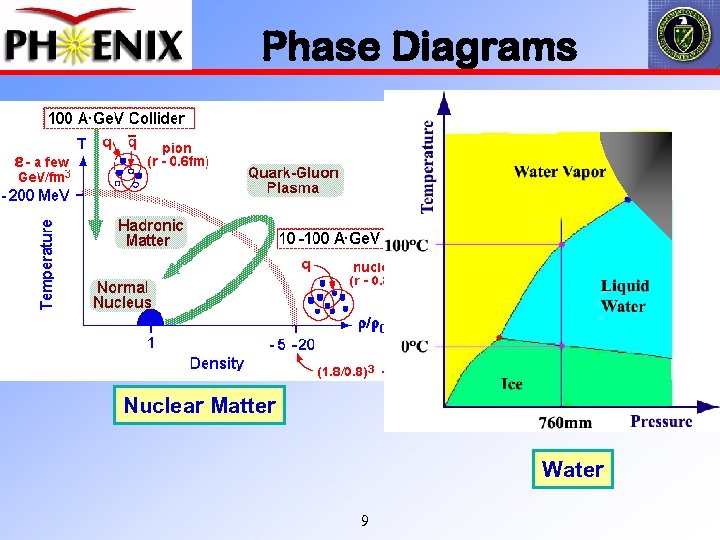
Phase Diagrams Nuclear Matter Water 9
A Silly Analogy l Suppose… You lived in a frozen world where water existed only as ice and ice comes in only quantized sizes ~ ice cubes and theoretical friends tell you there should be a liquid phase and your only way to heat the ice is by colliding two ice cubes So you form a “bunch” containing a billion ice cubes which you collide with another such bunch 10 million times per second which produces about 1000 Ice. Cube-Ice. Cube collisions per second which you observe from the vicinity of Mars l Change the length scale by about 10 trillion è You’re doing physics at RHIC! 10
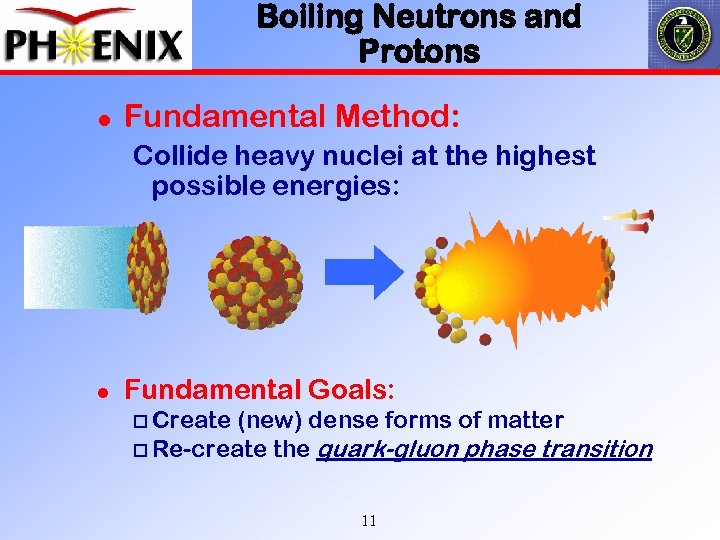
Boiling Neutrons and Protons l Fundamental Method: Collide heavy nuclei at the highest possible energies: l Fundamental Goals: Create (new) dense forms of matter Re-create the quark-gluon phase transition 11
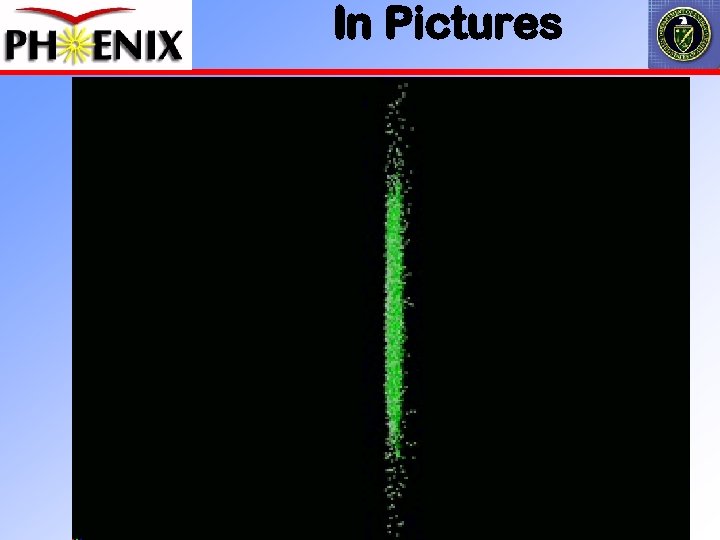
In Pictures 12
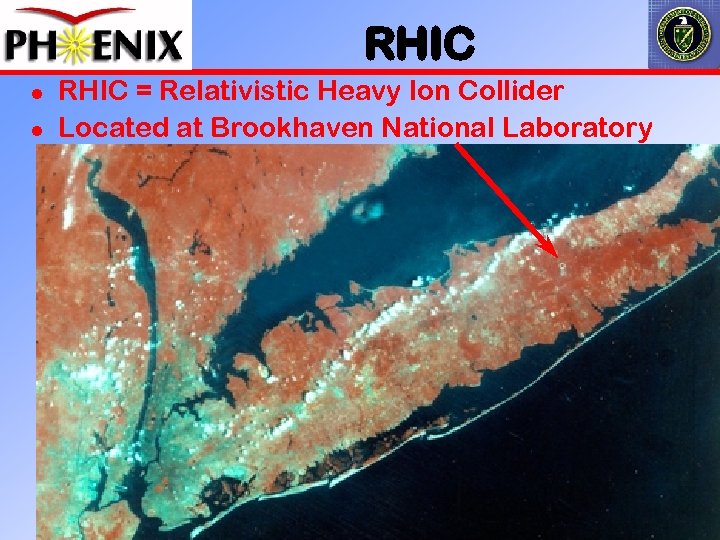
RHIC l l RHIC = Relativistic Heavy Ion Collider Located at Brookhaven National Laboratory 13
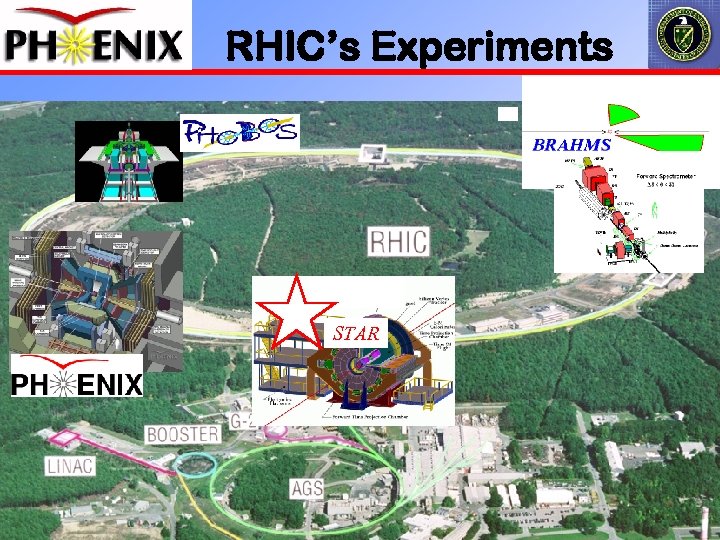
RHIC’s Experiments STAR 14
How is RHIC Different? l It’s a collider è Detector systematics independent of ECM è (No thick targets!) l It’s dedicated è Heavy ions will run 20 -30 weeks/year l It’s high energy è Access to non-perturbative phenomena u. Jets u. Non-linear d. E/dx l Its detectors are comprehensive è ~All final state species measured with a suite of detectors that nonetheless have significant overlap for comparisons 15
What is PHENIX? l Pioneering High Energy Nuclear Interaction e. Xperiment l Goals: Broadest possible study of A-A, p-p collisions to u. Study nuclear matter under extreme conditions u. Using a wide variety of probes sensitive to all timescales u. Study systematic variations with species and energy Measure spin structure of the nucleon è These two programs have produced a detector with unparalleled capabilities 16
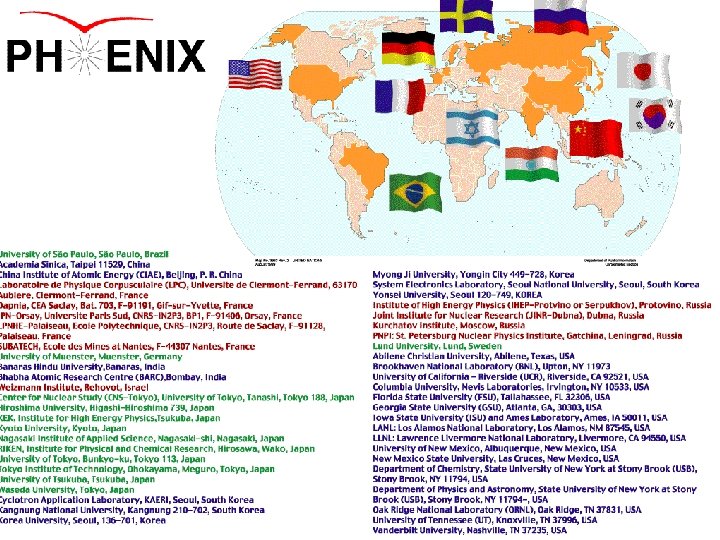
The Collaboration A strongly international venture: è 11 nations Brazil, China, France, Germany, India, Israel, Japan, South Korea, Russia, Sweden, United States è 51 institutions 17
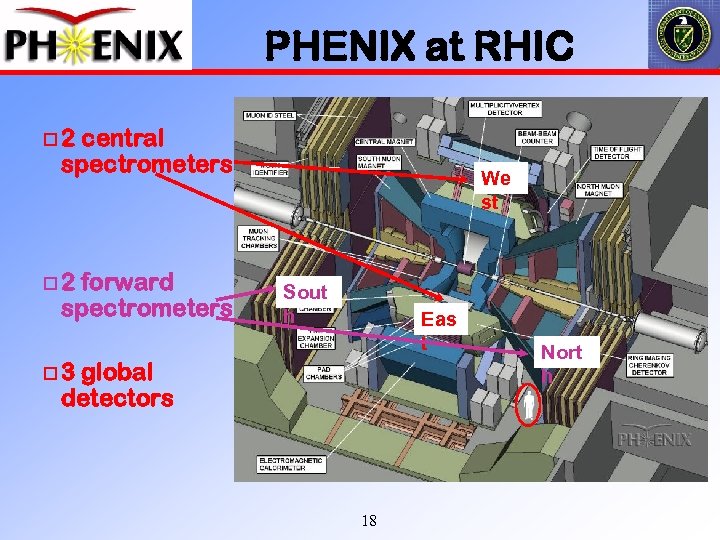
PHENIX at RHIC 2 central spectrometers 2 forward spectrometers We st Sout h Eas t 3 global detectors 18 Nort h
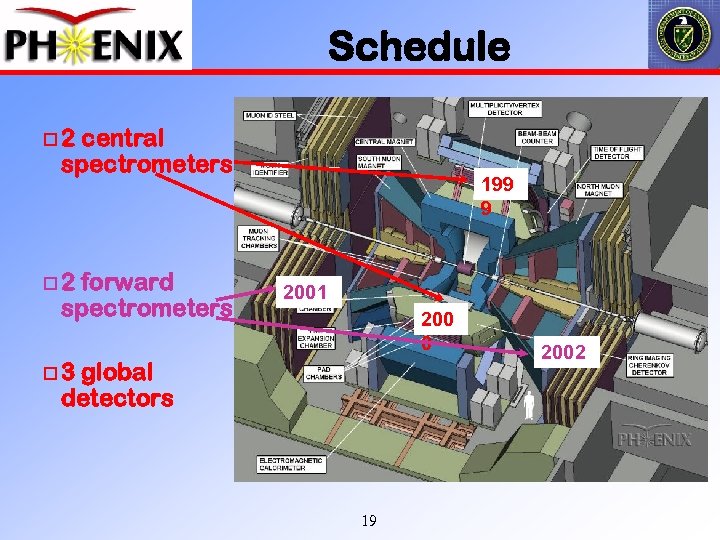
Schedule 2 central spectrometers 2 forward spectrometers 199 9 2001 200 0 3 global detectors 19 2002
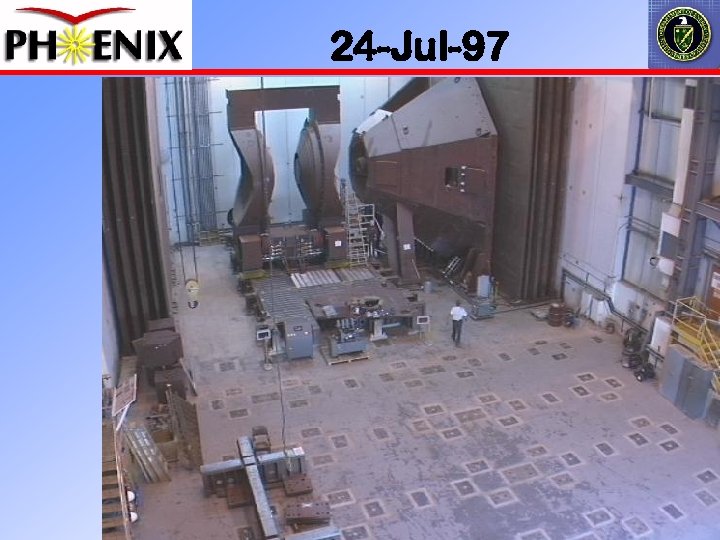
24 -Jul-97 20
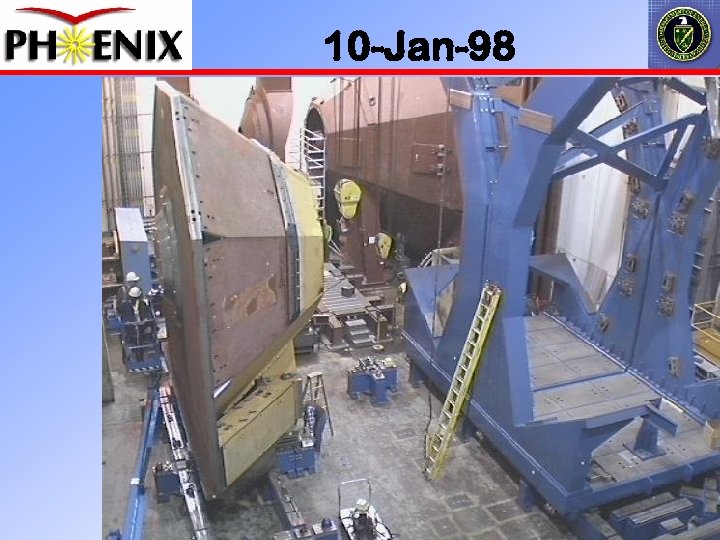
10 -Jan-98 21
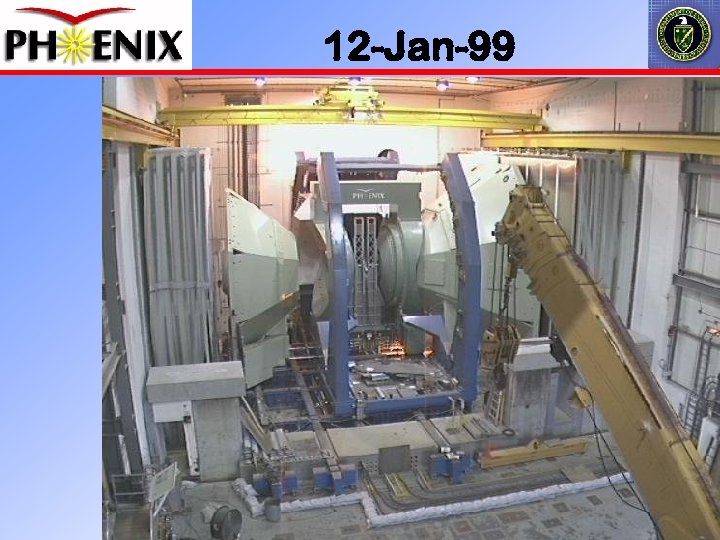
12 -Jan-99 22
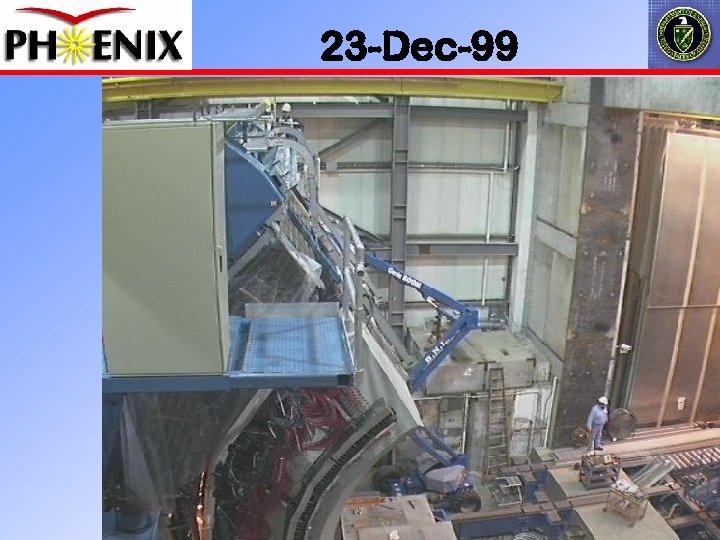
23 -Dec-99 23
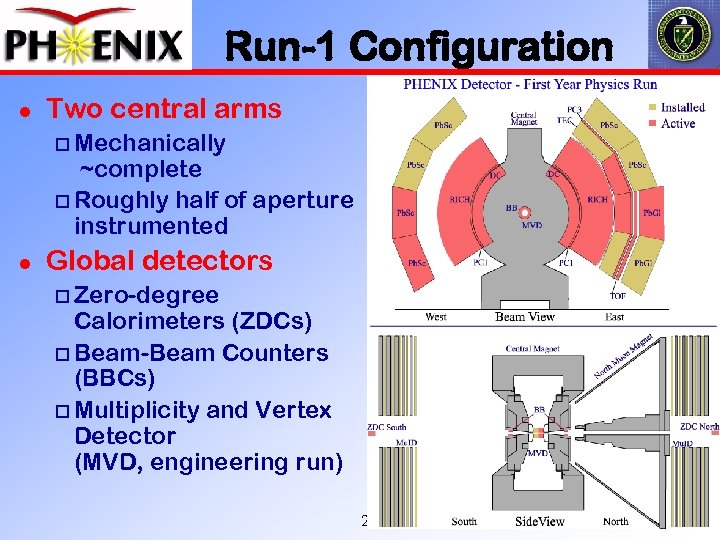
Run-1 Configuration l Two central arms Mechanically ~complete Roughly half of aperture instrumented l Global detectors Zero-degree Calorimeters (ZDCs) Beam-Beam Counters (BBCs) Multiplicity and Vertex Detector (MVD, engineering run) 24
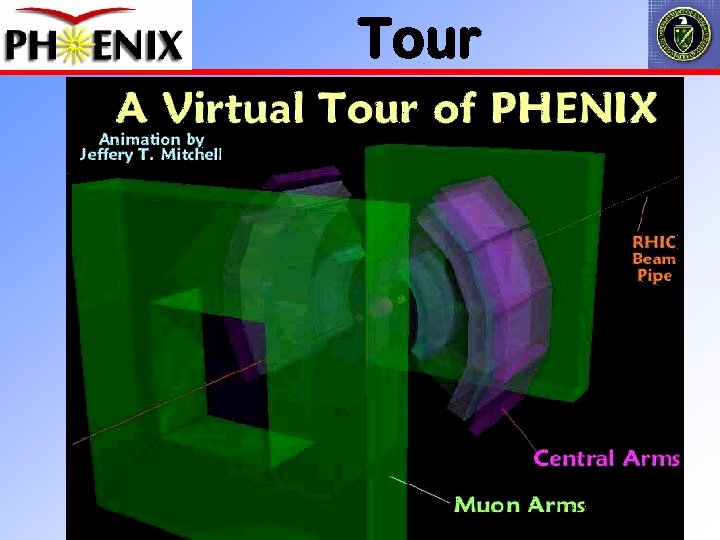
Tour 25
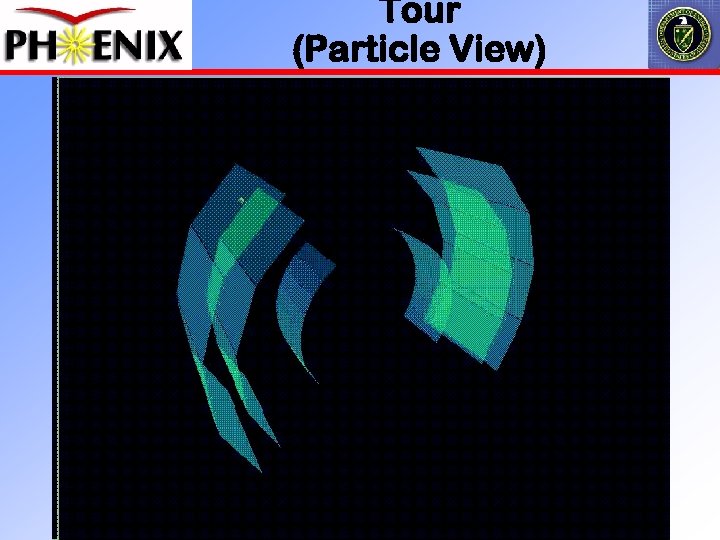
Tour (Particle View) 26
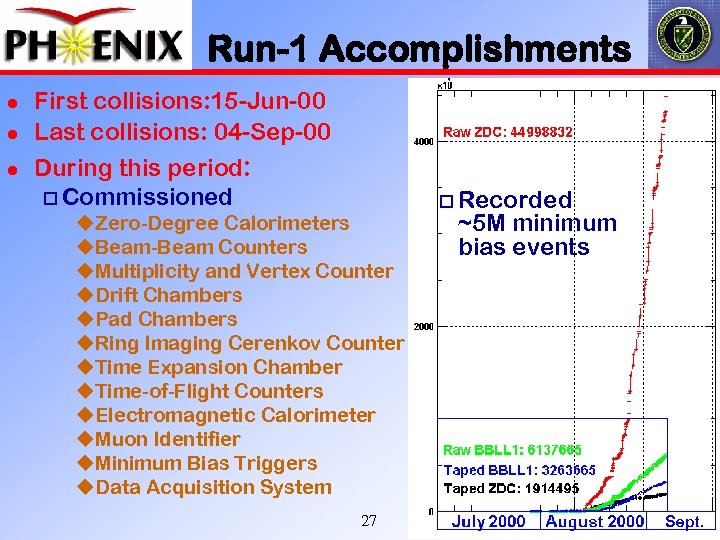
Run-1 Accomplishments l l l First collisions: 15 -Jun-00 Last collisions: 04 -Sep-00 During this period: Commissioned u. Zero-Degree Calorimeters u. Beam-Beam Counters u. Multiplicity and Vertex Counter u. Drift Chambers u. Pad Chambers u. Ring Imaging Cerenkov Counter u. Time Expansion Chamber u. Time-of-Flight Counters u. Electromagnetic Calorimeter u. Muon Identifier u. Minimum Bias Triggers u. Data Acquisition System 27 Recorded ~5 M minimum bias events
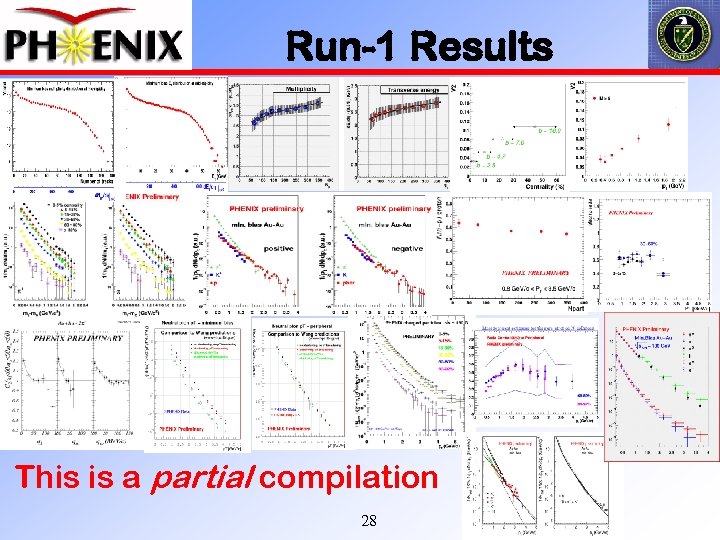
Run-1 Results This is a partial compilation 28
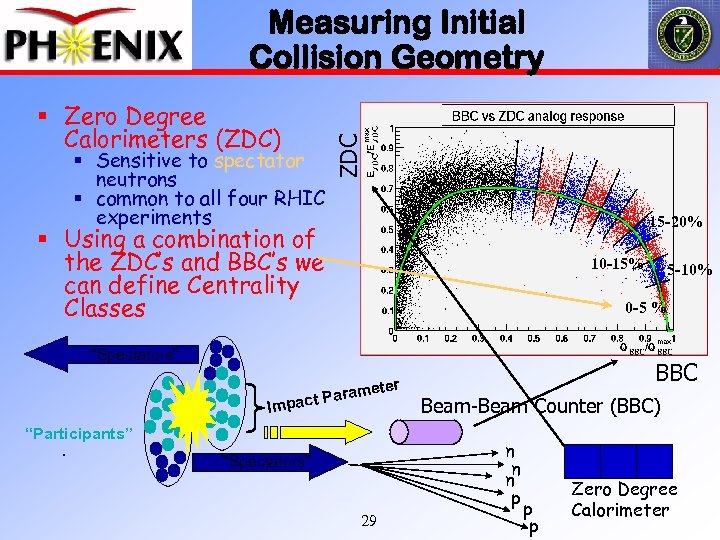
§ Zero Degree Calorimeters (ZDC) § Sensitive to spectator neutrons § common to all four RHIC experiments ZDC Measuring Initial Collision Geometry 15 -20% § Using a combination of the ZDC’s and BBC’s we can define Centrality Classes 10 -15% 0 -5 % “Spectators” eter Param t Impac “Participants” . 5 -10% BBC Beam-Beam Counter (BBC) n n n p “Spectators” 29 p p Zero Degree Calorimeter
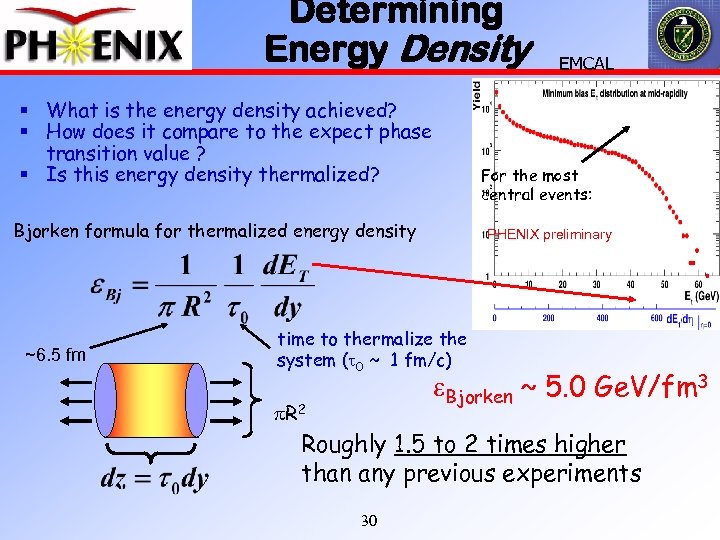
Determining Energy Density § What is the energy density achieved? § How does it compare to the expect phase transition value ? § Is this energy density thermalized? EMCAL For the most central events: Bjorken formula for thermalized energy density PHENIX preliminary ~6. 5 fm time to thermalize the system (t 0 ~ 1 fm/c) e. Bjorken ~ 5. 0 Ge. V/fm 3 R 2 Roughly 1. 5 to 2 times higher than any previous experiments 30
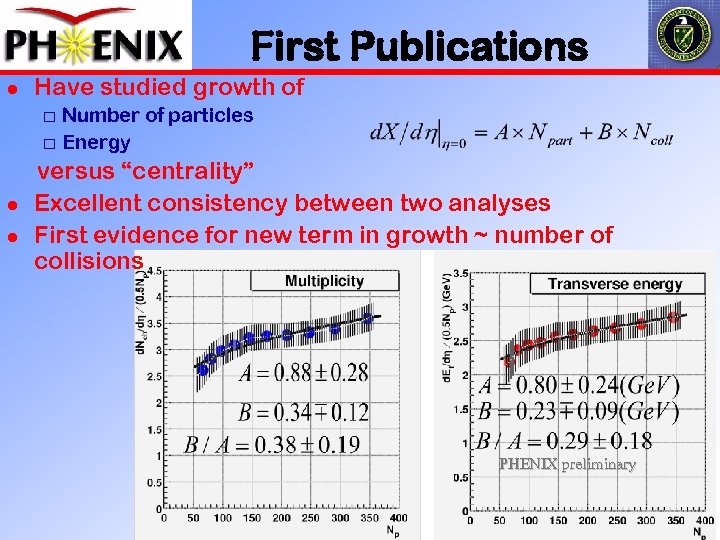
First Publications l Have studied growth of Number of particles Energy l l versus “centrality” Excellent consistency between two analyses First evidence for new term in growth ~ number of collisions PHENIX preliminary 31
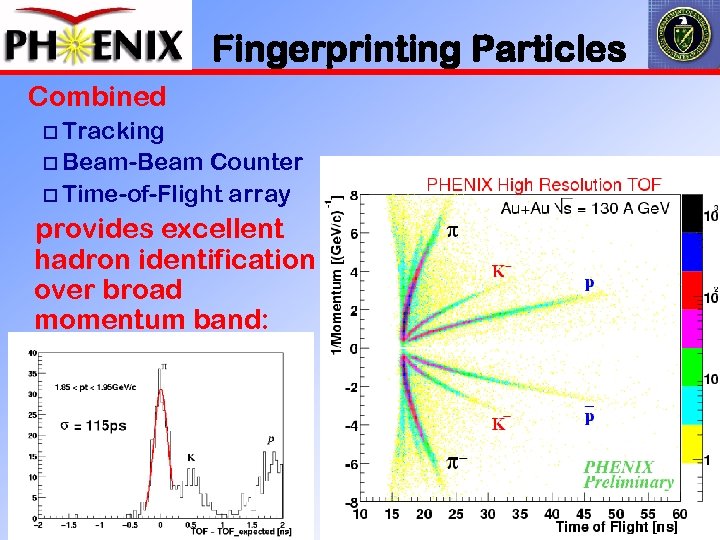
Fingerprinting Particles Combined Tracking Beam-Beam Counter Time-of-Flight array provides excellent hadron identification over broad momentum band: 32
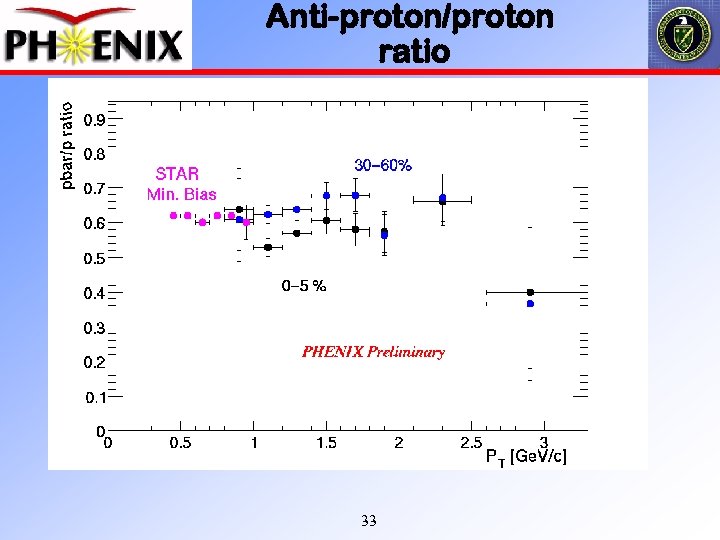
Anti-proton/proton ratio 33
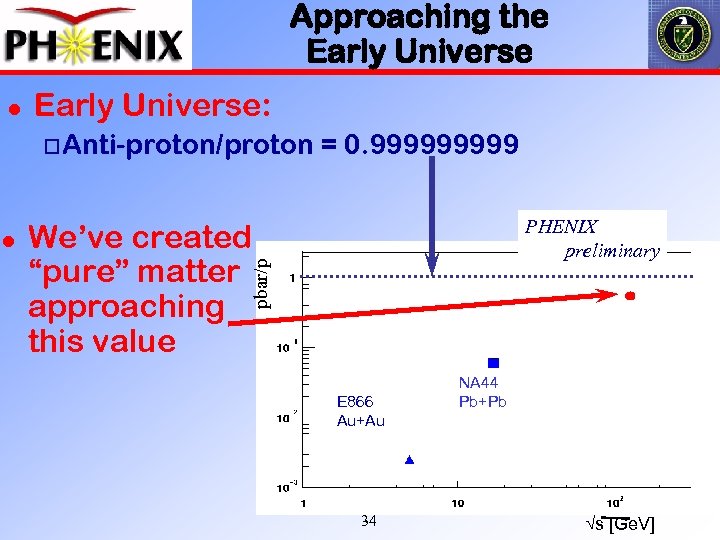
Approaching the Early Universe l Early Universe: Anti-proton/proton PHENIX preliminary We’ve created “pure” matter approaching this value pbar/p l = 0. 99999 E 866 Au+Au 34 NA 44 Pb+Pb √s [Ge. V]
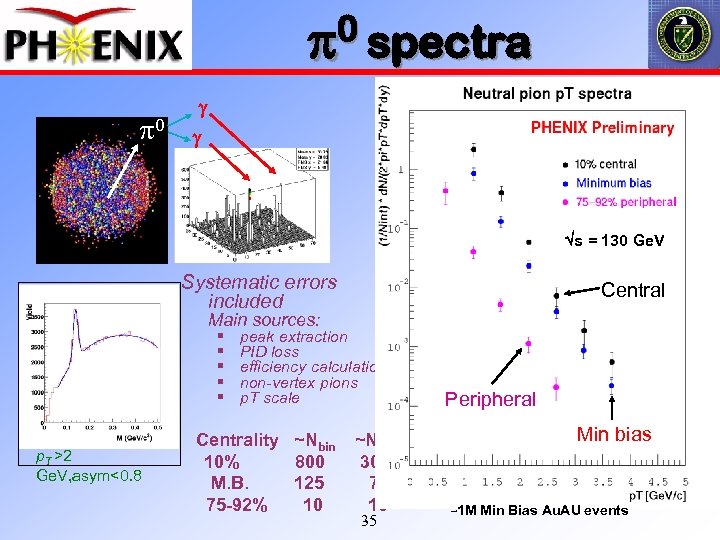
0 spectra p 0 g g s = 130 Ge. V Systematic errors included Main sources: § § § p. T >2 Ge. V, asym<0. 8 Central peak extraction PID loss efficiency calculations non-vertex pions p. T scale Centrality ~Nbin 10% 800 M. B. 125 75 -92% 10 ~Npart 300 75 10 35 Peripheral Min bias ~1 M Min Bias Au. AU events
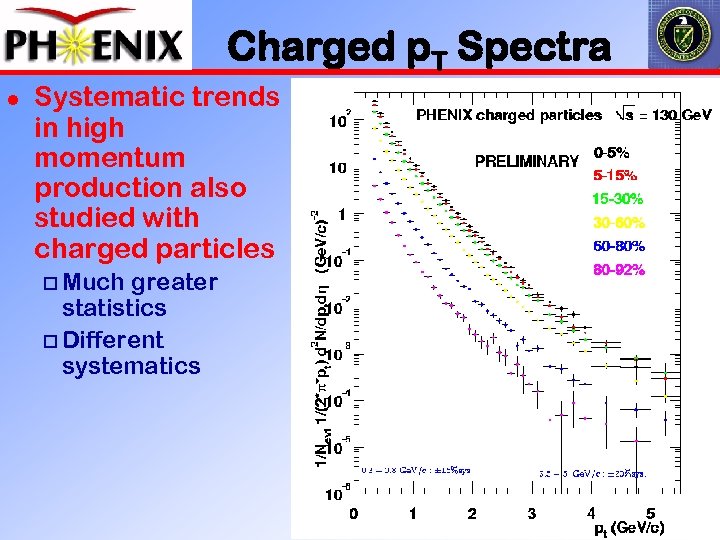
Charged p. T Spectra l Systematic trends in high momentum production also studied with charged particles Much greater statistics Different systematics 36
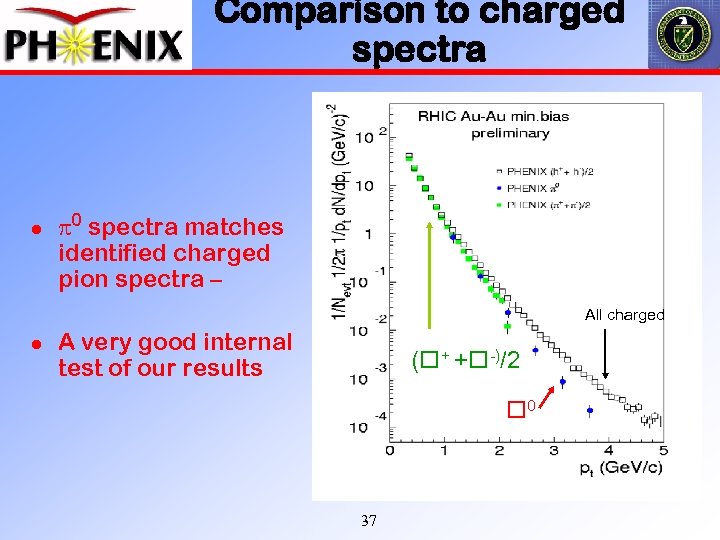
Comparison to charged spectra l l 0 spectra matches identified charged pion spectra – All charged A very good internal test of our results ( + + -)/2 0 37
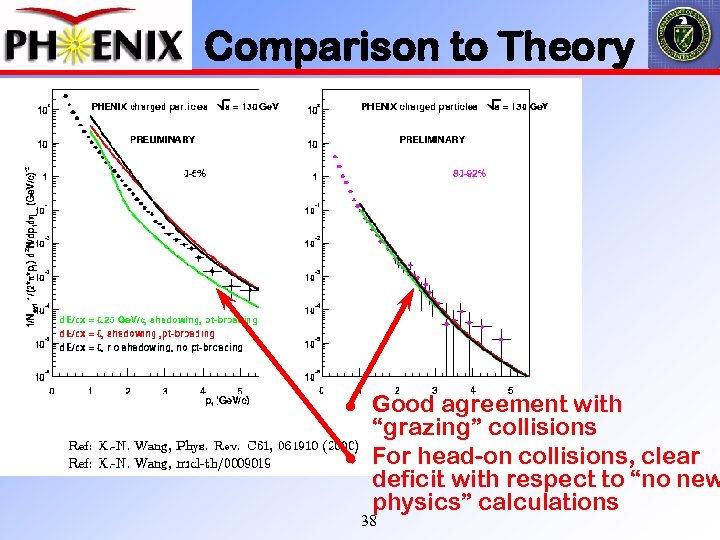
Comparison to Theory l l Good agreement with “grazing” collisions For head-on collisions, clear deficit with respect to “no new physics” calculations 38
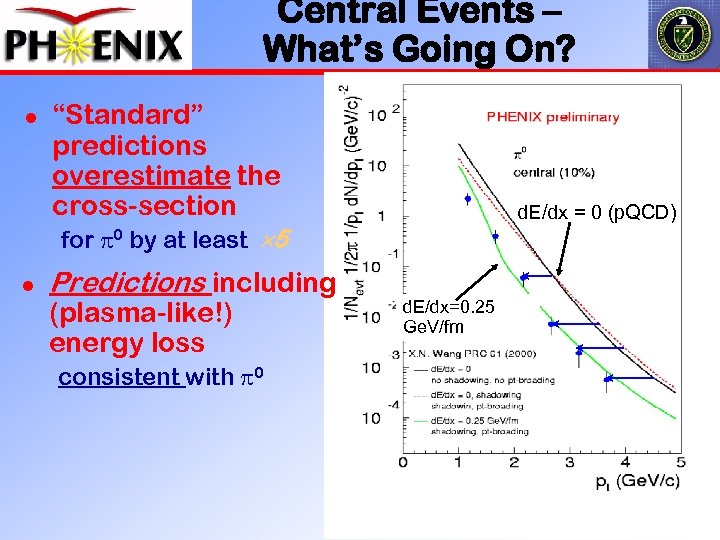
Central Events – What’s Going On? l “Standard” predictions overestimate the cross-section d. E/dx = 0 (p. QCD) for 0 by at least 5 l Predictions including (plasma-like!) energy loss d. E/dx=0. 25 Ge. V/fm consistent with 0 39
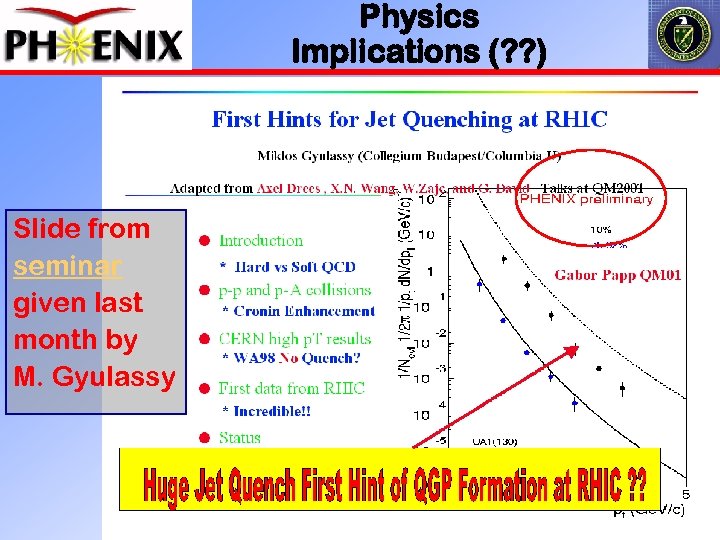
Physics Implications (? ? ) Slide from seminar given last month by M. Gyulassy 40
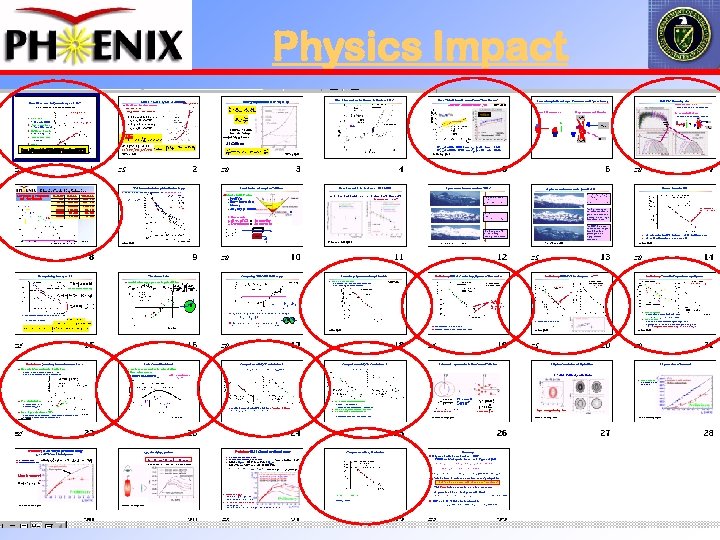
Physics Impact 41
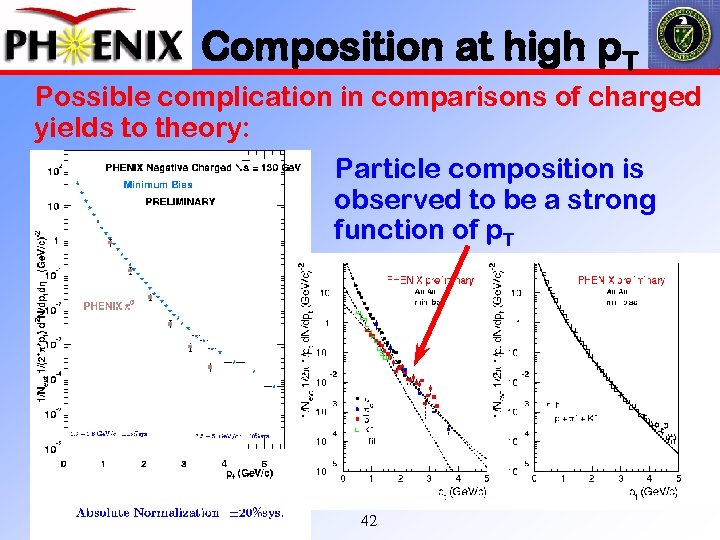
Composition at high p. T Possible complication in comparisons of charged yields to theory: Particle composition is observed to be a strong function of p. T 42
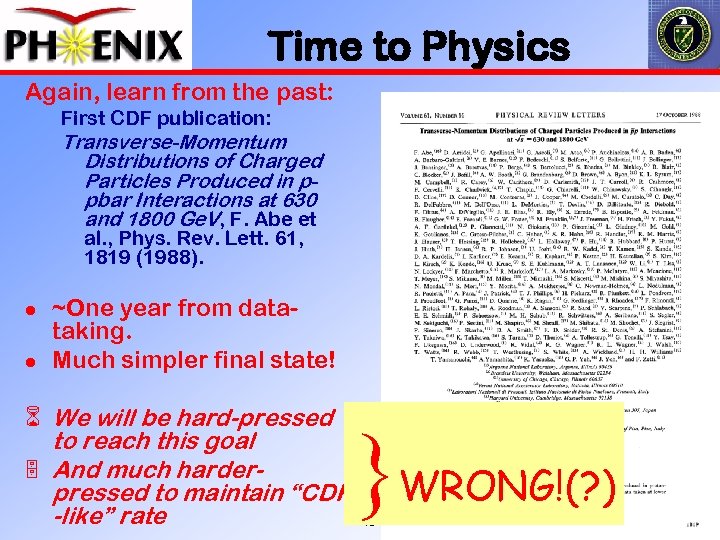
Time to Physics Again, learn from the past: First CDF publication: Transverse-Momentum Distributions of Charged Particles Produced in ppbar Interactions at 630 and 1800 Ge. V, F. Abe et al. , Phys. Rev. Lett. 61, 1819 (1988). l l ~One year from datataking. Much simpler final state! 6 We will be hard-pressed to reach this goal 5 And much harderpressed to maintain “CDF -like” rate }WRONG!(? ) 43
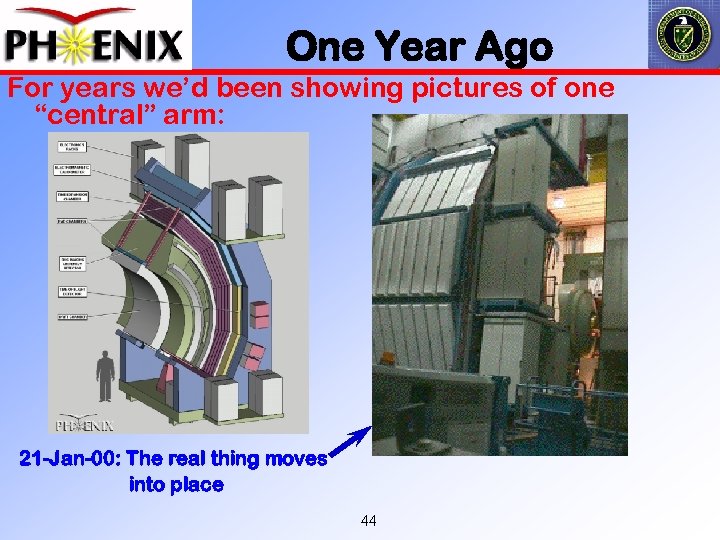
One Year Ago For years we’d been showing pictures of one “central” arm: 21 -Jan-00: The real thing moves into place 44
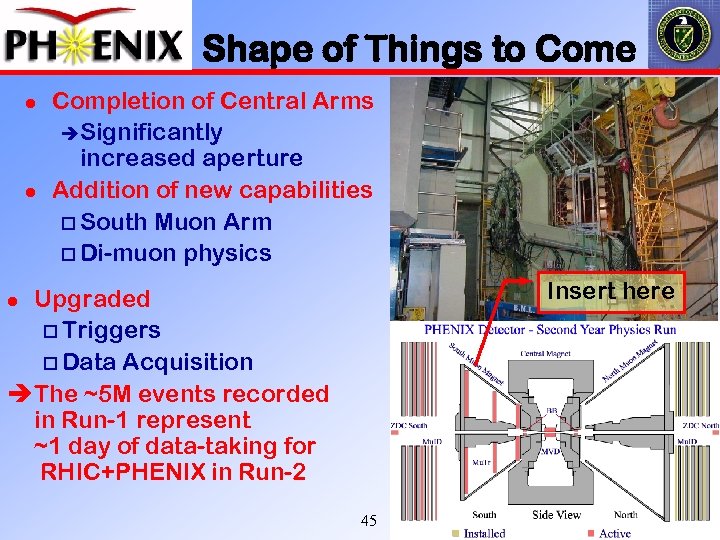
Shape of Things to Come l l Completion of Central Arms èSignificantly increased aperture Addition of new capabilities South Muon Arm Di-muon physics Upgraded Triggers Data Acquisition è The ~5 M events recorded in Run-1 represent ~1 day of data-taking for RHIC+PHENIX in Run-2 l Insert here 45
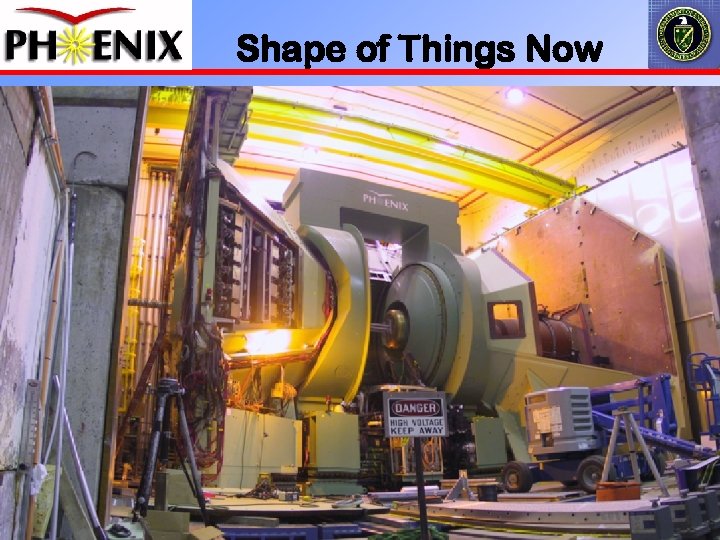
Shape of Things Now 46
Summary l PHENIX detector has provided outstanding data in first year of RHIC operations Measured u. Charged multiplicity u. Transverse energy u. Elliptic flow u. Identified particle spectra u HBT parameters u. High p. T spectra u. Inclusive electron spectrum u(much more) Observed u. New trends in particle production u. New behavior in particle yields at high momentum l Ideally positioned to dramatically extend these results in second year of RHIC running 47
Скачать презентацию PHENIX OVERVIEW W A Zajc Columbia University for
cc236719a7b9344142ce10b427ceb462.ppt