


 Скачать презентацию PHENIX for the First Spin Collider RHIC Hideto
e07093c9327d7fc95d50f8d357cacd6a.ppt
- Количество слайдов: 30
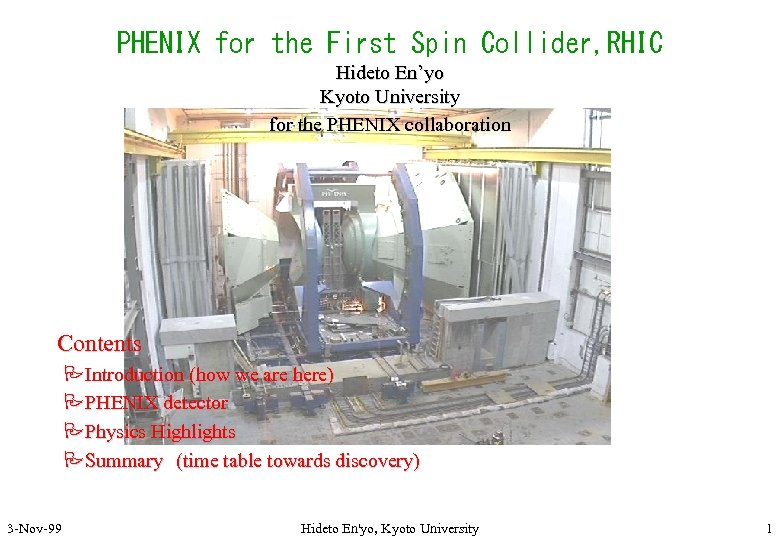 PHENIX for the First Spin Collider, RHIC Hideto En’yo Kyoto University for the PHENIX collaboration Contents PIntroduction (how we are here) PPHENIX detector PPhysics Highlights PSummary (time table towards discovery) 3 -Nov-99 Hideto En'yo, Kyoto University 1
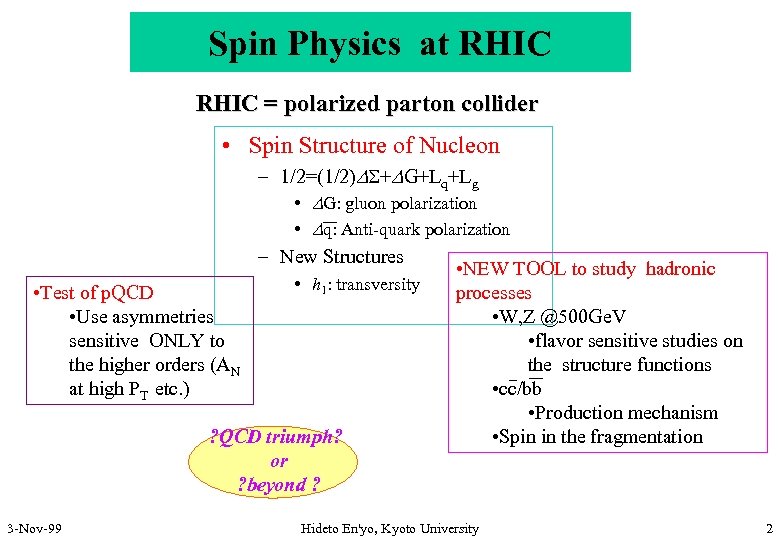 Spin Physics at RHIC = polarized parton collider • Spin Structure of Nucleon – 1/2=(1/2)DS+DG+Lq+Lg • DG: gluon polarization • Dq: Anti-quark polarization – New Structures • Test of p. QCD • Use asymmetries sensitive ONLY to the higher orders (AN at high PT etc. ) • h 1: transversity ? QCD triumph? or ? beyond ? 3 -Nov-99 • NEW TOOL to study hadronic processes • W, Z @500 Ge. V • flavor sensitive studies on the structure functions • cc/bb • Production mechanism • Spin in the fragmentation Hideto En'yo, Kyoto University 2
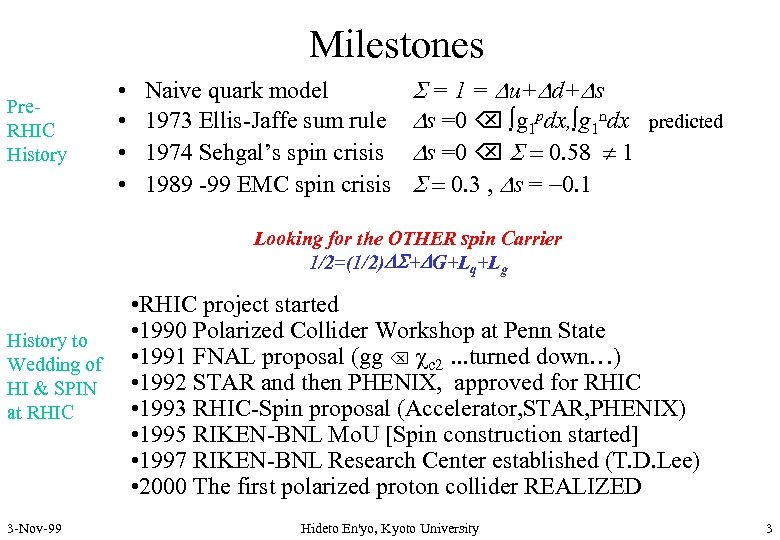 Milestones Pre. RHIC History • • Naive quark model 1973 Ellis-Jaffe sum rule 1974 Sehgal’s spin crisis 1989 -99 EMC spin crisis S = 1 = Du+Dd+Ds Ds =0 g 1 pdx, g 1 ndx predicted Ds =0 S = 0. 58 1 S = 0. 3 , Ds = -0. 1 Looking for the OTHER spin Carrier 1/2=(1/2)DS+DG+Lq+Lg History to Wedding of HI & SPIN at RHIC 3 -Nov-99 • RHIC project started • 1990 Polarized Collider Workshop at Penn State • 1991 FNAL proposal (gg cc 2. . . turned down…) • 1992 STAR and then PHENIX, approved for RHIC • 1993 RHIC-Spin proposal (Accelerator, STAR, PHENIX) • 1995 RIKEN-BNL Mo. U [Spin construction started] • 1997 RIKEN-BNL Research Center established (T. D. Lee) • 2000 The first polarized proton collider REALIZED Hideto En'yo, Kyoto University 3
 3 -Nov-99 Hideto En'yo, Kyoto University 4
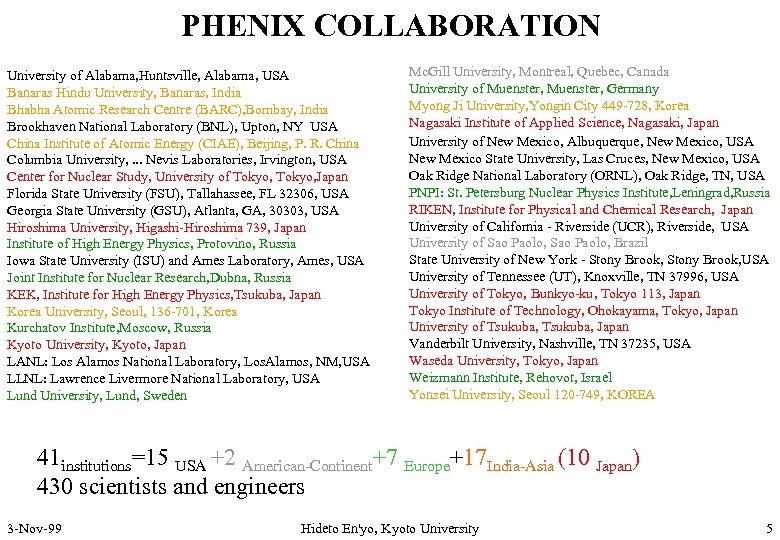 PHENIX COLLABORATION University of Alabama, Huntsville, Alabama, USA Banaras Hindu University, Banaras, India Bhabha Atomic Research Centre (BARC), Bombay, India Brookhaven National Laboratory (BNL), Upton, NY USA China Institute of Atomic Energy (CIAE), Beijing, P. R. China Columbia University, . . . Nevis Laboratories, Irvington, USA Center for Nuclear Study, University of Tokyo, Japan Florida State University (FSU), Tallahassee, FL 32306, USA Georgia State University (GSU), Atlanta, GA, 30303, USA Hiroshima University, Higashi-Hiroshima 739, Japan Institute of High Energy Physics, Protovino, Russia Iowa State University (ISU) and Ames Laboratory, Ames, USA Joint Institute for Nuclear Research, Dubna, Russia KEK, Institute for High Energy Physics, Tsukuba, Japan Korea University, Seoul, 136 -701, Korea Kurchatov Institute, Moscow, Russia Kyoto University, Kyoto, Japan LANL: Los Alamos National Laboratory, Los. Alamos, NM, USA LLNL: Lawrence Livermore National Laboratory, USA Lund University, Lund, Sweden Mc. Gill University, Montreal, Quebec, Canada University of Muenster, Germany Myong Ji University, Yongin City 449 -728, Korea Nagasaki Institute of Applied Science, Nagasaki, Japan University of New Mexico, Albuquerque, New Mexico, USA New Mexico State University, Las Cruces, New Mexico, USA Oak Ridge National Laboratory (ORNL), Oak Ridge, TN, USA PNPI: St. Petersburg Nuclear Physics Institute, Leningrad, Russia RIKEN, Institute for Physical and Chemical Research, Japan University of California - Riverside (UCR), Riverside, USA University of Sao Paolo, Brazil State University of New York - Stony Brook, USA University of Tennessee (UT), Knoxville, TN 37996, USA University of Tokyo, Bunkyo-ku, Tokyo 113, Japan Tokyo Institute of Technology, Ohokayama, Tokyo, Japan University of Tsukuba, Japan Vanderbilt University, Nashville, TN 37235, USA Waseda University, Tokyo, Japan Weizmann Institute, Rehovot, Israel Yonsei University, Seoul 120 -749, KOREA 41 institutions=15 USA +2 American-Continent+7 Europe+17 India-Asia (10 Japan) 430 scientists and engineers 3 -Nov-99 Hideto En'yo, Kyoto University 5
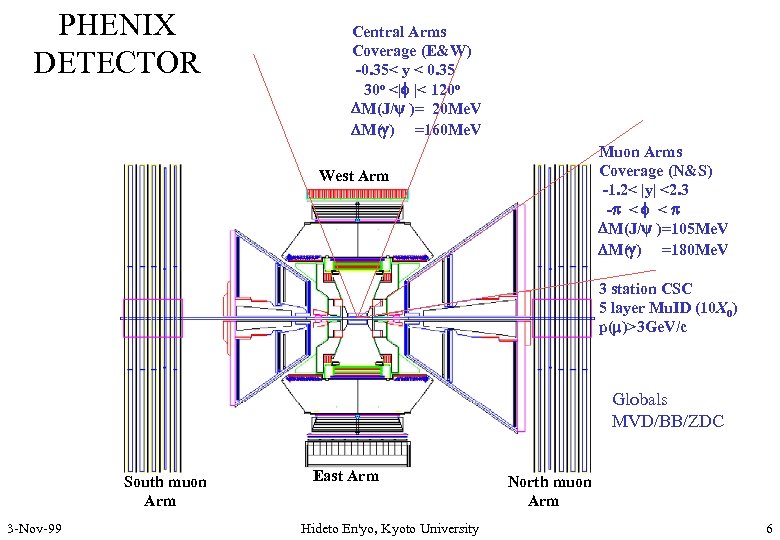 PHENIX DETECTOR Central Arms Coverage (E&W) -0. 35< y < 0. 35 30 o <|f |< 120 o DM(J/y )= 20 Me. V DM(g) =160 Me. V Muon Arms Coverage (N&S) -1. 2< |y| <2. 3 -p < f < p DM(J/y )=105 Me. V DM(g) =180 Me. V West Arm 3 station CSC 5 layer Mu. ID (10 X 0) p(m)>3 Ge. V/c Globals MVD/BB/ZDC South muon Arm 3 -Nov-99 East Arm Hideto En'yo, Kyoto University North muon Arm 6
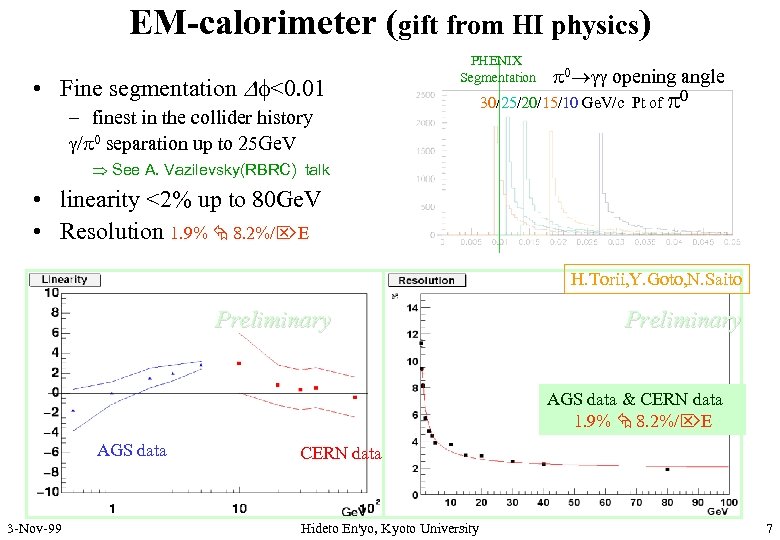 EM-calorimeter (gift from HI physics) • Fine segmentation Df<0. 01 PHENIX Segmentation – finest in the collider history / 0 separation up to 25 Ge. V 0 opening angle 30/25/20/15/10 Ge. V/c Pt of 0 See A. Vazilevsky(RBRC) talk • linearity <2% up to 80 Ge. V • Resolution 1. 9% 8. 2%/ E H. Torii, Y. Goto, N. Saito Preliminary AGS data & CERN data 1. 9% 8. 2%/ E AGS data 3 -Nov-99 CERN data Hideto En'yo, Kyoto University 7
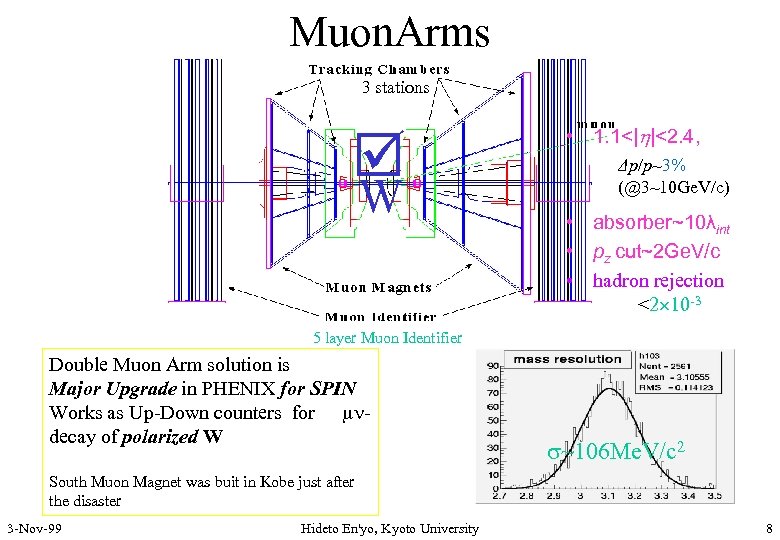 Muon. Arms 3 stations W • 1. 1<| |<2. 4, Δp/p~3% (@3~10 Ge. V/c) • absorber~10λint • pz cut~2 Ge. V/c • hadron rejection <2 10 -3 5 layer Muon Identifier Double Muon Arm solution is Major Upgrade in PHENIX for SPIN Works as Up-Down counters for ndecay of polarized W s~106 Me. V/c 2 South Muon Magnet was buit in Kobe just after the disaster 3 -Nov-99 Hideto En'yo, Kyoto University 8
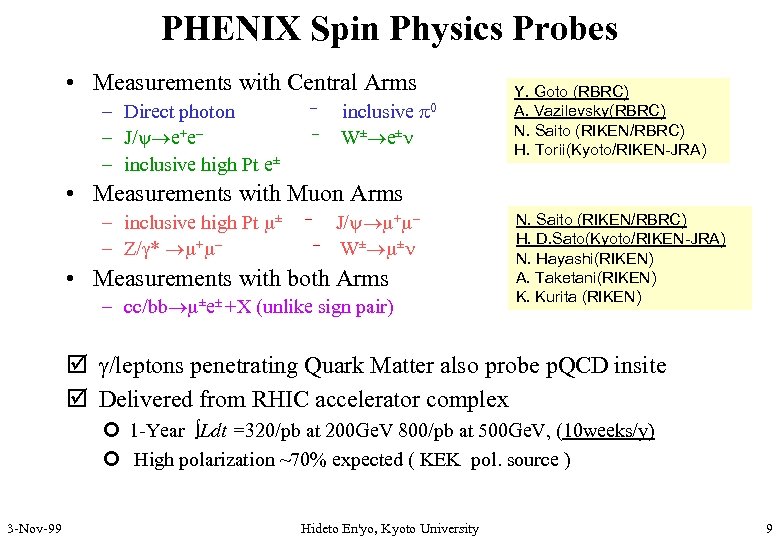 PHENIX Spin Physics Probes • Measurements with Central Arms – Direct photon – J/ e+e– inclusive high Pt e± - inclusive W± e±n 0 Y. Goto (RBRC) A. Vazilevsky(RBRC) N. Saito (RIKEN/RBRC) H. Torii(Kyoto/RIKEN-JRA) • Measurements with Muon Arms – inclusive high Pt ± – Z/ * + - - J/ + W± ±n • Measurements with both Arms – cc/bb ±e +X (unlike sign pair) N. Saito (RIKEN/RBRC) H. D. Sato(Kyoto/RIKEN-JRA) N. Hayashi(RIKEN) A. Taketani(RIKEN) K. Kurita (RIKEN) /leptons penetrating Quark Matter also probe p. QCD insite Delivered from RHIC accelerator complex ¢ 1 -Year Ldt =320/pb at 200 Ge. V 800/pb at 500 Ge. V, (10 weeks/y) ¢ High polarization ~70% expected ( KEK pol. source ) 3 -Nov-99 Hideto En'yo, Kyoto University 9
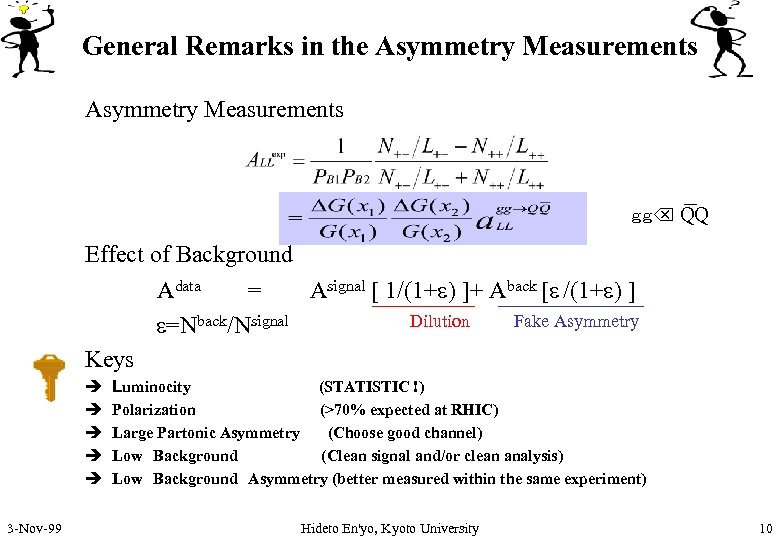 General Remarks in the Asymmetry Measurements gg QQ Effect of Background Adata = Asignal [ 1/(1+e) ]+ Aback [e /(1+e) ] Dilution Fake Asymmetry e=Nback/Nsignal Keys è è è 3 -Nov-99 Luminocity (STATISTIC !) Polarization (>70% expected at RHIC) Large Partonic Asymmetry (Choose good channel) Low Background (Clean signal and/or clean analysis) Low Background Asymmetry (better measured within the same experiment) Hideto En'yo, Kyoto University 10
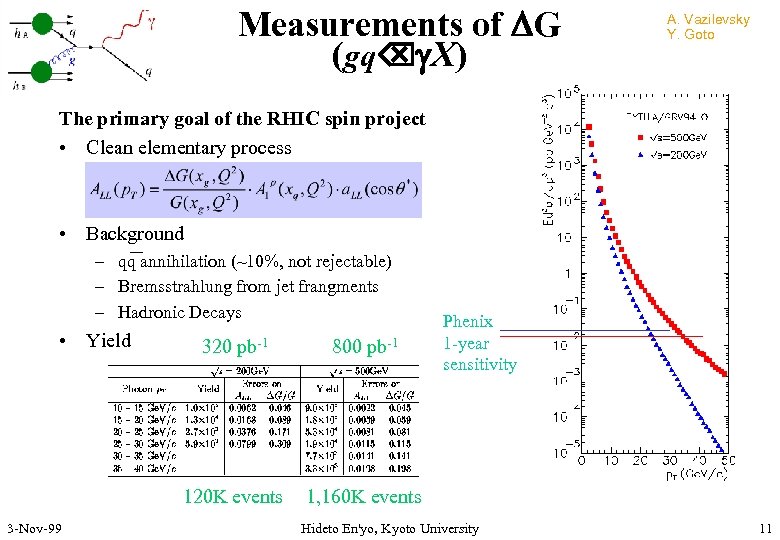 Measurements of DG (gq g. X) A. Vazilevsky Y. Goto The primary goal of the RHIC spin project • Clean elementary process • Background – qq annihilation (~10%, not rejectable) – Bremsstrahlung from jet frangments – Hadronic Decays • Yield 800 pb-1 120 K events 3 -Nov-99 320 pb-1 Phenix 1 -year sensitivity 1, 160 K events Hideto En'yo, Kyoto University 11
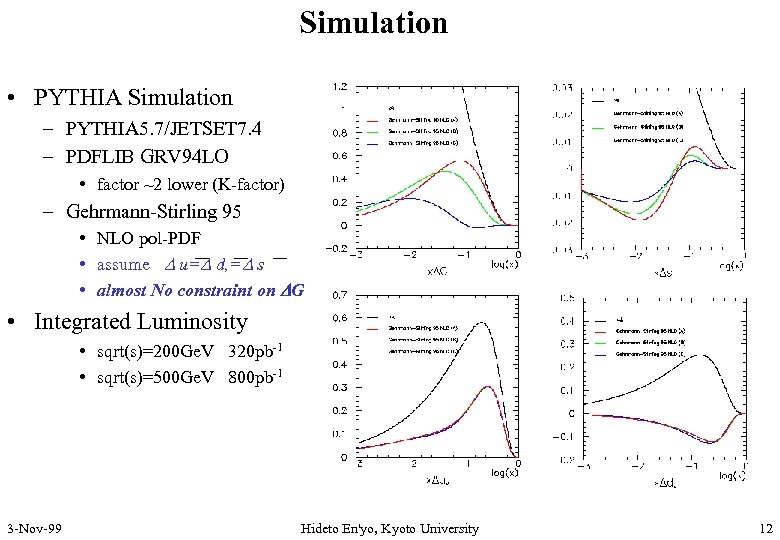 Simulation • PYTHIA Simulation – PYTHIA 5. 7/JETSET 7. 4 – PDFLIB GRV 94 LO • factor ~2 lower (K-factor) – Gehrmann-Stirling 95 • NLO pol-PDF • assume D u=D d, =D s • almost No constraint on DG • Integrated Luminosity • sqrt(s)=200 Ge. V 320 pb-1 • sqrt(s)=500 Ge. V 800 pb-1 3 -Nov-99 Hideto En'yo, Kyoto University 12
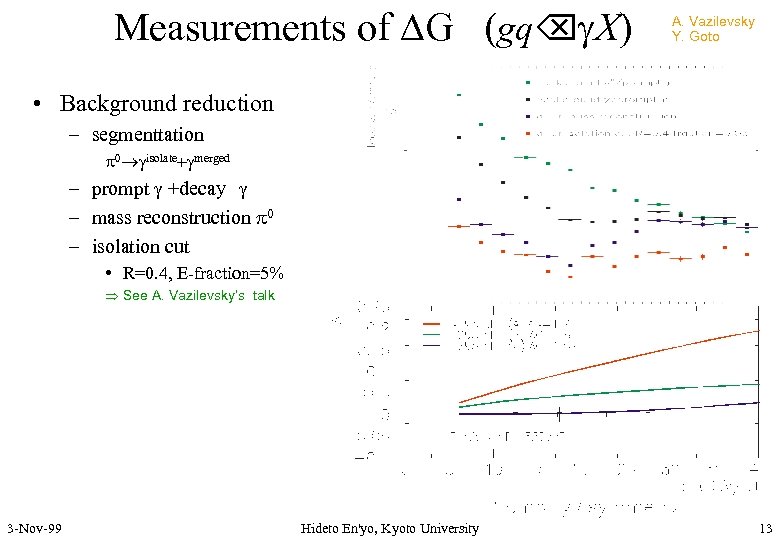 Measurements of DG (gq X) A. Vazilevsky Y. Goto • Background reduction – segmenttation 0 isolate+ merged – prompt +decay – mass reconstruction 0 – isolation cut • R=0. 4, E-fraction=5% See A. Vazilevsky’s talk 3 -Nov-99 Hideto En'yo, Kyoto University 13
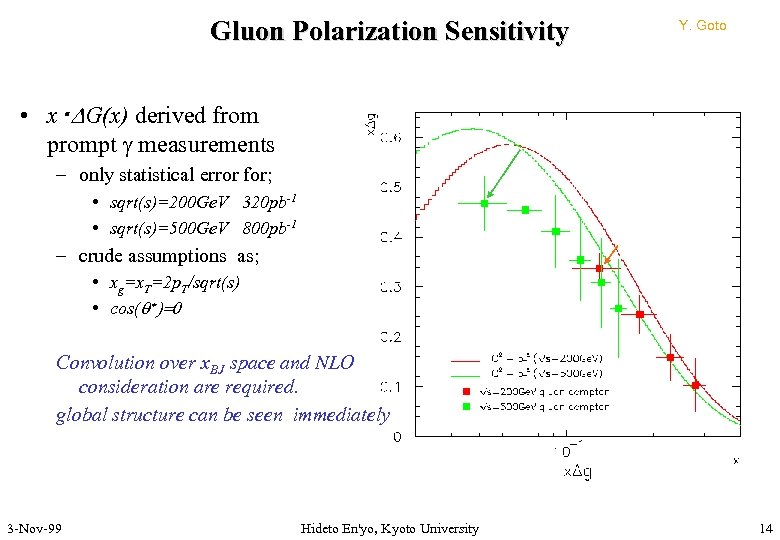 Gluon Polarization Sensitivity Y. Goto • x・DG(x) derived from prompt measurements – only statistical error for; • sqrt(s)=200 Ge. V 320 pb-1 • sqrt(s)=500 Ge. V 800 pb-1 – crude assumptions as; • xg=x. T=2 p. T/sqrt(s) • cos(q*)=0 Convolution over x. BJ space and NLO consideration are required. global structure can be seen immediately 3 -Nov-99 Hideto En'yo, Kyoto University 14
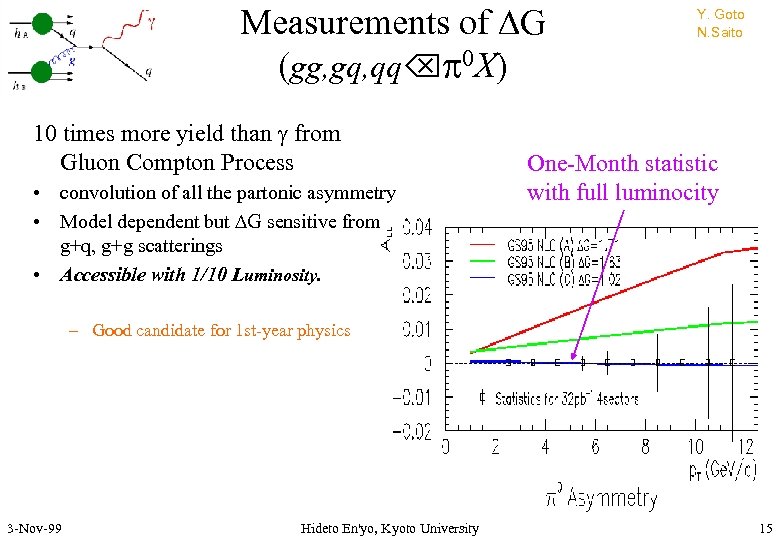 Measurements of DG (gg, gq, qq 0 X) 10 times more yield than from Gluon Compton Process • convolution of all the partonic asymmetry • Model dependent but DG sensitive from g+q, g+g scatterings • Accessible with 1/10 Luminosity. Y. Goto N. Saito One-Month statistic with full luminocity – Good candidate for 1 st-year physics 3 -Nov-99 Hideto En'yo, Kyoto University 15
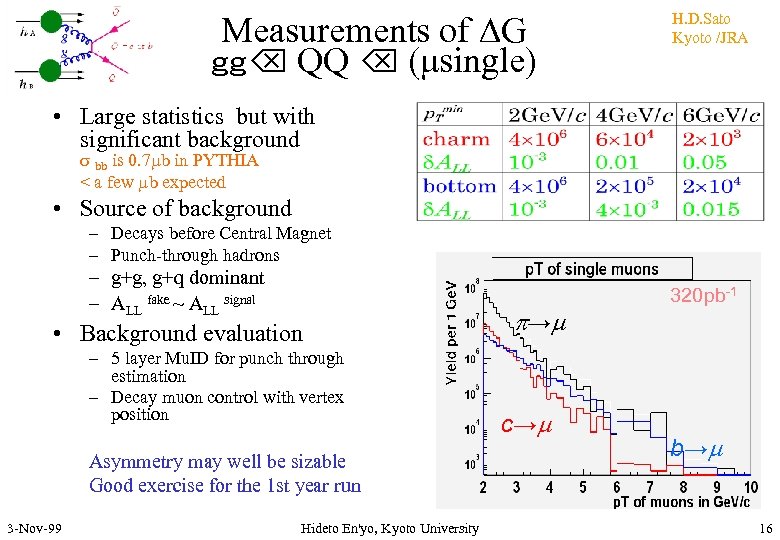 Measurements of DG gg QQ (μsingle) H. D. Sato Kyoto /JRA • Large statistics but with significant background s bb is 0. 7 b in PYTHIA < a few b expected • Source of background – Decays before Central Magnet – Punch-through hadrons – g+g, g+q dominant – ALL fake ~ ALL signal • Background evaluation – 5 layer Mu. ID for punch through estimation – Decay muon control with vertex position Asymmetry may well be sizable Good exercise for the 1 st year run 3 -Nov-99 Hideto En'yo, Kyoto University → c→ 320 pb-1 b→ 16
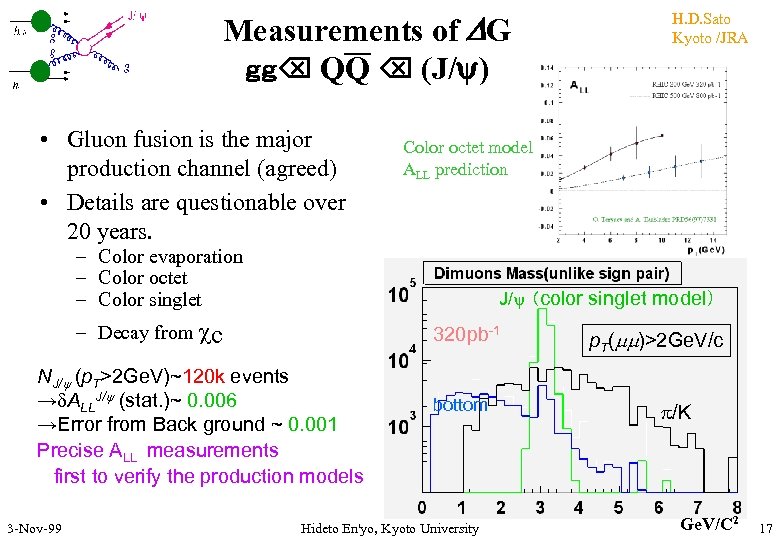 Measurements of DG gg QQ (J/y) • Gluon fusion is the major production channel (agreed) • Details are questionable over 20 years. Color octet model ALL prediction – Color evaporation – Color octet – Color singlet J/ (color singlet model) – Decay from cc 320 pb-1 NJ/ (p. T>2 Ge. V)~120 k events → ALLJ/ (stat. )~ 0. 006 →Error from Back ground ~ 0. 001 Precise ALL measurements first to verify the production models 3 -Nov-99 H. D. Sato Kyoto /JRA bottom Hideto En'yo, Kyoto University p. T( )>2 Ge. V/c /K Ge. V/C 2 17
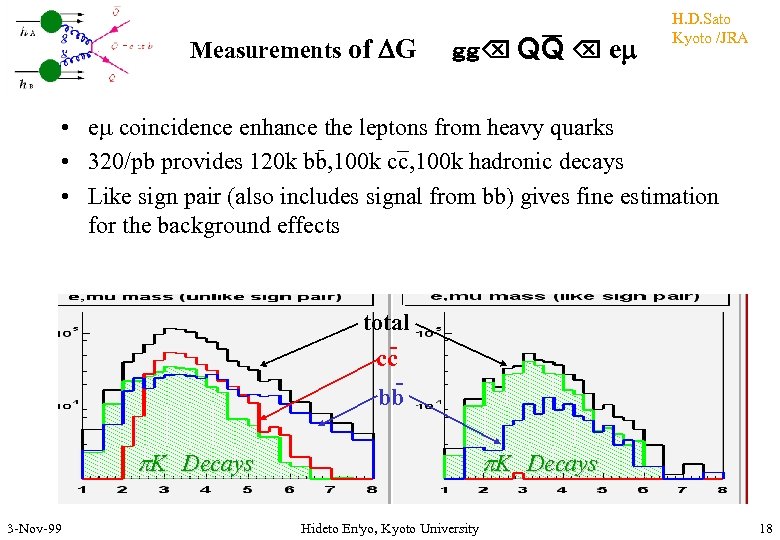 Measurements of DG gg QQ em H. D. Sato Kyoto /JRA • e coincidence enhance the leptons from heavy quarks • 320/pb provides 120 k bb, 100 k cc, 100 k hadronic decays • Like sign pair (also includes signal from bb) gives fine estimation for the background effects total cc bb K Decays 3 -Nov-99 K Decays Hideto En'yo, Kyoto University 18
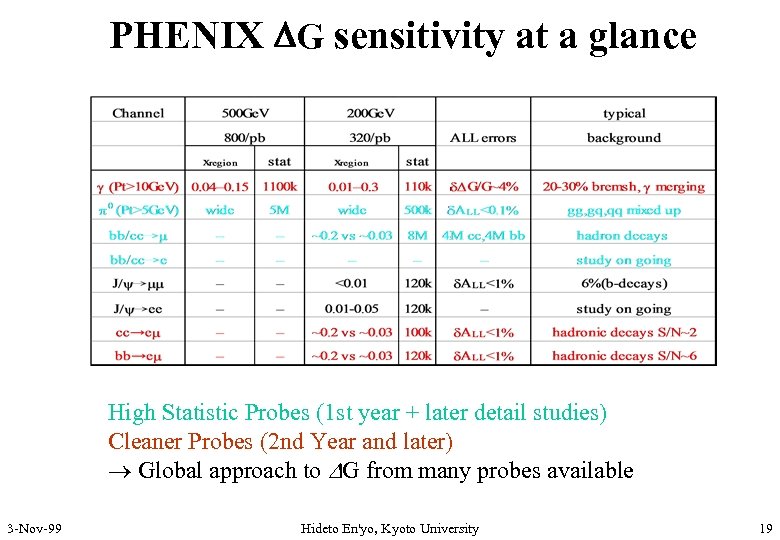 PHENIX DG sensitivity at a glance High Statistic Probes (1 st year + later detail studies) Cleaner Probes (2 nd Year and later) Global approach to DG from many probes available 3 -Nov-99 Hideto En'yo, Kyoto University 19
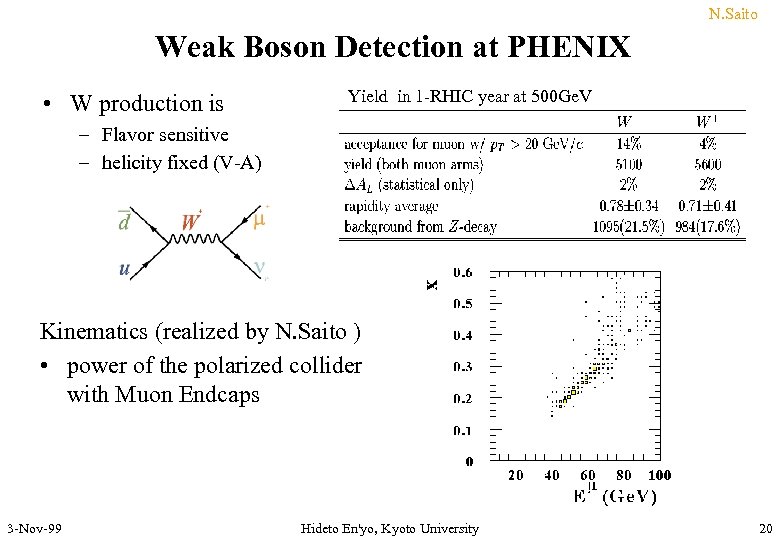 N. Saito Weak Boson Detection at PHENIX • W production is Yield in 1 -RHIC year at 500 Ge. V – Flavor sensitive – helicity fixed (V-A) Kinematics (realized by N. Saito ) • power of the polarized collider with Muon Endcaps 3 -Nov-99 Hideto En'yo, Kyoto University 20
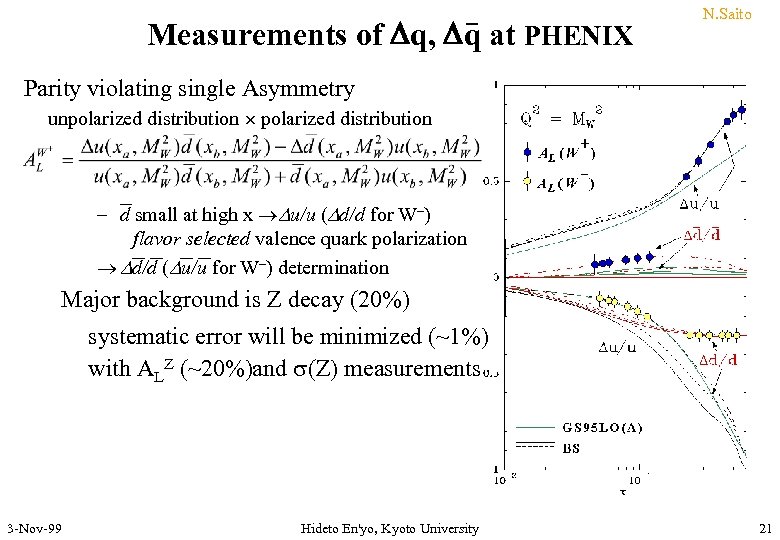 Measurements of Dq, Dq at PHENIX N. Saito Parity violating single Asymmetry unpolarized distribution – d small at high x Du/u (Dd/d for W-) flavor selected valence quark polarization Dd/d (Du/u for W-) determination Major background is Z decay (20%) systematic error will be minimized (~1%) with ALZ (~20%)and s(Z) measurements 3 -Nov-99 Hideto En'yo, Kyoto University 21
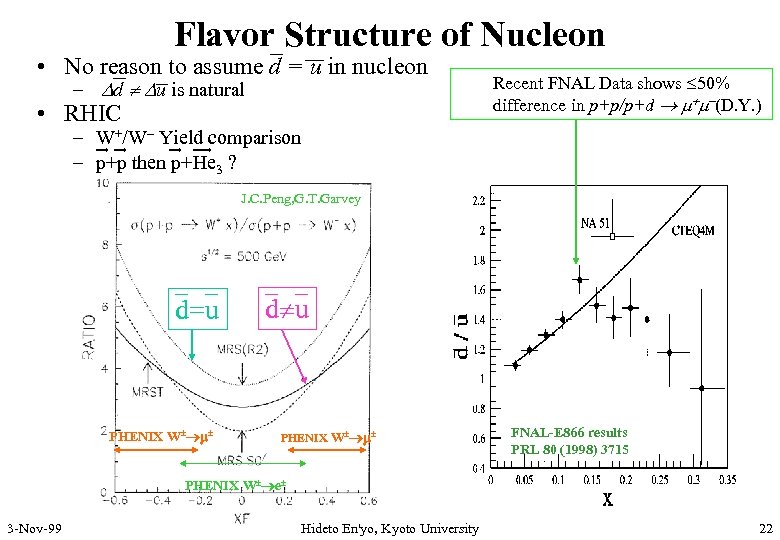 Flavor Structure of Nucleon • No reason to assume d = u in nucleon – Dd Du is natural • RHIC Recent FNAL Data shows 50% difference in p+p/p+d (D. Y. ) – W+/W- Yield comparison – p+p then p+He 3 ? J. C. Peng, G. T. Garvey d=u PHENIX W m d u PHENIX W m FNAL-E 866 results PRL 80 (1998) 3715 PHENIX W e 3 -Nov-99 Hideto En'yo, Kyoto University 22
 Conclusions (Time Table towards discovery) • PHENIX construction on going – Y 2000 Spring E&W Central Arms ready for the first Au-Au collisions – Y 2000 Summer South Muon Arm ready for the first polarized collisions – Y 2001 Summer North Muon Arm ready for the 500 Ge. V running • PHENIX High rate capability • PHENIX Powerful particle IDs for p. QCD probes • Y 2001, The first measurements of helicity asymmetry will be performed @200 Ge. V. Sizable DG generates surprises in the High p. T 0 , High p. T , J/ data. • Y 2002, Statistics will be much improved @200 Ge. V, ensuring the determination of DG in direct and e- coincidence data. “Spin Crisis” will hopefully be solved by them. • Y 200? , Weak Bosons will be produced at RHIC, the NEW “flavor sensitive” tool for the anti-quark/quark polarization and unpolarized structure function of antiquark measurements. • And beyond… beyond 3 -Nov-99 Hideto En'yo, Kyoto University 23
 Following view graphs are for backups • Following view graphs are for backups 3 -Nov-99 Hideto En'yo, Kyoto University 24
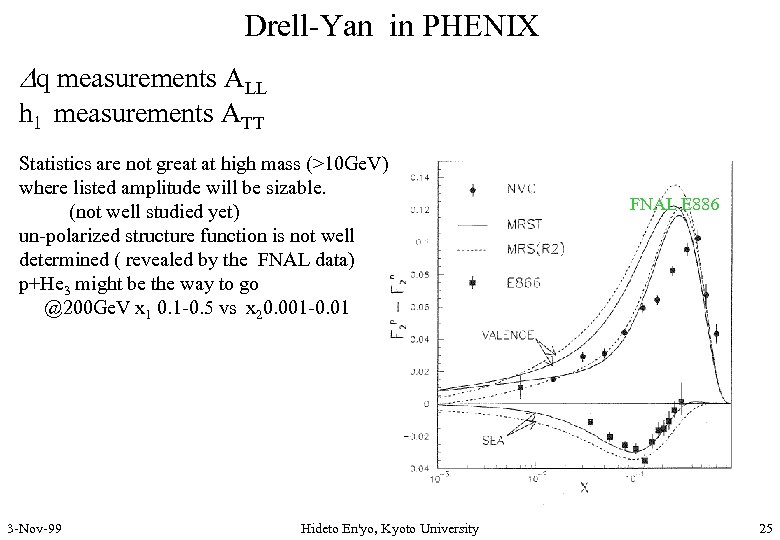 Drell-Yan in PHENIX Dq measurements ALL h 1 measurements ATT Statistics are not great at high mass (>10 Ge. V) where listed amplitude will be sizable. (not well studied yet) un-polarized structure function is not well determined ( revealed by the FNAL data) p+He 3 might be the way to go @200 Ge. V x 1 0. 1 -0. 5 vs x 20. 001 -0. 01 3 -Nov-99 Hideto En'yo, Kyoto University FNAL E 886 25
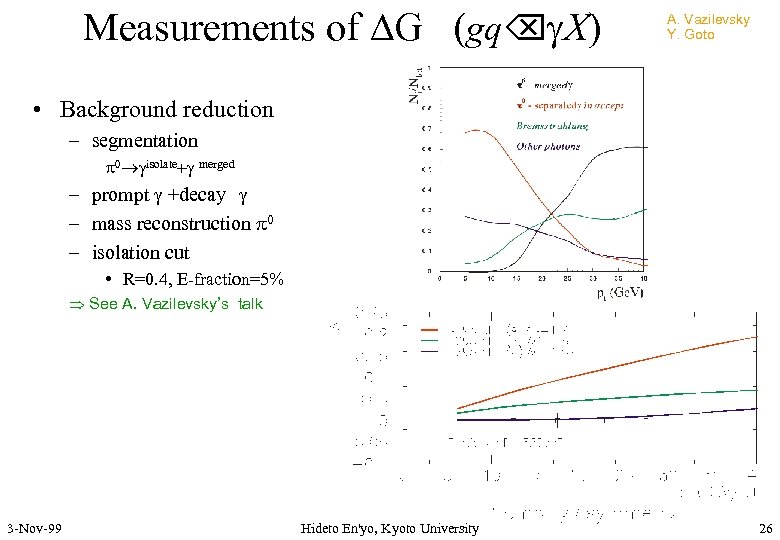 Measurements of DG (gq X) A. Vazilevsky Y. Goto • Background reduction – segmentation 0 isolate+ merged – prompt +decay – mass reconstruction 0 – isolation cut • R=0. 4, E-fraction=5% See A. Vazilevsky’s talk 3 -Nov-99 Hideto En'yo, Kyoto University 26
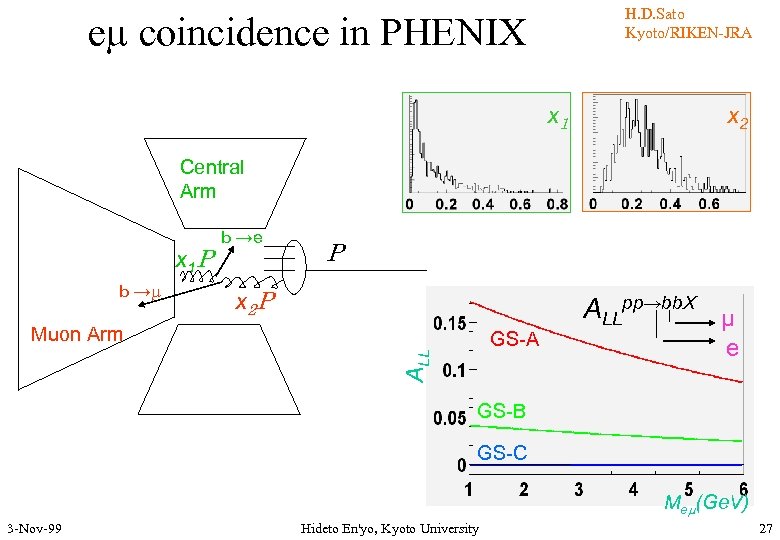 H. D. Sato Kyoto/RIKEN-JRA e coincidence in PHENIX x 1 x 2 Central Arm x 1 P b→ b→e P x 2 P Muon Arm ALL GS-A ALLpp→bbX μ e GS-B GS-C Me (Ge. V) 3 -Nov-99 Hideto En'yo, Kyoto University 27
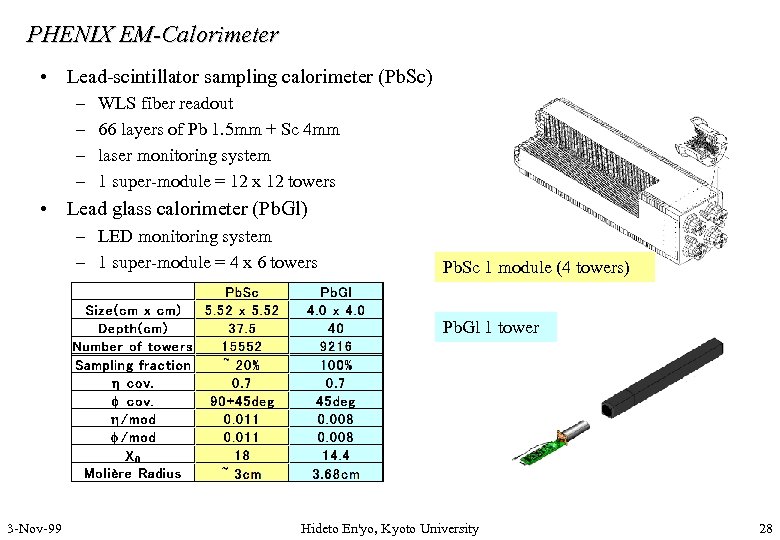 PHENIX EM-Calorimeter • Lead-scintillator sampling calorimeter (Pb. Sc) – – WLS fiber readout 66 layers of Pb 1. 5 mm + Sc 4 mm laser monitoring system 1 super-module = 12 x 12 towers • Lead glass calorimeter (Pb. Gl) – LED monitoring system – 1 super-module = 4 x 6 towers Pb. Sc 1 module (4 towers) Pb. Gl 1 tower 3 -Nov-99 Hideto En'yo, Kyoto University 28
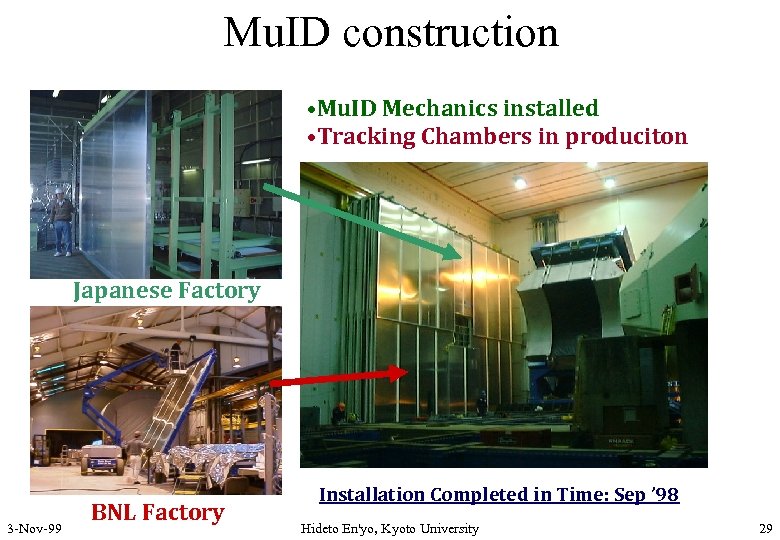 Mu. ID construction • Mu. ID Mechanics installed • Tracking Chambers in produciton Japanese Factory 3 -Nov-99 BNL Factory Installation Completed in Time: Sep ’ 98 Hideto En'yo, Kyoto University 29
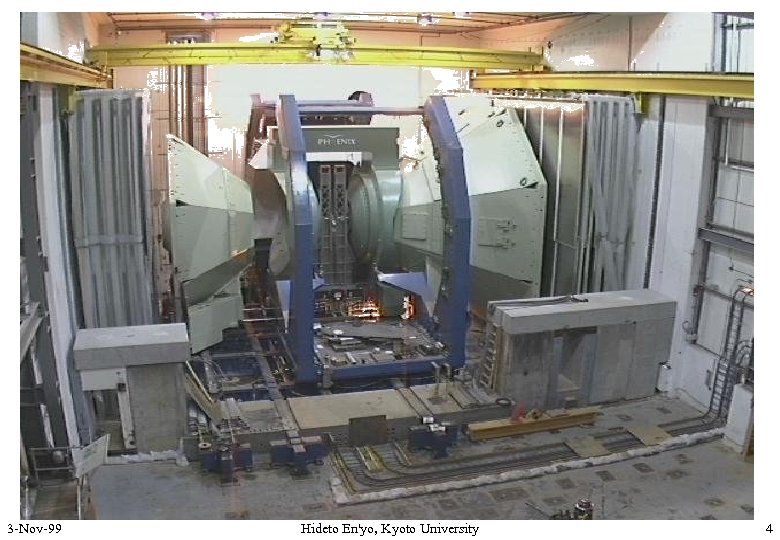
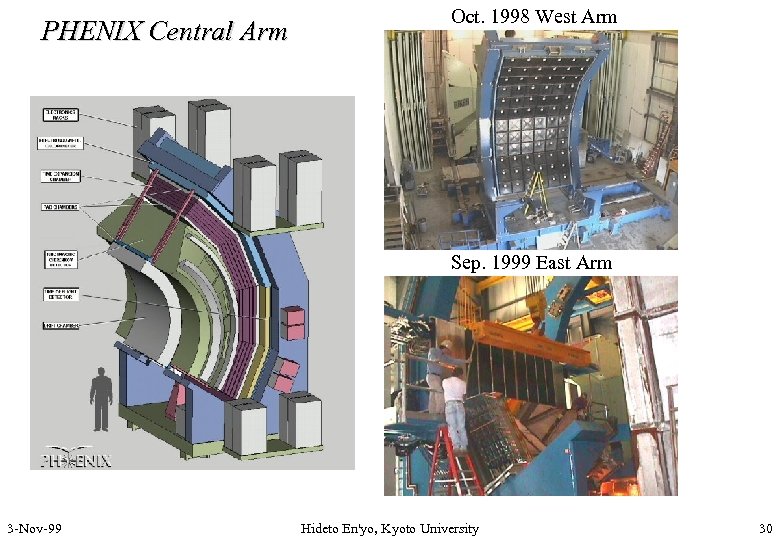 PHENIX Central Arm Oct. 1998 West Arm Sep. 1999 East Arm 3 -Nov-99 Hideto En'yo, Kyoto University 30