 Скачать презентацию PHENIX Beam Use Proposal W A Zajc for
31f89dc0f75aff39e363ff65c93ada56.ppt
- Количество слайдов: 46



PHENIX Beam Use Proposal W. A. Zajc for the PHENIX Collaboration ( this talk available at http: //www. phenix. bnl. gov/phenix/WWW/publish/zajc/sp/presentations/RBUP 05/ )
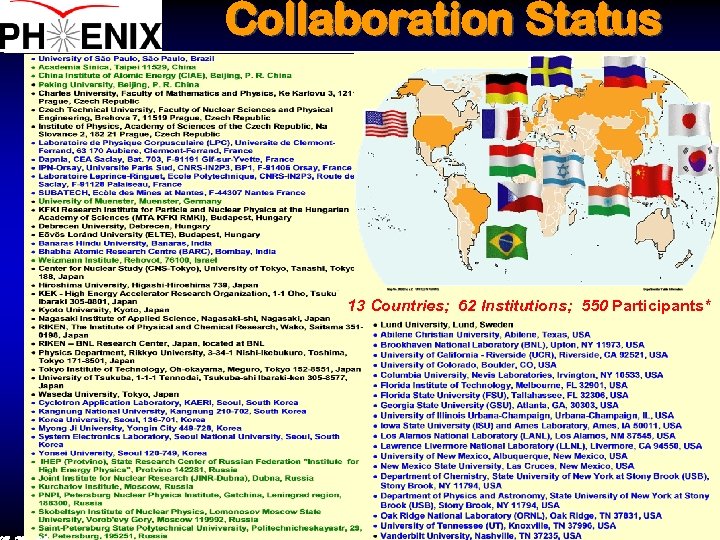
Collaboration Status 13 Countries; 62 Institutions; 550 Participants*
Beam Use Proposal Requested input: Desired “beam run segments” q Physics from same q Nominal (restricted) 29(20) week scenarios q Collaboration/experiment status q l A note on nomenclature: “Run-1” Summer-2000 Au+Au run at 130 Ge. V q “Run-2” 2001/2002 Au+Au/p+p at 200 Ge. V q “Run-3” 2003 run d+Au/p+p at 200 Ge. V q “Run-4” 2004 run Au+Au/p+p at 200 (62) Ge. V q “Run-5” 2005 run Cu+Cu/p+p at 200 (62) Ge. V q
Summary l PHENIX has done great things in the past l PHENIX is doing great things in the present l Our request will insure that PHENIX does great things in the future

Past Accomplishments
![Run-1 to Run-4 Capsule History Run Year Species s 1/2 [Ge. V ] Ldt](https://present5.com/presentation/31f89dc0f75aff39e363ff65c93ada56/image-6.jpg "Run-1 to Run-4 Capsule History Run Year Species s 1/2 [Ge. V ] Ldt")
Run-1 to Run-4 Capsule History Run Year Species s 1/2 [Ge. V ] Ldt Ntot p-p Equivalent Data Size 01 2000 Au+Au 130 1 mb-1 10 M 0. 04 pb-1 3 TB 02 2001/2002 Au+Au 200 24 mb-1 170 M 1. 0 pb-1 10 TB p+p 200 0. 15 pb-1 3. 7 G 0. 15 pb-1 20 TB 03 2002/2003 d+Au 200 2. 74 nb-1 5. 5 G 1. 1 pb-1 46 TB p+p 200 0. 35 pb-1 6. 6 G 0. 35 pb-1 35 TB PHENIX Successes (to date) 04 2003/2004 Au+Au 200 241 mb-1 1. 5 G 10. 0 pb-1 270 TB based on ability -1 10 TB Au+Au 62 9 mb-1 58 M 0. 36 pbto deliver physics at ~all scales: : Multiplicity (Entropy) millibarn: Flavor yields (temperature) Run-3 Run-2 Run-1 barn microbarn: Charm (transport) nanobarn: Jets (density) picobarn: J/Psi (deconfinement ? )
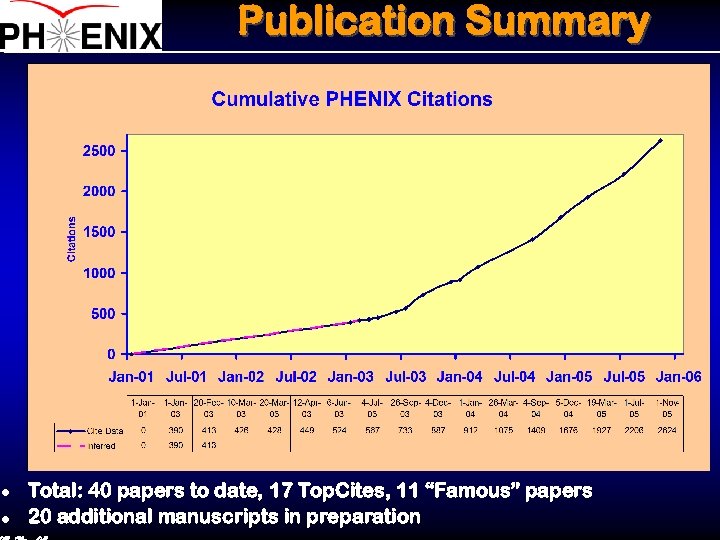
Publication Summary l l Total: 40 papers to date, 17 Top. Cites, 11 “Famous” papers 20 additional manuscripts in preparation
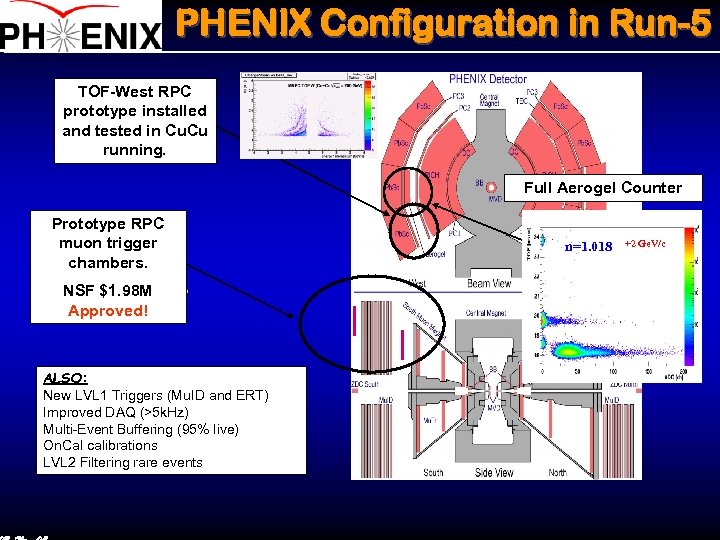
PHENIX Configuration in Run-5 TOF-West RPC prototype installed and tested in Cu. Cu running. Full Aerogel Counter Prototype RPC muon trigger chambers. NSF $1. 98 M Approved! ALSO: New LVL 1 Triggers (Mu. ID and ERT) Improved DAQ (>5 k. Hz) Multi-Event Buffering (95% live) On. Cal calibrations LVL 2 Filtering rare events n=1. 018 +2 Ge. V/c
![Run-1 to Run-5 Capsule History Run Year Species s 1/2 [Ge. V ] Ldt](https://present5.com/presentation/31f89dc0f75aff39e363ff65c93ada56/image-9.jpg "Run-1 to Run-5 Capsule History Run Year Species s 1/2 [Ge. V ] Ldt")
Run-1 to Run-5 Capsule History Run Year Species s 1/2 [Ge. V ] Ldt NTot p-p Equivalent Data Size 01 2000 Au+Au 130 1 mb-1 10 M 0. 04 pb-1 3 TB 02 2001/2002 Au+Au 200 24 mb-1 170 M 1. 0 pb-1 10 TB p+p 200 0. 15 pb-1 3. 7 G 0. 15 pb-1 20 TB 03 2002/2003 d+Au 200 2. 74 nb-1 5. 5 G 1. 1 pb-1 46 TB p+p 200 0. 35 pb-1 6. 6 G 0. 35 pb-1 35 TB 04 2003/2004 Au+Au 200 241 mb-1 1. 5 G 10. 0 pb-1 270 TB Au+Au 62 9 mb-1 58 M 0. 36 pb-1 10 TB 05 2004/2005 Cu+Cu 200 3 nb-1 8. 6 G 11. 9 pb-1 173 TB Cu+Cu 62 0. 19 nb-1 0. 4 G 0. 8 pb-1 48 TB Cu+Cu 22. 5 2. 7 mb-1 9 M 0. 01 pb-1 1 TB p+p 200 3. 8 pb-1 85 B 3. 8 pb-1 262 TB
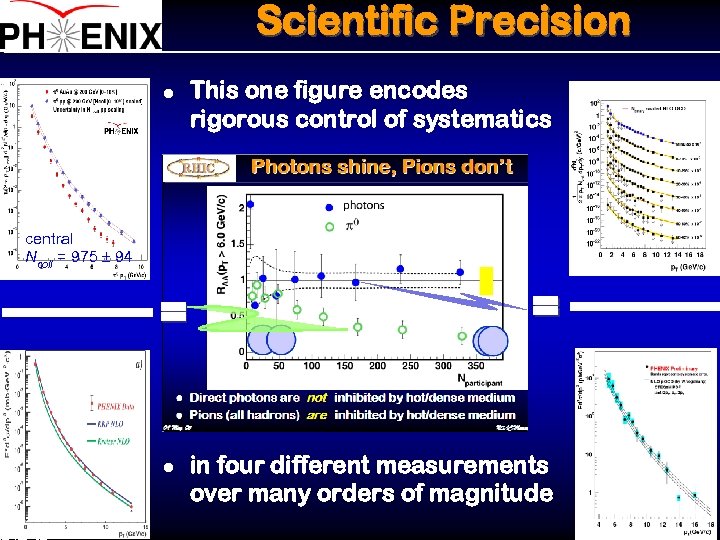
Scientific Precision This one figure encodes rigorous control of systematics l central Ncoll = 975 94 = l = in four different measurements over many orders of magnitude
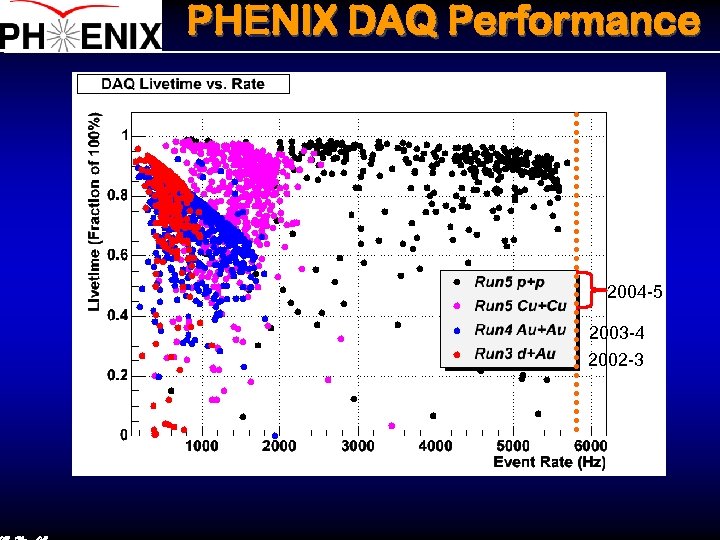
PHENIX DAQ Performance 2004 -5 2003 -4 2002 -3
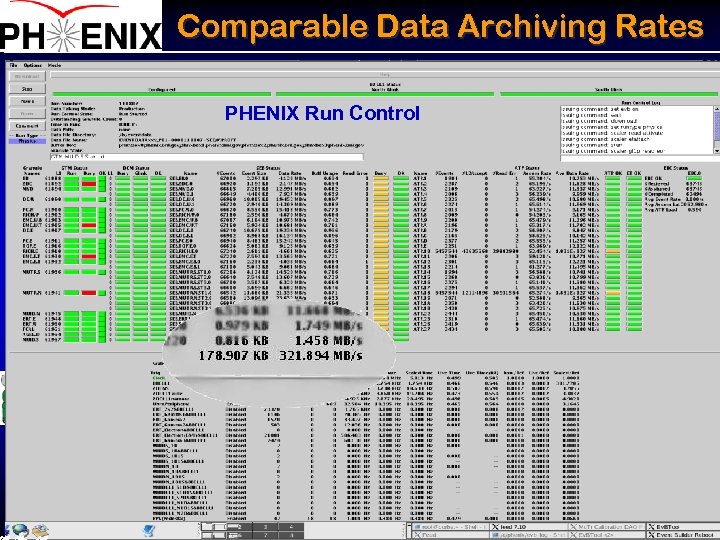
Comparable Data Archiving Rates ALICE All in MB/s all approximate PHENIX Run Control PHENIX Run-5 ~1250 PHENIX Run-4 PHENIX Run-3 PHENIX Run-2 CMS ATLAS LHCb ~100 ~25 ~40 ~100 ~150 ~600
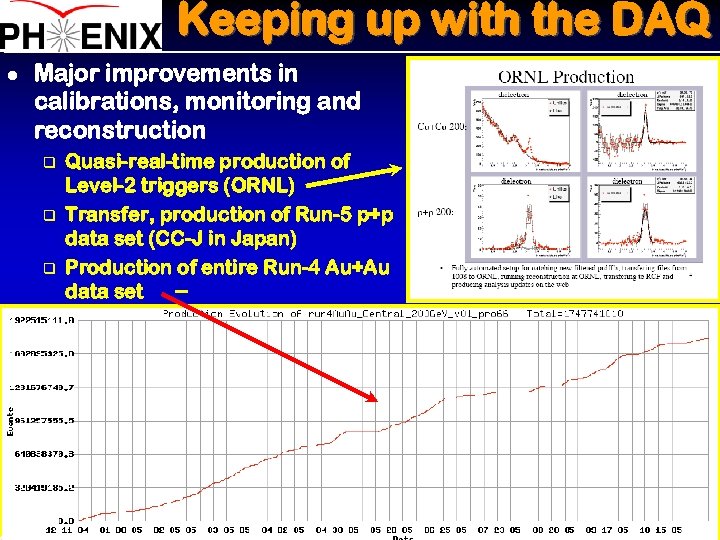
Keeping up with the DAQ l Major improvements in calibrations, monitoring and reconstruction q q q Quasi-real-time production of Level-2 triggers (ORNL) Transfer, production of Run-5 p+p data set (CC-J in Japan) Production of entire Run-4 Au+Au data set

Present Status
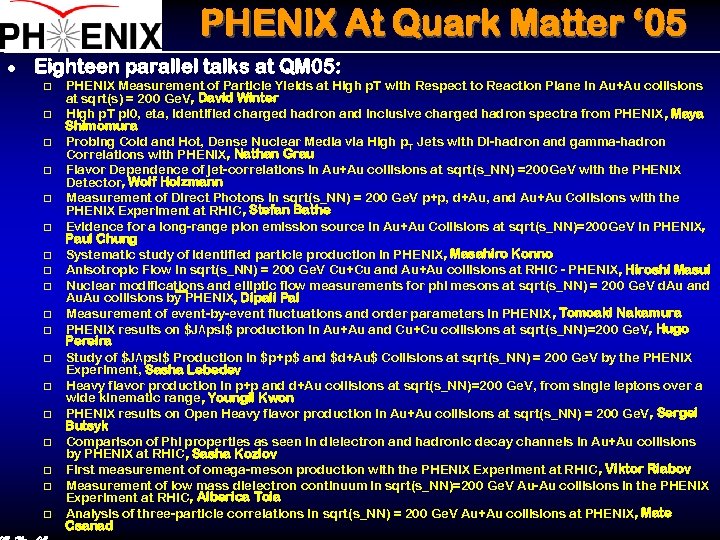
PHENIX At Quark Matter ‘ 05 l Eighteen parallel talks at QM 05: q q q q q PHENIX Measurement of Particle Yields at High p. T with Respect to Reaction Plane in Au+Au collisions at sqrt(s) = 200 Ge. V, David Winter High p. T pi 0, eta, identified charged hadron and inclusive charged hadron spectra from PHENIX, Maya Shimomura Probing Cold and Hot, Dense Nuclear Media via High p. T Jets with Di-hadron and gamma-hadron Correlations with PHENIX, Nathan Grau Flavor Dependence of jet-correlations in Au+Au collisions at sqrt(s_NN) =200 Ge. V with the PHENIX Detector, Wolf Holzmann Measurement of Direct Photons in sqrt(s_NN) = 200 Ge. V p+p, d+Au, and Au+Au Collisions with the PHENIX Experiment at RHIC, Stefan Bathe Evidence for a long-range pion emission source in Au+Au Collisions at sqrt(s_NN)=200 Ge. V in PHENIX, Paul Chung Systematic study of identified particle production in PHENIX, Masahiro Konno Anisotropic Flow in sqrt(s_NN) = 200 Ge. V Cu+Cu and Au+Au collisions at RHIC - PHENIX, Hiroshi Masui Nuclear modifications and elliptic flow measurements for phi mesons at sqrt(s_NN) = 200 Ge. V d. Au and Au. Au collisions by PHENIX, Dipali Pal Measurement of event-by-event fluctuations and order parameters in PHENIX, Tomoaki Nakamura PHENIX results on $J/psi$ production in Au+Au and Cu+Cu collisions at sqrt(s_NN)=200 Ge. V, Hugo Pereira Study of $J/psi$ Production in $p+p$ and $d+Au$ Collisions at sqrt(s_NN) = 200 Ge. V by the PHENIX Experiment, Sasha Lebedev Heavy flavor production in p+p and d+Au collisions at sqrt(s_NN)=200 Ge. V, from single leptons over a wide kinematic range, Youngil Kwon PHENIX results on Open Heavy flavor production in Au+Au collisions at sqrt(s_NN) = 200 Ge. V, Sergei Butsyk Comparison of Phi properties as seen in dielectron and hadronic decay channels in Au+Au collisions by PHENIX at RHIC, Sasha Kozlov First measurement of omega-meson production with the PHENIX Experiment at RHIC, Viktor Riabov Measurement of low mass dielectron continuum in sqrt(s_NN)=200 Ge. V Au-Au collisions in the PHENIX Experiment at RHIC, Alberica Toia Analysis of three-particle correlations in sqrt(s_NN) = 200 Ge. V Au+Au collisions at PHENIX, Mate Csanad
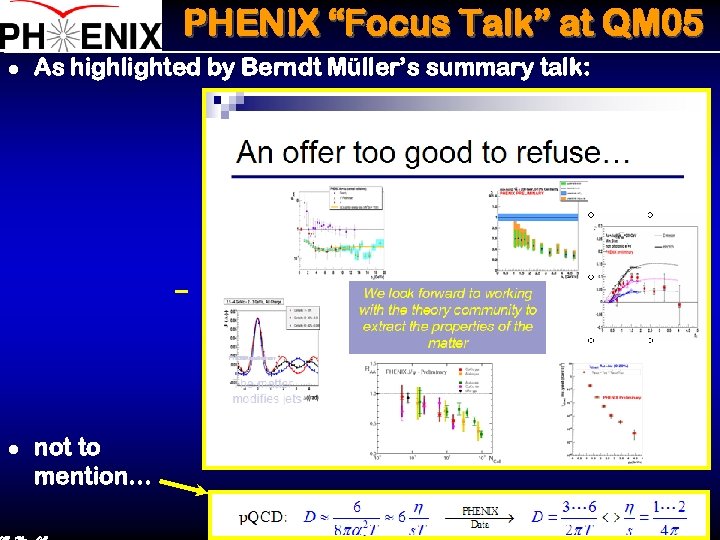
PHENIX “Focus Talk” at QM 05 l As highlighted by Berndt Müller’s summary talk: l not to mention…
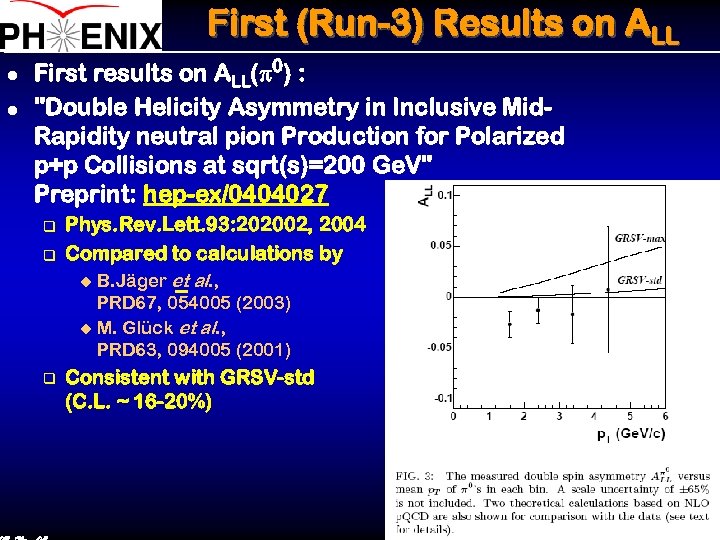
First (Run-3) Results on ALL l l First results on ALL(p 0) : "Double Helicity Asymmetry in Inclusive Mid. Rapidity neutral pion Production for Polarized p+p Collisions at sqrt(s)=200 Ge. V" Preprint: hep-ex/0404027 q q Phys. Rev. Lett. 93: 202002, 2004 Compared to calculations by u B. Jäger et al. , PRD 67, 054005 (2003) u M. Glück et al. , PRD 63, 094005 (2001) q Consistent with GRSV-std (C. L. ~ 16 -20%)
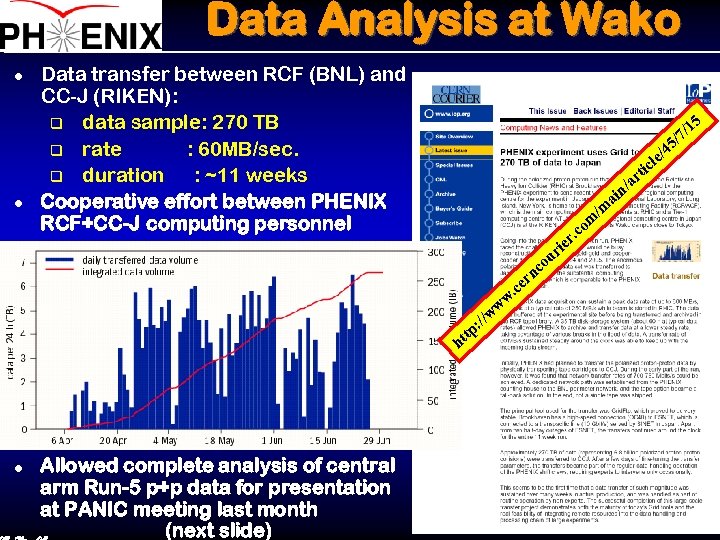
Data Analysis at Wako l l Data transfer between RCF (BNL) and CC-J (RIKEN): q data sample: 270 TB q rate : 60 MB/sec. q duration : ~11 weeks Cooperative effort between PHENIX RCF+CC-J computing personnel / l m. co r rie u co rn. ce w : ttp h Allowed complete analysis of central arm Run-5 p+p data for presentation at PANIC meeting last month (next slide) ic rt /a n ai l 5 e/4 w //w /m 5 1 7/
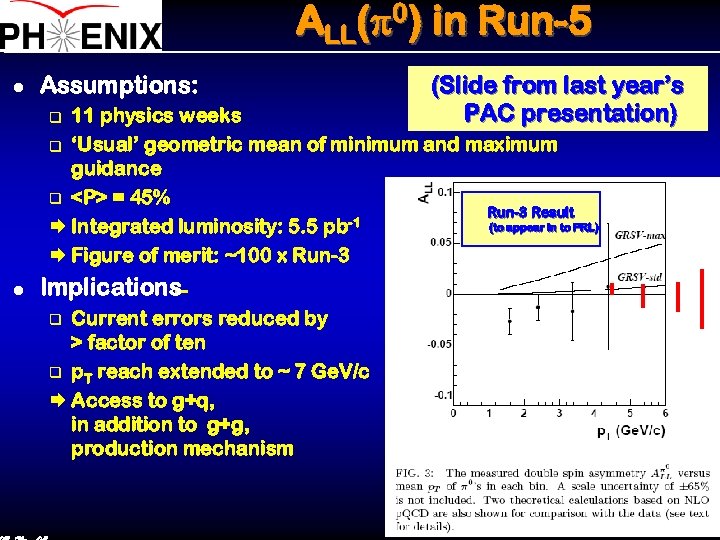
ALL(p 0) in Run-5 l Assumptions: (Slide from last year’s PAC presentation) 11 physics weeks q ‘Usual’ geometric mean of minimum and maximum guidance q <P> = 45% Run-3 Result -1 (to appear in to PRL) Integrated luminosity: 5. 5 pb Figure of merit: ~100 x Run-3 q l Implications Current errors reduced by > factor of ten q p. T reach extended to ~ 7 Ge. V/c Access to g+q, in addition to g+g, production mechanism q
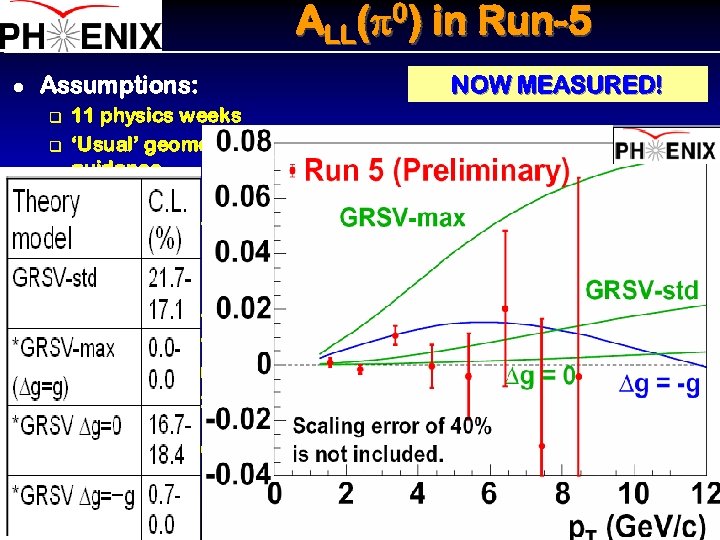
ALL(p 0) in Run-5 l Assumptions: NOW MEASURED! 11 physics weeks q ‘Usual’ geometric mean of minimum and maximum guidance q <P> = 45% Run-3 Result -1 (to appear in PRL) Integrated luminosity: 5. 5 pb Figure of merit: ~100 x Run-3 q l Implications Current errors reduced by > factor of ten q p. T reach extended to ~ 7 Ge. V/c Access to g+q, in addition to g+g, production mechanism q

Future Goals
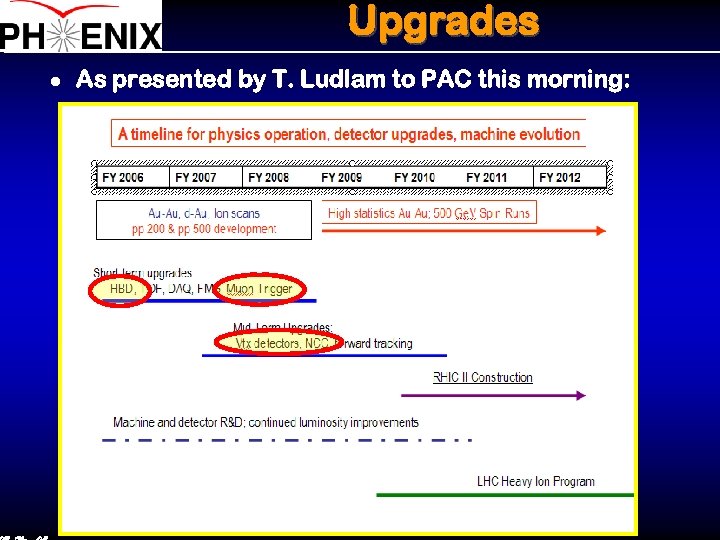
Upgrades l As presented by T. Ludlam to PAC this morning:
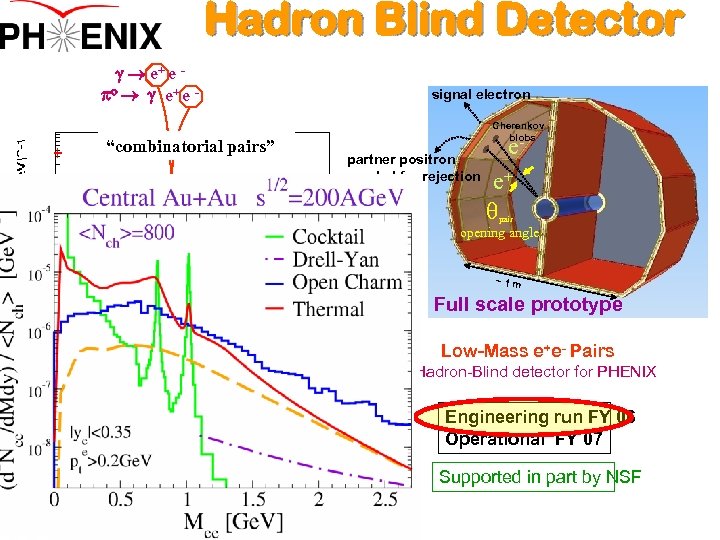
Hadron Blind Detector e+ e po e+ e - signal electron “combinatorial pairs” Cherenkov blobs partner positron needed for rejection e- e+ q pair S/B ~ 1/500 total background all signal Irreducible charm background opening angle ~1 m Full scale prototype Low-Mass e+e- Pairs charm signal A Hadron-Blind detector for PHENIX Engineering run FY 06 Operational FY 07 Supported in part by NSF
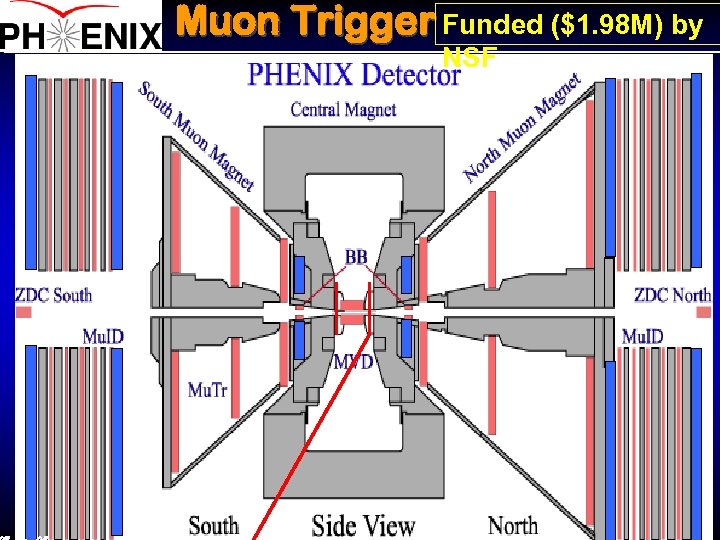
Muon Trigger Funded ($1. 98 M) by NSF
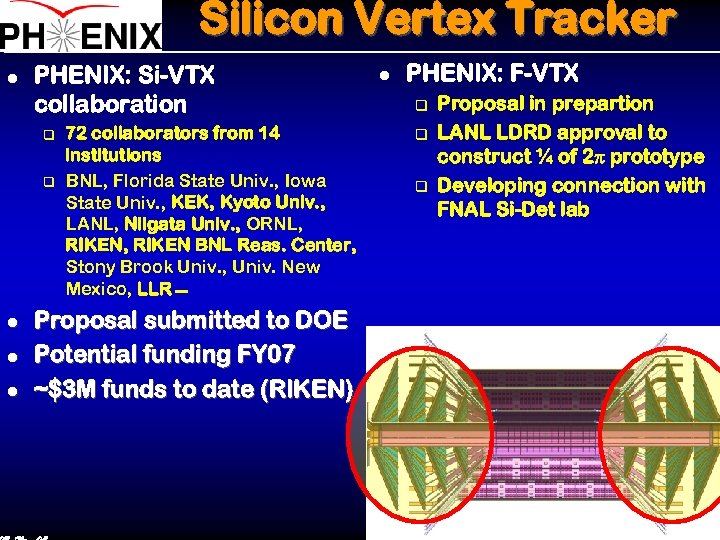
Silicon Vertex Tracker l PHENIX: Si-VTX collaboration q q 72 collaborators from 14 institutions BNL, Florida State Univ. , Iowa State Univ. , KEK, Kyoto Univ. , LANL, Niigata Univ. , ORNL, RIKEN BNL Reas. Center, Stony Brook Univ. , Univ. New Mexico, LLR l l l Proposal submitted to DOE Potential funding FY 07 ~$3 M funds to date (RIKEN) l PHENIX: F-VTX q q q Proposal in prepartion LANL LDRD approval to construct ¼ of 2 p prototype Developing connection with FNAL Si-Det lab
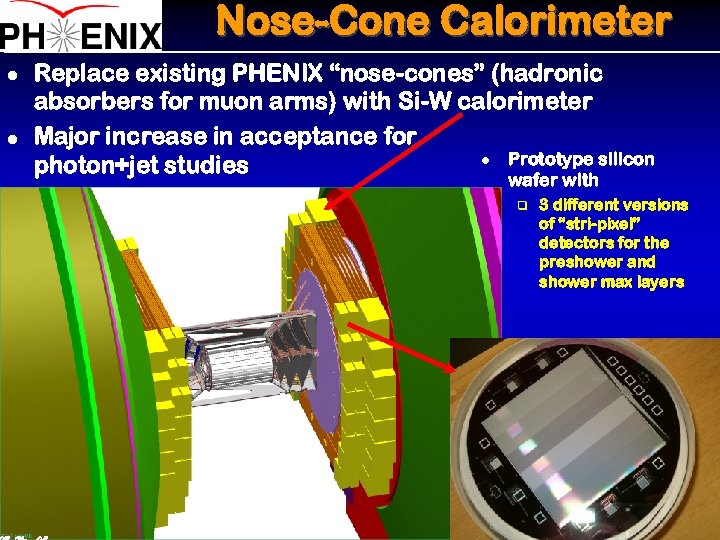
Nose-Cone Calorimeter l l Replace existing PHENIX “nose-cones” (hadronic absorbers for muon arms) with Si-W calorimeter Major increase in acceptance for l Prototype silicon photon+jet studies wafer with q 3 different versions of “stri-pixel” detectors for the preshower and shower max layers
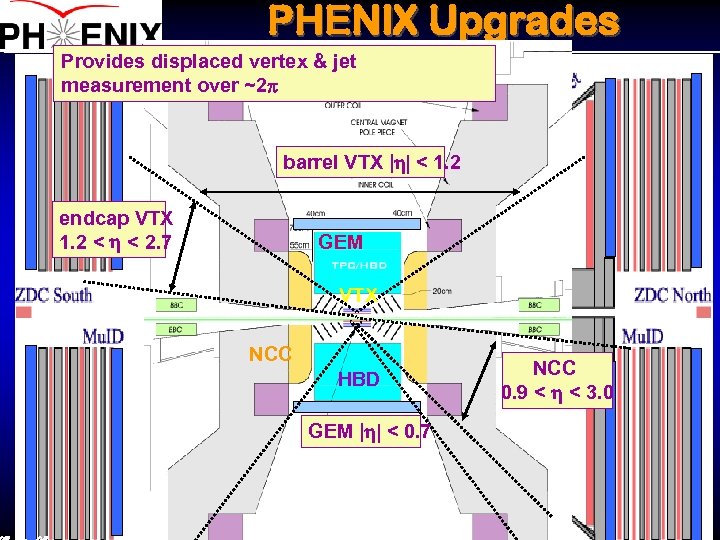
PHENIX Upgrades Provides displaced vertex & jet measurement over ~2 p barrel VTX |h| < 1. 2 endcap VTX 1. 2 < h < 2. 7 GEM VTX NCC HBD GEM |h| < 0. 7 NCC 0. 9 < h < 3. 0
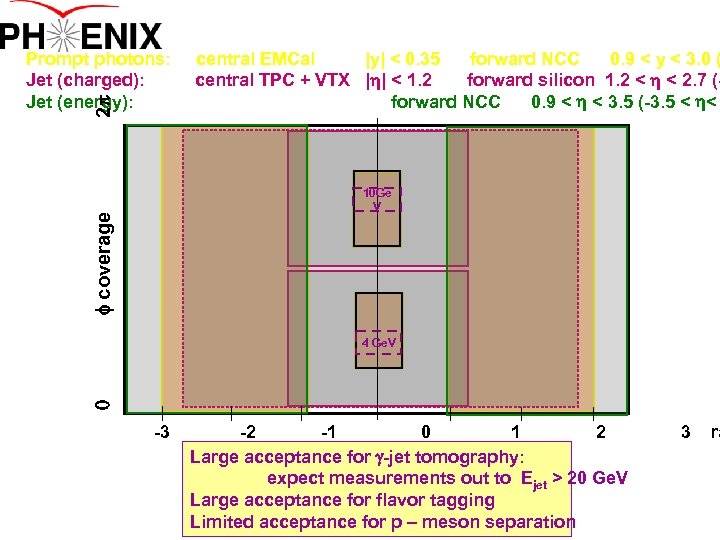
2 p Prompt photons: Jet (charged): Jet (energy): central EMCal |y| < 0. 35 forward NCC 0. 9 < y < 3. 0 ( central TPC + VTX |h| < 1. 2 forward silicon 1. 2 < h < 2. 7 (forward NCC 0. 9 < h < 3. 5 (-3. 5 < h< 0 f coverage 10 Ge V 4 Ge. V -3 -2 -1 0 1 2 Large acceptance for -jet tomography: expect measurements out to Ejet > 20 Ge. V Large acceptance for flavor tagging Limited acceptance for p – meson separation 3 ra
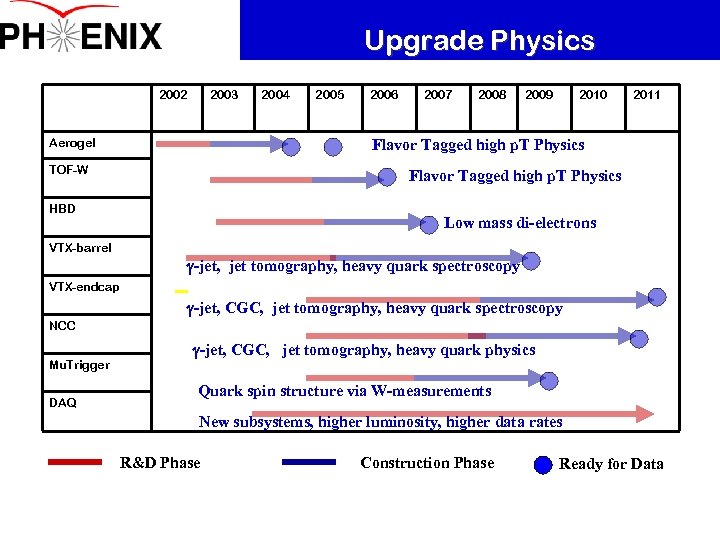
Upgrade Physics 2002 2003 2004 2005 Aerogel 2007 2008 2009 2010 2011 Flavor Tagged high p. T Physics TOF-W Flavor Tagged high p. T Physics HBD VTX-barrel 2006 Low mass di-electrons -jet, jet tomography, heavy quark spectroscopy VTX-endcap -jet, CGC, jet tomography, heavy quark spectroscopy NCC Mu. Trigger DAQ -jet, CGC, jet tomography, heavy quark physics Quark spin structure via W-measurements New subsystems, higher luminosity, higher data rates R&D Phase Construction Phase Ready for Data
Notes on Methodology l l Similar to previous year’s (calibrated, demonstrated) run planning Implements q l (Revised) C-AD guidance, “linear growth model” Assumes q Overheads: u u u Cool-down: 2 weeks Warm-up : 0. 5 week Set-up : m m u Ramp-up: m m m q u u u 70% useful vertex fraction 60% efficiency Use geometric mean of C-AD minimal and maximal guidance (unpolarized) Use 70% of C-AD maximum for polarized running (consistent with Spin Plan) Physics Weeks: q q l Useful stable initial luminosity = 2 weeks (1 week for 2 nd species) Useful stable initial luminosity = 25% of final value Linear ramp over 4 weeks to final luminosity value PHENIX u l Initial set-up = 2 weeks Second species = 1 week (2 for polarized protons) 1 -mode: N Cryo Weeks – 2 –(2 +1) -- 0. 5 = N Cryo Weeks – 5. 5 2 -mode: N Cryo Weeks – 2 –(2 +1)-(2+1) – 0. 5 = N Cryo Weeks – 8. 5 General PHENIX approach: When ever possible, develop equivalent parton+parton luminosity for all species studied
Strategy l Continued enrichment of existing data sets that are statistically sparse in essential physics channels F accepting that this may in fact require accumulation of data over multi-year periods F exploiting the improvements in our DAQ (and RHIC) that make it profitable to re-visit “canonical” systems (Au+Au, d+Au) l Continued development of luminosity and polarization to l Completing surveys by securing requisite baseline data in l Goal: To maintain and enhance the discovery program maximize efficient usage of scarce weeks timely fashion, so that comparison data sets are obtained with essentially the same detector configuration. essential to further progress in RHIC science
Request Summary l Additional Au+Au running at √s. NN = 200 Ge. V to significantly advance the statistical reach and physics precision of our existing Run-4 data set: F Run-6 + Run-8 = factor of 10 beyond Run-4 l Two comparison runs: q q l l l p+p collisions at 62. 4 Ge. V to complete the investigation of the energy dependence of the high p. T suppression pattern observed at 200 Ge. V. p+p collisions at 22. 5 Ge. V to complete the Run-5 low energy studies in the Cu+Cu system, and to make valuable comparisons between RHIC and SPS measurements of the nuclear modification factor. A period of polarized proton running with transverse (radial) polarization, to perform a measurement of the gluon Sivers function. Continued development of polarized proton luminosity and polarization leading to a sensitive measurement of the gluon polarization of the proton via 200 (and 500) Ge. V p+p collisions. A d+Au run, again to take advantage of significant advances in luminosity and data acquisition throughput to refine our knowledge of this essential baseline system.
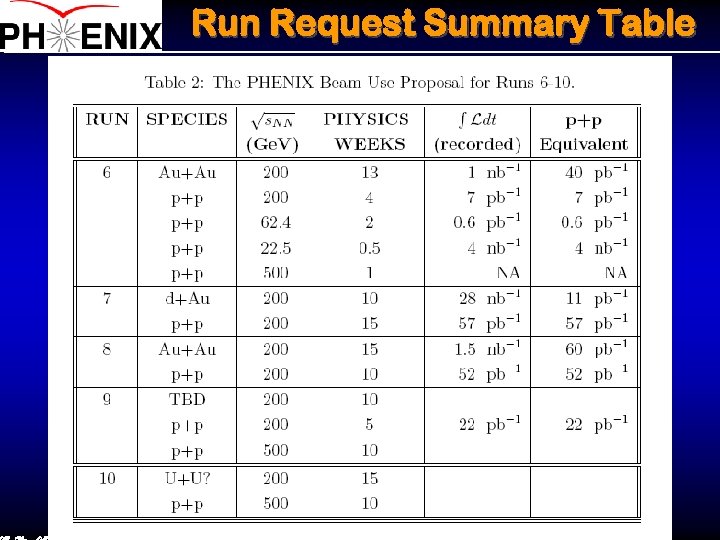
Run Request Summary Table
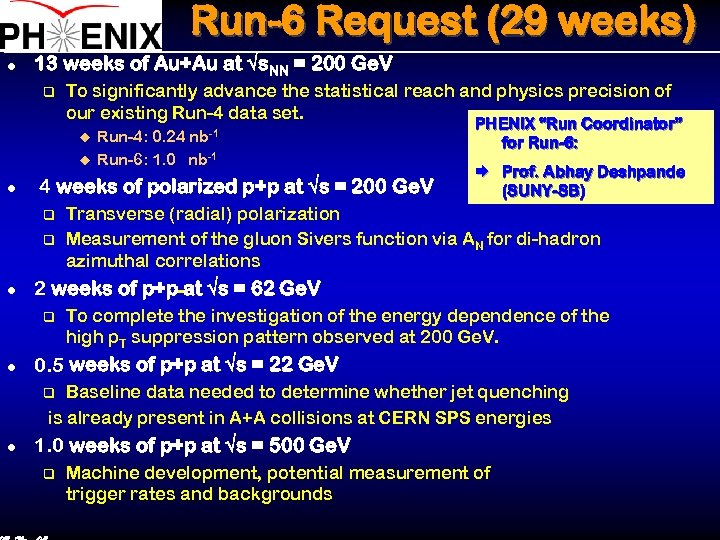
Run-6 Request (29 weeks) l 13 weeks of Au+Au at √s. NN = 200 Ge. V q To significantly advance the statistical reach and physics precision of our existing Run-4 data set. u u l 4 weeks of polarized p+p at √s = 200 Ge. V q q l PHENIX “Run Coordinator” for Run-6: Prof. Abhay Deshpande (SUNY-SB) Transverse (radial) polarization Measurement of the gluon Sivers function via AN for di-hadron azimuthal correlations 2 weeks of p+p at √s = 62 Ge. V q l Run-4: 0. 24 nb-1 Run-6: 1. 0 nb-1 To complete the investigation of the energy dependence of the high p. T suppression pattern observed at 200 Ge. V. 0. 5 weeks of p+p at √s = 22 Ge. V Baseline data needed to determine whether jet quenching is already present in A+A collisions at CERN SPS energies q l 1. 0 weeks of p+p at √s = 500 Ge. V q Machine development, potential measurement of trigger rates and backgrounds
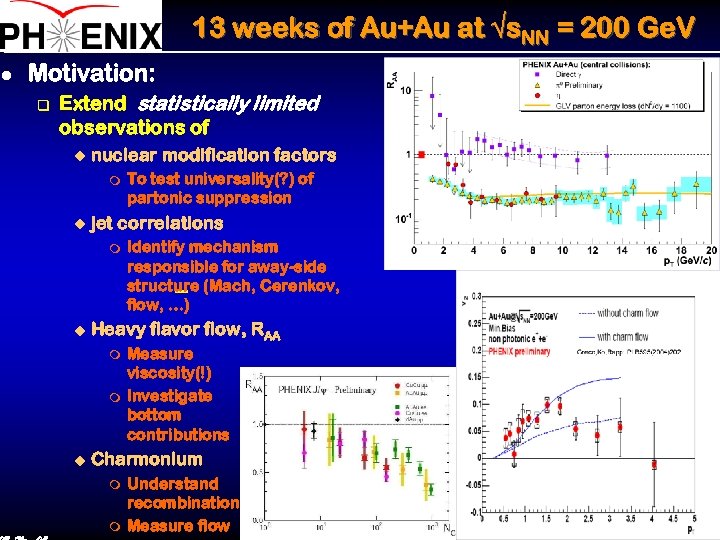
13 weeks of Au+Au at √s. NN = 200 Ge. V l Motivation: q Extend statistically limited observations of u nuclear m u jet modification factors To test universality(? ) of partonic suppression correlations m Identify mechanism responsible for away-side (Mach, Cerenkov, structure flow, …) u Heavy m m flavor flow, RAA Measure viscosity(!) Investigate bottom contributions u Charmonium m m Understand recombination Measure flow
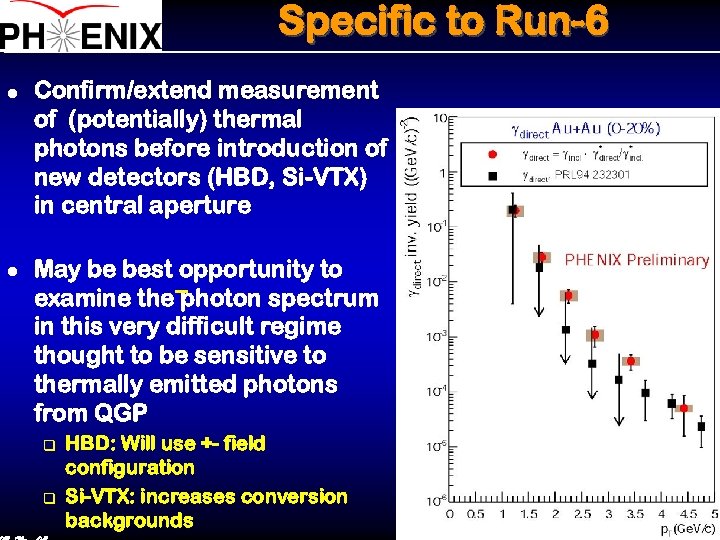
Specific to Run-6 l l Confirm/extend measurement of (potentially) thermal photons before introduction of new detectors (HBD, Si-VTX) in central aperture May be best opportunity to examine the photon spectrum in this very difficult regime thought to be sensitive to thermally emitted photons from QGP q q HBD: Will use +- field configuration Si-VTX: increases conversion backgrounds
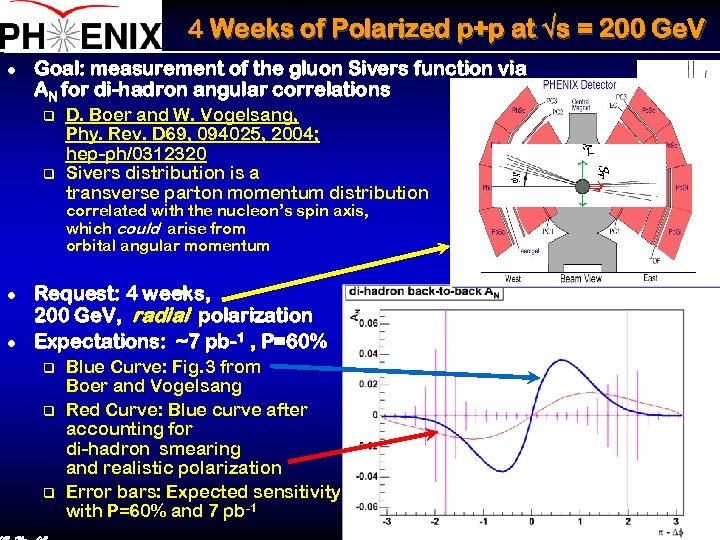
4 Weeks of Polarized p+p at √s = 200 Ge. V l Goal: measurement of the gluon Sivers function via AN for di-hadron angular correlations q q D. Boer and W. Vogelsang, Phy. Rev. D 69, 094025, 2004; hep-ph/0312320 Sivers distribution is a transverse parton momentum distribution correlated with the nucleon’s spin axis, which could arise from orbital angular momentum l l Request: 4 weeks, 200 Ge. V, radial polarization Expectations: ~7 pb-1 , P=60% q q q Blue Curve: Fig. 3 from Boer and Vogelsang Red Curve: Blue curve after accounting for di-hadron smearing and realistic polarization Error bars: Expected sensitivity with P=60% and 7 pb-1
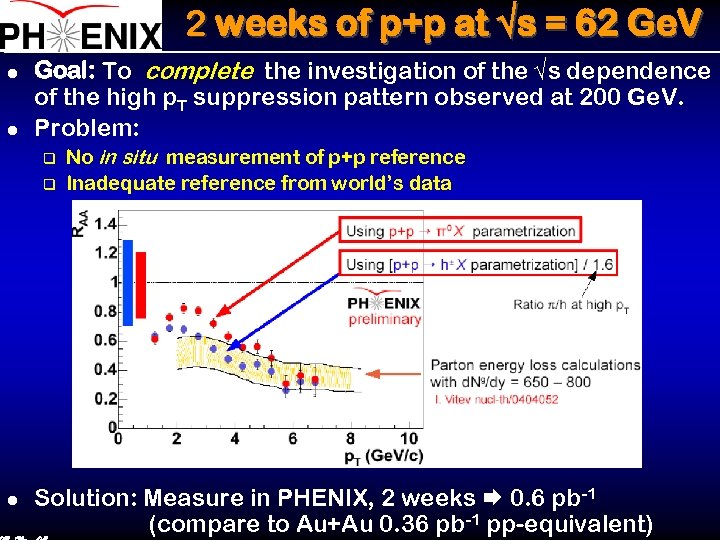
2 weeks of p+p at √s = 62 Ge. V l l Goal: To complete the investigation of the √s dependence of the high p. T suppression pattern observed at 200 Ge. V. Problem: q q No in situ measurement of p+p reference Inadequate reference from world’s data l Solution: Measure in PHENIX, 2 weeks 0. 6 pb-1 (compare to Au+Au 0. 36 pb-1 pp-equivalent)
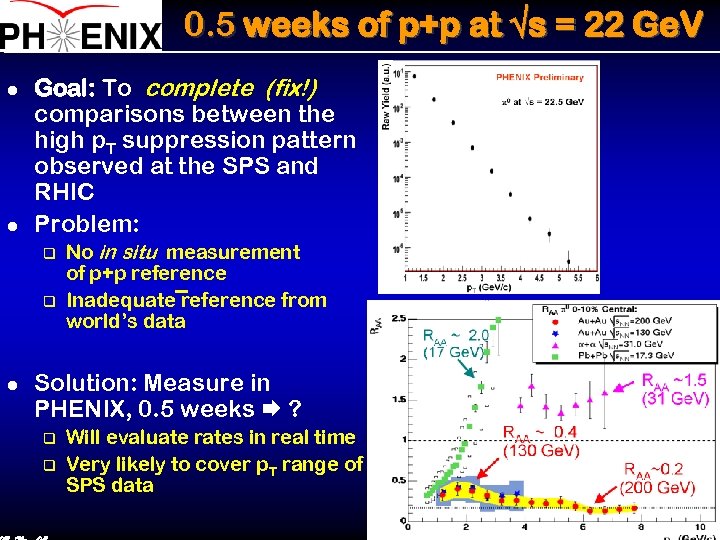
0. 5 weeks of p+p at √s = 22 Ge. V l l Goal: To complete (fix!) comparisons between the high p. T suppression pattern observed at the SPS and RHIC Problem: q q l No in situ measurement of p+p reference Inadequate reference from world’s data Solution: Measure in PHENIX, 0. 5 weeks ? q q Will evaluate rates in real time Very likely to cover p. T range of SPS data
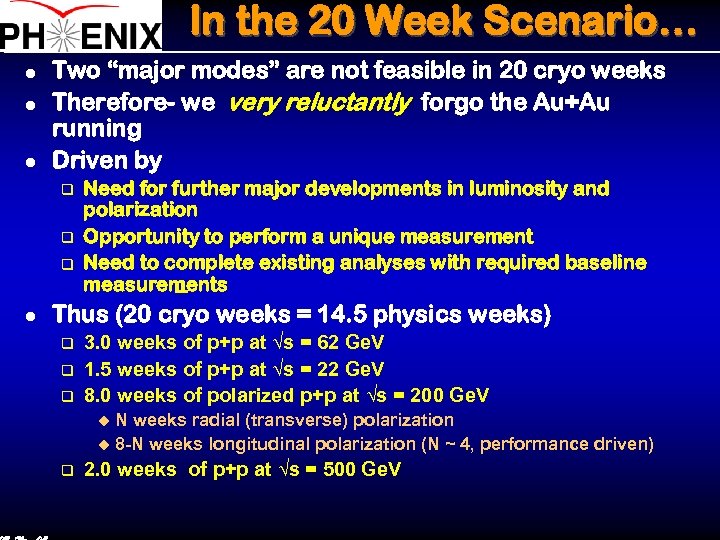
In the 20 Week Scenario… l l l Two “major modes” are not feasible in 20 cryo weeks Therefore- we very reluctantly forgo the Au+Au running Driven by q q q l Need for further major developments in luminosity and polarization Opportunity to perform a unique measurement Need to complete existing analyses with required baseline measurements Thus (20 cryo weeks = 14. 5 physics weeks) q q q 3. 0 weeks of p+p at √s = 62 Ge. V 1. 5 weeks of p+p at √s = 22 Ge. V 8. 0 weeks of polarized p+p at √s = 200 Ge. V u. N weeks radial (transverse) polarization u 8 -N weeks longitudinal polarization (N ~ 4, performance driven) q 2. 0 weeks of p+p at √s = 500 Ge. V
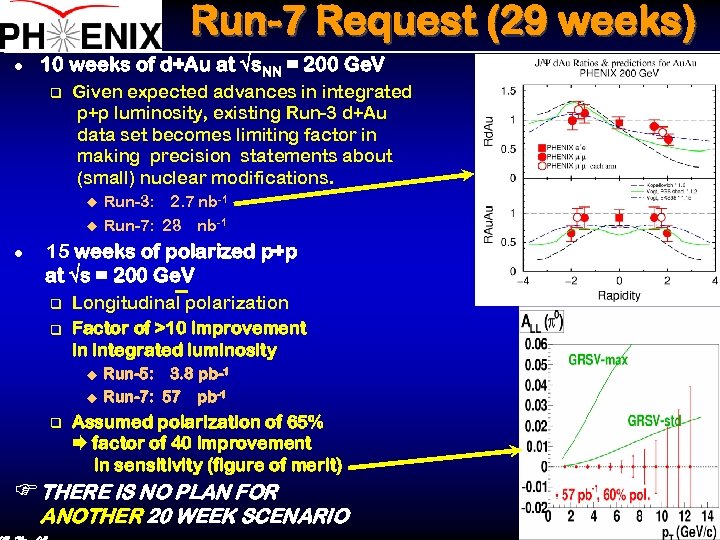
Run-7 Request (29 weeks) l 10 weeks of d+Au at √s. NN = 200 Ge. V q Given expected advances in integrated p+p luminosity, existing Run-3 d+Au data set becomes limiting factor in making precision statements about (small) nuclear modifications. u u l Run-3: 2. 7 nb-1 Run-7: 28 nb-1 15 weeks of polarized p+p at √s = 200 Ge. V q q Longitudinal polarization Factor of >10 improvement in integrated luminosity u u q Run-5: 3. 8 pb-1 Run-7: 57 pb-1 Assumed polarization of 65% factor of 40 improvement in sensitivity (figure of merit) F THERE IS NO PLAN FOR ANOTHER 20 WEEK SCENARIO
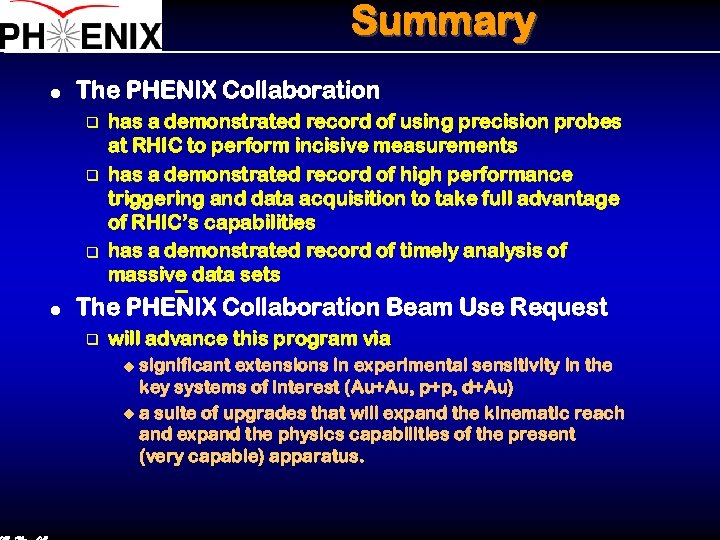
Summary l The PHENIX Collaboration q q q l has a demonstrated record of using precision probes at RHIC to perform incisive measurements has a demonstrated record of high performance triggering and data acquisition to take full advantage of RHIC’s capabilities has a demonstrated record of timely analysis of massive data sets The PHENIX Collaboration Beam Use Request q will advance this program via u significant extensions in experimental sensitivity in the key systems of interest (Au+Au, p+p, d+Au) u a suite of upgrades that will expand the kinematic reach and expand the physics capabilities of the present (very capable) apparatus.
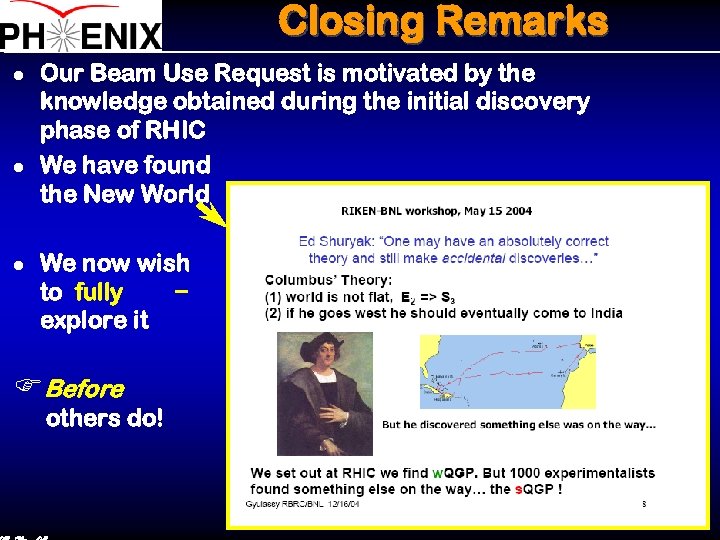
Closing Remarks l l l Our Beam Use Request is motivated by the knowledge obtained during the initial discovery phase of RHIC We have found the New World We now wish to fully explore it FBefore others do!
Back-up
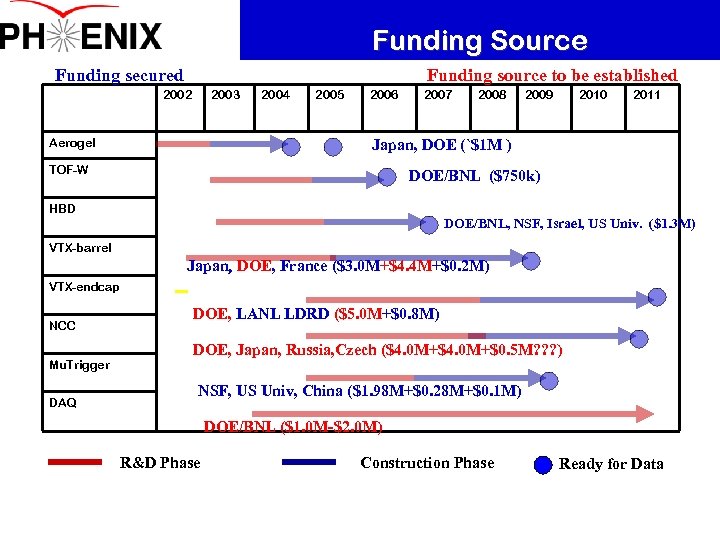
Funding Source Funding secured Funding source to be established 2002 2003 2004 2005 Aerogel 2006 2007 2008 2009 2010 2011 Japan, DOE (`$1 M ) TOF-W DOE/BNL ($750 k) HBD DOE/BNL, NSF, Israel, US Univ. ($1. 3 M) VTX-barrel Japan, DOE, France ($3. 0 M+$4. 4 M+$0. 2 M) VTX-endcap NCC Mu. Trigger DAQ DOE, LANL LDRD ($5. 0 M+$0. 8 M) DOE, Japan, Russia, Czech ($4. 0 M+$0. 5 M? ? ? ) NSF, US Univ, China ($1. 98 M+$0. 28 M+$0. 1 M) DOE/BNL ($1. 0 M-$2. 0 M) R&D Phase Construction Phase Ready for Data
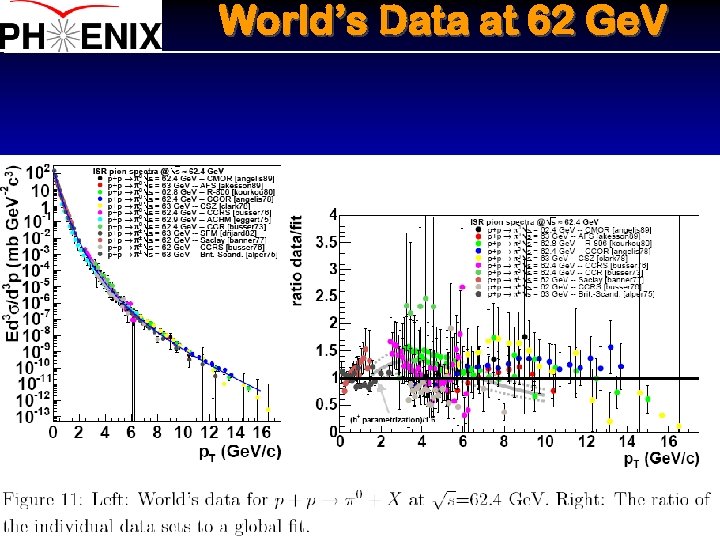
World’s Data at 62 Ge. V
Скачать презентацию PHENIX Beam Use Proposal W A Zajc for
31f89dc0f75aff39e363ff65c93ada56.ppt