


 Скачать презентацию Phase II Trial Designs Old and New Methods
ebd6bfac93346488ae296973d4a0c05f.ppt
- Количество слайдов: 42
 Phase II Trial Designs: Old and New Methods in Clinical Cancer Research February 3, 2015
 Outline of Talk Goals of Phase II study p Single arm studies p n n p Traditional (frequentist) Bayesian designs Multiple outcome designs Time to event outcomes Two (or more) arm studies n n Traditional randomized Phase II Novel multi-arm Phase II
 Goals of Phase II Trials p Provide initial assessment of efficacy or ‘clinical activity’ n n p Screen out ineffective drugs Identify promising new drugs for further evaluation Further define safety and toxicity n n Type Frequency
 Important Design Considerations in Phase II trials p Minimize cost of the trial n n Minimize number of patients exposed to an ineffective treatment Enroll as few patients as “necessary” to show benefit or failure
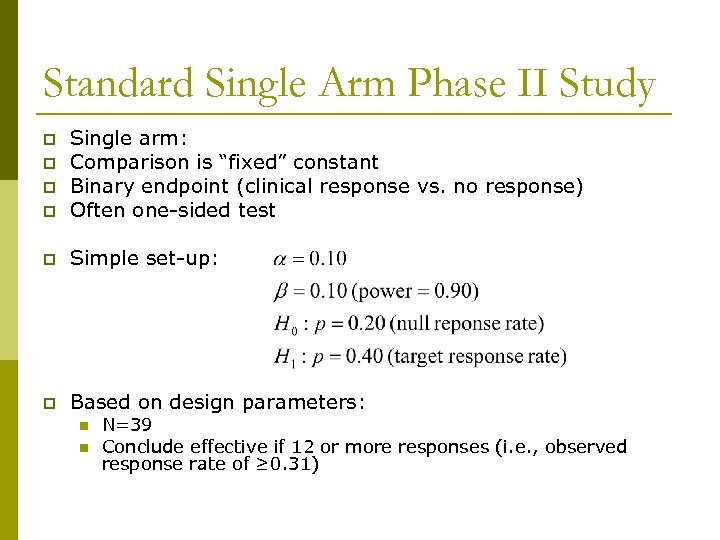 Standard Single Arm Phase II Study p Single arm: Comparison is “fixed” constant Binary endpoint (clinical response vs. no response) Often one-sided test p Simple set-up: p Based on design parameters: p p p n n N=39 Conclude effective if 12 or more responses (i. e. , observed response rate of ≥ 0. 31)
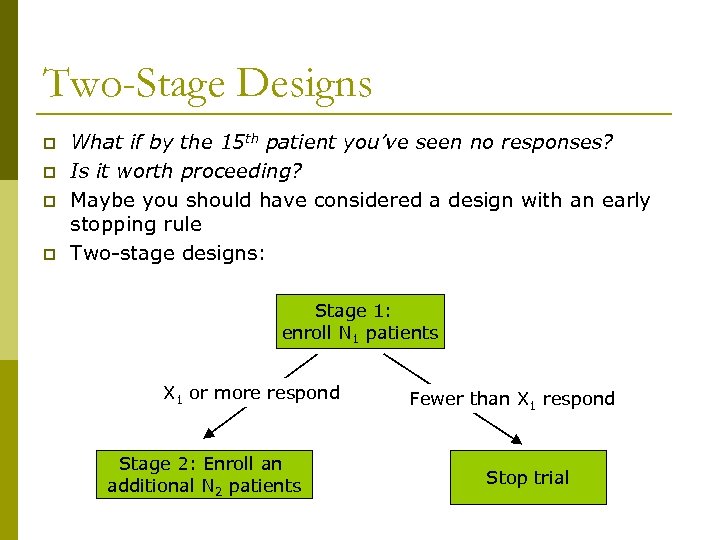 Two-Stage Designs p p What if by the 15 th patient you’ve seen no responses? Is it worth proceeding? Maybe you should have considered a design with an early stopping rule Two-stage designs: Stage 1: enroll N 1 patients X 1 or more respond Stage 2: Enroll an additional N 2 patients Fewer than X 1 respond Stop trial
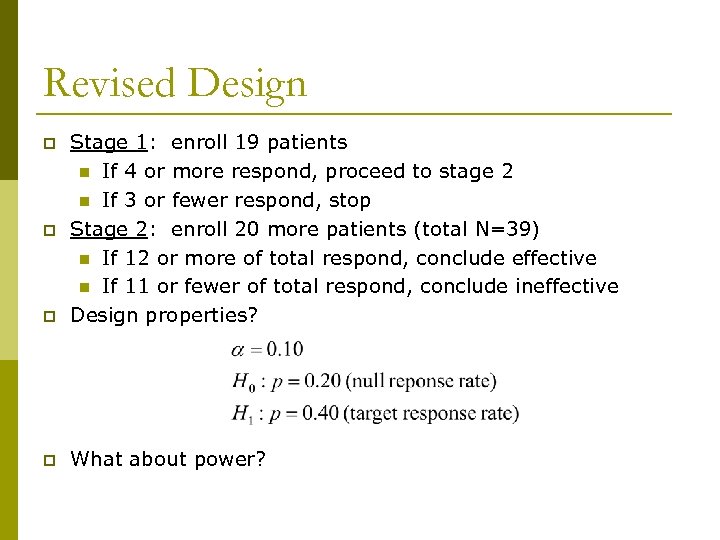 Revised Design p Stage 1: enroll 19 patients n If 4 or more respond, proceed to stage 2 n If 3 or fewer respond, stop Stage 2: enroll 20 more patients (total N=39) n If 12 or more of total respond, conclude effective n If 11 or fewer of total respond, conclude ineffective Design properties? p What about power? p p
 Question 1: p The power of this two stage design is: 1. higher than in the single stage study 2. lower than in the single stage study 3. the same as in the single stage study 4. I can’t remember what power is… q Answer:
 Two-stage Designs o Simon two-stage (1989) n n n Used in example MANY designs fit the criteria “Optimal” p p n p Minimum expected sample size under H 0 Minimum maximum sample size Preserves alpha and power, and permits early look Gehan two-stage (1961) n n n At stage 1, stop if 0 responses Choose N 1 such that early stopping has ‘good’ properties “Special case” of Simon two-stage
 Early Stopping FUTILITY stopping p The designs discussed so far ONLY allow stopping if there is strong evidence that the treatment is not efficacious p Can also have early stopping for efficacy p n n n Generally not popular in single arm studies Important to accumulate evidence to support claim of efficacy But, not stopping prolongs time to launch phase III
 Frequentist versus Bayesians So far, “frequentist” approaches p Frequentists: α and β errors p Bayesians: p n n Quantify designs with other properties General philosophy Start with prior information (“prior distribution”) p Observe data (“likelihood function”) p Combine prior and data to get “posterior” distribution p Make inferences based on posterior p
 Bayesian inference No p-values and confidence intervals p From the posterior distribution: p n n n p Posterior probabilities Prediction intervals Credible intervals Bayesian designs n n Can look at data as often as you like (!) Use information as it accumulates Make “what if? ” calculations Helps decide to stop now or not
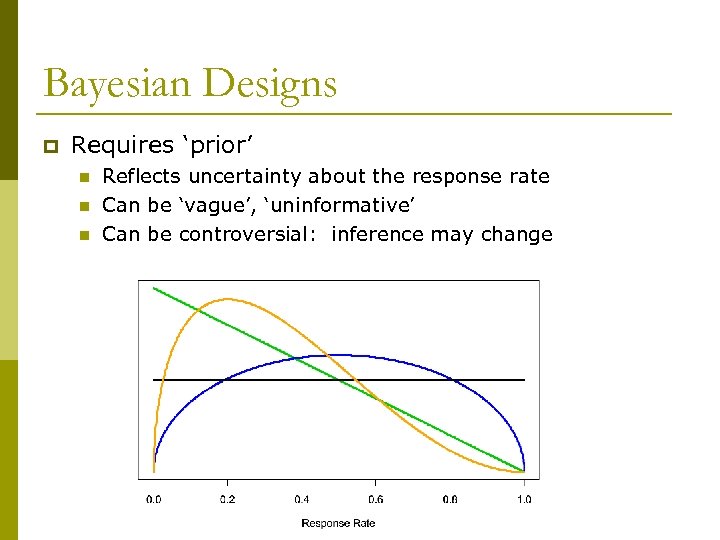 Bayesian Designs p Requires ‘prior’ n n n Reflects uncertainty about the response rate Can be ‘vague’, ‘uninformative’ Can be controversial: inference may change
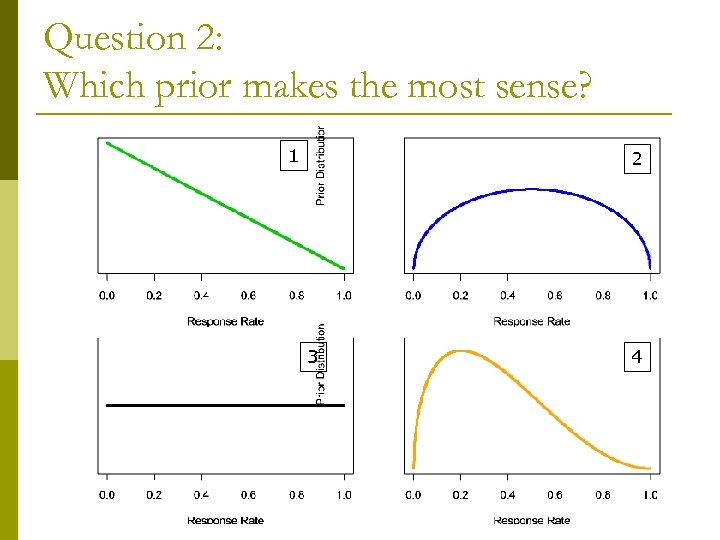 Question 2: Which prior makes the most sense? 1 2 3 4
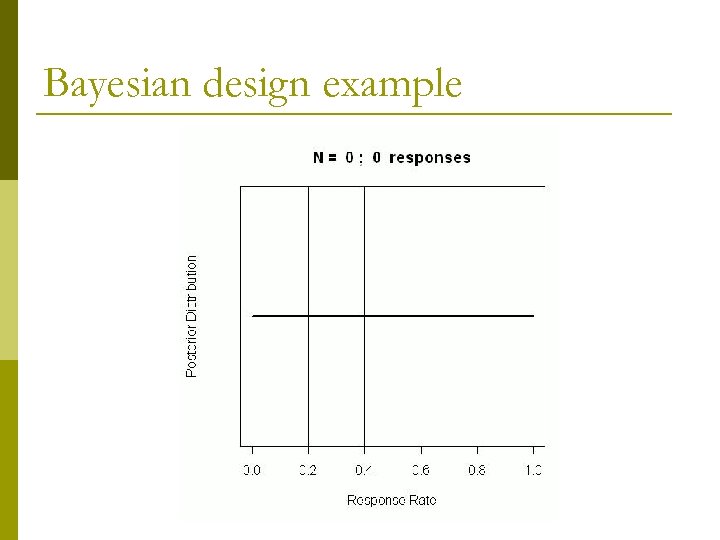 Bayesian design example
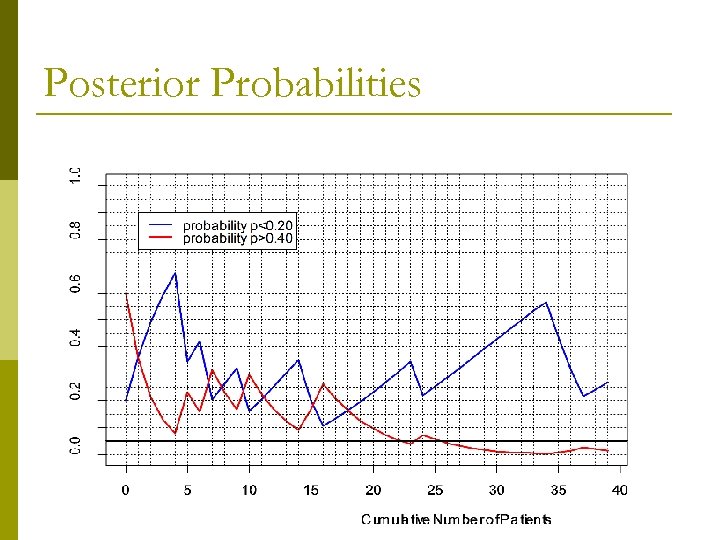 Posterior Probabilities
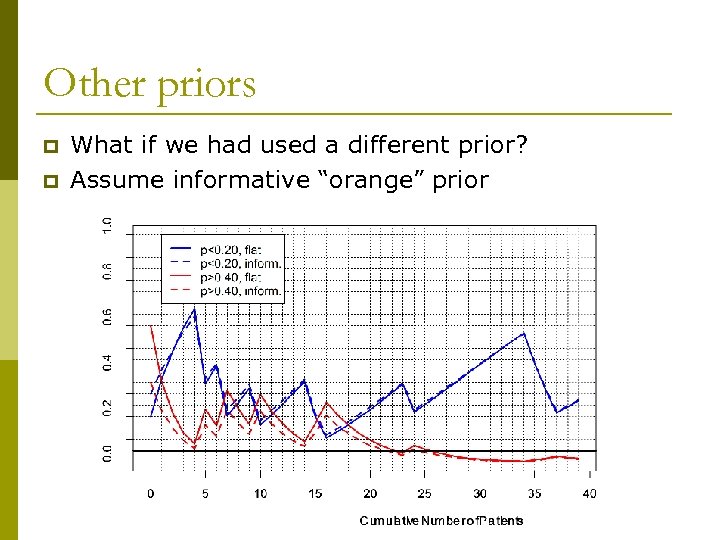 Other priors p p What if we had used a different prior? Assume informative “orange” prior
 Likelihood Approach Similar to Bayesian p Royall (1997), Blume (2002) p No prior distribution required p Quantified by intuitive properties p n n n instead of α and β “Probability of misleading evidence” (i. e. choosing the wrong hypothesis) Likelihood ratio used for making inferences p Can look at data as it accumulates p
 Multiple Outcomes Phase II = “safety + efficacy” trial p Then why are we only talking about efficacy? p Bryant and Day (1995): extend Simon two-stage to incorporate both outcomes p Thall and Cheng (1999): treated as “true” bivariate outcome. p
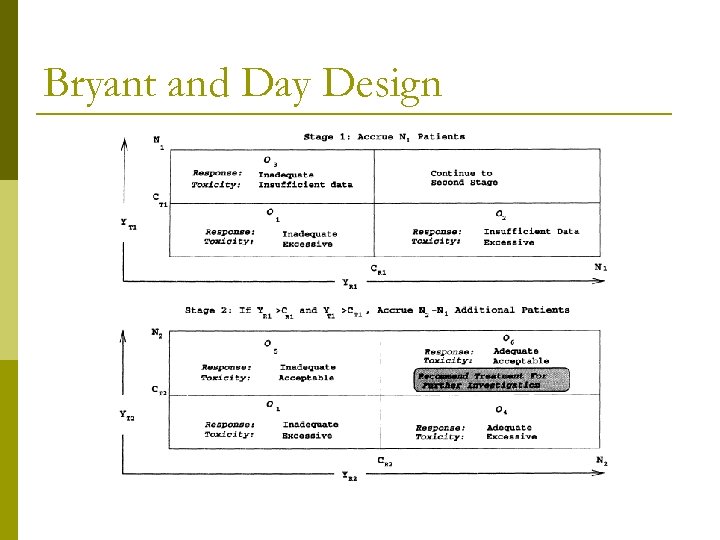 Bryant and Day Design
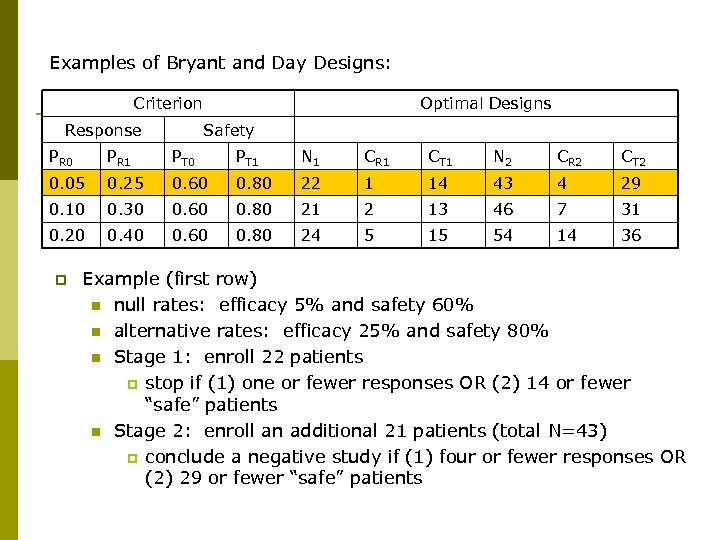 Examples of Bryant and Day Designs: Criterion Response Optimal Designs Safety PR 0 PR 1 PT 0 PT 1 N 1 CR 1 CT 1 N 2 CR 2 CT 2 0. 05 0. 25 0. 60 0. 80 22 1 14 43 4 29 0. 10 0. 30 0. 60 0. 80 21 2 13 46 7 31 0. 20 0. 40 0. 60 0. 80 24 5 15 54 14 36 p Example (first row) n null rates: efficacy 5% and safety 60% n alternative rates: efficacy 25% and safety 80% n Stage 1: enroll 22 patients p stop if (1) one or fewer responses OR (2) 14 or fewer “safe” patients n Stage 2: enroll an additional 21 patients (total N=43) p conclude a negative study if (1) four or fewer responses OR (2) 29 or fewer “safe” patients
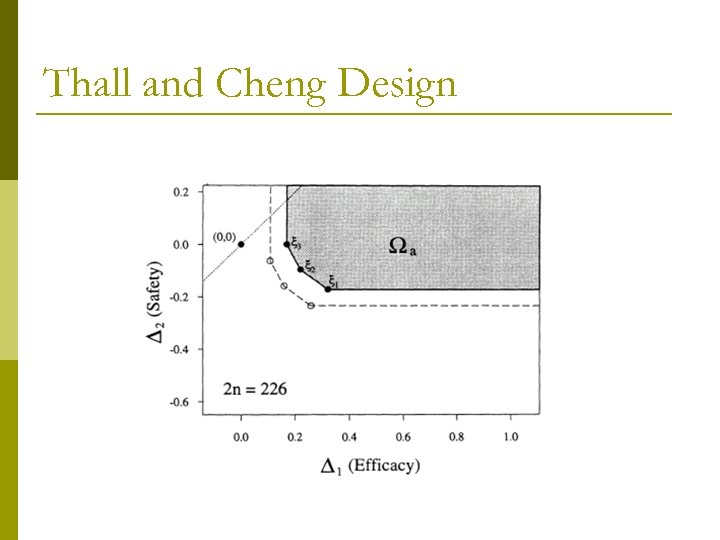 Thall and Cheng Design
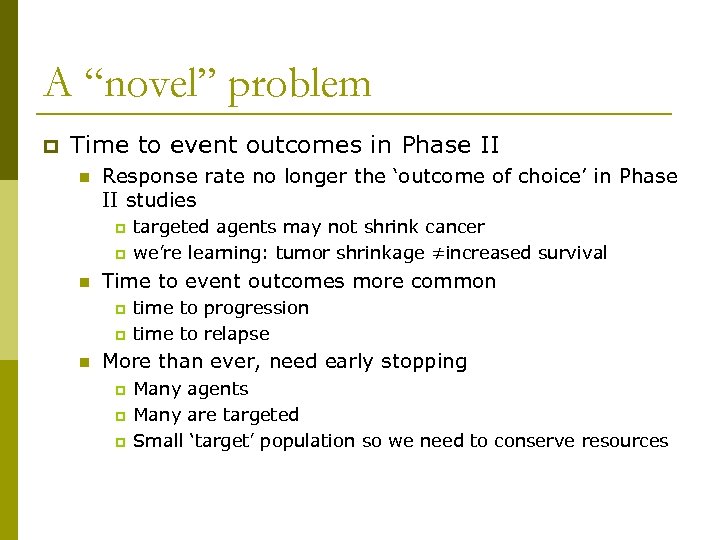 A “novel” problem p Time to event outcomes in Phase II n Response rate no longer the ‘outcome of choice’ in Phase II studies p p n Time to event outcomes more common p p n targeted agents may not shrink cancer we’re learning: tumor shrinkage ≠increased survival time to progression time to relapse More than ever, need early stopping p p p Many agents Many are targeted Small ‘target’ population so we need to conserve resources
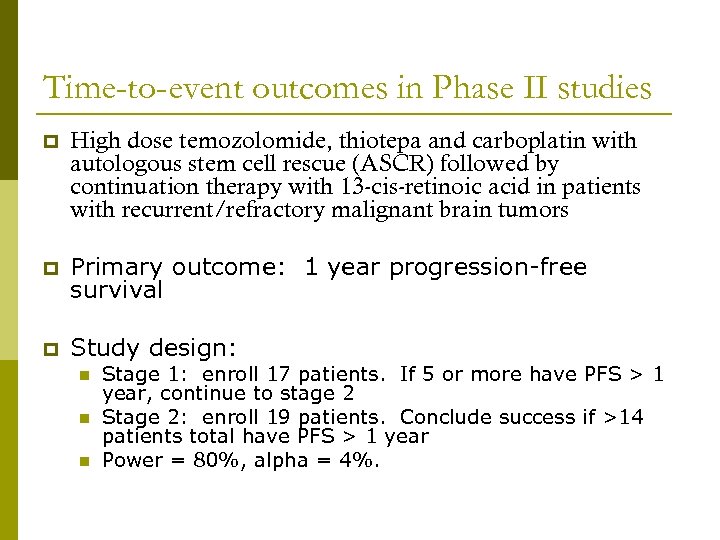 Time-to-event outcomes in Phase II studies p High dose temozolomide, thiotepa and carboplatin with autologous stem cell rescue (ASCR) followed by continuation therapy with 13 -cis-retinoic acid in patients with recurrent/refractory malignant brain tumors p Primary outcome: 1 year progression-free survival p Study design: n n n Stage 1: enroll 17 patients. If 5 or more have PFS > 1 year, continue to stage 2 Stage 2: enroll 19 patients. Conclude success if >14 patients total have PFS > 1 year Power = 80%, alpha = 4%.
 Time-to-event outcomes in Phase II studies p You have enrolled the 17 th patient p Accrued data: n n n p 2 patients were progression-free at 1 year visit 9 patients progressed before 1 year 6 patients have been followed for less than 1 year and are currently progression-free (times = 1, 2, 5, 7, 7, 9) Study design calls for ‘interim analysis’ at the 17 th patient.
 What do you do? 1. Halt enrollment (which may be for 6+ months) to wait to see if the stopping rule is met. 2. Continue enrolling while waiting to see if stopping rule is met. 3. Extrapolate what 1 year PFS would be for the 6 patients who haven’t reached 1 year based on what we’ve seen thus far
 Randomized phase II p Why randomized? n Want to explore efficacy n Not willing to invest in phase III (yet) n Want some “control” or “prioritization” n Primarily two different kinds of randomized phase II studies p Phase II selection design (prioritization) p Phase II designs with reference control arm (control) n Also phase II/III studies
 Phase II selection design (prioritization) p p p Two parallel one arm studies (classic case) Do not directly compare arms to each other. Compare each to “null rate” Why? To compare to each other, you’ll need a study at least two times as large. “Pick the Winner” (Simon, 1985) n Appropriate to use when: p p n Selecting among NEW agents Selecting among different schedules or doses NOT appropriate when p Trying to directly compare treatment efficacies (not powered)
 Phase II selection design (prioritization) p “Pick the Winner” (continued) n n 90% chance of choosing better arm so long as true difference in response rates is >15%. Uses 2+ Simon two-stage designs Each arm is compared to a null rate p Must satisfy efficacy criteria of Simon design p Move the “winner” to phase III p Only have to pick winner if more than one arm shows efficacy p n Can be used when the goal is prioritizing which (if any) experimental regimen should move to phase III when no a priori information to favor one.
 Randomized Phase II designs with reference arm (control) p Includes reference arm to ensure that historical rate is “on target” p Reference arm is not directly compared to experimental arm(s) (due to small N) p Can see if failure (or success) is due to incomparability of patient populations
 Other Randomized Phase II designs? Lots of randomized studies are calling themselves randomized phase II studies these days: n If outcome of interest is surrogate p Correlative (biomarker) p Clinical (response) n If sample size is relatively small but direct comparison is made n If study is comparative, but is not definitive for whatever reason (e. g. if α and β are large)
 Phase II/III studies p Several versions {Schaid (1988), Storer (1990), Ellenberg and Eisenberger (1985), Scher and Heller (2002)} p p General idea n Begin with randomized phase II study n Randomize to control arm & experimental arm(s) n If some threshold of efficacy is met, continue to phase III sample size for direct comparison Benefits: n Allow use of phase II data in phase III inference n Minimize delay in starting up phase III study n Uses concurrent control
 Phase II/III studies p p p Cons: n The sample size for the phase II part is approximately twice as large as would be needed for standard phase II n Need phase III infrastructure developed even if it stops early. n Phase II outcome is not always the same as the Phase III outcome Would be useful if MOST phase II studies showed efficacy (not the case!) Really, these could be considered phase III designs with very aggressive early stopping rules.
 Adaptive Randomization Designs p p Randomization is “adapted” based on accumulated information Adaptive on Outcome (Bayesian/Likelihood) n Assign treatments according to accumulated information about best treatment. (Berry and Eick, 1995) n Assign with higher probabilities to better therapies n Example: Troxacitabine in AML (Giles et al. 2003)
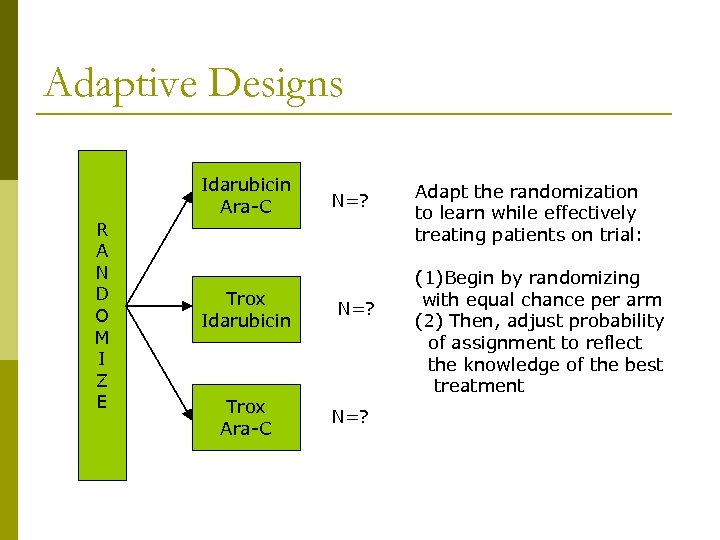 Adaptive Designs Idarubicin Ara-C R A N D O M I Z E Trox Idarubicin Trox Ara-C N=? N=25 Adapt the randomization to learn while effectively treating patients on trial: Standard Design (1)Begin by randomizing with equal chance per arm (2) Then, adjust probability of assignment to reflect the knowledge of the best treatment
 Adaptive Designs p p Begin assuming equally effective (1/3, 1/3) May wait until a minimum number have been treated per arm Based on currently available (accumulated) data, randomize next patient (i. e. , “weighted” randomization) Stopping rules: drop an arm when there is “strong” evidence that n n It has low efficacy OR It has lower efficacy than competing treatments
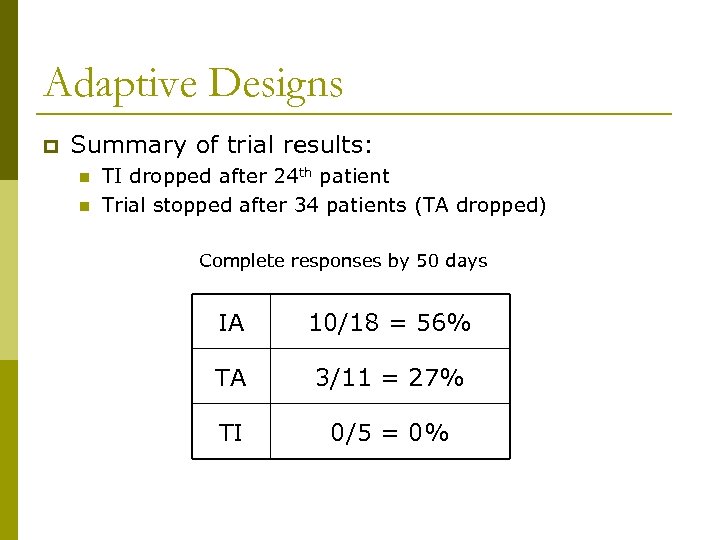 Adaptive Designs p Summary of trial results: n n TI dropped after 24 th patient Trial stopped after 34 patients (TA dropped) Complete responses by 50 days IA 10/18 = 56% TA 3/11 = 27% TI 0/5 = 0%
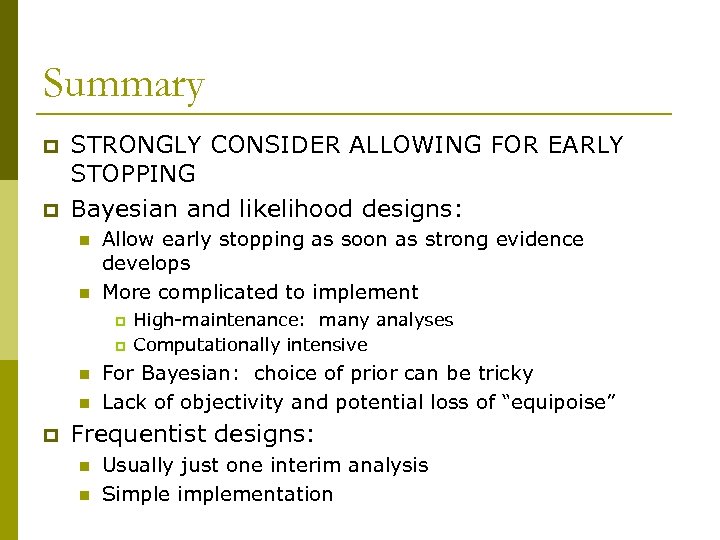 Summary p p STRONGLY CONSIDER ALLOWING FOR EARLY STOPPING Bayesian and likelihood designs: n n Allow early stopping as soon as strong evidence develops More complicated to implement p p n n p High-maintenance: many analyses Computationally intensive For Bayesian: choice of prior can be tricky Lack of objectivity and potential loss of “equipoise” Frequentist designs: n n Usually just one interim analysis Simplementation
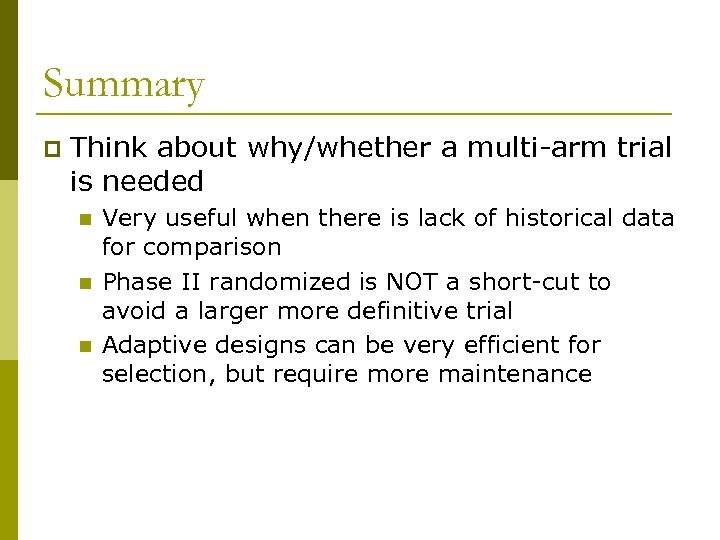 Summary p Think about why/whether a multi-arm trial is needed n n n Very useful when there is lack of historical data for comparison Phase II randomized is NOT a short-cut to avoid a larger more definitive trial Adaptive designs can be very efficient for selection, but require more maintenance
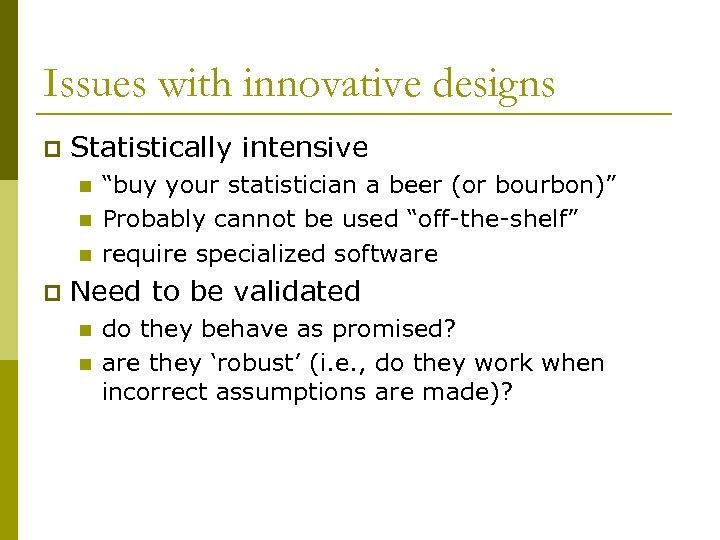 Issues with innovative designs p Statistically intensive n n n p “buy your statistician a beer (or bourbon)” Probably cannot be used “off-the-shelf” require specialized software Need to be validated n n do they behave as promised? are they ‘robust’ (i. e. , do they work when incorrect assumptions are made)?
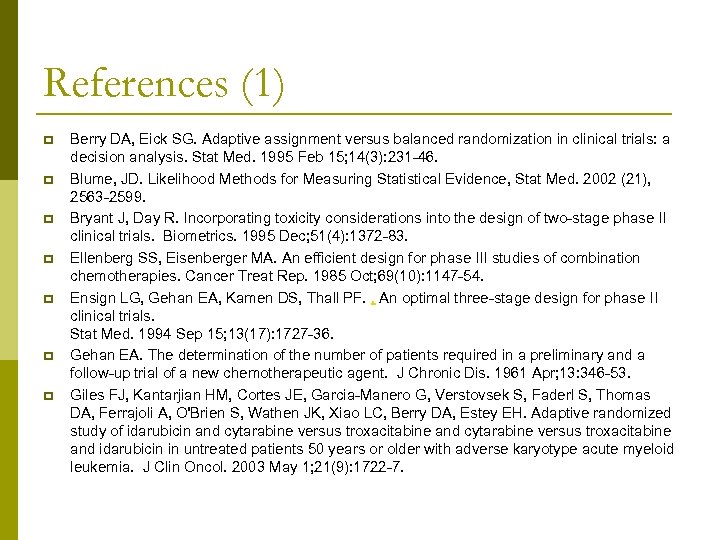 References (1) p p p p Berry DA, Eick SG. Adaptive assignment versus balanced randomization in clinical trials: a decision analysis. Stat Med. 1995 Feb 15; 14(3): 231 -46. Blume, JD. Likelihood Methods for Measuring Statistical Evidence, Stat Med. 2002 (21), 2563 -2599. Bryant J, Day R. Incorporating toxicity considerations into the design of two-stage phase II clinical trials. Biometrics. 1995 Dec; 51(4): 1372 -83. Ellenberg SS, Eisenberger MA. An efficient design for phase III studies of combination chemotherapies. Cancer Treat Rep. 1985 Oct; 69(10): 1147 -54. Ensign LG, Gehan EA, Kamen DS, Thall PF. , An optimal three-stage design for phase II clinical trials. Stat Med. 1994 Sep 15; 13(17): 1727 -36. Gehan EA. The determination of the number of patients required in a preliminary and a follow-up trial of a new chemotherapeutic agent. J Chronic Dis. 1961 Apr; 13: 346 -53. Giles FJ, Kantarjian HM, Cortes JE, Garcia-Manero G, Verstovsek S, Faderl S, Thomas DA, Ferrajoli A, O'Brien S, Wathen JK, Xiao LC, Berry DA, Estey EH. Adaptive randomized study of idarubicin and cytarabine versus troxacitabine and idarubicin in untreated patients 50 years or older with adverse karyotype acute myeloid leukemia. J Clin Oncol. 2003 May 1; 21(9): 1722 -7.
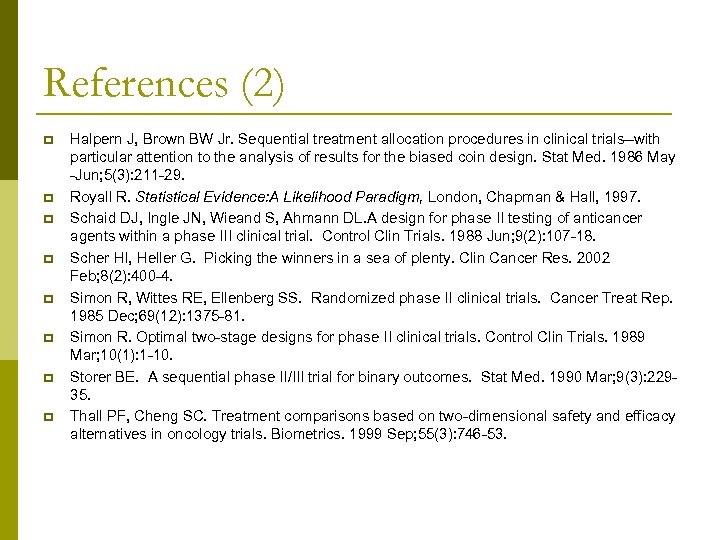 References (2) p p p p Halpern J, Brown BW Jr. Sequential treatment allocation procedures in clinical trials--with particular attention to the analysis of results for the biased coin design. Stat Med. 1986 May -Jun; 5(3): 211 -29. Royall R. Statistical Evidence: A Likelihood Paradigm, London, Chapman & Hall, 1997. Schaid DJ, Ingle JN, Wieand S, Ahmann DL. A design for phase II testing of anticancer agents within a phase III clinical trial. Control Clin Trials. 1988 Jun; 9(2): 107 -18. Scher HI, Heller G. Picking the winners in a sea of plenty. Clin Cancer Res. 2002 Feb; 8(2): 400 -4. Simon R, Wittes RE, Ellenberg SS. Randomized phase II clinical trials. Cancer Treat Rep. 1985 Dec; 69(12): 1375 -81. Simon R. Optimal two-stage designs for phase II clinical trials. Control Clin Trials. 1989 Mar; 10(1): 1 -10. Storer BE. A sequential phase II/III trial for binary outcomes. Stat Med. 1990 Mar; 9(3): 22935. Thall PF, Cheng SC. Treatment comparisons based on two-dimensional safety and efficacy alternatives in oncology trials. Biometrics. 1999 Sep; 55(3): 746 -53.