


 Скачать презентацию Pharmacy Services Dr Yaseen Hayajneh Pharmacy n
b074058cc8a652ecbdf2ae5fbb767adb.ppt
- Количество слайдов: 15
 Pharmacy Services Dr. Yaseen Hayajneh
 Pharmacy n The art and science of preparing, compounding, stabilizing, preserving and dispensing medications and the provision of drug and related information. n Also a place where drugs are stored, compounded and dispensed. n A Pharmacist is a health care professional who n Compounds and dispenses medications and other pharmaceutical supplies, using standard physical and chemical procedures to fill written prescriptions issued by physicians. n Maintains records on all unit dose for each nursing unit and also IV additive program. n Maintains inventory of supplies. n A graduate from accredited school of pharmacy and licensed in the state of practice. Dr. Yaseen Hayajneh
 Responsibilities of Pharmacists n Compounding drugs n Dispensing drugs n Medication profile review n Patient education n Provider of drug information n Clinical pharmacy n Pharmaceutical care n Patient care provider Dr. Yaseen Hayajneh
 Compounding Drugs n Pharmacists compounded drugs used to treat patients in the 1940 s and 50 s. n Then pharmaceutical manufacturers began to take over this role. n Hospital pharmacists assumed responsibility for compounding parenteral admixtures in the 1960 s and 70 s. n Today more pharmacists are compounding specialty products that are not commercially available and more compounding is predicted in the future. Dr. Yaseen Hayajneh
 Dispensing Drugs n In the 1960 s hospital pharmacists implemented unit- dose drug distribution systems to reduce medication dispensing and administration errors. n In unit dose system medication distribution, medications are contained in single unit packages; they are dispensed in as ready-to-administer form as possible; and for most medications, not more than a 24 -hour supply of doses is delivered to or available at the patient-care area at any time. n Most hospitals and long term care facilities now use a unit-dose system. n In the 80 s automated dispensing devices became available for use in hospital and community settings. Dr. Yaseen Hayajneh
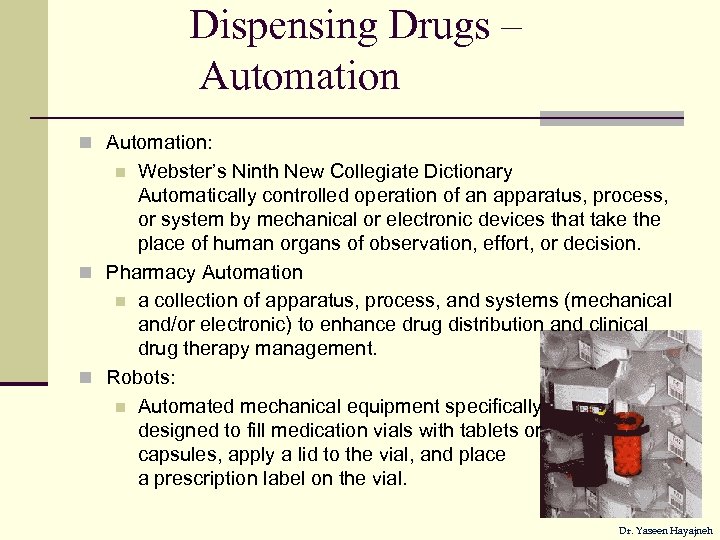 Dispensing Drugs – Automation n Automation: Webster’s Ninth New Collegiate Dictionary Automatically controlled operation of an apparatus, process, or system by mechanical or electronic devices that take the place of human organs of observation, effort, or decision. n Pharmacy Automation n a collection of apparatus, process, and systems (mechanical and/or electronic) to enhance drug distribution and clinical drug therapy management. n Robots: n Automated mechanical equipment specifically designed to fill medication vials with tablets or capsules, apply a lid to the vial, and place a prescription label on the vial. n Dr. Yaseen Hayajneh
 Dispensing Drugs – Automation Benefits n Automation of the dispensing process offers the potential for improved service delivery in four key areas: n Efficiency. n n n Safety n n According to the US National Academy of Science, > 78% of dispensing errors could be avoided by the use of automated dispensing systems. Stock management. n n n Faster speed of operation than humans Staff can then be utilized in more patient-centered activities Improve stock rotation Improve overall stock control Environment. n n Less space requirements Less staff movements Dr. Yaseen Hayajneh
 Medication Profile Review n In the 1970 s pharmacists began maintaining medication profiles to review patient medications for drug related problems. n Computerized systems for automatically reviewing prescriptions for allergies, drug interactions, appropriateness of the dosage, and other common drug related problems have since evolved. Dr. Yaseen Hayajneh
 Patient Education n In the 1980 s most states required pharmacists to provide patient medication counseling to outpatients on new prescriptions. n Verbal, written and computerized printed education materials to supplement verbal patient counseling has since evolved. Dr. Yaseen Hayajneh
 Provider of Drug Information n In the 1960 s drug information centers were created in hospitals to provide drug information to physicians and other health care providers. n The role of pharmacists as drug information providers led to decentralization of pharmacists to provide drug information. Dr. Yaseen Hayajneh
 Clinical Pharmacy In the 70 s and 80 s most hospitals began to develop clinical pharmacy services. • Pharmacists were decentralized to patient care units to provide clinical services. • Ambulatory clinical services also began in clinics and a few community pharmacies. n Early Clinical Pharmacy n Patient focused, drug focused, interdisciplinary, and data driven n Provider of drug information to patients and health professionals n Individualizing doses: clinical pharmacokinetics n Monitoring drug therapy: Order review and feedback n Nutritional support • Dr. Yaseen Hayajneh
 Pharmaceutical Care n A fairly new concept in providing health care; 1990 s - these terms became very popular n Involves direct involvement of the pharmacist in the design, implementation, and monitoring of a therapeutic drug plan to produce a specific therapeutic outcome. n A strategy that attempts to utilize drug therapy more efficiently to achieve definite outcomes that improve a patient’s quality of life. n Requires a reorientation of physicians, pharmacists, and nurses toward effective drug therapy outcomes. n It is a set of relationships and decisions through which pharmacists, physicians, nurses, and patients work together to design, implement, and monitor a therapeutic plan that will produce specific therapeutic outcomes. Dr. Yaseen Hayajneh
 Community Pharmacy Practice • • • Community pharmacists • counsel patients, • answer questions about prescription and over-the-counter drugs, such as possible adverse reactions and interactions, and • give patients health care advice. • They also give advice about durable medical equipment, home care and preventive care. Some community pharmacists offer disease management services for conditions such as diabetes, asthma, hypertension, etc. Some community pharmacists offer preventive health programs: smoking cessation, immunizations, screening for lipid disorders, etc. Dr. Yaseen Hayajneh
 Hospital Pharmacy Practice • Unit-dose and parenteral admixture programs • Clinical services. • Computerized drug distribution systems and use some automated dispensing devices. • Some hospitals have comprehensive inpatient pharmaceutical care programs. • Few hospitals have extensive ambulatory pharmaceutical care programs. Dr. Yaseen Hayajneh
 Pharmacy Trends n Increased emphasis on patient care services as well n n as drug distribution Increased emphasis on continuity of care (homeoffice practice-hospital-long term care, etc. ) Increased emphasis on preventive care (use of OTCs, alternative medicines, self-diagnostic kits, diet, screening procedures, immunizations, etc. ) Increased use of automation for pharmacy dispensing Increased use of information technology Dr. Yaseen Hayajneh