Скачать презентацию Pharmacy National Procurement Christine Gilmour Chief Pharmacist
9bc3adb308241aacfb9ad16410d4296d.ppt
- Количество слайдов: 28
 Pharmacy & National Procurement Christine Gilmour Chief Pharmacist NHS Lanarkshire
 Overview 1 Background 2 Life before National Procurement 3 Current Situation 4 What’s Next?
 Overview 1 Background 2 Life before National Procurement 3 Current Situation 4 What’s Next?
 Principles of Medicine Purchasing (in the managed service) n Pharmacy = single purchase point n Pharmacy decides what to buy n No non-stock n Purchase order every time
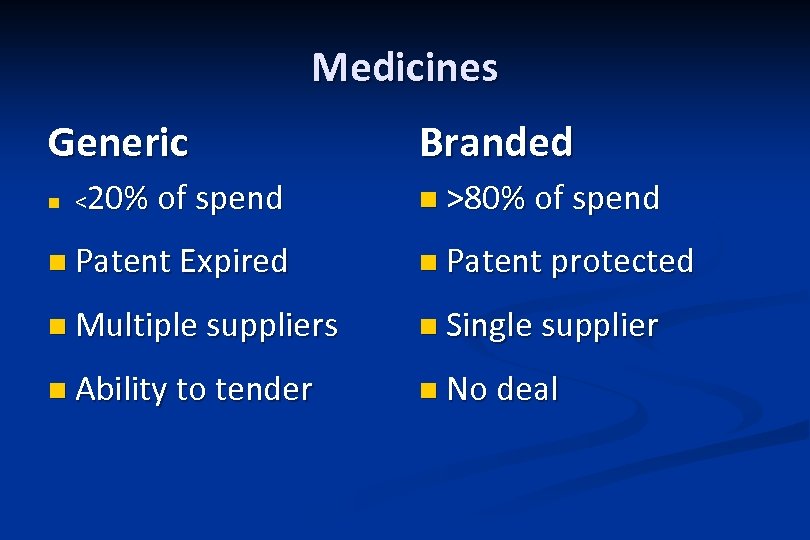 Medicines Generic n <20% of spend Branded n >80% of spend n Patent Expired n Patent protected n Multiple suppliers n Single supplier n Ability to tender n No deal
 Primary Care n Bulk of NHS medicine spend is in primary care n Generic drug prices controlled via Drug Tariff n Medicines are sourced and purchased by the community pharmacy contractor who is then reimbursed at tariff or list price. NHS does not buy the medicines.
 Branded Medicines n Branded medicines = ~80% of the NHS drug spend n Prices of branded medicines are controlled by the Pharmaceutical Price Regulation Scheme (PPRS). n Therapeutic tendering has been challenged
 Pharmaceutical Price Regulation Scheme (PPRS) n Is a reserved matter negotiated by Do. H n Is a voluntary agreement n Regulates UK market for branded medicines. n Allows manufacturers to make a capped level of profit in relation to their investment. n Manufacturers are able to modulate prices across a product range
 Overview 1 Background 2 Life before National Procurement 3 Current Situation 4 What’s Next?
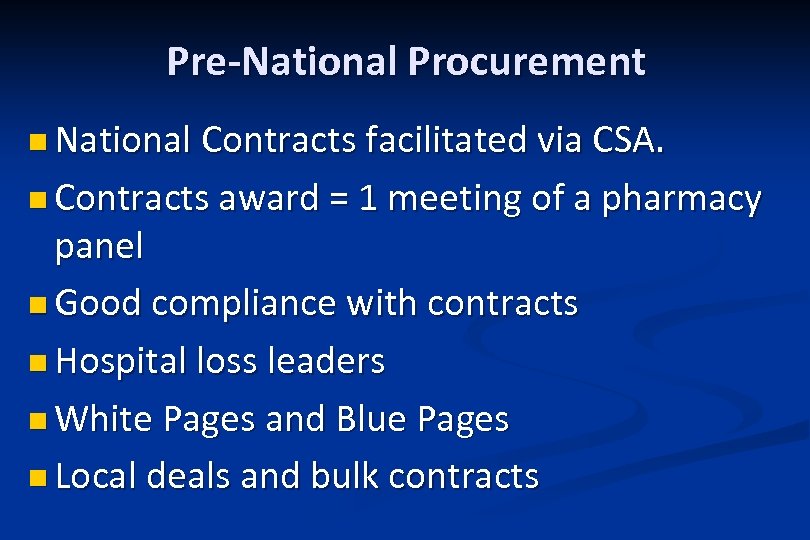 Pre-National Procurement n National Contracts facilitated via CSA. n Contracts award = 1 meeting of a pharmacy panel n Good compliance with contracts n Hospital loss leaders n White Pages and Blue Pages n Local deals and bulk contracts
 Overview 1 Background 2 Life before National Procurement 3 Current Situation 4 What’s Next
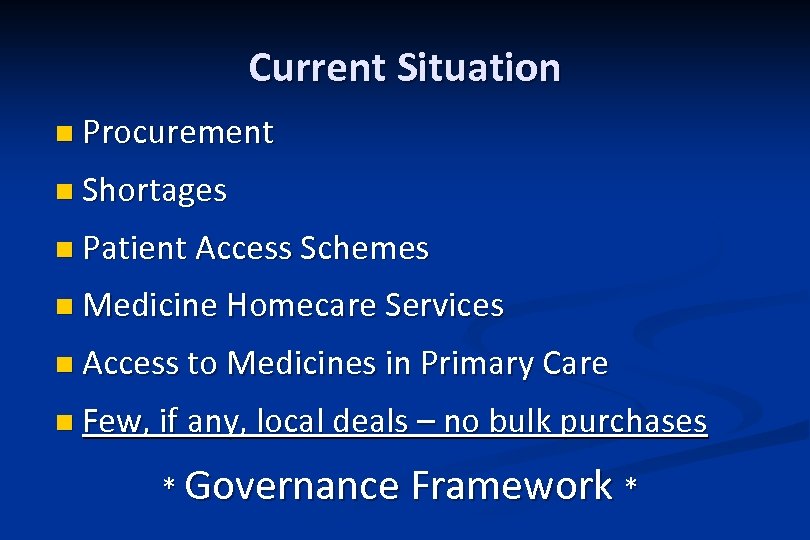 Current Situation n Procurement n Shortages n Patient Access Schemes n Medicine Homecare Services n Access to Medicines in Primary Care n Few, if any, local deals – no bulk purchases * Governance Framework *
 Pharmacy Team within NP
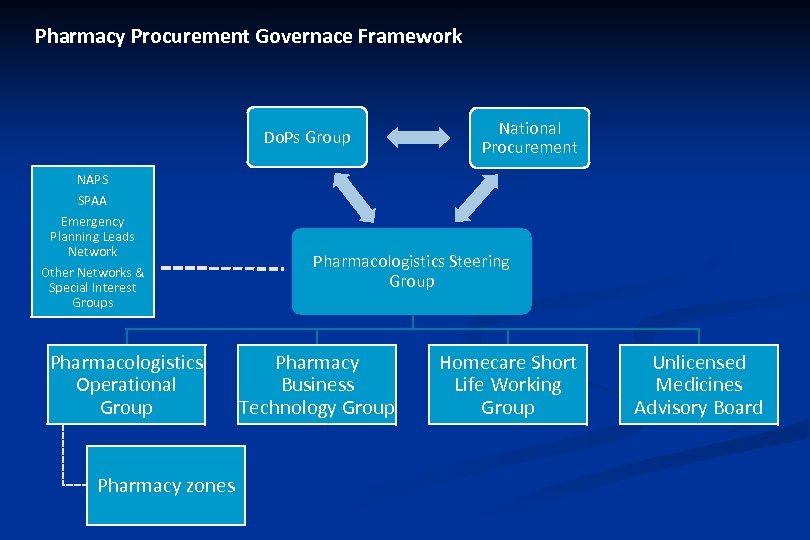 Pharmacy Procurement Governace Framework Do. Ps Group National Procurement NAPS SPAA Emergency Planning Leads Network Other Networks & Special Interest Groups Pharmacologistics Operational Group Pharmacy zones Pharmacologistics Steering Group Pharmacy Business Technology Group Homecare Short Life Working Group Unlicensed Medicines Advisory Board
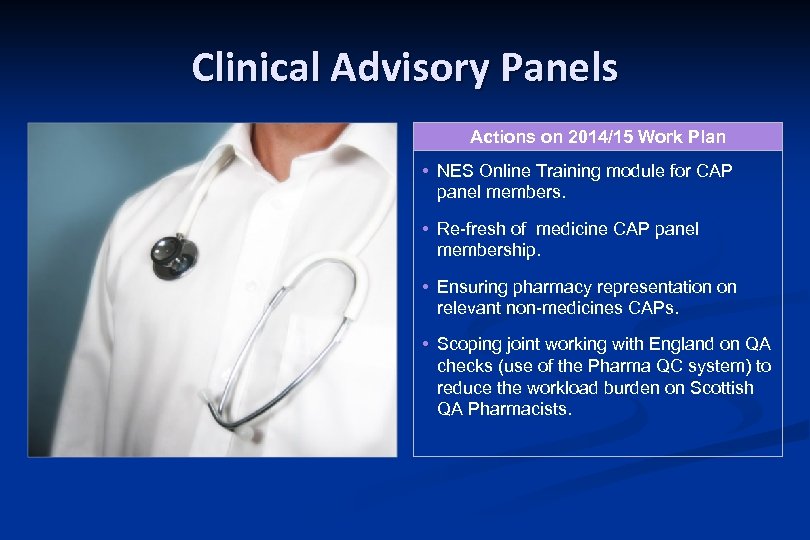 Clinical Advisory Panels Actions on 2014/15 Work Plan • NES Online Training module for CAP panel members. • Re-fresh of medicine CAP panel membership. • Ensuring pharmacy representation on relevant non-medicines CAPs. • Scoping joint working with England on QA checks (use of the Pharma QC system) to reduce the workload burden on Scottish QA Pharmacists.
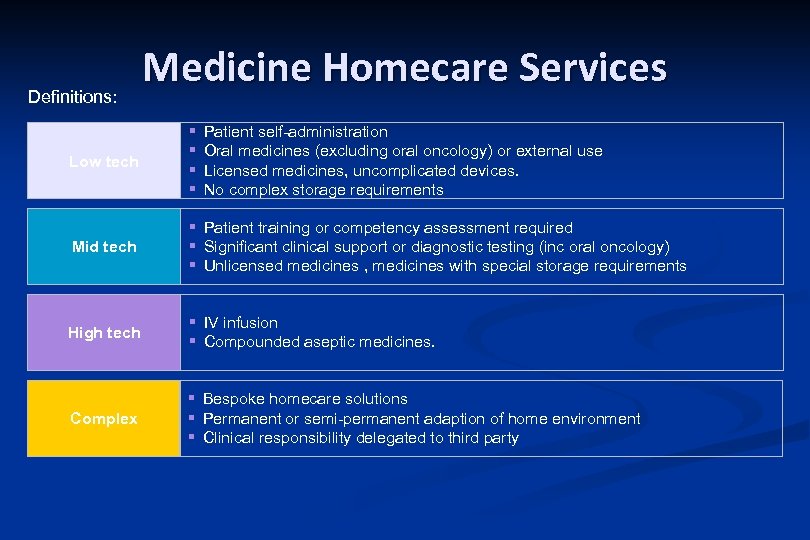 Definitions: Medicine Homecare Services Low tech § § Mid tech § Patient training or competency assessment required § Significant clinical support or diagnostic testing (inc oral oncology) § Unlicensed medicines , medicines with special storage requirements High tech § IV infusion § Compounded aseptic medicines. Complex § Bespoke homecare solutions § Permanent or semi-permanent adaption of home environment § Clinical responsibility delegated to third party Patient self-administration Oral medicines (excluding oral oncology) or external use Licensed medicines, uncomplicated devices. No complex storage requirements
 Overview 1 Background 2 Life before National Procurement 3 Current Situation 4 What’s Next?
 Whole New Agenda!
 n Shortages n Patient Access Schemes n Access to Medicines in Primary Care n Medicine Homecare Services n Complex discount schemes n Biosimilar medicines n European Medicines Verification System n Managing Suppliers n Optimising efficiency of procurement & supply chain
 n Shortages n Patient Access Schemes n Access to Medicines in Primary Care n Medicine Homecare Services n Complex discount schemes n Biosimilar medicines n European Medicines Verification System n Managing Suppliers n Optimising efficiency of procurement & supply chain
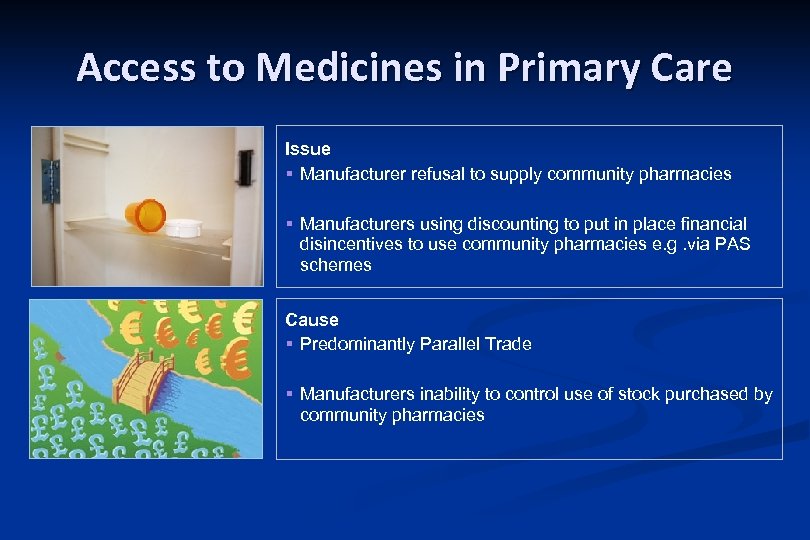 Access to Medicines in Primary Care Issue § Manufacturer refusal to supply community pharmacies § Manufacturers using discounting to put in place financial disincentives to use community pharmacies e. g. via PAS schemes Cause § Predominantly Parallel Trade § Manufacturers inability to control use of stock purchased by community pharmacies
 n Shortages n Patient Access Schemes n Access to Medicines in Primary Care n Medicine Homecare Services n Complex discount schemes n Biosimilar medicines n European Medicines Verification System n Managing Suppliers n Optimising efficiency of procurement & supply chain
 Complex Discounts Not business as usual n Each is unique n Usually involve individual patient tracking n Need to ensure they do not dictate patient pathways of care. n
 n Shortages n Patient Access Schemes n Access to Medicines in Primary Care n Medicine Homecare Services n Complex discount schemes n Biosimilar medicines n European Medicines Verification System n Managing Suppliers n Optimising efficiency of procurement & supply chain
 Biologics & Biosimilars n n Expensive to research, develop, manufacture and bring to the market – hence the very high prices charged. The same molecule manufactured by another company is known as a biosimilar Much debate as to whether patients can or should be switched from one biosimilar to another. Biosimilars are just emerging on to the market
 n Shortages n Patient Access Schemes n Access to Medicines in Primary Care n Medicine Homecare Services n Complex discount schemes n Biosimilar medicines n European Medicines Verification System n Managing Suppliers n Optimising efficiency of procurement & supply chain
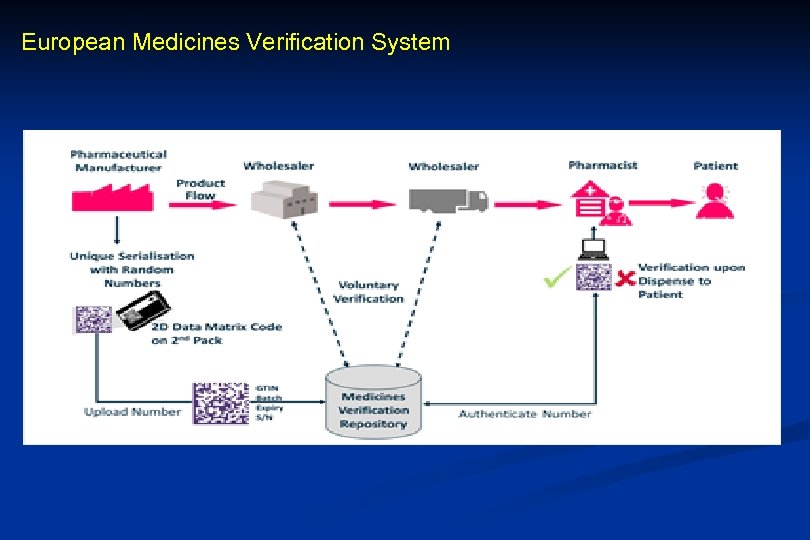 European Medicines Verification System