 Скачать презентацию Pharmacy Factors Affect Success of Pharmacy-based Influenza Immunization
924b6c1ae0e2c8cf3f0774dd7c3bbca9.ppt
- Количество слайдов: 18




Pharmacy Factors Affect Success of Pharmacy-based Influenza Immunization Programs Suntaree Watcharadamrongkun Jeanine K. Mount University of Wisconsin-Madison School of Pharmacy Research supported by grant R 06 -CCR 523387 from the Public Health Law Program of the Centers for Disease Control & Prevention
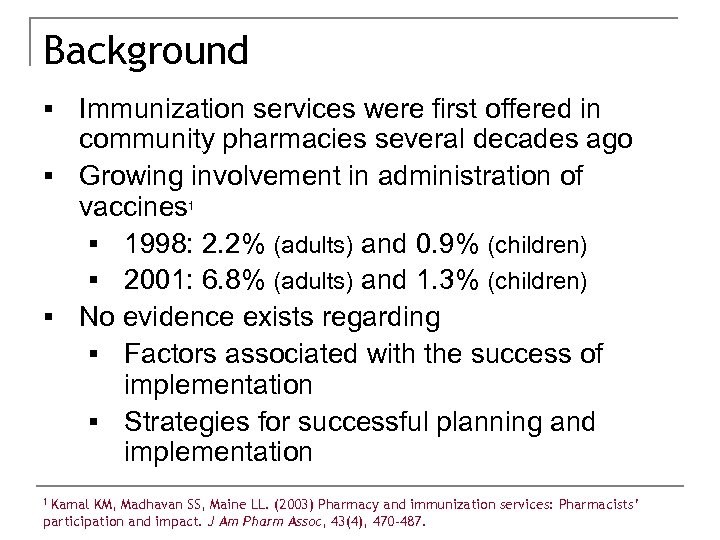
Background § Immunization services were first offered in community pharmacies several decades ago § Growing involvement in administration of vaccines 1 § 1998: 2. 2% (adults) and 0. 9% (children) § 2001: 6. 8% (adults) and 1. 3% (children) § No evidence exists regarding § Factors associated with the success of implementation § Strategies for successful planning and implementation Kamal KM, Madhavan SS, Maine LL. (2003) Pharmacy and immunization services: Pharmacists’ participation and impact. J Am Pharm Assoc, 43(4), 470 -487. 1
Objective Identify pharmacy characteristics that predict success of community pharmacy-based immunization delivery programs
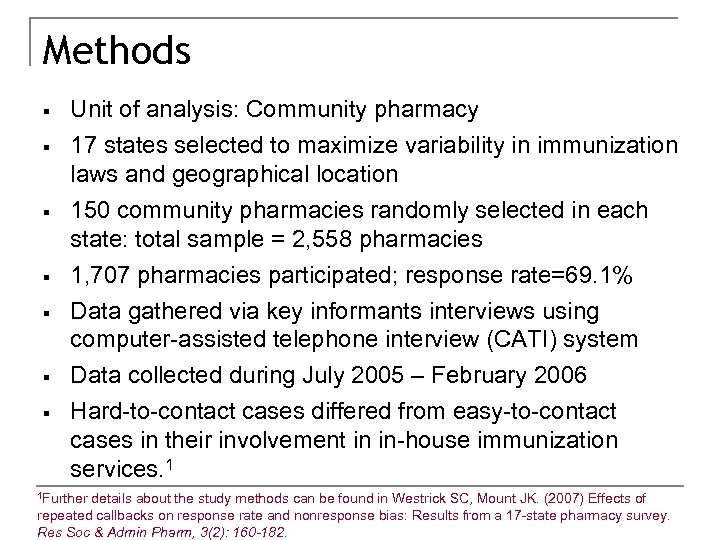
Methods § § § Unit of analysis: Community pharmacy 17 states selected to maximize variability in immunization laws and geographical location 150 community pharmacies randomly selected in each state: total sample = 2, 558 pharmacies 1, 707 pharmacies participated; response rate=69. 1% Data gathered via key informants interviews using computer-assisted telephone interview (CATI) system § Data collected during July 2005 – February 2006 § Hard-to-contact cases differed from easy-to-contact cases in their involvement in in-house immunization services. 1 1 Further details about the study methods can be found in Westrick SC, Mount JK. (2007) Effects of repeated callbacks on response rate and nonresponse bias: Results from a 17 -state pharmacy survey. Res Soc & Admin Pharm, 3(2): 160 -182.
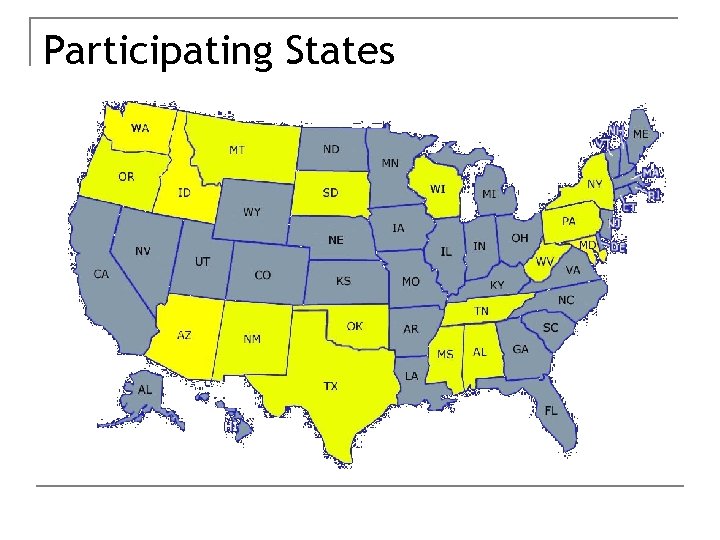
Participating States
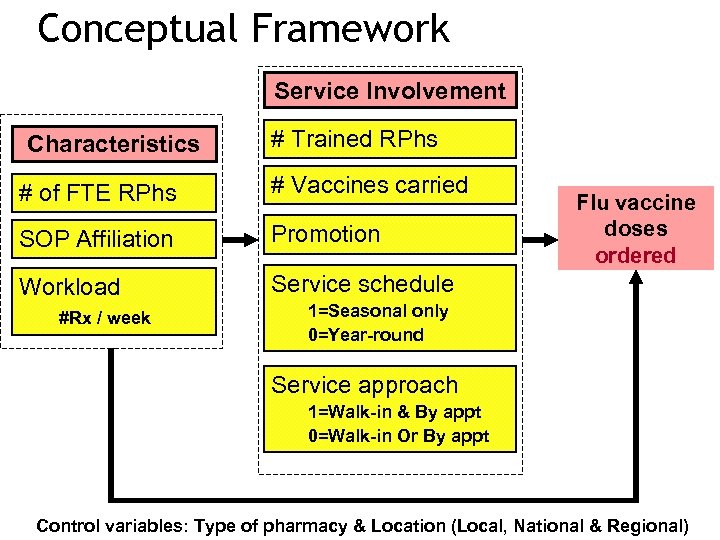
Conceptual Framework Service Involvement Characteristics # Trained RPhs # of FTE RPhs # Vaccines carried SOP Affiliation Promotion Workload Service schedule #Rx / week Flu vaccine doses ordered 1=Seasonal only 0=Year-round Service approach 1=Walk-in & By appt 0=Walk-in Or By appt Control variables: Type of pharmacy & Location (Local, National & Regional)
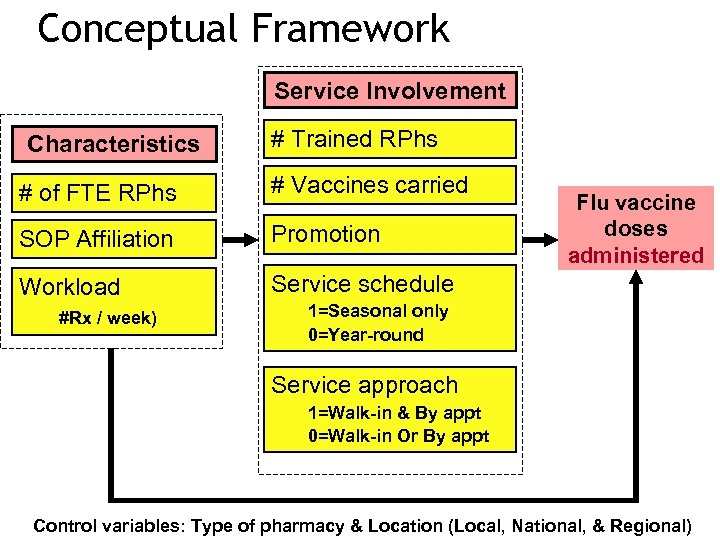
Conceptual Framework Service Involvement Characteristics # Trained RPhs # of FTE RPhs # Vaccines carried SOP Affiliation Promotion Workload Service schedule #Rx / week) Flu vaccine doses administered 1=Seasonal only 0=Year-round Service approach 1=Walk-in & By appt 0=Walk-in Or By appt Control variables: Type of pharmacy & Location (Local, National, & Regional)
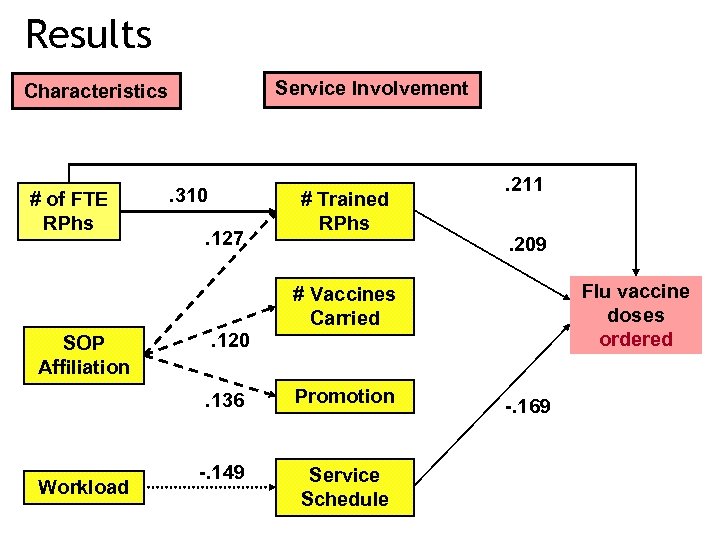
Results Service Involvement Characteristics # of FTE RPhs . 310. 127 # Trained RPhs . 211. 209 Flu vaccine doses ordered # Vaccines Carried SOP Affiliation . 120. 136 Workload Promotion -. 149 Service Schedule -. 169
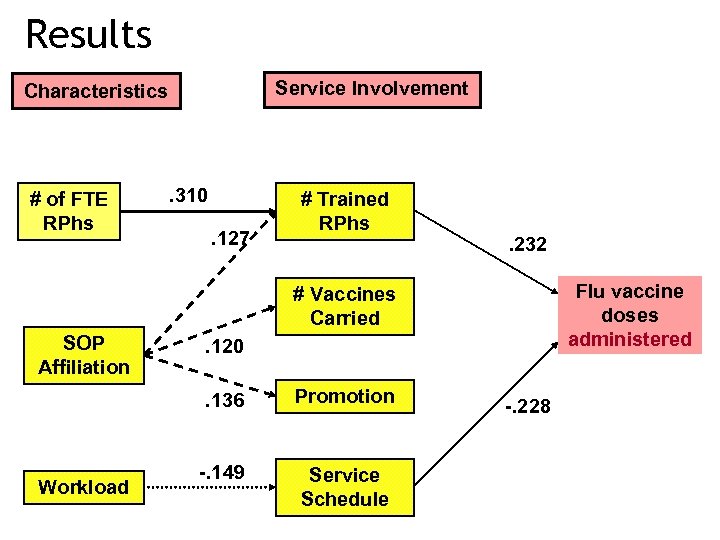
Results Service Involvement Characteristics # of FTE RPhs . 310. 127 # Trained RPhs . 232 Flu vaccine doses administered # Vaccines Carried SOP Affiliation . 120. 136 Workload Promotion -. 149 Service Schedule -. 228
Discussion § Number of FTE RPhs predicted number of flu doses ordered but not number of flu doses administered § Affiliation with a school of pharmacy encouraged § Pharmacists trained in immunization delivery § Expansion of number of vaccines carried § Support the promotion in pharmacies
Discussion (cont’d) Multiple factors affect success of implementation of a community pharmacy-based immunization program: § Employ a greater number of pharmacists § Be affiliated with a school or college of pharmacy § Have a higher workload in pharmacies § Have more pharmacists trained in immunization delivery § Provide immunization services on a year-round basis
Discussion This finding corresponds with a national survey that pharmacists who had attended immunizationrelated educational programs were more willing to provide immunization 1
Discussion (cont’d) Managerial strategies that may be considered to increase the success of community pharmacies in in-house immunization: 1. Pharmacy Characteristics § Increase # of FTE RPhs § Affiliate with a school of pharmacy § Have appropriate workload for pharmacy personnel
Discussion (cont’d) 2. Service arrangement § Increase # of Trained RPhs § Provide services on a year-round basis § Expand scope of vaccines carried § Increase promotion
Discussion (cont’d) Other suggestions § Offering at least 1 vaccine that is not related to the “flu season” was found to influence a greater service impact on immunization services. § Providing flu vaccines may be an important first step in implementing an immunization service, however, management may expand the service into other vaccines in order to increase the impact of the services.
Limitations § Results may not be generalized to other states outside the 17 states § Services were focused on only in-house services; results may not be generalized to other services in community pharmacies or other institutions
Acknowledgements § We thank all participants and the UW Survey Research Center for their assistance § Research was supported by R 06 CCR 523387 from the Public Health Law Program if the US Centers for Disease Control & Prevention

Contact information Jeanine K. Mount: jkmount@pharmacy. wisc. edu Suntaree Watcharadamrongkun: watcharadamr@wisc. edu University of Wisconsin-Madison Social and Administrative Sciences in Pharmacy 777 Highland Ave. Madison, WI 53705 -2222 U. S. A
Скачать презентацию Pharmacy Factors Affect Success of Pharmacy-based Influenza Immunization
924b6c1ae0e2c8cf3f0774dd7c3bbca9.ppt