


 Скачать презентацию Pharmacoeconomic and Outcomes Fellowship Guidelines ISPOR and ACCP
af3f06eec83a6a7b3b94c68d5f12995f.ppt
- Количество слайдов: 30
 Pharmacoeconomic and Outcomes Fellowship Guidelines ISPOR and ACCP Joint Statement ISPOR Annual Meeting May 22, 2007
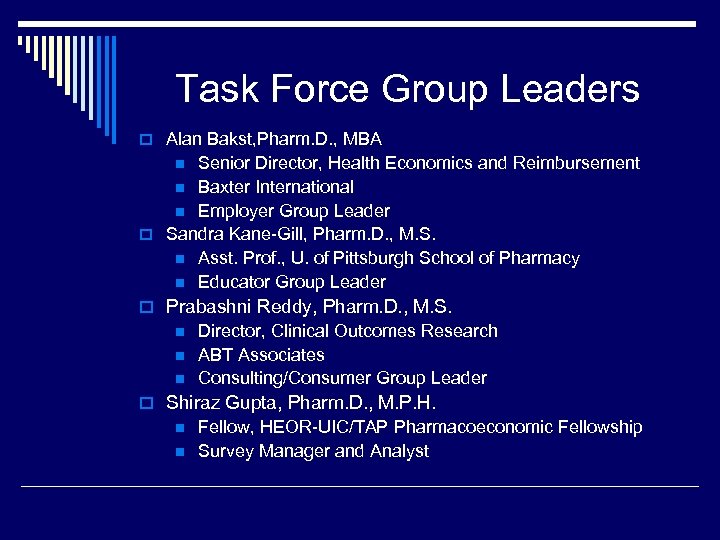 Task Force Group Leaders o Alan Bakst, Pharm. D. , MBA Senior Director, Health Economics and Reimbursement n Baxter International n Employer Group Leader o Sandra Kane-Gill, Pharm. D. , M. S. n Asst. Prof. , U. of Pittsburgh School of Pharmacy n Educator Group Leader n o Prabashni Reddy, Pharm. D. , M. S. n n n Director, Clinical Outcomes Research ABT Associates Consulting/Consumer Group Leader o Shiraz Gupta, Pharm. D. , M. P. H. n n Fellow, HEOR-UIC/TAP Pharmacoeconomic Fellowship Survey Manager and Analyst
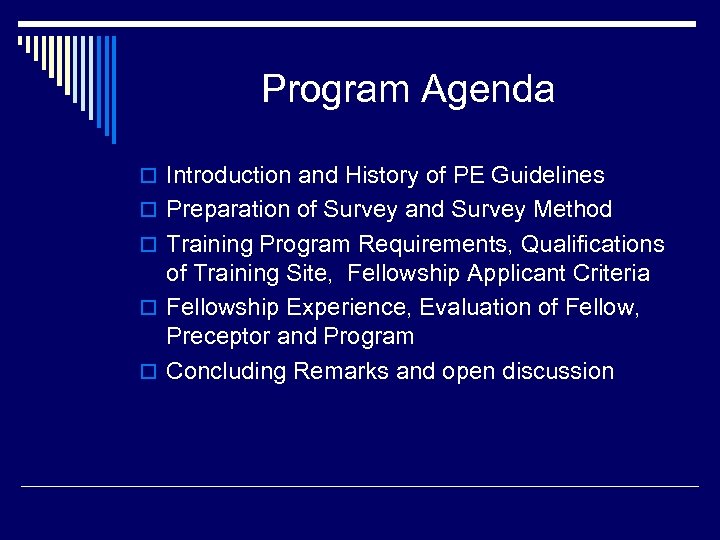 Program Agenda o Introduction and History of PE Guidelines o Preparation of Survey and Survey Method o Training Program Requirements, Qualifications of Training Site, Fellowship Applicant Criteria o Fellowship Experience, Evaluation of Fellow, Preceptor and Program o Concluding Remarks and open discussion
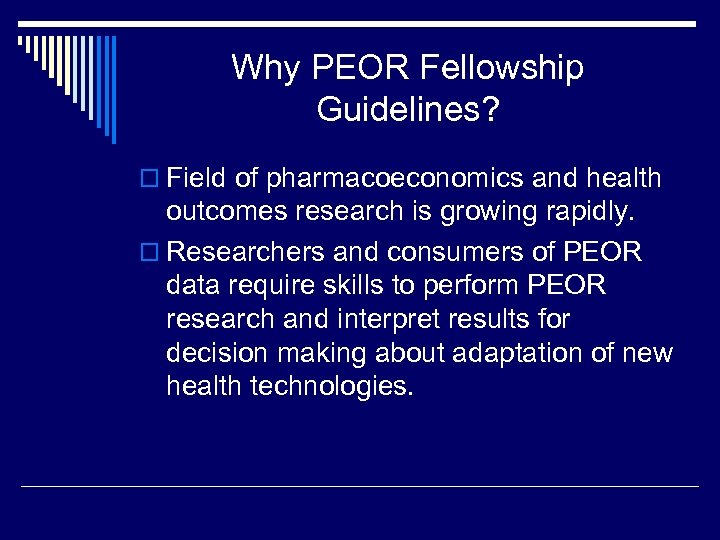 Why PEOR Fellowship Guidelines? o Field of pharmacoeconomics and health outcomes research is growing rapidly. o Researchers and consumers of PEOR data require skills to perform PEOR research and interpret results for decision making about adaptation of new health technologies.
 Why PEOR Fellowship Guidelines? o Candidates interested in the PEOR field come from multiple disciplines. Providing a recommended framework for core didactic coursework and experiential training may be valuable for people seeking entry to the field.
 Why PEOR Fellowship Guidelines? o Organizations and sponsors interested in providing training in PEOR can utilize guidelines to develop their programs o Professional organizations may utilize guidelines to accredit PEOR fellowships o Employers in field can feel comfortable in the expertise provided by person completing a fellowship.
 Why PEOR Fellowship Guidelines? o Assists candidates in evaluating and comparing training programs
 History of PEOR Fellowship Guidelines o 1999 Am. College of Clinical Pharmacy issues a Position Statement on Guidelines for PE Research Fellowships n Pharmacotherapy 1999; 19(9): 1105 -1109 o May 1998 ISPOR position statement on Standards for fellowship training in pharmacoeconomics and outcomes research. o Vittorio Maio, Jennifer Lofland, Tammy Girts, David Nash, and others who have surveyed PE fellowship programs, preceptors and fellows, and described their findings in publications (Am. J. Pharm. Ed. 2003; 67 (3) )
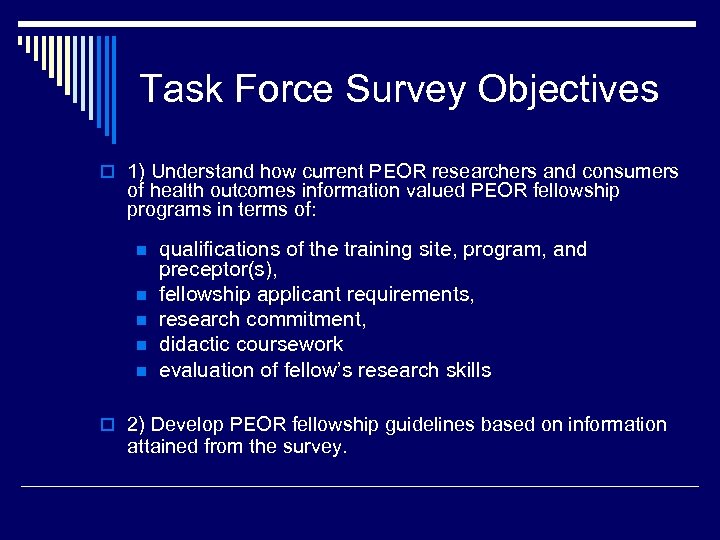 Task Force Survey Objectives o 1) Understand how current PEOR researchers and consumers of health outcomes information valued PEOR fellowship programs in terms of: n n n qualifications of the training site, program, and preceptor(s), fellowship applicant requirements, research commitment, didactic coursework evaluation of fellow’s research skills o 2) Develop PEOR fellowship guidelines based on information attained from the survey.
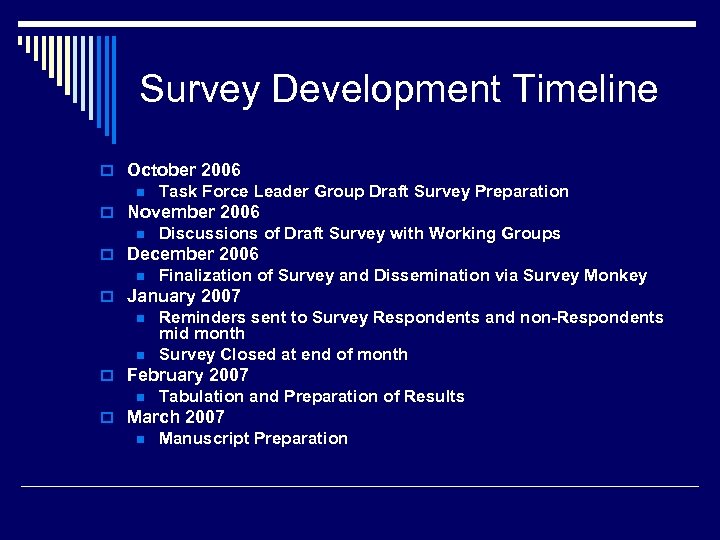 Survey Development Timeline o October 2006 n Task Force Leader Group Draft Survey Preparation o November 2006 n Discussions of Draft Survey with Working Groups o December 2006 n Finalization of Survey and Dissemination via Survey Monkey o January 2007 n n Reminders sent to Survey Respondents and non-Respondents mid month Survey Closed at end of month o February 2007 n Tabulation and Preparation of Results o March 2007 n Manuscript Preparation
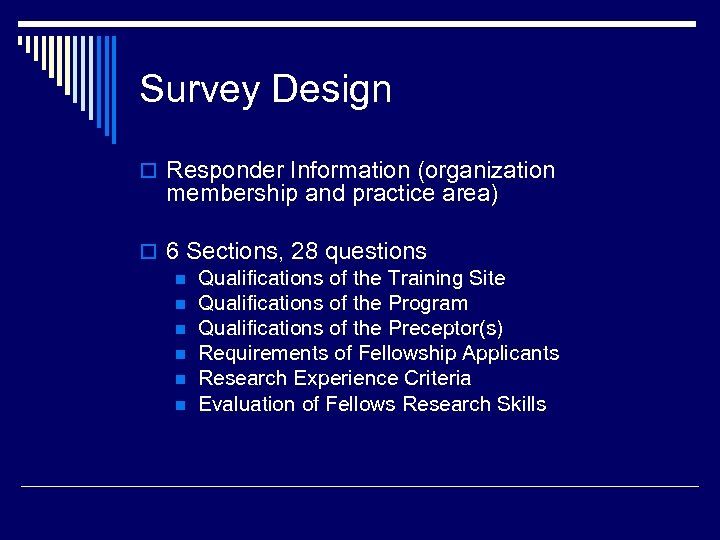 Survey Design o Responder Information (organization membership and practice area) o 6 Sections, 28 questions n Qualifications of the Training Site n Qualifications of the Program n Qualifications of the Preceptor(s) n Requirements of Fellowship Applicants n Research Experience Criteria n Evaluation of Fellows Research Skills
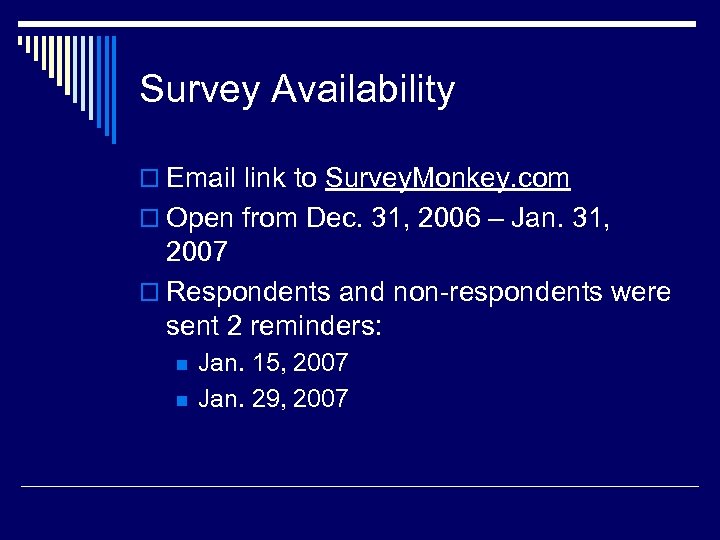 Survey Availability o Email link to Survey. Monkey. com o Open from Dec. 31, 2006 – Jan. 31, 2007 o Respondents and non-respondents were sent 2 reminders: n n Jan. 15, 2007 Jan. 29, 2007
 Survey Respondents o ISPOR Fellowship Task Force o ACCP Outcomes and Economics Practice Research Network (PRN) o 280 Total Survey Recipients o 117 Total Survey Respondents o 42% Response Rate
 Analysis of Data o Response frequencies calculated as percentage of total responses per question o Free-text response data incorporated in discussion sections of guidelines
 Training Program Requirements o A minimum of 3, 000 hours (approximately 75%) of the fellowship training time should be devoted to PEOR research-related activities over a minimum period of two years. o Develop a documented training plan with goals and objectives prior to starting the fellowship.
 Training Program Requirements o Availability of advanced educational opportunities in research-related topics. o Ready access to personnel that teach and use research skills. o Have a team of preceptors however fellow assigned one preceptor to be an advisor to oversee the fellow’s training and fellowship experience.
 Qualifications of Site o Demonstrate capabilities in performing PEOR through publications, presentation at scientific meetings or through known collaboration with organizations producing PEOR. o Direct or indirect access to healthcare information providing fellow with data to perform PEOR. o Appropriate facilities to conduct research
 Qualifications of Site o Administrative support for the preceptor’s research program and the fellowship training program. o Ready access to a medical library or electronic access to medical literature as well as computing facilities. o Access to other sites to provide fellow with experience in multiple practice environments
 Preceptor Qualifications o Established and ongoing record of independent research accomplishments and expertise in the area of PEOR through n n n Fellowship training, a graduate degree and/or equivalent experience Principal or primary investigator on research grants and/or projects Published research papers in the peer-reviewed scientific literature on which the preceptor is the primary or senior author
 Preceptor Qualifications o Didactic training in research methods and PEOR. o Prior experience training fellows and/or other individuals in PEOR. o Active collaborative research relationship with other health outcomes researchers or organizations.
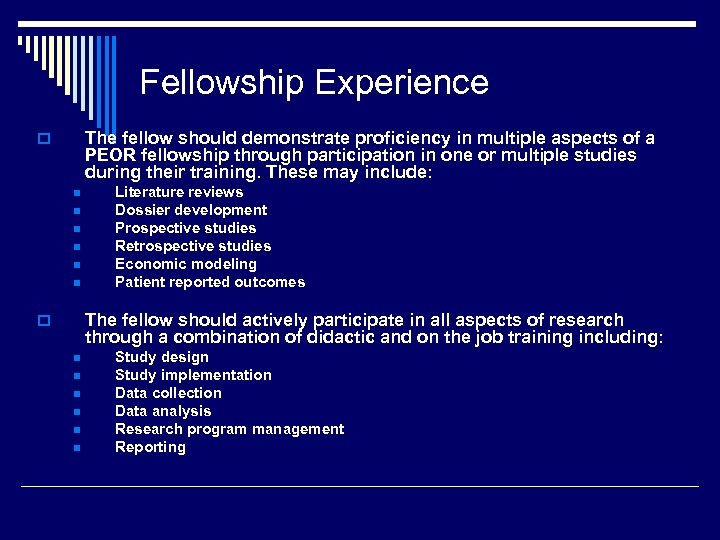 Fellowship Experience The fellow should demonstrate proficiency in multiple aspects of a PEOR fellowship through participation in one or multiple studies during their training. These may include: o n n n Literature reviews Dossier development Prospective studies Retrospective studies Economic modeling Patient reported outcomes The fellow should actively participate in all aspects of research through a combination of didactic and on the job training including: o n n n Study design Study implementation Data collection Data analysis Research program management Reporting
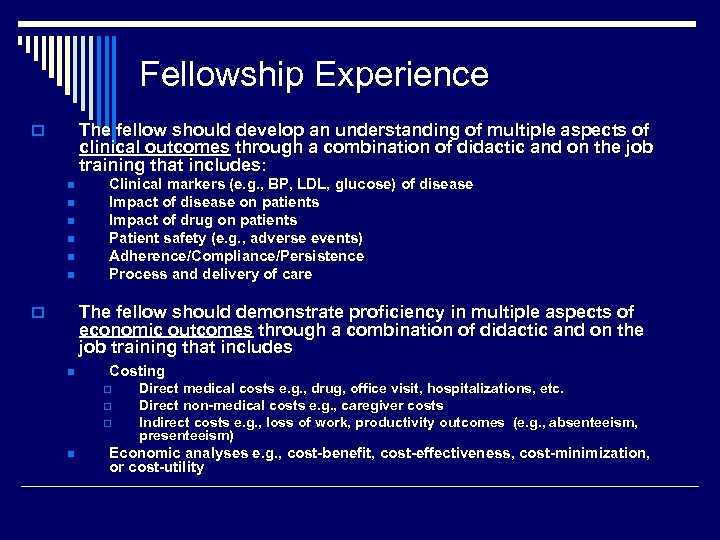 Fellowship Experience The fellow should develop an understanding of multiple aspects of clinical outcomes through a combination of didactic and on the job training that includes: o n n n Clinical markers (e. g. , BP, LDL, glucose) of disease Impact of disease on patients Impact of drug on patients Patient safety (e. g. , adverse events) Adherence/Compliance/Persistence Process and delivery of care The fellow should demonstrate proficiency in multiple aspects of economic outcomes through a combination of didactic and on the job training that includes o n Costing p p p n Direct medical costs e. g. , drug, office visit, hospitalizations, etc. Direct non-medical costs e. g. , caregiver costs Indirect costs e. g. , loss of work, productivity outcomes (e. g. , absenteeism, presenteeism) Economic analyses e. g. , cost-benefit, cost-effectiveness, cost-minimization, or cost-utility
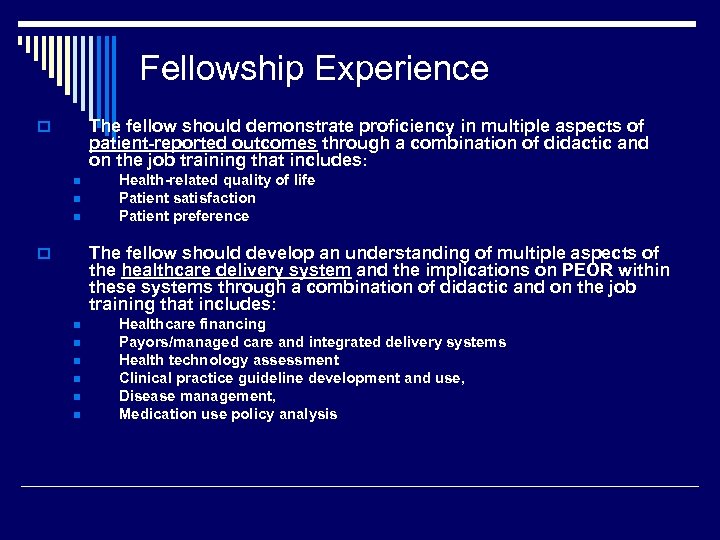 Fellowship Experience The fellow should demonstrate proficiency in multiple aspects of patient-reported outcomes through a combination of didactic and on the job training that includes: o n n n Health-related quality of life Patient satisfaction Patient preference The fellow should develop an understanding of multiple aspects of the healthcare delivery system and the implications on PEOR within these systems through a combination of didactic and on the job training that includes: o n n n Healthcare financing Payors/managed care and integrated delivery systems Health technology assessment Clinical practice guideline development and use, Disease management, Medication use policy analysis
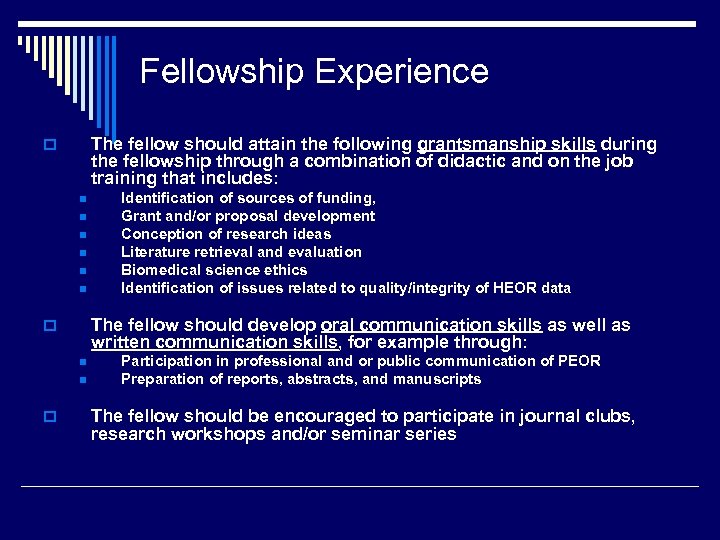 Fellowship Experience The fellow should attain the following grantsmanship skills during the fellowship through a combination of didactic and on the job training that includes: o n n n The fellow should develop oral communication skills as well as written communication skills, for example through: o n n o Identification of sources of funding, Grant and/or proposal development Conception of research ideas Literature retrieval and evaluation Biomedical science ethics Identification of issues related to quality/integrity of HEOR data Participation in professional and or public communication of PEOR Preparation of reports, abstracts, and manuscripts The fellow should be encouraged to participate in journal clubs, research workshops and/or seminar series
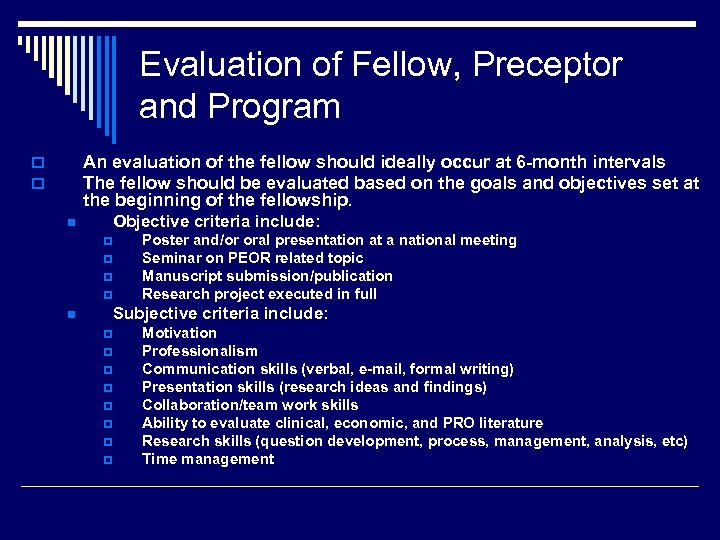 Evaluation of Fellow, Preceptor and Program An evaluation of the fellow should ideally occur at 6 -month intervals The fellow should be evaluated based on the goals and objectives set at the beginning of the fellowship. o o n Objective criteria include: p p n Poster and/or oral presentation at a national meeting Seminar on PEOR related topic Manuscript submission/publication Research project executed in full Subjective criteria include: p p p p Motivation Professionalism Communication skills (verbal, e-mail, formal writing) Presentation skills (research ideas and findings) Collaboration/team work skills Ability to evaluate clinical, economic, and PRO literature Research skills (question development, process, management, analysis, etc) Time management
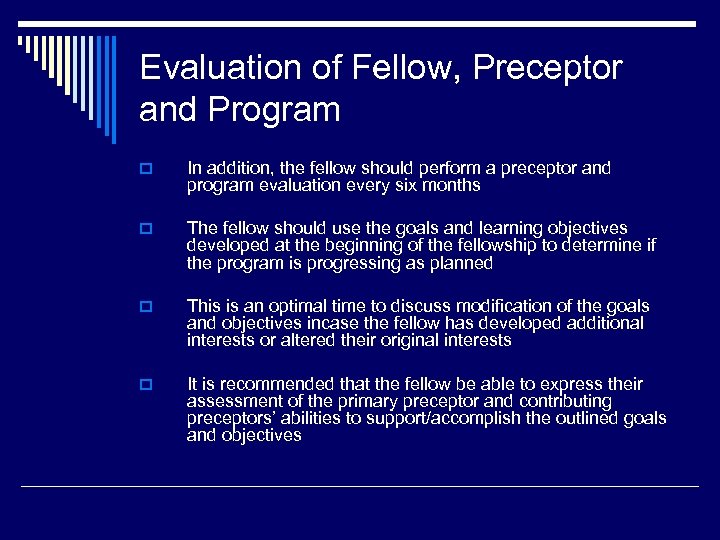 Evaluation of Fellow, Preceptor and Program o In addition, the fellow should perform a preceptor and program evaluation every six months o The fellow should use the goals and learning objectives developed at the beginning of the fellowship to determine if the program is progressing as planned o This is an optimal time to discuss modification of the goals and objectives incase the fellow has developed additional interests or altered their original interests o It is recommended that the fellow be able to express their assessment of the primary preceptor and contributing preceptors’ abilities to support/accomplish the outlined goals and objectives
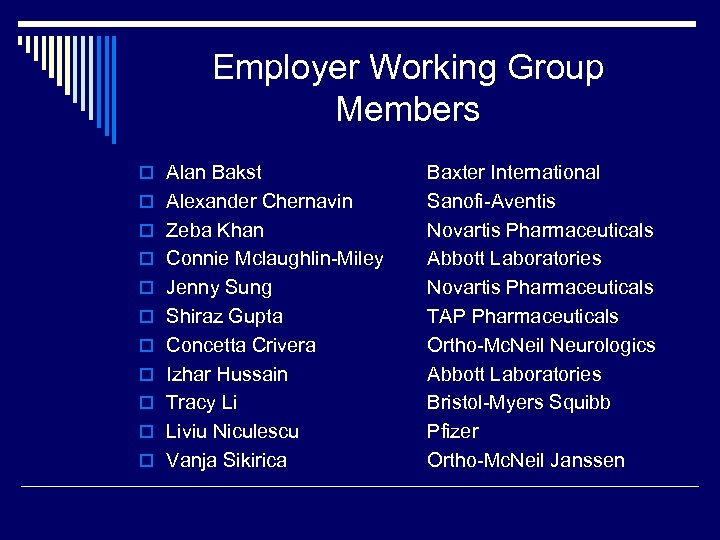 Employer Working Group Members o Alan Bakst o Alexander Chernavin o Zeba Khan o Connie Mclaughlin-Miley o Jenny Sung o Shiraz Gupta o Concetta Crivera o Izhar Hussain o Tracy Li o Liviu Niculescu o Vanja Sikirica Baxter International Sanofi-Aventis Novartis Pharmaceuticals Abbott Laboratories Novartis Pharmaceuticals TAP Pharmaceuticals Ortho-Mc. Neil Neurologics Abbott Laboratories Bristol-Myers Squibb Pfizer Ortho-Mc. Neil Janssen
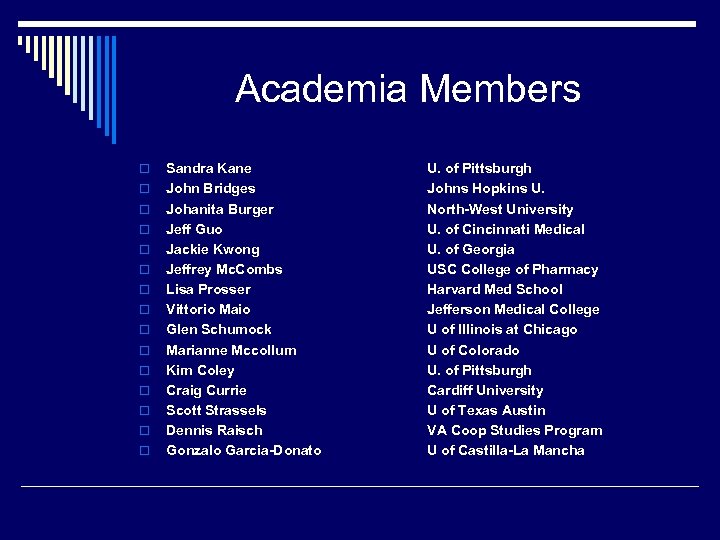 Academia Members o o o o Sandra Kane John Bridges Johanita Burger Jeff Guo Jackie Kwong Jeffrey Mc. Combs Lisa Prosser Vittorio Maio Glen Schumock Marianne Mccollum Kim Coley Craig Currie Scott Strassels Dennis Raisch Gonzalo Garcia-Donato U. of Pittsburgh Johns Hopkins U. North-West University U. of Cincinnati Medical U. of Georgia USC College of Pharmacy Harvard Med School Jefferson Medical College U of Illinois at Chicago U of Colorado U. of Pittsburgh Cardiff University U of Texas Austin VA Coop Studies Program U of Castilla-La Mancha
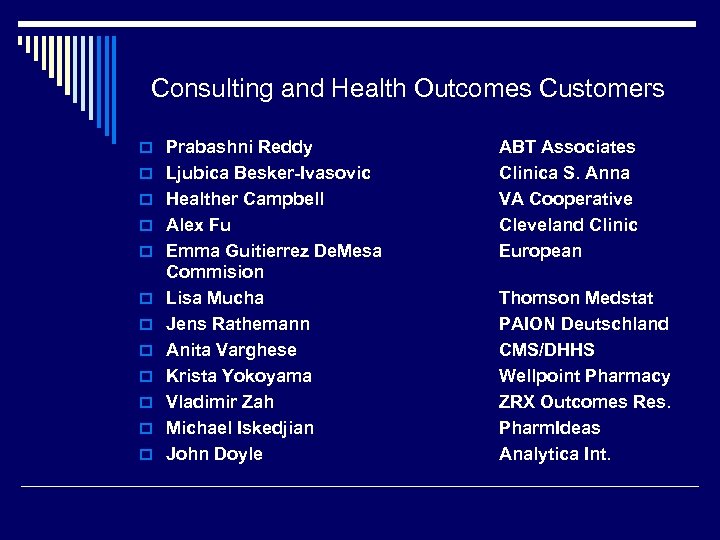 Consulting and Health Outcomes Customers o Prabashni Reddy o Ljubica Besker-Ivasovic o Healther Campbell o Alex Fu o Emma Guitierrez De. Mesa o o o o Commision Lisa Mucha Jens Rathemann Anita Varghese Krista Yokoyama Vladimir Zah Michael Iskedjian John Doyle ABT Associates Clinica S. Anna VA Cooperative Cleveland Clinic European Thomson Medstat PAION Deutschland CMS/DHHS Wellpoint Pharmacy ZRX Outcomes Res. Pharm. Ideas Analytica Int.
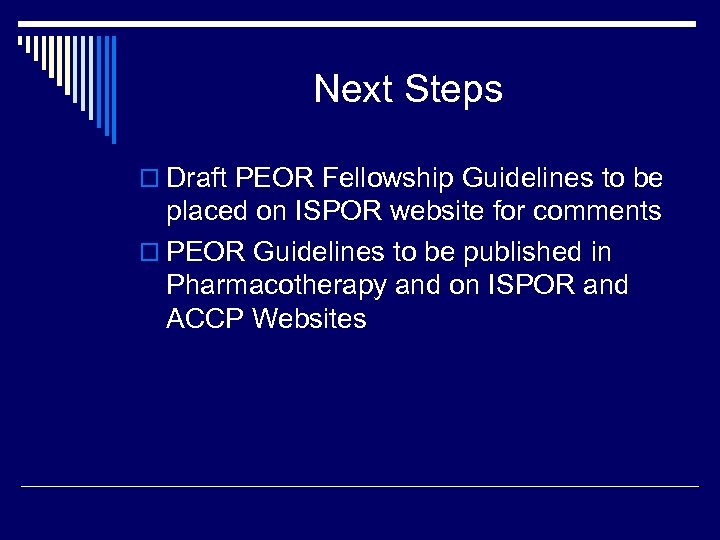 Next Steps o Draft PEOR Fellowship Guidelines to be placed on ISPOR website for comments o PEOR Guidelines to be published in Pharmacotherapy and on ISPOR and ACCP Websites