


 Скачать презентацию Ph D Proposal Understanding how User-Generated Content UGC
6ffcaf578400d74f8e444a2431e82fe4.ppt
- Количество слайдов: 27
 Ph. D Proposal Understanding how User-Generated Content (UGC) empowers online consumer behavior in the travel industry: an extension of the Theory of Planned Behavior Luiz Mendes Filho Supervisors: Felix Tan, Simon Milne August 2008
 Outline Introduction 1. ◦ ◦ Motivation of the study Objective Research Model Contributions Literature Review 3. Hypotheses 4. Design of the study 2. ◦ ◦ Pilot Phase Testing Phase Ph. D Student – Luiz Mendes Filho Understanding how User-Generated Content (UGC) empowers online consumer behavior in the travel industry 2
 Motivation of the study 1. Introduction Users have spent more time on the web and shared more information with each other New forms of content generation, communication and collaboration have emerged on the web User-Generated Content (UGC) allows Internet users to make comments in a large variety of forms such as photos, videos, ratings, reviews, articles and blogs (Gretzel & Yoo, 2008) The reasons why individuals generate content on the Internet are (George & Scerri, 2007): ◦ analysis and commentary ◦ entertainment ◦ review (e. g. books, products, travellers’ comments on hotels) Ph. D Student – Luiz Mendes Filho Understanding how User-Generated Content (UGC) empowers online consumer behavior in the travel industry 3
 Motivation of the study 1. Introduction 60% of European online users used UGC in 2007 (Carrera et al. , 2008) 101 million Internet users using UGC in the US in 2011 (e. Marketer, 2007) A study undertaken by Delloite Touche USA in 2007 showed that (Constantinides, 2007): ◦ 62% of American consumers read user-generated online reviews ◦ 98% of these consumers find the reviews reliable ◦ 80% of them agree that the reviews affected their buying intentions Ph. D Student – Luiz Mendes Filho Understanding how User-Generated Content (UGC) empowers online consumer behavior in the travel industry 5
 Motivation of the study 1. Introduction The implications brought by the empowerment of Internet users and travellers are tremendous for the tourism and travel industry (Schegg, Liebrich, Scaglione, & Ahmad, 2008) Consumers feel empowered accessing information and taking accessing information independent voluntary action in their own behalf (Freedman, 2007) Information is essential for travellers, and the Internet allows them to search for travel-related information UGC activities such as blogs, podcasts, wikis, and map mashups to share their travel experiences with others Ph. D Student – Luiz Mendes Filho Understanding how User-Generated Content (UGC) empowers online consumer behavior in the travel industry 6
 Motivation of the study 1. Introduction Few authors have applied concepts of consumer empowerment to Few authors have applied concepts of consumer empowerment the characteristics of the Internet (Rezabakhsh et al. , 2006) Few studies have examined UGC in the scientific community Few studies have examined UGC (O'Connor, 2008) It is not clear the value and benefits underpinning UGC activities (Constantinides, 2007) Hoegg et al. (2006) claim that this UGC trend should be seen as an new philosophy of information management, and Lu & Hsiao new philosophy of information management (2007) consider it a new information systems context Ph. D Student – Luiz Mendes Filho Understanding how User-Generated Content (UGC) empowers online consumer behavior in the travel industry 8
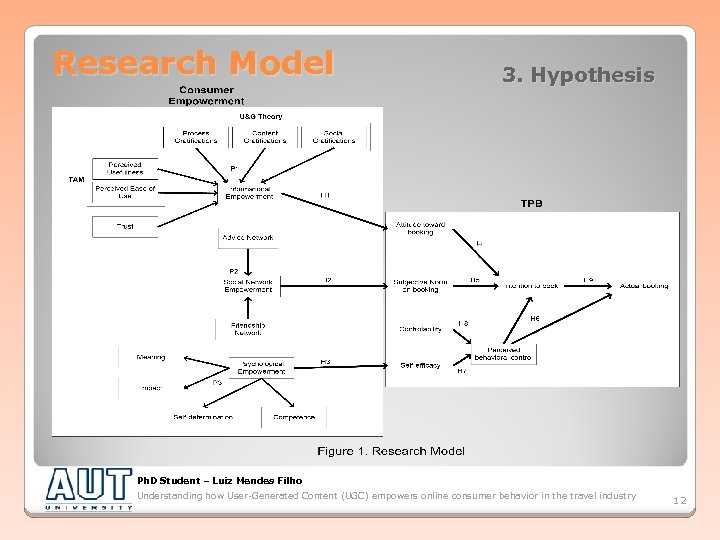
 Objective 1. Introduction Theoretically propose and empirically test a set of factors that integrate UGC adoption with consumer empowerment variables to enhance our understanding of how UGC empowers online consumer behavior in booking accommodation Consumer Empowerment consists of three constructs: Informational Empowerment, Social Network Empowerment and Psychological Empowerment To undertake this study, a theoretical framework using the Theory of Planned Behavior (TPB) as its basis was established. Ph. D Student – Luiz Mendes Filho Understanding how User-Generated Content (UGC) empowers online consumer behavior in the travel industry 9
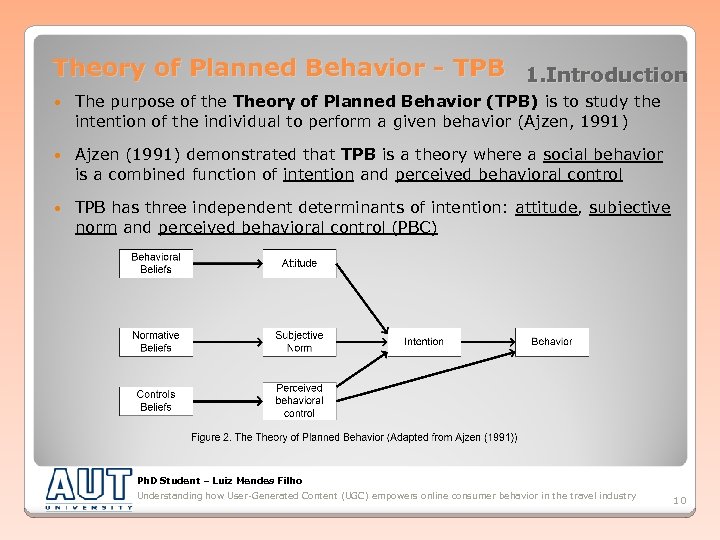 Theory of Planned Behavior - TPB 1. Introduction The purpose of the Theory of Planned Behavior (TPB) is to study the intention of the individual to perform a given behavior (Ajzen, 1991) Ajzen (1991) demonstrated that TPB is a theory where a social behavior is a combined function of intention and perceived behavioral control TPB has three independent determinants of intention: attitude, subjective norm and perceived behavioral control (PBC) Ph. D Student – Luiz Mendes Filho Understanding how User-Generated Content (UGC) empowers online consumer behavior in the travel industry 10
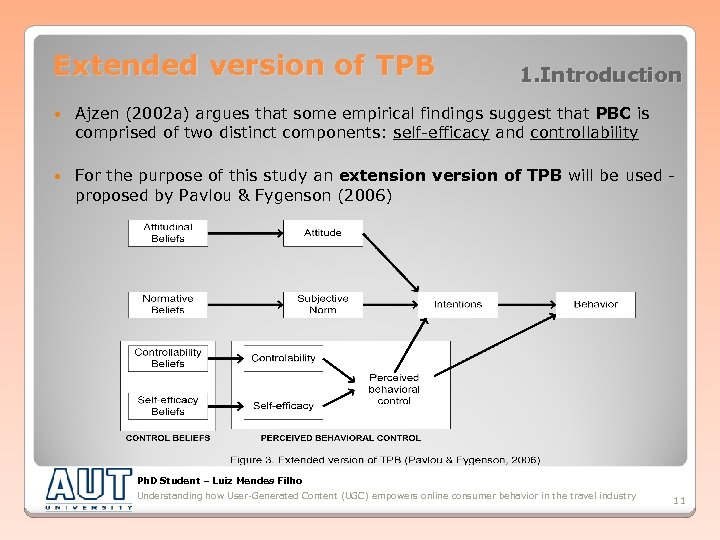 Extended version of TPB 1. Introduction Ajzen (2002 a) argues that some empirical findings suggest that PBC is comprised of two distinct components: self-efficacy and controllability For the purpose of this study an extension version of TPB will be used - proposed by Pavlou & Fygenson (2006) Ph. D Student – Luiz Mendes Filho Understanding how User-Generated Content (UGC) empowers online consumer behavior in the travel industry 11
 Research Model 3. Hypothesis Ph. D Student – Luiz Mendes Filho Understanding how User-Generated Content (UGC) empowers online consumer behavior in the travel industry 12
 Contributions 1. Introduction Extending TPB in a new context (i. e. UGC) The extended version of TPB is a more parsimonious and meaningful model on the UGC context with the proposition of three constructs: ◦ (1) Informational Empowerment ◦ (2) Social Network Empowerment ◦ (3) Psychological Empowerment Proposing a new construct of Consumer Empowerment Proposing the Social Network Empowerment construct Proposing a new construct of Informational Empowerment with three theories: TAM, U&G Theory, Trust Ph. D Student – Luiz Mendes Filho Understanding how User-Generated Content (UGC) empowers online consumer behavior in the travel industry 13
 Contributions 1. Introduction The thesis findings will: ◦ support the New Zealand Tourism Strategy 2015 for RTONZ ◦ help the tourism sector which is a major employer in the New Zealand economy ◦ help the competitiveness of the accommodation sector ◦ be aligned with New Zealand’s Digital Strategy This thesis topic will be valuable to: ◦ web researchers ◦ lodging practitioners This thesis will contribute to the research outputs/profile of AUT’s: ◦ New Zealand Tourism Research Institute (NZTRI) ◦ Centre for Research on Information Systems Management (CRISM) Ph. D Student – Luiz Mendes Filho Understanding how User-Generated Content (UGC) empowers online consumer behavior in the travel industry 14
 2. Literature Review UGC in the Tourism industry UGC is changing the dynamics of the travel industry (Arsal et al. , 2008) Travellers are getting in touch directly with other travellers who have similar destination interests through on-line social networking (Laboy & Torchio, 2007) Consumer-generated content facilitates tourists evaluate travel alternatives during decision-making processes on the Internet (O'Connor, 2008) The content generated is empowering online travellers in the planning and buying processes of their trips (Schegg et al. , 2008; Sigala, 2007 b) Gretzel & Yoo (2008) highlight that most review readers are perceiving tourist reviews as essential for accommodation decisions Ph. D Student – Luiz Mendes Filho Understanding how User-Generated Content (UGC) empowers online consumer behavior in the travel industry 15
 2. Literature Review Consumer Empowerment Following Rappaport (1987), consumer empowerment is defined in the context of this study as “a process by which tourists gain control over their own destiny using the user-generated content to help book an accommodation” Consumer Empowerment comprises three constructs: Informational Empowerment, Social Network Empowerment and Psychological Empowerment Borrowed from Conger & Kanungo (1988) and Zimmerman & Rappaport (1988), psychological empowerment is described in this study as “the tourists’ competence empowered by the user-generated content to book an accommodation” Psychological Empowerment is a motivational construct comprising of four cognitions: Meaning, Competence, Self-determination, Impact (Spreitzer, 1995) Ph. D Student – Luiz Mendes Filho Understanding how User-Generated Content (UGC) empowers online consumer behavior in the travel industry 16
 2. Literature Review Social Network Empowerment For the purpose of this study, social network empowerment is described as “a group of tourists with a common link, which is to book accommodation, where they are empowered by user-generated content to communicate, interact and exchange knowledge among them”, following concepts from Mitchell (1969) and Knights (2007) There are two types of relations: Friendship Network (relation between friends) and Advice Network (relation between advisor and advisee) (Gibbons, 2004) Ph. D Student – Luiz Mendes Filho Understanding how User-Generated Content (UGC) empowers online consumer behavior in the travel industry 17
 2. Literature Review Informational Empowerment Following O’Connor (2008), informational empowerment is defined in the context of this study as “a process by which tourists create, use, and exchange information with others using the user-generated content to empower them in booking accommodation decision” Ten antecedents are posited that help determine Informational Empowerment concept on UGC: Ease of Use, Usefulness, Content Gratifications, Process Gratifications , Social Gratifications and Trust These antecedents are grounded in three theories: TAM (Technology Acceptance Model) Uses & Gratifications theory Trust Ph. D Student – Luiz Mendes Filho Understanding how User-Generated Content (UGC) empowers online consumer behavior in the travel industry 18
 3. Hypothesis The research model used in this study is based on TPB The behavior in question is the decision to book accommodation empowered by user-generated content The directionality stated in each hypothesis is derived from the three empowerment constructs (Informational, Social Network and Psychological) and from the extended structure Psychological of TPB There are nine hypotheses embodied in the research model Ph. D Student – Luiz Mendes Filho Understanding how User-Generated Content (UGC) empowers online consumer behavior in the travel industry 19
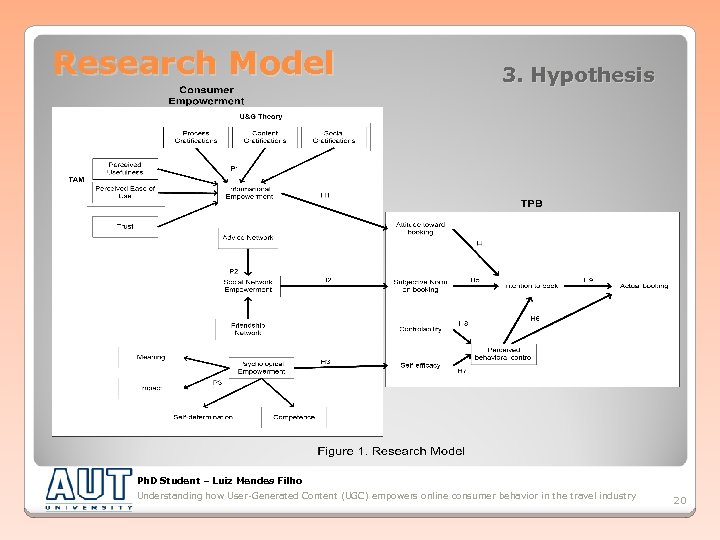 Research Model 3. Hypothesis Ph. D Student – Luiz Mendes Filho Understanding how User-Generated Content (UGC) empowers online consumer behavior in the travel industry 20
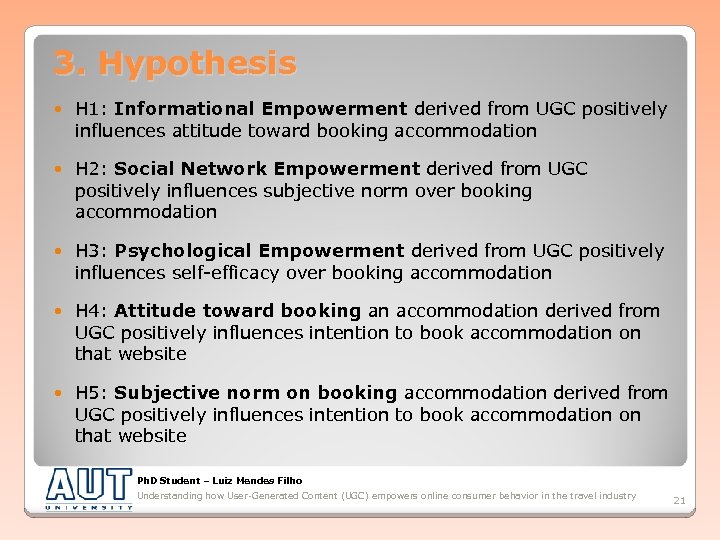 3. Hypothesis H 1: Informational Empowerment derived from UGC positively influences attitude toward booking accommodation H 2: Social Network Empowerment derived from UGC positively influences subjective norm over booking accommodation H 3: Psychological Empowerment derived from UGC positively influences self-efficacy over booking accommodation H 4: Attitude toward booking an accommodation derived from UGC positively influences intention to book accommodation on that website H 5: Subjective norm on booking accommodation derived from UGC positively influences intention to book accommodation on that website Ph. D Student – Luiz Mendes Filho Understanding how User-Generated Content (UGC) empowers online consumer behavior in the travel industry 21
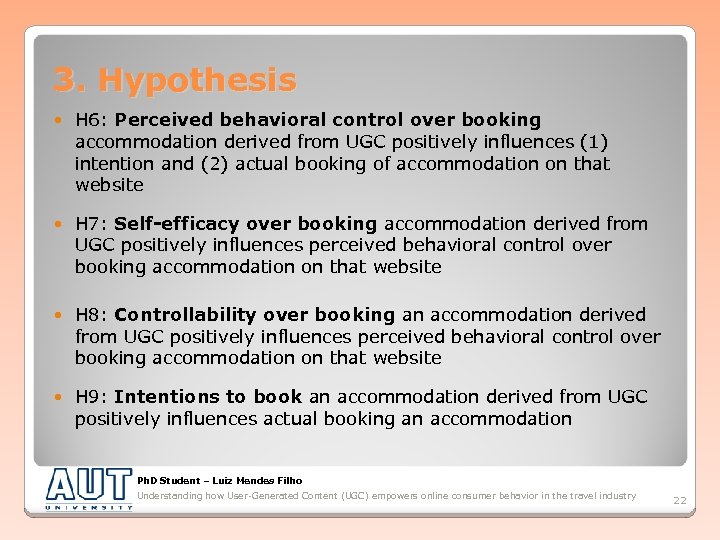 3. Hypothesis H 6: Perceived behavioral control over booking accommodation derived from UGC positively influences (1) intention and (2) actual booking of accommodation on that website H 7: Self-efficacy over booking accommodation derived from UGC positively influences perceived behavioral control over booking accommodation on that website H 8: Controllability over booking an accommodation derived from UGC positively influences perceived behavioral control over booking accommodation on that website H 9: Intentions to book an accommodation derived from UGC positively influences actual booking an accommodation Ph. D Student – Luiz Mendes Filho Understanding how User-Generated Content (UGC) empowers online consumer behavior in the travel industry 22
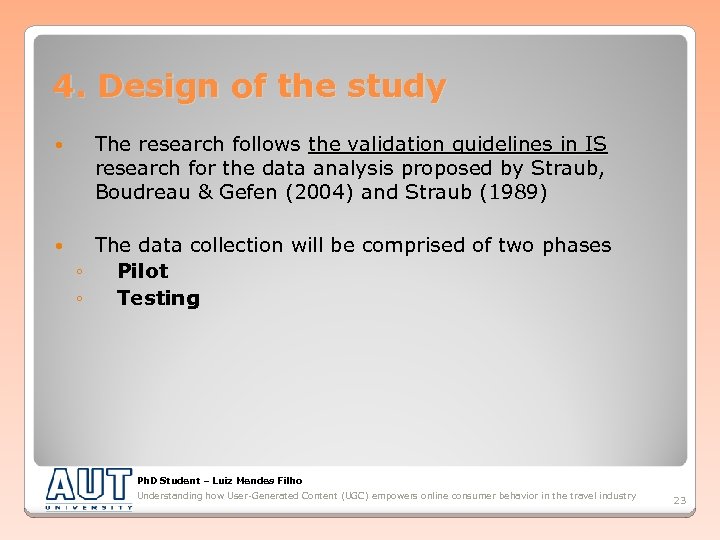 4. Design of the study The research follows the validation guidelines in IS research for the data analysis proposed by Straub, Boudreau & Gefen (2004) and Straub (1989) The data collection will be comprised of two phases ◦ Pilot ◦ Testing Ph. D Student – Luiz Mendes Filho Understanding how User-Generated Content (UGC) empowers online consumer behavior in the travel industry 23
 Pilot Phase 4. Design of the study Content validity will be established through literature reviews and expert judges The measurements items used in this research were identified by relevant prior research The items will be reviewed and discussed by expert judges with in -depth interviews comprising 40 participants from various areas: ◦ academic experts in IS and methodology ◦ practitioner experts in IS and tourism Ph. D Student – Luiz Mendes Filho Understanding how User-Generated Content (UGC) empowers online consumer behavior in the travel industry 24
 Pilot Phase 4. Design of the study A survey instrument covering all key constructs will be developed The pilot study will then be employed to assess reliability of the questionnaire The pilot study will be relevant to: ◦ ensure that the items will adapted appropriately to the current context ◦ modify the wording of measurement items A group of 80 undergraduate students will be chosen at random to participate in the pilot study Validity of construct measures will be conducted using the pilot study Ph. D Student – Luiz Mendes Filho Understanding how User-Generated Content (UGC) empowers online consumer behavior in the travel industry 26
 Testing Phase 4. Design of the study Survey involving international tourism backpackers to New Zealand Word-of-mouth and recommendations have been a powerful source of information for backpackers (Sorensson, 2008) The international backpacker market is (Newlands, 2004): ◦ a significant element of the visitor market mix for New Zealand ◦ an important component of its tourism earnings Backpacker guest nights: ◦ in 2006 had the fastest growth, increasing by 107% since 1997 (Ministry of Tourism, 2006) ◦ achieved 4, 543, 775 in the last year (from March 2007 to 4, 543, 775 March 2008)(Ministry of Tourism, 2008) Ph. D Student – Luiz Mendes Filho Understanding how User-Generated Content (UGC) empowers online consumer behavior in the travel industry 27
 Testing Phase 4. Design of the study The data will be collected with 500 international backpackers staying in YHA (Youth Hostels Association) hostels and backpacker lodges throughout New Zealand ◦ Face-to-face questionnaire ◦ Have used any application of UGC before or during the trip Getting help from NZ Tourism Research Institute (NZTRI) The YHA New Zealand is the world’s first and largest budget accommodation network (YHA New Zealand, 2007) YHA’s network in New Zealand (YHA New Zealand, 2007): ◦ more than 50 hostels ◦ 500, 000 bednights ◦ 24, 000 plus members Ph. D Student – Luiz Mendes Filho Understanding how User-Generated Content (UGC) empowers online consumer behavior in the travel industry 28
 Testing Phase 4. Design of the study The research model will be validated using Partial Least Squares (PLS), a technique comprised of measurement and structural models (Chin, 1998; Gefen, Straub, & Boudreau, 2000) PLS was chosen for 4 reasons: PLS was chosen for 4 reasons ◦ Modelling latent constructs under conditions of non-normality and small to medium sample sizes (Chin, 1998) ◦ Modelling of constructs with formative indicators is allowed using PLS (Chin, 1998) ◦ PLS will be applied to avoid inadmissible solutions and factor indeterminacy (Pavlou & Fygenson, 2006) ◦ PLS has been used successfully in information systems research (Pavlou, Liang, & Xue, 2007; Venkatesh & Agarwal, 2006) Ph. D Student – Luiz Mendes Filho Understanding how User-Generated Content (UGC) empowers online consumer behavior in the travel industry 29
 Acknowledgments My supervisors: ◦ Felix Tan ◦ Simon Milne Top Achiever Doctoral Scholarship from the Tertiary Education Commission (TEC) Thanks for your attention! Ph. D Student – Luiz Mendes Filho Understanding how User-Generated Content (UGC) empowers online consumer behavior in the travel industry 30