 Скачать презентацию Ph D Grzegorz Zając Basic terminology of international
lect_1_i.pptx
- Количество слайдов: 15



Ph. D. Grzegorz Zając Basic terminology of international aviation law. Chicago convention regime Aviation Laws and Organizations, WSIZ Rzeszów 2013/2014
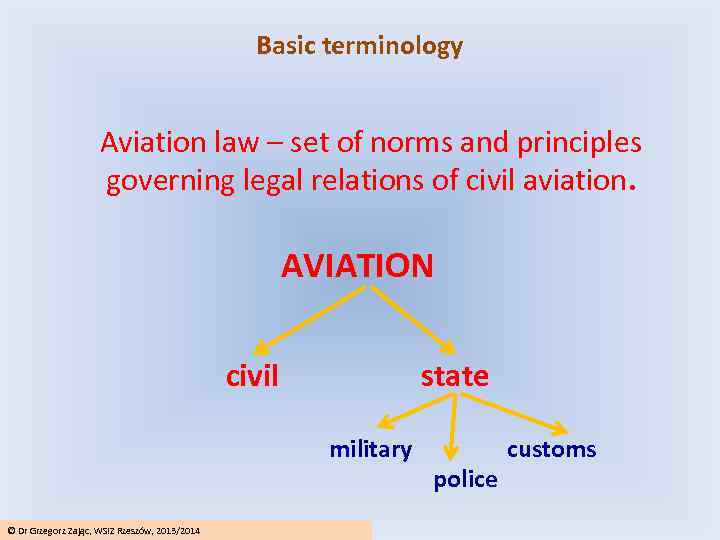
Basic terminology Aviation law – set of norms and principles governing legal relations of civil aviation. AVIATION civil state military © Dr Grzegorz Zając, WSIZ Rzeszów, 2013/2014 police customs
Basic terminology • Aerodrome. A defined area on land or water (including any buildings, installations and equipment) intended to be used either wholly or in part for the arrival, departure and surface movement of aircraft. (Annex No 2). • Airport: means any area in a Member State especially adapted for air services (Europe – Regulation EU No 1008/2008). © Dr Grzegorz Zając, WSIZ Rzeszów, 2013/2014
The basis of international aviation law CONVENTION ON INTERNATIONAL CIVIL AVIATION, SIGNED AT CHICAGO, ON 7 DECEMBER 1944 (CHICAGO CONVENTION) (Dz. U. of 1959 r. No 35, poz. 212, with changes) © Dr Grzegorz Zając, WSIZ Rzeszów, 2013/2014 © Dr Grzegorz Zając
The Chicago convention regime consists of: a) Chicago Convention of 1944 b) The International Air Services Transit Agreement or "Two Freedom", 1944. c) The International Air Transport Agreement or "Five Freedom”, 1944 d) Annexes to Chicago Convention (18) e) Rules adopted by Council of ICAO (Documents) © Dr Grzegorz Zając, WSIZ Rzeszów, 2013/2014 © Dr Grzegorz Zając
Freedoms of the Air • There are 8 freedoms of the air. • ICAO characterizes all "freedoms" beyond the Fifth as "so-called" because only the first five "freedoms" have been officially recognized as such by international treaty. • The first „two freedoms” are technical. • The next „three freedoms” are commercial. © Dr Grzegorz Zając, WSIZ Rzeszów, 2013/2014
1 st freedom (technical) The right to fly over a foreign country, without landing there. Example: Berlin – Kiev, as a German company, overflying the Poland. © Dr Grzegorz Zając, WSIZ Rzeszów, 2013/2014
2 nd freedom (technical) The right or privilege to land for nontraffic purposes. (e. g. to refuel or carry out maintenance). Example: Berlin – Kiev, as a German company, but stopping for fuel in Poland. © Dr Grzegorz Zając, WSIZ Rzeszów, 2013/2014
3 rd freedom (commercial) The privilege to put down passengers, mail and cargo taken on in the territory of the State whose nationality the aircraft possesses. Example: Ankara – Cairo, as a Turkish airline. © Dr Grzegorz Zając, WSIZ Rzeszów, 2013/2014
4 th freedom (commercial) The privilege to take on passengers, mail and cargo destined for the territory of the State whose nationality the aircraft possesses. Example: Ankara – Cairo, as an Egyptian airline. © Dr Grzegorz Zając, WSIZ Rzeszów, 2013/2014
5 th freedom (commercial) The privilege to take on passengers, mail and cargo destined for the territory of any other contracting State and the privilege to put down passengers, mail and cargo coming from any such territory. Example: Paris – Athens – New Delhi – Tokyo, as a French airline. © Dr Grzegorz Zając, WSIZ Rzeszów, 2013/2014
6 th freedom The right or privilege to carry passengers or cargo between two different States, via the home State of the carrier. Example: New York – London – Moscow, as a British airline. © Dr Grzegorz Zając, WSIZ Rzeszów, 2013/2014
7 th freedom The right to carry passengers or cargo between two foreign countries without any continuing service to one's own country. Example: Warsaw – Helsinki, as an Irish airline. © Dr Grzegorz Zając, WSIZ Rzeszów, 2013/2014
8 th freedom/9 th freedom The right to fly between two or more airports in a foreign country while continuing service to one's own country. Example: Munich – Hamburg – Amsterdam, as a Dutch airline. © Dr Grzegorz Zając, WSIZ Rzeszów, 2013/2014

Thank you!
Скачать презентацию Ph D Grzegorz Zając Basic terminology of international
lect_1_i.pptx