


 Скачать презентацию PH 103 Dr Cecilia Vogel Lecture 10
1b0cadaeb388461a2dd369aa65b1456c.ppt
- Количество слайдов: 11
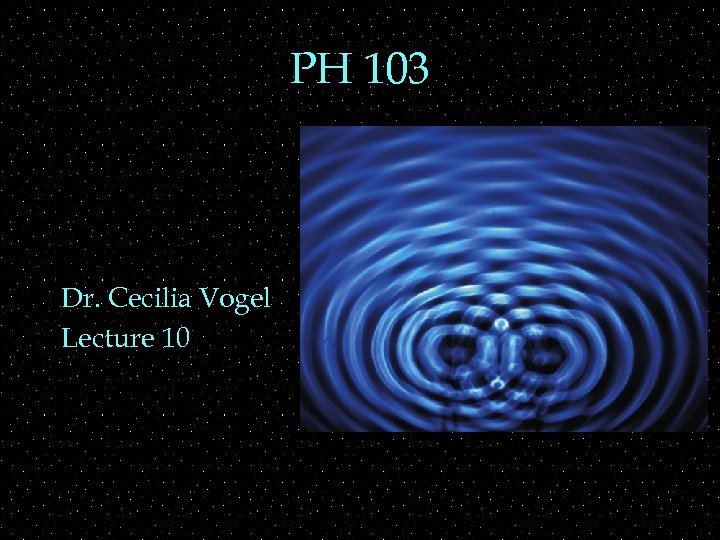 PH 103 Dr. Cecilia Vogel Lecture 10
 Review a. Lenses amultiple lenses aapplication to microscope aapplication to telescope Outline adiffraction abreakdown of ray model aspecial case: single slit aresolution
 Recall Ray Model a. Light travels in a straight line aexcept when it strikes a new material a. Works very well for all waves awhenever wavelength << sizes of obstacles and openings a. Examples alight through a window or open door a satellite signal approaching earth a“line-of-sight“
 Diffraction a. Ray model breaks down for all waves awhenever wavelength sizes of obstacles and openings a. Wave diffracts - bends, changes direction through opening, or around obstacle a. Examples a sound through open door a radio wave around building a visible light thru very small slit anot line-of-sight
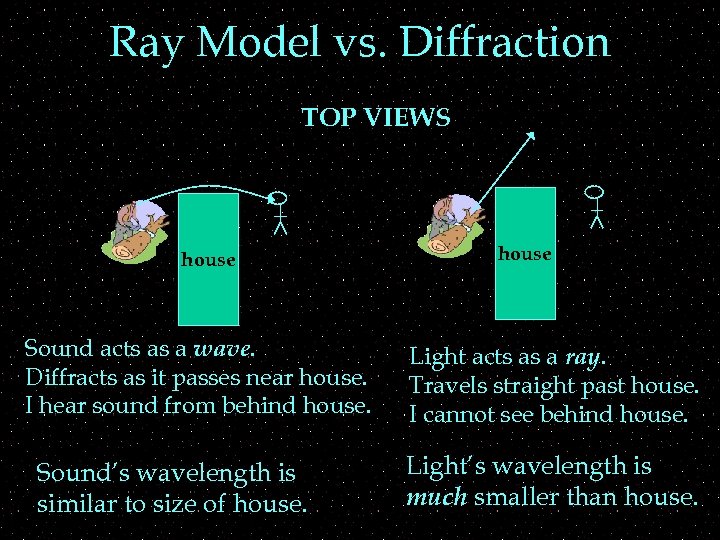 Ray Model vs. Diffraction TOP VIEWS house Sound acts as a wave. Diffracts as it passes near house. I hear sound from behind house. Sound’s wavelength is similar to size of house Light acts as a ray. Travels straight past house. I cannot see behind house. Light’s wavelength is much smaller than house.
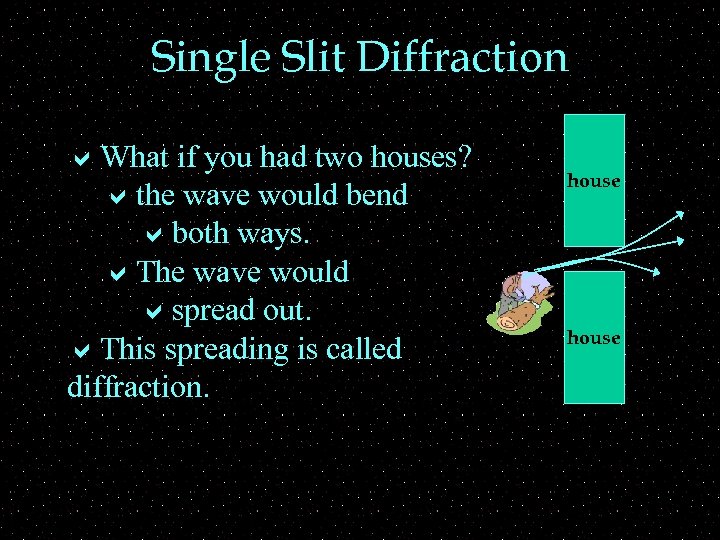 Single Slit Diffraction a. What if you had two houses? athe wave would bend aboth ways. a. The wave would aspread out. a. This spreading is called diffraction. house
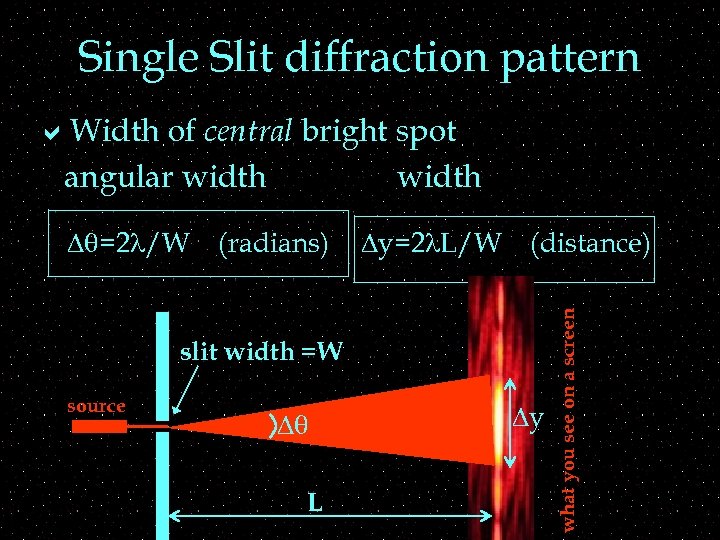 Single Slit diffraction pattern a. Width of central bright spot angular width (radians) Dy=2 l. L/W (distance) slit width =W source Dq L Dy what you see on a screen Dq=2 l/W
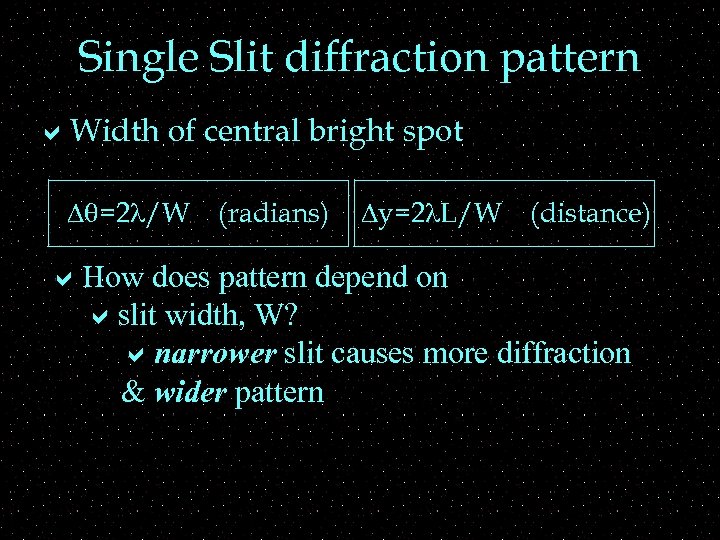 Single Slit diffraction pattern a. Width of central bright spot Dq=2 l/W (radians) Dy=2 l. L/W (distance) a. How does pattern depend on aslit width, W? anarrower slit causes more diffraction & wider pattern
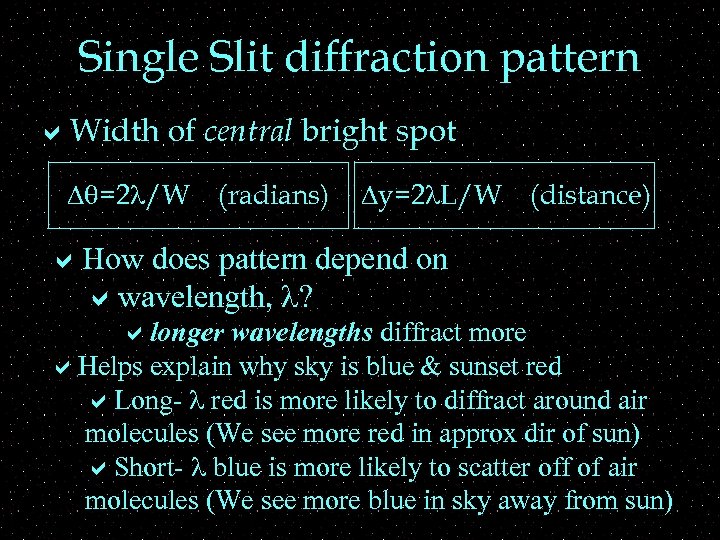 Single Slit diffraction pattern a. Width of central bright spot Dq=2 l/W (radians) Dy=2 l. L/W (distance) a. How does pattern depend on awavelength, l? alonger wavelengths diffract more a. Helps explain why sky is blue & sunset red a. Long- l red is more likely to diffract around air molecules (We see more red in approx dir of sun) a. Short- l blue is more likely to scatter off of air molecules (We see more blue in sky away from sun)
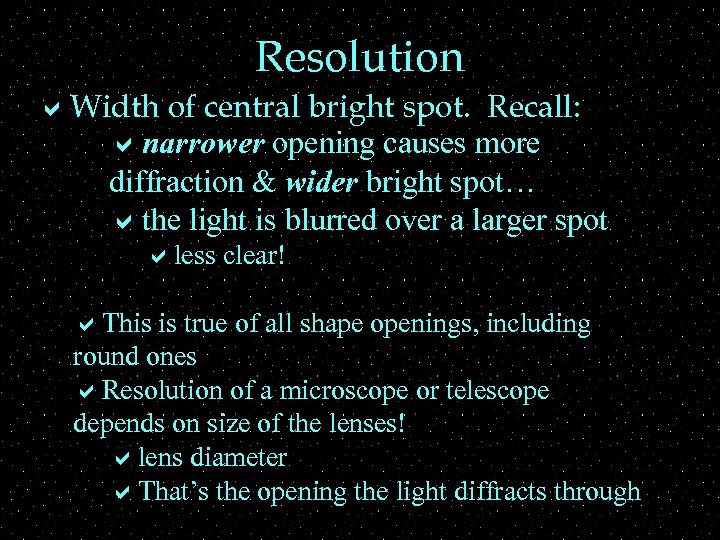 Resolution a. Width of central bright spot. Recall: anarrower opening causes more diffraction & wider bright spot… athe light is blurred over a larger spot aless clear! a. This is true of all shape openings, including round ones a. Resolution of a microscope or telescope depends on size of the lenses! alens diameter a. That’s the opening the light diffracts through
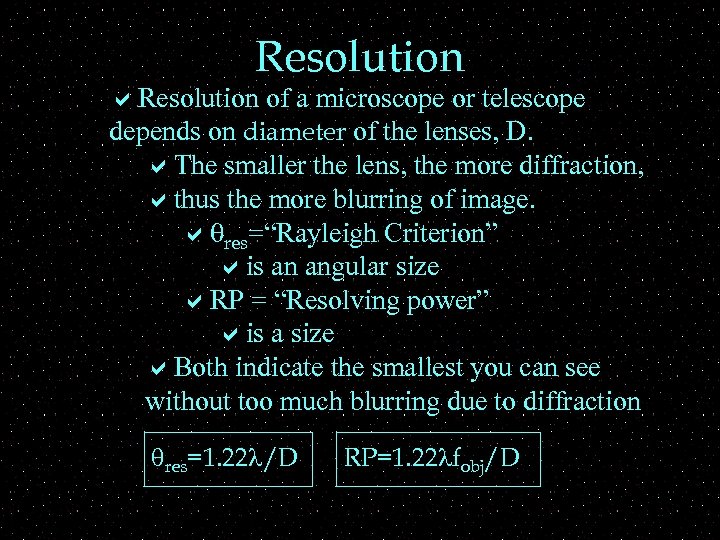 Resolution a. Resolution of a microscope or telescope depends on diameter of the lenses, D. a. The smaller the lens, the more diffraction, athus the more blurring of image. aqres=“Rayleigh Criterion” ais an angular size a. RP = “Resolving power” ais a size a. Both indicate the smallest you can see without too much blurring due to diffraction qres=1. 22 l/D RP=1. 22 lfobj/D