


 Скачать презентацию PETE 411 Well Drilling Lesson 24 Kicks and
2c3907226de3430993c5798499c71d16.ppt
- Количество слайдов: 58
 PETE 411 Well Drilling Lesson 24 Kicks and Well Control 1
 Kicks and Well Control Methods u The Anatomy of a KICK u Kicks - Definition u Kick Detection u Kick Control u (a) u (b) * * Dynamic Kick Control Other Kick Control Methods Driller’s Method Engineer’s Method 2
 Read: Applied Drilling Engineering, Ch. 4 HW #13 dc - Exponent due Nov. 6, 2002 3
 4
4
 5
5
 6
6
 7
7
 Causes of Kicks 8
 Causes of Kicks 9
 Causes of Kicks 10
 11
11
 12
12
 13
13
 14
14
 15
15
 16
16
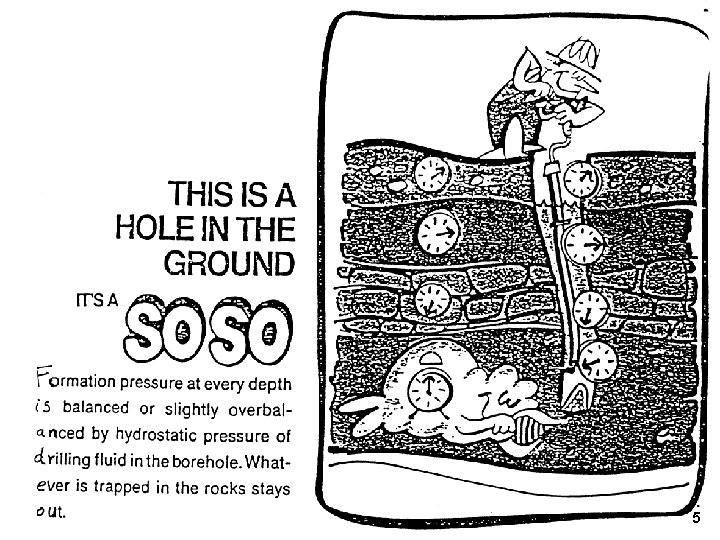
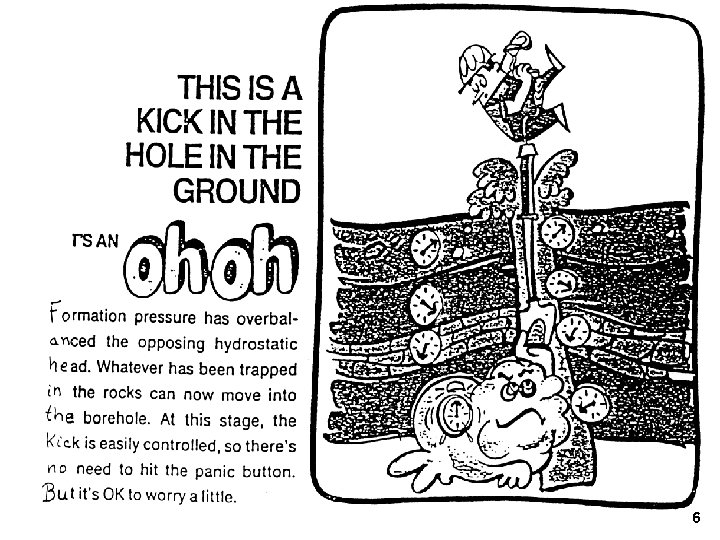
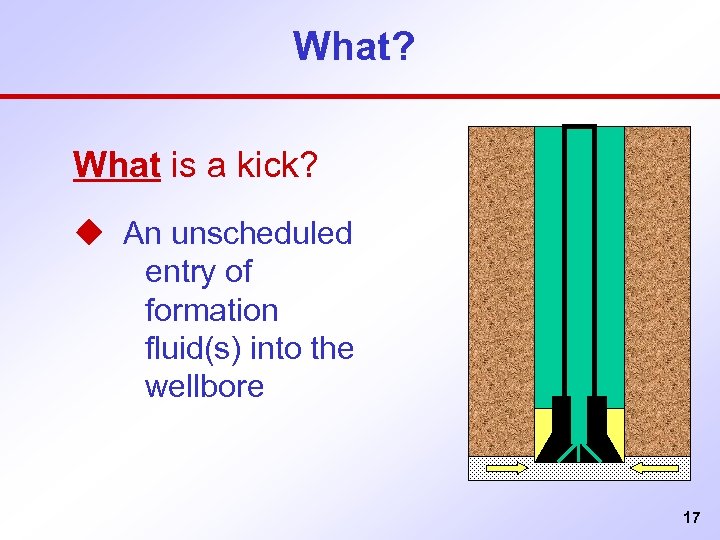 What? What is a kick? u An unscheduled entry of formation fluid(s) into the wellbore 17
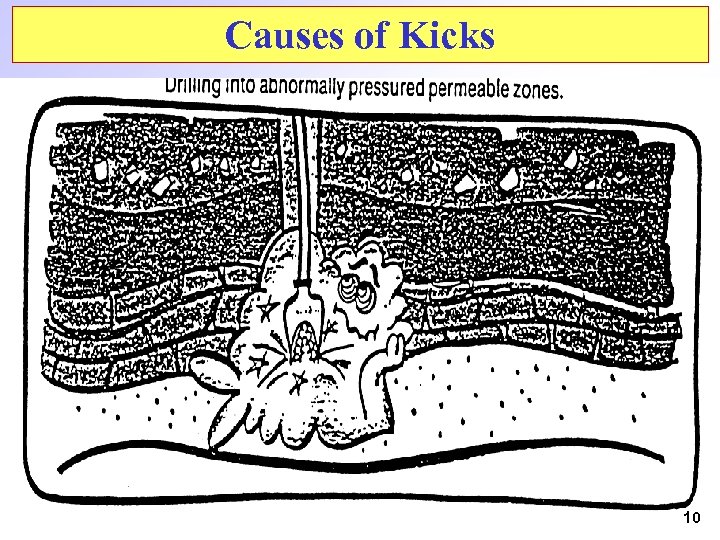
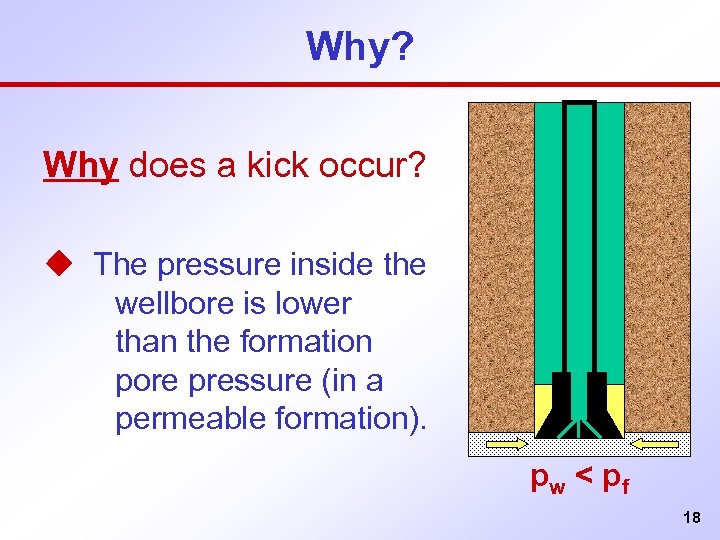 Why? Why does a kick occur? u The pressure inside the wellbore is lower than the formation pore pressure (in a permeable formation). pw < p f 18
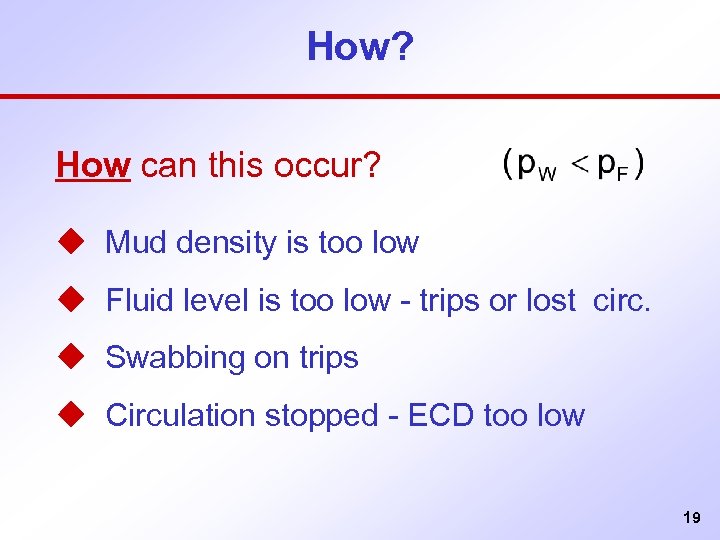 How? How can this occur? u Mud density is too low u Fluid level is too low - trips or lost circ. u Swabbing on trips u Circulation stopped - ECD too low 19
 What ? What happens if a kick is not controlled? ê BLOWOUT !!! 20
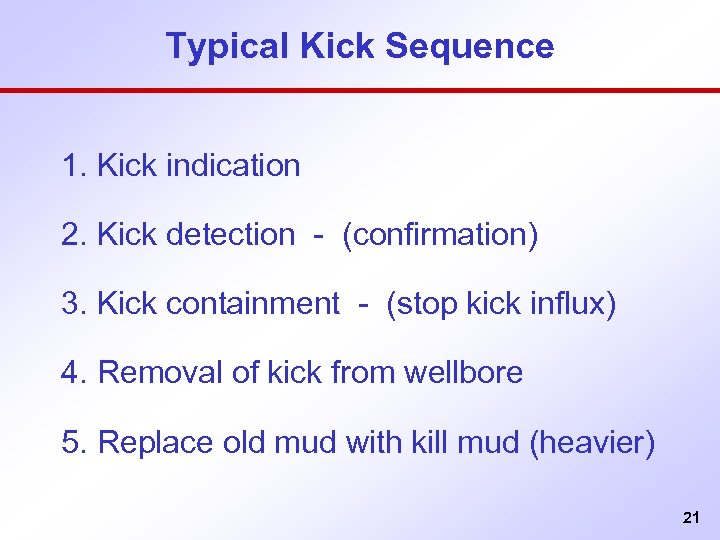 Typical Kick Sequence 1. Kick indication 2. Kick detection - (confirmation) 3. Kick containment - (stop kick influx) 4. Removal of kick from wellbore 5. Replace old mud with kill mud (heavier) 21
 Kick Detection and Control Kick Detection Kick Control 22
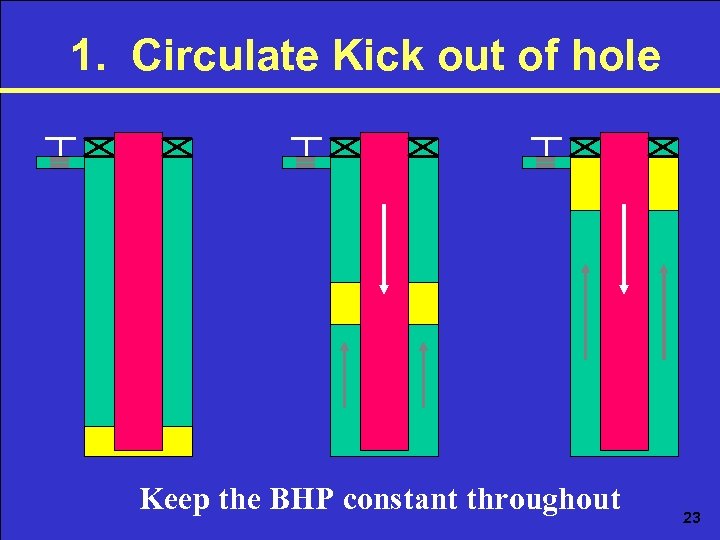 1. Circulate Kick out of hole Keep the BHP constant throughout 23
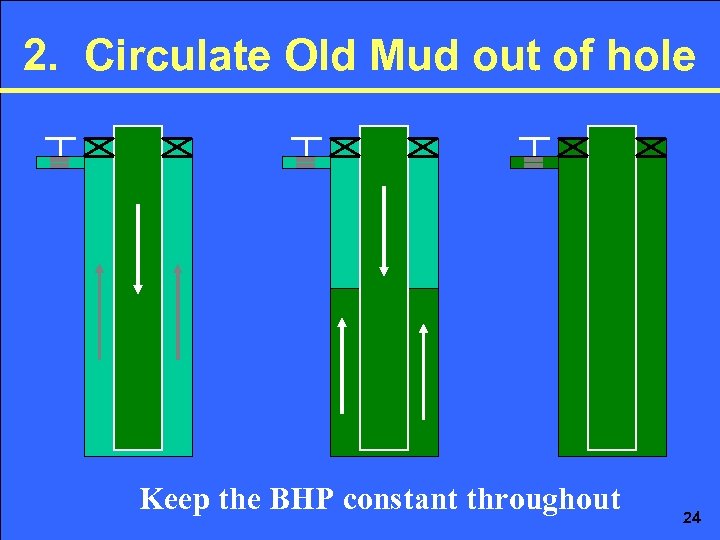 2. Circulate Old Mud out of hole Keep the BHP constant throughout 24
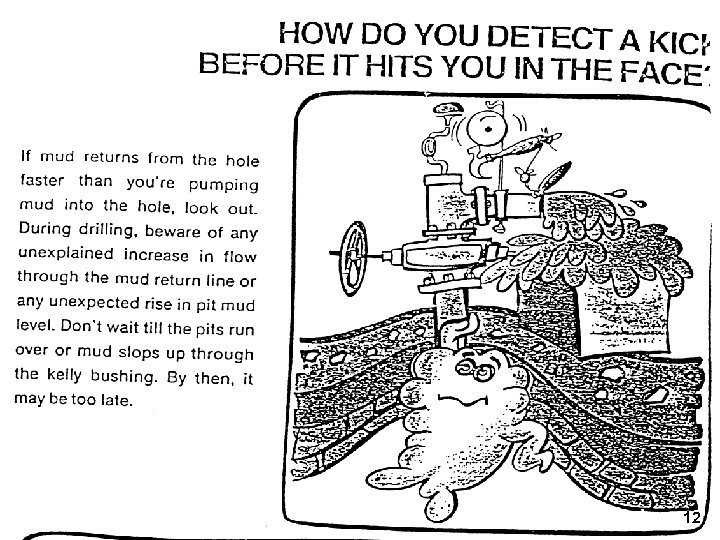
 Kick Detection Some of the preliminary events that may be associated with a well-control problem, not necessarily in the order of occurrence, are: 1. Pit gain; 2. Increase in flow of mud from the well 3. Drilling break (sudden increase in drilling rate) 25
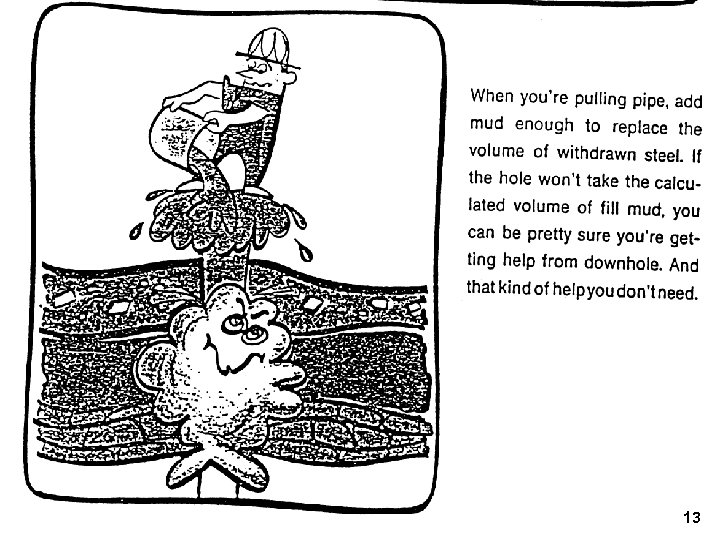
 Kick Detection 4. Decrease in circulating pressure; 5. Shows of gas, oil, or salt water 6. Well flows after mud pump has been shut down 7. Increase in hook load 8. Incorrect fill-up on trips 26
![Dynamic Kick Control [Kill well “on the fly”] For use in controlling shallow gas](https://present5.com/presentation/2c3907226de3430993c5798499c71d16/image-27.jpg "Dynamic Kick Control [Kill well “on the fly”] For use in controlling shallow gas") Dynamic Kick Control [Kill well “on the fly”] For use in controlling shallow gas kicks § § No competent casing seat No surface casing - only conductor Use diverter (not BOP’s) Do not shut well in! 27
Dynamic Kick Control [Kill well “on the fly”] For use in controlling shallow gas kicks § § No competent casing seat No surface casing - only conductor Use diverter (not BOP’s) Do not shut well in! 27
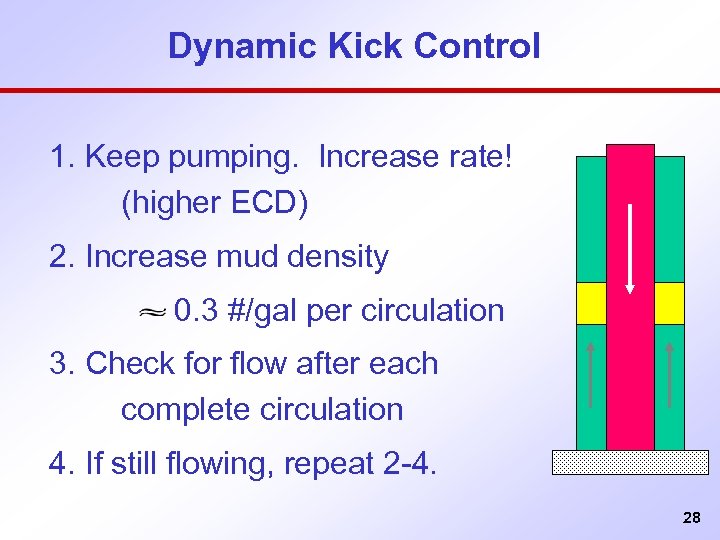 Dynamic Kick Control 1. Keep pumping. Increase rate! (higher ECD) 2. Increase mud density 0. 3 #/gal per circulation 3. Check for flow after each complete circulation 4. If still flowing, repeat 2 -4. 28
 Dynamic Kick Control Other ways that shallow gas kicks may be stopped: 1. The well may breach with the wellbore essentially collapsing. 2. The reservoir may deplete to the point where flow stops. 29
 Conventional Kick Control {Surface Casing and BOP Stack are in place} Shut in well for pressure readings. (a) Remove kick fluid from wellbore; (b) Replace old mud with kill weight mud Use choke to keep BHP constant. 30
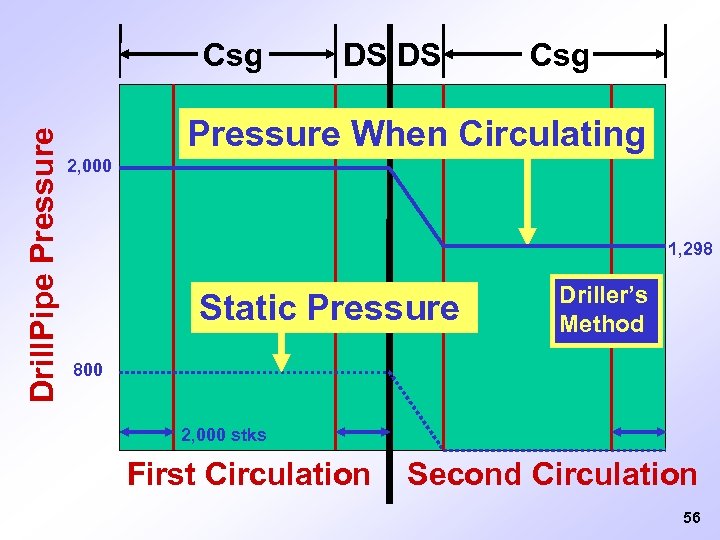
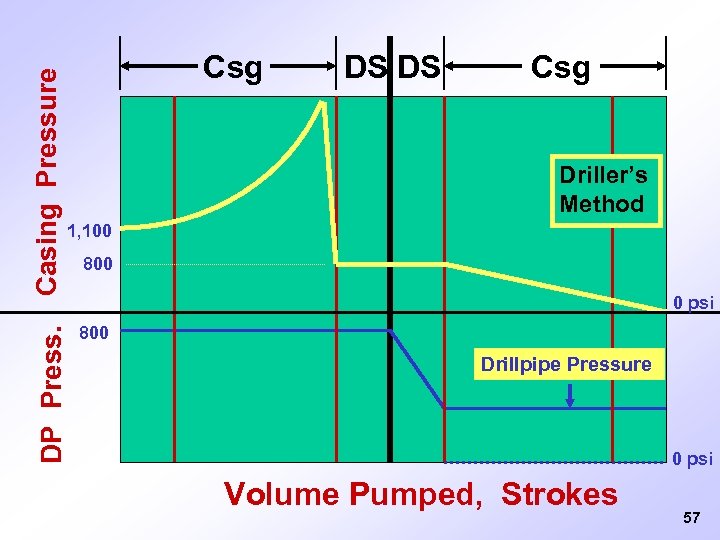
 Conventional Kick Control 1. DRILLER’S METHOD ** TWO complete circulations ** 4 Circulate kick out of hole using old mud 4 Circulate old mud out of hole using kill weight mud 31
 Conventional Kick Control 2. WAIT AND WEIGHT METHOD (Engineer’s Method) ** ONE complete circulation ** 4 Circulate kick out of hole using kill weight mud 32
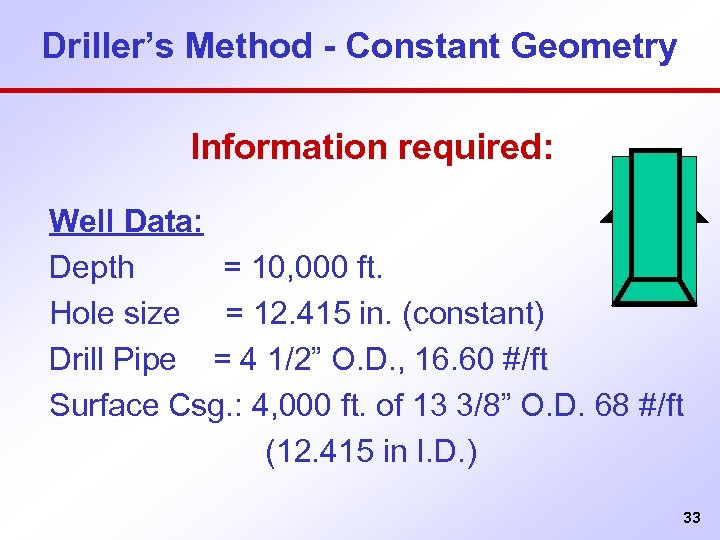 Driller’s Method - Constant Geometry Information required: Well Data: Depth = 10, 000 ft. Hole size = 12. 415 in. (constant) Drill Pipe = 4 1/2” O. D. , 16. 60 #/ft Surface Csg. : 4, 000 ft. of 13 3/8” O. D. 68 #/ft (12. 415 in I. D. ) 33
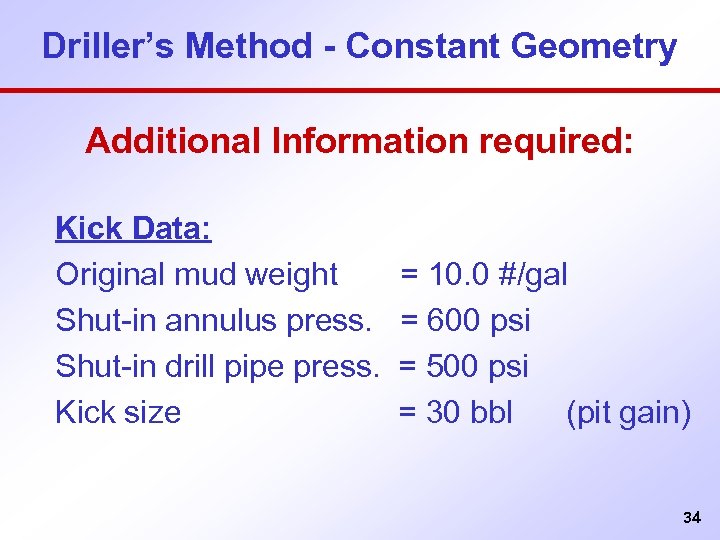 Driller’s Method - Constant Geometry Additional Information required: Kick Data: Original mud weight Shut-in annulus press. Shut-in drill pipe press. Kick size = 10. 0 #/gal = 600 psi = 500 psi = 30 bbl (pit gain) 34
 Constant Annular Geometry. Initial conditions: Kick has just entered the wellbore Pressures have stabilized 35
 Successful Well Control 1. At no time during the process of removing the kick fluid from the wellbore will the pressure exceed the pressure capability of 4 the formation 4 the casing 4 the wellhead equipment 36
 Successful Well Control 2. When the process is complete the wellbore is completely filled with a fluid of sufficient density (kill mud) to control the formation pressure. Under these conditions the well will not flow when the BOP’s are opened. 3. Keep the BHP constant throughout. 37
 Calculations From the initial shut-in data we can calculate: Ø Bottom hole pressure Ø Casing seat pressure Ø Height of kick Ø Density of kick fluid 38
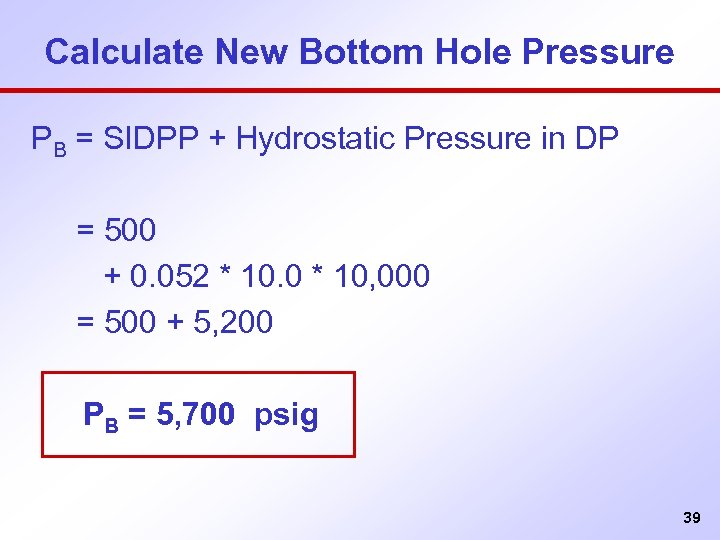 Calculate New Bottom Hole Pressure PB = SIDPP + Hydrostatic Pressure in DP = 500 + 0. 052 * 10. 0 * 10, 000 = 500 + 5, 200 PB = 5, 700 psig 39
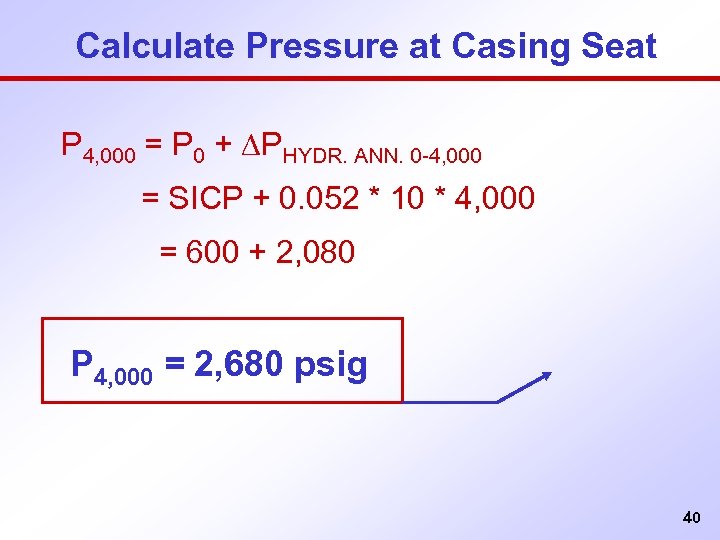 Calculate Pressure at Casing Seat P 4, 000 = P 0 + DPHYDR. ANN. 0 -4, 000 = SICP + 0. 052 * 10 * 4, 000 = 600 + 2, 080 P 4, 000 = 2, 680 psig 40
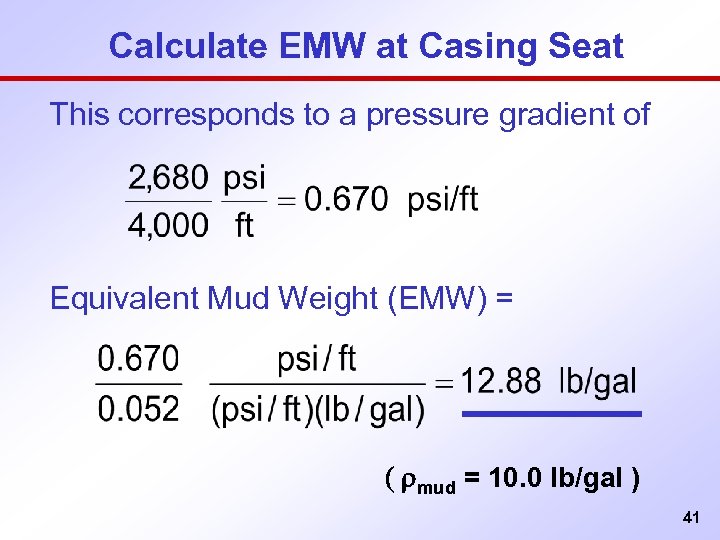 Calculate EMW at Casing Seat This corresponds to a pressure gradient of Equivalent Mud Weight (EMW) = ( rmud = 10. 0 lb/gal ) 41
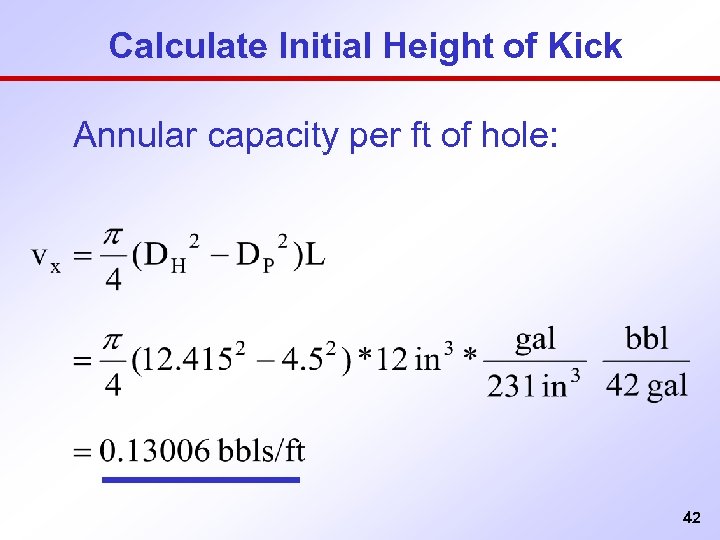 Calculate Initial Height of Kick Annular capacity per ft of hole: 42
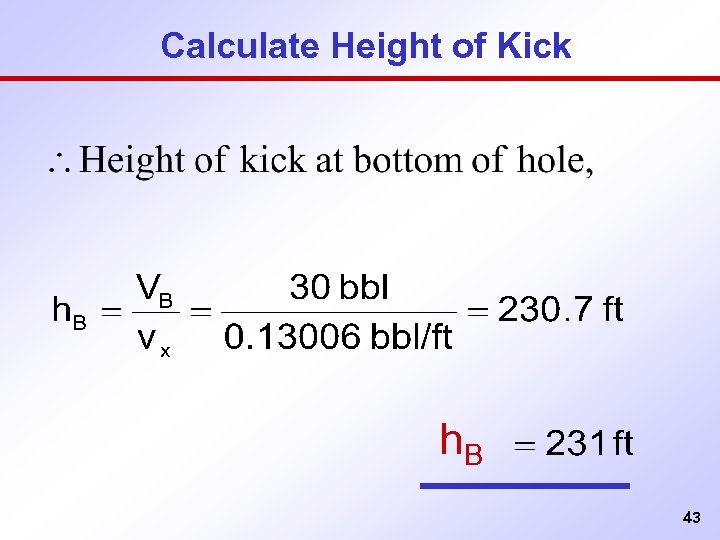 Calculate Height of Kick h. B 43
 Calculate Density of Kick Fluid The bottom hole pressure is the pressure at the surface plus the total hydrostatic pressure between the surface and the bottom: Annulus PB = SICP + DPMA + DPKB Drill String PB = SIDPP + DPMD 44
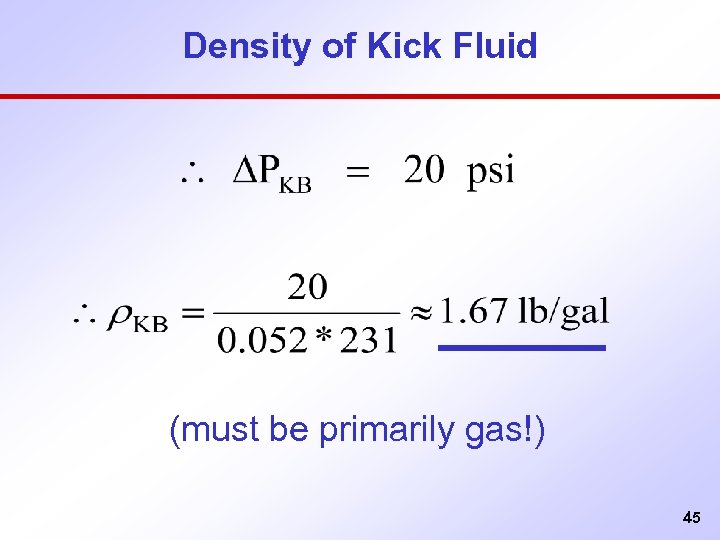 Density of Kick Fluid (must be primarily gas!) 45
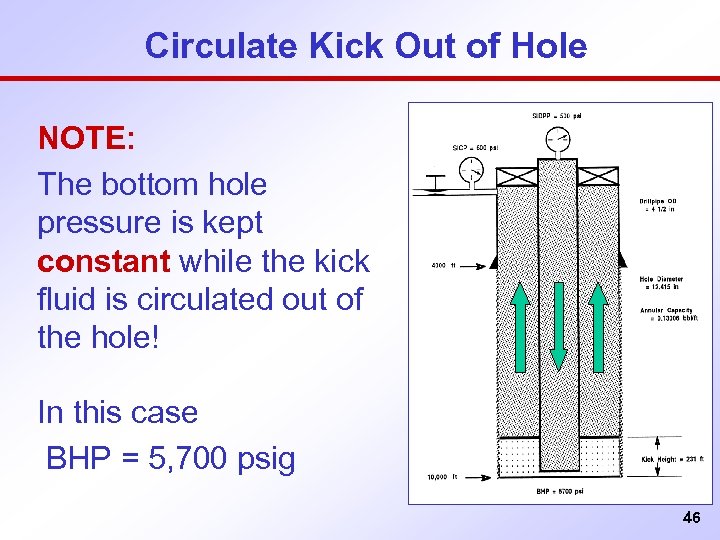 Circulate Kick Out of Hole NOTE: The bottom hole pressure is kept constant while the kick fluid is circulated out of the hole! In this case BHP = 5, 700 psig 46
 Constant Annular Geometry Driller’s Method. Conditions When Top of Kick Fluid Reaches the Surface BHP = const. 47
 48
48
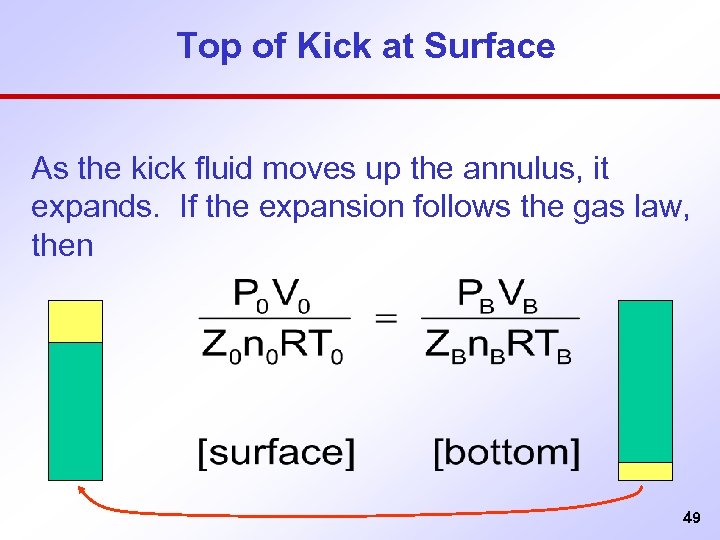 Top of Kick at Surface As the kick fluid moves up the annulus, it expands. If the expansion follows the gas law, then 49
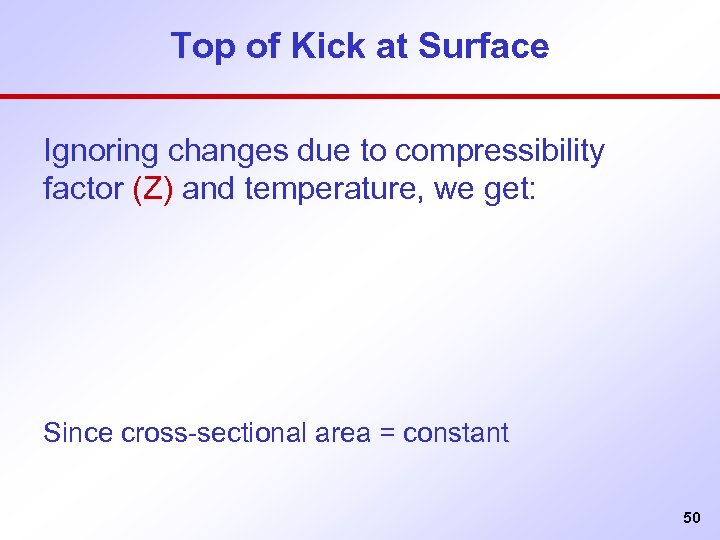 Top of Kick at Surface Ignoring changes due to compressibility factor (Z) and temperature, we get: Since cross-sectional area = constant 50
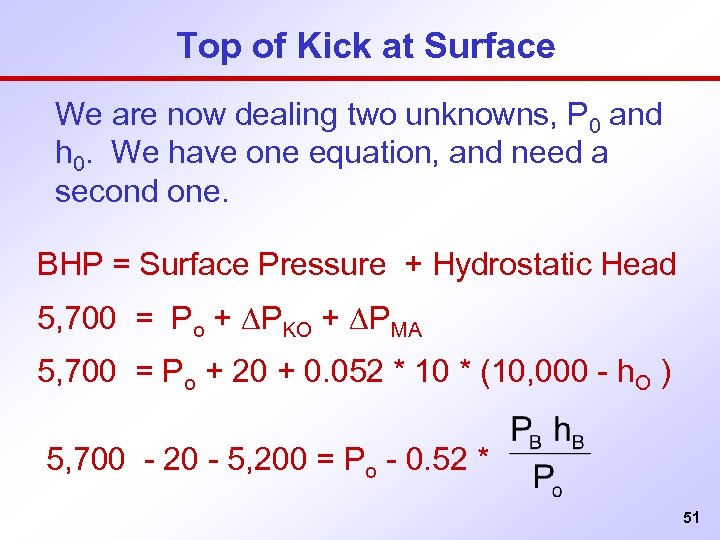 Top of Kick at Surface We are now dealing two unknowns, P 0 and h 0. We have one equation, and need a second one. BHP = Surface Pressure + Hydrostatic Head 5, 700 = Po + DPKO + DPMA 5, 700 = Po + 20 + 0. 052 * 10 * (10, 000 - h. O ) 5, 700 - 20 - 5, 200 = Po - 0. 52 * 51
 Top of Kick at Surface 52
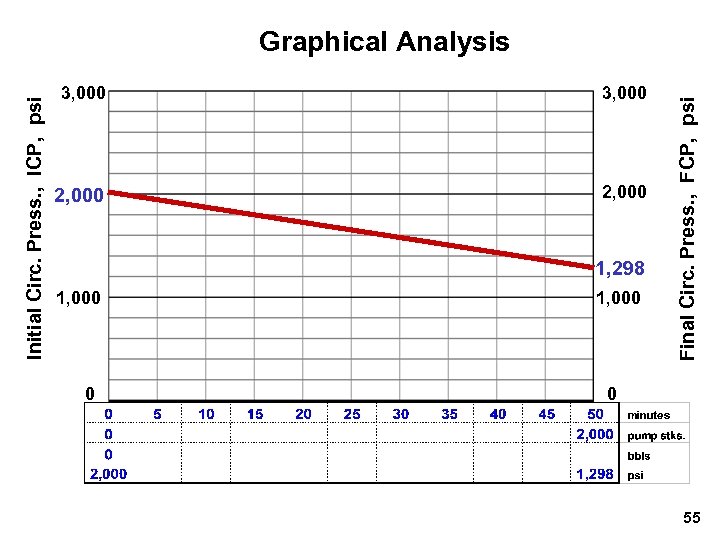
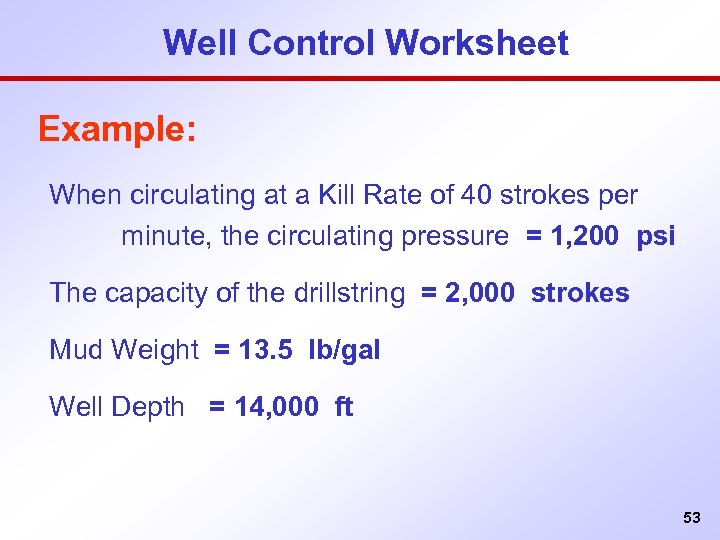 Well Control Worksheet Example: When circulating at a Kill Rate of 40 strokes per minute, the circulating pressure = 1, 200 psi The capacity of the drillstring = 2, 000 strokes Mud Weight = 13. 5 lb/gal Well Depth = 14, 000 ft 53
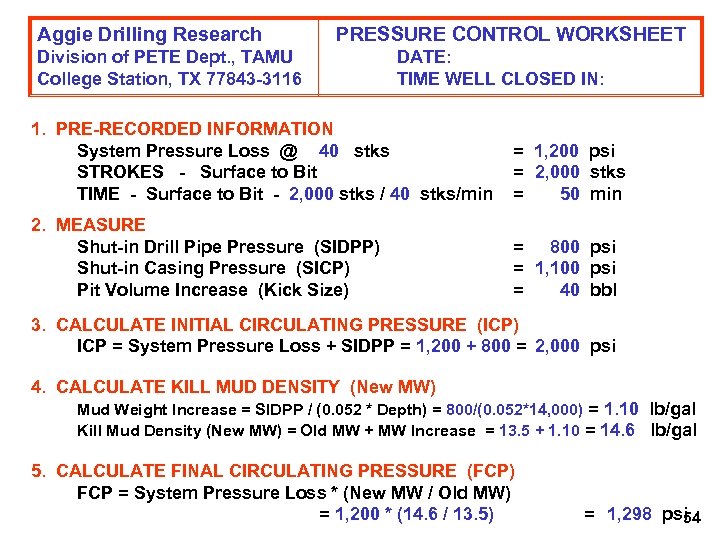 Aggie Drilling Research PRESSURE CONTROL WORKSHEET Division of PETE Dept. , TAMU College Station, TX 77843 -3116 DATE: TIME WELL CLOSED IN: 1. PRE-RECORDED INFORMATION System Pressure Loss @ 40 stks STROKES - Surface to Bit TIME - Surface to Bit - 2, 000 stks / 40 stks/min = 1, 200 psi = 2, 000 stks = 50 min 2. MEASURE Shut-in Drill Pipe Pressure (SIDPP) Shut-in Casing Pressure (SICP) Pit Volume Increase (Kick Size) = 800 psi = 1, 100 psi = 40 bbl 3. CALCULATE INITIAL CIRCULATING PRESSURE (ICP) ICP = System Pressure Loss + SIDPP = 1, 200 + 800 = 2, 000 psi 4. CALCULATE KILL MUD DENSITY (New MW) Mud Weight Increase = SIDPP / (0. 052 * Depth) = 800/(0. 052*14, 000) = 1. 10 lb/gal Kill Mud Density (New MW) = Old MW + MW Increase = 13. 5 + 1. 10 = 14. 6 lb/gal 5. CALCULATE FINAL CIRCULATING PRESSURE (FCP) FCP = System Pressure Loss * (New MW / Old MW) = 1, 200 * (14. 6 / 13. 5) = 1, 298 psi 4 5
 Initial Circ. Press. , ICP, psi 3, 000 2, 000 1, 298 1, 000 0 1, 000 Final Circ. Press. , FCP, psi Graphical Analysis 0 55
 Drill. Pipe Pressure Csg DS DS Csg Pressure When Circulating 2, 000 1, 298 Static Pressure Driller’s Method 800 2, 000 stks First Circulation Second Circulation 56
 Casing Pressure DP Press. Csg DS DS Csg Driller’s Method 1, 100 800 0 psi 800 Drillpipe Pressure 0 psi Volume Pumped, Strokes 57
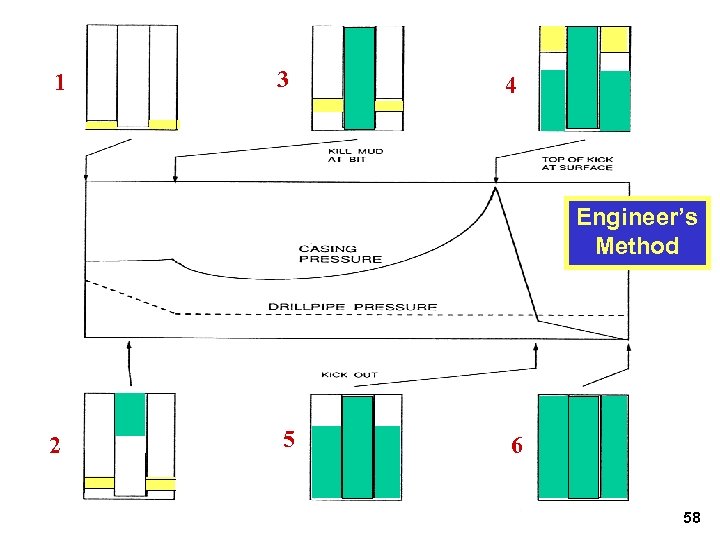 1 3 4 Engineer’s Method 2 5 6 58