 Скачать презентацию Pervasive Computing offers Adaptable Interfaces Signals Standards Metadata
71e6b25a4a8d2d8488a13ea38b6a3110.ppt
- Количество слайдов: 25



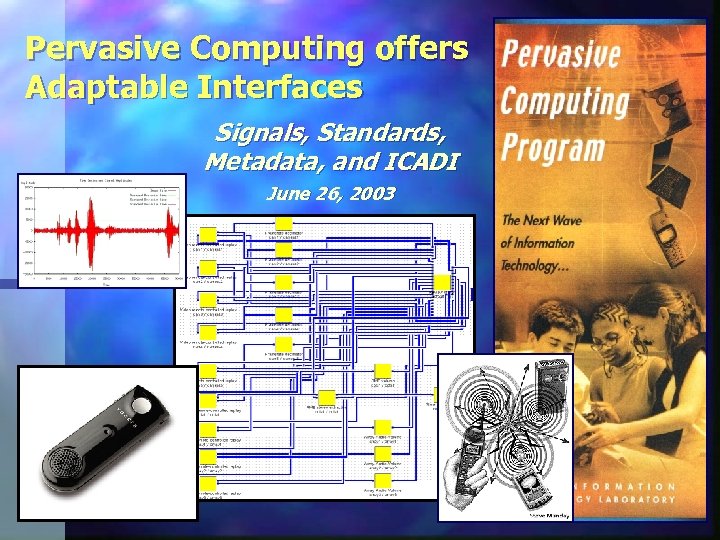
Pervasive Computing offers Adaptable Interfaces Signals, Standards, Metadata, and ICADI June 26, 2003
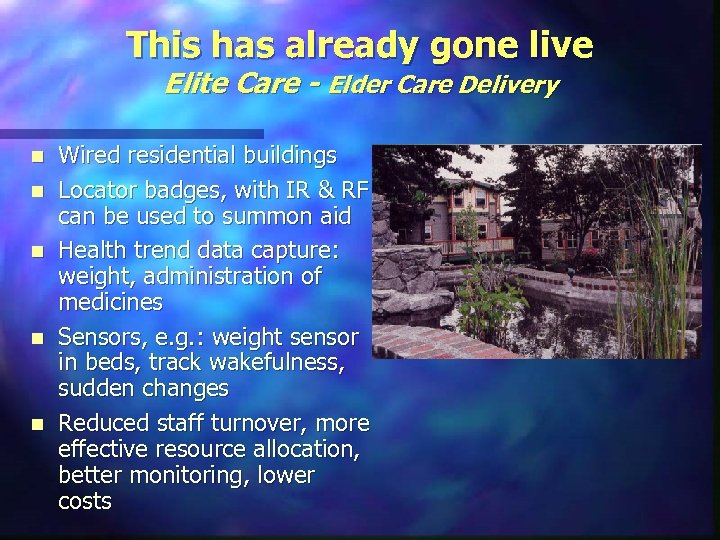
This has already gone live Elite Care - Elder Care Delivery n n n Wired residential buildings Locator badges, with IR & RF can be used to summon aid Health trend data capture: weight, administration of medicines Sensors, e. g. : weight sensor in beds, track wakefulness, sudden changes Reduced staff turnover, more effective resource allocation, better monitoring, lower costs
Research Interfaces Can Also Contribute n n Visionary system concepts, like oxygen, HPCS, Cognitive, and Pervasive systems offer essential road maps But real challenges remain to developing perceptive systems that: – Sense user signals like speech, gesture, and physiological measurement – Recognize words, speakers, gestural referents – Understand context, and user intent – Respond with information retrieval, computation, and rendering
NIST Smart Space and Meeting Room Projects Smart Space data: – Multi modal multi channel data acquisition and transport – Distributed processing – DSP Preprocessing: n n n – – – Signal conditioning Beam forming Feature extraction Time tagging Archival storage Retrieval Meeting Room metadata: – Meeting data sets – Multi level annotation, e. g. – Capitalization – Acronym detection – Proper noun detection – Sentence/utterance boundary detection – Filled pauses – Verbal edits (repeats, restarts, revisions)
Smart Spaces – What’s Real? n Speech recognition possible using microphone arrays for skilled speakers n Speech segmentation and speaker verification possible n A selected skilled user can be transcribed in a cooperative group n Transcribed speech can be parsed for basic commands
Meeting Room Data Collection Laboratory n n n Phased microphone arrays Computer-controlled video cameras Biometric sensor fusion using commercial components: – Acoustic speaker identification – Facial image classification Speaker dependent speech recognition Data flow test-bed for integration of commercial products
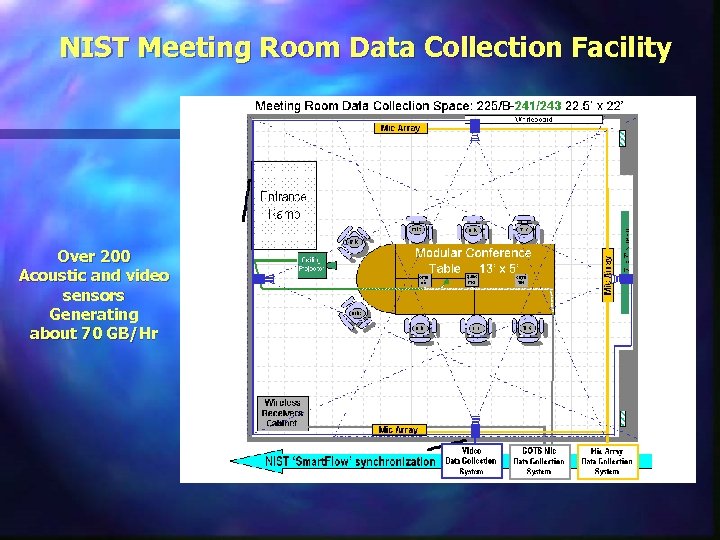
NIST Meeting Room Data Collection Facility Over 200 Acoustic and video sensors Generating about 70 GB/Hr
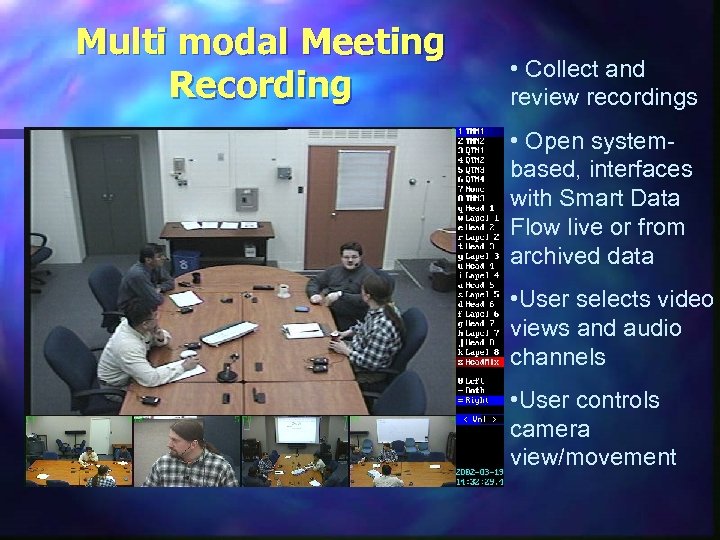
Multi modal Meeting Recording • Collect and review recordings • Open systembased, interfaces with Smart Data Flow live or from archived data • User selects video views and audio channels • User controls camera view/movement
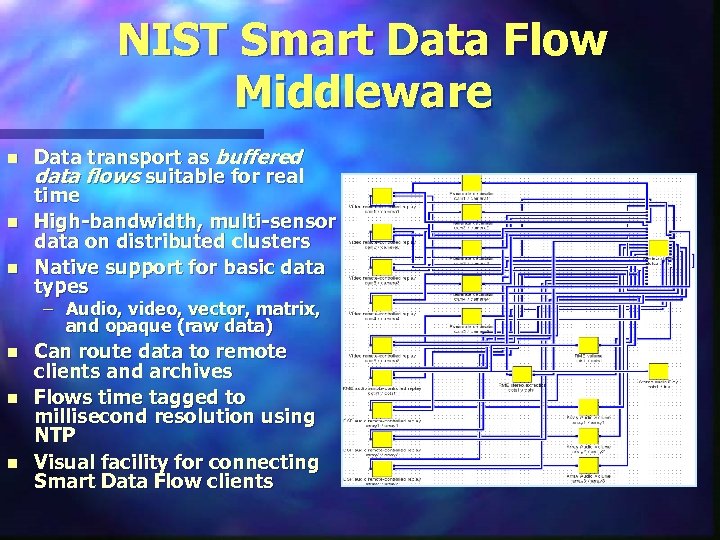
NIST Smart Data Flow Middleware n n n Data transport as buffered data flows suitable for real time High-bandwidth, multi-sensor data on distributed clusters Native support for basic data types – Audio, video, vector, matrix, and opaque (raw data) n n n Can route data to remote clients and archives Flows time tagged to millisecond resolution using NTP Visual facility for connecting Smart Data Flow clients
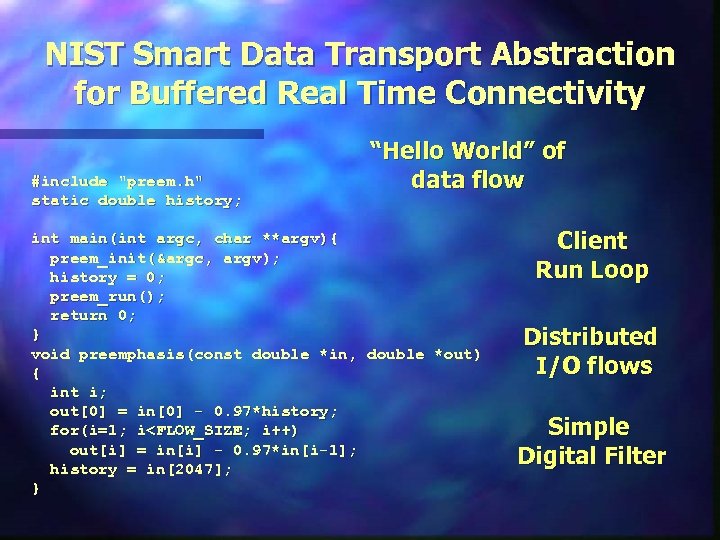
NIST Smart Data Transport Abstraction for Buffered Real Time Connectivity #include "preem. h" static double history; “Hello World” of data flow int main(int argc, char **argv){ preem_init(&argc, argv); history = 0; preem_run(); return 0; } void preemphasis(const double *in, double *out) { int i; out[0] = in[0] - 0. 97*history; for(i=1; i<FLOW_SIZE; i++) out[i] = in[i] - 0. 97*in[i-1]; history = in[2047]; } Client Run Loop Distributed I/O flows Simple Digital Filter
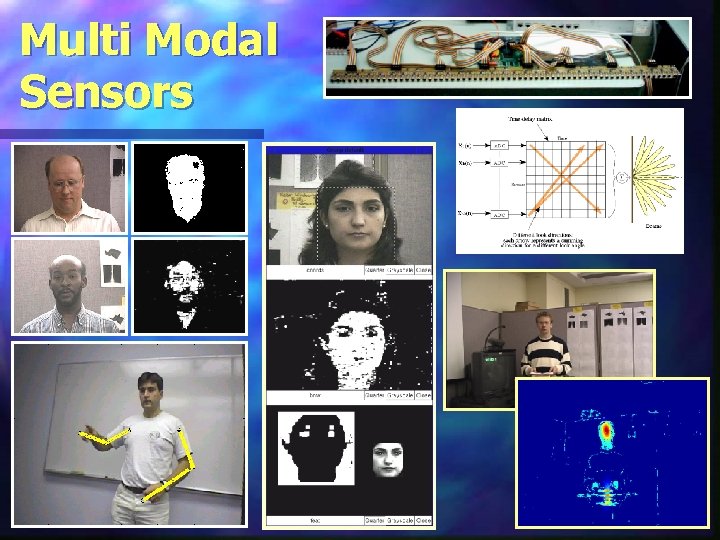
Multi Modal Sensors
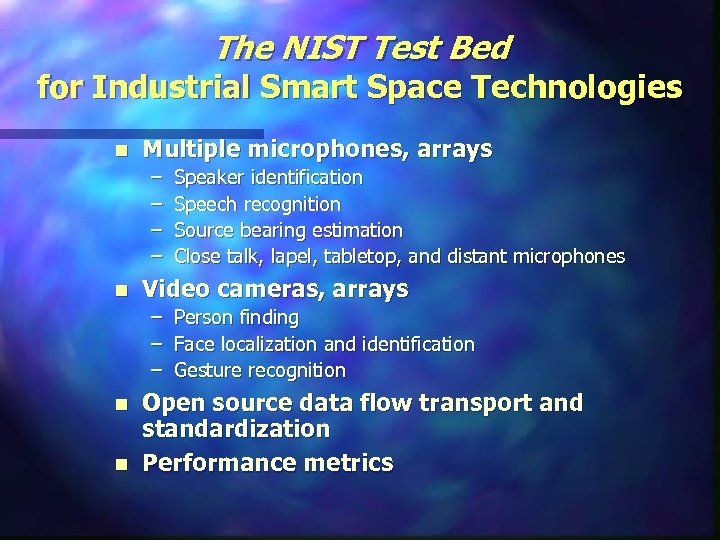
The NIST Test Bed for Industrial Smart Space Technologies n Multiple microphones, arrays – – n Speaker identification Speech recognition Source bearing estimation Close talk, lapel, tabletop, and distant microphones Video cameras, arrays – Person finding – Face localization and identification – Gesture recognition n n Open source data flow transport and standardization Performance metrics
Usability Features NIST Smart Data Flow System n Initial version was difficult to deploy and use – New version under development: – Visual flow graphs – Code generator – Simplified API – Device, user, and service discovery – Fault tolerant
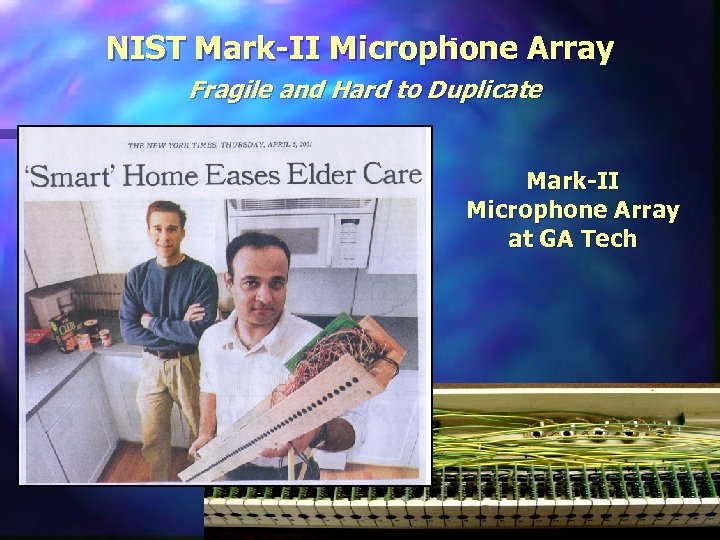
- NIST Mark-II Microphone Array Fragile and Hard to Duplicate Mark-II Microphone Array at GA Tech
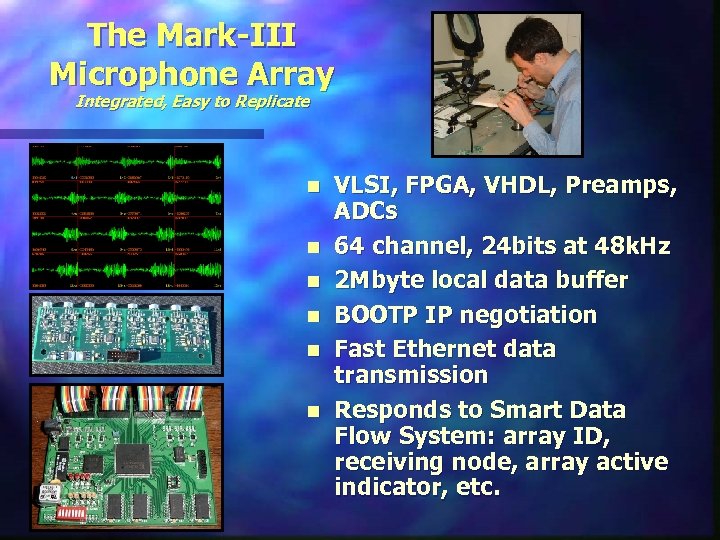
The Mark-III Microphone Array Integrated, Easy to Replicate n n n VLSI, FPGA, VHDL, Preamps, ADCs 64 channel, 24 bits at 48 k. Hz 2 Mbyte local data buffer BOOTP IP negotiation Fast Ethernet data transmission Responds to Smart Data Flow System: array ID, receiving node, array active indicator, etc.
Smart Space Prototype Technologies n Integrated industrial components: – – – n Unique sensor arrays for data acquisition: – – – n IBM speech recognition Intel Open. CV face recognition Wireless networking Beam forming Source localization Acoustic/video sensor fusion Large scale data collection for smart space R&D
Sensors Will Allow Personal Interfaces n Current interfaces are nominal – who presses the buttons does not matter n Sensor based interfaces can be personalized – Recognize – who said what, gestures etc. – Understand – what did it mean in context n “Computer, bring up my appointment calendar. ” n Customized to user mode prefrences
Vision of the Possible: An Accessible Meeting Room That. . . n Takes the minutes from the moderator n Responds to commands, depending on who spoke, what they were looking at, or pointing to n Accesses information by voice query n Provides security based on participant identity n Completely Hands free
Accessibility Prototype: Hands Free Services User device discovery n Hands free preference negotiation n Service discovery: n – Microphone array – Speaker ID – Speaker dependent speech recognition Upload biometric profiles for recognition n Distributed data acquisition and processing n
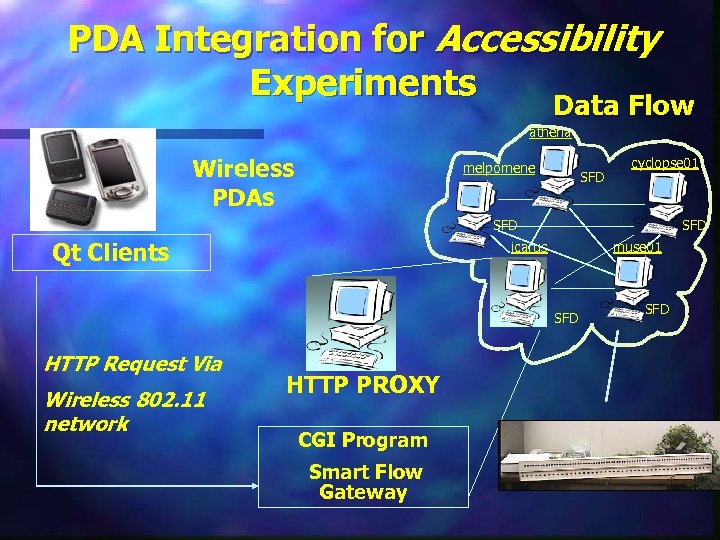
PDA Integration for Accessibility Experiments Data Flow athena Wireless PDAs melpomene SFD cyclopse 01 SFD Qt Clients SFD icarus muse 01 SFD HTTP Request Via Wireless 802. 11 network HTTP PROXY CGI Program Smart Flow Gateway SFD
Personalized User Interfaces: User Discovery n Automated device/service discovery using INCITS V 2 preference protocol: – – – n Hands free Eyes free Ears free Define appropriate multi modal service responses: – – – Speaker ID and speech recognition Screen Reader with Braille or TTS output Automatic meeting captioning
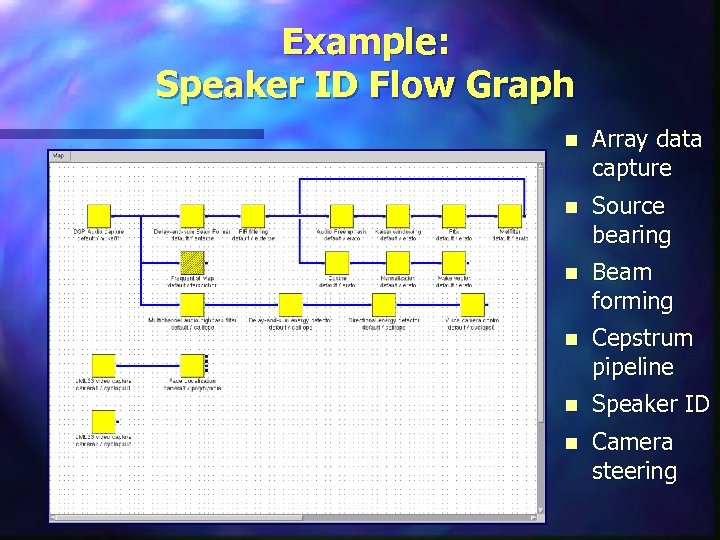
Example: Speaker ID Flow Graph n Array data capture n Source bearing n Beam forming n Cepstrum pipeline n Speaker ID n Camera steering
What Can NIST Do for this Community? n Chartered to enhance industrial technology using measurements and standards n Be a neutral moderator of industry/academic partnerships n Provide advanced metrology, advice n Cooperatively produce standard reference data n Publish measurement algorithms and protocols n Publish non-regulatory standards embodying community agreements
Measurements and Standards Will be Key… n Performance metrics n Standardized integrating platform: – Data formats – Transport mechanisms – Distributed computing – Adaptive interfaces for the disabled n Contact stanford@nist. gov if you are interested in a working group
Questions n Your Thoughts? n Your Experiences?
Скачать презентацию Pervasive Computing offers Adaptable Interfaces Signals Standards Metadata
71e6b25a4a8d2d8488a13ea38b6a3110.ppt