 Скачать презентацию Pervasive Computing and Space A Knowledge Based Approach
86de7a1c3ac752a6c32cf1b4aebe2cfc.ppt
- Количество слайдов: 94




Pervasive Computing and Space: A Knowledge Based Approach M. Palmonari University of Milan-Bicocca Department of Computer Science, Systems and Communication Artificial Intelligence Lab
Outline p Motivation n p Correlation of Traffic Alarms on a Highway n n p n From 1 D to 2 D, with different spatial relations The Hybrid Logic Perspective A Case Study: correlation of events for the Supercentro Project n n p Correlation of alarms for the system SAMOT Monodimensional Space, Modal Logic Approach Commonsense Spatial Model and Commonsense Spatial Hybrid Logic n p Pervasive computing and information correlation Correlation of information with (qualitative) spatial reasoning A Knowledge Representation approach: a strategy focusing on space Road. Network Spatial Environment Extending the Commonsense Spatial Hybrid Logic Few Concluding Remarks (KR)
Outline p Motivation n p Correlation of Traffic Alarms on an Highway n n p n From 1 D to 2 D, with different spatial relations The Hybrid Logic Perspective A Case Study: correlation of events for the Supercentro Project n n p Correlation of alarms in the system SAMOT Monodimensional Space, Modal Approach Commonsense Spatial Model and Commonsense Spatial Hybrid Logic n p Pervasive computing and information correlations Correlation of information with (qualitative) spatial reasoning A Knowledge Representation approach: a strategy focusing on space Road. Network Spatial Environment Extending the Commonsense Spatial Hybrid Logic Few Concluding Remarks (KR)
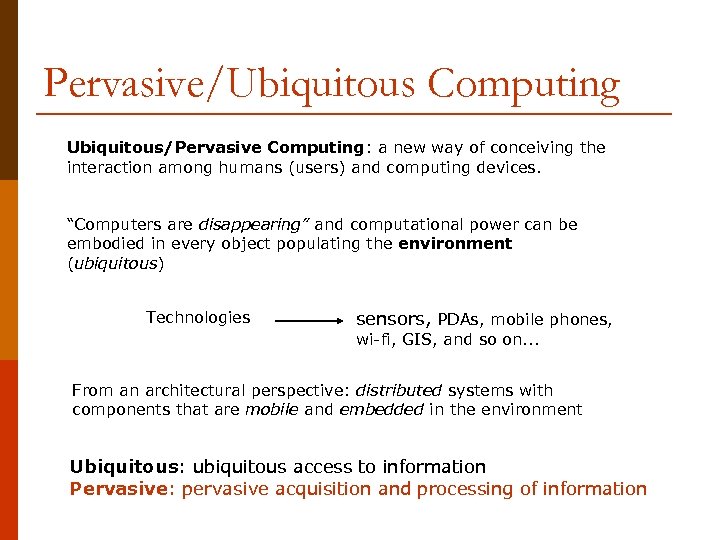
Pervasive/Ubiquitous Computing Ubiquitous/Pervasive Computing: a new way of conceiving the interaction among humans (users) and computing devices. “Computers are disappearing” and computational power can be embodied in every object populating the environment (ubiquitous) Technologies sensors, PDAs, mobile phones, wi-fi, GIS, and so on. . . From an architectural perspective: distributed systems with components that are mobile and embedded in the environment Ubiquitous: ubiquitous access to information Pervasive: pervasive acquisition and processing of information
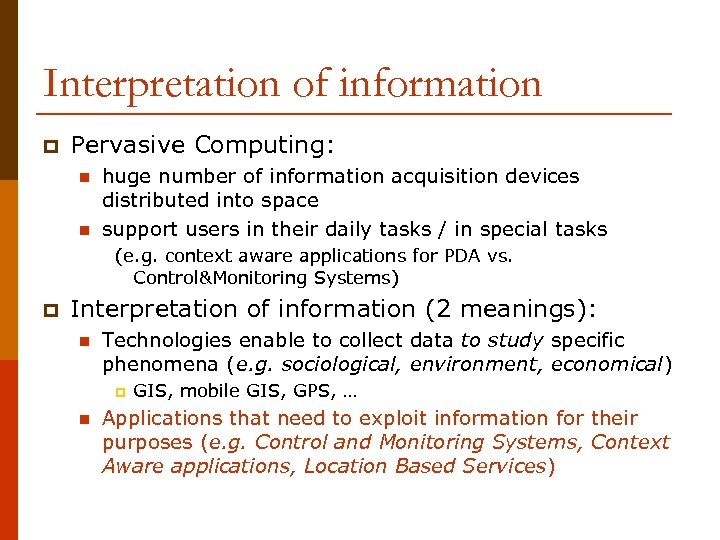
Interpretation of information p Pervasive Computing: n n huge number of information acquisition devices distributed into space support users in their daily tasks / in special tasks (e. g. context aware applications for PDA vs. Control&Monitoring Systems) p Interpretation of information (2 meanings): n Technologies enable to collect data to study specific phenomena (e. g. sociological, environment, economical) p n GIS, mobile GIS, GPS, … Applications that need to exploit information for their purposes (e. g. Control and Monitoring Systems, Context Aware applications, Location Based Services)
Correlation of information p Problem: information provided by acquisition devices on the environment may loss significance as a huge number of sensors tend to produce a overload of information p Information correlation to integrate different sensors data n n p Integration of information from heterogeneous data sources for decision support systems Context Awareness Knowledge based approach: n n Integration into a higher level non knowledge based techniques Generality
A knowledge based approach p Usually: information fusion n Statistic based techniques: p p Very efficient Domain specific Data for calibration? Training data sets? A Knowledge based approach n n n A knowledge based correlation level Integrating non knowledge based techniques into a knowledge based level Background: p p Control&Monitoring systems: experience from experts systems Context Awareness: attention to high level/general/formal KR techniques (e. g. Ontologies) A 4 -level conceptual architecture
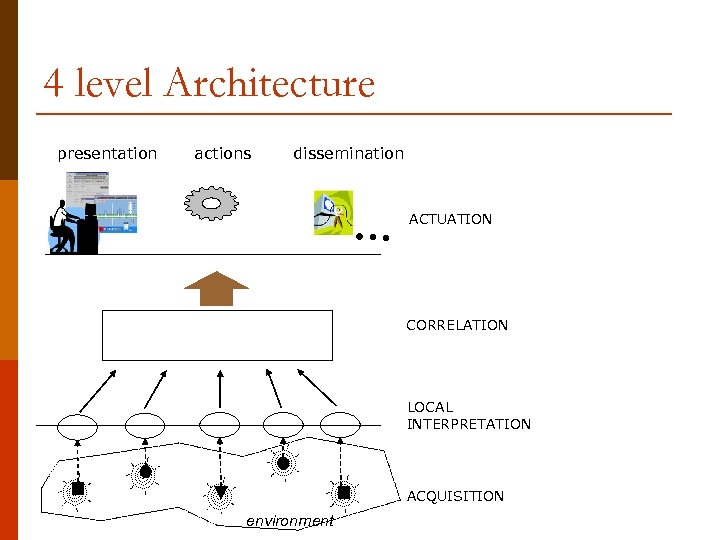
4 level Architecture presentation actions dissemination … ACTUATION CORRELATION LOCAL INTERPRETATION ACQUISITION environment
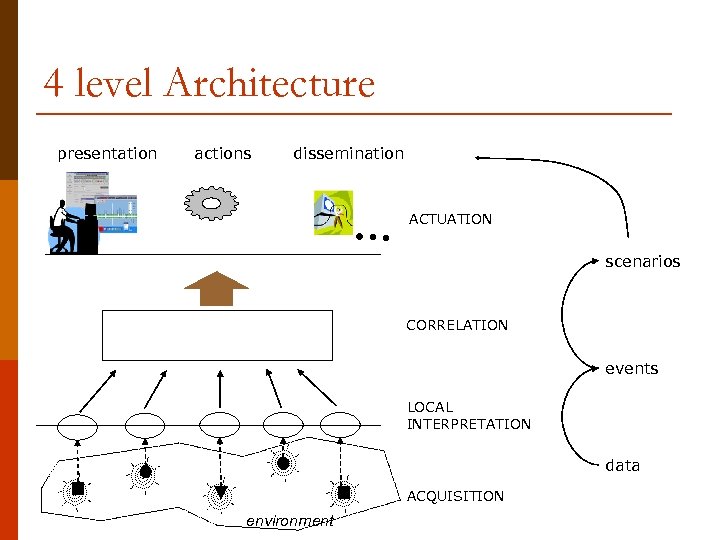
4 level Architecture presentation actions dissemination … ACTUATION scenarios CORRELATION events LOCAL INTERPRETATION data ACQUISITION environment
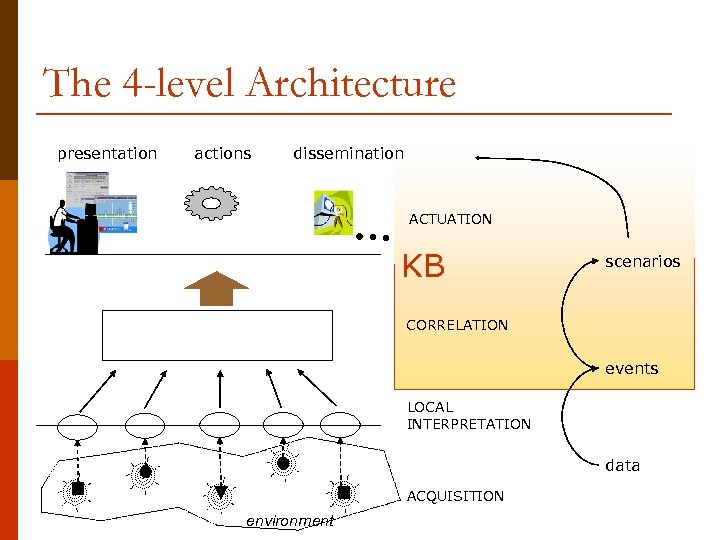
The 4 -level Architecture presentation actions dissemination … ACTUATION KB scenarios CORRELATION events LOCAL INTERPRETATION data ACQUISITION environment
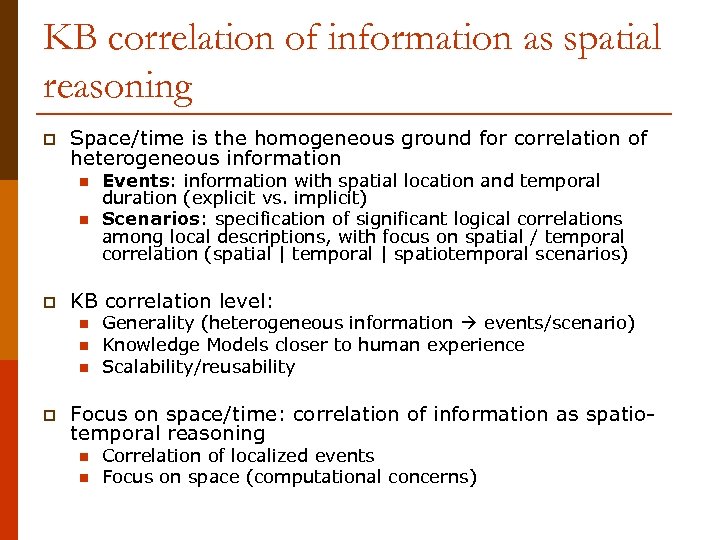
KB correlation of information as spatial reasoning p Space/time is the homogeneous ground for correlation of heterogeneous information n n p KB correlation level: n n n p Events: information with spatial location and temporal duration (explicit vs. implicit) Scenarios: specification of significant logical correlations among local descriptions, with focus on spatial / temporal correlation (spatial | temporal | spatiotemporal scenarios) Generality (heterogeneous information events/scenario) Knowledge Models closer to human experience Scalability/reusability Focus on space/time: correlation of information as spatiotemporal reasoning n n Correlation of localized events Focus on space (computational concerns)
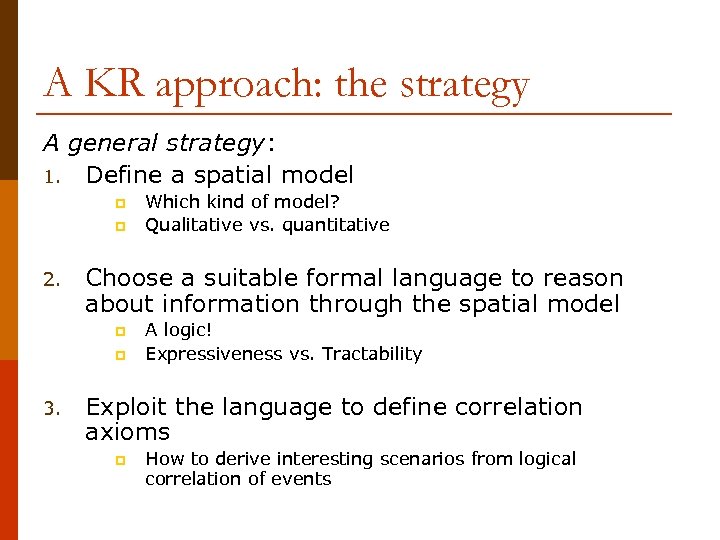
A KR approach: the strategy A general strategy: 1. Define a spatial model p p 2. Choose a suitable formal language to reason about information through the spatial model p p 3. Which kind of model? Qualitative vs. quantitative A logic! Expressiveness vs. Tractability Exploit the language to define correlation axioms p How to derive interesting scenarios from logical correlation of events
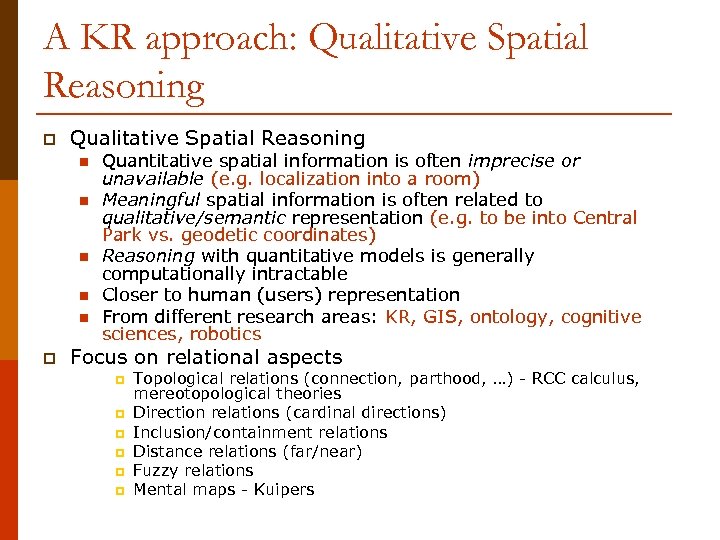
A KR approach: Qualitative Spatial Reasoning p Qualitative Spatial Reasoning n n n p Quantitative spatial information is often imprecise or unavailable (e. g. localization into a room) Meaningful spatial information is often related to qualitative/semantic representation (e. g. to be into Central Park vs. geodetic coordinates) Reasoning with quantitative models is generally computationally intractable Closer to human (users) representation From different research areas: KR, GIS, ontology, cognitive sciences, robotics Focus on relational aspects p p p Topological relations (connection, parthood, …) - RCC calculus, mereotopological theories Direction relations (cardinal directions) Inclusion/containment relations Distance relations (far/near) Fuzzy relations Mental maps - Kuipers
A KR approach: Modal Like Logics p Qualitative Spatial Models: relational models, spatial entities and spatial relations (calculus: algebra vs. logic) p Modal Like Logics: fragments of First Order Logic representing relational aspects with a particular perspective over reasoning n n p Semantics: relational structures (or topological spaces) Generally: good computational properties Compact formulas and proofs Local perspective on reasoning (formulas have context dependent meaning) We will see them in action!
From monodimensional to bidimensional space and maps Walking through different classes of spatial models: 1. Correlation of events on a highway p p p 2. Different spatial relations: Commonsense Spatial Hybrid Logic (CSHL) p p p 3. Correlation Module of SAMOT Spatio-temporal correlation (1 -d space-time) Adaptation of temporal modal logic Examples from Smart Home applications Places and Commonsense Spatial Relations on 2 D Hybrid Logic, Calculus, Proofs Correlation of events on a Road Network p p p Event Correlation Model for Supercentro Modification of CSHL to represent the road network and other relevant spatial entities (2 D) Examples of complex scenarios definable in the logic
Alarm Correlation with a Spatio Temporal Modal Logic SAMOT a System for Monitoring Traffic Flows on an Highway
The SAMOT project p p To deliver a monitoring and control system to support traffic operators of Italian highways in their activities to improve traffic safety, congestion prevention and effectively act in case of emergencies SAMOT (System for Automatic MOnitoring of Traffic) n n n Automatic detection of traffic flow anomalies (queue, stopped vehicle, wrong-way driving vehicle…) Automatic control of some traffic flow anomalies Alert traffic operators in case of emergencies Correlation of local sensor states into complex anomalous traffic patterns (Detection Rate improvement) Filtering of alarms according to highway sections’ peculiarities (False Alarm Rate reduction)
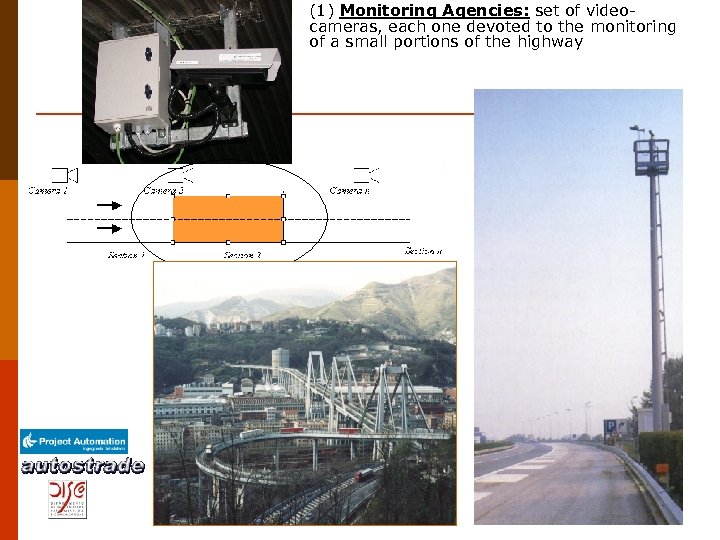
(1) Monitoring Agencies: set of videocameras, each one devoted to the monitoring of a small portions of the highway 1 vation Obser 2 tation e Interpr n 4 rrelatio Co ion Actuat 3
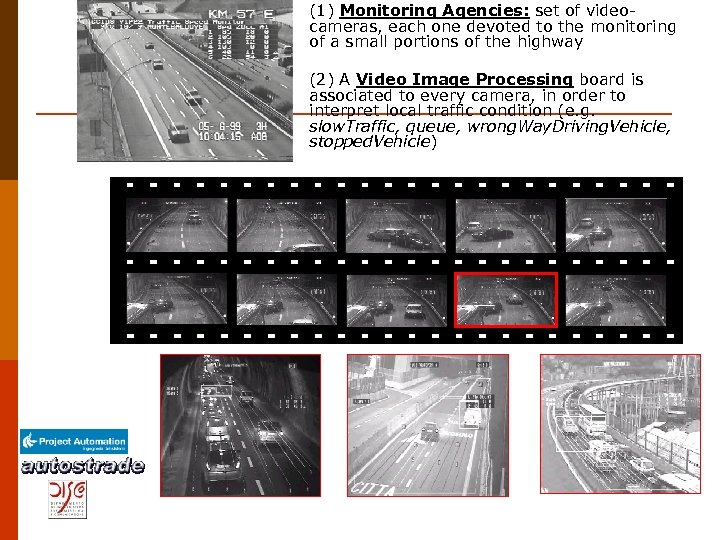
(1) Monitoring Agencies: set of videocameras, each one devoted to the monitoring of a small portions of the highway 1 vation Obser 2 tation e Interpr n 4 rrelatio Co ion Actuat 3 (2) A Video Image Processing board is associated to every camera, in order to interpret local traffic condition (e. g. slow. Traffic, queue, wrong. Way. Driving. Vehicle, stopped. Vehicle)
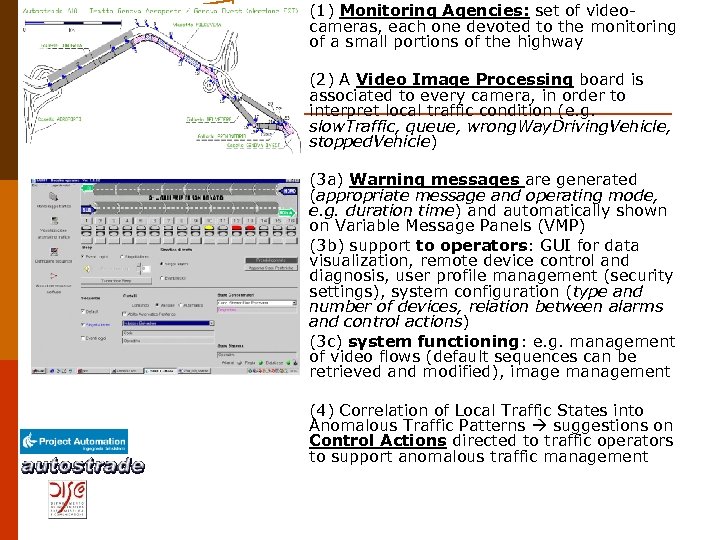
(1) Monitoring Agencies: set of videocameras, each one devoted to the monitoring of a small portions of the highway 1 vation Obser 2 tation e Interpr n 4 rrelatio Co ion Actuat 3 (2) A Video Image Processing board is associated to every camera, in order to interpret local traffic condition (e. g. slow. Traffic, queue, wrong. Way. Driving. Vehicle, stopped. Vehicle) (3 a) Warning messages are generated (appropriate message and operating mode, e. g. duration time) and automatically shown on Variable Message Panels (VMP) (3 b) support to operators: GUI for data visualization, remote device control and diagnosis, user profile management (security settings), system configuration (type and number of devices, relation between alarms and control actions) (3 c) system functioning: e. g. management of video flows (default sequences can be retrieved and modified), image management (4) Correlation of Local Traffic States into Anomalous Traffic Patterns suggestions on Control Actions directed to traffic operators to support anomalous traffic management
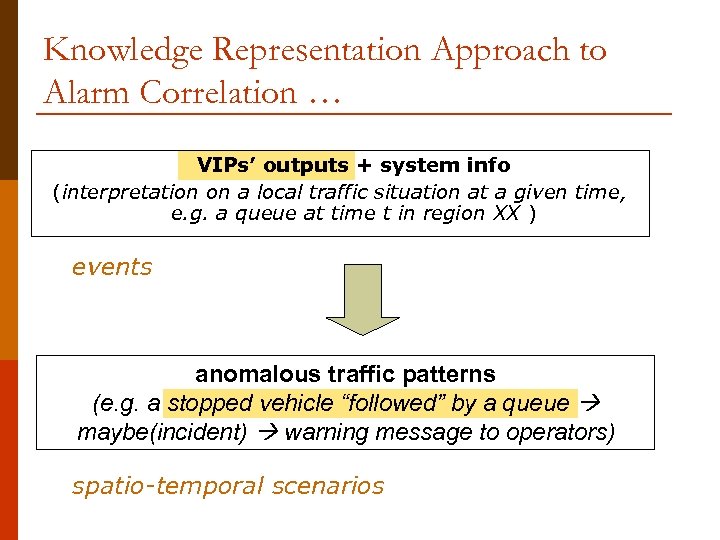
Knowledge Representation Approach to Alarm Correlation … VIPs’ outputs + system info (interpretation on a local traffic situation at a given time, e. g. a queue at time t in region XX ) events anomalous traffic patterns (e. g. a stopped vehicle “followed” by a queue maybe(incident) warning message to operators) spatio-temporal scenarios
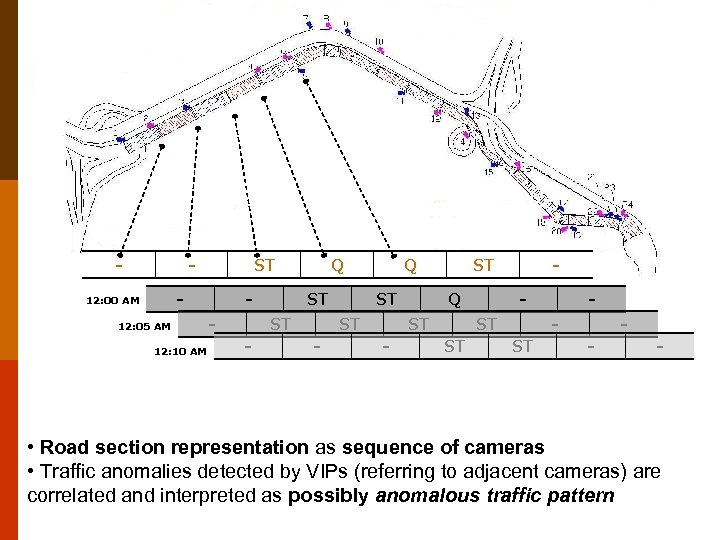
- - ST - 12: 00 AM 12: 05 AM 12: 10 AM - Q ST ST - ST Q ST - - ST ST - - • Road section representation as sequence of cameras • Traffic anomalies detected by VIPs (referring to adjacent cameras) are correlated and interpreted as possibly anomalous traffic pattern
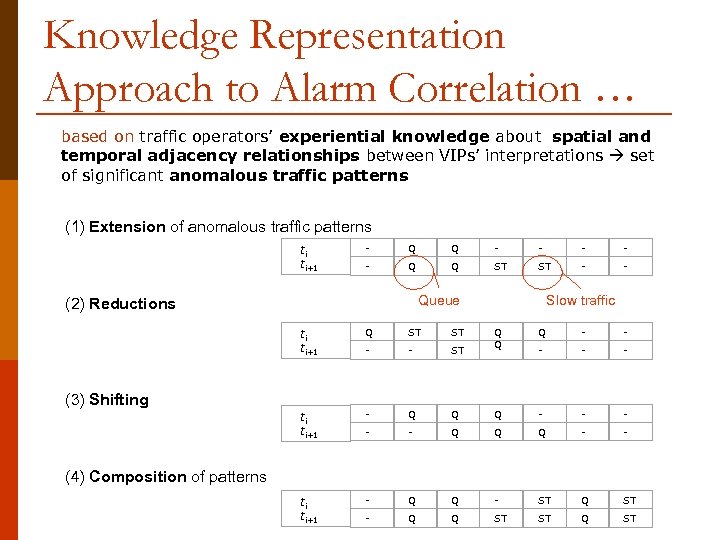
Knowledge Representation Approach to Alarm Correlation … based on traffic operators’ experiential knowledge about spatial and temporal adjacency relationships between VIPs’ interpretations set of significant anomalous traffic patterns (1) Extension of anomalous traffic patterns ti ti+1 - Q Q - - - Q Q ST ST - - Queue (2) Reductions ti ti+1 (3) Shifting Q ST ST - - ST ti ti+1 - Q - ti ti+1 Slow traffic Q Q Q - - - Q Q Q - - - Q Q - ST Q ST - Q Q ST ST Q ST (4) Composition of patterns
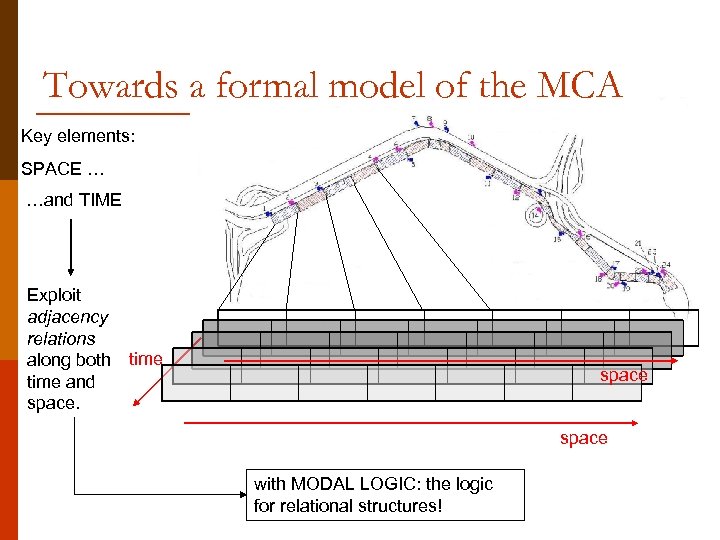
Towards a formal model of the MCA Key elements: SPACE … …and TIME Exploit adjacency relations along both time and space. time space with MODAL LOGIC: the logic for relational structures!
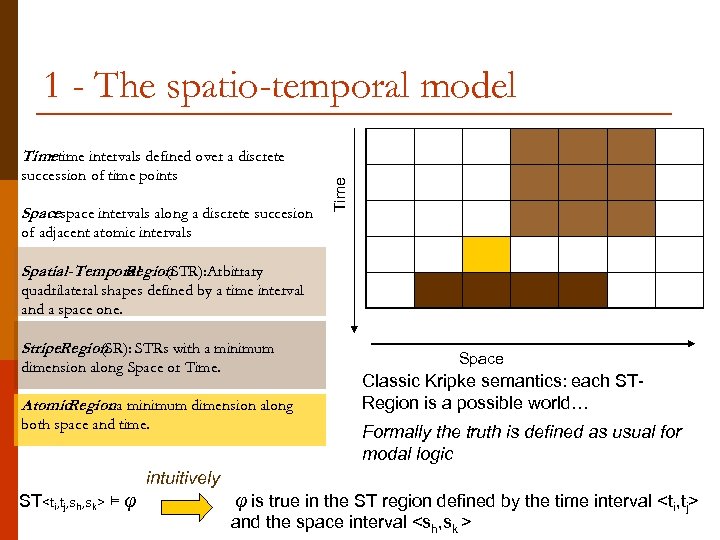
1 - The spatio-temporal model succession of time points Spacespace intervals along a discrete succesion : Timetime intervals defined over a discrete : of adjacent atomic intervals Spatial-Temporal Region (STR): Arbitrary quadrilateral shapes defined by a time interval and a space one. Stripe. Region (SR): STRs with a minimum dimension along Space or Time. Atomic Regiona minimum dimension along : both space and time. Space Classic Kripke semantics: each STRegion is a possible world… Formally the truth is defined as usual for modal logic intuitively ST<ti, tj, sh, sk> ⊨ φ φ is true in the ST region defined by the time interval <ti, tj> and the space interval <sh, sk >
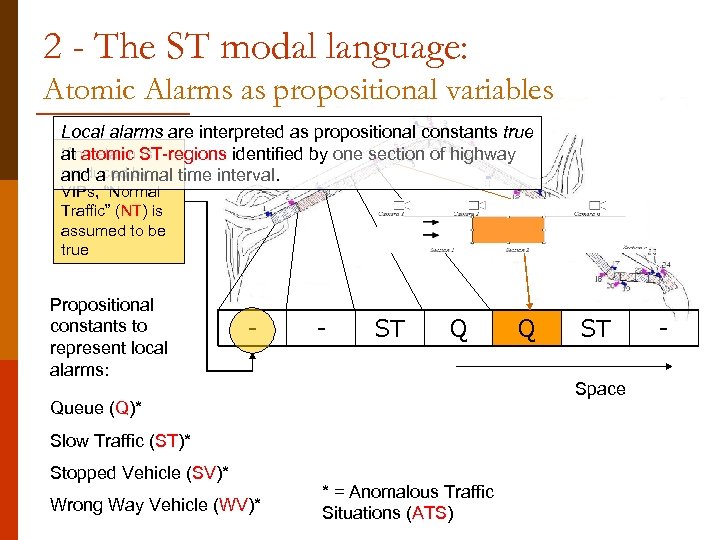
2 - The ST modal language: Atomic Alarms as propositional variables Local alarms are interpreted as propositional constants true If atomic is atno alarm ST-regions identified by one section of highway produced by and a minimal time interval. VIPs, “Normal Traffic” (NT) is assumed to be true Propositional constants to represent local alarms: - - ST Q Slow Traffic (ST)* Wrong Way Vehicle (WV)* ST Space Queue (Q)* Stopped Vehicle (SV)* Q * = Anomalous Traffic Situations (ATS) -
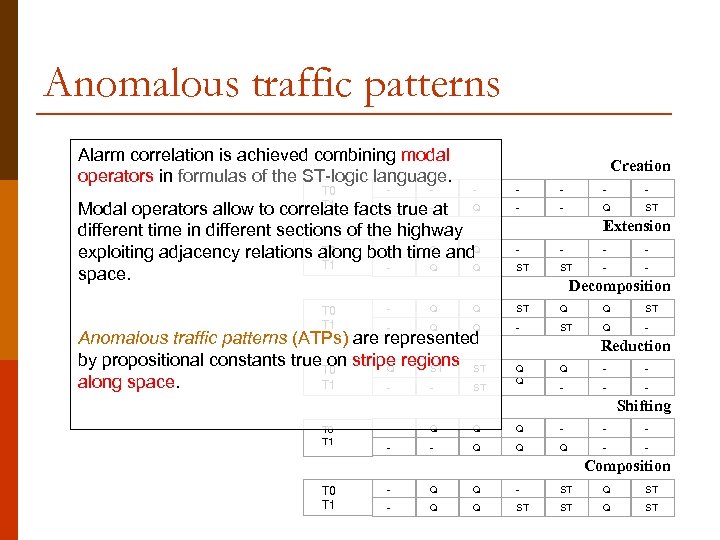
Anomalous traffic patterns Alarm correlation is achieved combining modal operators in formulas of the ST-logic language. T 0 T 1 correlate - - Creation - Modal operators allow to facts true -at Q different time in different sections of the highway Q T 0 exploiting adjacency relations along both time and. Q T 1 Q Q space. T 0 T 1 - - - Q ST Extension - - ST ST - - Decomposition - Q Q ST - Q Q - ST Q - Anomalous traffic patterns (ATPs) are represented by propositional constants true. T 0 stripe regions ST on Q ST along space. T 1 ST Reduction Q Q Q - - - Shifting T 0 T 1 - Q Q Q - - Composition T 0 T 1 - Q Q - ST Q ST - Q Q ST ST Q ST
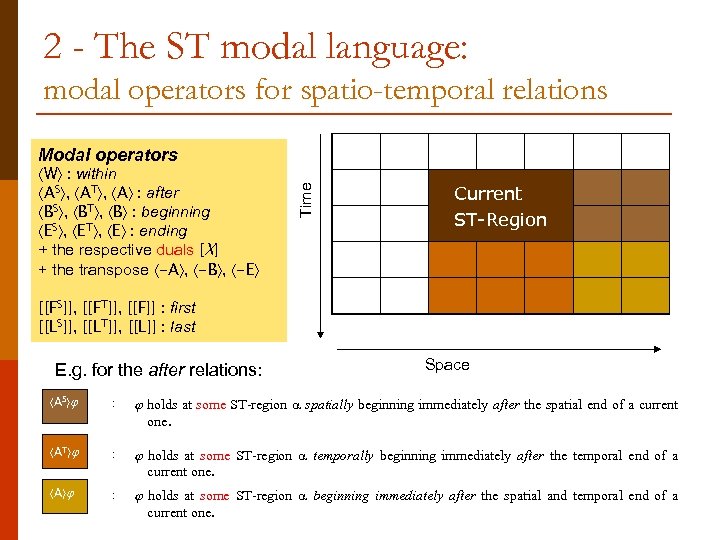
2 - The ST modal language: modal operators for spatio-temporal relations W : within AS , AT , A : after BS , BT , B : beginning ES , ET , E : ending + the respective duals [X] + the transpose -A , -B , -E Time Modal operators Current ST-Region [[FS]], [[FT]], [[F]] : first [[LS]], [[LT]], [[L]] : last E. g. for the after relations: AS : Space holds at some ST-region spatially beginning immediately after the spatial end of a current one. AT : holds at some ST-region temporally beginning immediately after the temporal end of a current one. A : holds at some ST-region beginning immediately after the spatial and temporal end of a current one.
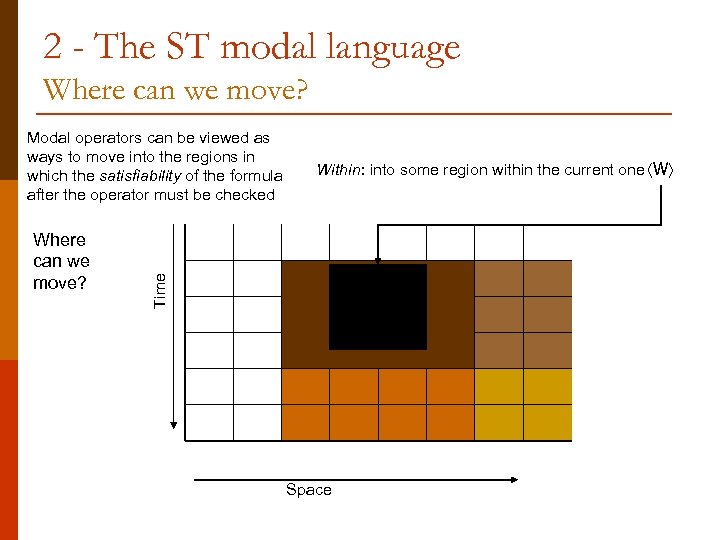
2 - The ST modal language Where can we move? Within: into some region within the current one W Time Modal operators can be viewed as ways to move into the regions in which the satisfiability of the formula after the operator must be checked Space
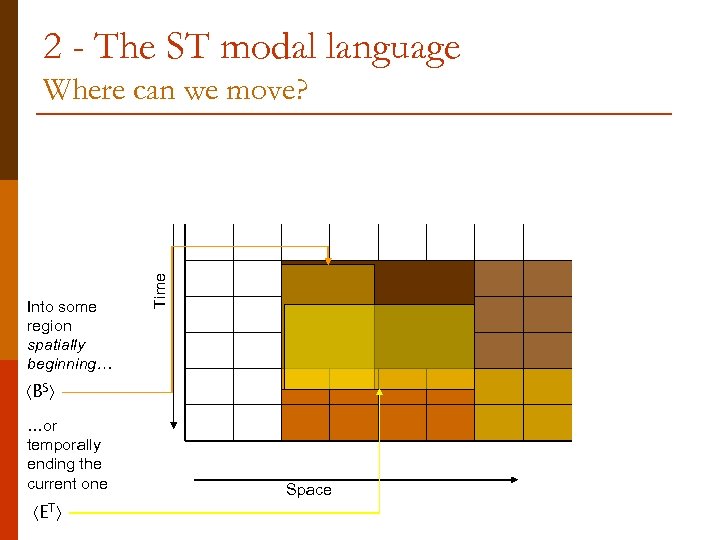
2 - The ST modal language Into some region spatially beginning… Time Where can we move? BS …or temporally ending the current one ET Space
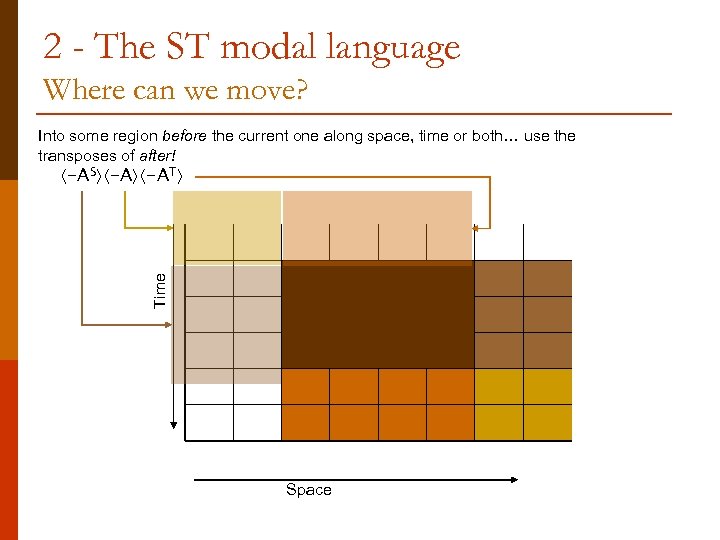
2 - The ST modal language Where can we move? Into some region before the current one along space, time or both… use the transposes of after! Time -AS -AT Space
![2 - The ST modal language Where can we move? [[FS]] AS Into the](https://present5.com/presentation/86de7a1c3ac752a6c32cf1b4aebe2cfc/image-32.jpg "2 - The ST modal language Where can we move? [[FS]] AS Into the")
2 - The ST modal language Where can we move? [[FS]] AS Into the spatially last region of some region spatially after the current one Space
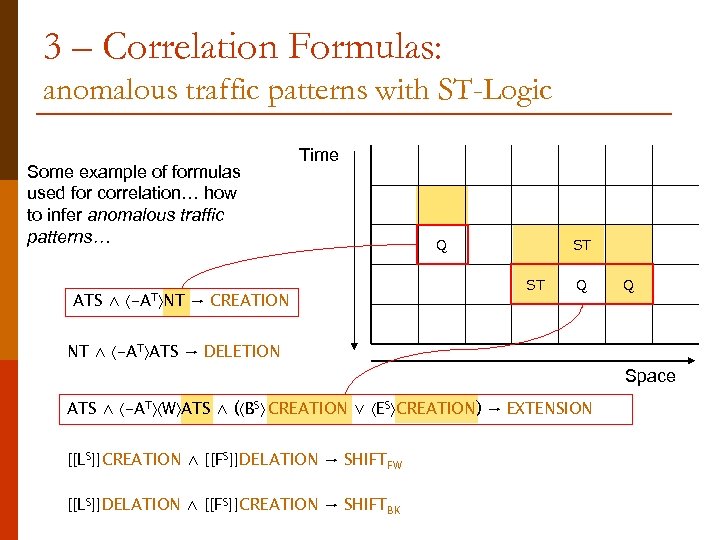
3 – Correlation Formulas: anomalous traffic patterns with ST-Logic Some example of formulas used for correlation… how to infer anomalous traffic patterns… ATS ∧ -AT NT Time → CREATION Q ST ST Q Q NT ∧ -AT ATS → DELETION Space ATS ∧ -AT W ATS ∧ ( BS CREATION ∨ ES CREATION) → EXTENSION [[LS]]CREATION ∧ [[FS]]DELATION → SHIFTFW [[LS]]DELATION ∧ [[FS]]CREATION → SHIFTBK
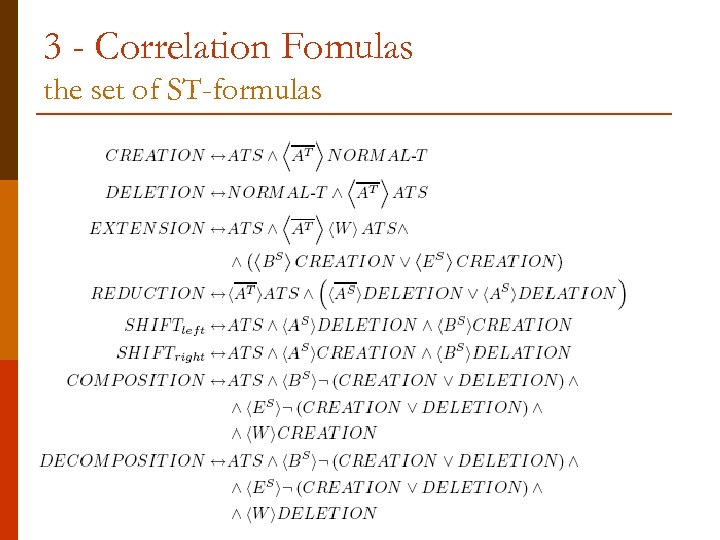
3 - Correlation Fomulas the set of ST-formulas
Implementation and Limits p Implementation into a rule based system n p Limits & further works: n n p Model vs. Implementation Adaptation of interval based temporal logic ST-Logic is undecidable (the problem of spatio-temporal representation) Spatial representation too simple for most application domains (1 -D) Heterogeneous events From 1 D to 2 D spatial representations
A Commonsense Spatial Hybrid Logic For information correlation in pervasive computing
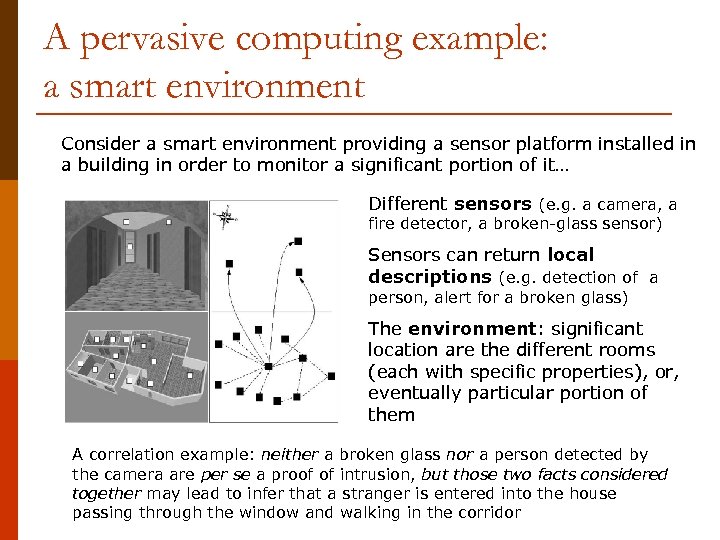
A pervasive computing example: a smart environment Consider a smart environment providing a sensor platform installed in a building in order to monitor a significant portion of it… Different sensors (e. g. a camera, a fire detector, a broken-glass sensor) Sensors can return local descriptions (e. g. detection of a person, alert for a broken glass) The environment: significant location are the different rooms (each with specific properties), or, eventually particular portion of them A correlation example: neither a broken glass nor a person detected by the camera are per se a proof of intrusion, but those two facts considered together may lead to infer that a stranger is entered into the house passing through the window and walking in the corridor
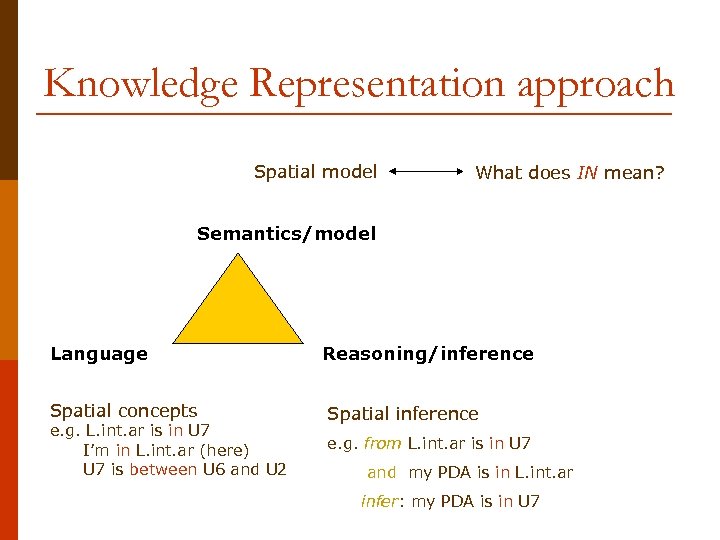
Knowledge Representation approach Spatial model What does IN mean? Semantics/model Language Spatial concepts e. g. L. int. ar is in U 7 I’m in L. int. ar (here) U 7 is between U 6 and U 2 Reasoning/inference Spatial inference e. g. from L. int. ar is in U 7 and my PDA is in L. int. ar infer: my PDA is in U 7
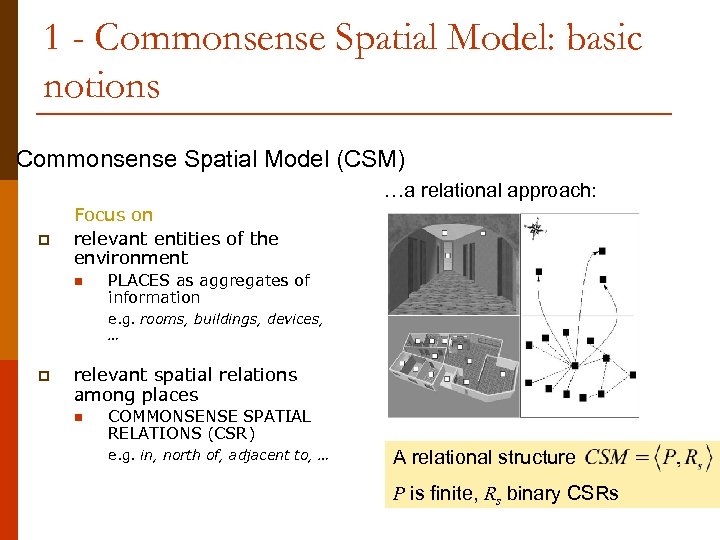
1 - Commonsense Spatial Model: basic notions Commonsense Spatial Model (CSM) …a relational approach: p Focus on relevant entities of the environment n PLACES as aggregates of information e. g. rooms, buildings, devices, … p relevant spatial relations among places n COMMONSENSE SPATIAL RELATIONS (CSR) e. g. in, north of, adjacent to, … A relational structure P is finite, Rs binary CSRs
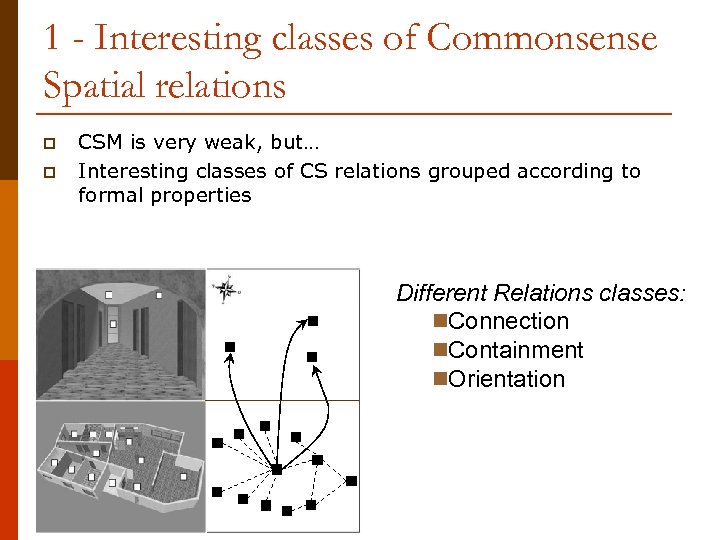
1 - Interesting classes of Commonsense Spatial relations p p CSM is very weak, but… Interesting classes of CS relations grouped according to formal properties Different Relations classes: n. Connection n. Containment n. Orientation
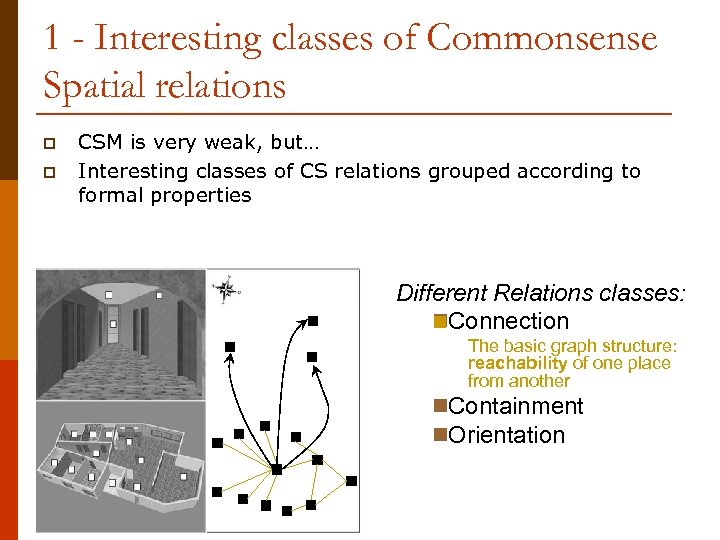
1 - Interesting classes of Commonsense Spatial relations p p CSM is very weak, but… Interesting classes of CS relations grouped according to formal properties Different Relations classes: n. Connection The basic graph structure: reachability of one place from another n. Containment n. Orientation
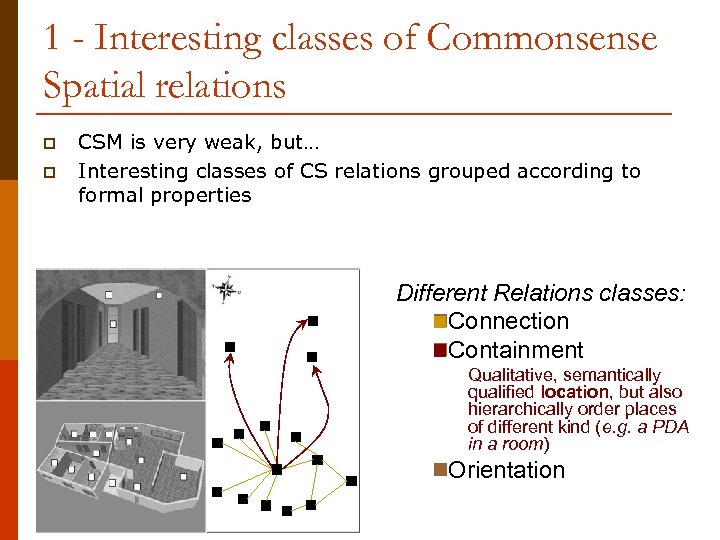
1 - Interesting classes of Commonsense Spatial relations p p CSM is very weak, but… Interesting classes of CS relations grouped according to formal properties Different Relations classes: n. Connection n. Containment Qualitative, semantically qualified location, but also hierarchically order places of different kind (e. g. a PDA in a room) n. Orientation
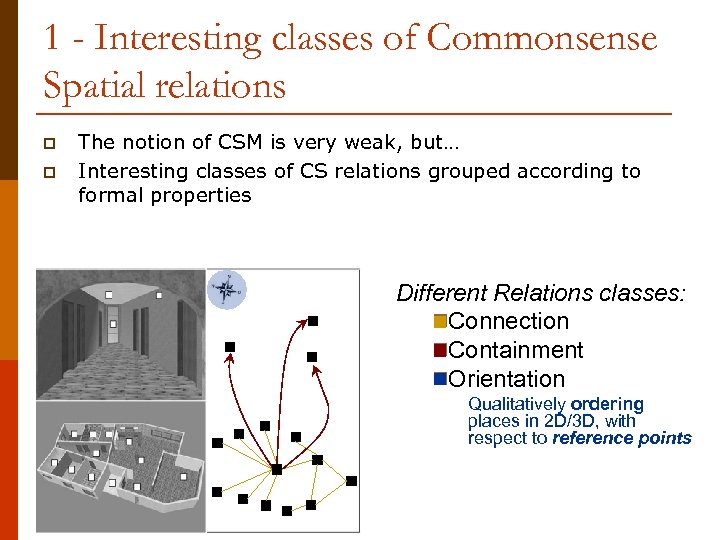
1 - Interesting classes of Commonsense Spatial relations p p The notion of CSM is very weak, but… Interesting classes of CS relations grouped according to formal properties Different Relations classes: n. Connection n. Containment n. Orientation Qualitatively ordering places in 2 D/3 D, with respect to reference points
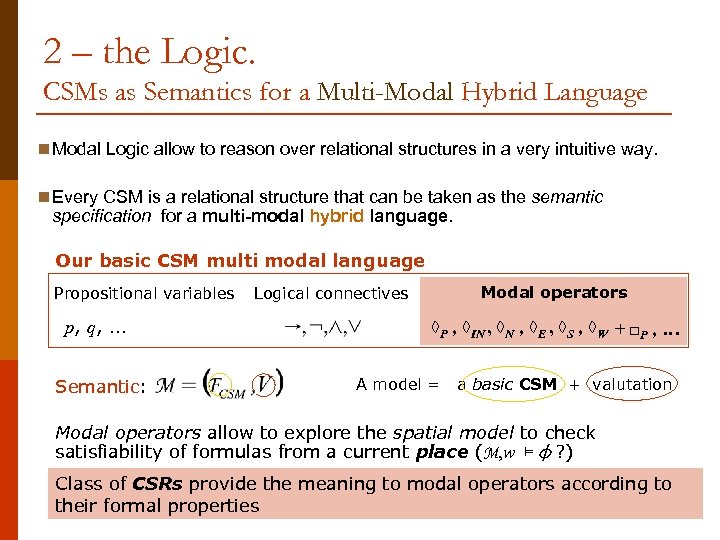
2 – the Logic. CSMs as Semantics for a Multi-Modal Hybrid Language n Modal Logic allow to reason over relational structures in a very intuitive way. n Every CSM is a relational structure that can be taken as the semantic specification for a multi-modal hybrid language. Our basic CSM multi modal language Propositional variables p, q, … Semantic: Modal operators Logical connectives ◊P , ◊IN , ◊E , ◊S , ◊W + □P , … A model = a basic CSM + valutation Modal operators allow to explore the spatial model to check satisfiability of formulas from a current place (M, w ⊨ φ ? ) Class of CSRs provide the meaning to modal operators according to their formal properties
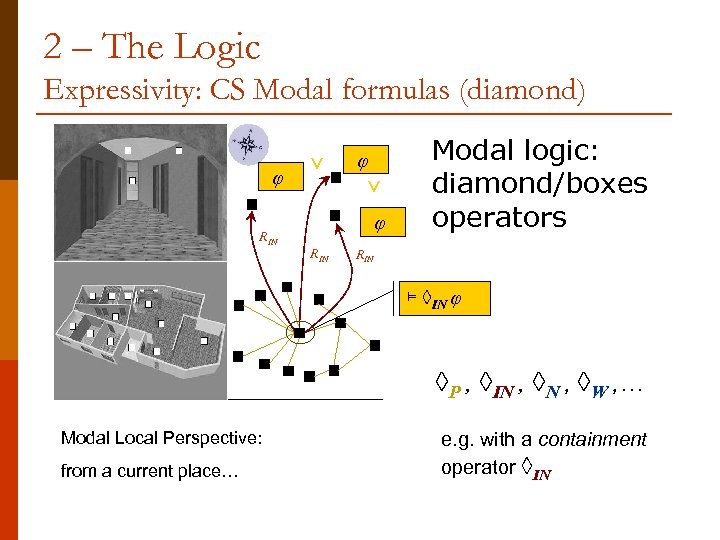
2 – The Logic Expressivity: CS Modal formulas (diamond) φ RIN ∨ φ RIN Modal logic: diamond/boxes operators RIN ⊨ ◊IN φ ◊P , ◊IN , ◊W , … Modal Local Perspective: from a current place… e. g. with a containment operator ◊IN
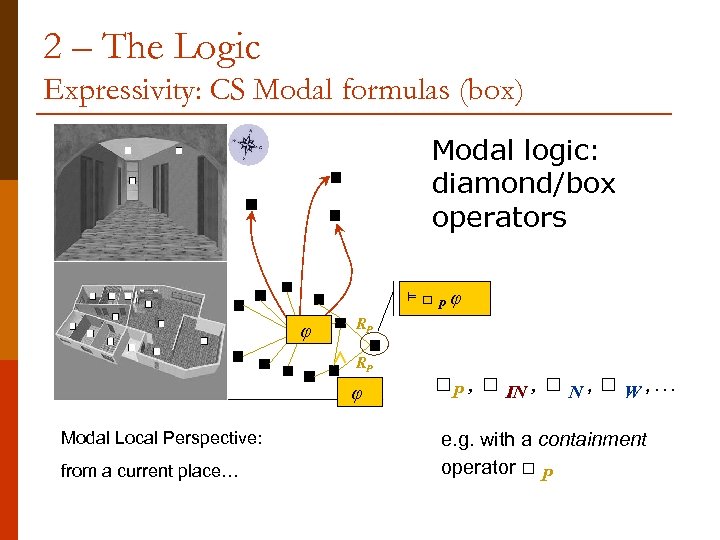
2 – The Logic Expressivity: CS Modal formulas (box) Modal logic: diamond/box operators ⊨□Pφ φ RP ∧ R P φ Modal Local Perspective: from a current place… □P , □ IN , □ W , … e. g. with a containment operator □ P
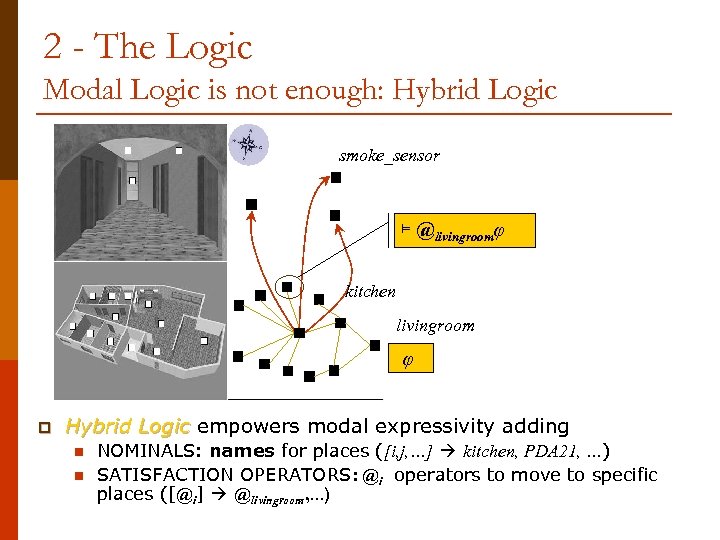
2 - The Logic Modal Logic is not enough: Hybrid Logic smoke_sensor ⊨ @livingroomφ kitchen livingroom φ p Hybrid Logic empowers modal expressivity adding n n NOMINALS: names for places ([i, j, …] kitchen, PDA 21, …) SATISFACTION OPERATORS: @i operators to move to specific places ([@i] @livingroom, . . . )
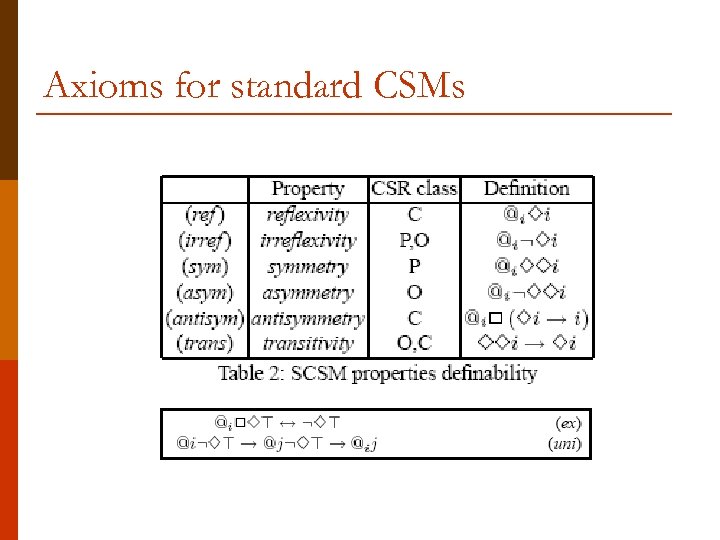
2 - The Logic Axioms for standard CSMs p How to specify the meaning of spatial modal operators in proof theory? n p Meaning of operators is related to properties of the respective accessibility relations Stantard CSMs n Relations are characterized by formal properties and grouped together in classes n Definition enough precise for axiomatixation n Definition of a calculus for Commonsense Spatial Reasoning with tableaux
Axioms for standard CSMs
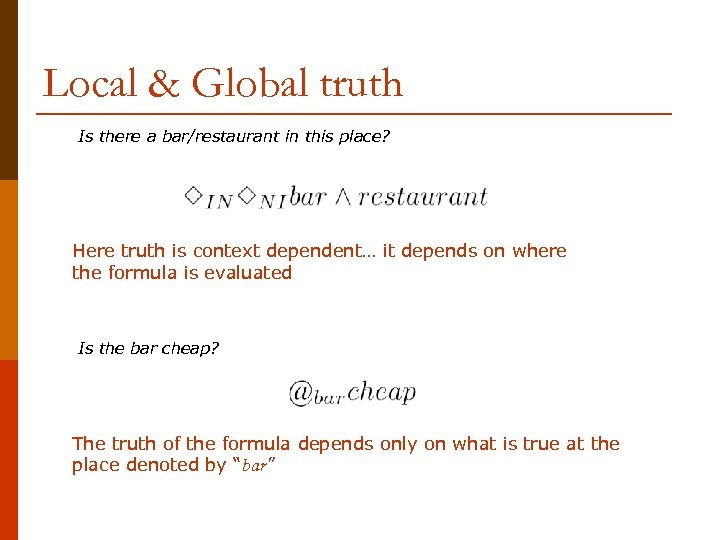
Local & Global truth Is there a bar/restaurant in this place? Here truth is context dependent… it depends on where the formula is evaluated Is the bar cheap? The truth of the formula depends only on what is true at the place denoted by “bar”
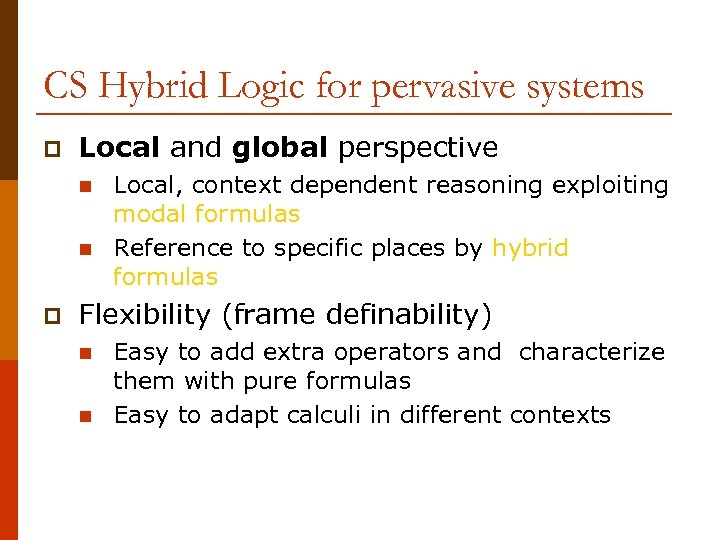
CS Hybrid Logic for pervasive systems p Local and global perspective n n p Local, context dependent reasoning exploiting modal formulas Reference to specific places by hybrid formulas Flexibility (frame definability) n n Easy to add extra operators and characterize them with pure formulas Easy to adapt calculi in different contexts
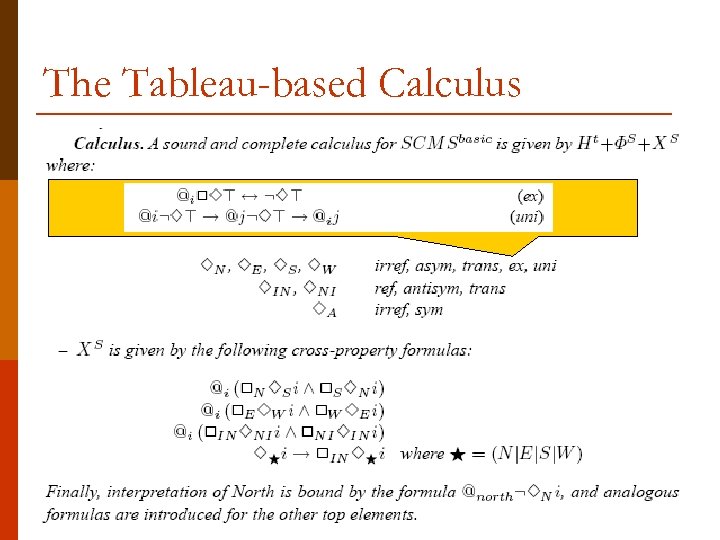
The Tableau-based Calculus
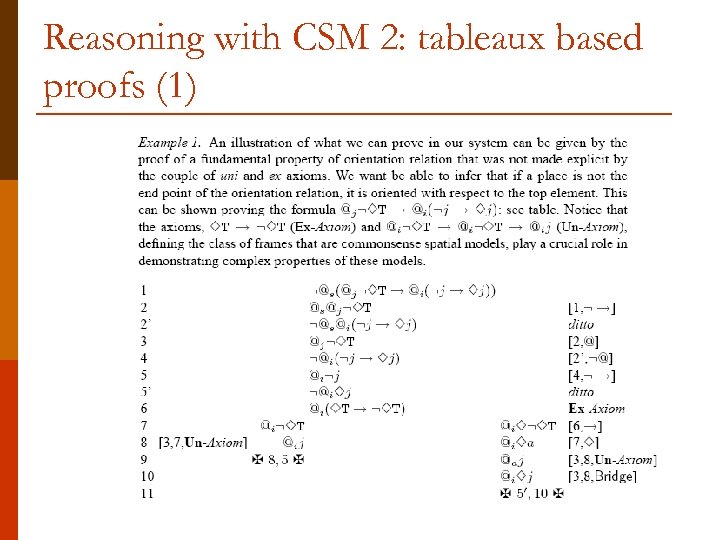
Reasoning with CSM 2: tableaux based proofs (1)
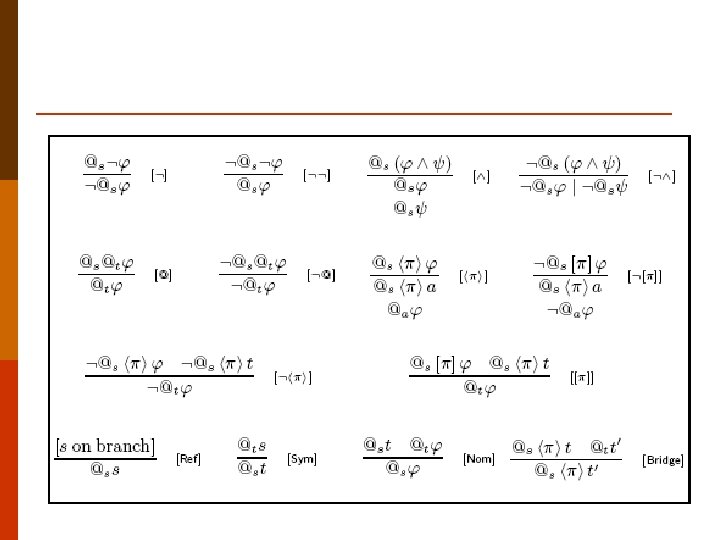
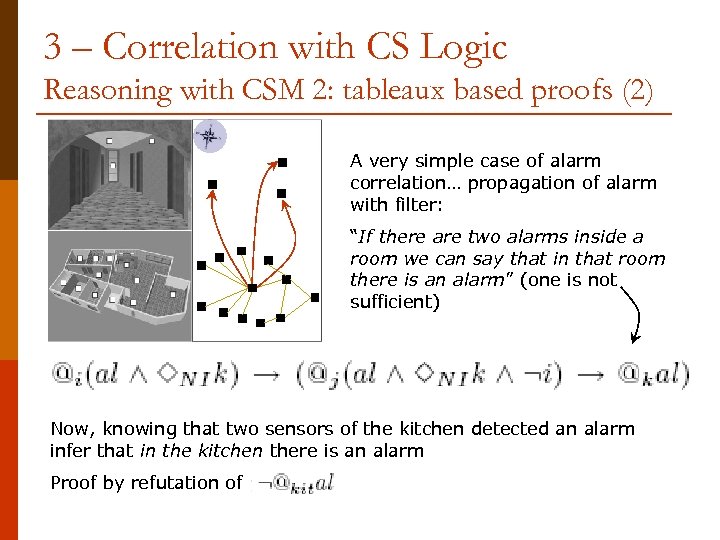
3 – Correlation with CS Logic Reasoning with CSM 2: tableaux based proofs (2) A very simple case of alarm correlation… propagation of alarm with filter: “If there are two alarms inside a room we can say that in that room there is an alarm” (one is not sufficient) Now, knowing that two sensors of the kitchen detected an alarm infer that in the kitchen there is an alarm Proof by refutation of
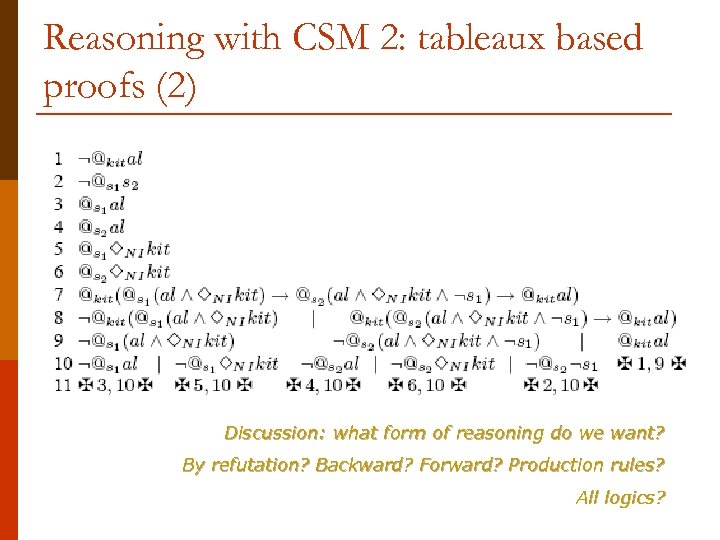
Reasoning with CSM 2: tableaux based proofs (2) Discussion: what form of reasoning do we want? By refutation? Backward? Forward? Production rules? All logics?
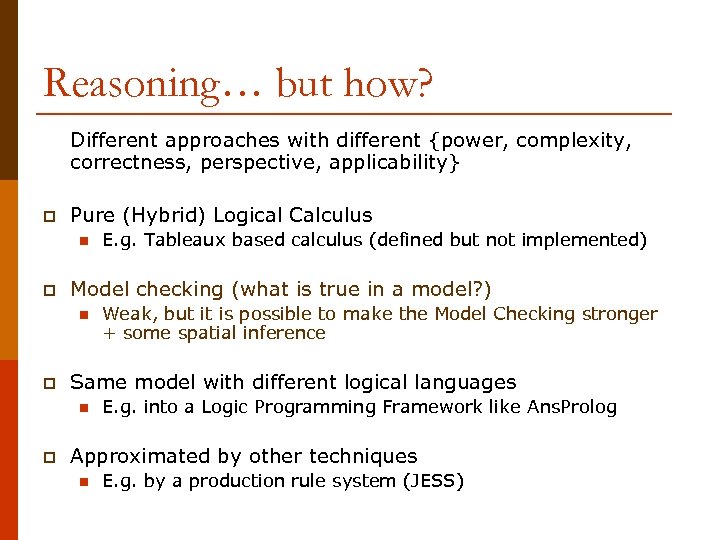
Reasoning… but how? Different approaches with different {power, complexity, correctness, perspective, applicability} p Pure (Hybrid) Logical Calculus n p Model checking (what is true in a model? ) n p Weak, but it is possible to make the Model Checking stronger + some spatial inference Same model with different logical languages n p E. g. Tableaux based calculus (defined but not implemented) E. g. into a Logic Programming Framework like Ans. Prolog Approximated by other techniques n E. g. by a production rule system (JESS)
The Supercentro Project. Correlating information on a road network spatial environment
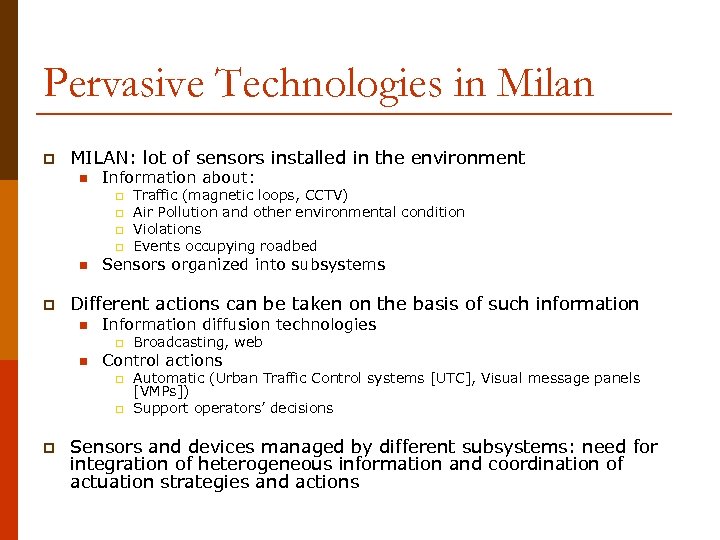
Pervasive Technologies in Milan p MILAN: lot of sensors installed in the environment n Information about: p p n p Sensors organized into subsystems Different actions can be taken on the basis of such information n Information diffusion technologies p n Broadcasting, web Control actions p p p Traffic (magnetic loops, CCTV) Air Pollution and other environmental condition Violations Events occupying roadbed Automatic (Urban Traffic Control systems [UTC], Visual message panels [VMPs]) Support operators’ decisions Sensors and devices managed by different subsystems: need for integration of heterogeneous information and coordination of actuation strategies and actions
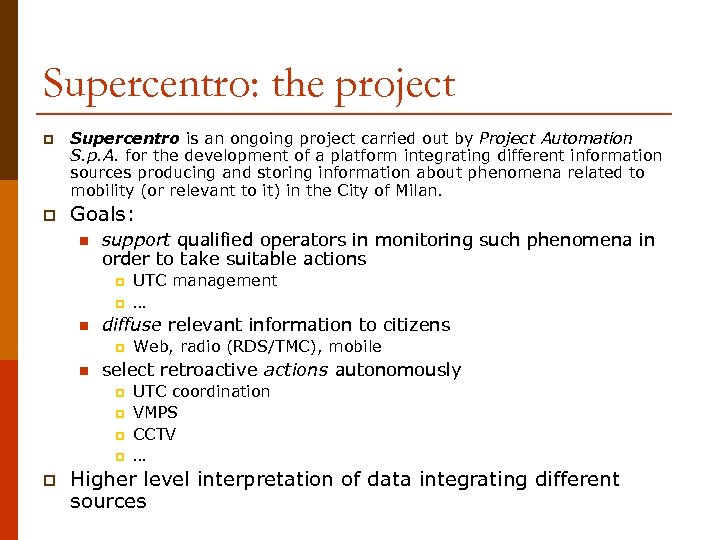
Supercentro: the project p Supercentro is an ongoing project carried out by Project Automation S. p. A. for the development of a platform integrating different information sources producing and storing information about phenomena related to mobility (or relevant to it) in the City of Milan. p Goals: n support qualified operators in monitoring such phenomena in order to take suitable actions p p n diffuse relevant information to citizens p n Web, radio (RDS/TMC), mobile select retroactive actions autonomously p p p UTC management … UTC coordination VMPS CCTV … Higher level interpretation of data integrating different sources
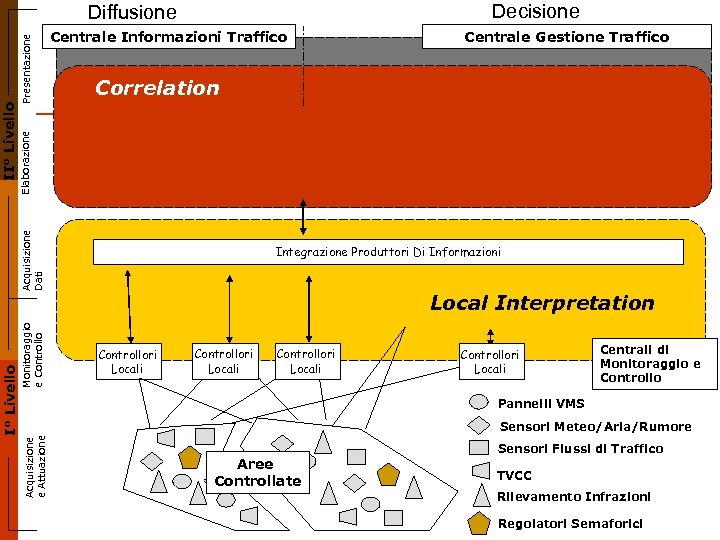
Decisione Correlation Monitoraggio e Controllo Integrazione Produttori Di Informazioni Local Interpretation Controllori Locali Centrali di Monitoraggio e Controllo Pannelli VMS Sensori Meteo/Aria/Rumore Acquisizione e Attuazione I° Livello Centrale Gestione Traffico Elaborazione Presentazione Centrale Informazioni Traffico Acquisizione Dati II° Livello Diffusione Aree Controllate Sensori Flussi di Traffico TVCC Rilevamento Infrazioni Regolatori Semaforici
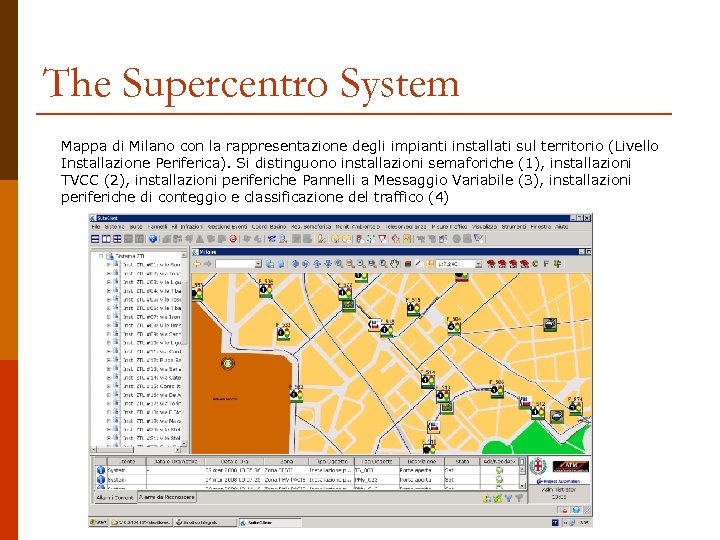
The Supercentro System Mappa di Milano con la rappresentazione degli impianti installati sul territorio (Livello Installazione Periferica). Si distinguono installazioni semaforiche (1), installazioni TVCC (2), installazioni periferiche Pannelli a Messaggio Variabile (3), installazioni periferiche di conteggio e classificazione del traffico (4)
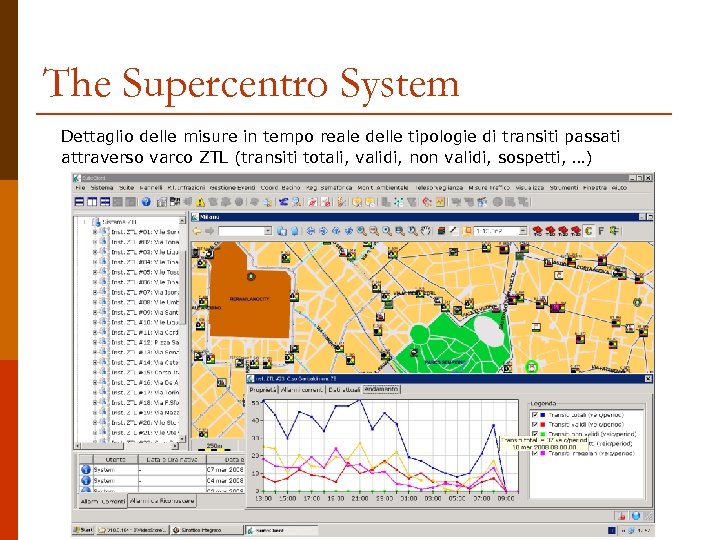
The Supercentro System Dettaglio delle misure in tempo reale delle tipologie di transiti passati attraverso varco ZTL (transiti totali, validi, non validi, sospetti, …)
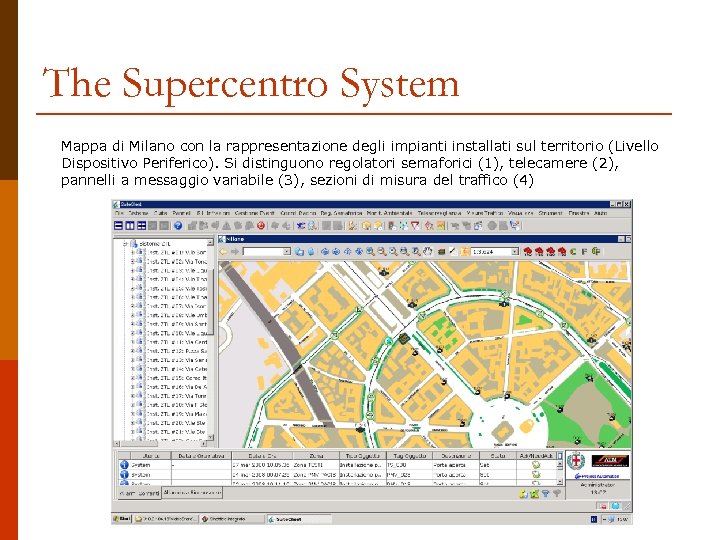
The Supercentro System Mappa di Milano con la rappresentazione degli impianti installati sul territorio (Livello Dispositivo Periferico). Si distinguono regolatori semaforici (1), telecamere (2), pannelli a messaggio variabile (3), sezioni di misura del traffico (4)
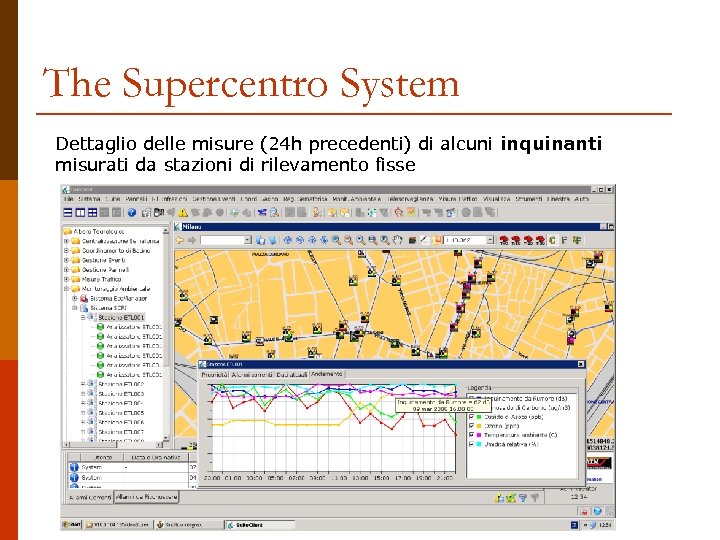
The Supercentro System Dettaglio delle misure (24 h precedenti) di alcuni inquinanti misurati da stazioni di rilevamento fisse
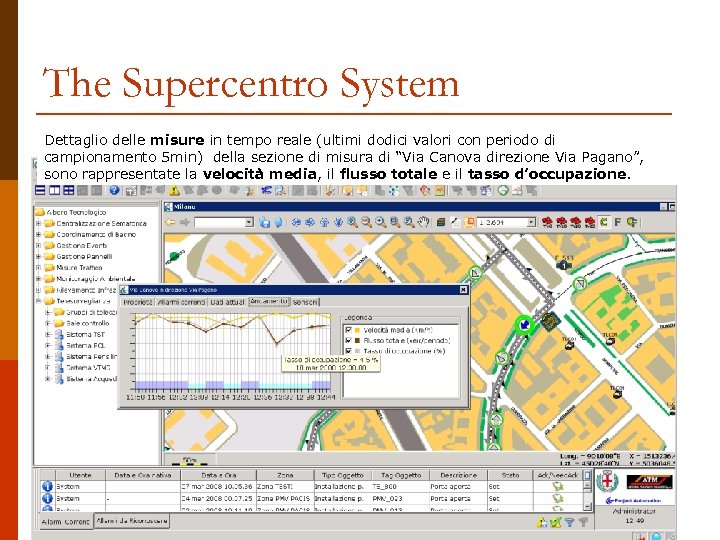
The Supercentro System Dettaglio delle misure in tempo reale (ultimi dodici valori con periodo di campionamento 5 min) della sezione di misura di “Via Canova direzione Via Pagano”, sono rappresentate la velocità media, il flusso totale e il tasso d’occupazione.
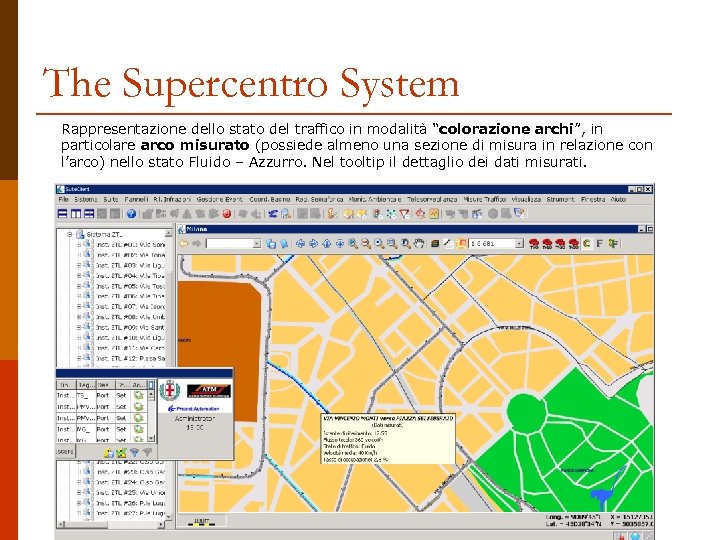
The Supercentro System Rappresentazione dello stato del traffico in modalità “colorazione archi”, in particolare arco misurato (possiede almeno una sezione di misura in relazione con l’arco) nello stato Fluido – Azzurro. Nel tooltip il dettaglio dei dati misurati.
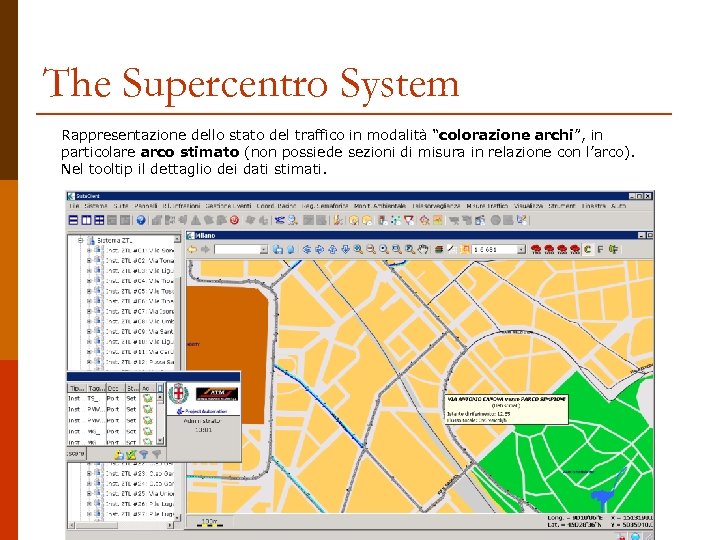
The Supercentro System Rappresentazione dello stato del traffico in modalità “colorazione archi”, in particolare arco stimato (non possiede sezioni di misura in relazione con l’arco). Nel tooltip il dettaglio dei dati stimati.
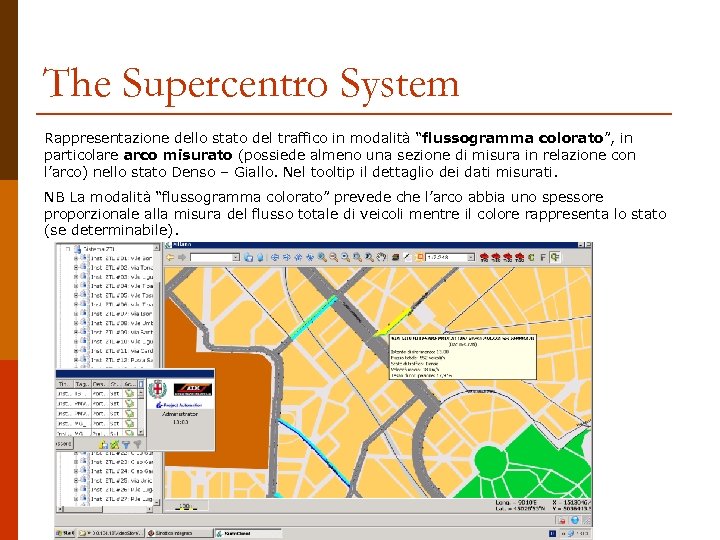
The Supercentro System Rappresentazione dello stato del traffico in modalità “flussogramma colorato”, in particolare arco misurato (possiede almeno una sezione di misura in relazione con l’arco) nello stato Denso – Giallo. Nel tooltip il dettaglio dei dati misurati. NB La modalità “flussogramma colorato” prevede che l’arco abbia uno spessore proporzionale alla misura del flusso totale di veicoli mentre il colore rappresenta lo stato (se determinabile).
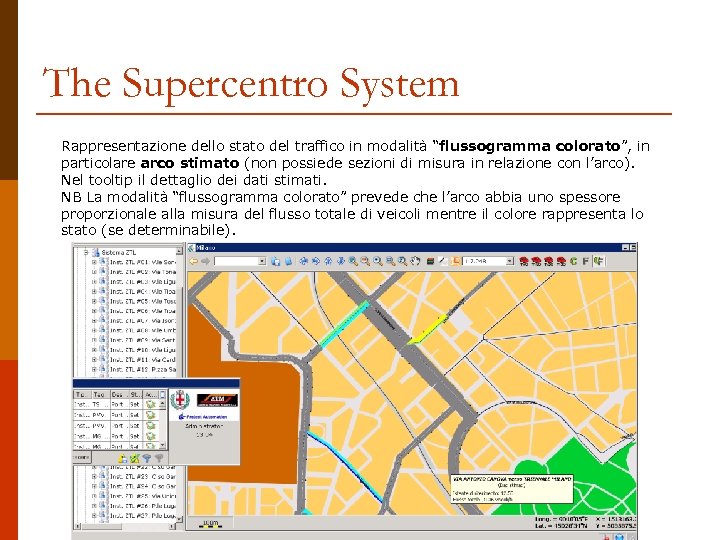
The Supercentro System Rappresentazione dello stato del traffico in modalità “flussogramma colorato”, in particolare arco stimato (non possiede sezioni di misura in relazione con l’arco). Nel tooltip il dettaglio dei dati stimati. NB La modalità “flussogramma colorato” prevede che l’arco abbia uno spessore proporzionale alla misura del flusso totale di veicoli mentre il colore rappresenta lo stato (se determinabile).
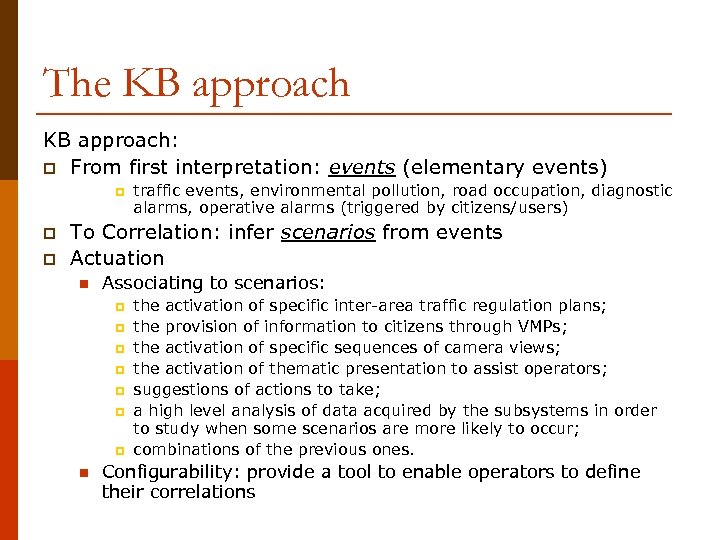
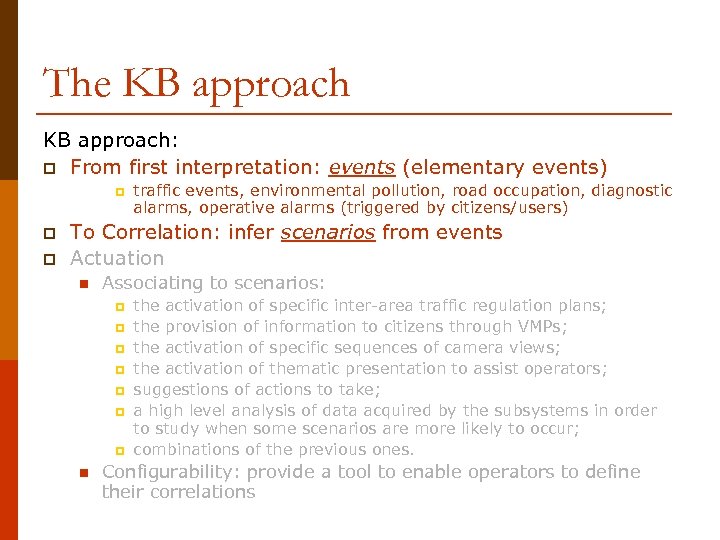
The KB approach: p From first interpretation: events (elementary events) p p p traffic events, environmental pollution, road occupation, diagnostic alarms, operative alarms (triggered by citizens/users) To Correlation: infer scenarios from events Actuation n Associating to scenarios: p p p p n the activation of specific inter-area traffic regulation plans; the provision of information to citizens through VMPs; the activation of specific sequences of camera views; the activation of thematic presentation to assist operators; suggestions of actions to take; a high level analysis of data acquired by the subsystems in order to study when some scenarios are more likely to occur; combinations of the previous ones. Configurability: provide a tool to enable operators to define their correlations
The KB approach: p From first interpretation: events (elementary events) p p p traffic events, environmental pollution, road occupation, diagnostic alarms, operative alarms (triggered by citizens/users) To Correlation: infer scenarios from events Actuation n Associating to scenarios: p p p p n the activation of specific inter-area traffic regulation plans; the provision of information to citizens through VMPs; the activation of specific sequences of camera views; the activation of thematic presentation to assist operators; suggestions of actions to take; a high level analysis of data acquired by the subsystems in order to study when some scenarios are more likely to occur; combinations of the previous ones. Configurability: provide a tool to enable operators to define their correlations
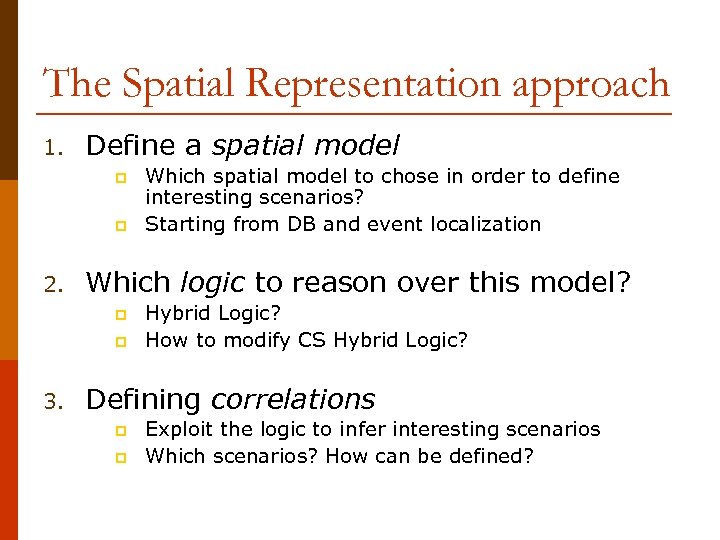
The Spatial Representation approach 1. Define a spatial model p p 2. Which logic to reason over this model? p p 3. Which spatial model to chose in order to define interesting scenarios? Starting from DB and event localization Hybrid Logic? How to modify CS Hybrid Logic? Defining correlations p p Exploit the logic to infer interesting scenarios Which scenarios? How can be defined?
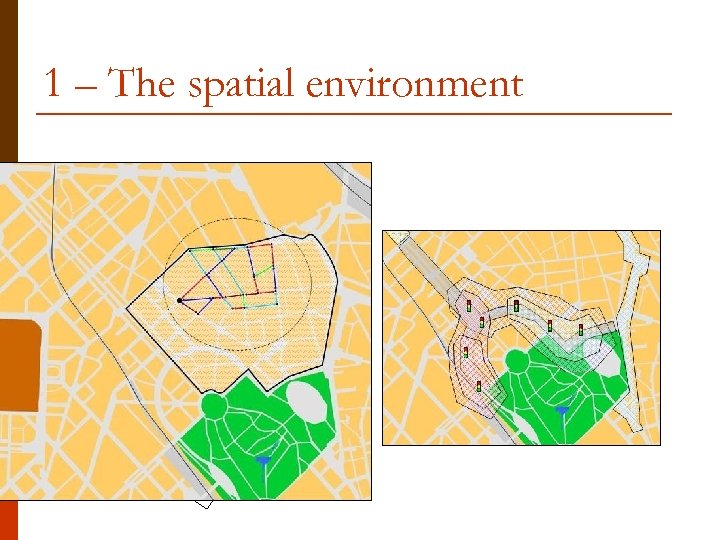
1 – The spatial environment
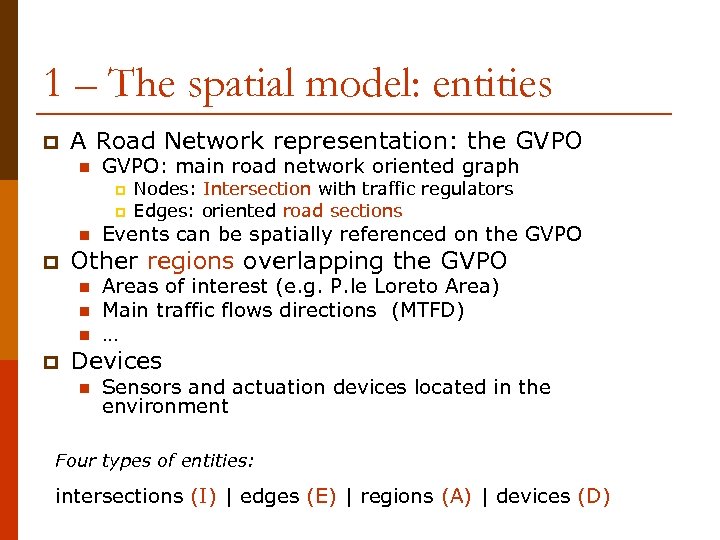
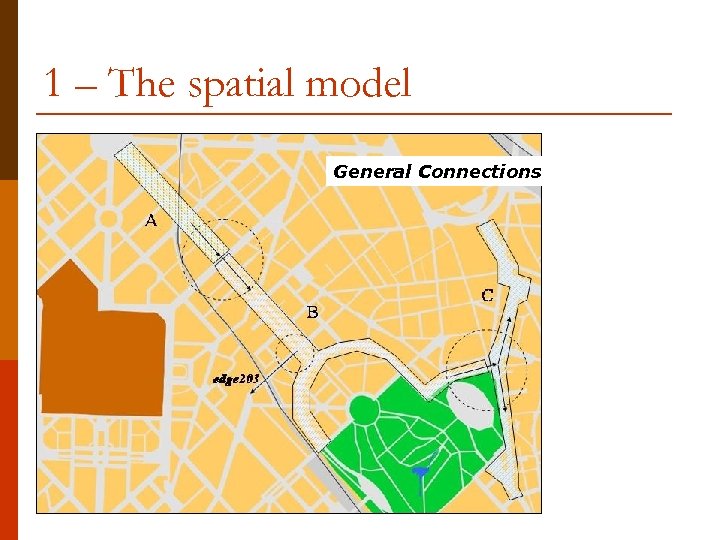
1 – The spatial model: entities p A Road Network representation: the GVPO n GVPO: main road network oriented graph p p n p Events can be spatially referenced on the GVPO Other regions overlapping the GVPO n n n p Nodes: Intersection with traffic regulators Edges: oriented road sections Areas of interest (e. g. P. le Loreto Area) Main traffic flows directions (MTFD) … Devices n Sensors and actuation devices located in the environment Four types of entities: intersections (I) | edges (E) | regions (A) | devices (D)
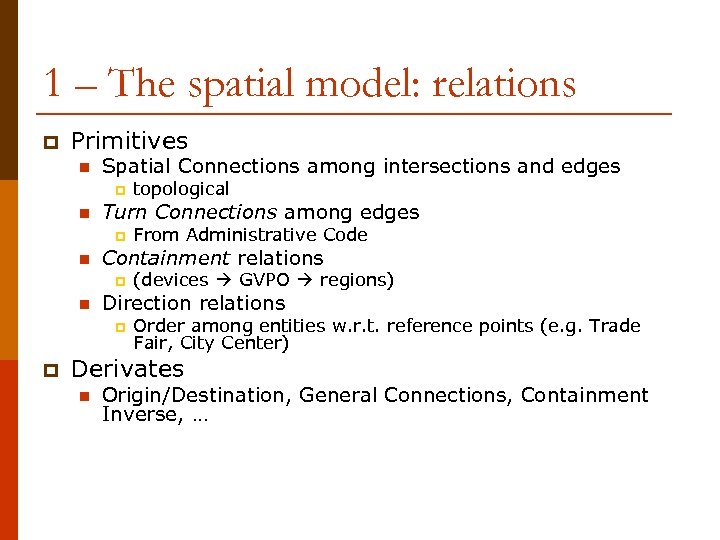
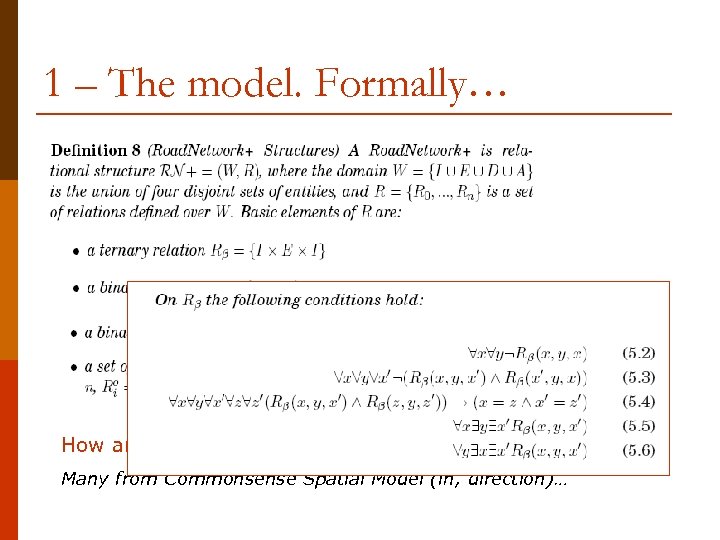
1 – The spatial model: relations p Primitives n Spatial Connections among intersections and edges p n Turn Connections among edges p n (devices GVPO regions) Direction relations p p From Administrative Code Containment relations p n topological Order among entities w. r. t. reference points (e. g. Trade Fair, City Center) Derivates n Origin/Destination, General Connections, Containment Inverse, …
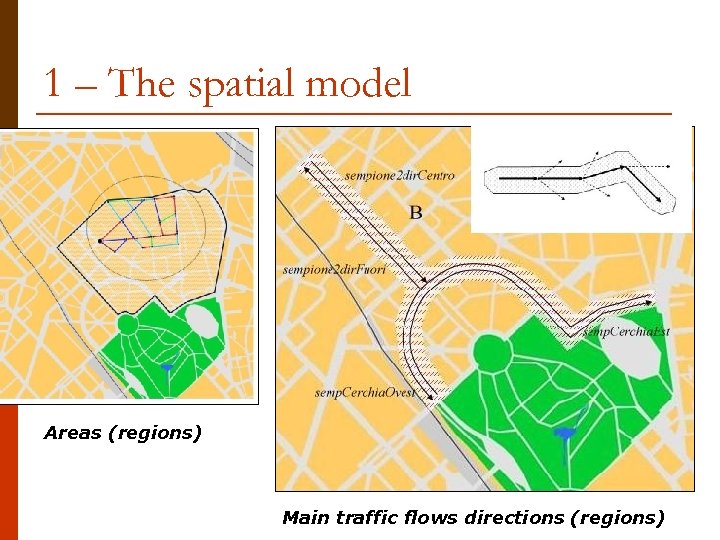
1 – The spatial model Areas (regions) Main traffic flows directions (regions)
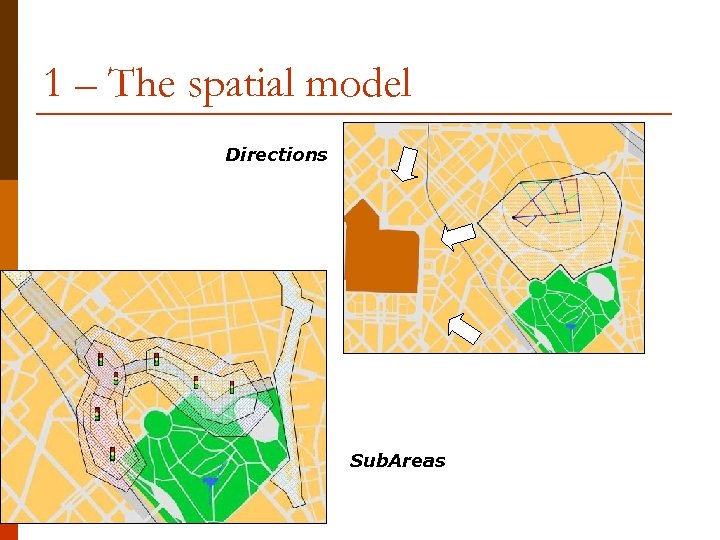
1 – The spatial model Directions Sub. Areas
1 – The spatial model General Connections
1 – The model. Formally… How are those relations intensionally characterized? Many from Commonsense Spatial Model (in, direction)…
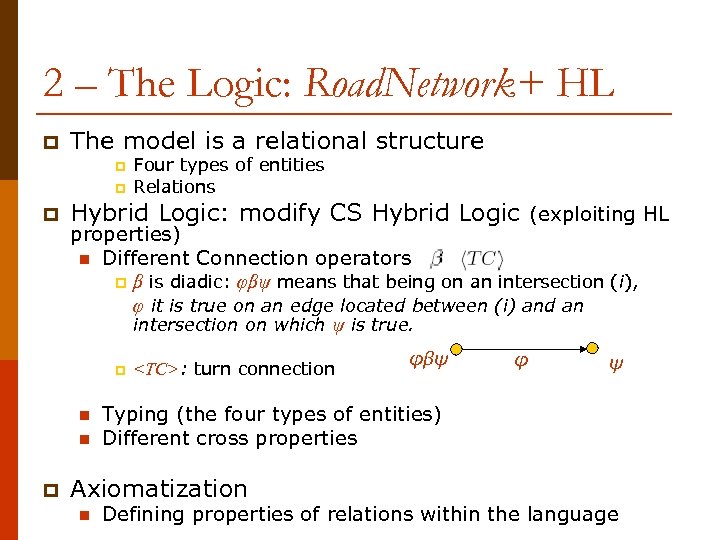
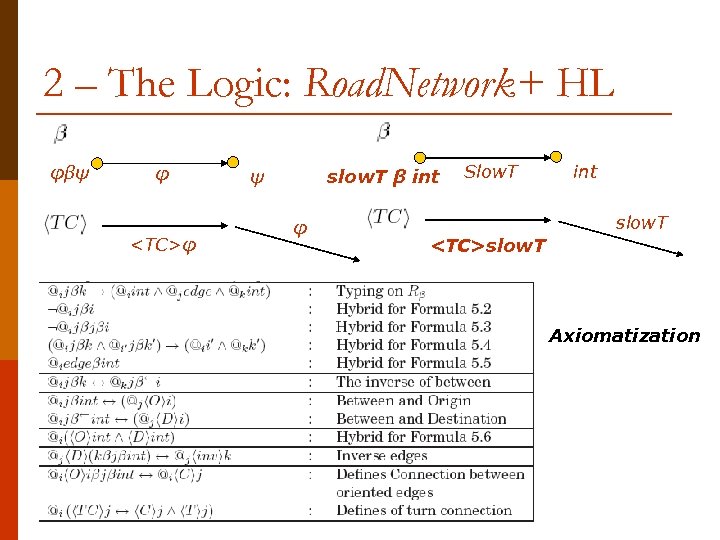
2 – The Logic: Road. Network+ HL p The model is a relational structure p p p Hybrid Logic: modify CS Hybrid Logic (exploiting HL properties) n Different Connection operators p β is diadic: φβψ means that being on an intersection (i), φ it is true on an edge located between (i) and an intersection on which ψ is true. p n n p Four types of entities Relations <TC>: turn connection φ ψ Typing (the four types of entities) Different cross properties Axiomatization n φβψ Defining properties of relations within the language
2 – The Logic: Road. Network+ HL φβψ φ <TC>φ ψ slow. T β int φ Slow. T int slow. T <TC>slow. T Axiomatization
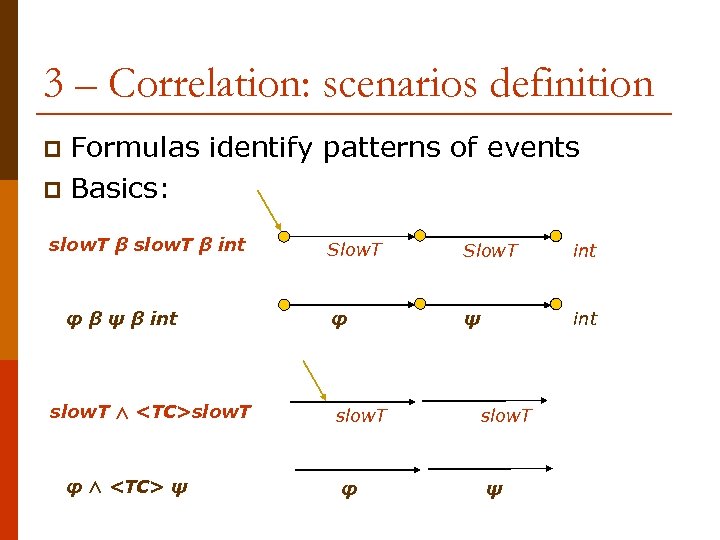
3 – Correlation: scenarios definition Formulas identify patterns of events p Basics: p slow. T β int φ β ψ β int slow. T ∧ <TC>slow. T φ ∧ <TC> ψ Slow. T int φ ψ int slow. T φ ψ
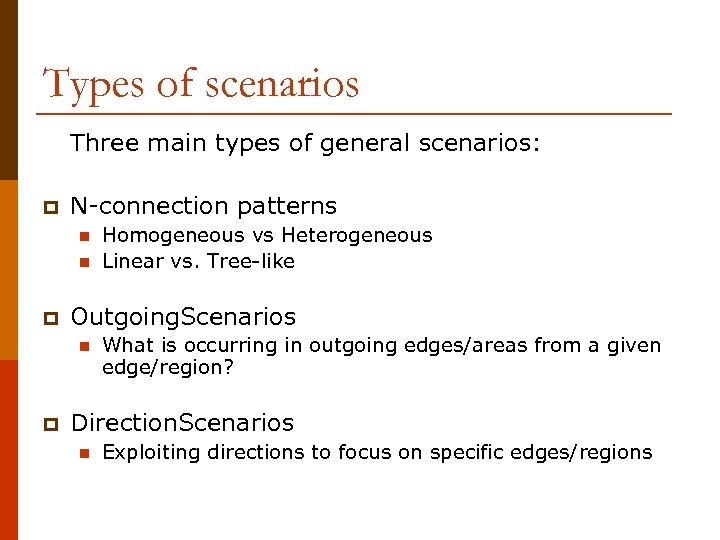
Types of scenarios Three main types of general scenarios: p N-connection patterns n n p Outgoing. Scenarios n p Homogeneous vs Heterogeneous Linear vs. Tree-like What is occurring in outgoing edges/areas from a given edge/region? Direction. Scenarios n Exploiting directions to focus on specific edges/regions
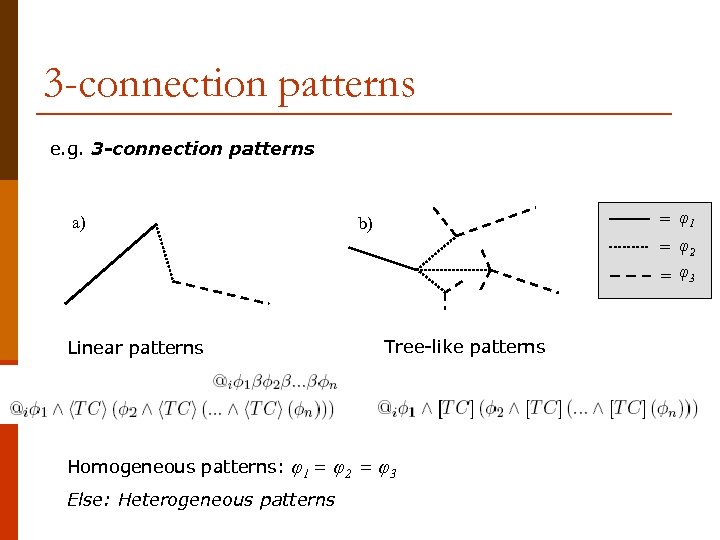
3 -connection patterns e. g. 3 -connection patterns a) Linear patterns = φ1 = φ2 = φ3 b) Tree-like patterns Homogeneous patterns: φ1 = φ2 = φ3 Else: Heterogeneous patterns
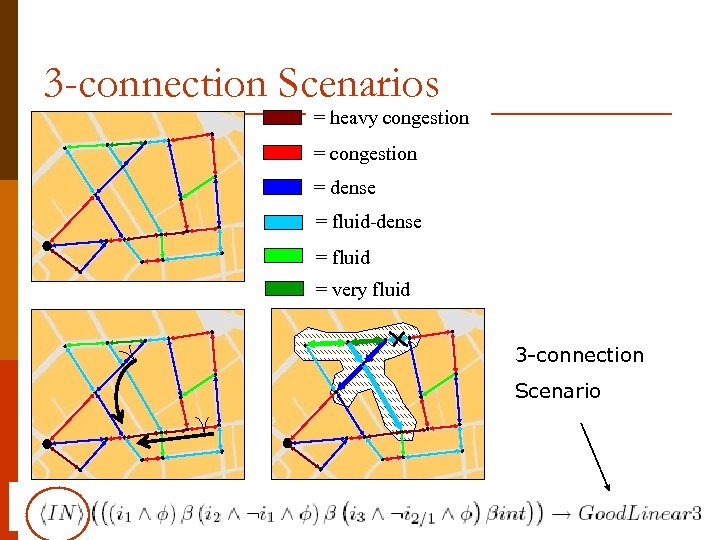
3 -connection Scenarios = heavy congestion = dense = fluid-dense = fluid = very fluid 3 -connection Scenario
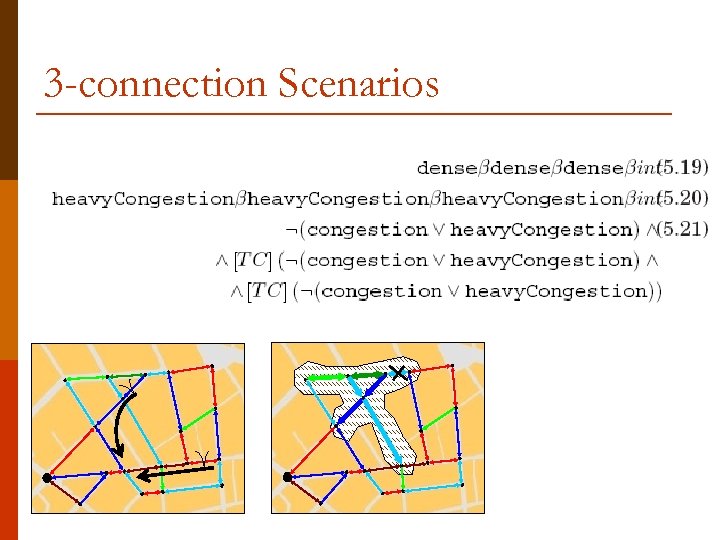
3 -connection Scenarios
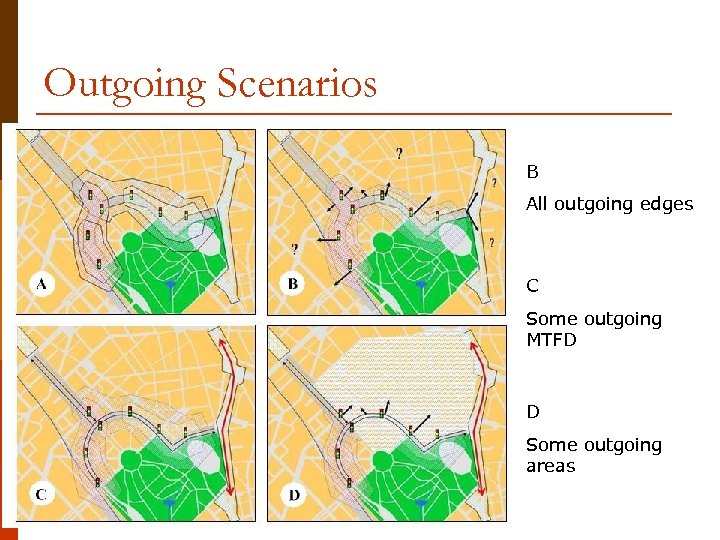
Outgoing Scenarios B All outgoing edges C Some outgoing MTFD D Some outgoing areas
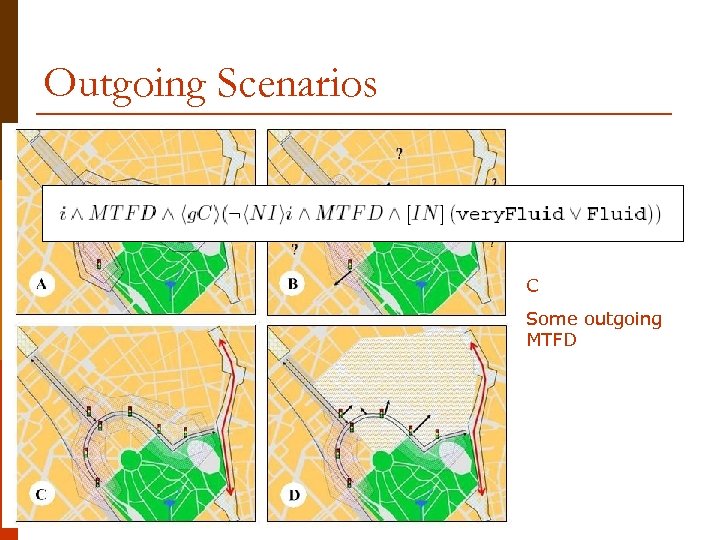
Outgoing Scenarios C Some outgoing MTFD
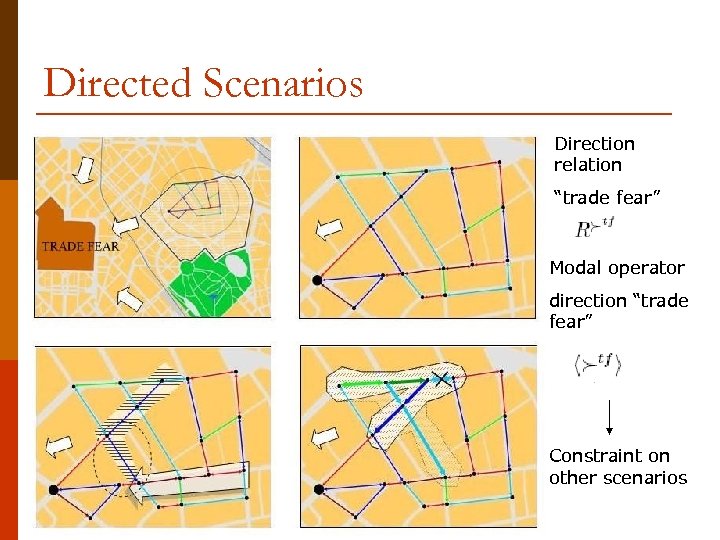
Directed Scenarios Direction relation “trade fear” Modal operator direction “trade fear” Constraint on other scenarios
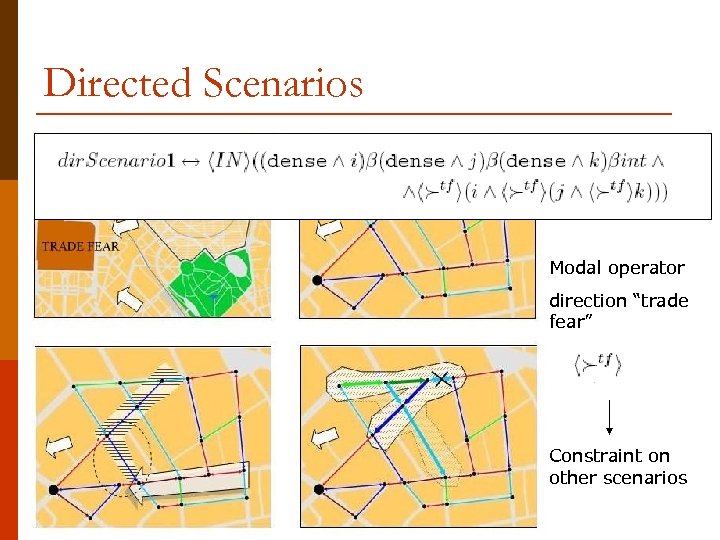
Directed Scenarios Modal operator direction “trade fear” Constraint on other scenarios
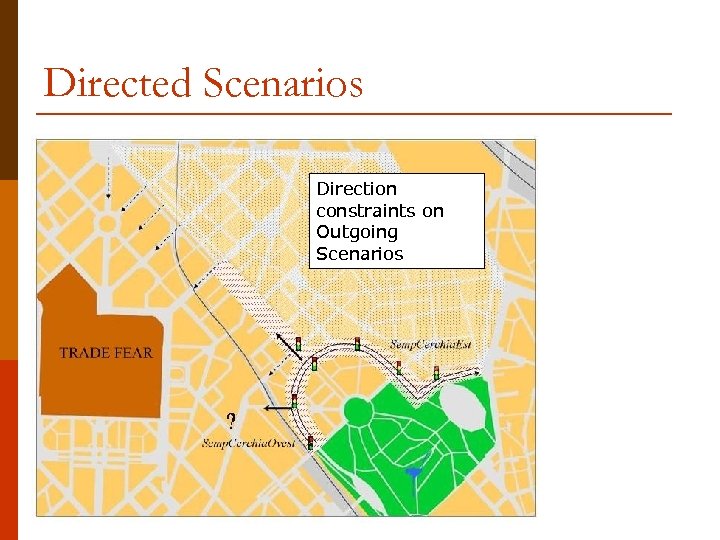
Directed Scenarios Direction constraints on Outgoing Scenarios
Few Concluding Remarks (KR) p p p General strategy focusing on space Different spatial models, different languages, different representational issues Hybrid Logic good perspective on reasoning in these domains: n n n p Modal Perspective on relational structures Good expressive power Flexibility in defining axiomatization and calculus KR with logic: a good framework for models n n n Model vs. implementation Control on assumptions with proofs Generality

Questions? Than you for the attention!
Скачать презентацию Pervasive Computing and Space A Knowledge Based Approach
86de7a1c3ac752a6c32cf1b4aebe2cfc.ppt