


 Скачать презентацию PERT CPM Models for Project Management Irwin Mc Graw-Hill 8
04e3b42fb0817131cdf66b2cb9cd2b5f.ppt
- Количество слайдов: 40
 PERT/CPM Models for Project Management Irwin/Mc. Graw-Hill 8. 1 © The Mc. Graw-Hill Companies, Inc. , 2003
 Project Management • Characteristics of Projects – – • Unique, one-time operations Involve a large number of activities that must be planned and coordinated Long time-horizon Goals of meeting completion deadlines and budgets Examples – Building a house – Planning a meeting – Introducing a new product • PERT—Project Evaluation and Review Technique CPM—Critical Path Method – A graphical or network approach for planning and coordinating large-scale projects. Mc. Graw-Hill/Irwin 2 © The Mc. Graw-Hill Companies, Inc. , 2003
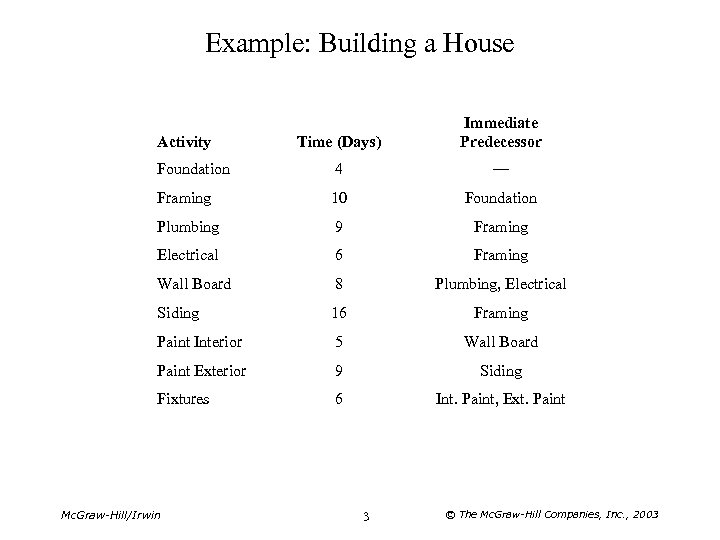 Example: Building a House Time (Days) Immediate Predecessor Foundation 4 — Framing 10 Foundation Plumbing 9 Framing Electrical 6 Framing Wall Board 8 Plumbing, Electrical Siding 16 Framing Paint Interior 5 Wall Board Paint Exterior 9 Siding Fixtures 6 Int. Paint, Ext. Paint Activity Mc. Graw-Hill/Irwin 3 © The Mc. Graw-Hill Companies, Inc. , 2003
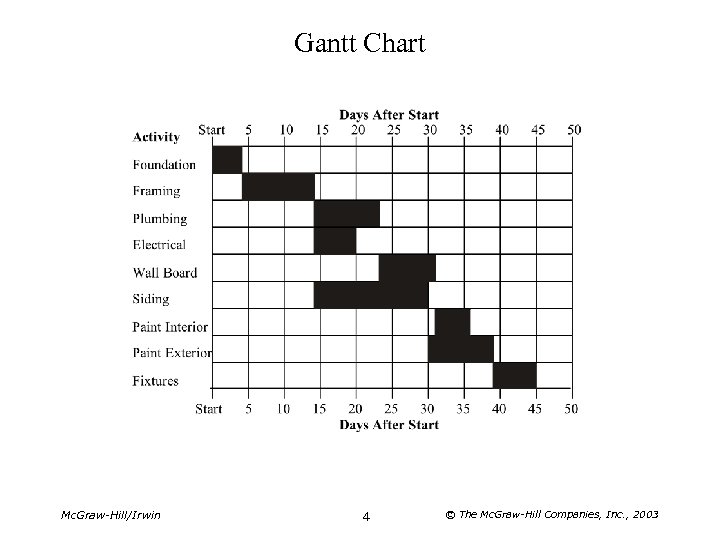 Gantt Chart Mc. Graw-Hill/Irwin 4 © The Mc. Graw-Hill Companies, Inc. , 2003
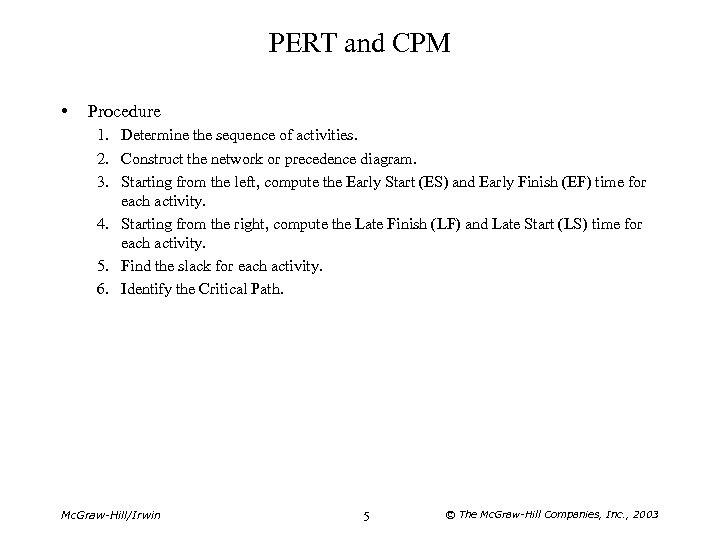 PERT and CPM • Procedure 1. Determine the sequence of activities. 2. Construct the network or precedence diagram. 3. Starting from the left, compute the Early Start (ES) and Early Finish (EF) time for each activity. 4. Starting from the right, compute the Late Finish (LF) and Late Start (LS) time for each activity. 5. Find the slack for each activity. 6. Identify the Critical Path. Mc. Graw-Hill/Irwin 5 © The Mc. Graw-Hill Companies, Inc. , 2003
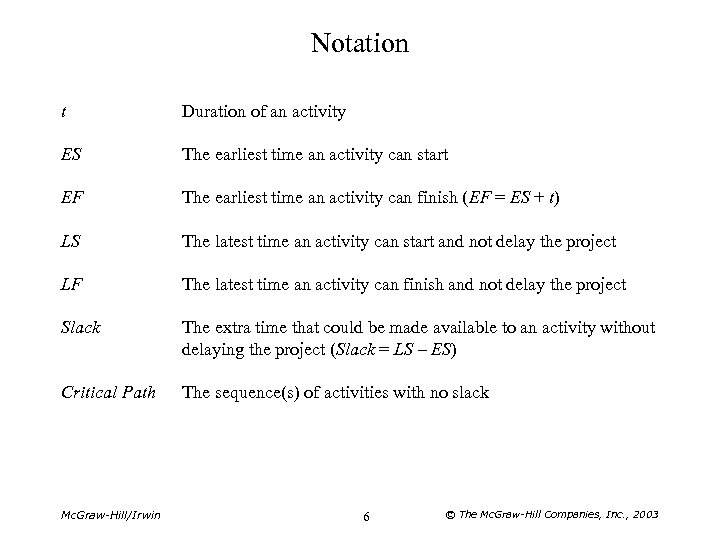 Notation t Duration of an activity ES The earliest time an activity can start EF The earliest time an activity can finish (EF = ES + t) LS The latest time an activity can start and not delay the project LF The latest time an activity can finish and not delay the project Slack The extra time that could be made available to an activity without delaying the project (Slack = LS – ES) Critical Path The sequence(s) of activities with no slack Mc. Graw-Hill/Irwin 6 © The Mc. Graw-Hill Companies, Inc. , 2003
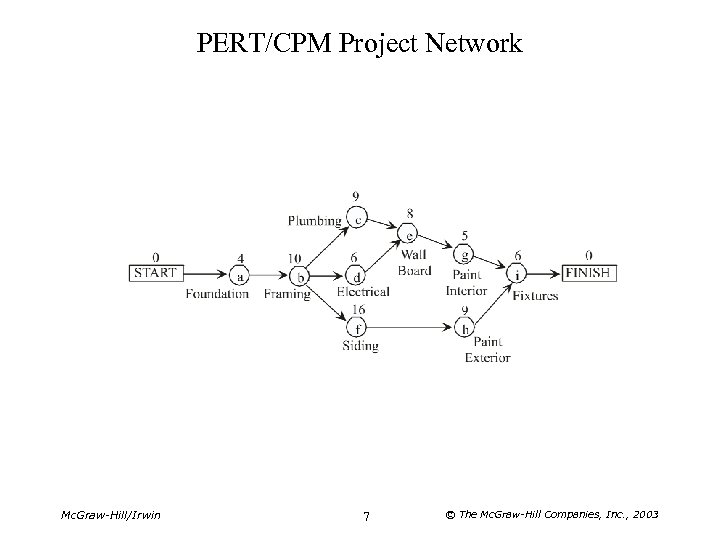 PERT/CPM Project Network Mc. Graw-Hill/Irwin 7 © The Mc. Graw-Hill Companies, Inc. , 2003
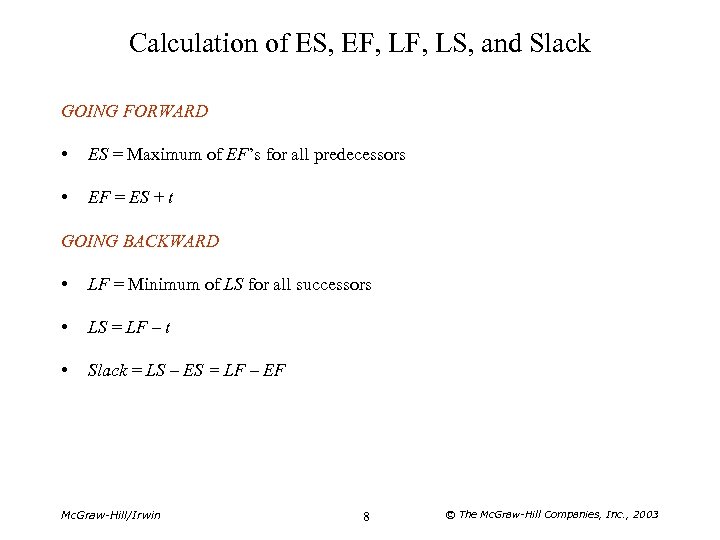 Calculation of ES, EF, LS, and Slack GOING FORWARD • ES = Maximum of EF’s for all predecessors • EF = ES + t GOING BACKWARD • LF = Minimum of LS for all successors • LS = LF – t • Slack = LS – ES = LF – EF Mc. Graw-Hill/Irwin 8 © The Mc. Graw-Hill Companies, Inc. , 2003
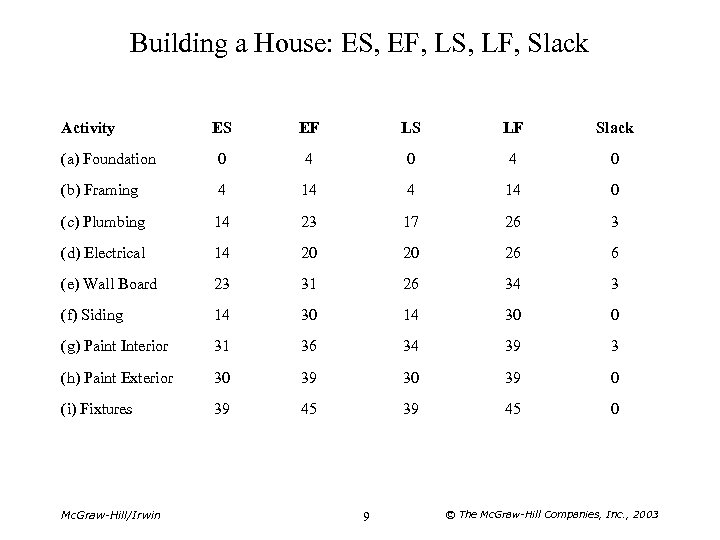 Building a House: ES, EF, LS, LF, Slack Activity ES EF LS LF Slack (a) Foundation 0 4 0 (b) Framing 4 14 0 (c) Plumbing 14 23 17 26 3 (d) Electrical 14 20 20 26 6 (e) Wall Board 23 31 26 34 3 (f) Siding 14 30 0 (g) Paint Interior 31 36 34 39 3 (h) Paint Exterior 30 39 0 (i) Fixtures 39 45 0 Mc. Graw-Hill/Irwin 9 © The Mc. Graw-Hill Companies, Inc. , 2003
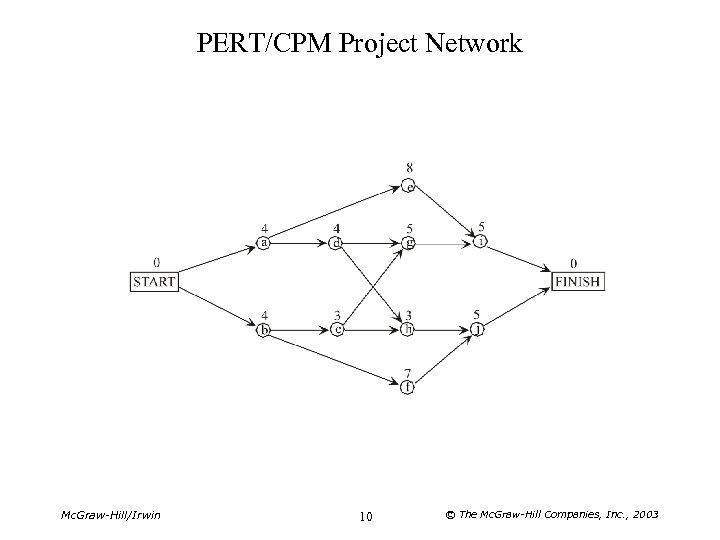 PERT/CPM Project Network Mc. Graw-Hill/Irwin 10 © The Mc. Graw-Hill Companies, Inc. , 2003
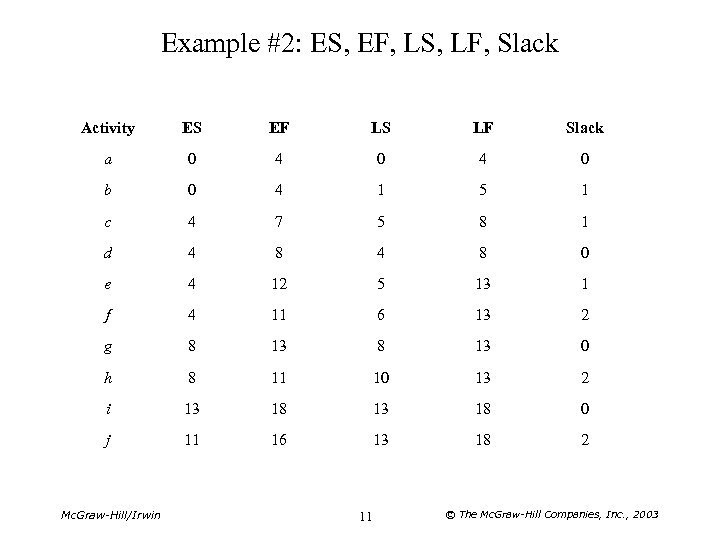 Example #2: ES, EF, LS, LF, Slack Activity ES EF LS LF Slack a 0 4 0 b 0 4 1 5 1 c 4 7 5 8 1 d 4 8 0 e 4 12 5 13 1 f 4 11 6 13 2 g 8 13 0 h 8 11 10 13 2 i 13 18 0 j 11 16 13 18 2 Mc. Graw-Hill/Irwin 11 © The Mc. Graw-Hill Companies, Inc. , 2003
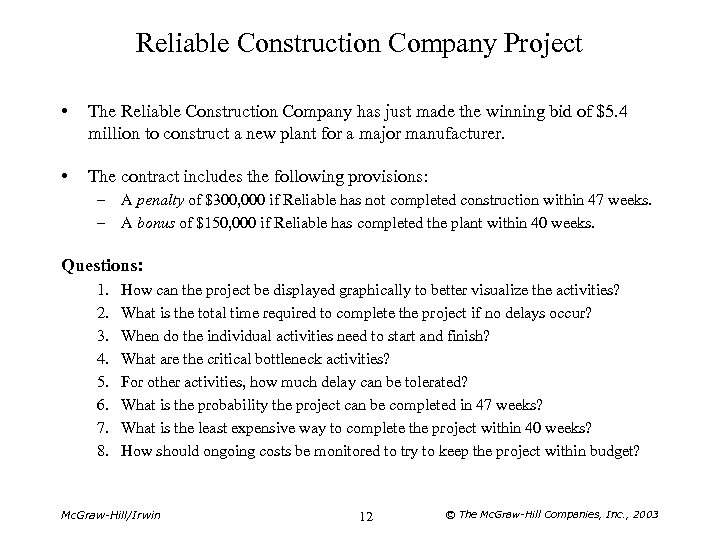 Reliable Construction Company Project • The Reliable Construction Company has just made the winning bid of $5. 4 million to construct a new plant for a major manufacturer. • The contract includes the following provisions: – A penalty of $300, 000 if Reliable has not completed construction within 47 weeks. – A bonus of $150, 000 if Reliable has completed the plant within 40 weeks. Questions: 1. 2. 3. 4. 5. 6. 7. 8. How can the project be displayed graphically to better visualize the activities? What is the total time required to complete the project if no delays occur? When do the individual activities need to start and finish? What are the critical bottleneck activities? For other activities, how much delay can be tolerated? What is the probability the project can be completed in 47 weeks? What is the least expensive way to complete the project within 40 weeks? How should ongoing costs be monitored to try to keep the project within budget? Mc. Graw-Hill/Irwin 12 © The Mc. Graw-Hill Companies, Inc. , 2003
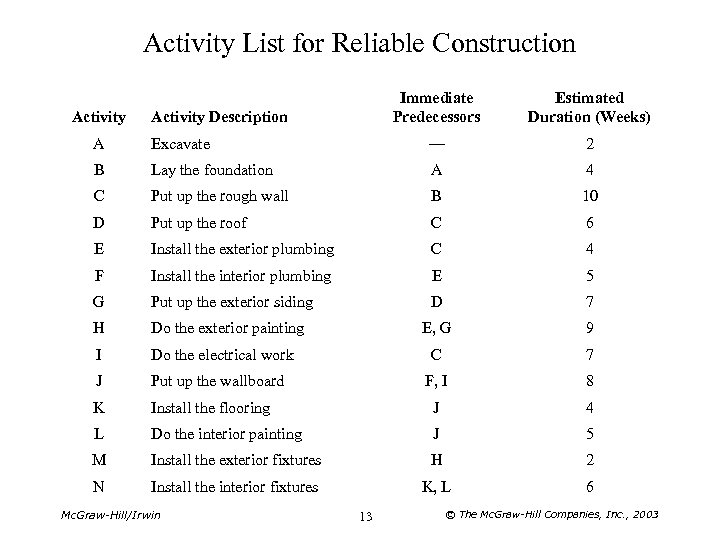 Activity List for Reliable Construction Activity Immediate Predecessors Activity Description Estimated Duration (Weeks) A Excavate — 2 B Lay the foundation A 4 C Put up the rough wall B 10 D Put up the roof C 6 E Install the exterior plumbing C 4 F Install the interior plumbing E 5 G Put up the exterior siding D 7 H Do the exterior painting E, G 9 I Do the electrical work C 7 J Put up the wallboard F, I 8 K Install the flooring J 4 L Do the interior painting J 5 M Install the exterior fixtures H 2 N Install the interior fixtures K, L 6 Mc. Graw-Hill/Irwin 13 © The Mc. Graw-Hill Companies, Inc. , 2003
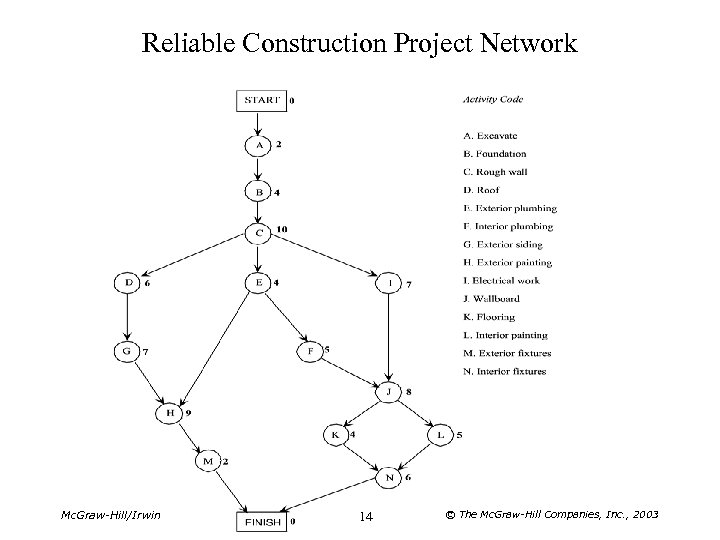 Reliable Construction Project Network Mc. Graw-Hill/Irwin 14 © The Mc. Graw-Hill Companies, Inc. , 2003
 The Critical Path • A path through a network is one of the routes following the arrows (arcs) from the start node to the finish node. • The length of a path is the sum of the (estimated) durations of the activities on the path. • The (estimated) project duration equals the length of the longest path through the project network. • This longest path is called the critical path. (If more than one path tie for the longest, they all are critical paths. ) Mc. Graw-Hill/Irwin 15 © The Mc. Graw-Hill Companies, Inc. , 2003
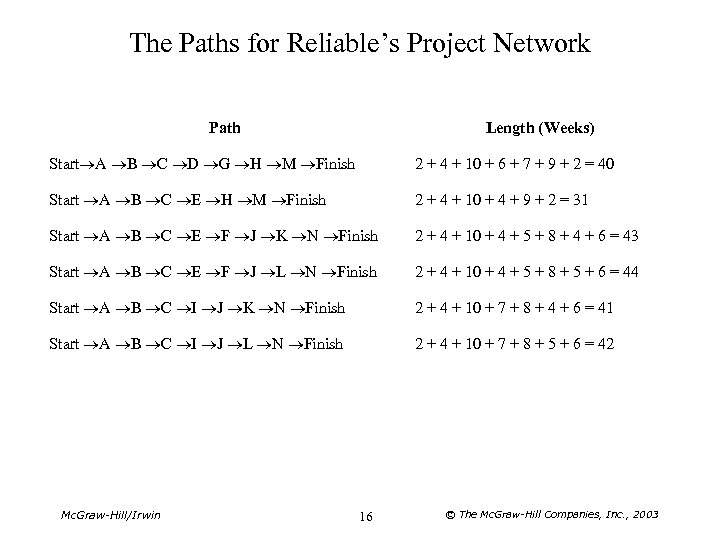 The Paths for Reliable’s Project Network Path Length (Weeks) Start A B C D G H M Finish 2 + 4 + 10 + 6 + 7 + 9 + 2 = 40 Start A B C E H M Finish 2 + 4 + 10 + 4 + 9 + 2 = 31 Start A B C E F J K N Finish 2 + 4 + 10 + 4 + 5 + 8 + 4 + 6 = 43 Start A B C E F J L N Finish 2 + 4 + 10 + 4 + 5 + 8 + 5 + 6 = 44 Start A B C I J K N Finish 2 + 4 + 10 + 7 + 8 + 4 + 6 = 41 Start A B C I J L N Finish 2 + 4 + 10 + 7 + 8 + 5 + 6 = 42 Mc. Graw-Hill/Irwin 16 © The Mc. Graw-Hill Companies, Inc. , 2003
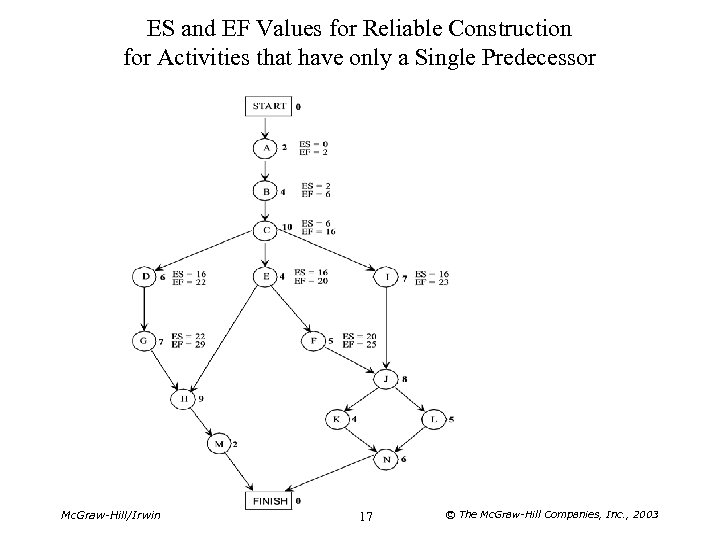 ES and EF Values for Reliable Construction for Activities that have only a Single Predecessor Mc. Graw-Hill/Irwin 17 © The Mc. Graw-Hill Companies, Inc. , 2003
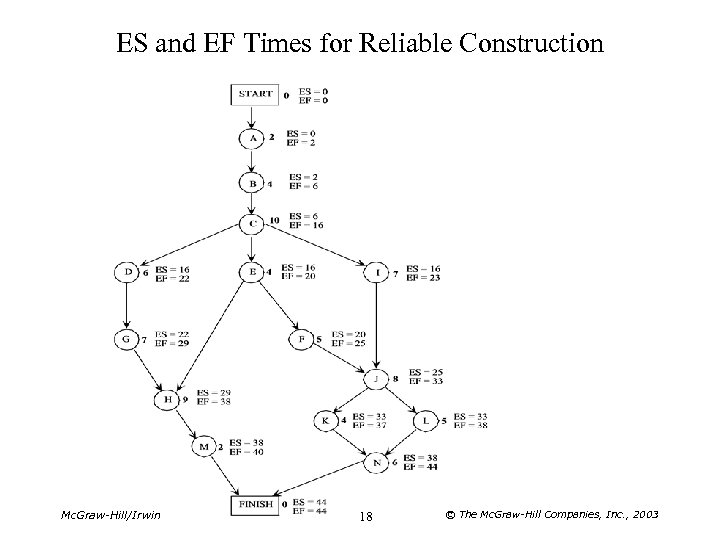 ES and EF Times for Reliable Construction Mc. Graw-Hill/Irwin 18 © The Mc. Graw-Hill Companies, Inc. , 2003
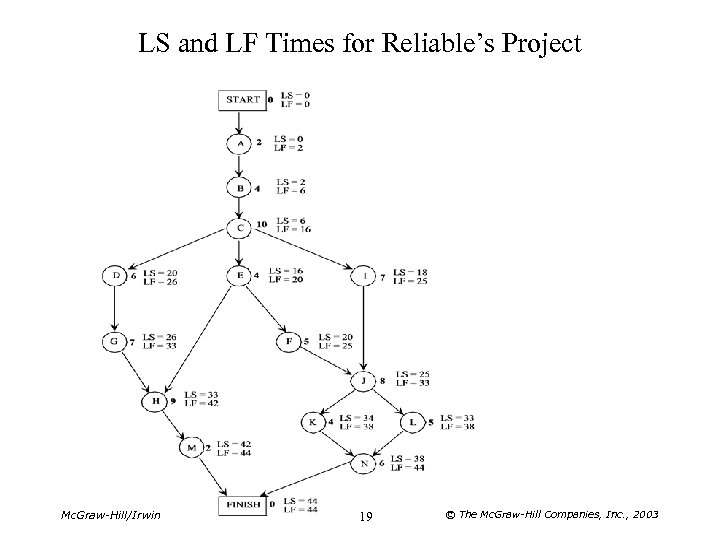 LS and LF Times for Reliable’s Project Mc. Graw-Hill/Irwin 19 © The Mc. Graw-Hill Companies, Inc. , 2003
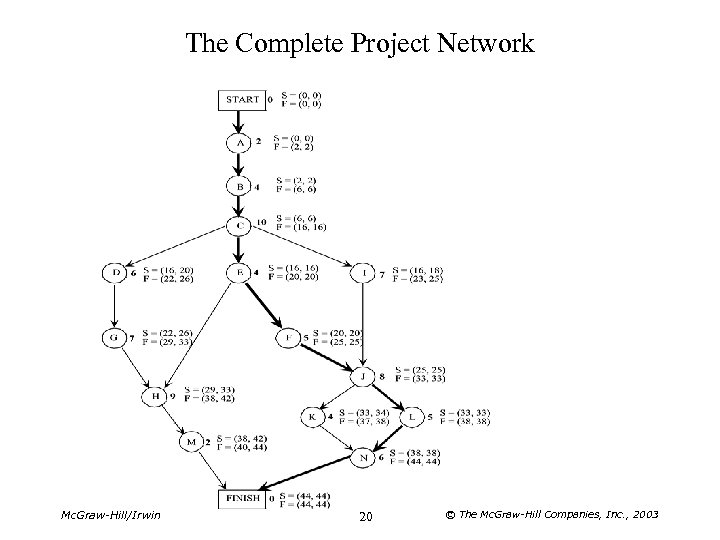 The Complete Project Network Mc. Graw-Hill/Irwin 20 © The Mc. Graw-Hill Companies, Inc. , 2003
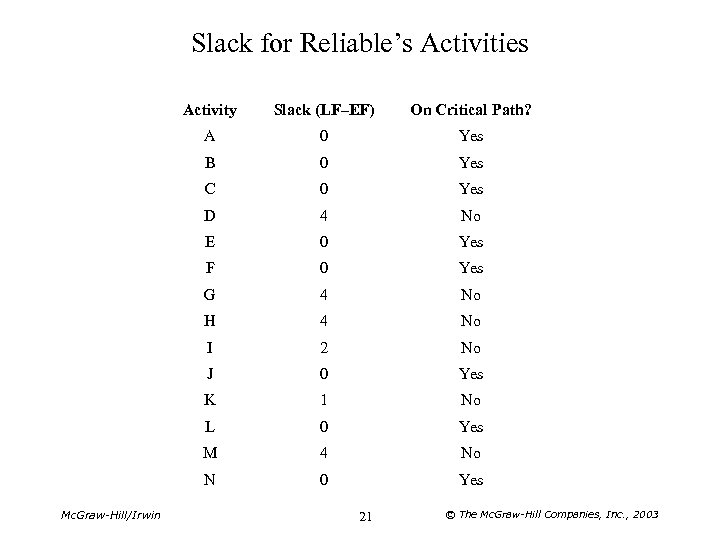 Slack for Reliable’s Activities Activity On Critical Path? A 0 Yes B 0 Yes C 0 Yes D 4 No E 0 Yes F 0 Yes G 4 No H 4 No I 2 No J 0 Yes K 1 No L 0 Yes M 4 No N Mc. Graw-Hill/Irwin Slack (LF–EF) 0 Yes 21 © The Mc. Graw-Hill Companies, Inc. , 2003
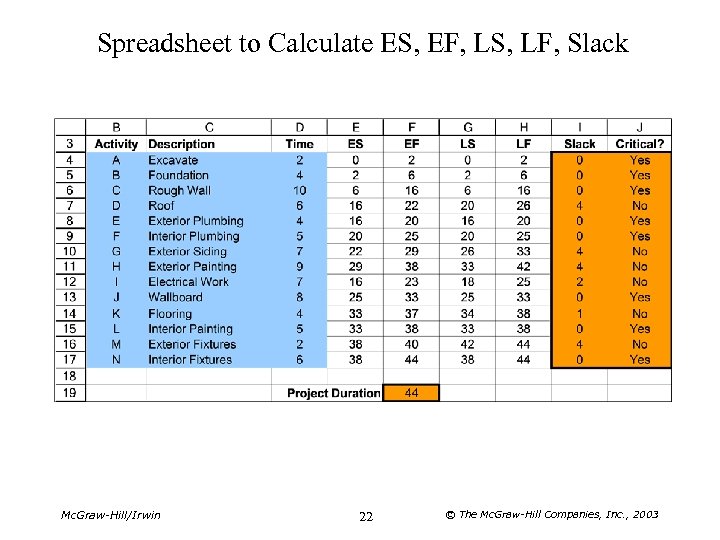 Spreadsheet to Calculate ES, EF, LS, LF, Slack Mc. Graw-Hill/Irwin 22 © The Mc. Graw-Hill Companies, Inc. , 2003
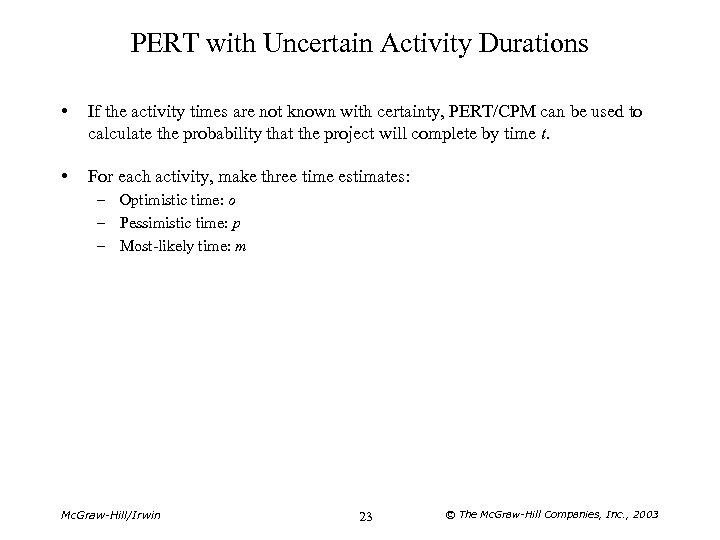 PERT with Uncertain Activity Durations • If the activity times are not known with certainty, PERT/CPM can be used to calculate the probability that the project will complete by time t. • For each activity, make three time estimates: – Optimistic time: o – Pessimistic time: p – Most-likely time: m Mc. Graw-Hill/Irwin 23 © The Mc. Graw-Hill Companies, Inc. , 2003
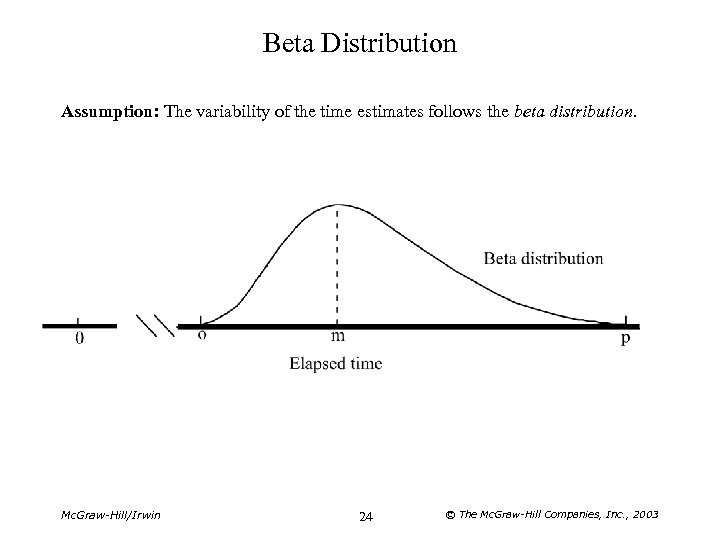 Beta Distribution Assumption: The variability of the time estimates follows the beta distribution. Mc. Graw-Hill/Irwin 24 © The Mc. Graw-Hill Companies, Inc. , 2003
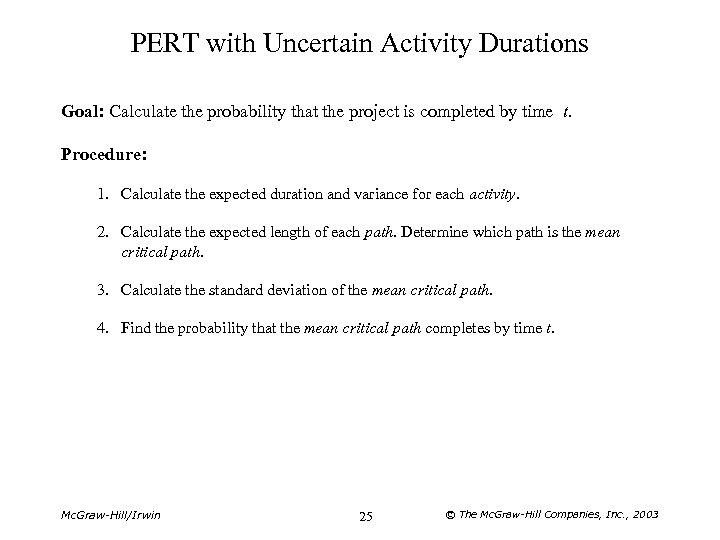 PERT with Uncertain Activity Durations Goal: Calculate the probability that the project is completed by time t. Procedure: 1. Calculate the expected duration and variance for each activity. 2. Calculate the expected length of each path. Determine which path is the mean critical path. 3. Calculate the standard deviation of the mean critical path. 4. Find the probability that the mean critical path completes by time t. Mc. Graw-Hill/Irwin 25 © The Mc. Graw-Hill Companies, Inc. , 2003
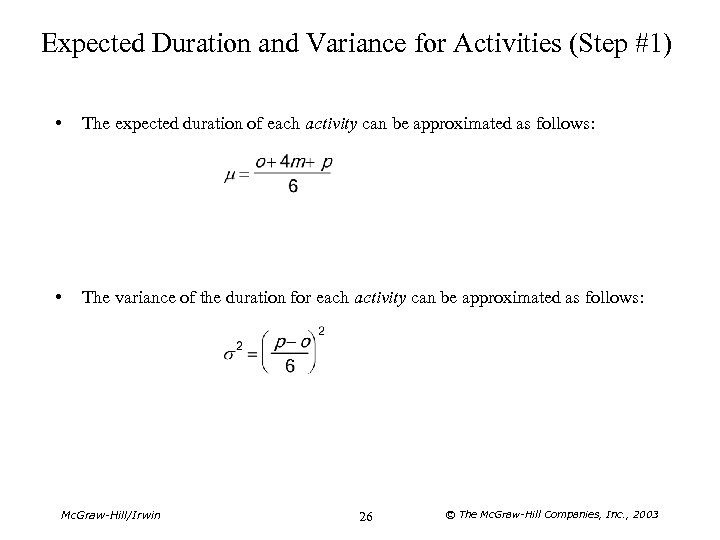 Expected Duration and Variance for Activities (Step #1) • The expected duration of each activity can be approximated as follows: • The variance of the duration for each activity can be approximated as follows: Mc. Graw-Hill/Irwin 26 © The Mc. Graw-Hill Companies, Inc. , 2003
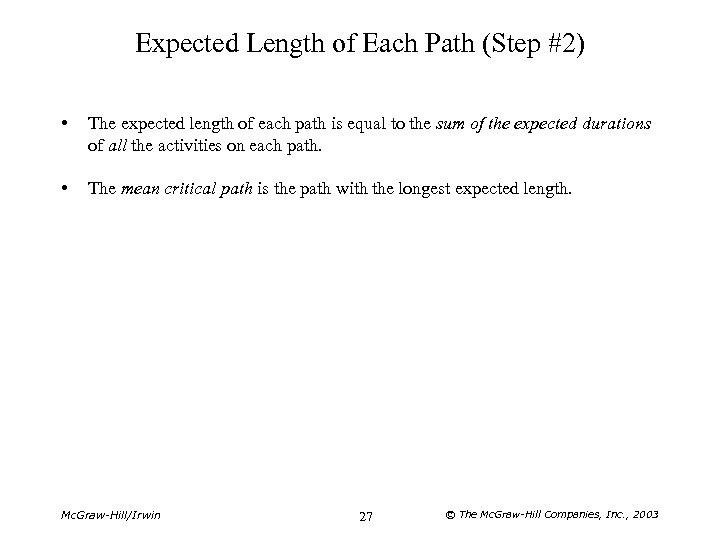 Expected Length of Each Path (Step #2) • The expected length of each path is equal to the sum of the expected durations of all the activities on each path. • The mean critical path is the path with the longest expected length. Mc. Graw-Hill/Irwin 27 © The Mc. Graw-Hill Companies, Inc. , 2003
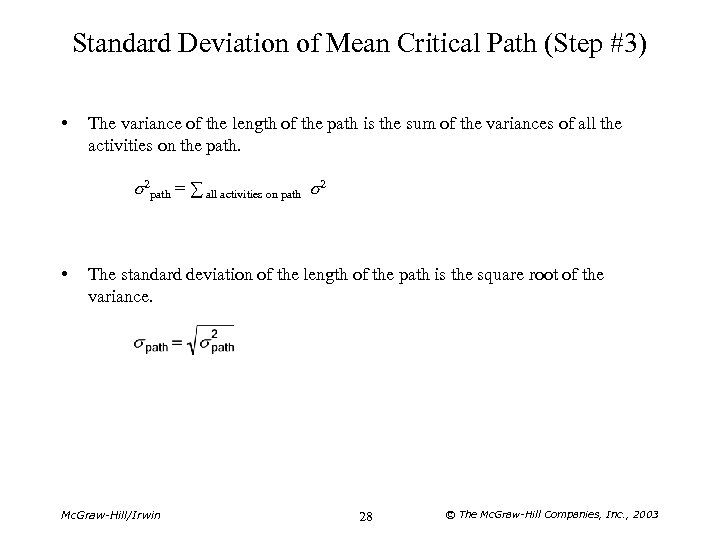 Standard Deviation of Mean Critical Path (Step #3) • The variance of the length of the path is the sum of the variances of all the activities on the path. s 2 path = ∑ all activities on path s 2 • The standard deviation of the length of the path is the square root of the variance. Mc. Graw-Hill/Irwin 28 © The Mc. Graw-Hill Companies, Inc. , 2003
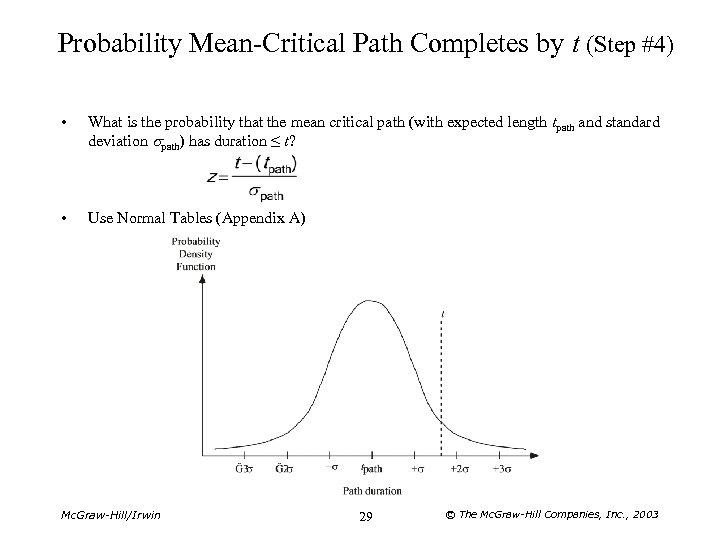 Probability Mean-Critical Path Completes by t (Step #4) • What is the probability that the mean critical path (with expected length tpath and standard deviation spath) has duration ≤ t? • Use Normal Tables (Appendix A) Mc. Graw-Hill/Irwin 29 © The Mc. Graw-Hill Companies, Inc. , 2003
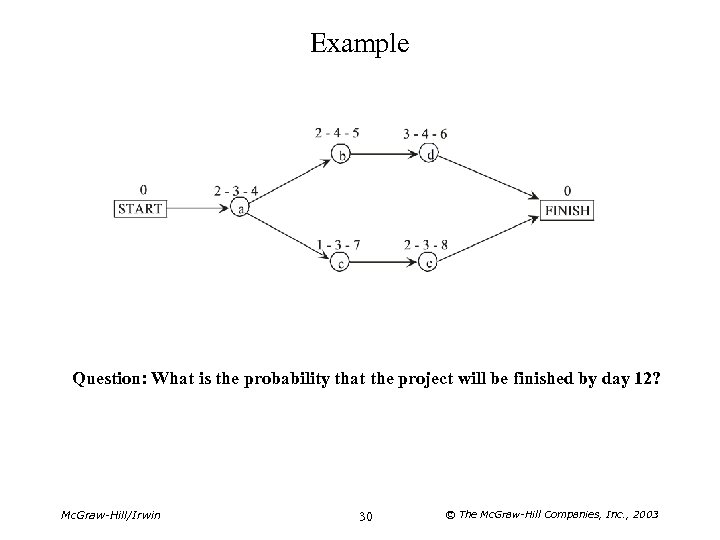 Example Question: What is the probability that the project will be finished by day 12? Mc. Graw-Hill/Irwin 30 © The Mc. Graw-Hill Companies, Inc. , 2003
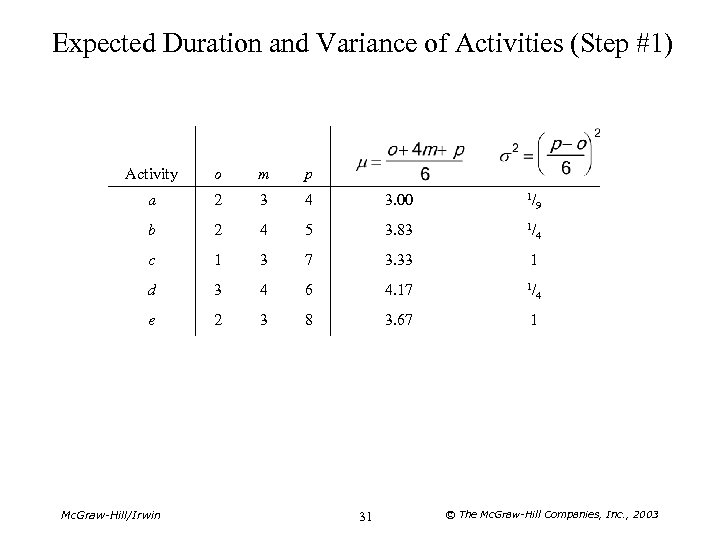 Expected Duration and Variance of Activities (Step #1) Activity o m p a 2 3 4 3. 00 1/ 9 b 2 4 5 3. 83 1/ 4 c 1 3 7 3. 33 1 d 3 4 6 4. 17 1/ e 2 3 8 3. 67 1 Mc. Graw-Hill/Irwin 31 4 © The Mc. Graw-Hill Companies, Inc. , 2003
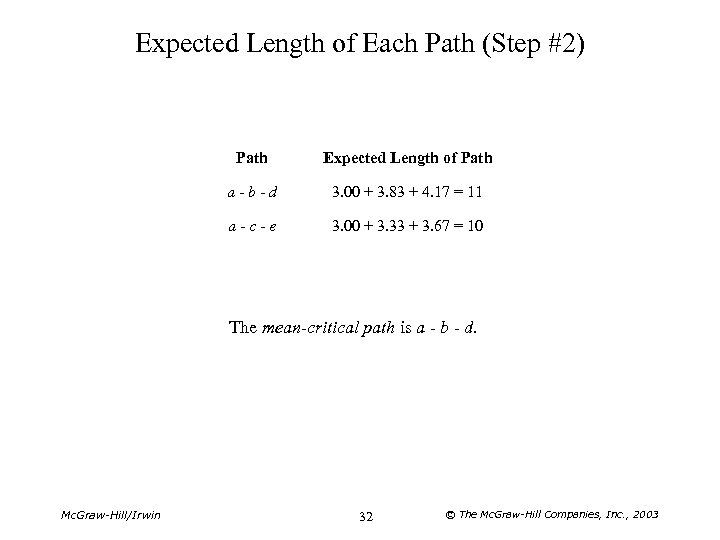 Expected Length of Each Path (Step #2) Path Expected Length of Path a - b - d 3. 00 + 3. 83 + 4. 17 = 11 a - c - e 3. 00 + 3. 33 + 3. 67 = 10 The mean-critical path is a - b - d. Mc. Graw-Hill/Irwin 32 © The Mc. Graw-Hill Companies, Inc. , 2003
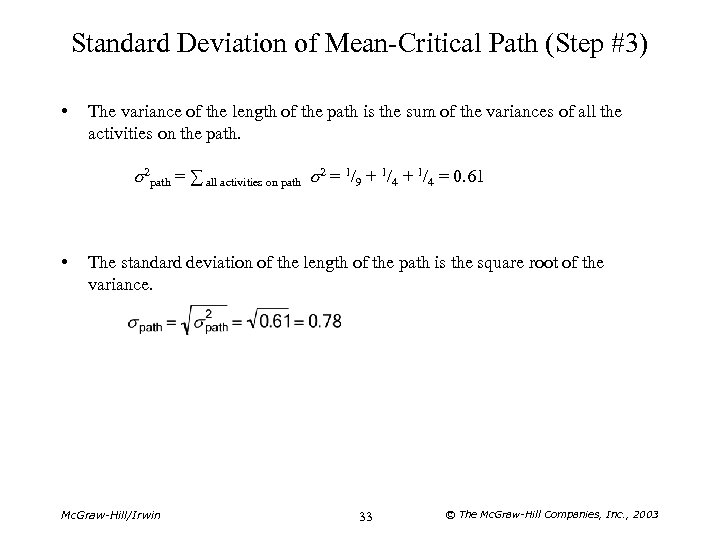 Standard Deviation of Mean-Critical Path (Step #3) • The variance of the length of the path is the sum of the variances of all the activities on the path. s 2 path = ∑ all activities on path s 2 = 1/9 + 1/4 = 0. 61 • The standard deviation of the length of the path is the square root of the variance. Mc. Graw-Hill/Irwin 33 © The Mc. Graw-Hill Companies, Inc. , 2003
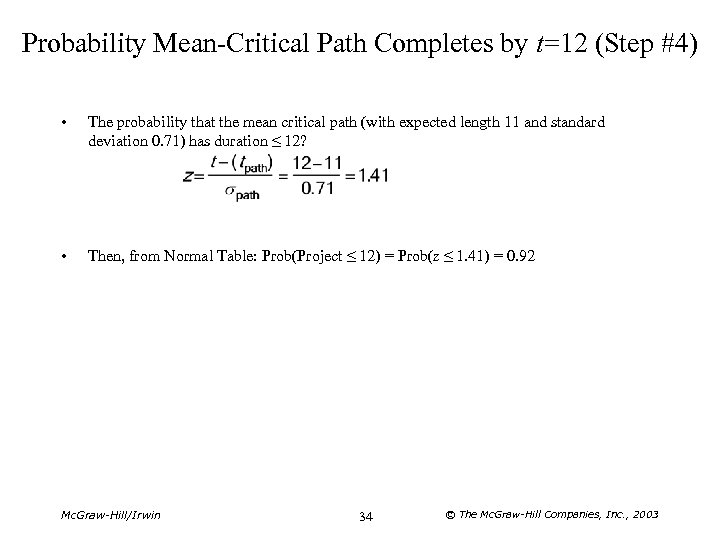 Probability Mean-Critical Path Completes by t=12 (Step #4) • The probability that the mean critical path (with expected length 11 and standard deviation 0. 71) has duration ≤ 12? • Then, from Normal Table: Prob(Project ≤ 12) = Prob(z ≤ 1. 41) = 0. 92 Mc. Graw-Hill/Irwin 34 © The Mc. Graw-Hill Companies, Inc. , 2003
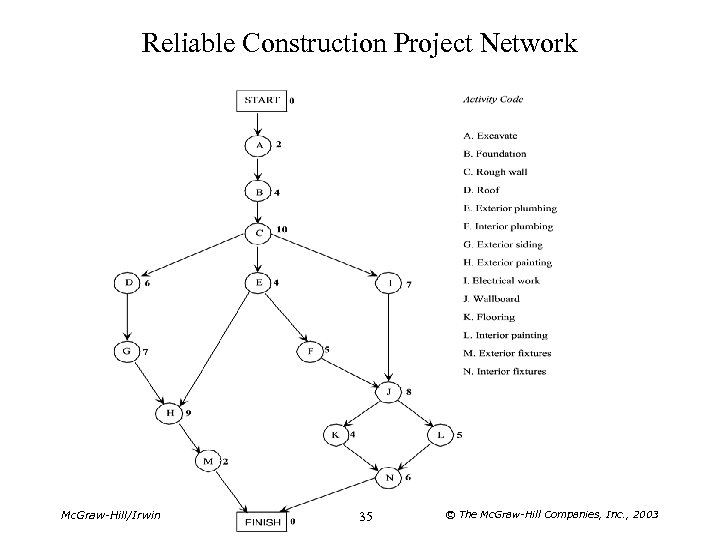 Reliable Construction Project Network Mc. Graw-Hill/Irwin 35 © The Mc. Graw-Hill Companies, Inc. , 2003
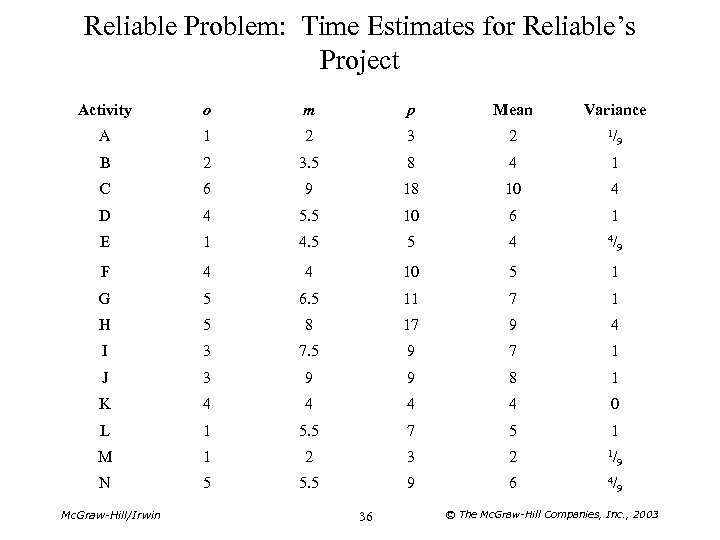 Reliable Problem: Time Estimates for Reliable’s Project Activity o m p Mean Variance A 1 2 3 2 1/ B 2 3. 5 8 4 1 C 6 9 18 10 4 D 4 5. 5 10 6 1 E 1 4. 5 5 4 4/ F 4 4 10 5 1 G 5 6. 5 11 7 1 H 5 8 17 9 4 I 3 7. 5 9 7 1 J 3 9 9 8 1 K 4 4 0 L 1 5. 5 7 5 1 M 1 2 3 2 1/ 9 N 5 5. 5 9 6 4/ 9 Mc. Graw-Hill/Irwin 36 9 9 © The Mc. Graw-Hill Companies, Inc. , 2003
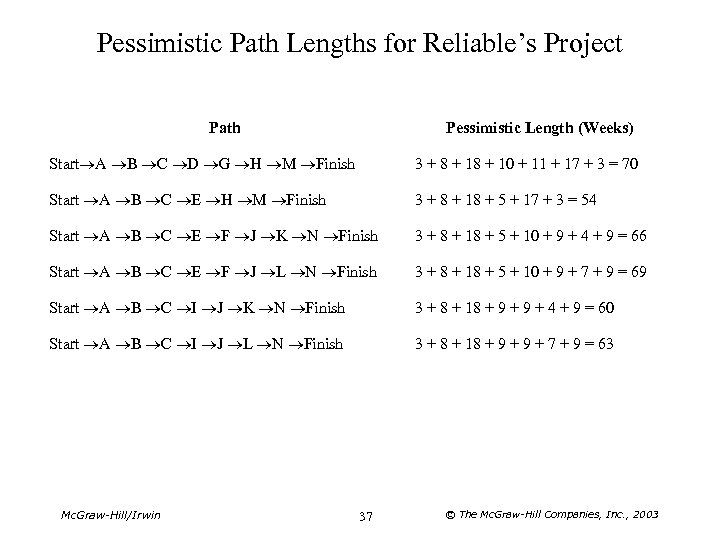 Pessimistic Path Lengths for Reliable’s Project Path Pessimistic Length (Weeks) Start A B C D G H M Finish 3 + 8 + 10 + 11 + 17 + 3 = 70 Start A B C E H M Finish 3 + 8 + 18 + 5 + 17 + 3 = 54 Start A B C E F J K N Finish 3 + 8 + 18 + 5 + 10 + 9 + 4 + 9 = 66 Start A B C E F J L N Finish 3 + 8 + 18 + 5 + 10 + 9 + 7 + 9 = 69 Start A B C I J K N Finish 3 + 8 + 18 + 9 + 4 + 9 = 60 Start A B C I J L N Finish 3 + 8 + 18 + 9 + 7 + 9 = 63 Mc. Graw-Hill/Irwin 37 © The Mc. Graw-Hill Companies, Inc. , 2003
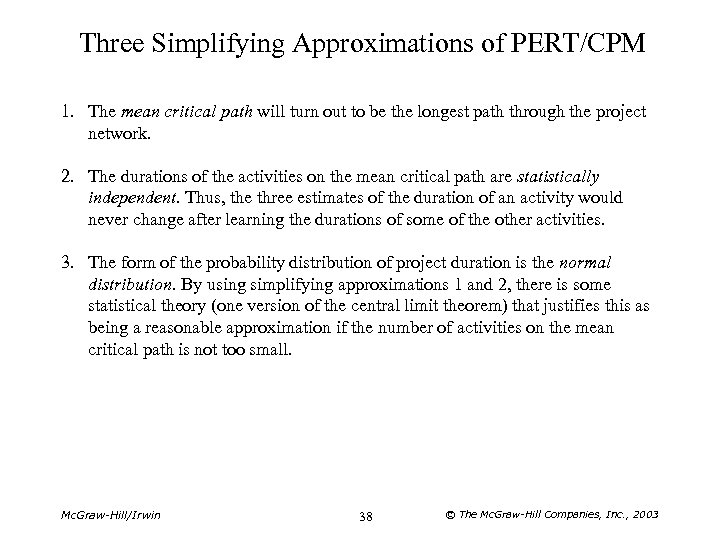 Three Simplifying Approximations of PERT/CPM 1. The mean critical path will turn out to be the longest path through the project network. 2. The durations of the activities on the mean critical path are statistically independent. Thus, the three estimates of the duration of an activity would never change after learning the durations of some of the other activities. 3. The form of the probability distribution of project duration is the normal distribution. By using simplifying approximations 1 and 2, there is some statistical theory (one version of the central limit theorem) that justifies this as being a reasonable approximation if the number of activities on the mean critical path is not too small. Mc. Graw-Hill/Irwin 38 © The Mc. Graw-Hill Companies, Inc. , 2003
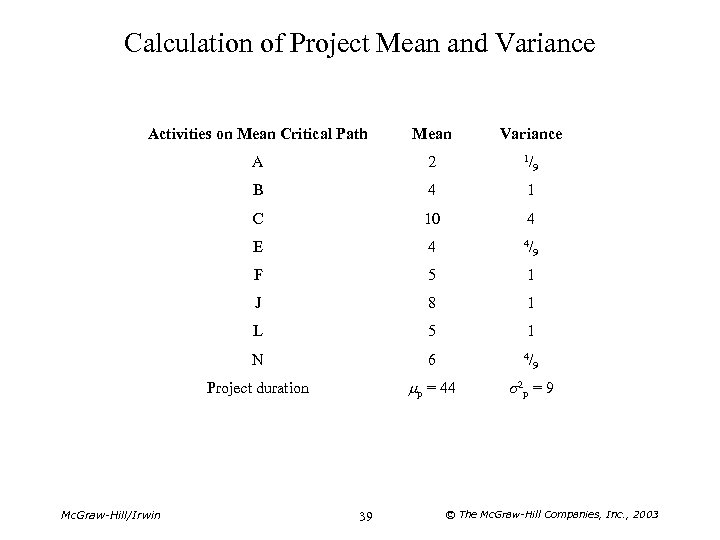 Calculation of Project Mean and Variance Activities on Mean Critical Path Mean Variance A 2 1/ B 4 1 C 10 4 E 4 4/ F 5 1 J 8 1 L 5 1 N 6 4/ Project duration mp = 44 s 2 p = 9 Mc. Graw-Hill/Irwin 39 9 © The Mc. Graw-Hill Companies, Inc. , 2003
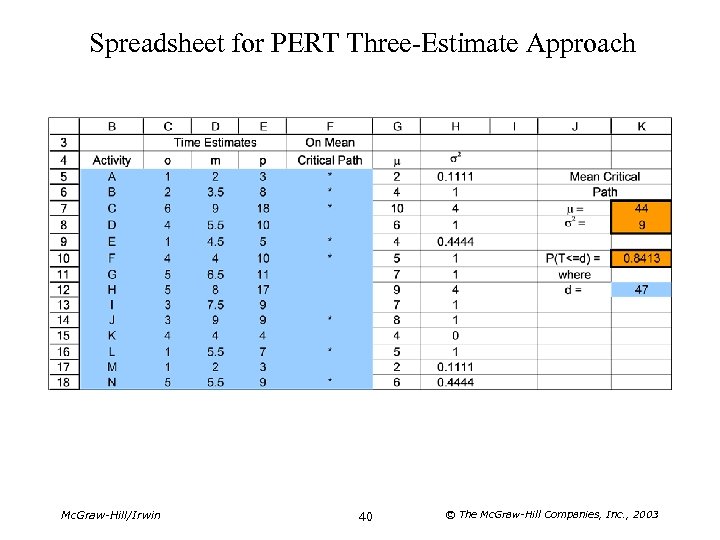 Spreadsheet for PERT Three-Estimate Approach Mc. Graw-Hill/Irwin 40 © The Mc. Graw-Hill Companies, Inc. , 2003