 Скачать презентацию Persuasive Arguments for Establishing an Institutional Repository James
8e15fab532febc555252098064650eea.ppt
- Количество слайдов: 34



Persuasive Arguments for Establishing an Institutional Repository James M. Donovan Faculty and Access Services Librarian University of Georgia Law School Carol A. Watson Associate Director for Information Technology University of Georgia Law School
Introduction An institutional repository is a means to collect the intellectual digital output of an organization Primary goals of the IR: Collect organization’s output into one virtual location Includes a variety of formats Provides open access to materials Increases an institution’s visibility on the Internet

THE BUSINESS PLAN: SSRN V. DIGITAL COMMONS DOES THE LAW SCHOOL NEED BOTH? James M. Donovan
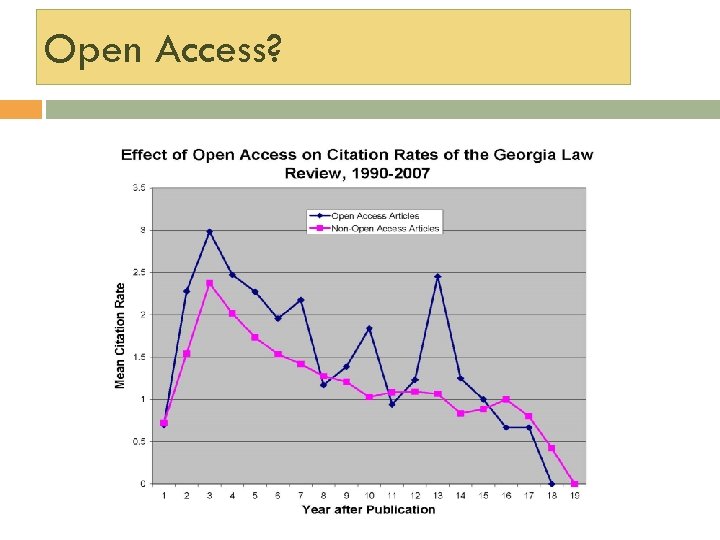
Open Access?
Which KIND of Open Access? SSRN v. Digital Commons
Factors to Consider Level of Promotion—SSRN favors individual, while Digital Commons prioritizes the institution Depth of Content—SSRN contains only text documents; Digital Commons allows a variety of file formats to be included Search Engine Visibility
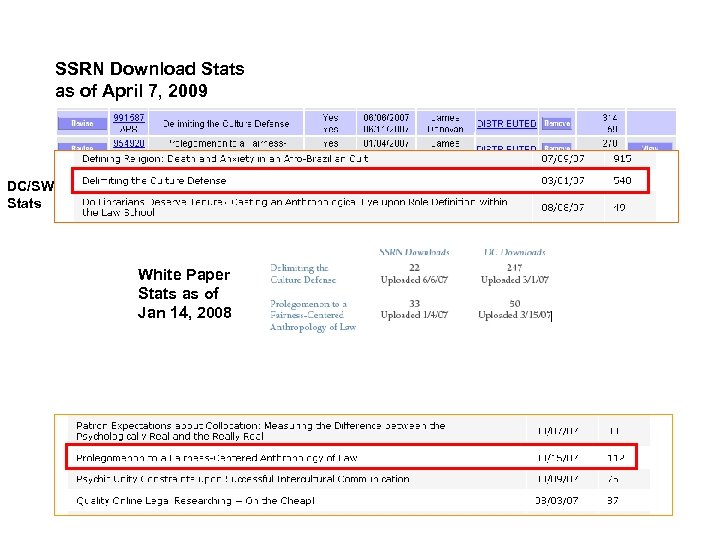
SSRN Download Stats as of April 7, 2009 DC/SW Stats White Paper Stats as of Jan 14, 2008
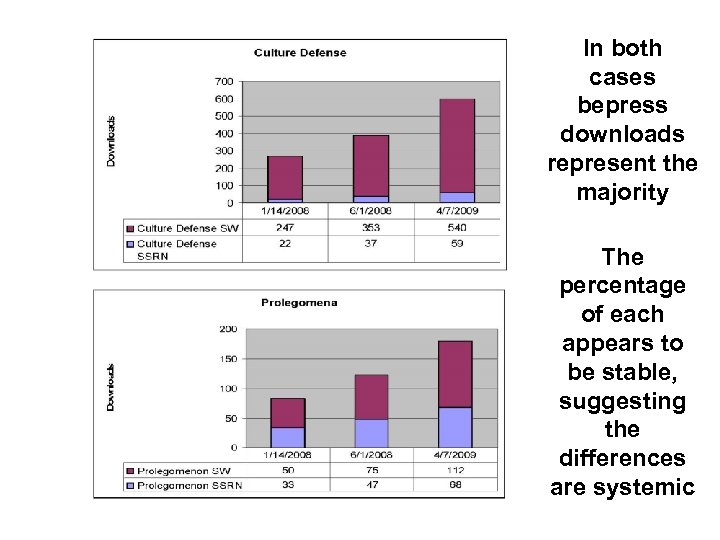
In both cases bepress downloads represent the majority The percentage of each appears to be stable, suggesting the differences are systemic
What About My SSRN Statistics? The concern: That IR documents will bleed download statistics away from SSRN, making my work appear unpopular. Wouldn’t those readers just use the SSRN copy instead?
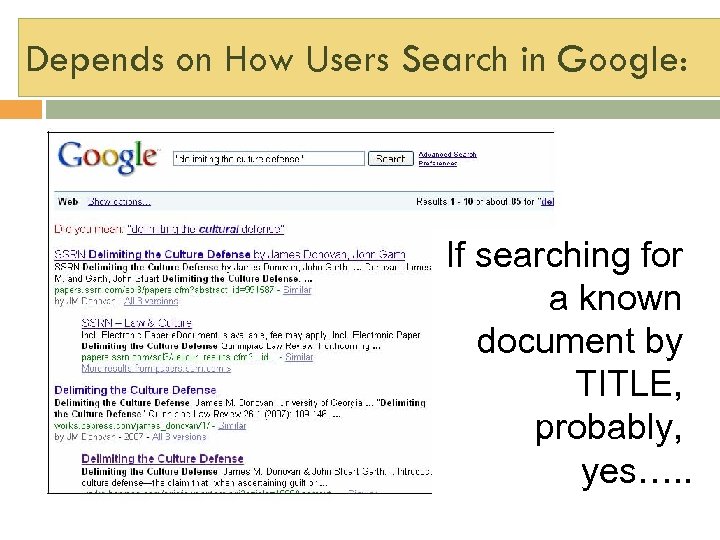
Depends on How Users Search in Google: If searching for a known document by TITLE, probably, yes…. .
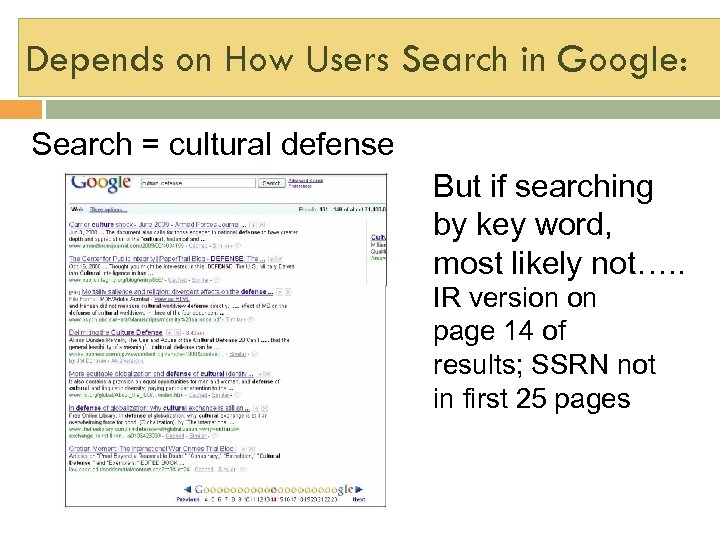
Depends on How Users Search in Google: Search = cultural defense But if searching by key word, most likely not…. . IR version on page 14 of results; SSRN not in first 25 pages
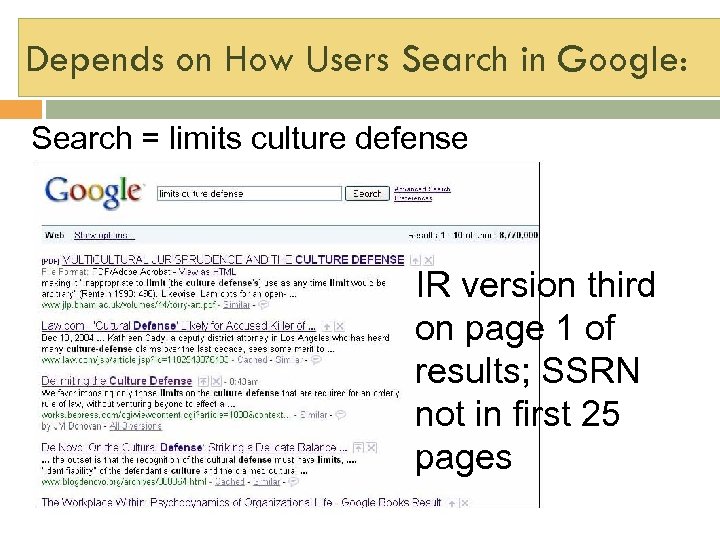
Depends on How Users Search in Google: Search = limits culture defense IR version third on page 1 of results; SSRN not in first 25 pages
What About My SSRN Statistics? Working hypothesis: IR may decrease SSRN statistics when users search in Google by title (the rare case); Those doing key word searching are far more likely to find only the IR document, so represent an absolute increase in readers, not displaced SSRN downloads
Our Conclusion: SSRN and Digital Commons are not redundant; each serves a different population of readers— SSRN targets immediate readers in the law community, Digital Commons/ Selected Works pushes longterm consumption by readers at large. Maximal distribution of scholarship requires both mechanisms. The dual expense is justified. However, as the advantages of SSRN can be obtained without a fee – individual uploads and inclusion in subject matter journals – if only one can be pursued, the institutional repository renders the greater return.

OBTAINING CONTENT AND BUILDING BUY-IN Carol A. Watson

Obtaining Content Building Buy-in ◦ Develop a Strategy to Promote Awareness of the Repository We populated each category with one representative document & included at least one document from each faculty. THEN…we held a wine and cheese reception.
Obtaining Content Building Buy-in Ease of submission is critical Direct submission Useful in an environment with a large contributor base Eliminates the need for contact with human intermediaries Mediated submission Better service Control over content Faculty are often unaware of copyright
Obtaining Content Building Buy-in Feedback and publicity promotes participation Monthly email report on downloads Link to full text in faculty bibliographies Tell a Colleague Paper of the Day At a Glance – top 10 downloads
Obtaining Content Building buy-in Improved placement in Google search results Long term preservation of documents with stable URLs Studies have shown online availability increases readership Steve Lawrence, “Online or Invisible, ” 411 Nature 521 (2001) James A. Evans and Jacob Reimer, “Open Access and Global Participation in Science, ” 323 Science 1025 (2009)

Establish Clear Content Policies 3 strategies: 1. 2. 3. Create distinct categories. For example, popular media vs. scholarly works Upload documents as supplements to a main record. Encourage faculty members to set up Select Works pages
COPYRIGHT: OBTAINING AND TRACKING PERMISSIONS James M. Donovan
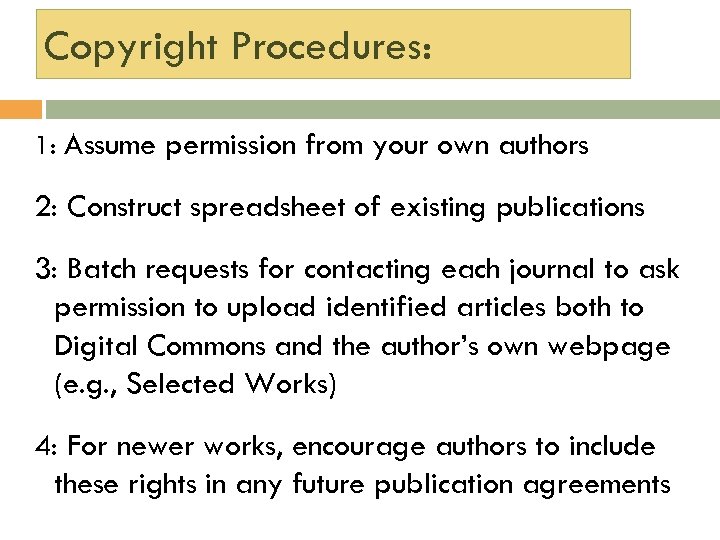
Copyright Procedures: 1: Assume permission from your own authors 2: Construct spreadsheet of existing publications 3: Batch requests for contacting each journal to ask permission to upload identified articles both to Digital Commons and the author’s own webpage (e. g. , Selected Works) 4: For newer works, encourage authors to include these rights in any future publication agreements
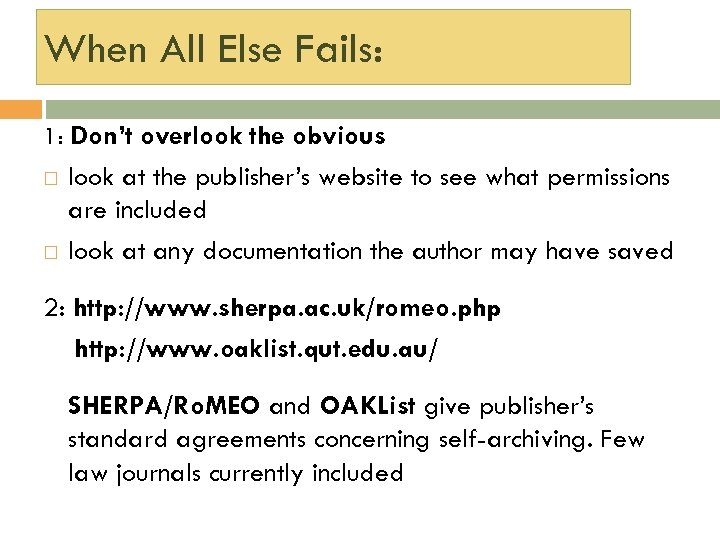
When All Else Fails: 1: Don’t overlook the obvious look at the publisher’s website to see what permissions are included look at any documentation the author may have saved 2: http: //www. sherpa. ac. uk/romeo. php http: //www. oaklist. qut. edu. au/ SHERPA/Ro. MEO and OAKList give publisher’s standard agreements concerning self-archiving. Few law journals currently included
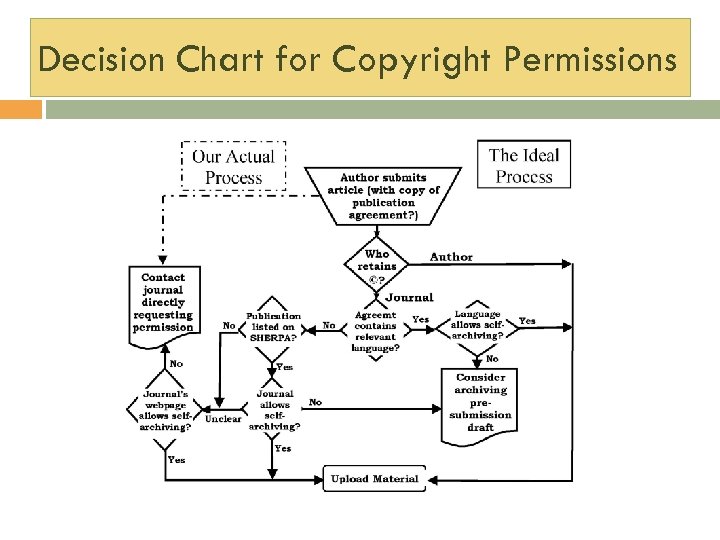
Decision Chart for Copyright Permissions
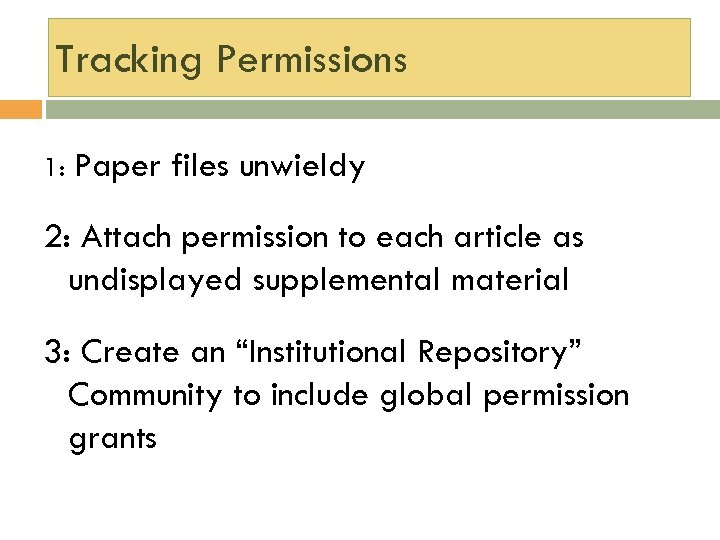
Tracking Permissions 1: Paper files unwieldy 2: Attach permission to each article as undisplayed supplemental material 3: Create an “Institutional Repository” Community to include global permission grants

EXPANDING THE REPOSITORY Carol A. Watson

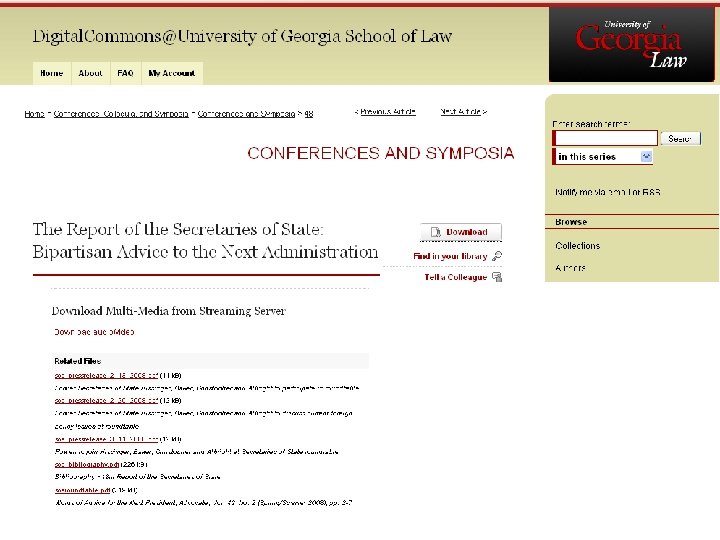
Expanding the IR Liaise with other administrative depts 16 th Annual Report of the Secretaries of State: Bipartisan Advice to the Next Administration
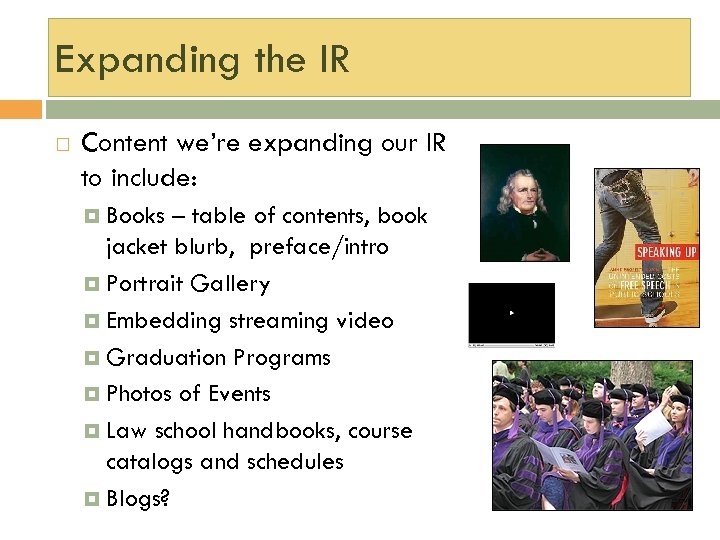
Expanding the IR Content we’re expanding our IR to include: Books – table of contents, book jacket blurb, preface/intro Portrait Gallery Embedding streaming video Graduation Programs Photos of Events Law school handbooks, course catalogs and schedules Blogs?
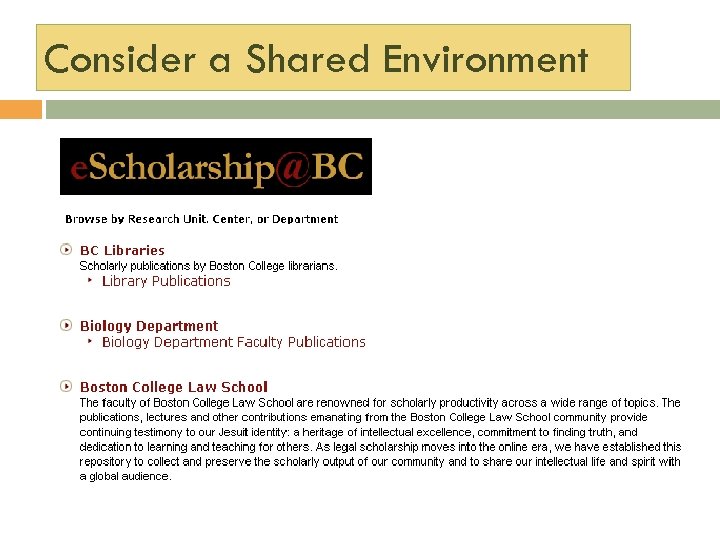
Consider a Shared Environment
Sharing an IR Advantages of sharing an IR Increased buying power Share tech support, experience & expertise Populate the IR more quickly Disadvantage of sharing an IR Loss of individual scholar’s primary institutional identity
Conclusion The goals of an IR are: to collect an institution or organization’s intellectual output, including gray literature to provide open access to repository materials to increase the visibility of the repository’s institution or organization Promoting the benefits of an IR is critical for a successful implementation.
Conclusion “Whether enhancing the scholarly reputation of an institution, serving as a historical archive of its achievements, or forging new relationships with peer institutions, the IR can become central to the organization’s mission to bring the world to its halls and to communicate its contributions. ”

For further reading: White Paper: Behind a Law School’s Decision to Implement an Institutional Repository James M. Donovan & Carol A. Watson, University of Georgia Law Library http: //digitalcommons. law. uga. edu/ir/1/
Скачать презентацию Persuasive Arguments for Establishing an Institutional Repository James
8e15fab532febc555252098064650eea.ppt