


 Скачать презентацию Perspectives on Meeting the Early Childhood Workforce Challenge
d8159117c0cb2cdd8334e8119b592826.ppt
- Количество слайдов: 38
 Perspectives on Meeting the Early Childhood Workforce Challenge Smart Start Conference May 8, 2009
 Today’s Session n A Child Care Provider’s Perspective ¨ n A Systems Perspective ¨ n Terry Casey, Pennsylvania Child Care Association The Changing Policy Context ¨ n Barbara Thompson, U. S. Department of Defense Addressing the Workforce at the State Level ¨ n Sara Moleski-Rice, Learning Care Group Mary Beth Salomone, Early Care and Education Consortium Discussion 2
 A Child Care Provider’s Perspective Dr. Sara Moleski-Rice Learning Care Group (248) 697 -9185 srice@learningcaregroup. com 3
 Child Care Workforce Dilemma n Rising expectation for credentialed staff ¨ Consensus: early childhood education needs “quality” ¨ The issue: quality = BA? Sooner or later? n ECE/child care divide – NAEYC Accreditation n Reality: diminishing talent pool n Compete with health care, education, service industries 4
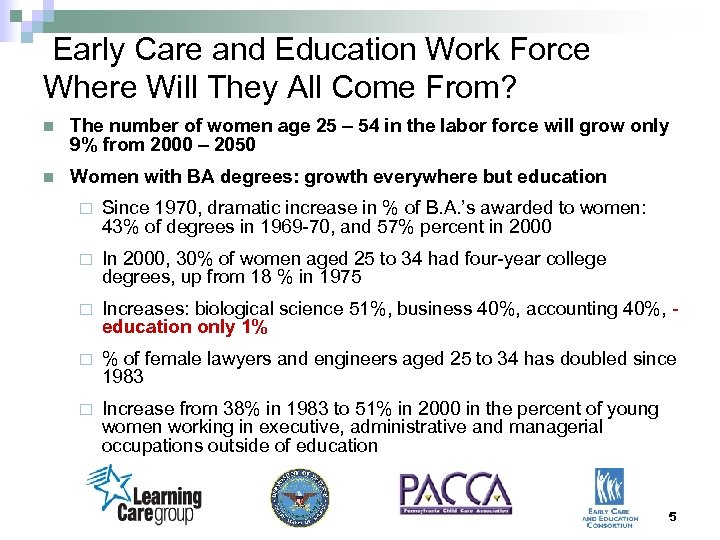 Early Care and Education Work Force Where Will They All Come From? n The number of women age 25 – 54 in the labor force will grow only 9% from 2000 – 2050 n Women with BA degrees: growth everywhere but education ¨ Since 1970, dramatic increase in % of B. A. ’s awarded to women: 43% of degrees in 1969 -70, and 57% percent in 2000 ¨ In 2000, 30% of women aged 25 to 34 had four-year college degrees, up from 18 % in 1975 ¨ Increases: biological science 51%, business 40%, accounting 40%, - education only 1% ¨ % of female lawyers and engineers aged 25 to 34 has doubled since 1983 ¨ Increase from 38% in 1983 to 51% in 2000 in the percent of young women working in executive, administrative and managerial occupations outside of education 5
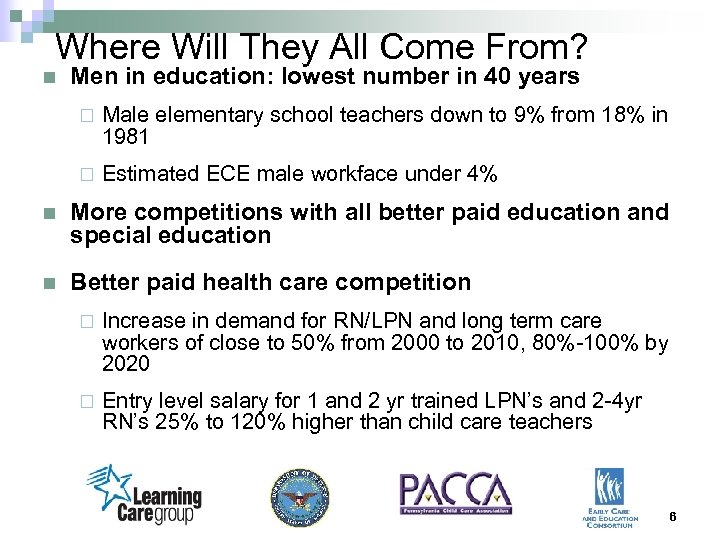 Where Will They All Come From? n Men in education: lowest number in 40 years ¨ Male elementary school teachers down to 9% from 18% in 1981 ¨ Estimated ECE male workface under 4% n More competitions with all better paid education and special education n Better paid health care competition ¨ Increase in demand for RN/LPN and long term care workers of close to 50% from 2000 to 2010, 80%-100% by 2020 ¨ Entry level salary for 1 and 2 yr trained LPN’s and 2 -4 yr RN’s 25% to 120% higher than child care teachers 6
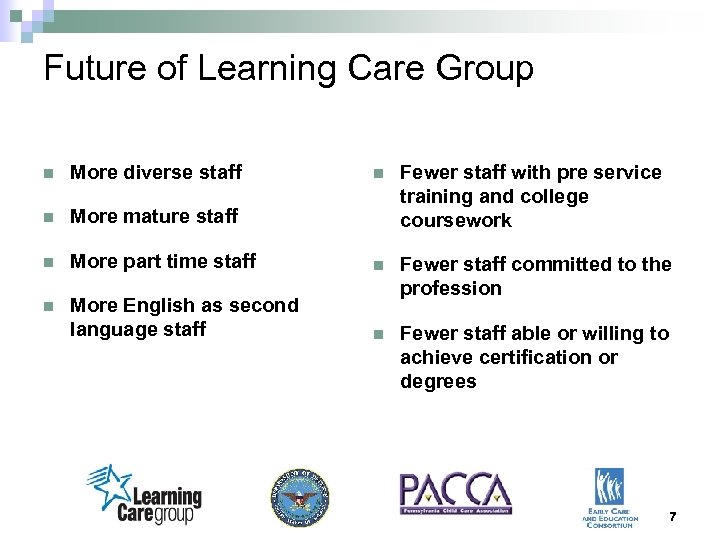 Future of Learning Care Group t Horizons Workforce n More diverse staff n Fewer staff with pre service training and college coursework n More mature staff n More part time staff n More English as second language staff Fewer staff committed to the profession n n Fewer staff able or willing to achieve certification or degrees 7
 A System’s Perspective Barbara Thompson Office of Family Policy/Children and Youth U. S. Department of Defense Barbara. Thompson@osd. mil
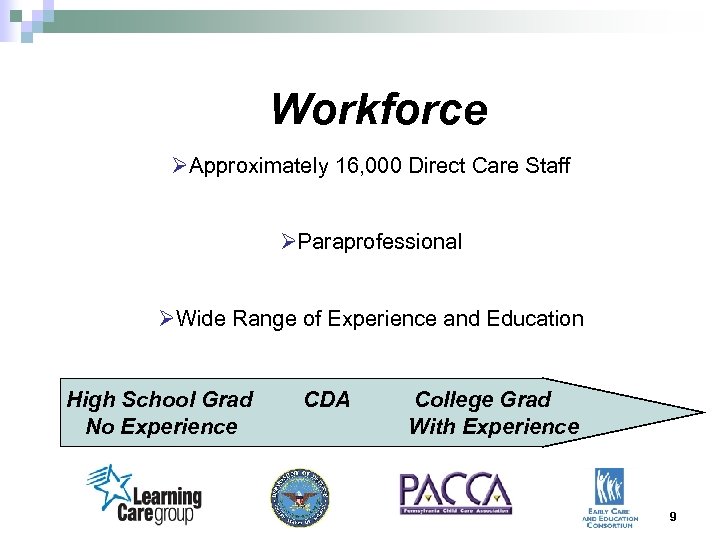 Workforce ØApproximately 16, 000 Direct Care Staff ØParaprofessional ØWide Range of Experience and Education High School Grad No Experience CDA College Grad With Experience 9
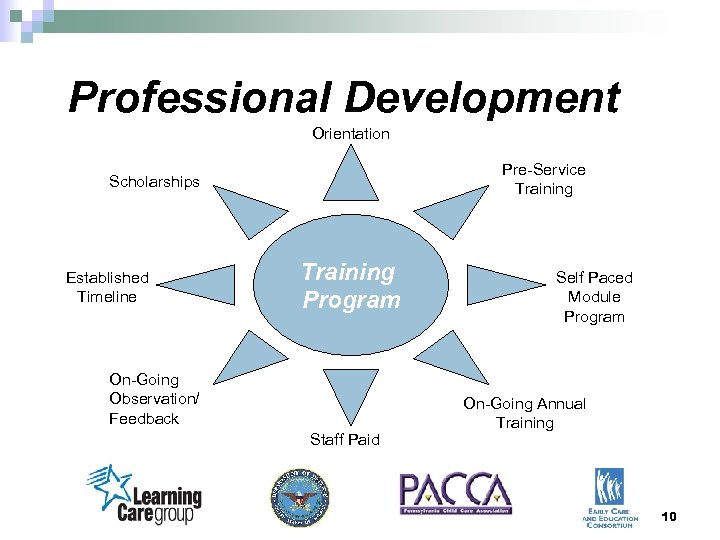 Professional Development Orientation Pre-Service Training Scholarships Established Timeline Training Program On-Going Observation/ Feedback Staff Paid Self Paced Module Program On-Going Annual Training 10
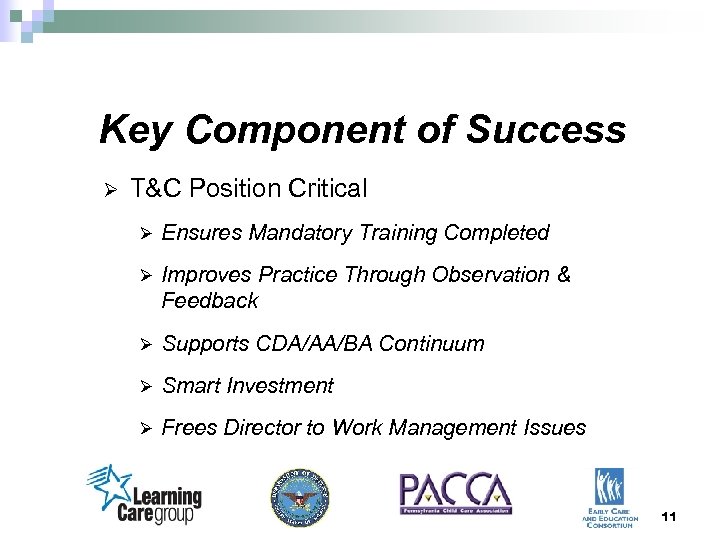 Key Component of Success Ø T&C Position Critical Ø Ensures Mandatory Training Completed Ø Improves Practice Through Observation & Feedback Ø Supports CDA/AA/BA Continuum Ø Smart Investment Ø Frees Director to Work Management Issues 11
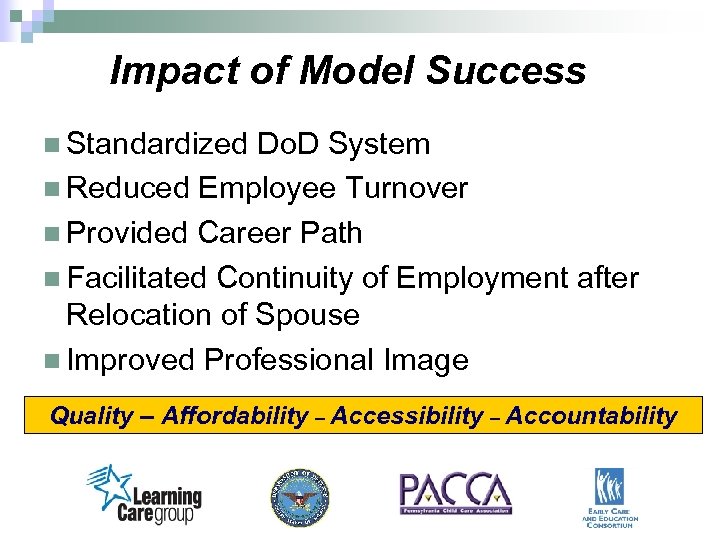 Impact of Model Success n Standardized Do. D System n Reduced Employee Turnover n Provided Career Path n Facilitated Continuity of Employment after Relocation of Spouse n Improved Professional Image Quality – Affordability – Accessibility – Accountability
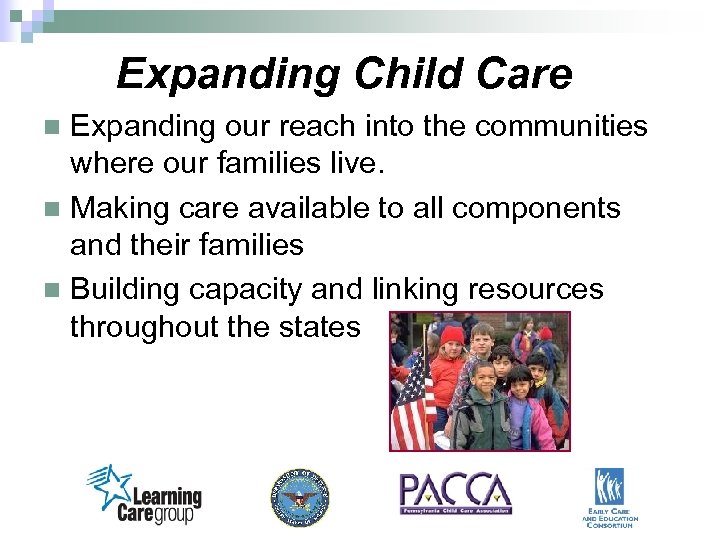 Expanding Child Care Expanding our reach into the communities where our families live. n Making care available to all components and their families n Building capacity and linking resources throughout the states n
 Expanding Child Care Do. D is expanding the process to n n n Identify care providers who want to serve military families Evaluate their level of quality using an assessment tool currently under development and Provide training and technical assistance offered through multiple partners such as the County Extension offices and local R&Rs to increase the providers’ level of quality
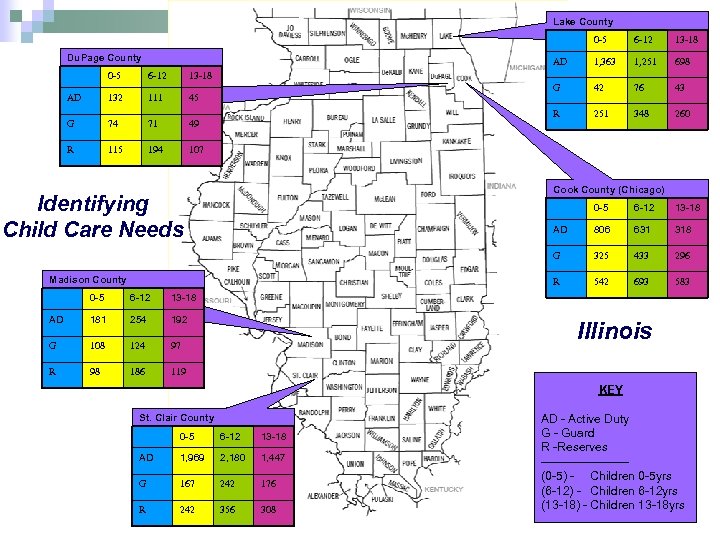 Lake County 0 -5 6 -12 132 111 G 74 71 R 115 194 698 42 76 43 R 49 1, 251 G 45 1, 363 251 348 260 13 -18 AD Du. Page County 6 -12 107 Cook County (Chicago) Identifying Child Care Needs 0 -5 181 254 192 G 108 124 97 R 98 186 318 325 433 296 542 693 583 13 -18 AD 631 R 6 -12 806 G 0 -5 13 -18 AD Madison County 6 -12 119 Illinois KEY St. Clair County 0 -5 6 -12 13 -18 AD 1, 969 2, 180 1, 447 G 167 242 176 R 242 356 308 AD - Active Duty G - Guard R -Reserves -----------(0 -5) - Children 0 -5 yrs (6 -12) - Children 6 -12 yrs (13 -18) - Children 13 -18 yrs
 Workforce n n n Establishing partnerships to attract and retain a high-quality workforce in Child Development, Youth Development, Counseling, Family Support, & Financial Management. Focusing on Land Grant University System, its Cooperative Extension Service in every county and the territories, and headquarters agency in USDA. Developing outreach strategies to increase the number of students completing internships and pursuing professional careers. Establishing campus-based partnerships to identify promising or best practices; develop training programs; and create campus-based seminars, colloquia, workshops, distal learning. Conducting research on the impact and quality of programs.
 For More Information Website: http: //militaryhomefront. dod. mil n Download Staffing Your Child Care Center at http: //www. cfs. purdue. edu/mfri/pages/rese arch/staffing_your_child_care_center. pdf n
 Addressing the Workforce at the State Level Terry Casey Pennsylvania Child Care Association (717) 657 -9000, ext. 114 terry@pacca. org 18
 Pennsylvania: Workforce Challenges vs Great Expectations n Some “Challenges” PA faces with ECE workforce? Ø High turnover ü ü Low wages Non-competing benefits More opportunity elsewhere Job stress Loss of degreed staff Ø Shrinking higher education programs to deliver ECE degree and credentials Ø 19
 Pennsylvania: Workforce Challenges vs Great Expectations n What are some of the “Great Expectations”? Ø Improving quality care and early learning for children through Keystone STARS (quality rating system) Ø Professionalization and retention of ECE practitioners Community programs participating/partnering in PA’s Pre K Counts initiative Ø 20
 Strategies to Overcome Challenges Financial incentives for child care programs and staff thru Keystone STARS: ¨ T. E. A. C. H. Early Childhood ® PENNSYLVANIA scholarship ¨ Educational Retention Award ¨ Merit Award ¨ Tiered reimbursement 21
 What is T. E. A. C. H. ? n Teacher Education And Compensation Helps is a nationally licensed scholarship program out of NC administered in PA by PACCA n Designed for those working in the early childhood field n Scholarship pays for 80% of tuition and fees, reimburses 75% of books, provides an $100 stipend to help with travel costs, reimburses sponsoring program for 75% of release time at $9 per hour. n Provides other supports such as counselor. 22
 Highlights of T. E. A. C. H. Scholarship n n n Nationally licensed program administered by statewide advocacy organizations in each of 22 states (more coming on board) Scholarship built on principles of maintaining and strengthening existing systems within each state Enables current workforce to work toward degree or credential in ECE Increases education and compensation of workforce Helps to retain educated staff in sponsoring programs 23
 Added Value of T. E. A. C. H. n Helps better serve communities through workforce development, n Builds advocacy base and empowerment, n Maintains and strengthens existing systems including higher education. 24
 T. E. A. C. H. scholarships funded in PA include. . . CDA Credential n CDA Assessment n Associate n Bachelor n PA Director Credential n Coming in 08 -09: scholarships for student teaching, practicum, & certification 25
 Overview from 1998 to 2007 n n n PACCA has awarded over 4, 700 scholarships in 65 out of 67 counties Recipients have completed over 55, 000 college credits at 40 participating colleges & universities 2, 100+/- child care programs have sponsored a scholarship recipient. 500+ graduates have earned an AA degree or CDA credentials. Compensation has increased by 34% over 4 contracts with turnover rate at 3% after 4 contracts 26
 T. E. A. C. H. Participant Profile n n n 98% are women 41% are persons of color 49% only have a high school diploma or GED 37% have some credit hours toward a 2 year degree 66% are parents 66% have household incomes of less than $20, 000 per year 27
 Workforce Needs More Educational Retention Awards (ERA) (depending on education level and size of program bonuses range from $250 to $5, 000) n Health Insurance – PA does not have a health insurance program for ECE workforce n ECE programs need help finding substitutes n System needs strong infrastructure and resources n 28
 Where does the funding come from? n In PA the funding comes from state and federal dollars as well as private sources such as foundations. n Programs must be in Keystone STARS and serving a minimum of 5% subsidy children to be eligible for Merit award and ERA funding. n Pre K Counts is funded at $75 million of state dollars. 29
 Why is it important to have a well educated, compensated workforce? n Good for young children n Good for workforce n Good for community programs that wish to be Pre K Counts provider (Must be STAR 2 or above now and STAR 3 by June 30, 2009. ) 30
 Useful websites for PA info n www. pacca. org – T. E. A. C. H. scholarship information, resource and information clearinghouse, plus advocacy n www. pakeys. org – Professional development information; Keystone STARS info on standards, career lattice, financial rewards 31
 The Changing Policy Context Mary Beth Salomone Early Care and Education Consortium (202) 408 -9623 msalomone@ececonsortium. org
 Rising Expectations Different requirements in settings: n Head Start ¨ 50% of teachers to have a BA by 2012 n State Pre. K ¨ BA, AA, other n Child Care Regulations ¨ No state requires a BA ¨ Pre-service, ongoing training (if that)
 Opportunities Policy n Higher Ed Act 2008 n CCDBG reauthorization n Challenge Grants n Pre. K Initiatives n QRIS n Focus on “systems” Funding n Recovery Act n FY 10 Appropriations?
 Challenges n Funds ¨ Tuition increasing ¨ State budget cuts ¨ FY 10 appropriations? n Capacity ¨ Insufficient availability of education and training programs n Time ¨ Legislation calling for BA in quick turnaround ¨ “Fake barrier”
 Increasing Awareness Same babies and young children, same workforce n House Education Committee hearings n ¨ Chairman: “false dichotomy” of work support and early learning n Senate legislation ¨ Pre. K and Child Care in separate bills ¨ Separate bills sometimes with same sponsor…
 Policy Priorities Staff qualifications and pre-service requirements ü Multiple pathways to achievement ü Recruit and retain ü
 For more information: www. ececonsortium. org Click on Issues in Focus C