


 Скачать презентацию Perspectives on LHC Computing José M Hernández CIEMAT
f8251499ad0487d6095ba3bb5c82fb7d.ppt
- Количество слайдов: 19
 Perspectives on LHC Computing José M. Hernández (CIEMAT, Madrid) On behalf of the Spanish LHC Computing community Jornadas CPAN 2013, Santiago de Compostela
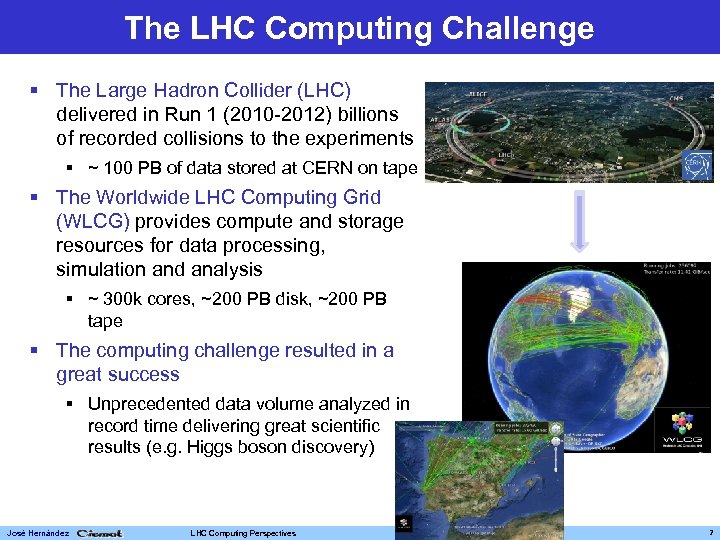 The LHC Computing Challenge § The Large Hadron Collider (LHC) delivered in Run 1 (2010 -2012) billions of recorded collisions to the experiments § ~ 100 PB of data stored at CERN on tape § The Worldwide LHC Computing Grid (WLCG) provides compute and storage resources for data processing, simulation and analysis § ~ 300 k cores, ~200 PB disk, ~200 PB tape § The computing challenge resulted in a great success § Unprecedented data volume analyzed in record time delivering great scientific results (e. g. Higgs boson discovery) José Hernández LHC Computing Perspectives 2
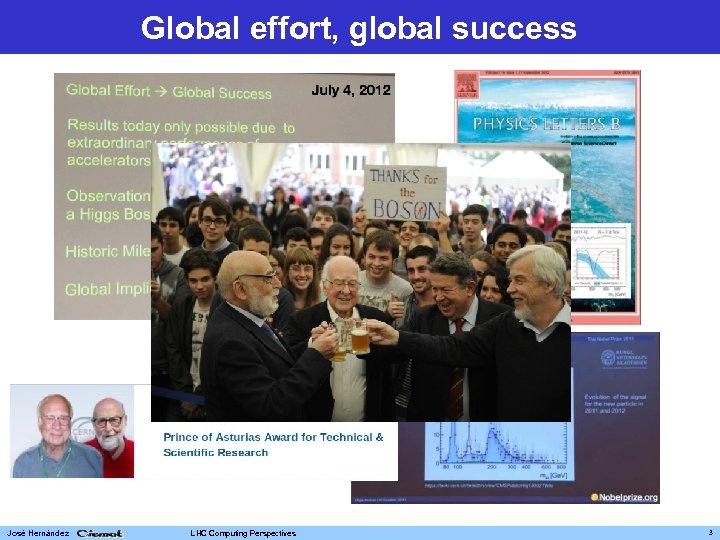 Global effort, global success José Hernández LHC Computing Perspectives 3
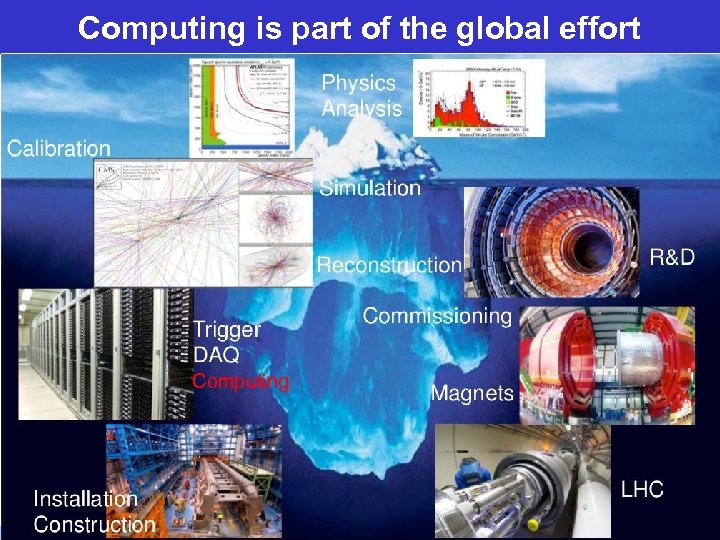 Computing is part of the global effort Computing José Hernández CMS Computing Upgrade and Evolution 28 October 2013, Seoul, Korea 4
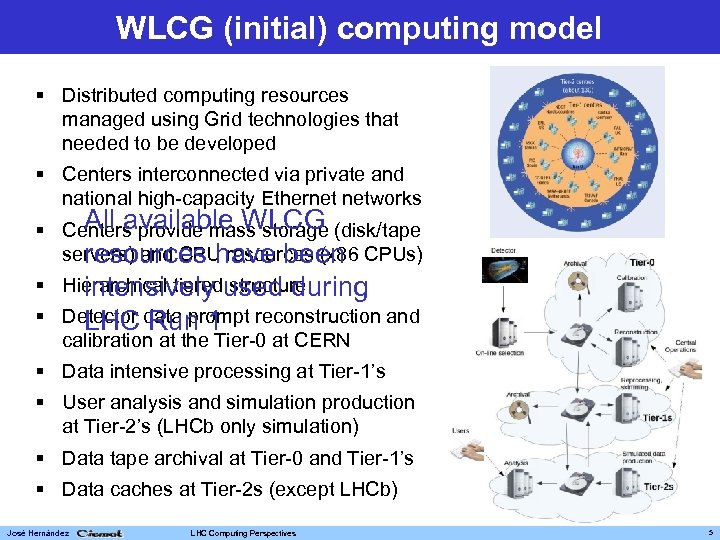 WLCG (initial) computing model § Distributed computing resources managed using Grid technologies that needed to be developed § Centers interconnected via private and national high-capacity Ethernet networks All available WLCG § Centers provide mass storage (disk/tape servers) and CPU resources (x 86 CPUs) resources have been § Hierarchical tieredused during intensively structure § Detector data prompt reconstruction and LHC Run 1 calibration at the Tier-0 at CERN § Data intensive processing at Tier-1’s § User analysis and simulation production at Tier-2’s (LHCb only simulation) § Data tape archival at Tier-0 and Tier-1’s § Data caches at Tier-2 s (except LHCb) José Hernández LHC Computing Perspectives 5
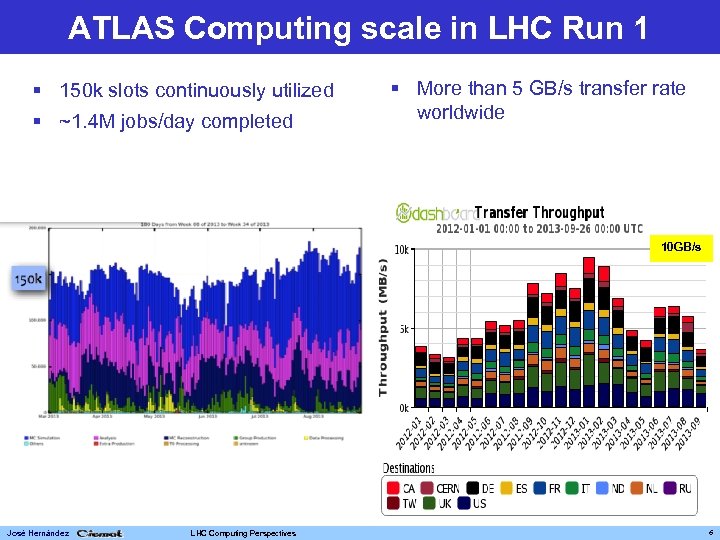 ATLAS Computing scale in LHC Run 1 § 150 k slots continuously utilized § ~1. 4 M jobs/day completed § More than 5 GB/s transfer rate worldwide 10 GB/s José Hernández LHC Computing Perspectives 6
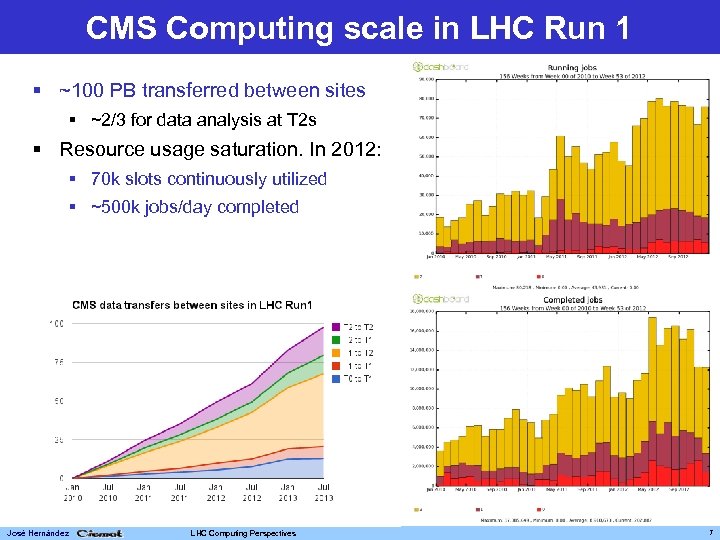 CMS Computing scale in LHC Run 1 § ~100 PB transferred between sites § ~2/3 for data analysis at T 2 s § Resource usage saturation. In 2012: § 70 k slots continuously utilized § ~500 k jobs/day completed José Hernández LHC Computing Perspectives 7
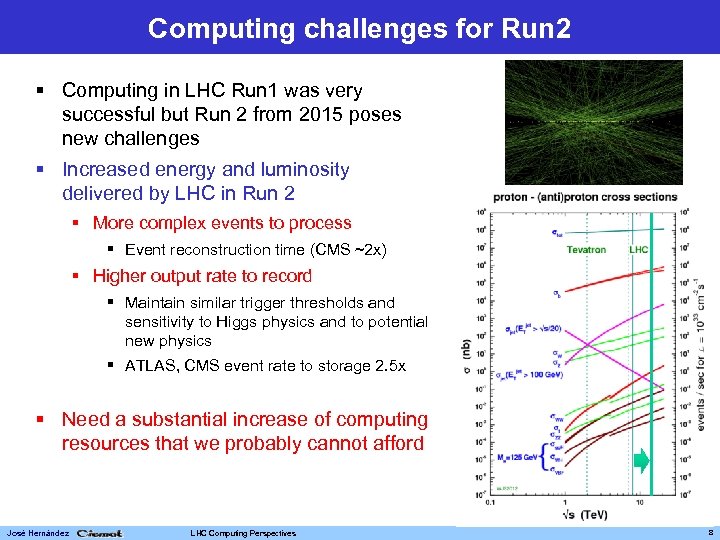 Computing challenges for Run 2 § Computing in LHC Run 1 was very successful but Run 2 from 2015 poses new challenges § Increased energy and luminosity delivered by LHC in Run 2 § More complex events to process § Event reconstruction time (CMS ~2 x) § Higher output rate to record § Maintain similar trigger thresholds and sensitivity to Higgs physics and to potential new physics § ATLAS, CMS event rate to storage 2. 5 x § Need a substantial increase of computing resources that we probably cannot afford José Hernández LHC Computing Perspectives 8
 Upgrading LHC Computing in LS 1 § The shutdown period is a valuable opportunity to asses § Lessons and operational experiences of Run 1 § Computing demands of Run 2 § The technical and cost evolution of computing § Undertake intensive planning and development to prepare LHC Computing for 2015 and beyond § While sustaining steady state full scale operations § With an assumption of constrained funding § This has been happening internally to the experiments and collaboratively with CERN IT, WLCG, common software and computing projects § Upgrade in parallel to accelerator and detector upgrades to push the frontiers of HEP José Hernández LHC Computing Perspectives 9
 Computing strategy for Run 2 § Increase resources in WLCG as much as possible § Try to conform to constrained budget situation § Make a more efficient and flexible use of the available resources § Reduce CPU and storage needs § Less reprocessing passes, less simulated events, more compact data format, reduce data replication factor § Intelligent dynamic data placement § Automatic replication of hot data and deletion of cold data § Break down the boundaries between the computing tiers § Run reconstruction, simulation and analysis at Tier-1/Tier-2 indistinctly § Tier-1 s extension of the Tier-0 § Keep higher service level and custodial tape storage at Tier-1 § Centralized production of group analysis datasets § Shrink ‘chaotic analysis’ to only what really is user specific § Remove redundancies in processing and storage, reducing operational workloads while improving turnaround for users José Hernández LHC Computing Perspectives 10
 Access to new resources for Run 2 § Access to opportunistic resources § HPC clusters, academic or commercial clouds, volunteer computing § Significant increase in capacity with low cost (satisfy capacity peaks) § Use HLT farm for offline data processing § A significant resource (>10 k slots) § During extended periods with no data taking and even inter-fill periods § Adopt advanced architectures § Processing in Run 1 done under Enterprise Linux on x 86 CPUs § Many-core processors, low-power CPUs, GPU environments § Challenging heterogeneous environment § Parallelization of processing application will be key José Hernández LHC Computing Perspectives 11
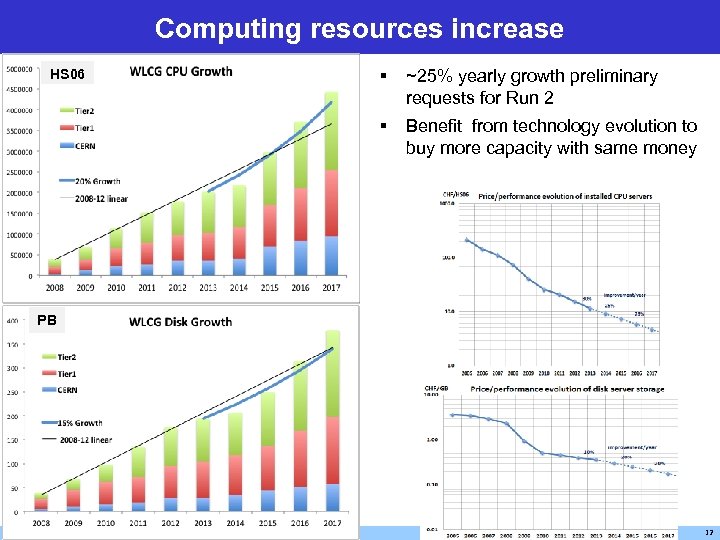 Computing resources increase § ~25% yearly growth preliminary requests for Run 2 § HS 06 Benefit from technology evolution to buy more capacity with same money PB José Hernández LHC Computing Perspectives 12
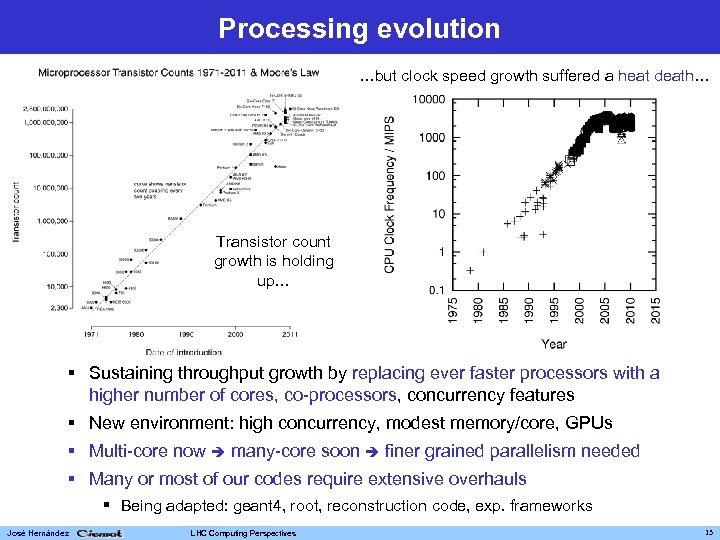 Processing evolution …but clock speed growth suffered a heat death… Transistor count growth is holding up… § Sustaining throughput growth by replacing ever faster processors with a higher number of cores, co-processors, concurrency features § New environment: high concurrency, modest memory/core, GPUs § Multi-core now many-core soon finer grained parallelism needed § Many or most of our codes require extensive overhauls § Being adapted: geant 4, root, reconstruction code, exp. frameworks José Hernández LHC Computing Perspectives 13
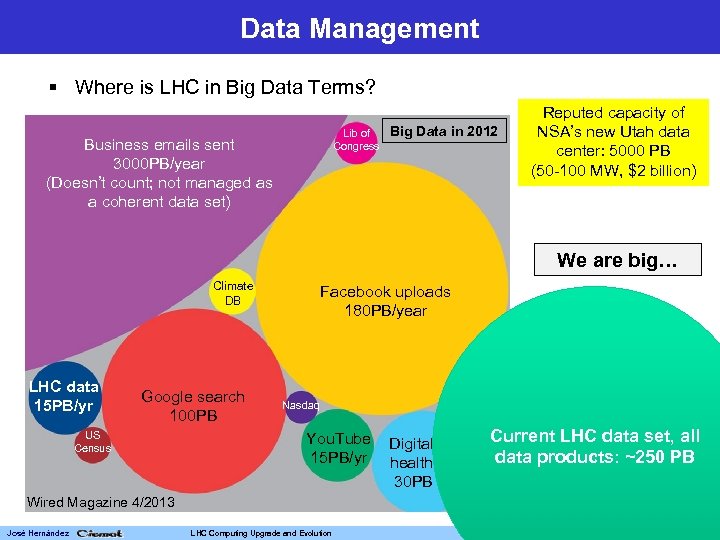 Data Management § Where is LHC in Big Data Terms? Lib of Congress Business emails sent 3000 PB/year (Doesn’t count; not managed as a coherent data set) Big Data in 2012 Reputed capacity of NSA’s new Utah data center: 5000 PB (50 -100 MW, $2 billion) We are big… Climate DB LHC data 15 PB/yr Google search 100 PB US Census Facebook uploads 180 PB/year Nasdaq You. Tube 15 PB/yr Digital health 30 PB Current LHC data set, all data products: ~250 PB Wired Magazine 4/2013 José Hernández LHC Computing Upgrade and Evolution 14
 Data Management evolution § Data access model during LHC Run 1 § Pre-locate and replicate data at sites, send jobs to the data § We need more efficient distributed data handling, lower disk storage demands and better use of available CPU resources § The network has been very reliable and has experimented a large increase in bandwidth § (Aspire to) send only the data you need, only where you need it (and cache it when it arrives) § Towards transparent distributed data access enabled by the network § Industry has been at this approach for years, in content delivery networks § Already successful approaches during Run 1… José Hernández LHC Computing Perspectives 15
 Data Management evolution in Run 1 § Scalable access to conditions data § Frontier for Scalable Distributed DB Access § Caching web proxies provide hierarchical, highly scalable cache based data access § Experiment software provisioning to the worker nodes § CERNVM File System (CVMFS) § Evolve towards a distributed data federation… José Hernández LHC Computing Perspectives 16
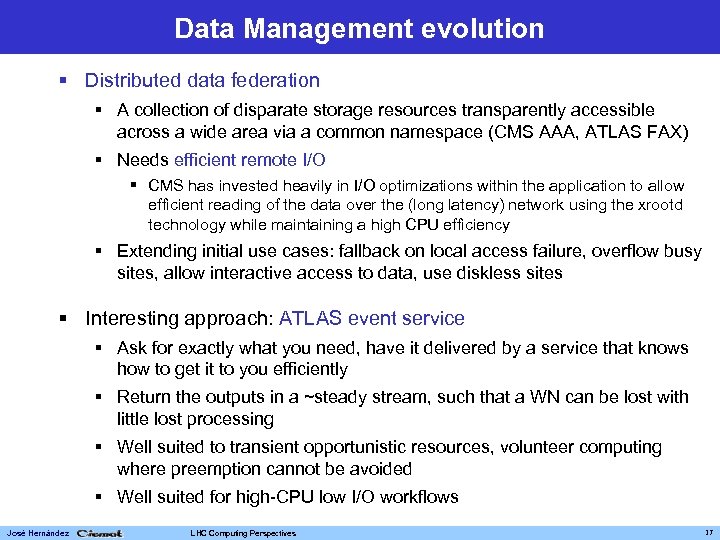 Data Management evolution § Distributed data federation § A collection of disparate storage resources transparently accessible across a wide area via a common namespace (CMS AAA, ATLAS FAX) § Needs efficient remote I/O § CMS has invested heavily in I/O optimizations within the application to allow efficient reading of the data over the (long latency) network using the xrootd technology while maintaining a high CPU efficiency § Extending initial use cases: fallback on local access failure, overflow busy sites, allow interactive access to data, use diskless sites § Interesting approach: ATLAS event service § Ask for exactly what you need, have it delivered by a service that knows how to get it to you efficiently § Return the outputs in a ~steady stream, such that a WN can be lost with little lost processing § Well suited to transient opportunistic resources, volunteer computing where preemption cannot be avoided § Well suited for high-CPU low I/O workflows José Hernández LHC Computing Perspectives 17
 From Grid to Clouds § Turning computing into a utility providing infrastructure as a service § Clouds evolve, complement and extend the Grid § Decrease heterogeneity seen by the user (hardware virtualization) § VMs provide a uniform user interface to resources § Integrate diverse resources manageably § Isolate software from physical hardware § Dynamic provision of resources § New resources (commercial, research clouds) § Huge community behind Cloud software § Grid of clouds already used by LHC exps § Several sites provide Cloud interface § ATLAS ~450 k production jobs from Google over a few weeks § Tests on amazon EC spot pricing ~economically viable José Hernández LHC Computing Perspectives 18
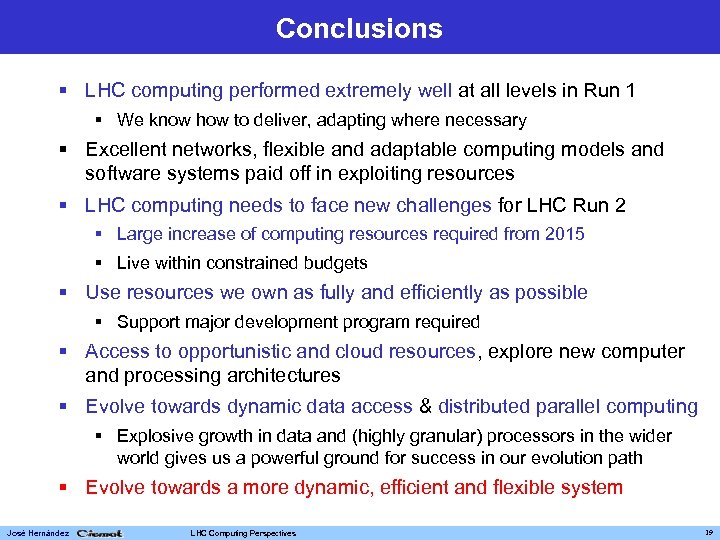 Conclusions § LHC computing performed extremely well at all levels in Run 1 § We know how to deliver, adapting where necessary § Excellent networks, flexible and adaptable computing models and software systems paid off in exploiting resources § LHC computing needs to face new challenges for LHC Run 2 § Large increase of computing resources required from 2015 § Live within constrained budgets § Use resources we own as fully and efficiently as possible § Support major development program required § Access to opportunistic and cloud resources, explore new computer and processing architectures § Evolve towards dynamic data access & distributed parallel computing § Explosive growth in data and (highly granular) processors in the wider world gives us a powerful ground for success in our evolution path § Evolve towards a more dynamic, efficient and flexible system José Hernández LHC Computing Perspectives 19