


 Скачать презентацию Perspectives of APAN For the next Generation GTS
c2bcdb2947f4337a13eb9ac3d59990c7.ppt
- Количество слайдов: 45
 Perspectives of APAN For the next Generation GTS of WMO 2003. 1. 22 Korea Meteorological Administration Dongil Lee
 Contents I. Understanding the needs II. Global Telecommunication System (GTS) III. Future WMO Information System IV. Future Plan
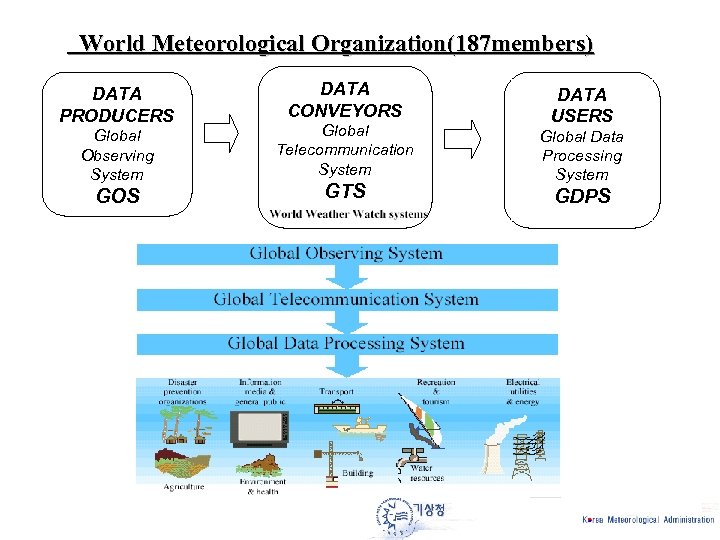 World Meteorological Organization(187 members) DATA PRODUCERS Global Observing System GOS DATA CONVEYORS Global Telecommunication System GTS DATA USERS Global Data Processing System GDPS
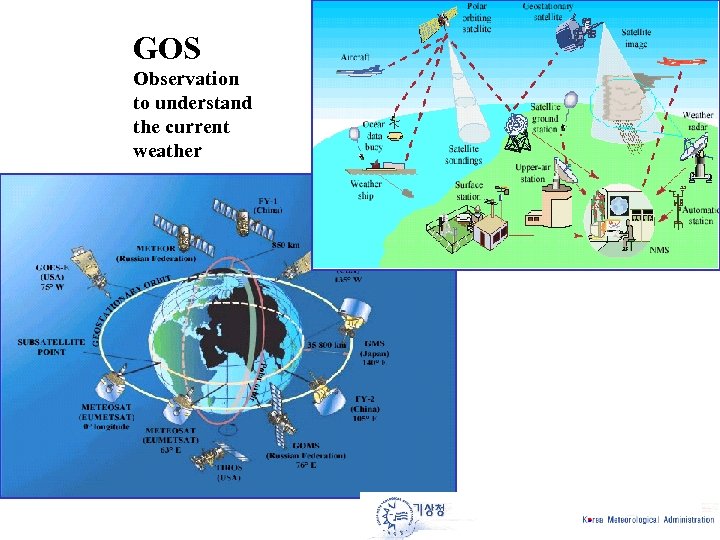 GOS Observation to understand the current weather
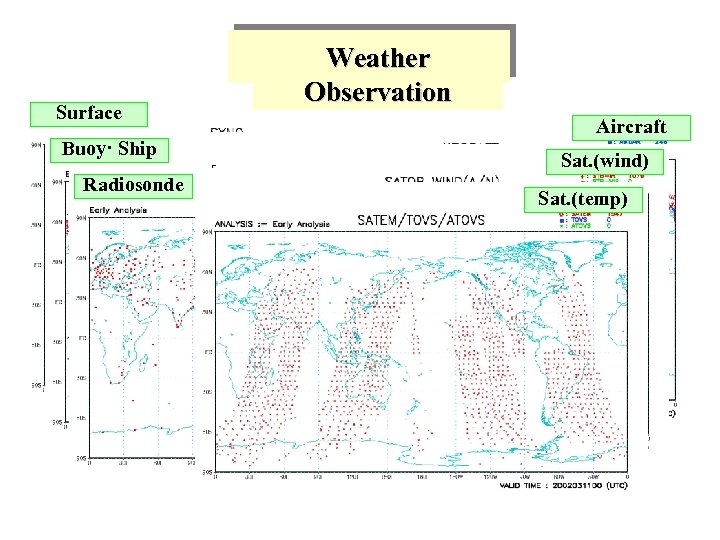 Surface Buoy· Ship Radiosonde Weather Observation Aircraft Sat. (wind) Sat. (temp)
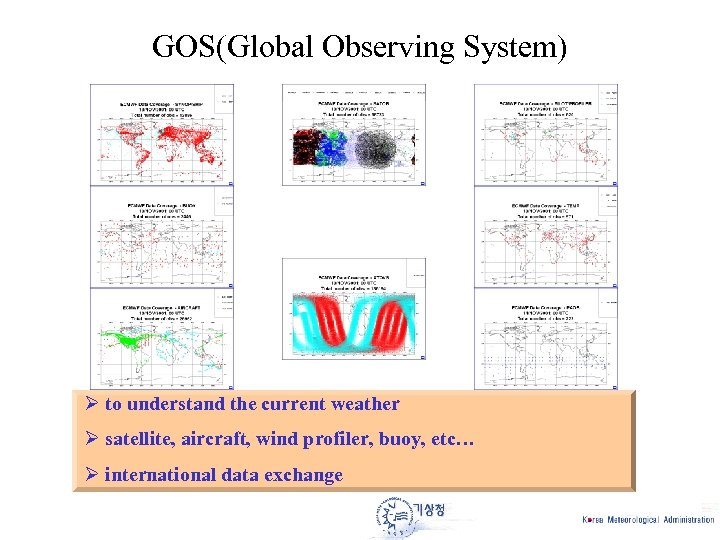 GOS(Global Observing System) Ø to understand the current weather Ø satellite, aircraft, wind profiler, buoy, etc… Ø international data exchange
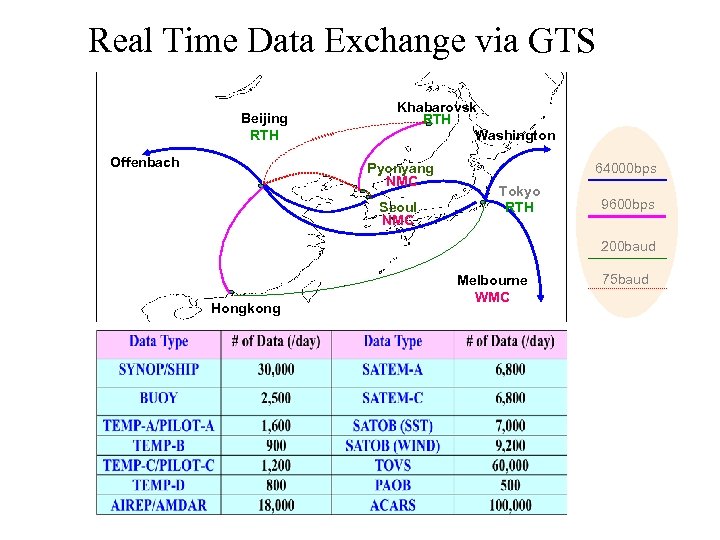 Real Time Data Exchange via GTS Beijing RTH Offenbach Khabarovsk RTH Washington Pyonyang NMC Seoul NMC 64000 bps Tokyo RTH 9600 bps 200 baud Hongkong Melbourne WMC 75 baud
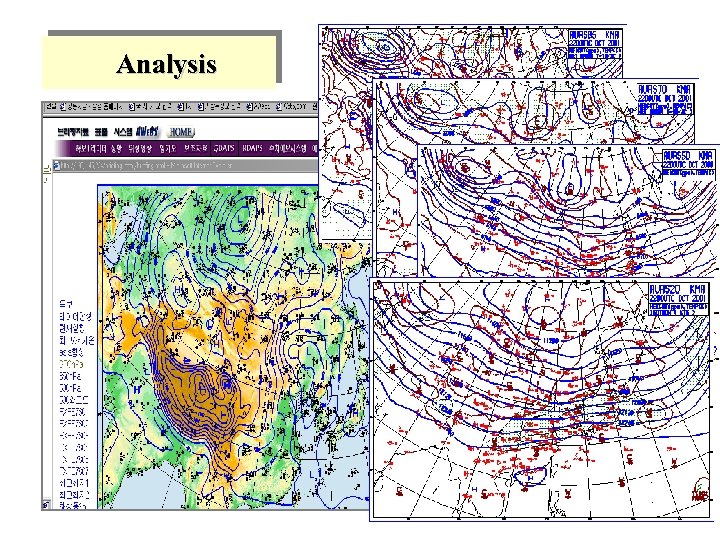
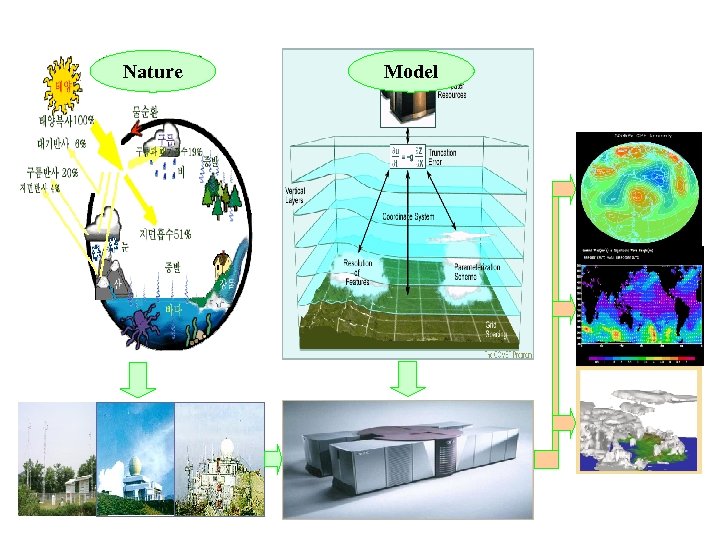
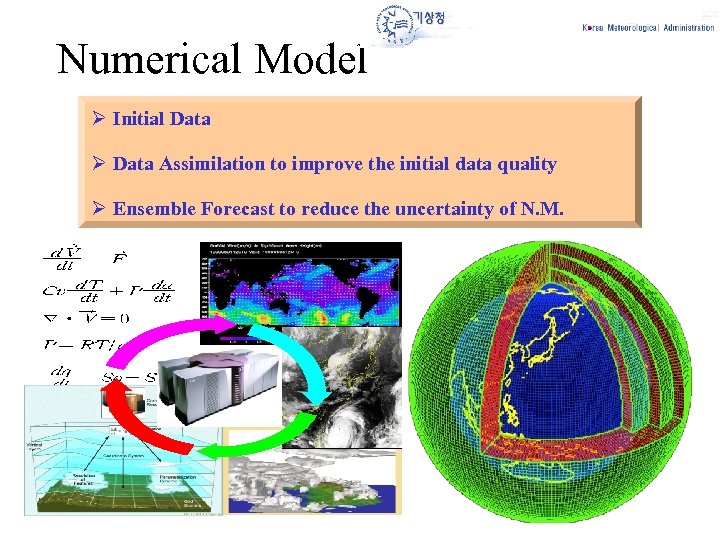
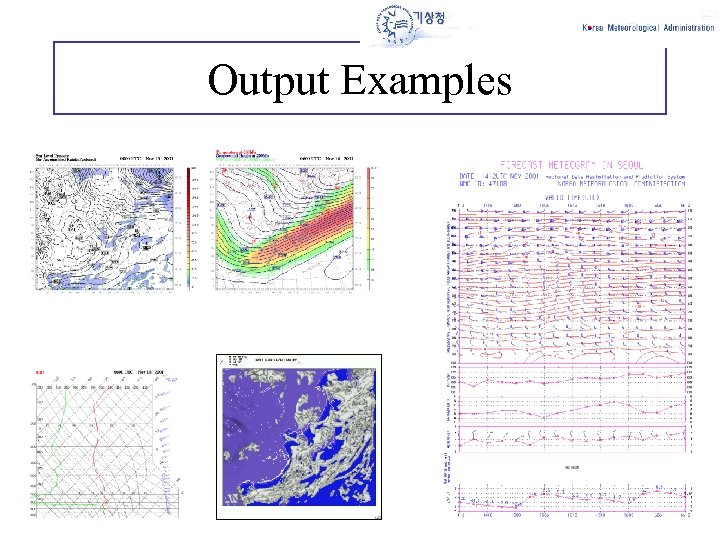
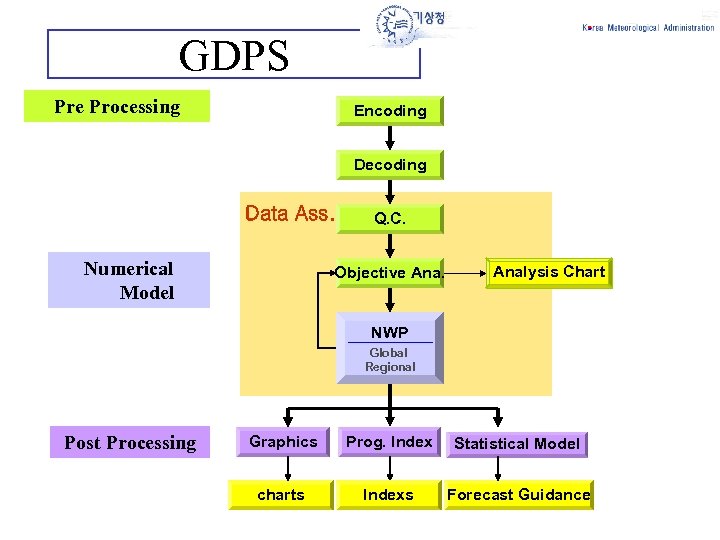 GDPS Pre Processing Encoding Decoding Data Ass. Numerical Model Q. C. Objective Analysis Chart NWP Global Regional Post Processing Graphics Prog. Index Statistical Model charts Indexs Forecast Guidance
 Analysis
 Nature Model
 Numerical Model Ø Initial Data q 예보모델 Ø Data Assimilation to improve the initial data quality Ø Ensemble Forecast to reduce the uncertainty of N. M.
 Output Examples 지상기압과 강수분포 단열선도 상층제트 Meteogram
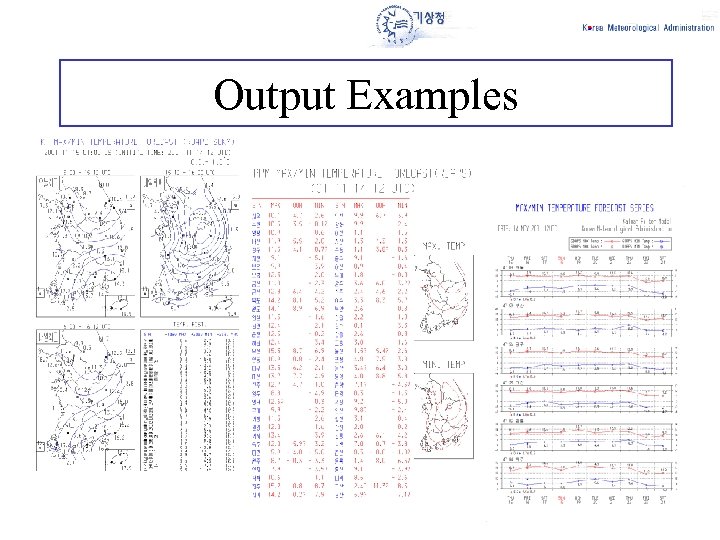 Kalman Filter Output Examples Perfect Prog Method Dynamic Linear
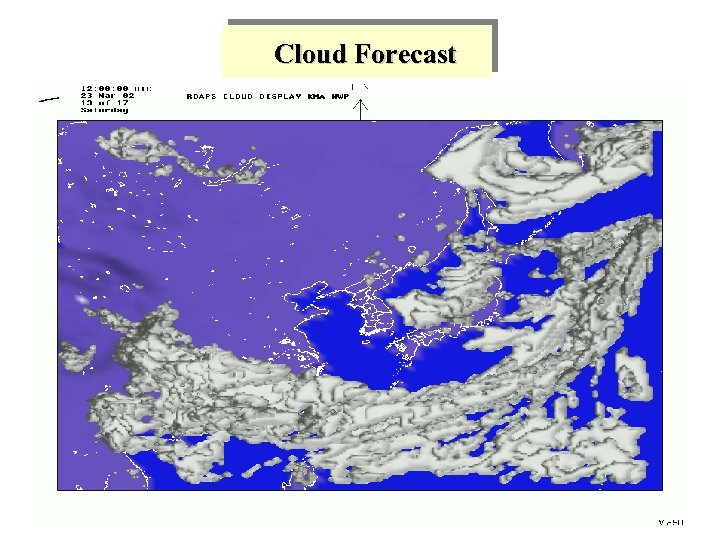 Cloud Forecast
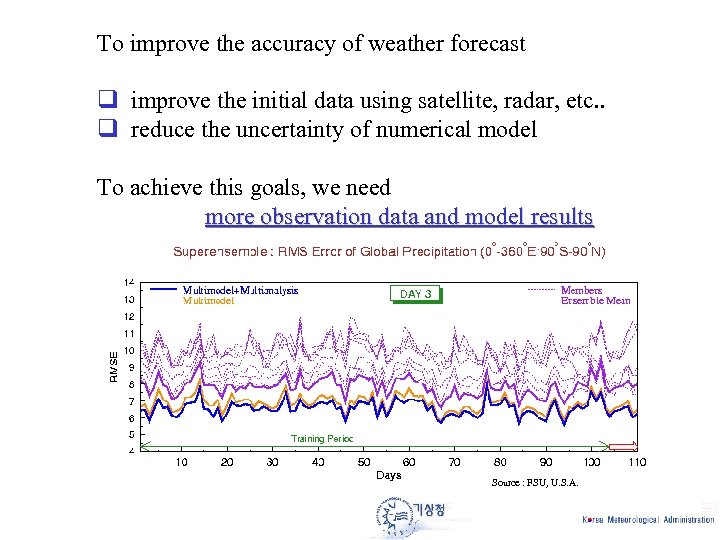 To improve the accuracy of weather forecast q improve the initial data using satellite, radar, etc. . q reduce the uncertainty of numerical model To achieve this goals, we need more observation data and model results Source : FSU, U. S. A.
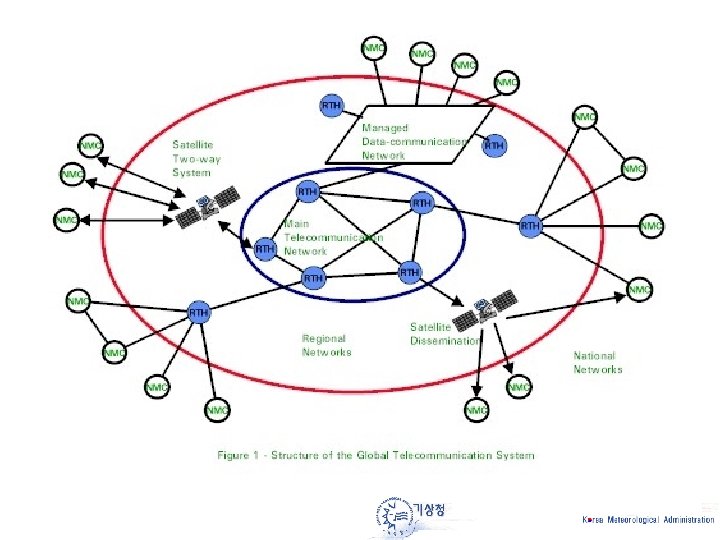
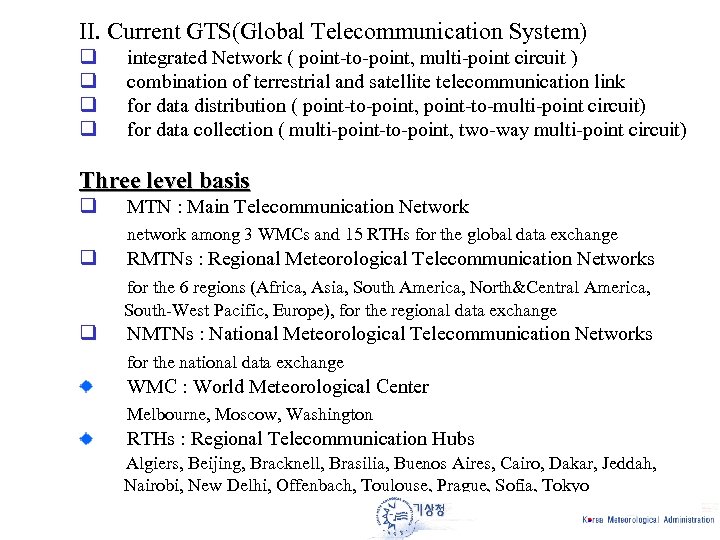 II. Current GTS(Global Telecommunication System) q q integrated Network ( point-to-point, multi-point circuit ) combination of terrestrial and satellite telecommunication link for data distribution ( point-to-point, point-to-multi-point circuit) for data collection ( multi-point-to-point, two-way multi-point circuit) Three level basis q MTN : Main Telecommunication Network network among 3 WMCs and 15 RTHs for the global data exchange q RMTNs : Regional Meteorological Telecommunication Networks for the 6 regions (Africa, Asia, South America, North&Central America, South-West Pacific, Europe), for the regional data exchange q NMTNs : National Meteorological Telecommunication Networks for the national data exchange WMC : World Meteorological Center Melbourne, Moscow, Washington RTHs : Regional Telecommunication Hubs Algiers, Beijing, Bracknell, Brasilia, Buenos Aires, Cairo, Dakar, Jeddah, Nairobi, New Delhi, Offenbach, Toulouse, Prague, Sofia, Tokyo
 Data Exchange with Satellite geostationary or near-polar orbiting satellite q Marine data(ARGOS etc) International Maritime Mobile Service INMASAT q Meteorological Satellite Meteorological Data Distribution(MDD) of METEOSAT q Communication Satellite RETIM or FAX-E via EUTELSAT : point-to-point q Countries Argentina, Canada, China, France, India, Indonesia, Mexico, Saudi Arabia, Thailand, USA Data Exchange with Internet q New Delhi - Melbourne, New Delhi-Muscat q From the new data source(aircraft, satellite, wind-profiler etc)
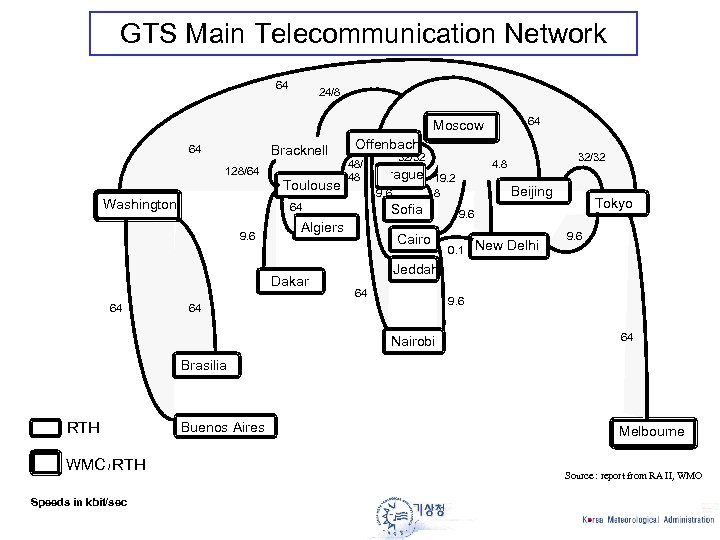 GTS Main Telecommunication Network 64 24/8 64 Moscow Bracknell 64 128/64 Toulouse Washington 48/ 48 Prague 32/32 4. 8 19. 2 8 Sofia Algiers Dakar 32/32 9. 6 64 Offenbach Cairo Beijing Tokyo 9. 6 0. 1 New Delhi 9. 6 Jeddah 64 9. 6 64 Nairobi 64 Brasilia RTH WMC / RTH Speeds in kbit/sec Buenos Aires Melbourne Source : report from RA II, WMO
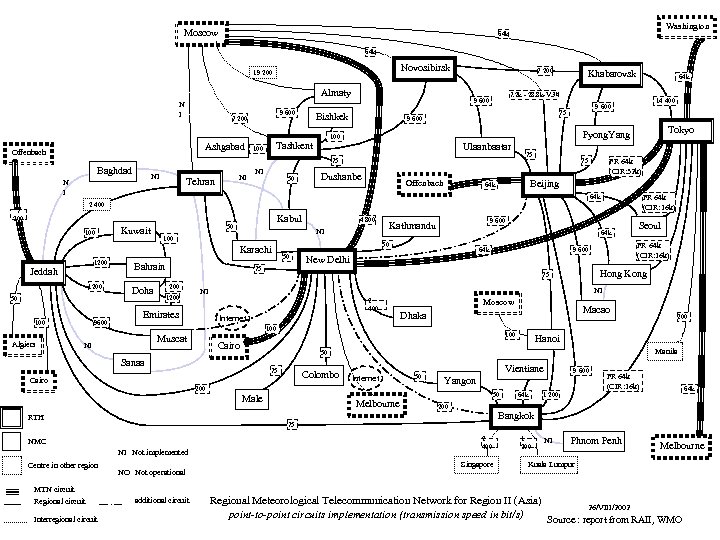 Moscow Washington 64 k Novosibirsk 19 200 Almaty N I 9 600 7 200 Ashgabad Offenbach NI N I NI Tehran NI 50 9 600 1200 50 9600 100 Algiers Kuwait Ulaanbaatar Dushanbe Kabul 50 Offenbach 100 Bahrain 75 Doha 1200 Internet RTH NI Not implemented NO Not operational additional circuit Hong Kong Moscow Macao Dhaka 100 Cairo 75 Colombo 200 Hanoi Manila 50 Internet Melbourne 50 Vientiane 9 600 Yangon 50 200 64 k FR 64 k (CIR: 16 k) 64 k 1 200 Bangkok 75 NMC FR 64 k (CIR: 16 k) 9 600 100 Male Interregional circuit 64 k Seoul NI 200 MTN circuit Regional circuit 64 k New Delhi 2 400 Muscat FR 64 k (CIR: 16 k) 9 600 Kathmandu NI Emirates NI Centre in other region FR 64 k (CIR: 32 k) Beijing 75 Cairo 75 64 k 50 50 75 200 4 800 NI Sanaa Tokyo 64 k Karachi Jeddah 14 400 Pyong. Yang 100 2 400 7 200 64 k 9 600 75 75 Baghdad Khabarovsk 7. 2 k - 28. 8 k-V. 34 9 600 Bishkek Tashkent 100 7 200 2 400 Singapore 1 200 NI Phnom Penh Melbourne Kuala Lumpur Regional Meteorological Telecommunication Network for Region II (Asia) point-to-point circuits implementation (transmission speed in bit/s) 26/VIII/2002 Source : report from RAII, WMO
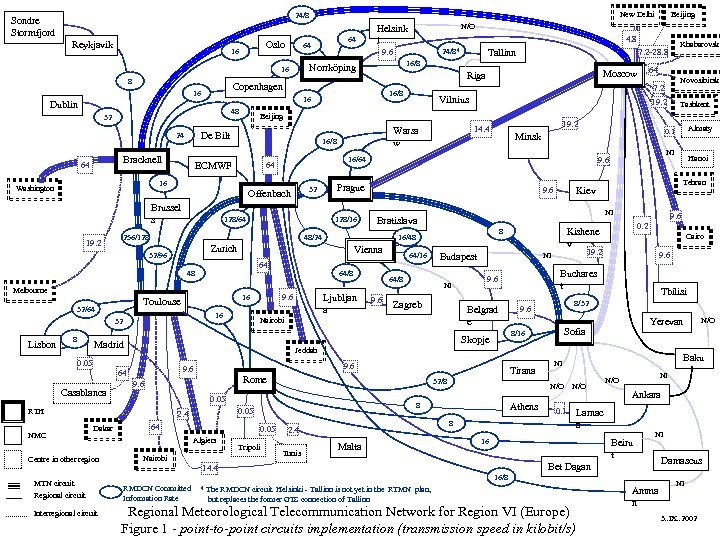 Reykjavik Oslo 16 8 48 32 Bracknell 64 19. 2 128/64 16 MTN circuit Regional circuit Interregional circuit 19. 2 9. 6 Tbilisi 8/32 9. 6 Yerevan Sofia 8/16 Tirana Rome 9. 6 32/8 0. 05 64 0. 05 Algiers Nairobi Athens Tripoli 8 2. 4 Tunis Malta 14. 4 RMDCN Committed * The RMDCN circuit Helsinki - Tallinn is not yet in the RTMN plan, Information Rate but replaces the former GTS connection of Tallinn 0. 1 N/O Baku NI N/O 8 0. 05 2. 4 Centre in other region Belgrad e Cairo Buchares t 9. 6 RTH Dakar Zagreb 9. 6 0. 2 Kishene v NI Skopje 64 NMC Tehran Jeddah 0. 05 9. 6 NI Nairobi Madrid Casablanca Ljubljan a 64/8 Hanoi Kiev 8 Budapest Almaty NI NI 16/48 64/16 Tashkent 0. 1 Bratislava 64/8 9. 6 16 Toulouse 32 8 9. 6 Vienna 64 Melbourne 32/64 Prague Zurich 48 19. 2 Minsk 9. 6 48/24 Novosibirsk 19. 2 14. 4 Warsa w 128/16 256/128 32/96 32 Offenbach Brussel s Vilnius 16/64 64 ECMWF 64 7. 2 16/8 16 Washington Moscow Riga Beijing De Bilt Khabarovsk 7. 2 -28. 8 Tallinn 24/8* 16/8 16 Dublin 4. 8 9. 6 Norrköping Beijing N/O Helsink i Copenhagen 16 24 64 64 16 Lisbon New Delhi 24/8 Sondre Stormfjord N/O NI N/O Ankara Larnac a Beiru t 16 NI Bet Dagan 16/8 Regional Meteorological Telecommunication Network for Region VI (Europe) Figure 1 - point-to-point circuits implementation (transmission speed in kilobit/s) Amma n Damascus NI 3. . IX. . 2002
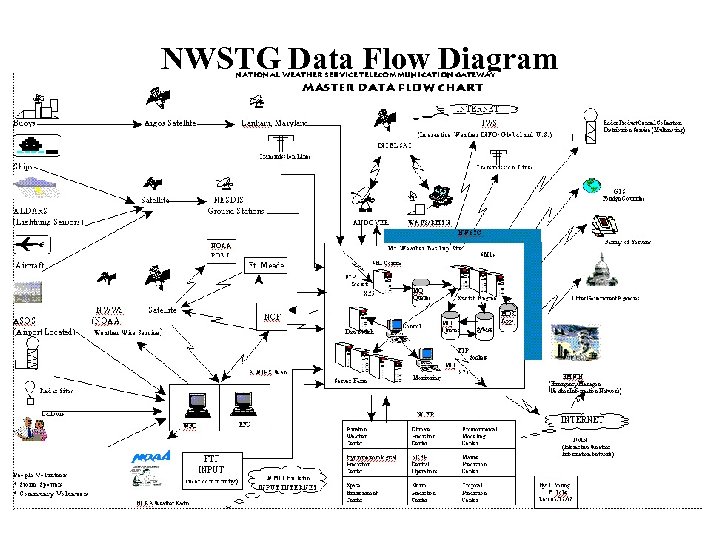 NWSTG Data Flow Diagram
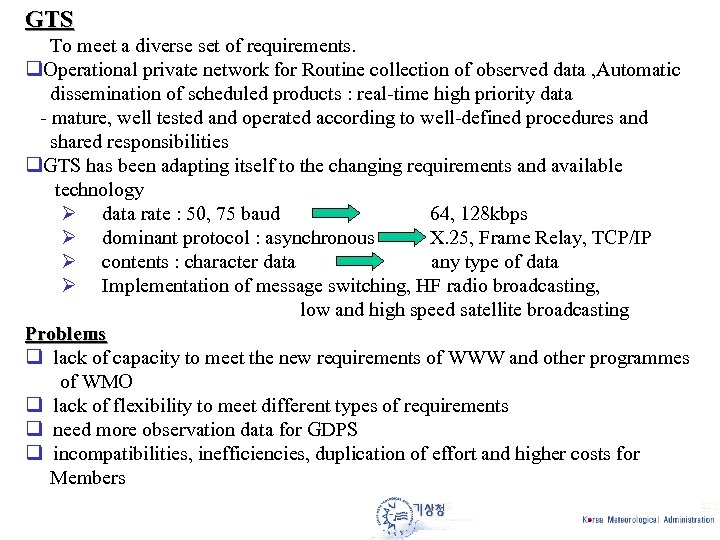 GTS To meet a diverse set of requirements. q. Operational private network for Routine collection of observed data , Automatic dissemination of scheduled products : real-time high priority data - mature, well tested and operated according to well-defined procedures and shared responsibilities q. GTS has been adapting itself to the changing requirements and available technology Ø data rate : 50, 75 baud 64, 128 kbps Ø dominant protocol : asynchronous X. 25, Frame Relay, TCP/IP Ø contents : character data any type of data Ø Implementation of message switching, HF radio broadcasting, low and high speed satellite broadcasting Problems q lack of capacity to meet the new requirements of WWW and other programmes of WMO q lack of flexibility to meet different types of requirements q need more observation data for GDPS q incompatibilities, inefficiencies, duplication of effort and higher costs for Members
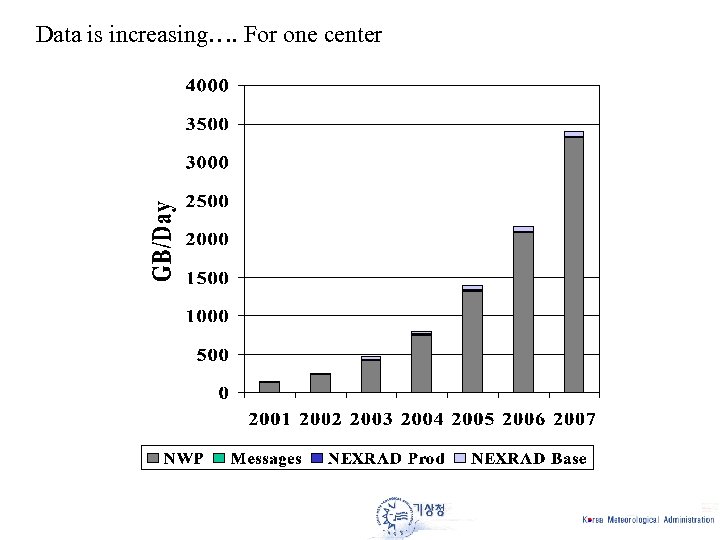 Data is increasing…. For one center
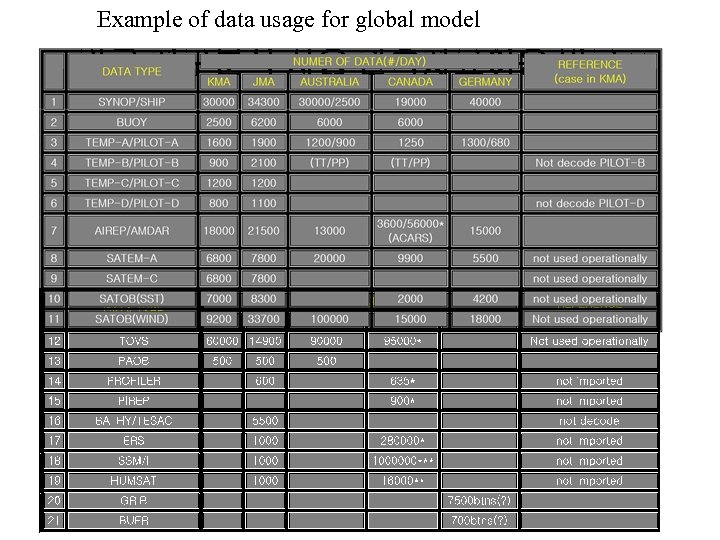 Example of data usage for global model 각국 전구분석 사용 관측자료이용 비교(I)
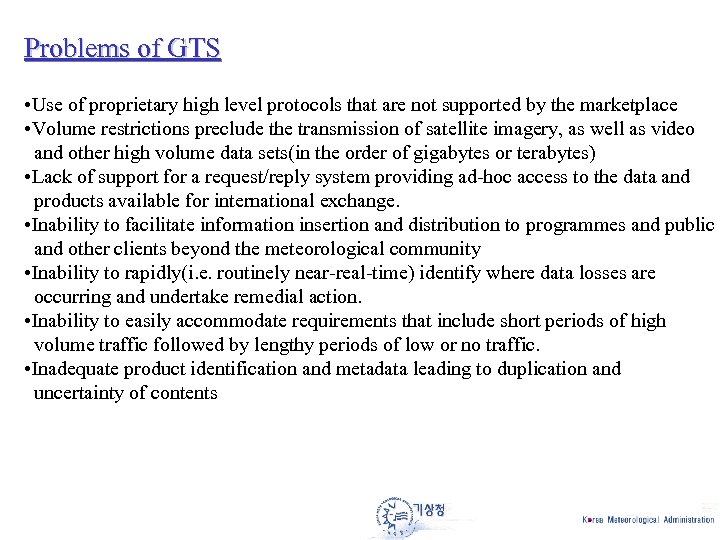 Problems of GTS • Use of proprietary high level protocols that are not supported by the marketplace • Volume restrictions preclude the transmission of satellite imagery, as well as video and other high volume data sets(in the order of gigabytes or terabytes) • Lack of support for a request/reply system providing ad-hoc access to the data and products available for international exchange. • Inability to facilitate information insertion and distribution to programmes and public and other clients beyond the meteorological community • Inability to rapidly(i. e. routinely near-real-time) identify where data losses are occurring and undertake remedial action. • Inability to easily accommodate requirements that include short periods of high volume traffic followed by lengthy periods of low or no traffic. • Inadequate product identification and metadata leading to duplication and uncertainty of contents
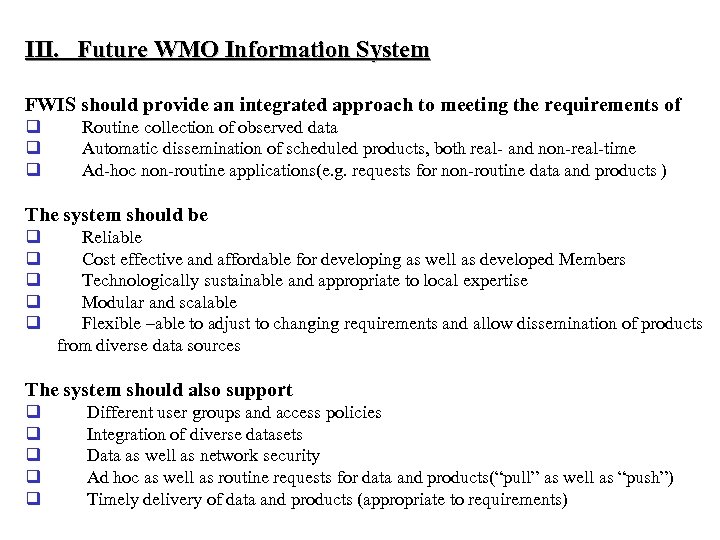 III. Future WMO Information System FWIS should provide an integrated approach to meeting the requirements of q q q Routine collection of observed data Automatic dissemination of scheduled products, both real- and non-real-time Ad-hoc non-routine applications(e. g. requests for non-routine data and products ) The system should be q Reliable q Cost effective and affordable for developing as well as developed Members q Technologically sustainable and appropriate to local expertise q Modular and scalable q Flexible –able to adjust to changing requirements and allow dissemination of products from diverse data sources The system should also support q q q Different user groups and access policies Integration of diverse datasets Data as well as network security Ad hoc as well as routine requests for data and products(“pull” as well as “push”) Timely delivery of data and products (appropriate to requirements)
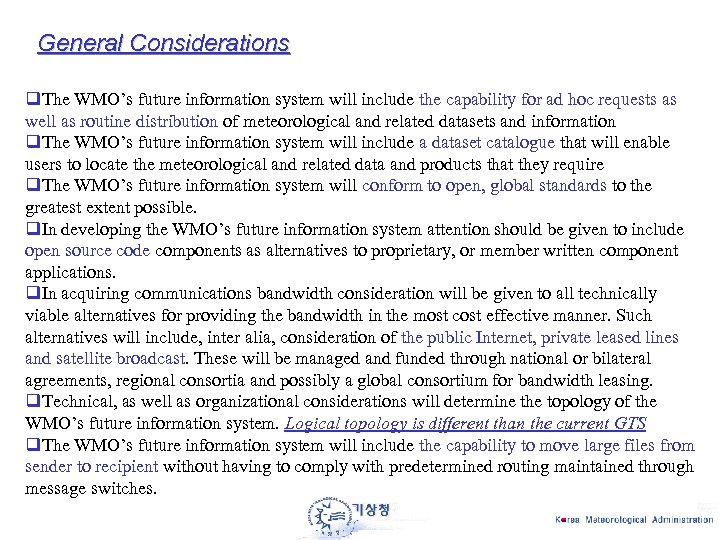 General Considerations q. The WMO’s future information system will include the capability for ad hoc requests as well as routine distribution of meteorological and related datasets and information q. The WMO’s future information system will include a dataset catalogue that will enable users to locate the meteorological and related data and products that they require q. The WMO’s future information system will conform to open, global standards to the greatest extent possible. q. In developing the WMO’s future information system attention should be given to include open source code components as alternatives to proprietary, or member written component applications. q. In acquiring communications bandwidth consideration will be given to all technically viable alternatives for providing the bandwidth in the most cost effective manner. Such alternatives will include, inter alia, consideration of the public Internet, private leased lines and satellite broadcast. These will be managed and funded through national or bilateral agreements, regional consortia and possibly a global consortium for bandwidth leasing. q. Technical, as well as organizational considerations will determine the topology of the WMO’s future information system. Logical topology is different than the current GTS q. The WMO’s future information system will include the capability to move large files from sender to recipient without having to comply with predetermined routing maintained through message switches.
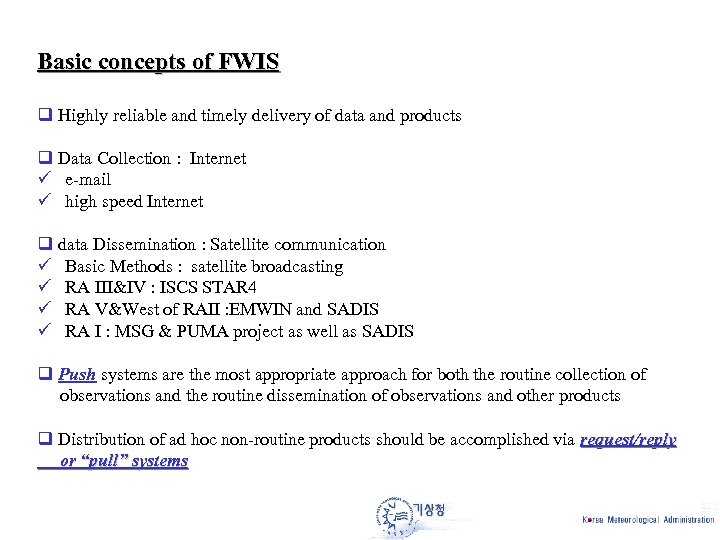 Basic concepts of FWIS q Highly reliable and timely delivery of data and products q Data Collection : Internet ü e-mail ü high speed Internet q data Dissemination : Satellite communication ü Basic Methods : satellite broadcasting ü RA III&IV : ISCS STAR 4 ü RA V&West of RAII : EMWIN and SADIS ü RA I : MSG & PUMA project as well as SADIS q Push systems are the most appropriate approach for both the routine collection of observations and the routine dissemination of observations and other products q Distribution of ad hoc non-routine products should be accomplished via request/reply or “pull” systems
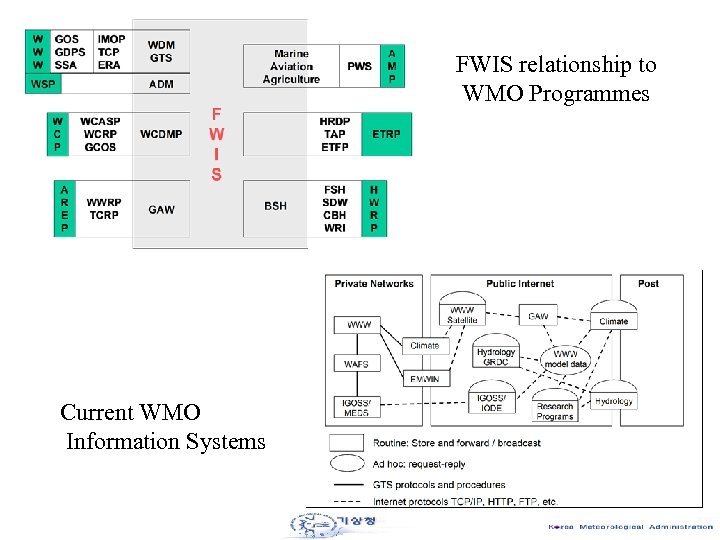 FWIS relationship to WMO Programmes Current WMO Information Systems
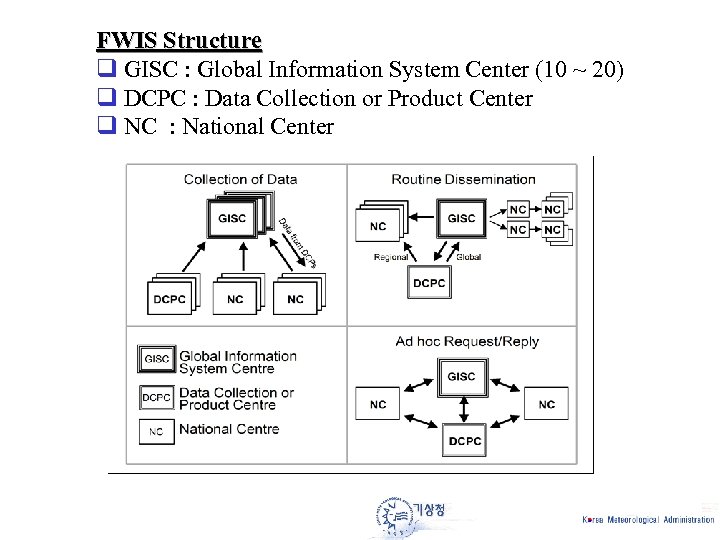 FWIS Structure q GISC : Global Information System Center (10 ~ 20) q DCPC : Data Collection or Product Center q NC : National Center
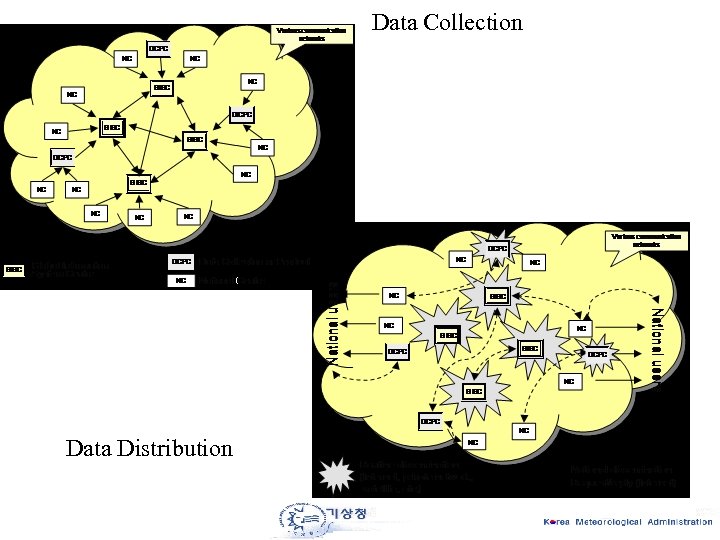 Data Collection Data Distribution
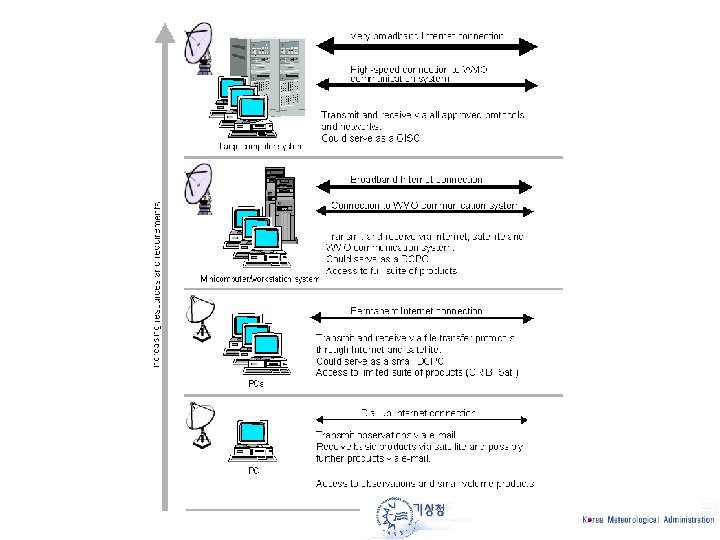
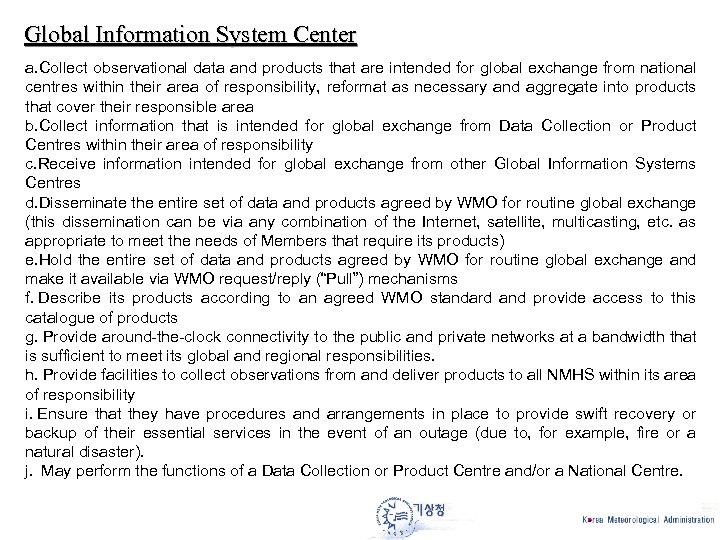 Global Information System Center a. Collect observational data and products that are intended for global exchange from national centres within their area of responsibility, reformat as necessary and aggregate into products that cover their responsible area b. Collect information that is intended for global exchange from Data Collection or Product Centres within their area of responsibility c. Receive information intended for global exchange from other Global Information Systems Centres d. Disseminate the entire set of data and products agreed by WMO for routine global exchange (this dissemination can be via any combination of the Internet, satellite, multicasting, etc. as appropriate to meet the needs of Members that require its products) e. Hold the entire set of data and products agreed by WMO for routine global exchange and make it available via WMO request/reply (“Pull”) mechanisms f. Describe its products according to an agreed WMO standard and provide access to this catalogue of products g. Provide around-the-clock connectivity to the public and private networks at a bandwidth that is sufficient to meet its global and regional responsibilities. h. Provide facilities to collect observations from and deliver products to all NMHS within its area of responsibility i. Ensure that they have procedures and arrangements in place to provide swift recovery or backup of their essential services in the event of an outage (due to, for example, fire or a natural disaster). j. May perform the functions of a Data Collection or Product Centre and/or a National Centre.
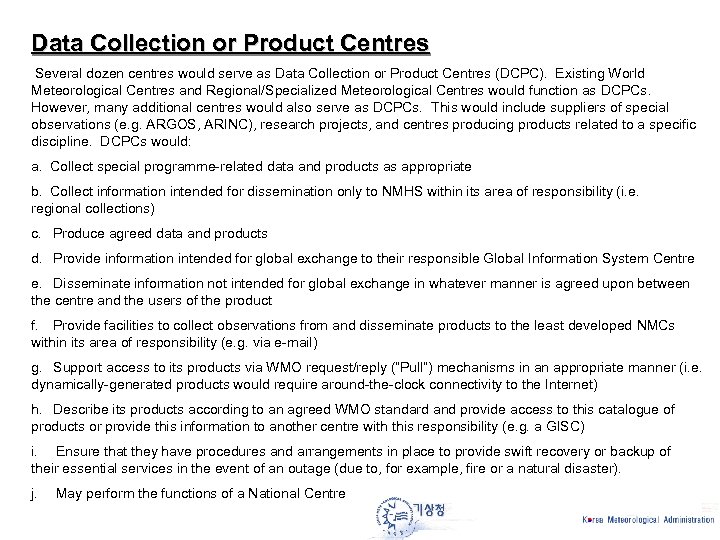 Data Collection or Product Centres Several dozen centres would serve as Data Collection or Product Centres (DCPC). Existing World Meteorological Centres and Regional/Specialized Meteorological Centres would function as DCPCs. However, many additional centres would also serve as DCPCs. This would include suppliers of special observations (e. g. ARGOS, ARINC), research projects, and centres producing products related to a specific discipline. DCPCs would: a. Collect special programme-related data and products as appropriate b. Collect information intended for dissemination only to NMHS within its area of responsibility (i. e. regional collections) c. Produce agreed data and products d. Provide information intended for global exchange to their responsible Global Information System Centre e. Disseminate information not intended for global exchange in whatever manner is agreed upon between the centre and the users of the product f. Provide facilities to collect observations from and disseminate products to the least developed NMCs within its area of responsibility (e. g. via e-mail) g. Support access to its products via WMO request/reply (“Pull”) mechanisms in an appropriate manner (i. e. dynamically-generated products would require around-the-clock connectivity to the Internet) h. Describe its products according to an agreed WMO standard and provide access to this catalogue of products or provide this information to another centre with this responsibility (e. g. a GISC) i. Ensure that they have procedures and arrangements in place to provide swift recovery or backup of their essential services in the event of an outage (due to, for example, fire or a natural disaster). j. May perform the functions of a National Centre
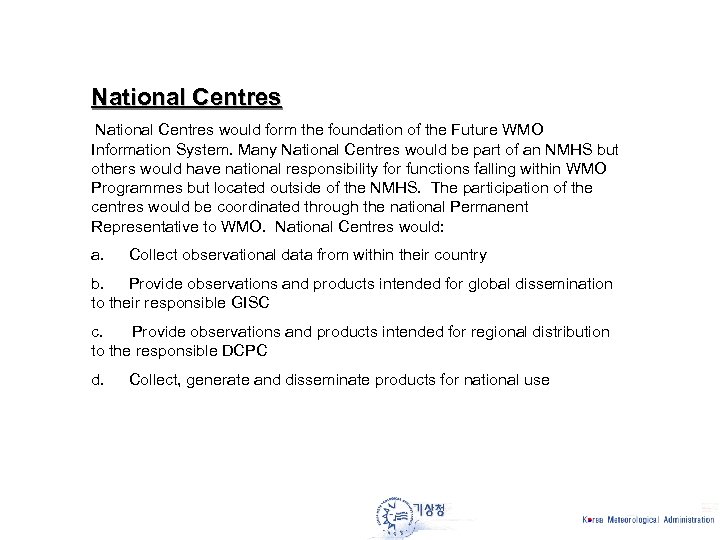 National Centres would form the foundation of the Future WMO Information System. Many National Centres would be part of an NMHS but others would have national responsibility for functions falling within WMO Programmes but located outside of the NMHS. The participation of the centres would be coordinated through the national Permanent Representative to WMO. National Centres would: a. Collect observational data from within their country b. Provide observations and products intended for global dissemination to their responsible GISC c. Provide observations and products intended for regional distribution to the responsible DCPC d. Collect, generate and disseminate products for national use
 FWIS techniques and pilot projects q. XML : Extensible Mark-up Language ( BUFR, WEB, CREX ) q. The Internet q. Open-Source software : Linux, GNU q. Unidata IDD : UCAR, the Internet Data Distribution(IDD) system - since 1995, providing the real time data to 150 universities - IDD has ‘Store and Forward’ hierarchy of data flow q. MED-HYCOS : Mediterranean Hydrological Cycle Observing System q. UNIDART : Uniform Data Request Interface q. MDi. S : Multicast-enable platform for distribution - based on MTP/SO (RFC 1301) and provides a socket style programming interface q. AFD : Automatic File distributor, DWD - FTP, SMTP, log, user interface, Multicasting q Web-Werdis ( Web-weather Request and Distribution System ) Further Development q. Development of the catalogue of products ( highest priority ) q. Proof of concept through pilot tests q. Upgrade of the GTS
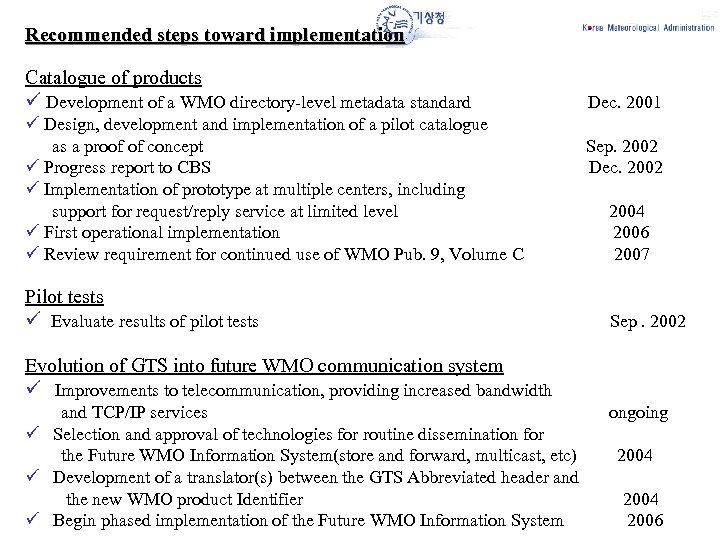 Recommended steps toward implementation Catalogue of products ü Development of a WMO directory-level metadata standard Dec. 2001 ü Design, development and implementation of a pilot catalogue as a proof of concept Sep. 2002 ü Progress report to CBS Dec. 2002 ü Implementation of prototype at multiple centers, including support for request/reply service at limited level 2004 ü First operational implementation 2006 ü Review requirement for continued use of WMO Pub. 9, Volume C 2007 Pilot tests ü Evaluate results of pilot tests Sep. 2002 Evolution of GTS into future WMO communication system ü Improvements to telecommunication, providing increased bandwidth and TCP/IP services ongoing ü Selection and approval of technologies for routine dissemination for the Future WMO Information System(store and forward, multicast, etc) 2004 ü Development of a translator(s) between the GTS Abbreviated header and the new WMO product Identifier 2004 ü Begin phased implementation of the Future WMO Information System 2006
 Current Pilot Project q. Cli. Ware Project q. UK-DWD pilot project (LDM test) q. RA VI Virtual GISC q. METGIS q. Unidata IDD - IDD & LDM q. Simple meteorological display system - METGIS from South Africa, METCAP from Turkey, EMWIN custom browser from USA - PUMA workstation in every NMHS in Africa q. UNIDART -request/reply capability There is no pilot project in ASIA…. .
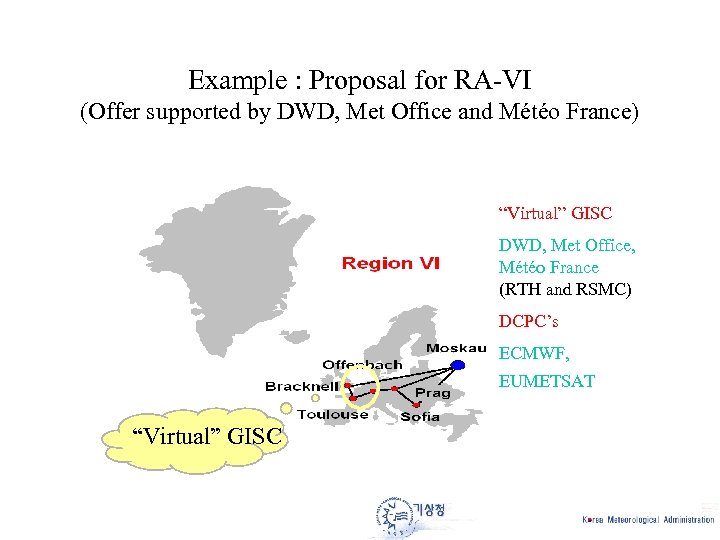 Example : Proposal for RA-VI (Offer supported by DWD, Met Office and Météo France) “Virtual” GISC DWD, Met Office, Météo France (RTH and RSMC) DCPC’s ECMWF, EUMETSAT “Virtual” GISC
 Some concerns - reliable and continuous connectivity - sufficient bandwidth to handle peak-period data transmission - responsive delivery of time-critical information - a secure networking environment Long term testing of Internet capabilities and advanced methodologies(e. g. IPv 6, Qo. S) that promise to provide a secure network and predictable performance
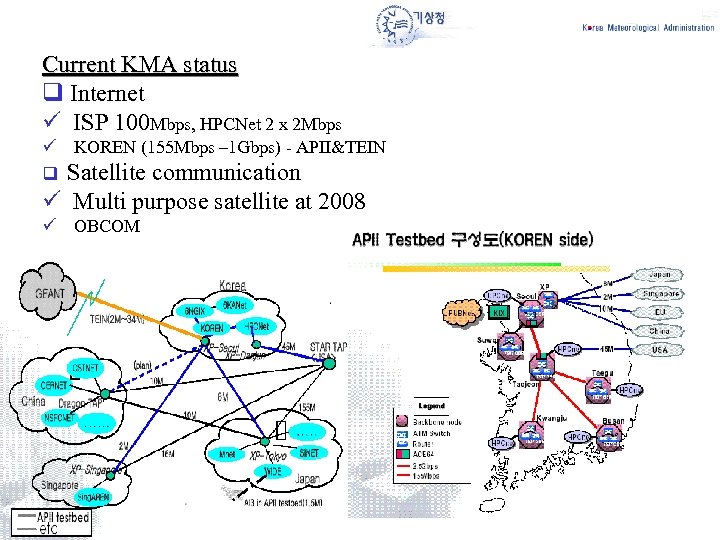 Current KMA status q Internet ü ISP 100 Mbps, HPCNet 2 x 2 Mbps ü KOREN (155 Mbps – 1 Gbps) - APII&TEIN q Satellite communication ü Multi purpose satellite at 2008 ü OBCOM
 Current and Future Plan to use APAN is important Infrastructure to exchange data and develop basic techniques for FWIS • KMA is collecting the Global Model data, observation data(satellite, ocean, aircraft) from U. S. A. routinely • KMA is exchanging the global model data with several centers • KMA is leading and involving some WMO projects ( APCN, ARGOS, WAMIS …) q KMA- JMA will exchange the ensemble data with Internet q KMA will receive the EU Met Satellite from DWD Data via TEIN - contents will be expanded q KMA will provide 2 Weather Radar data to USA on the near-real time base q KMA will adopt the GRID concept for the request/reply to exchange data q KMA wants to improve the network security, Qo. S and IPv 6 of FWIS with APAN
 Working Frame KMA 기상청 v National Frame APCN FWIS WAMIS WMO cluster Met Sat e-Science Grid ↔ GFK International Infra : APAN, TEIN, . . . National Infra KOREN, Kreonet, HPCNet v International Frame WMO/CBS - -GTS, GDPS WMO/CBS GTS, GDPS CAg. M - CAg. M CAS RAII JMA, NWS, 양국간 협력 DWD, BOM, CMA, etc 미국, 독일, 호주, 일본, 중국 GGF APAN KMA 기상청 GFK, APAN-KR
 기타 참고 자료 Thank you … Super Computer Center/KMA Lee, Dongil ldi@kma. go. kr