


 Скачать презентацию Perspective of supply chain optimization Tokyo University of
650a545843a15c28a44320fd7d4ea1e6.ppt
- Количество слайдов: 106
 Perspective of supply chain optimization Tokyo University of Marine Science and Technology Mikio Kubo
 Agenda • Supply Chain and Analytic IT • Mathematical Programming Solver Gurobi with Python language • Constrained Programming Solver SCOP • Scheduling Solver Opt. Seq
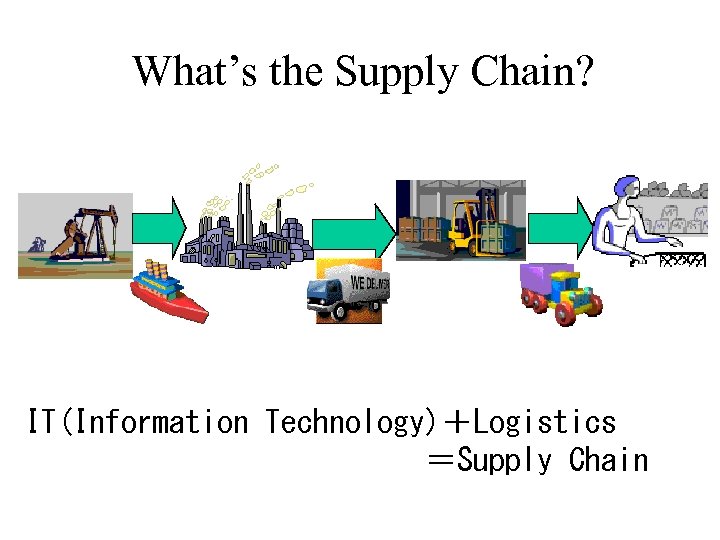 What’s the Supply Chain? IT(Information Technology)+Logistics =Supply Chain
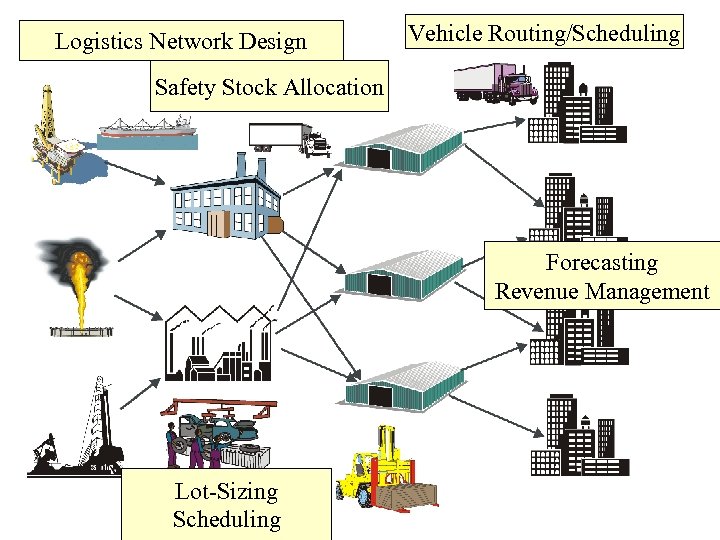 Logistics Network Design Vehicle Routing/Scheduling Safety Stock Allocation Forecasting Revenue Management Lot-Sizing Scheduling
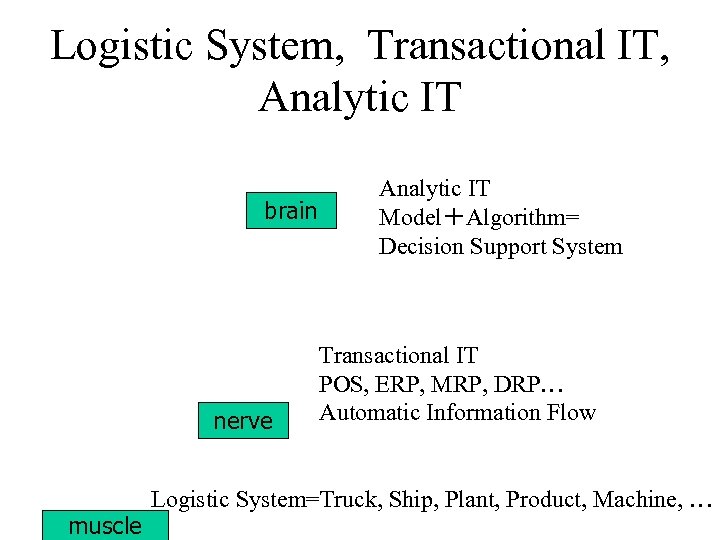 Logistic System, Transactional IT, Analytic IT brain nerve muscle Analytic IT Model+Algorithm= Decision Support System Transactional IT POS, ERP, MRP, DRP… Automatic Information Flow Logistic System=Truck, Ship, Plant, Product, Machine, …
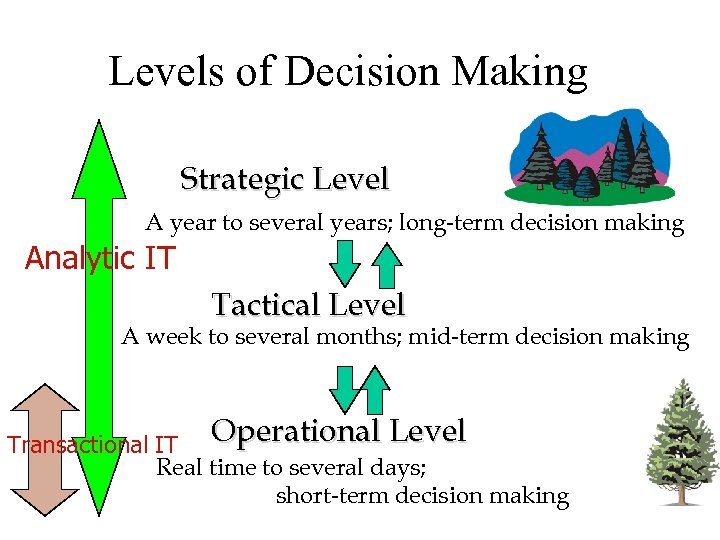 Levels of Decision Making Strategic Level A year to several years; long-term decision making Analytic IT Tactical Level A week to several months; mid-term decision making Operational Level Transactional IT Operational Level Real time to several days; short-term decision making
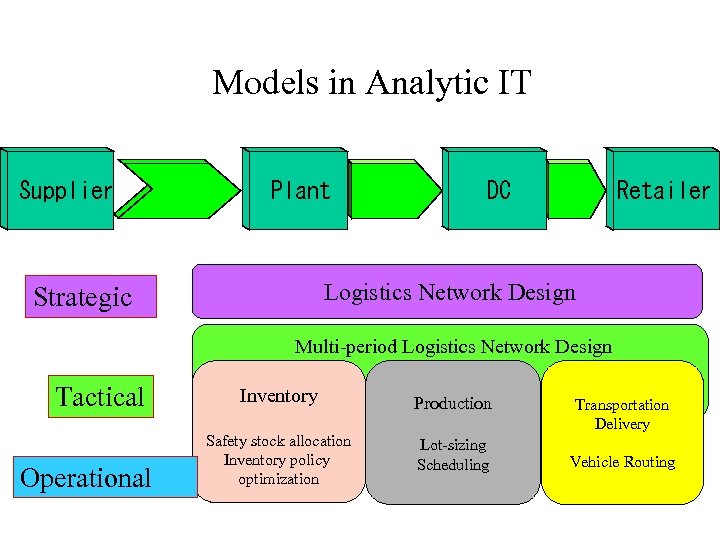 Models in Analytic IT Supplier Plant Retailer DC Logistics Network Design Strategic Multi-period Logistics Network Design Tactical Operational Inventory Safety stock allocation Inventory policy optimization Production Lot-sizing Scheduling Transportation Delivery Vehicle Routing
 How to Solve Real SC Optimization Problems Quickly • Mixed Integer Programming (MIP) Solver Gurobi =>Logistics Network Design, Lot-Sizing • Constraint Programming (CP) Solver SCOP =>Lot-Sizing, Staff Scheduling • Scheduling Solver Opt. Seq =>Scheduling • Vehicle Routing Solver • Inventory Policy Optimization Solver. . . using Python Language
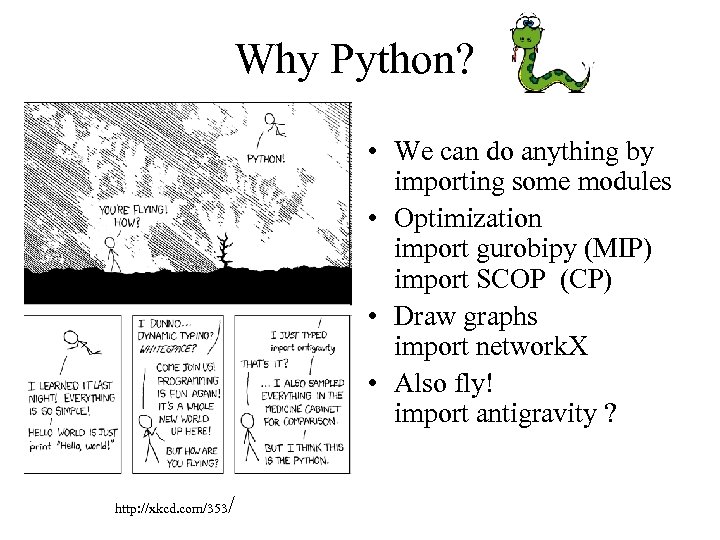 Why Python? • We can do anything by importing some modules • Optimization import gurobipy (MIP) import SCOP (CP) • Draw graphs import network. X • Also fly! import antigravity ? http: //xkcd. com/353 /
 What’s Gurobi? MIP solver Developed by: Zonghao Gu, Edward Rothberg, Robert Bixby Free academic license
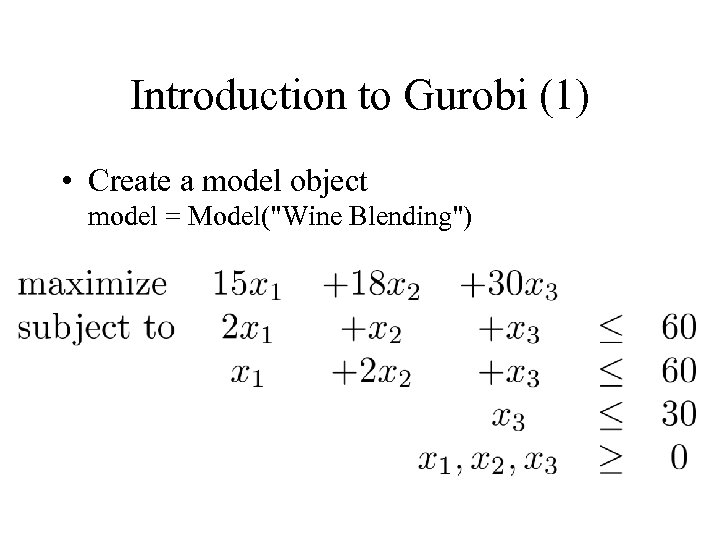 Introduction to Gurobi (1) • Create a model object model = Model("Wine Blending")
 Introduction to Gurobi (2) • Add variable objects x 1 = model. add. Var(name="x 1") x 2 = model. add. Var(name="x 2") x 3 = model. add. Var(name="x 3") • Model update (needed before adding constraints; lazy update!) model. update()
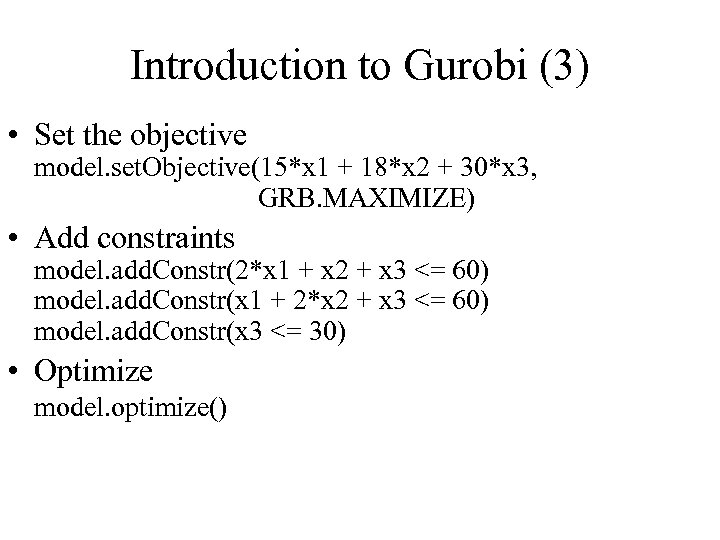 Introduction to Gurobi (3) • Set the objective model. set. Objective(15*x 1 + 18*x 2 + 30*x 3, GRB. MAXIMIZE) • Add constraints model. add. Constr(2*x 1 + x 2 + x 3 <= 60) model. add. Constr(x 1 + 2*x 2 + x 3 <= 60) model. add. Constr(x 3 <= 30) • Optimize model. optimize()
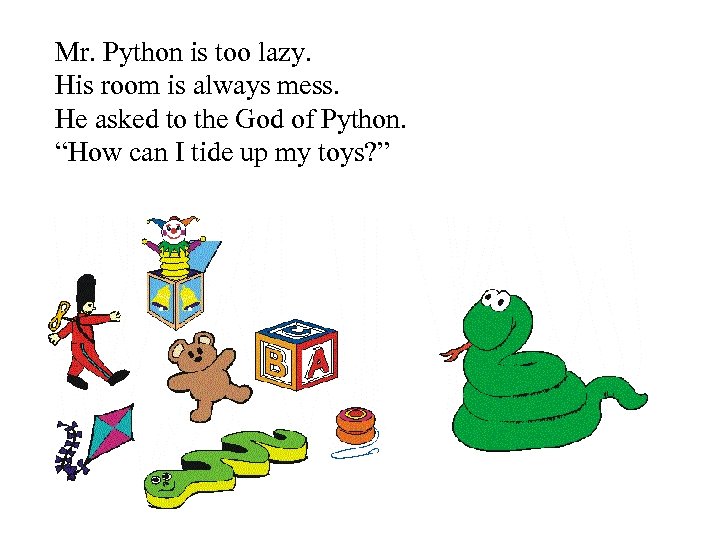 Mr. Python is too lazy. His room is always mess. He asked to the God of Python. “How can I tide up my toys? ”
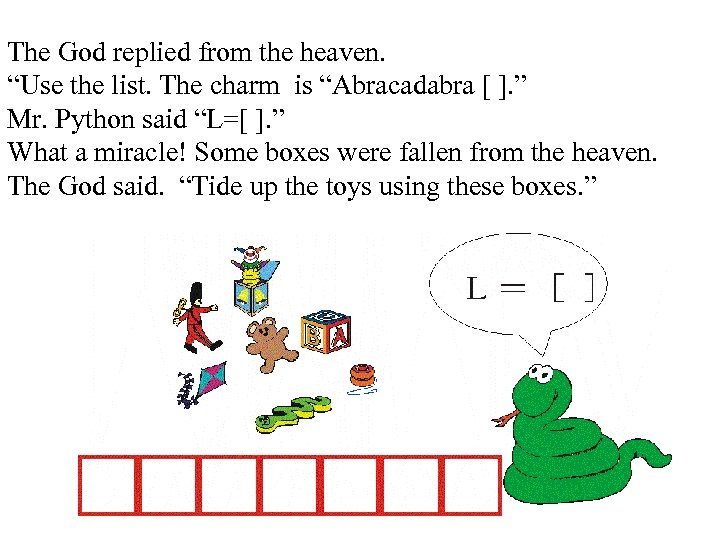 The God replied from the heaven. “Use the list. The charm is “Abracadabra [ ]. ” Mr. Python said “L=[ ]. ” What a miracle! Some boxes were fallen from the heaven. The God said. “Tide up the toys using these boxes. ”
![OK. Everything is packed into the list. To pick up “Teddy”, just say “L[3].](https://present5.com/presentation/650a545843a15c28a44320fd7d4ea1e6/image-16.jpg "OK. Everything is packed into the list. To pick up “Teddy”, just say “L[3].") OK. Everything is packed into the list. To pick up “Teddy”, just say “L[3]. ”
OK. Everything is packed into the list. To pick up “Teddy”, just say “L[3]. ”
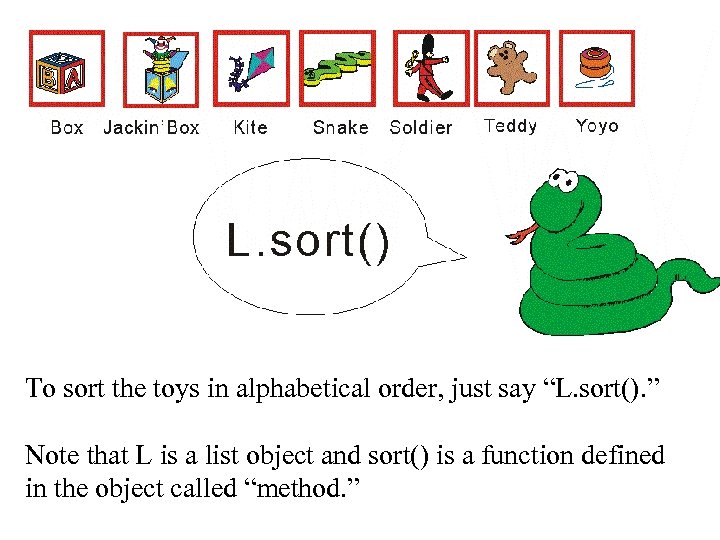 To sort the toys in alphabetical order, just say “L. sort(). ” Note that L is a list object and sort() is a function defined in the object called “method. ”
![Modeling with Lists • Add variable objects into list x=[] for i in range(3):](https://present5.com/presentation/650a545843a15c28a44320fd7d4ea1e6/image-18.jpg "Modeling with Lists • Add variable objects into list x=[] for i in range(3):") Modeling with Lists • Add variable objects into list x=[] for i in range(3): var=model. add. Var(name=“x[%s]”%i) x. append(var) • Add constraint “x 1 + x 2 + x 3 <= 2” model. add. Constr( sum(x) <= 2 ) or model. add. Constr( quicksum(x) <= 2 )
Modeling with Lists • Add variable objects into list x=[] for i in range(3): var=model. add. Var(name=“x[%s]”%i) x. append(var) • Add constraint “x 1 + x 2 + x 3 <= 2” model. add. Constr( sum(x) <= 2 ) or model. add. Constr( quicksum(x) <= 2 )
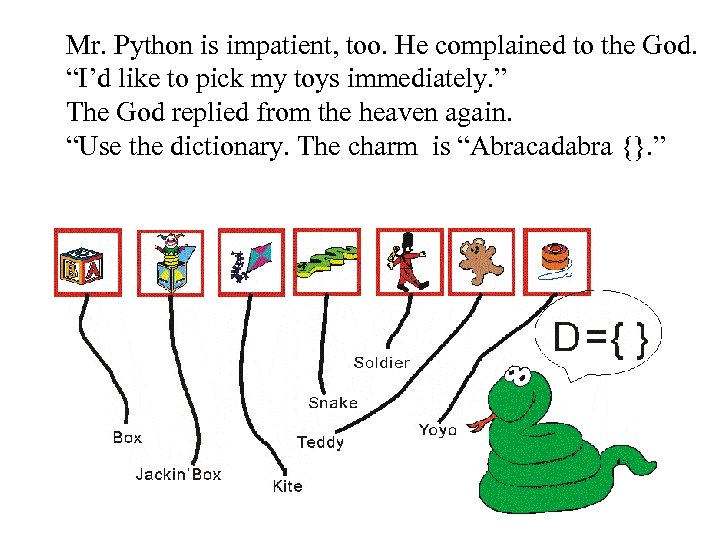 Mr. Python is impatient, too. He complained to the God. “I’d like to pick my toys immediately. ” The God replied from the heaven again. “Use the dictionary. The charm is “Abracadabra {}. ”
 Using lists and dictionaries, Mr. Python could manage his toys efficiently and lived happily ever after.
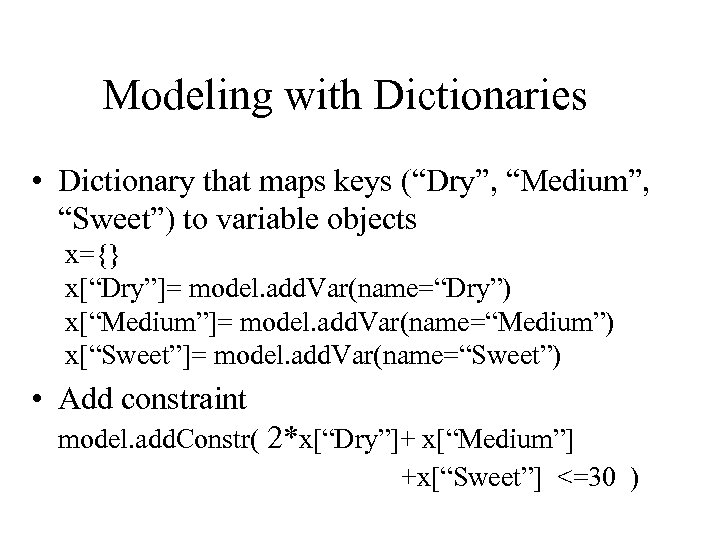 Modeling with Dictionaries • Dictionary that maps keys (“Dry”, “Medium”, “Sweet”) to variable objects x={} x[“Dry”]= model. add. Var(name=“Dry”) x[“Medium”]= model. add. Var(name=“Medium”) x[“Sweet”]= model. add. Var(name=“Sweet”) • Add constraint model. add. Constr( 2*x[“Dry”]+ x[“Medium”] +x[“Sweet”] <=30 )
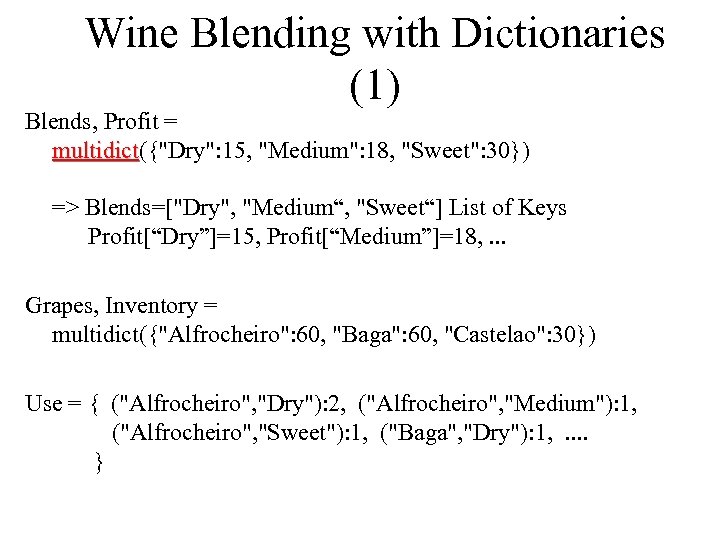 Wine Blending with Dictionaries (1) Blends, Profit = multidict({"Dry": 15, "Medium": 18, "Sweet": 30}) multidict => Blends=["Dry", "Medium“, "Sweet“] List of Keys Profit[“Dry”]=15, Profit[“Medium”]=18, . . . Grapes, Inventory = multidict({"Alfrocheiro": 60, "Baga": 60, "Castelao": 30}) Use = { ("Alfrocheiro", "Dry"): 2, ("Alfrocheiro", "Medium"): 1, ("Alfrocheiro", "Sweet"): 1, ("Baga", "Dry"): 1, . . }
![Wine Blending with Dictionaries (2) x = {} for j in Blends: x[j] =](https://present5.com/presentation/650a545843a15c28a44320fd7d4ea1e6/image-23.jpg "Wine Blending with Dictionaries (2) x = {} for j in Blends: x[j] =") Wine Blending with Dictionaries (2) x = {} for j in Blends: x[j] = model. add. Var(vtype="C", name="x[%s]"%j) model. update() model. set. Objective(quicksum(Profit[j]*x[j] for j in Blends), GRB. MAXIMIZE) for i in Grapes: model. add. Constr(quicksum(Use[i, j]*x[j] for j in Blends) <= Inventory[i], name="use[%s]"%i) model. optimize()
Wine Blending with Dictionaries (2) x = {} for j in Blends: x[j] = model. add. Var(vtype="C", name="x[%s]"%j) model. update() model. set. Objective(quicksum(Profit[j]*x[j] for j in Blends), GRB. MAXIMIZE) for i in Grapes: model. add. Constr(quicksum(Use[i, j]*x[j] for j in Blends) <= Inventory[i], name="use[%s]"%i) model. optimize()
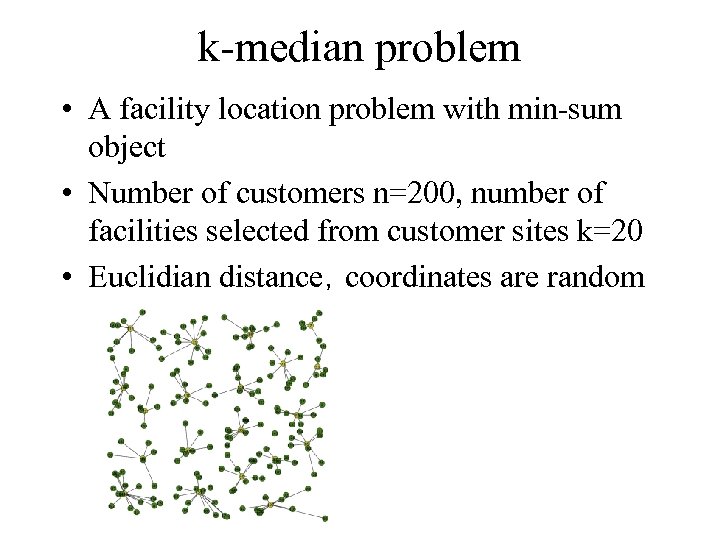 k-median problem • A facility location problem with min-sum object • Number of customers n=200, number of facilities selected from customer sites k=20 • Euclidian distance,coordinates are random
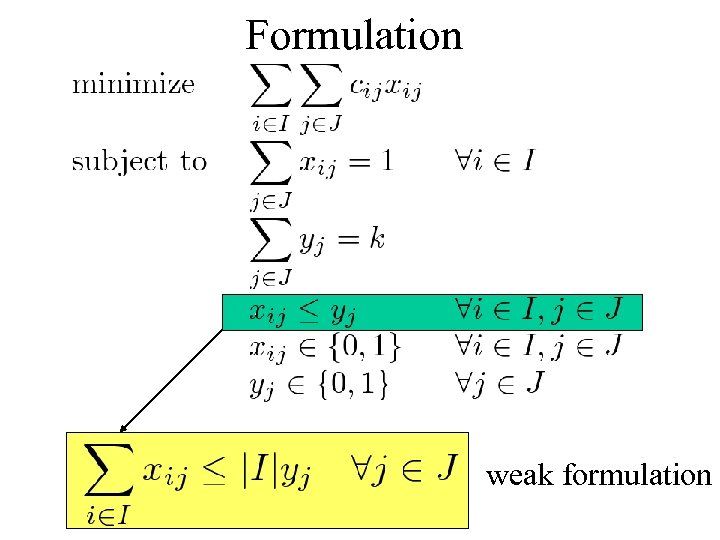 Formulation weak formulation
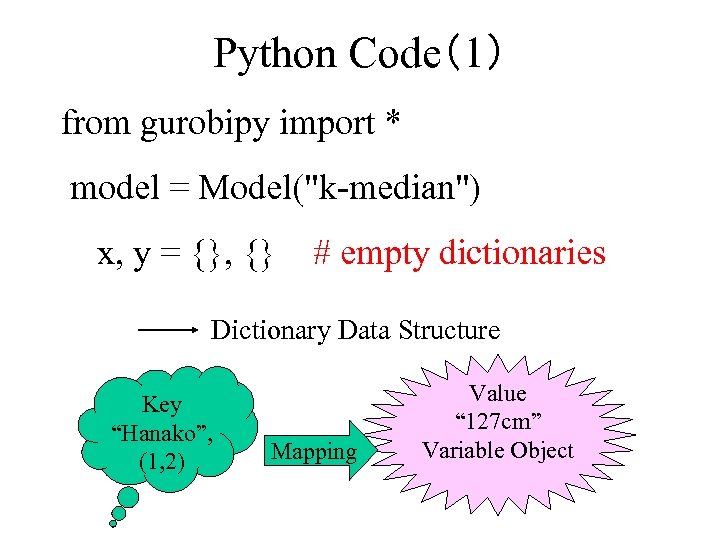 Python Code(1) from gurobipy import * model = Model("k-median") x, y = {}, {} # empty dictionaries Dictionary Data Structure Key “Hanako”, (1, 2) Mapping Value “ 127 cm” Variable Object
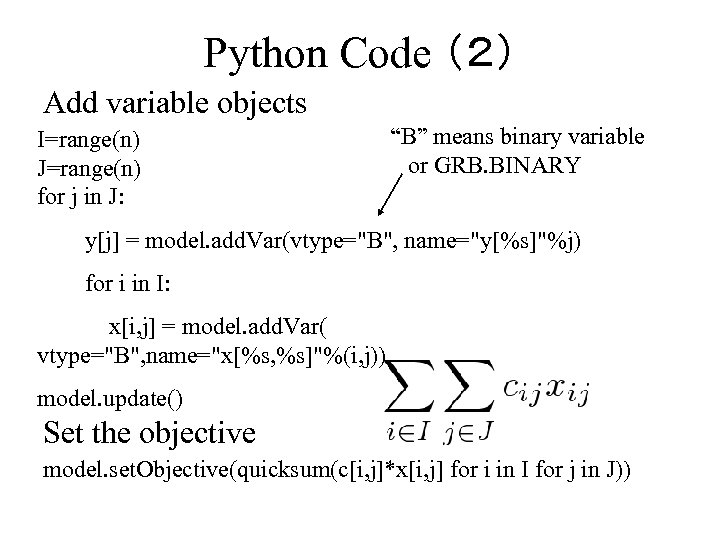 Python Code (2) Add variable objects I=range(n) J=range(n) for j in J: “B” means binary variable or GRB. BINARY y[j] = model. add. Var(vtype="B", name="y[%s]"%j) for i in I: x[i, j] = model. add. Var( vtype="B", name="x[%s, %s]"%(i, j)) model. update() Set the objective model. set. Objective(quicksum(c[i, j]*x[i, j] for i in I for j in J))
![Python Code (3) for i in I: model. add. Constr(quicksum(x[i, j] for j in](https://present5.com/presentation/650a545843a15c28a44320fd7d4ea1e6/image-28.jpg "Python Code (3) for i in I: model. add. Constr(quicksum(x[i, j] for j in") Python Code (3) for i in I: model. add. Constr(quicksum(x[i, j] for j in J) = = 1, "Assign[%s]"%i) for j in J: model. add. Constr(x[i, j] <= y[j], "Strong[%s, %s]"%(i, j)) model. add. Constr(quicksum(y[j] for j in J) = = k, "k_median")
Python Code (3) for i in I: model. add. Constr(quicksum(x[i, j] for j in J) = = 1, "Assign[%s]"%i) for j in J: model. add. Constr(x[i, j] <= y[j], "Strong[%s, %s]"%(i, j)) model. add. Constr(quicksum(y[j] for j in J) = = k, "k_median")
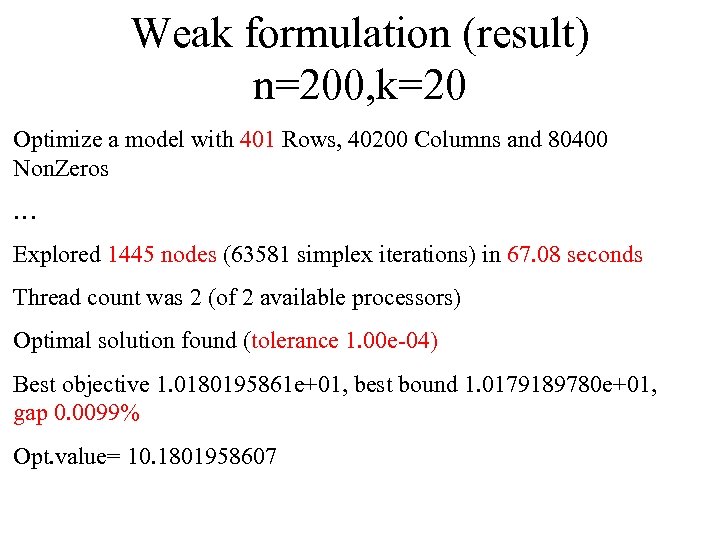 Weak formulation (result) n=200, k=20 Optimize a model with 401 Rows, 40200 Columns and 80400 Non. Zeros … Explored 1445 nodes (63581 simplex iterations) in 67. 08 seconds Thread count was 2 (of 2 available processors) Optimal solution found (tolerance 1. 00 e-04) Best objective 1. 0180195861 e+01, best bound 1. 0179189780 e+01, gap 0. 0099% Opt. value= 10. 1801958607
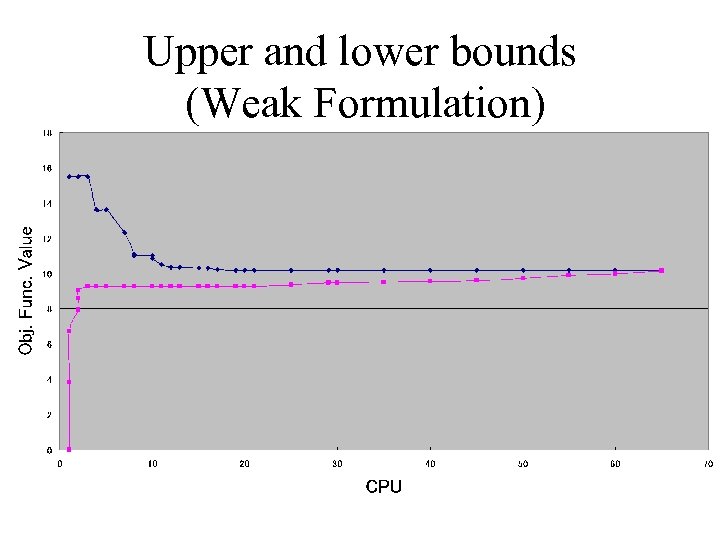 Upper and lower bounds (Weak Formulation)
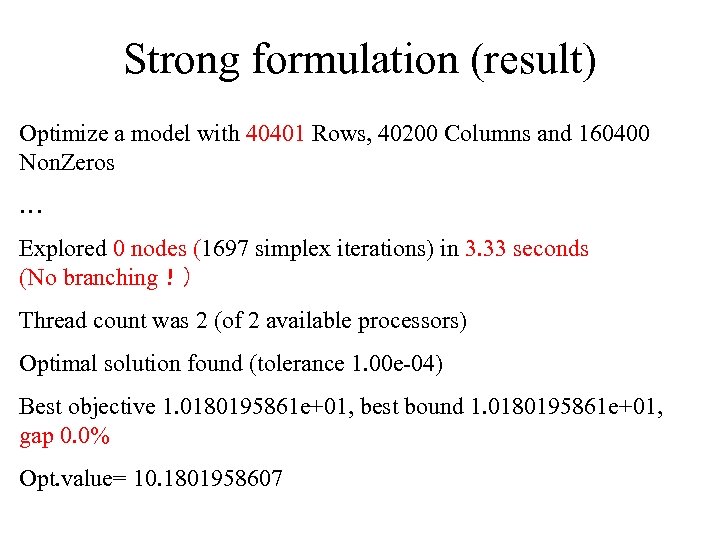 Strong formulation (result) Optimize a model with 40401 Rows, 40200 Columns and 160400 Non. Zeros … Explored 0 nodes (1697 simplex iterations) in 3. 33 seconds (No branching!) Thread count was 2 (of 2 available processors) Optimal solution found (tolerance 1. 00 e-04) Best objective 1. 0180195861 e+01, best bound 1. 0180195861 e+01, gap 0. 0% Opt. value= 10. 1801958607
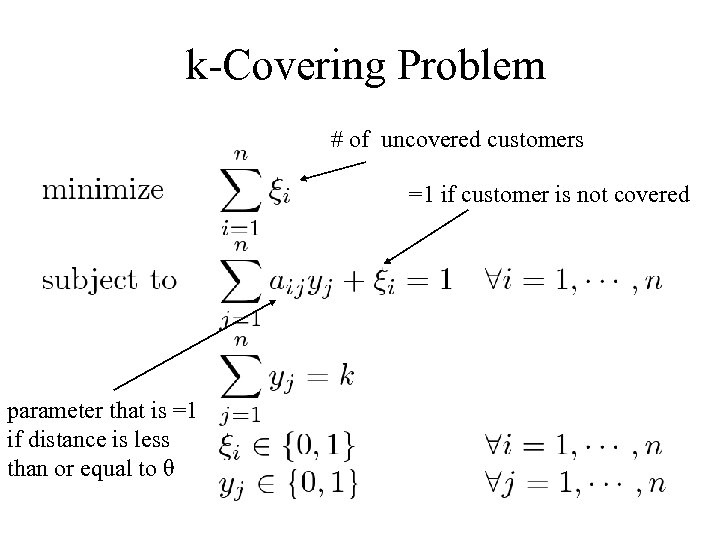
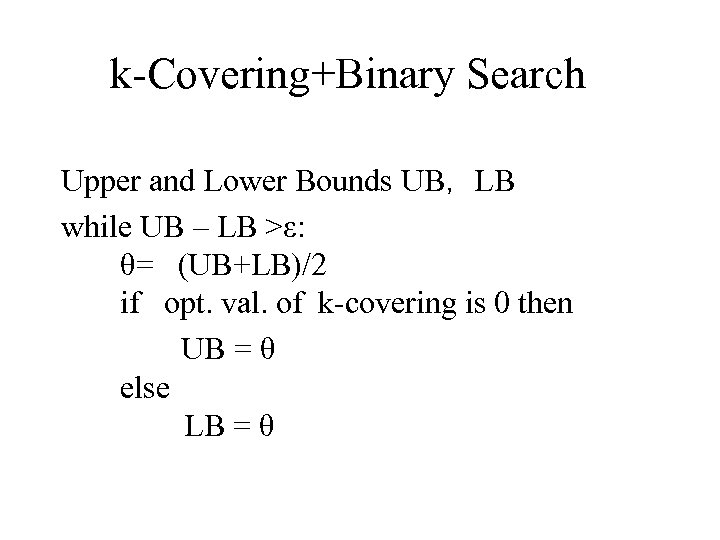
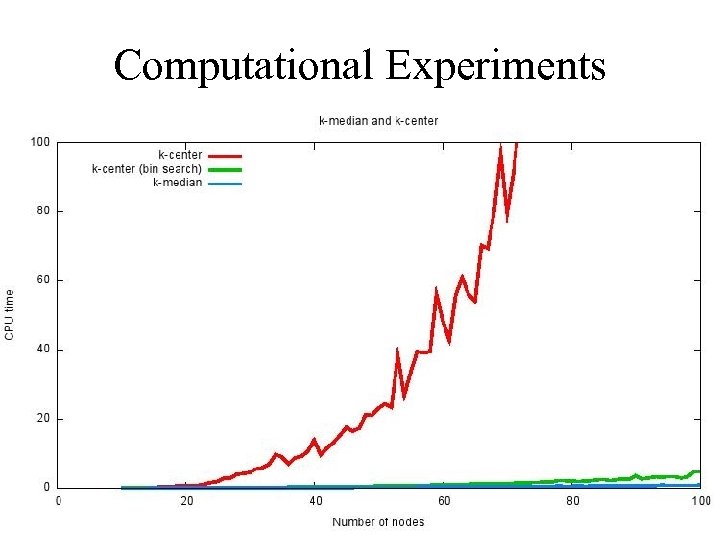
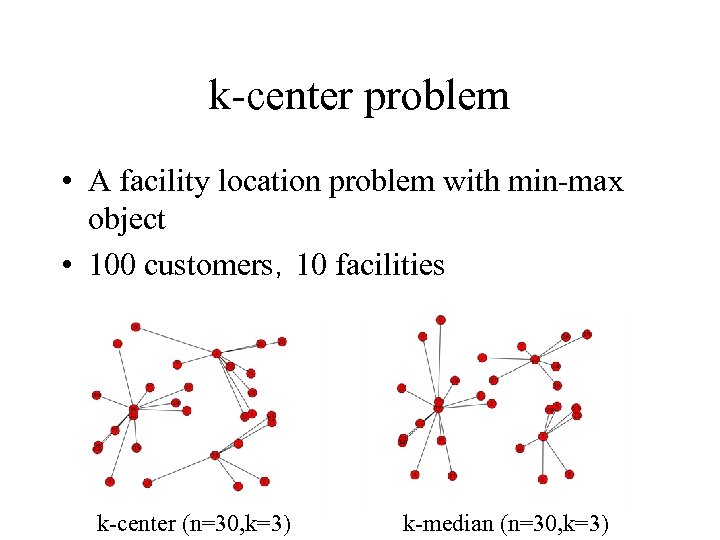 k-center problem • A facility location problem with min-max object • 100 customers,10 facilities k-center (n=30, k=3) k-median (n=30, k=3)
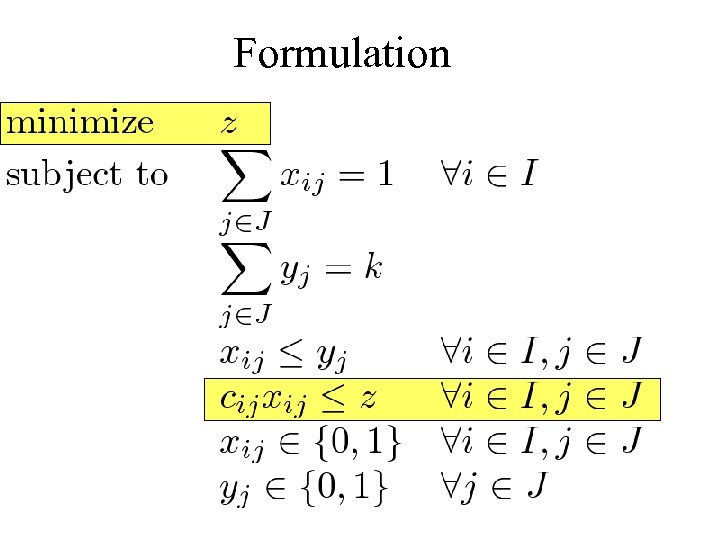 Formulation
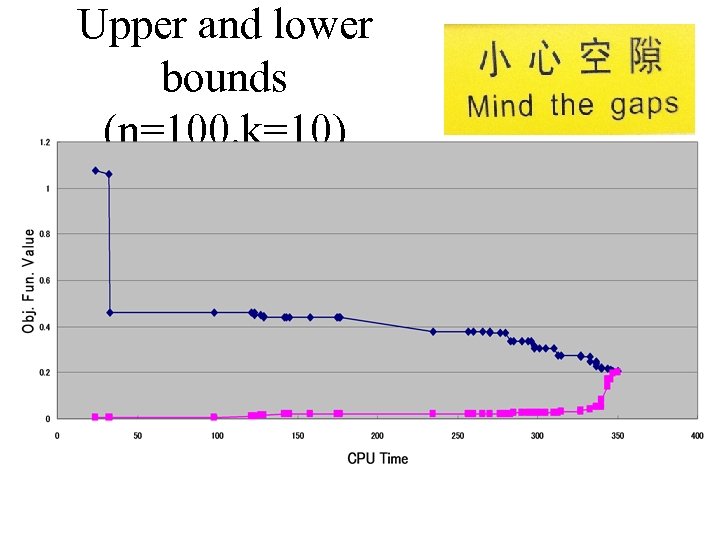 Upper and lower bounds (n=100, k=10)
 k-Covering Problem # of uncovered customers =1 if customer is not covered parameter that is =1 if distance is less than or equal to θ
 k-Covering+Binary Search Upper and Lower Bounds UB, LB while UB – LB >ε: θ= (UB+LB)/2 if opt. val. of k-covering is 0 then UB = θ else LB = θ
 Computational Experiments
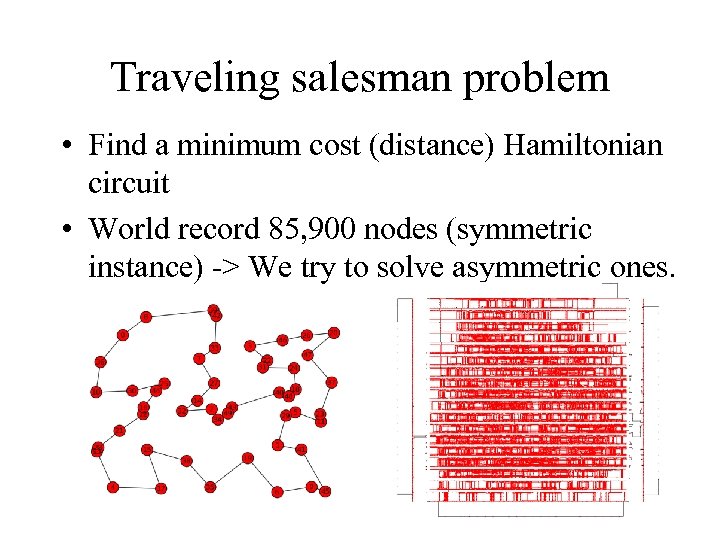 Traveling salesman problem • Find a minimum cost (distance) Hamiltonian circuit • World record 85, 900 nodes (symmetric instance) -> We try to solve asymmetric ones.
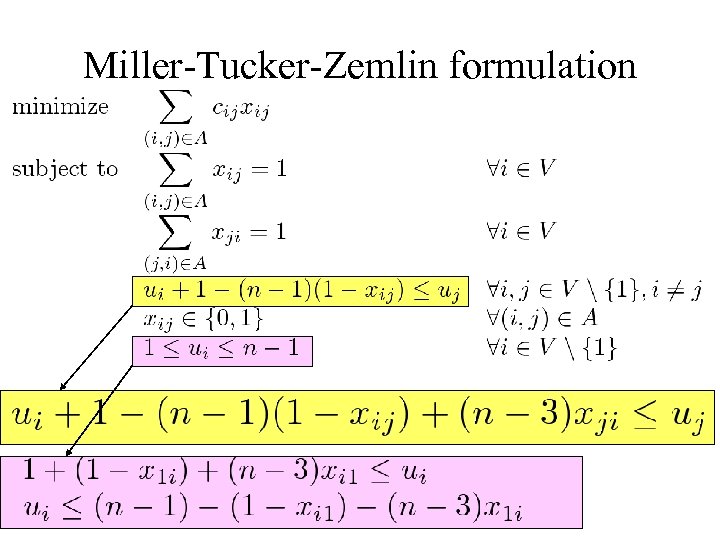 Miller-Tucker-Zemlin formulation
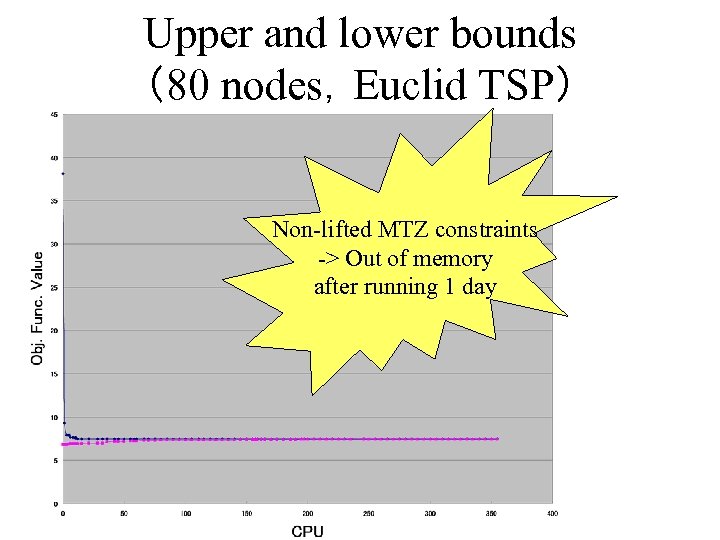 Upper and lower bounds (80 nodes,Euclid TSP) Non-lifted MTZ constraints -> Out of memory after running 1 day
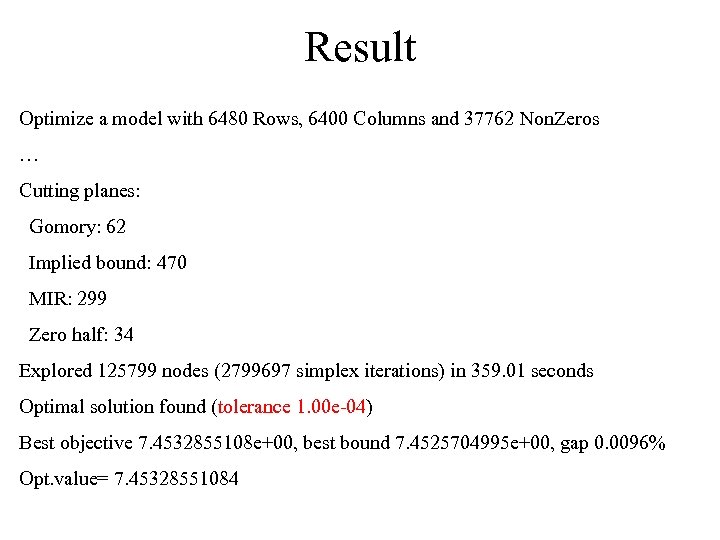 Result Optimize a model with 6480 Rows, 6400 Columns and 37762 Non. Zeros … Cutting planes: Gomory: 62 Implied bound: 470 MIR: 299 Zero half: 34 Explored 125799 nodes (2799697 simplex iterations) in 359. 01 seconds Optimal solution found (tolerance 1. 00 e-04) Best objective 7. 4532855108 e+00, best bound 7. 4525704995 e+00, gap 0. 0096% Opt. value= 7. 45328551084
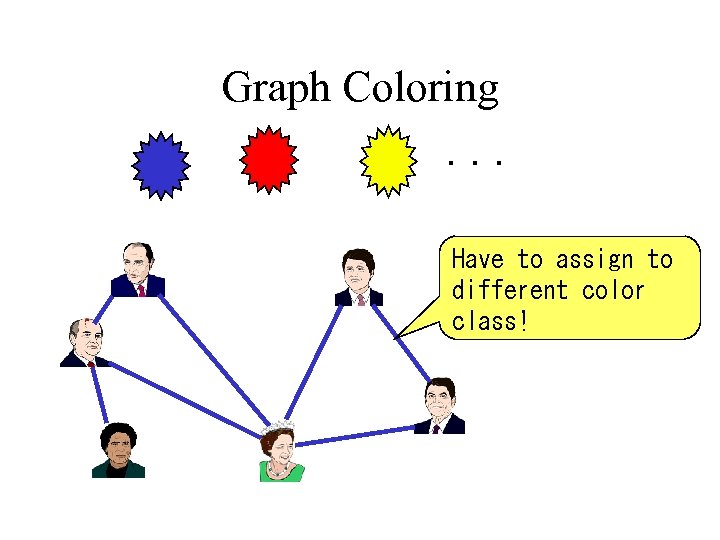
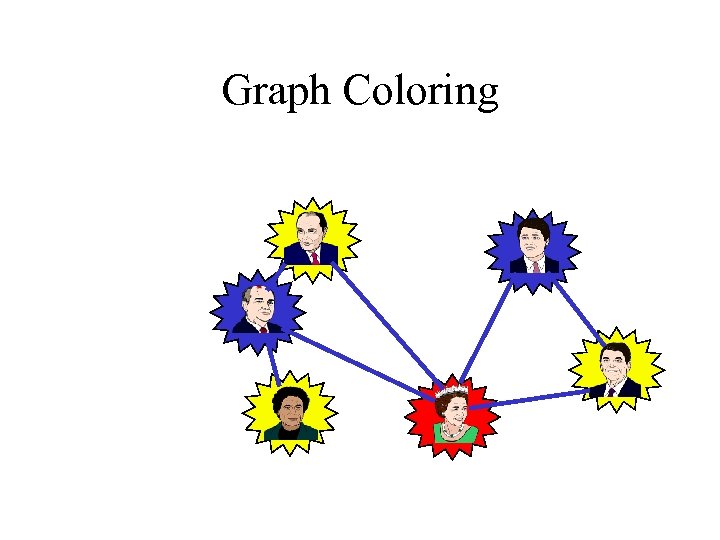
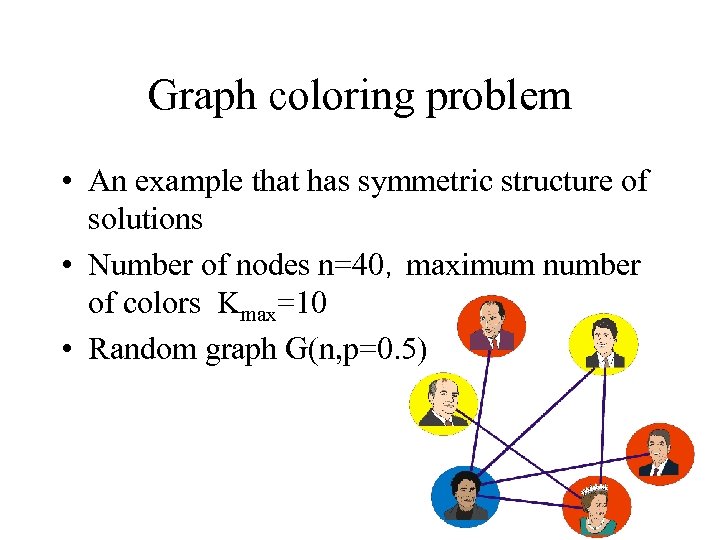 Graph coloring problem • An example that has symmetric structure of solutions • Number of nodes n=40,maximum number of colors Kmax=10 • Random graph G(n, p=0. 5)
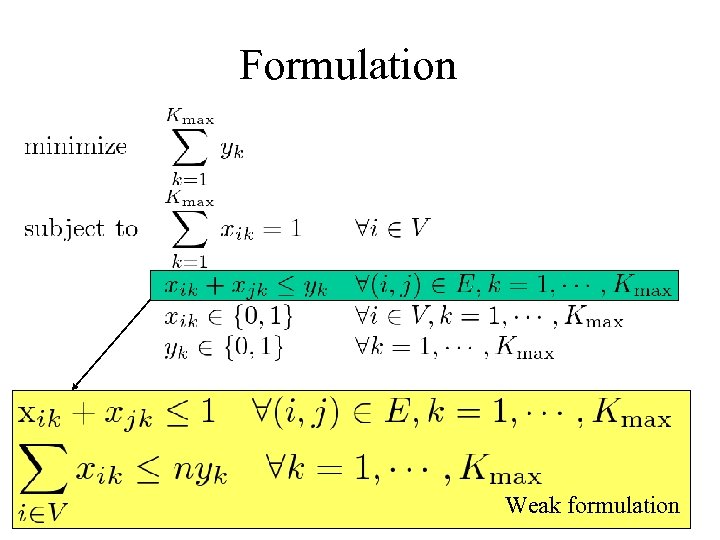 Formulation Weak formulation
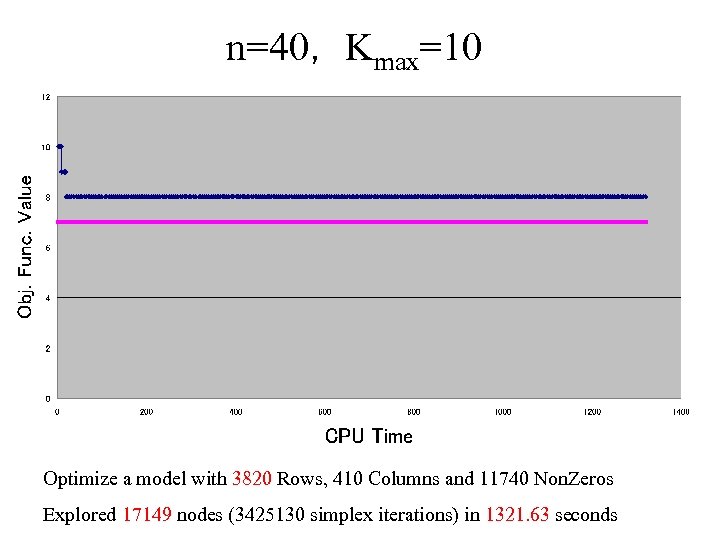 n=40, Kmax=10 Optimize a model with 3820 Rows, 410 Columns and 11740 Non. Zeros Explored 17149 nodes (3425130 simplex iterations) in 1321. 63 seconds
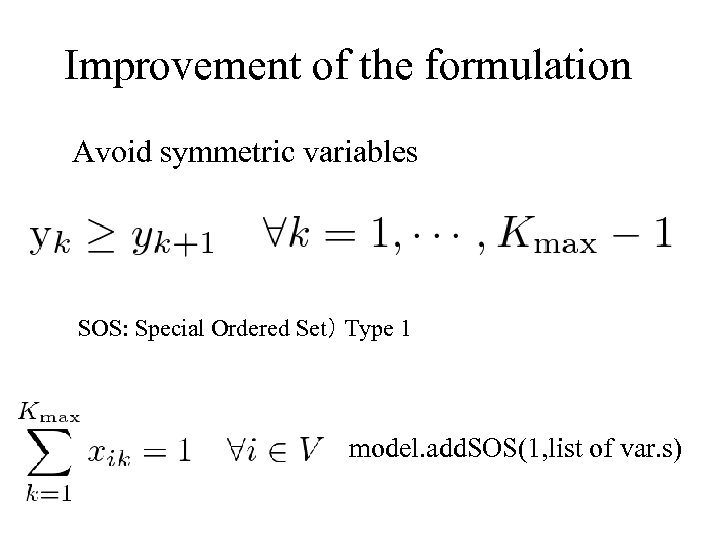 Improvement of the formulation Avoid symmetric variables SOS: Special Ordered Set) Type 1 model. add. SOS(1, list of var. s)
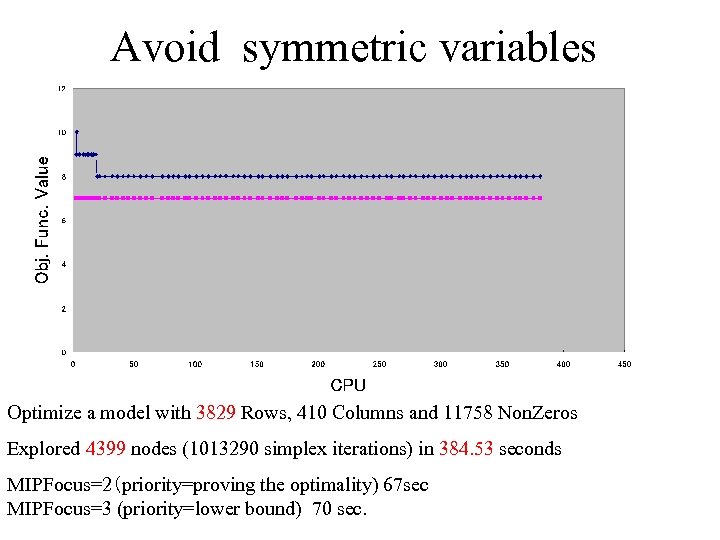 Avoid symmetric variables Optimize a model with 3829 Rows, 410 Columns and 11758 Non. Zeros Explored 4399 nodes (1013290 simplex iterations) in 384. 53 seconds MIPFocus=2(priority=proving the optimality) 67 sec MIPFocus=3 (priority=lower bound) 70 sec.
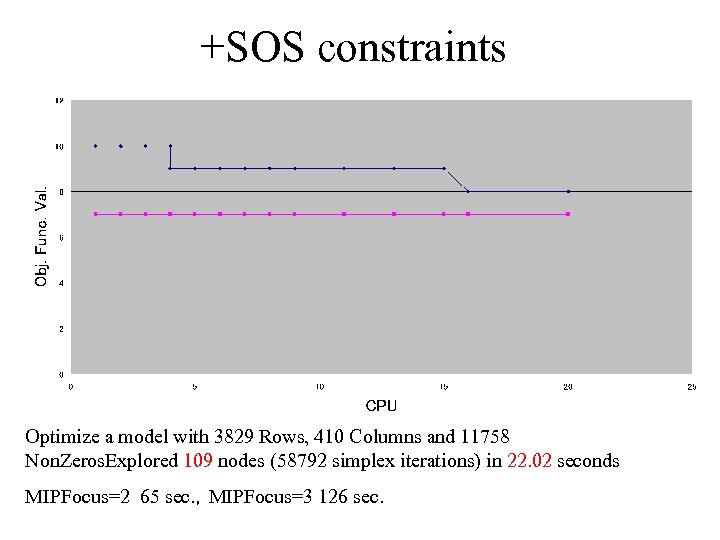 +SOS constraints Optimize a model with 3829 Rows, 410 Columns and 11758 Non. Zeros. Explored 109 nodes (58792 simplex iterations) in 22. 02 seconds MIPFocus=2 65 sec. ,MIPFocus=3 126 sec.
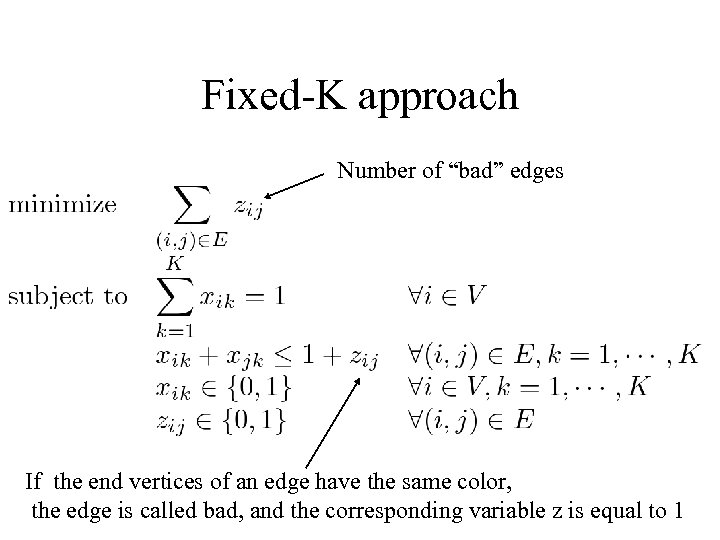 Fixed-K approach Number of “bad” edges If the end vertices of an edge have the same color, the edge is called bad, and the corresponding variable z is equal to 1
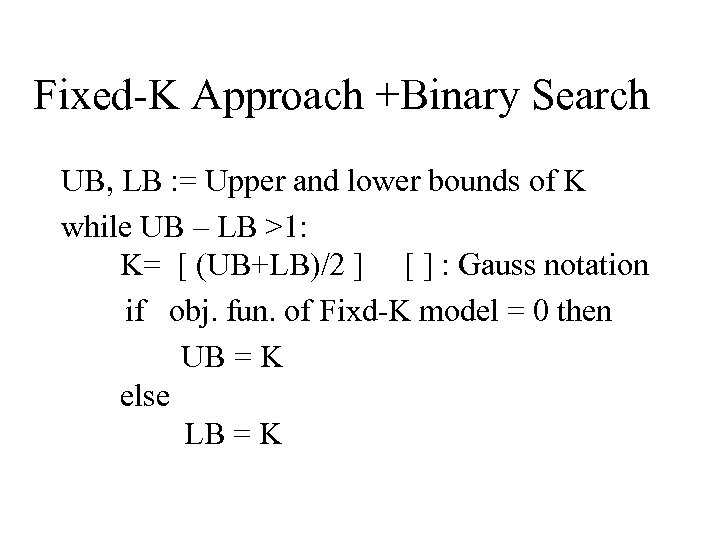 Fixed-K Approach +Binary Search UB, LB : = Upper and lower bounds of K while UB – LB >1: K= [ (UB+LB)/2 ] [ ] : Gauss notation if obj. fun. of Fixd-K model = 0 then UB = K else LB = K
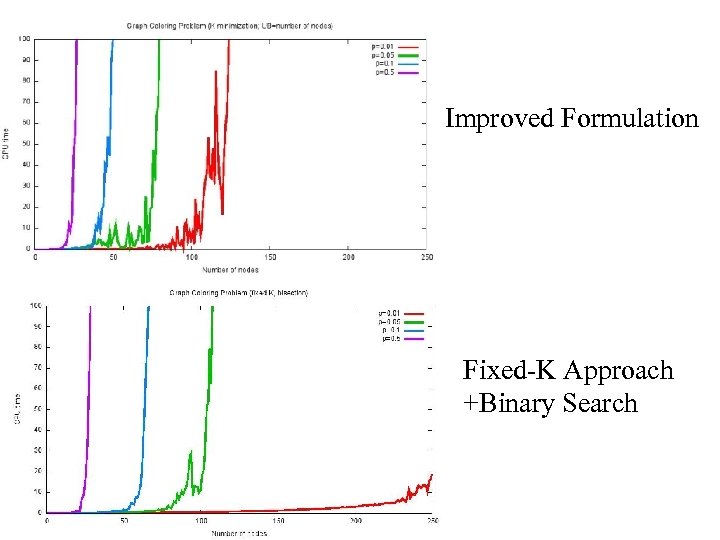 Improved Formulation Fixed-K Approach +Binary Search
 SCOP Solver for COnstraint Programming Log Opt Co. , Ltd.
 Agenda • • • Introduction SCOP Interfaces Demonstration Benchmark Case Study
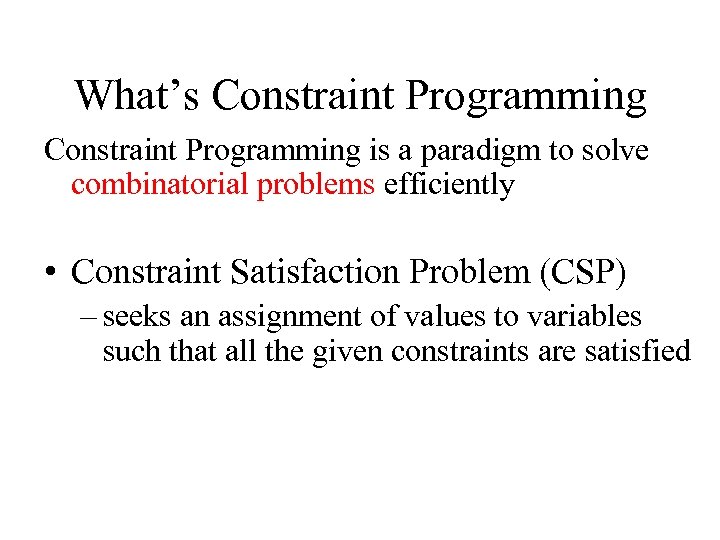 What’s Constraint Programming is a paradigm to solve combinatorial problems efficiently • Constraint Satisfaction Problem (CSP) – seeks an assignment of values to variables such that all the given constraints are satisfied
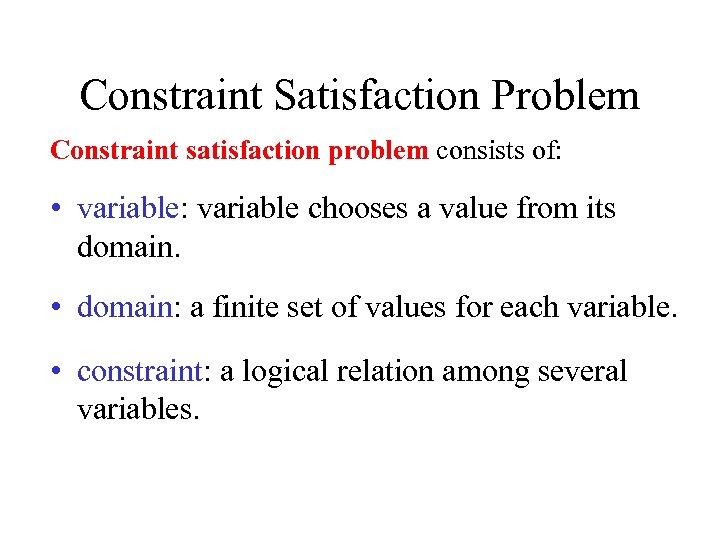 Constraint Satisfaction Problem Constraint satisfaction problem consists of: • variable: variable chooses a value from its domain. • domain: a finite set of values for each variable. • constraint: a logical relation among several variables.
 Weighted Constraint Satisfaction Problem (WCSP) • WCSP is an enhanced framework of CSP • Not just seeks an assignment that satisfies all of the constraints but to minimize the weighted sum of infeasibility of constraints (called penalties): – Hard Constraint weight is infinity, i. e. , constraint must be satisfied – Soft Constraint weight is a positive integer, i. e. , constraint may be violated by paying penalty • The goal is to minimize the total penalties =>optimization model.
 What’s SCOP Solver to solve a large combinatorial problems effectively • Based on Metaheuristics by Ibaraki (Kyotyo-University), Nonobe (Hosey-University) • Trial version (15 variables available) http: //www. logopt. com/scop. htm • 1. Simple modeling language (text file) • 2. Python interface • 3. Library (C++, . Visual Basic, C# ) SCOP is a solver for solving WCSP
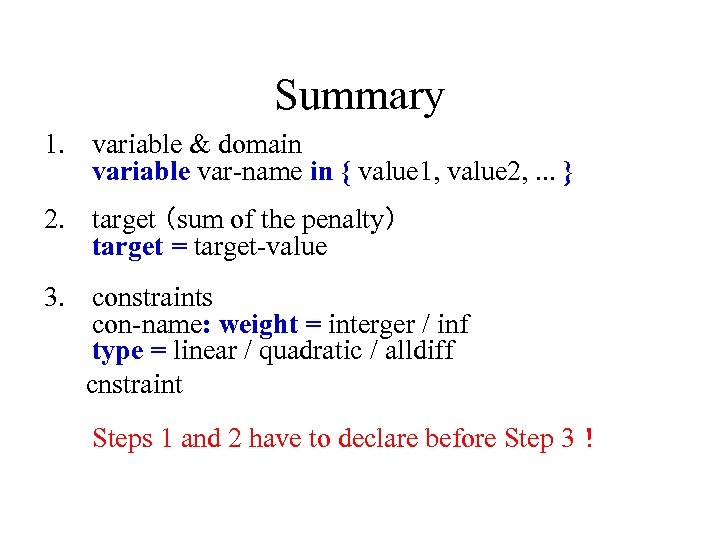
 SCOP Model • variable • domain • constraint: – weight = positive integer (soft constraint) inf (hard constraint) – type = linear,alldiff, quadratic
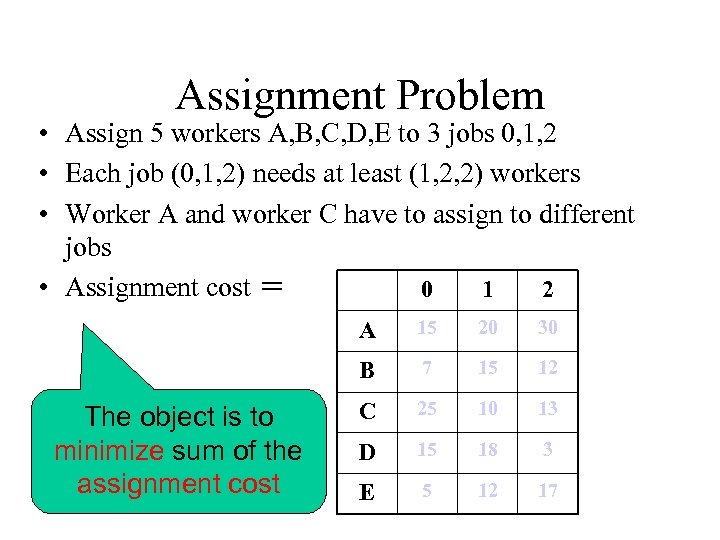 Assignment Problem • Assign 5 workers A, B, C, D, E to 3 jobs 0, 1, 2 • Each job (0, 1, 2) needs at least (1, 2, 2) workers • Worker A and worker C have to assign to different jobs • Assignment cost = 0 1 2 A 20 30 B The object is to minimize sum of the assignment cost 15 7 15 12 C 25 10 13 D 15 18 3 E 5 12 17
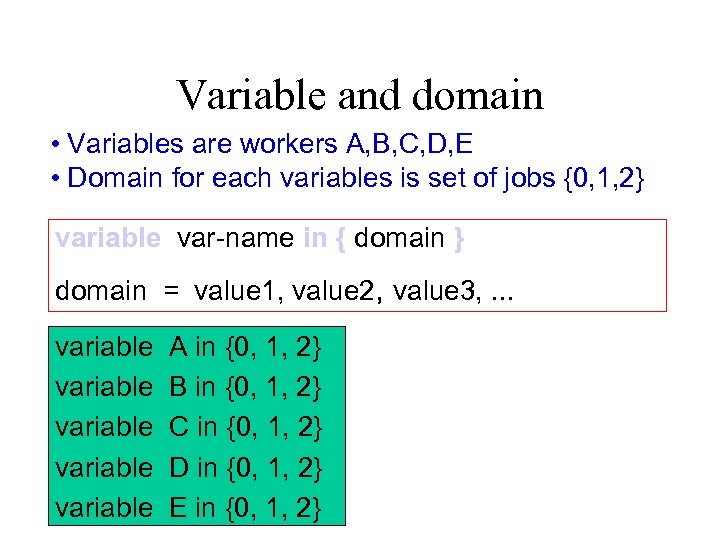 Variable and domain • Variables are workers A, B, C, D, E • Domain for each variables is set of jobs {0, 1, 2} variable var-name in { domain } domain = value 1, value 2, value 3, . . . variable variable A in {0, 1, 2} B in {0, 1, 2} C in {0, 1, 2} D in {0, 1, 2} E in {0, 1, 2}
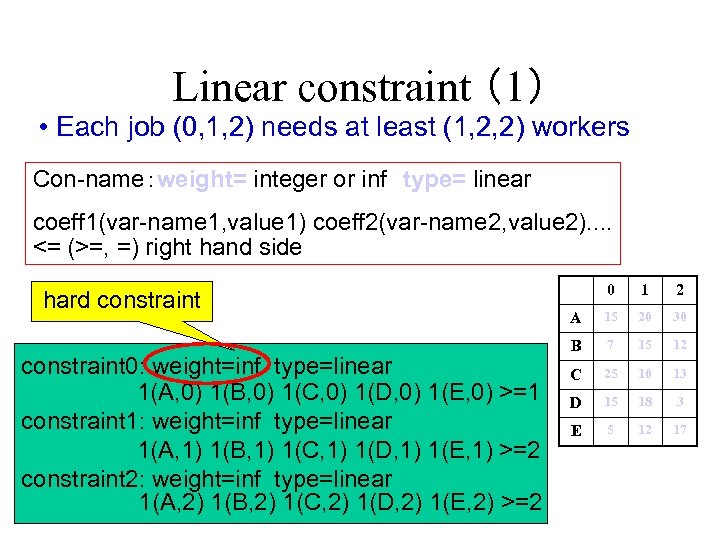 Linear constraint (1) • Each job (0, 1, 2) needs at least (1, 2, 2) workers Con-name:weight= integer or inf type= linear coeff 1(var-name 1, value 1) coeff 2(var-name 2, value 2). . <= (>=, =) right hand side hard constraint 0: weight=inf type=linear 1(A, 0) 1(B, 0) 1(C, 0) 1(D, 0) 1(E, 0) >=1 constraint 1: weight=inf type=linear 1(A, 1) 1(B, 1) 1(C, 1) 1(D, 1) 1(E, 1) >=2 constraint 2: weight=inf type=linear 1(A, 2) 1(B, 2) 1(C, 2) 1(D, 2) 1(E, 2) >=2 0 1 2 A 15 20 30 B 7 15 12 C 25 10 13 D 15 18 3 E 5 12 17
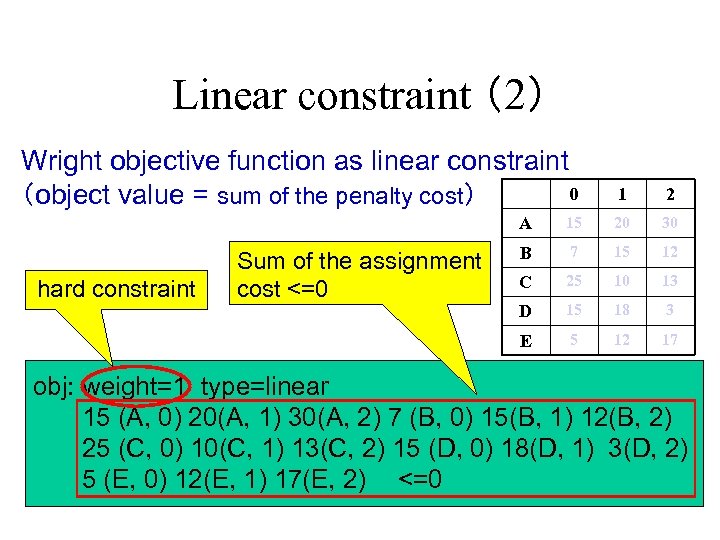 Linear constraint (2) Wright objective function as linear constraint 0 (object value = sum of the penalty cost) 1 2 A 15 20 30 B 7 15 12 C 25 10 13 D 15 18 3 E 5 12 17 hard constraint Sum of the assignment cost <=0 obj: weight=1 type=linear 15 (A, 0) 20(A, 1) 30(A, 2) 7 (B, 0) 15(B, 1) 12(B, 2) 25 (C, 0) 10(C, 1) 13(C, 2) 15 (D, 0) 18(D, 1) 3(D, 2) 5 (E, 0) 12(E, 1) 17(E, 2) <=0
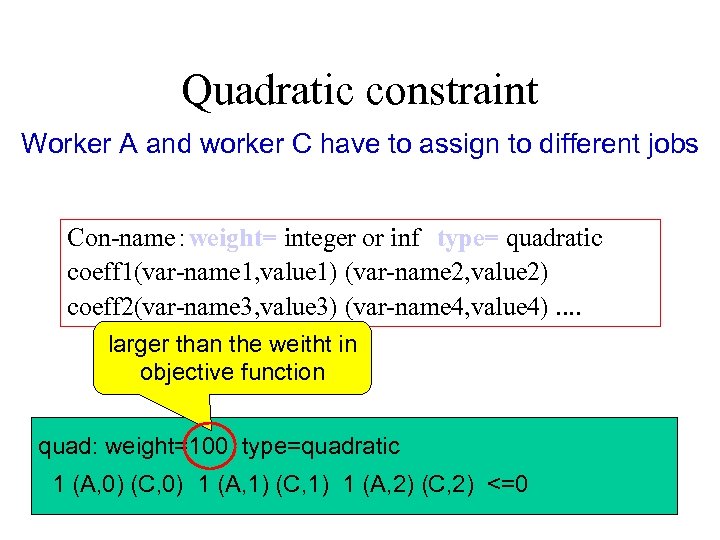 Quadratic constraint Worker A and worker C have to assign to different jobs Con-name:weight= integer or inf type= quadratic coeff 1(var-name 1, value 1) (var-name 2, value 2) coeff 2(var-name 3, value 3) (var-name 4, value 4). . larger than the weitht in objective function quad: weight=100 type=quadratic 1 (A, 0) (C, 0) 1 (A, 1) (C, 1) 1 (A, 2) (C, 2) <=0
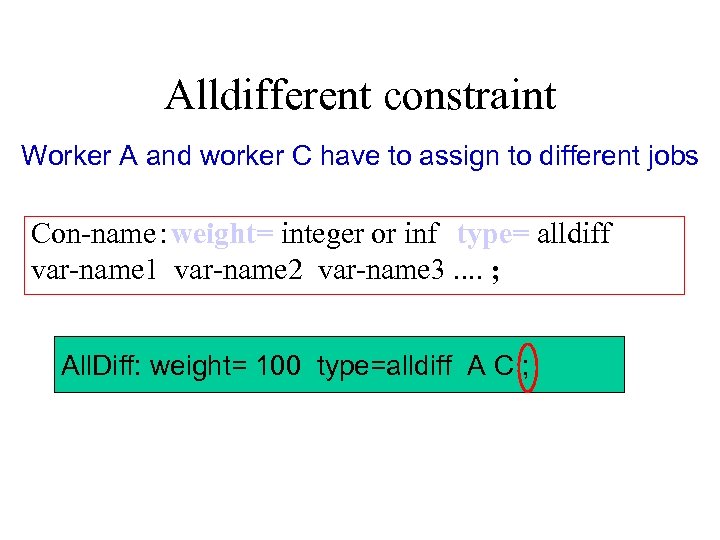 Alldifferent constraint Worker A and worker C have to assign to different jobs Con-name:weight= integer or inf type= alldiff var-name 1 var-name 2 var-name 3. . ; All. Diff: weight= 100 type=alldiff A C ;
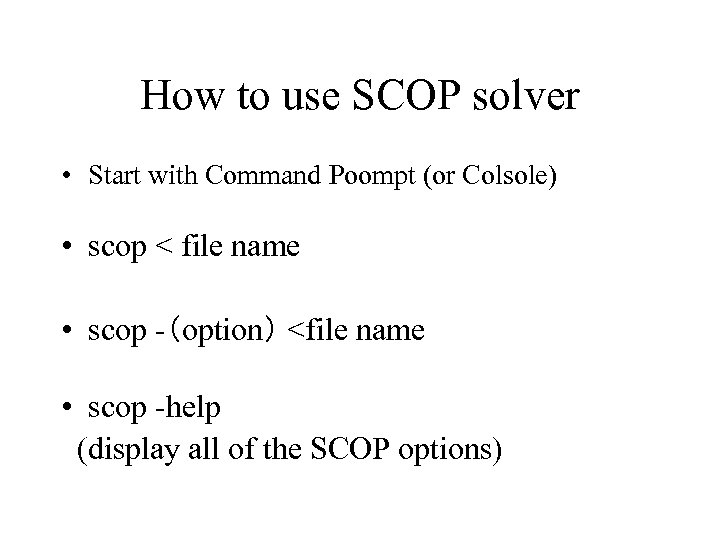 How to use SCOP solver • Start with Command Poompt (or Colsole) • scop < file name • scop -(option)
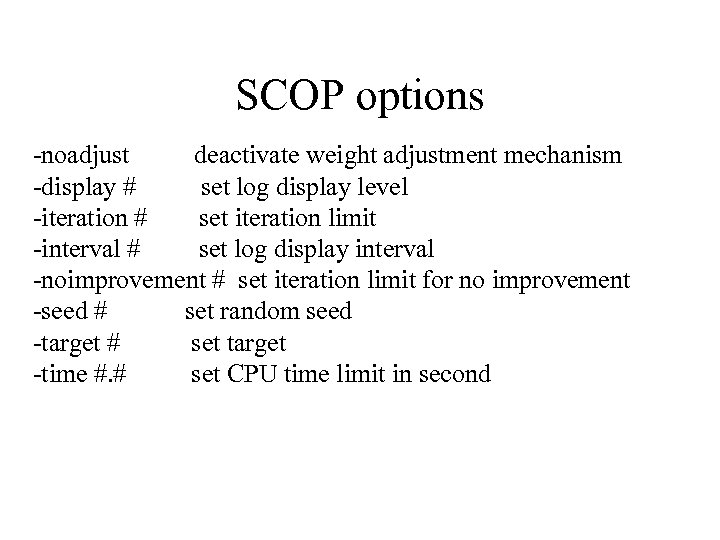 SCOP options -noadjust deactivate weight adjustment mechanism -display # set log display level -iteration # set iteration limit -interval # set log display interval -noimprovement # set iteration limit for no improvement -seed # set random seed -target # set target -time #. # set CPU time limit in second
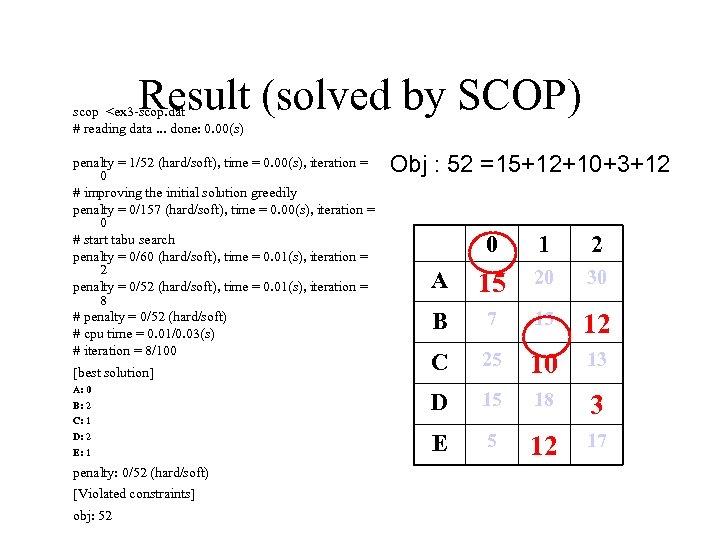 Result (solved by SCOP) scop
 Summary 1. variable & domain variable var-name in { value 1, value 2, . . . } 2. target (sum of the penalty) target = target-value 3. constraints con-name: weight = interger / inf type = linear / quadratic / alldiff cnstraint Steps 1 and 2 have to declare before Step 3!
 Graph Coloring ・・・ Have to assign to different color class!
 Graph Coloring
 Graph Coloring Programs SCOP Gurobi
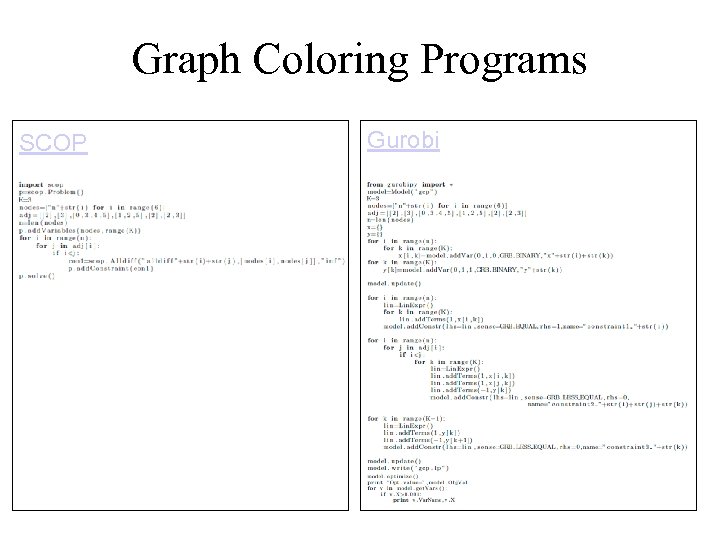
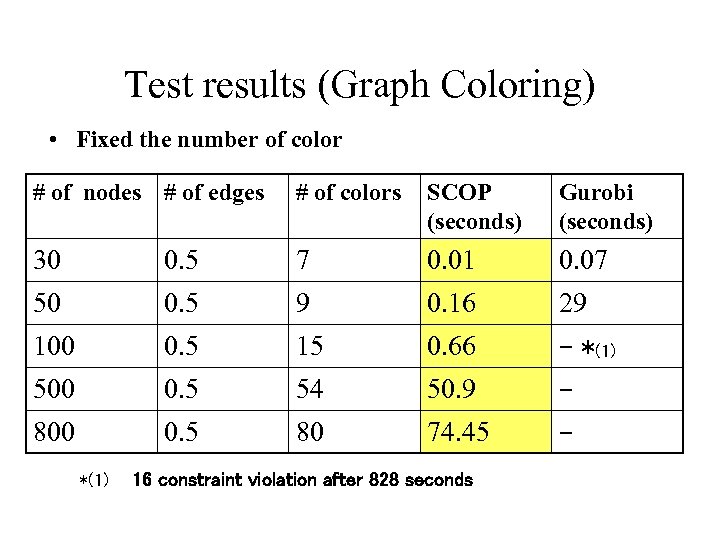 Test results (Graph Coloring) • Fixed the number of color # of nodes # of edges # of colors SCOP (seconds) Gurobi (seconds) 30 0. 5 7 0. 01 0. 07 50 0. 5 9 0. 16 29 100 0. 5 15 0. 66 - *(1) 500 0. 5 54 50. 9 - 800 0. 5 80 74. 45 - *(1) 16 constraint violation after 828 seconds
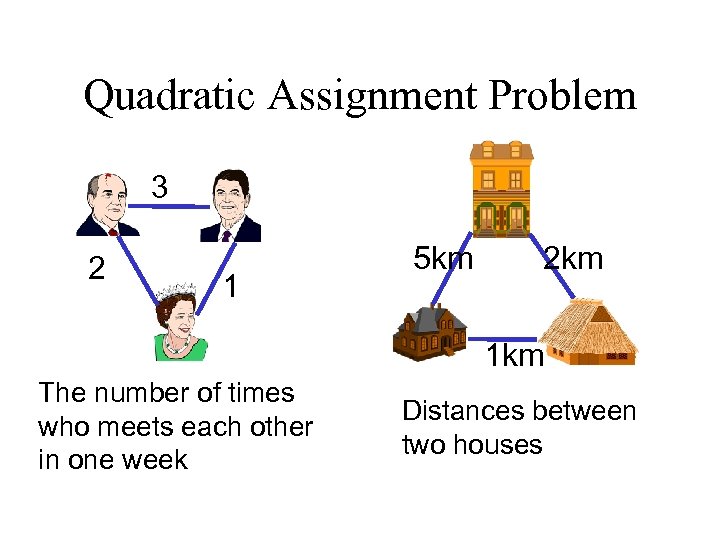 Quadratic Assignment Problem 3 2 1 The number of times who meets each other in one week 5 km 2 km 1 km Distances between two houses
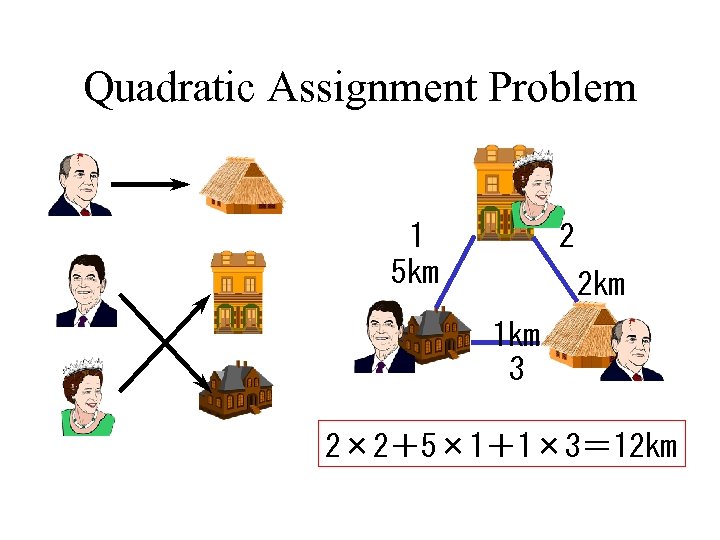 Quadratic Assignment Problem 1 5 km 2 2 km 1 km 3 2× 2+5× 1+1× 3= 12 km
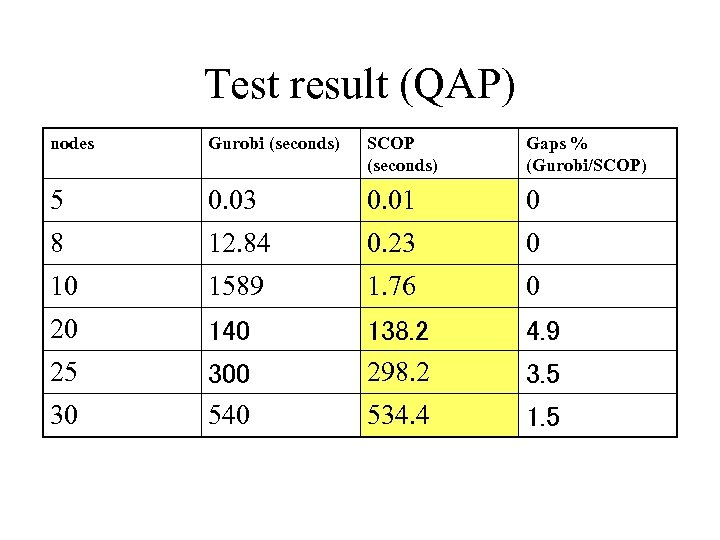 Test result (QAP) nodes Gurobi (seconds) SCOP (seconds) Gaps % (Gurobi/SCOP) 5 0. 03 0. 01 0 8 12. 84 0. 23 0 10 1589 1. 76 0 20 140 4. 9 25 300 540 138. 2 298. 2 534. 4 1. 5 30 3. 5
 Application of SCOP • • • Staff scheduling problem Time tabling problem Graph partition problem Maximum stable set problem Graph coloring problem Quadric assignment problem Travelling sails man problem Multiple knapsack problem Process Scheduling in Chemical Plants
 Scheduling optimization system Opt. Seq Log Opt Co. , Ltd. http: //www. logopt. com/Opt. Seq. htm
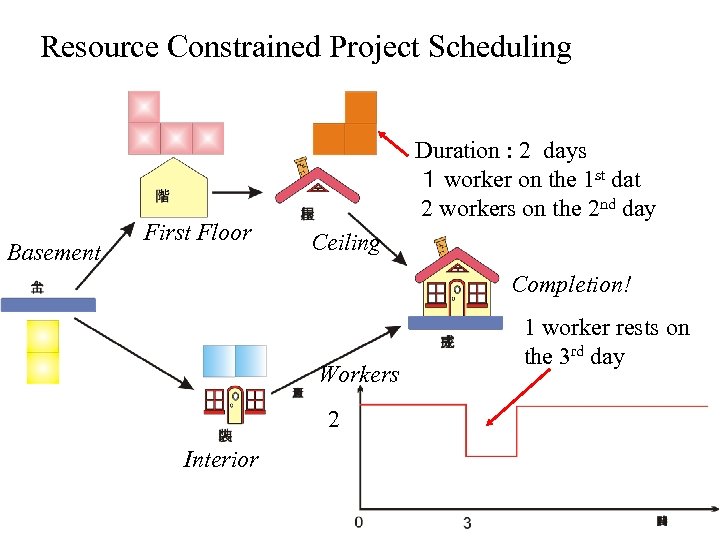
 What is the scheduling? • Allocation of activities (jobs, tasks) over time – Resource constraints. For example, machines, workers, raw material, etc. may be scare resources. – Precedence (or temporal) relation between activities. For example. , some activities cannot start unless other activities finish.
 Take off the airplane a. s. a. p. ! You’re a consultant of an airline company. Your job is to find a schedule that takes off the airplane as soon as possible. We need several activities before taking off the airplane. Firstly let the passengers get off and unload their baggage; secondly clean up the cabin; finally let new passengers get on and load their baggage. What is the best (shortest) schedule for taking off the airplane?
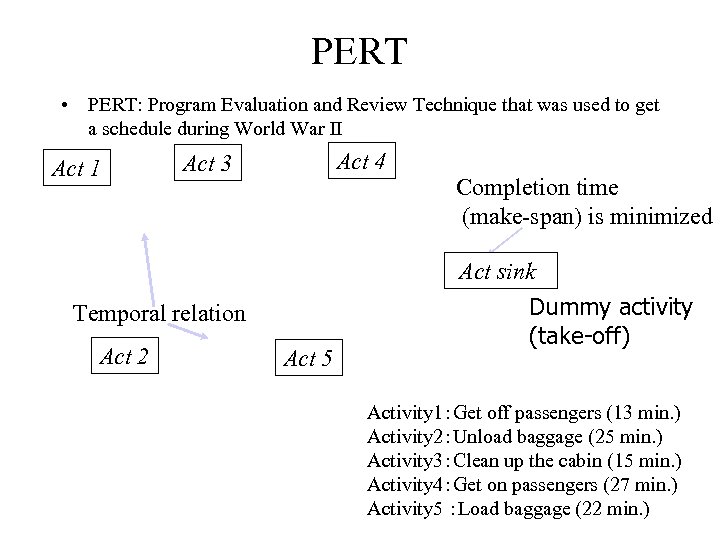 PERT • PERT: Program Evaluation and Review Technique that was used to get a schedule during World War II Act 1 Act 4 Act 3 Completion time (make-span) is minimized Act sink Temporal relation Act 2 Act 5 Dummy activity (take-off) Activity 1:Get off passengers (13 min. ) Activity 2:Unload baggage (25 min. ) Activity 3:Clean up the cabin (15 min. ) Activity 4:Get on passengers (27 min. ) Activity 5 :Load baggage (22 min. )
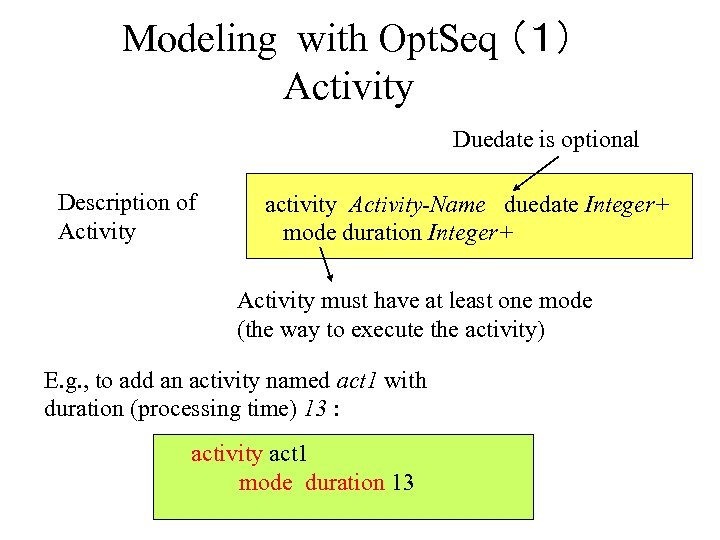 Modeling with Opt. Seq (1) Activity Duedate is optional Description of Activity activity Activity-Name duedate Integer+ mode duration Integer+ Activity must have at least one mode (the way to execute the activity) E. g. , to add an activity named act 1 with duration (processing time) 13 : activity act 1 mode duration 13
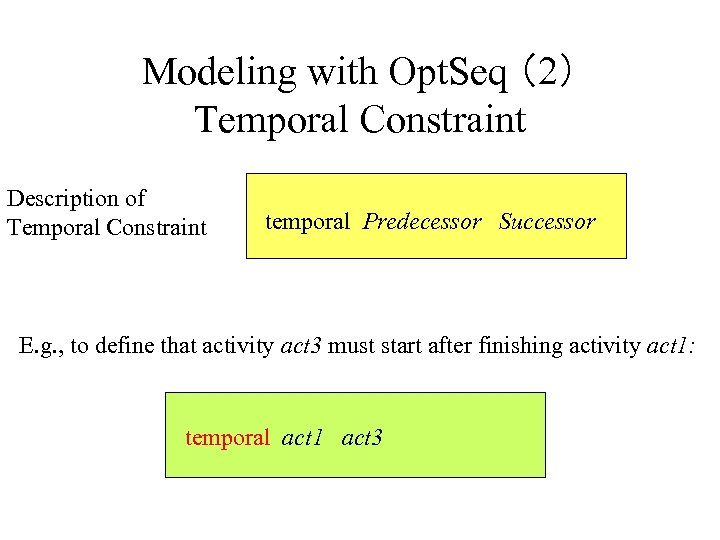 Modeling with Opt. Seq (2) Temporal Constraint Description of Temporal Constraint temporal Predecessor Successor E. g. , to define that activity act 3 must start after finishing activity act 1: temporal act 1 act 3
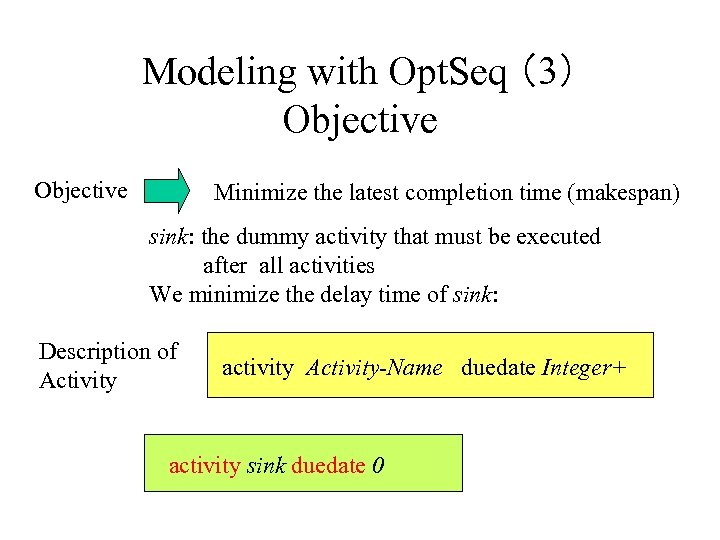 Modeling with Opt. Seq (3) Objective Minimize the latest completion time (makespan) sink: the dummy activity that must be executed after all activities We minimize the delay time of sink: Description of Activity activity Activity-Name duedate Integer+ activity sink duedate 0
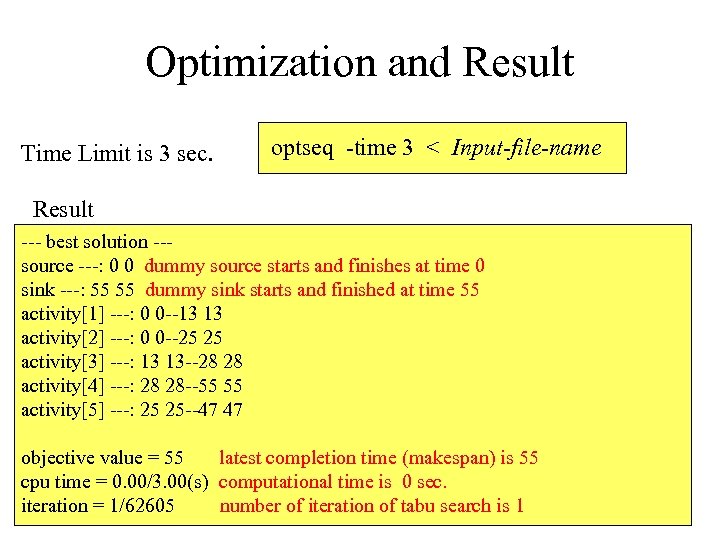 Optimization and Result Time Limit is 3 sec. optseq -time 3 < Input-file-name Result --- best solution --source ---: 0 0 dummy source starts and finishes at time 0 sink ---: 55 55 dummy sink starts and finished at time 55 activity[1] ---: 0 0 --13 13 activity[2] ---: 0 0 --25 25 activity[3] ---: 13 13 --28 28 activity[4] ---: 28 28 --55 55 activity[5] ---: 25 25 --47 47 objective value = 55 latest completion time (makespan) is 55 cpu time = 0. 00/3. 00(s) computational time is 0 sec. iteration = 1/62605 number of iteration of tabu search is 1
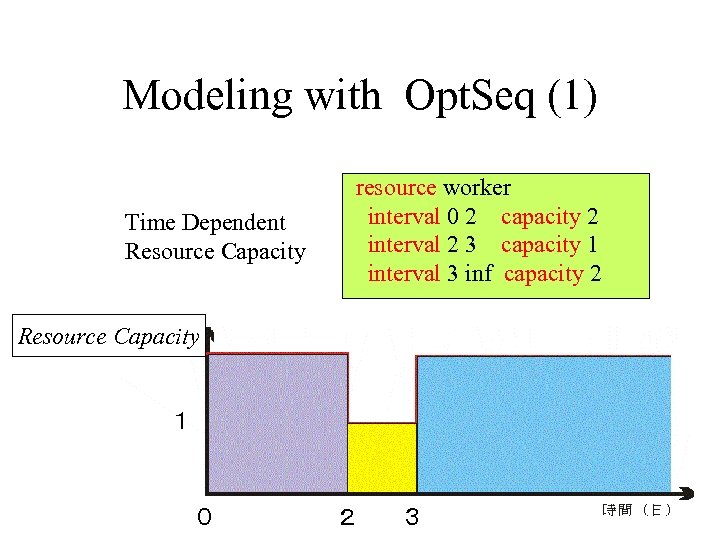
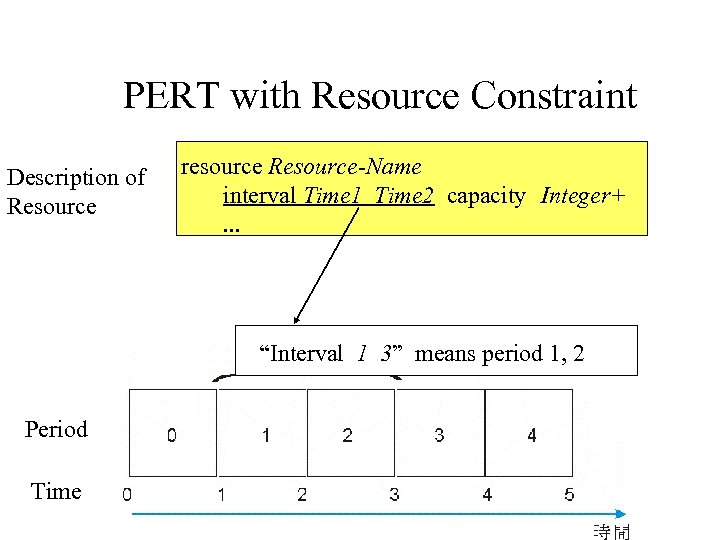 PERT with Resource Constraint Description of Resource resource Resource-Name interval Time 1 Time 2 capacity Integer+. . . “Interval 1 3” means period 1, 2 Period Time
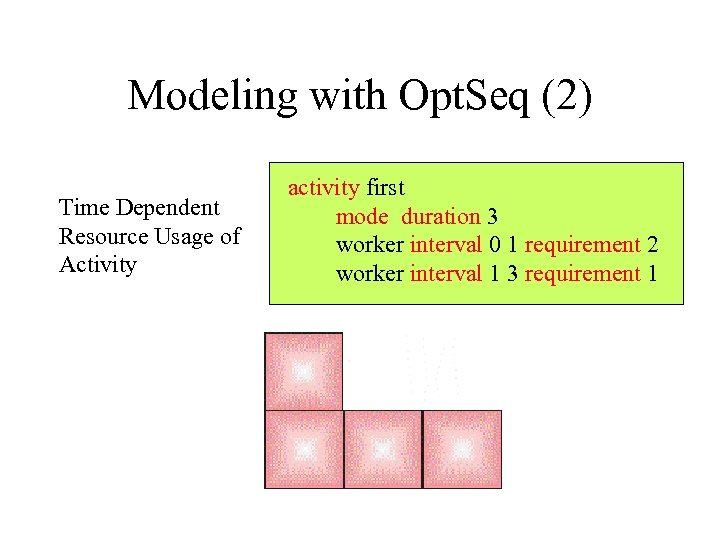
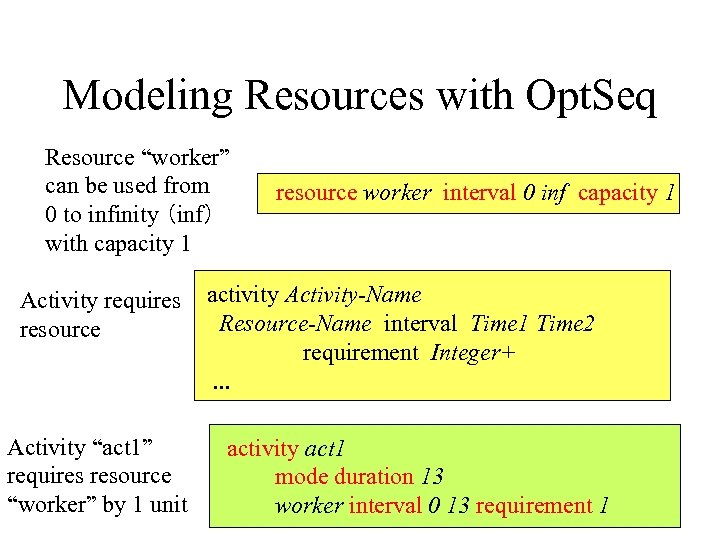 Modeling Resources with Opt. Seq Resource “worker” can be used from 0 to infinity (inf) with capacity 1 Activity requires resource Activity “act 1” requires resource “worker” by 1 unit resource worker interval 0 inf capacity 1 activity Activity-Name Resource-Name interval Time 1 Time 2 requirement Integer+ . . . activity act 1 mode duration 13 worker interval 0 13 requirement 1
![Optimization and Result source ---: 0 0 sink ---: 102 activity[1] ---: 47 47](https://present5.com/presentation/650a545843a15c28a44320fd7d4ea1e6/image-86.jpg "Optimization and Result source ---: 0 0 sink ---: 102 activity[1] ---: 47 47") Optimization and Result source ---: 0 0 sink ---: 102 activity[1] ---: 47 47 --60 60 activity[2] ---: 0 0 --25 25 activity[3] ---: 60 60 --75 75 activity[4] ---: 75 75 --102 activity[5] ---: 25 25 --47 47 objective value = 102 cpu time = 0. 00/3. 00(s) iteration = 0/64983
Optimization and Result source ---: 0 0 sink ---: 102 activity[1] ---: 47 47 --60 60 activity[2] ---: 0 0 --25 25 activity[3] ---: 60 60 --75 75 activity[4] ---: 75 75 --102 activity[5] ---: 25 25 --47 47 objective value = 102 cpu time = 0. 00/3. 00(s) iteration = 0/64983
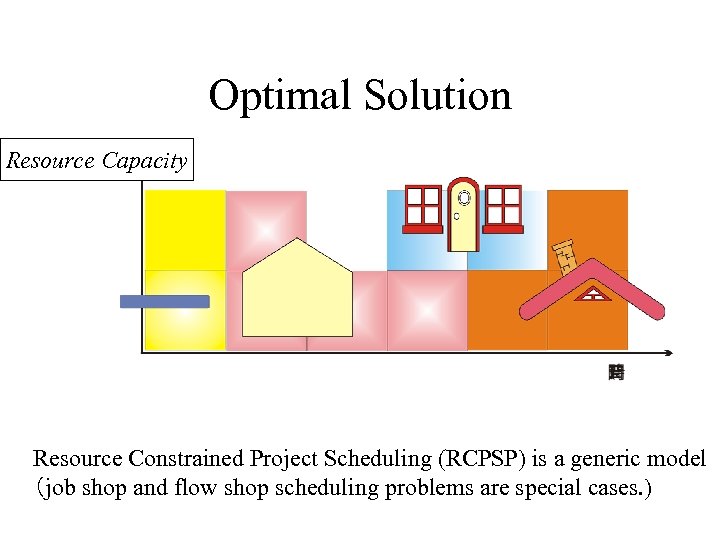
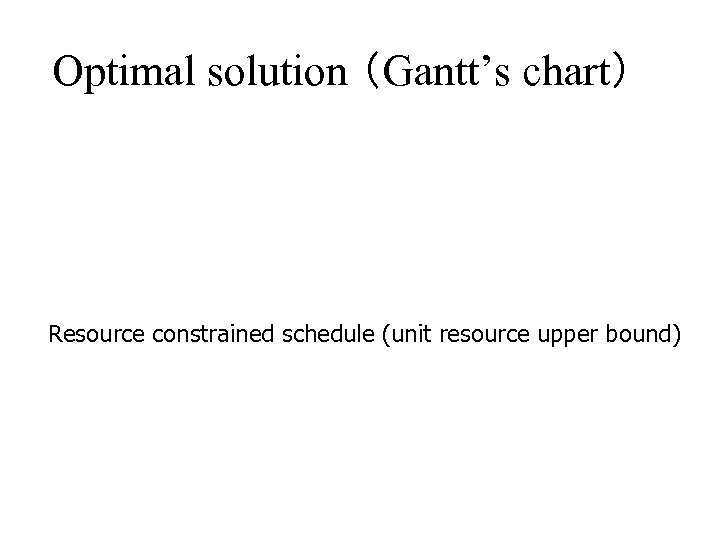 Optimal solution (Gantt’s chart) Resource constrained schedule (unit resource upper bound)
 Example 2 Minimize the Pit-in time! You’re a staff of F 1 race. There are three pit staffs who have to do some tasks for your F 1 car. Find the best schedule that minimizes the pit-in time.
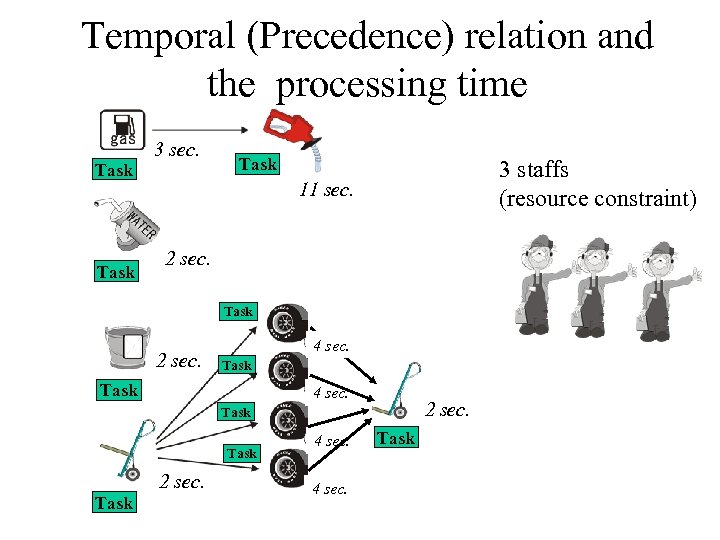 Temporal (Precedence) relation and the processing time Task 3 sec. Task 3 staffs (resource constraint) 11 sec. 2 sec. Task 2 sec. 4 sec. Task 4 sec. 2 sec. Task 2 sec. Task 4 sec. Task
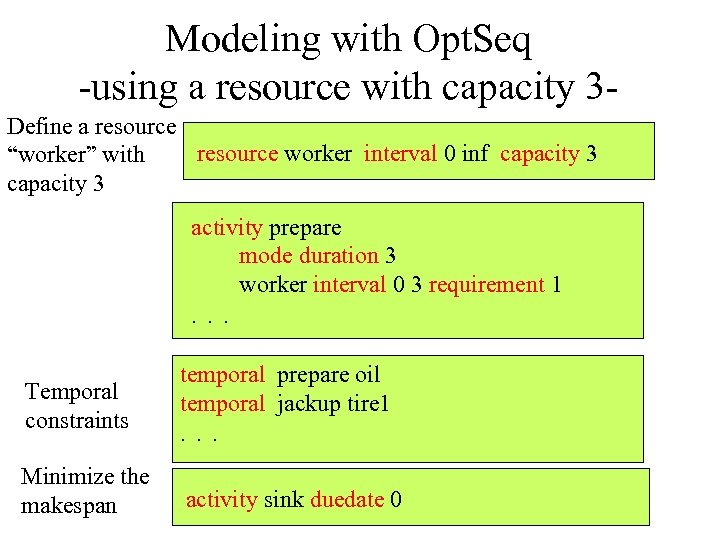 Modeling with Opt. Seq -using a resource with capacity 3 Define a resource worker interval 0 inf capacity 3 “worker” with capacity 3 activity prepare mode duration 3 worker interval 0 3 requirement 1 ... Temporal constraints temporal prepare oil temporal jackup tire 1 ... Minimize the makespan activity sink duedate 0
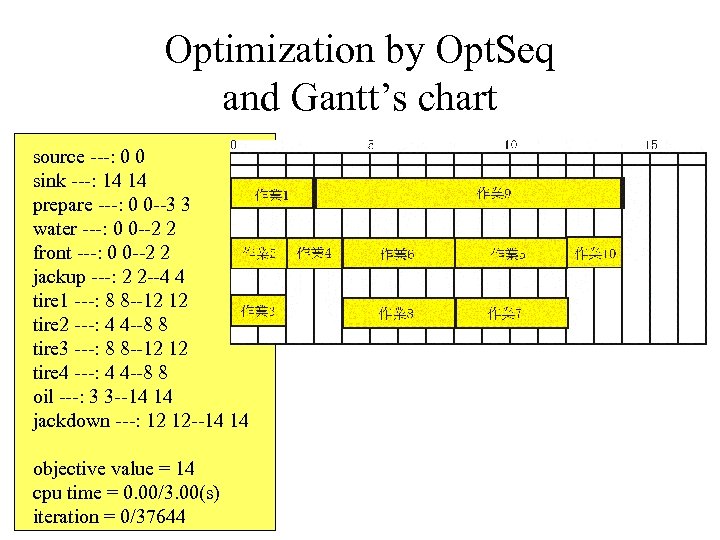 Optimization by Opt. Seq and Gantt’s chart source ---: 0 0 sink ---: 14 14 prepare ---: 0 0 --3 3 water ---: 0 0 --2 2 front ---: 0 0 --2 2 jackup ---: 2 2 --4 4 tire 1 ---: 8 8 --12 12 tire 2 ---: 4 4 --8 8 tire 3 ---: 8 8 --12 12 tire 4 ---: 4 4 --8 8 oil ---: 3 3 --14 14 jackdown ---: 12 12 --14 14 objective value = 14 cpu time = 0. 00/3. 00(s) iteration = 0/37644
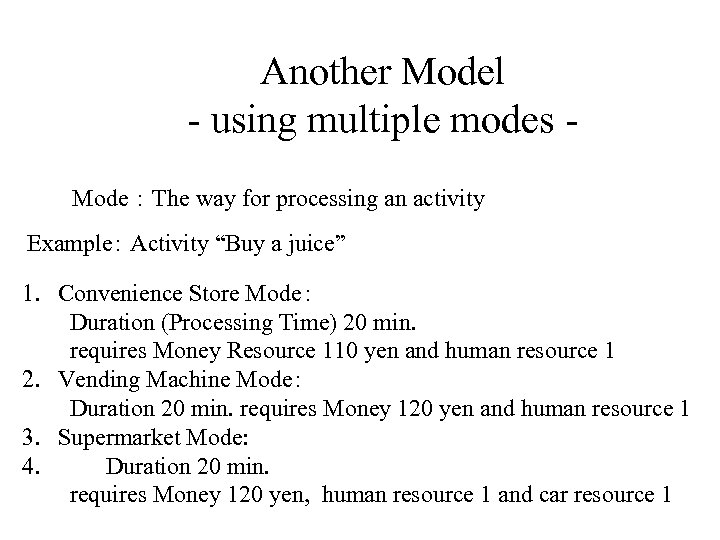 Another Model - using multiple modes Mode : The way for processing an activity Example: Activity “Buy a juice” 1. Convenience Store Mode: Duration (Processing Time) 20 min. requires Money Resource 110 yen and human resource 1 2. Vending Machine Mode: Duration 20 min. requires Money 120 yen and human resource 1 3. Supermarket Mode: 4. Duration 20 min. requires Money 120 yen, human resource 1 and car resource 1
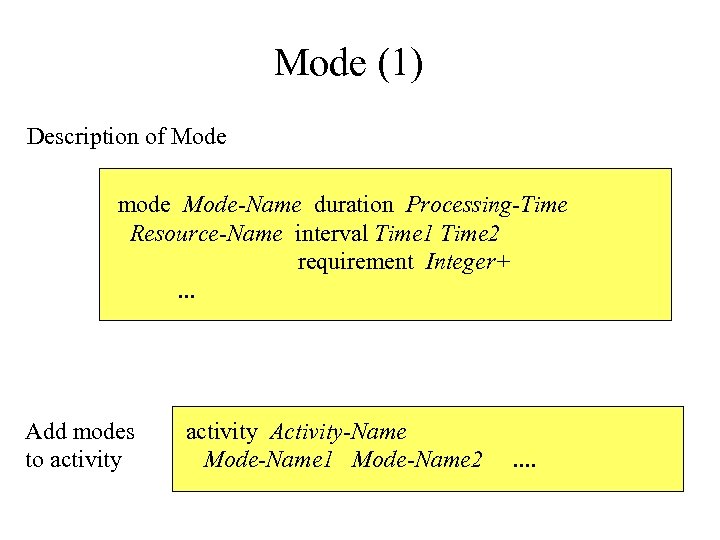 Mode (1) Description of Mode mode Mode-Name duration Processing-Time Resource-Name interval Time 1 Time 2 requirement Integer+ . . . Add modes to activity Activity-Name Mode-Name 1 Mode-Name 2 . .
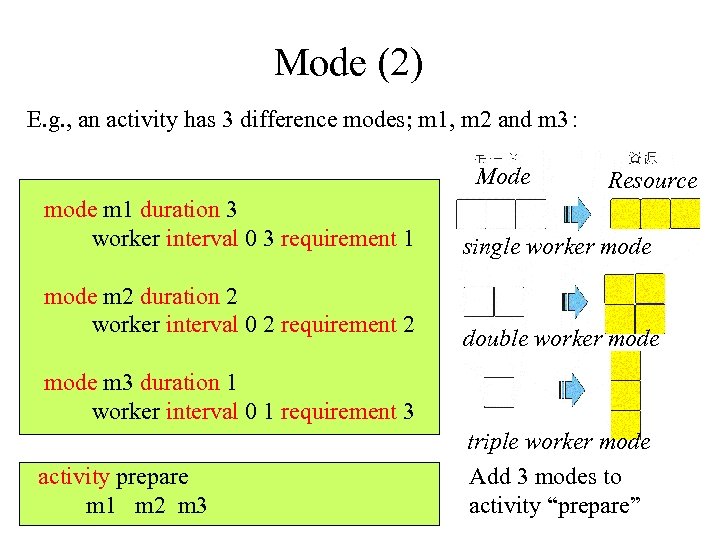 Mode (2) E. g. , an activity has 3 difference modes; m 1, m 2 and m 3: Mode m 1 duration 3 worker interval 0 3 requirement 1 mode m 2 duration 2 worker interval 0 2 requirement 2 Resource single worker mode double worker mode m 3 duration 1 worker interval 0 1 requirement 3 activity prepare m 1 m 2 m 3 triple worker mode Add 3 modes to activity “prepare”
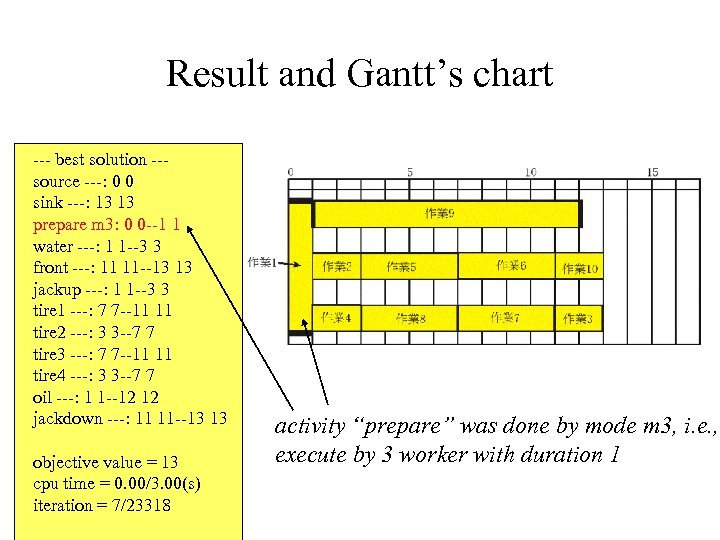 Result and Gantt’s chart --- best solution --source ---: 0 0 sink ---: 13 13 prepare m 3: 0 0 --1 1 water ---: 1 1 --3 3 front ---: 11 11 --13 13 jackup ---: 1 1 --3 3 tire 1 ---: 7 7 --11 11 tire 2 ---: 3 3 --7 7 tire 3 ---: 7 7 --11 11 tire 4 ---: 3 3 --7 7 oil ---: 1 1 --12 12 jackdown ---: 11 11 --13 13 objective value = 13 cpu time = 0. 00/3. 00(s) iteration = 7/23318 activity “prepare” was done by mode m 3, i. e. , execute by 3 worker with duration 1
 Resource Constrained Project Scheduling Basement First Floor Duration : 2 days 1 worker on the 1 st dat 2 workers on the 2 nd day Ceiling Completion! Workers 2 Interior 1 worker rests on the 3 rd day
 Modeling with Opt. Seq (1) Time Dependent Resource Capacity resource worker interval 0 2 capacity 2 interval 2 3 capacity 1 interval 3 inf capacity 2 Resource Capacity 1 0 2 3
 Modeling with Opt. Seq (2) Time Dependent Resource Usage of Activity activity first mode duration 3 worker interval 0 1 requirement 2 worker interval 1 3 requirement 1
 Optimal Solution Resource Capacity Resource Constrained Project Scheduling (RCPSP) is a generic model (job shop and flow shop scheduling problems are special cases. )
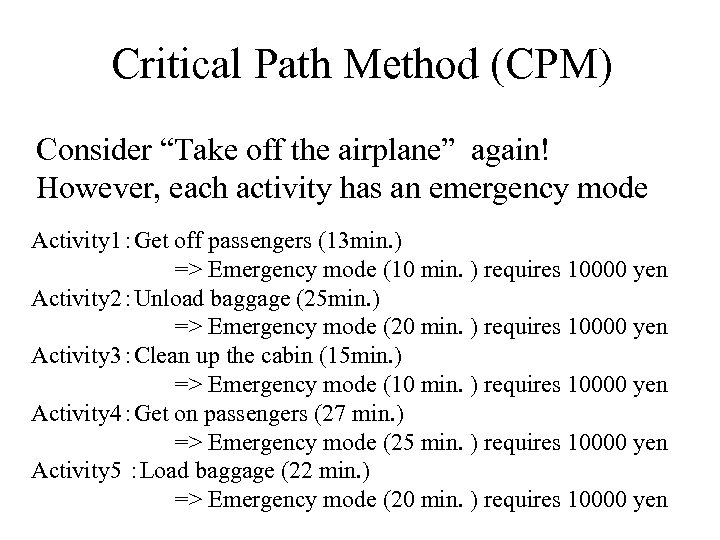 Critical Path Method (CPM) Consider “Take off the airplane” again! However, each activity has an emergency mode Activity 1:Get off passengers (13 min. ) => Emergency mode (10 min. ) requires 10000 yen Activity 2:Unload baggage (25 min. ) => Emergency mode (20 min. ) requires 10000 yen Activity 3:Clean up the cabin (15 min. ) => Emergency mode (10 min. ) requires 10000 yen Activity 4:Get on passengers (27 min. ) => Emergency mode (25 min. ) requires 10000 yen Activity 5 :Load baggage (22 min. ) => Emergency mode (20 min. ) requires 10000 yen
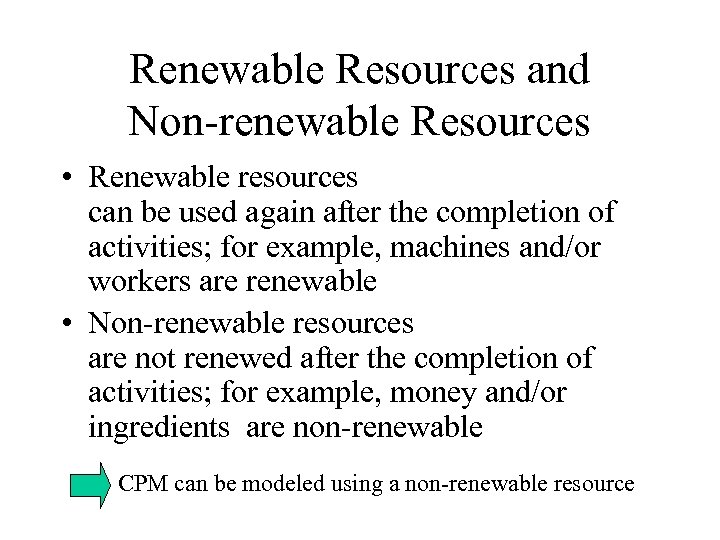 Renewable Resources and Non-renewable Resources • Renewable resources can be used again after the completion of activities; for example, machines and/or workers are renewable • Non-renewable resources are not renewed after the completion of activities; for example, money and/or ingredients are non-renewable CPM can be modeled using a non-renewable resource
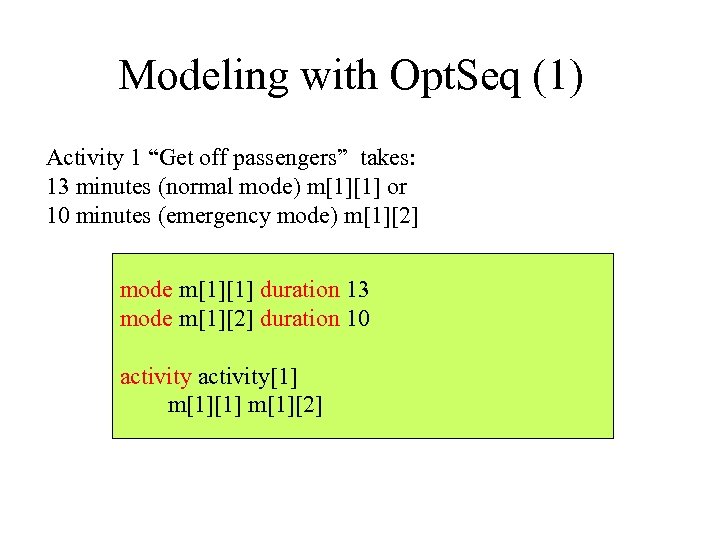 Modeling with Opt. Seq (1) Activity 1 “Get off passengers” takes: 13 minutes (normal mode) m[1][1] or 10 minutes (emergency mode) m[1][2] mode m[1][1] duration 13 mode m[1][2] duration 10 activity[1] m[1][2]
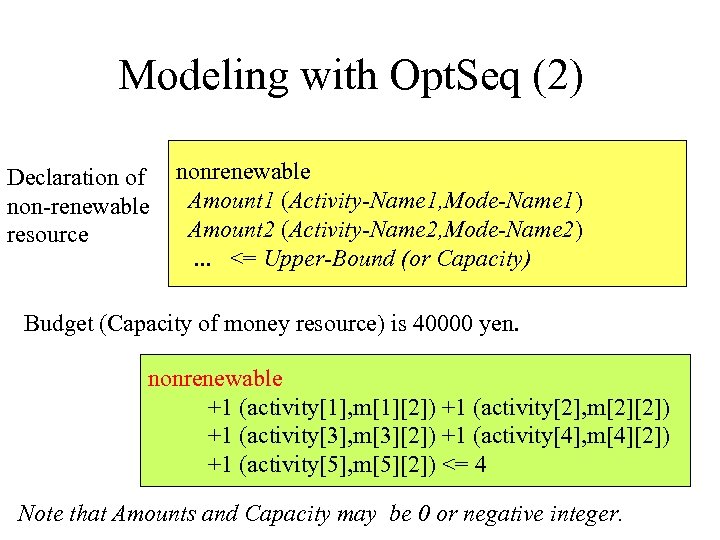 Modeling with Opt. Seq (2) Declaration of non-renewable resource nonrenewable Amount 1 (Activity-Name 1, Mode-Name 1) Amount 2 (Activity-Name 2, Mode-Name 2). . . <= Upper-Bound (or Capacity) Budget (Capacity of money resource) is 40000 yen. nonrenewable +1 (activity[1], m[1][2]) +1 (activity[2], m[2][2]) +1 (activity[3], m[3][2]) +1 (activity[4], m[4][2]) +1 (activity[5], m[5][2]) <= 4 Note that Amounts and Capacity may be 0 or negative integer.
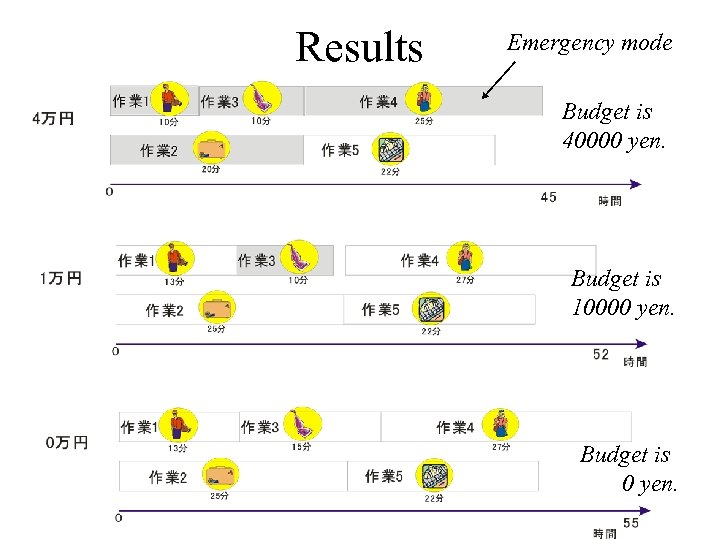 Results Emergency mode Budget is 40000 yen. Budget is 10000 yen. Budget is 0 yen.
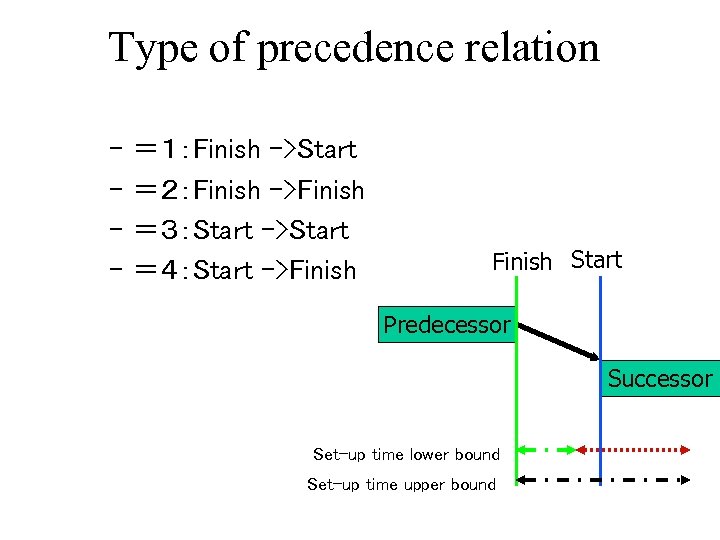 Type of precedence relation – =1:Finish ->Start – =2:Finish ->Finish – =3:Start ->Start – =4:Start ->Finish Start Predecessor Successor Set-up time lower bound Set-up time upper bound
 Opt. Seq Capability • Opt. Seq is a solver for Resource Constrained Project Scheduling Problem with: – Time-Dependent Resource Usage and Capacity – Non-renewable Resource Constraints – Generic Temporal Constraints also it is possible to: – declare activities are breakable and/or processed in parallel – add “states” to represents the generic states of the system