 Скачать презентацию PERSONNEL MANAGEMENT — IES MCRC Bandra Personnel
fb2722033d398f0a64e031a1aeb7e3e9.ppt
- Количество слайдов: 34



PERSONNEL MANAGEMENT - IES MCRC, Bandra.
Personnel Policies & Standing Orders - Lecture 3 A
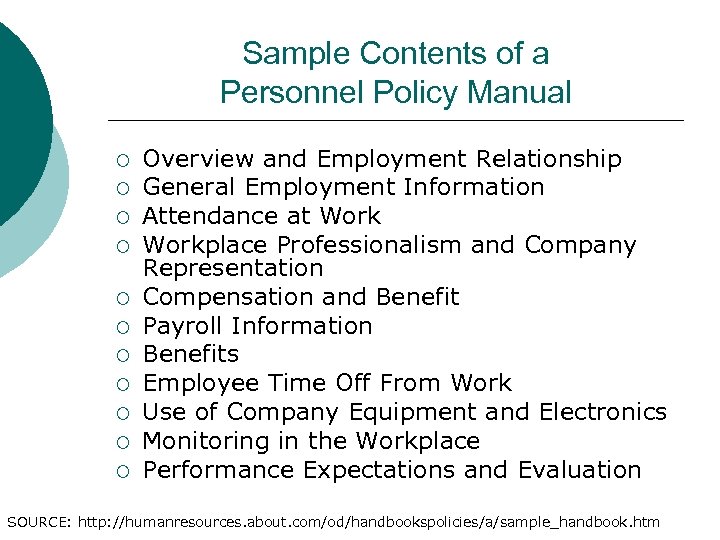
Sample Contents of a Personnel Policy Manual ¡ ¡ ¡ Overview and Employment Relationship General Employment Information Attendance at Workplace Professionalism and Company Representation Compensation and Benefit Payroll Information Benefits Employee Time Off From Work Use of Company Equipment and Electronics Monitoring in the Workplace Performance Expectations and Evaluation SOURCE: http: //humanresources. about. com/od/handbookspolicies/a/sample_handbook. htm
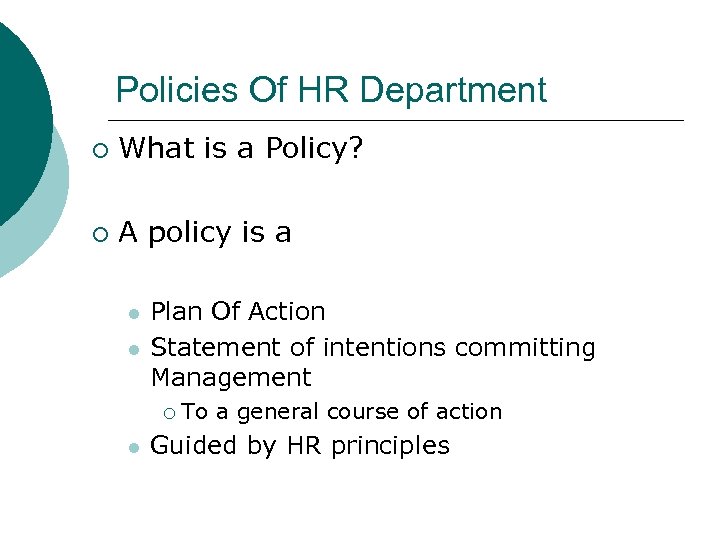
Policies Of HR Department ¡ What is a Policy? ¡ A policy is a l l Plan Of Action Statement of intentions committing Management ¡ l To a general course of action Guided by HR principles
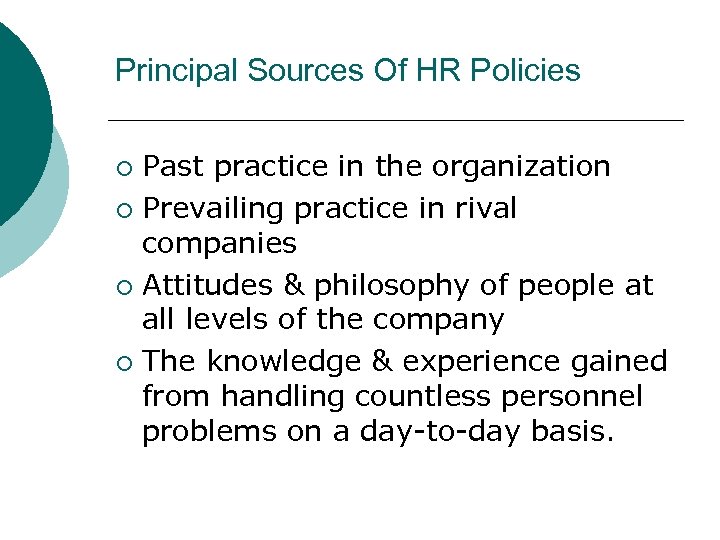
Principal Sources Of HR Policies Past practice in the organization ¡ Prevailing practice in rival companies ¡ Attitudes & philosophy of people at all levels of the company ¡ The knowledge & experience gained from handling countless personnel problems on a day-to-day basis. ¡
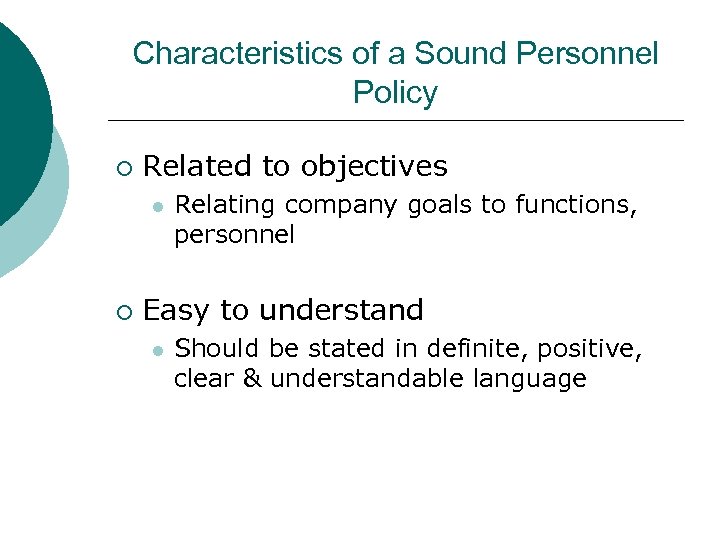
Characteristics of a Sound Personnel Policy ¡ Related to objectives l ¡ Relating company goals to functions, personnel Easy to understand l Should be stated in definite, positive, clear & understandable language
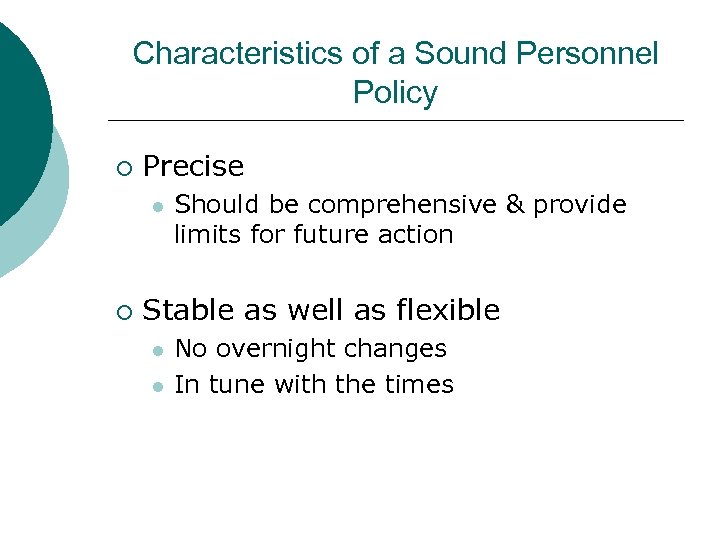
Characteristics of a Sound Personnel Policy ¡ Precise l ¡ Should be comprehensive & provide limits for future action Stable as well as flexible l l No overnight changes In tune with the times
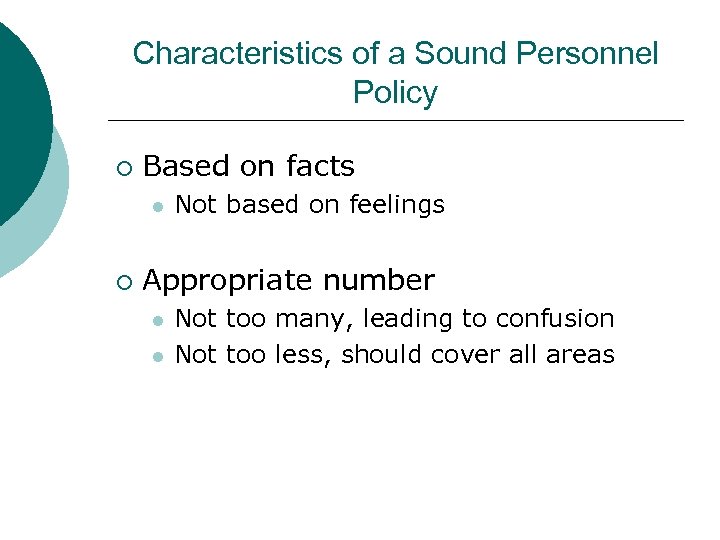
Characteristics of a Sound Personnel Policy ¡ Based on facts l ¡ Not based on feelings Appropriate number l l Not too many, leading to confusion Not too less, should cover all areas
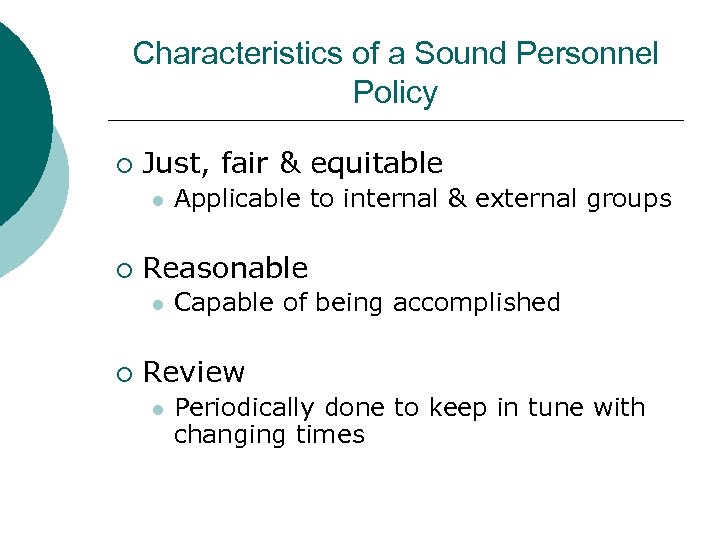
Characteristics of a Sound Personnel Policy ¡ Just, fair & equitable l ¡ Reasonable l ¡ Applicable to internal & external groups Capable of being accomplished Review l Periodically done to keep in tune with changing times
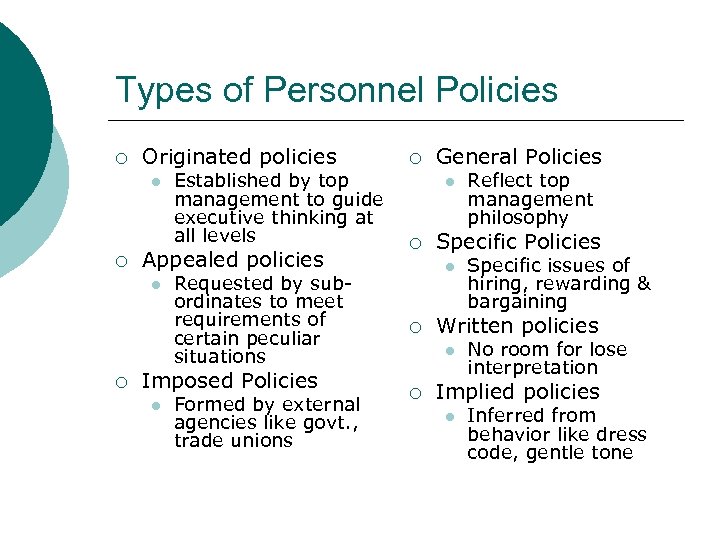
Types of Personnel Policies ¡ Originated policies l ¡ Appealed policies l ¡ Established by top management to guide executive thinking at all levels Requested by subordinates to meet requirements of certain peculiar situations Imposed Policies l Formed by external agencies like govt. , trade unions ¡ General Policies l ¡ Specific issues of hiring, rewarding & bargaining Written policies l ¡ Reflect top management philosophy No room for lose interpretation Implied policies l Inferred from behavior like dress code, gentle tone
Formulation of Personnel Policies ¡ Identifying the need l l Important areas in Recruitment, Selection, Training, Compensation are identified Policies must be formulated in these areas
Formulation of Personnel Policies ¡ Collecting Data l ¡ Explained in slide 4 as principal sources of HR Policies Specifying alternatives l They should emerge clearly after collecting relevant data from various sources
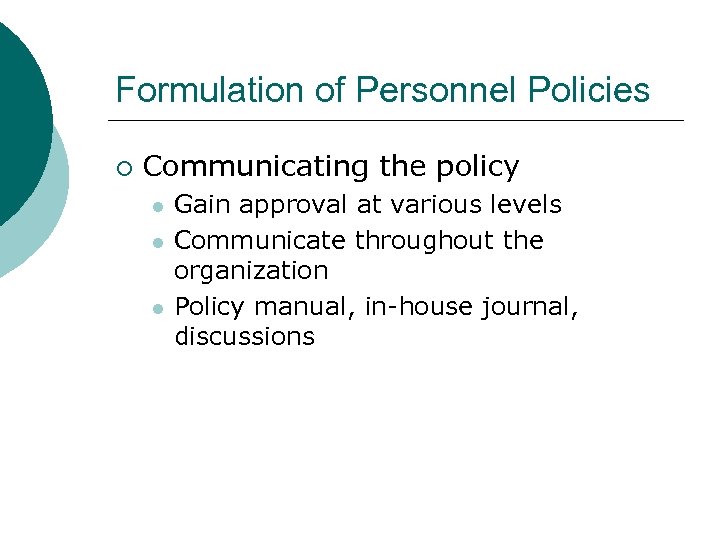
Formulation of Personnel Policies ¡ Communicating the policy l l l Gain approval at various levels Communicate throughout the organization Policy manual, in-house journal, discussions
Formulation of Personnel Policies ¡ Evaluating the policy l To be more effective ¡ Review, Evaluate & Control regularly against set standards.
Few Personnel policies… ¡ Policy of hiring people with due respect to factors like l ¡ reservation, gender, marital status, and the like. Policy on terms & conditions of employment l compensation policy & methods, hours of work, overtime, promotion, transfer, lay-off, and the like.
Advantages of Personnel Policies Delegation ¡ Uniformity ¡ Better control ¡ Standards of efficiency ¡ Confidence ¡ Speedy Decisions ¡ Coordinating devices ¡
Standing Orders should include ¡ ¡ ¡ Classification of workmen, e. g. , whether permanent, temporary, apprentices, probationers, or badlies. Manner of intimating to workmen periods and hours of work, holidays, paydays and wage rates. Shift working. Attendance and late coming. Conditions of procedure in applying for, and the authority which may grant leave and holidays.
Standing Orders should include ¡ ¡ ¡ Requirement to enter premises by certain gates, and liability to search. Closing and reopening of sections of the industrial establishment, and temporary stoppages of work and the rights and liabilities of the employer and workmen arising there from. Termination of employment, and the notice thereof to be given by employer and workmen. Suspension or dismissal for misconduct, and acts or omissions which constitute misconduct. Means of redress for workmen against unfair treatment or wrongful exactions by the employer or his agents or servants. Any other matter which may be prescribed.
Discuss in groups In the field of Personnel Policies, it is important to integrate the various organizational objectives with the desired results, through the people in action. ¡ Do you agree / disagree? ¡ Explain
Absenteeism, Personnel Turnover & Problem of indiscipline - Lecture 3 B
Absenteeism exists when a person fails to come to work when properly scheduled to work ¡ It may be due to the job situation (role stress), personal characteristics (age), and ability to attend (family responsibilities) ¡
Types of Absenteeism ¡ Authorized ¡ Unauthorized ¡ Willful ¡ Caused by circumstances beyond one’s control – l accident/ sudden sickness
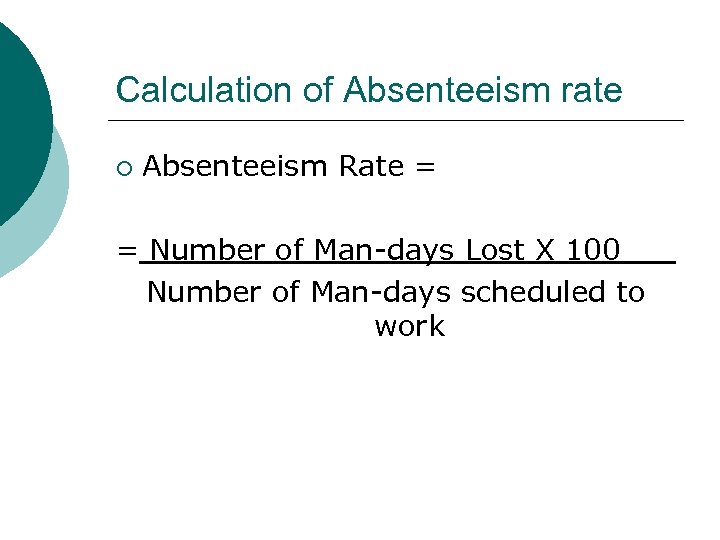
Calculation of Absenteeism rate ¡ Absenteeism Rate = = Number of Man-days Lost X 100___ Number of Man-days scheduled to work
5 categories of chronic absentees - By K. N. Vaid ¡ Entrepreneurs l ¡ Status seekers l ¡ Want money, but are unwilling to work Family-oriented l ¡ Perceive & maintain a higher ascribed social status Epicureans l ¡ They perceive their jobs as small & engage in other social activities Over identified with family activities Sick & Old l Unhealthy/weak or old people
Personnel Turnover ¡ Personnel Turnover refers to the movement l l ¡ into and out of an organization by l The work force.
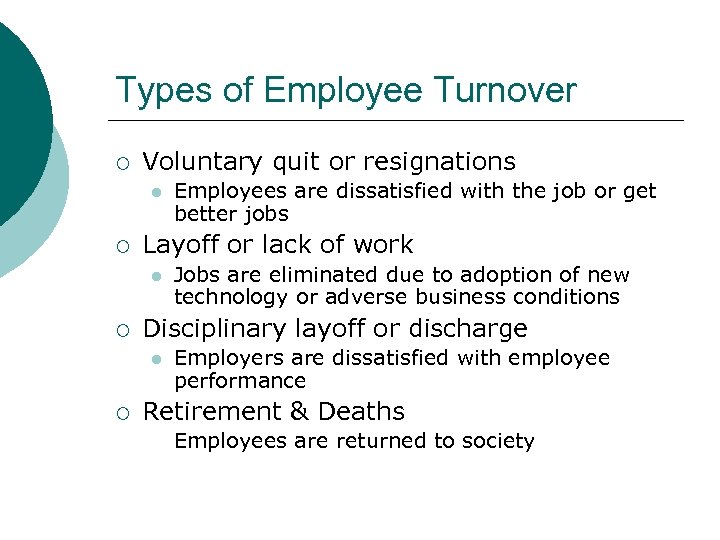
Types of Employee Turnover ¡ Voluntary quit or resignations l ¡ Layoff or lack of work l ¡ Jobs are eliminated due to adoption of new technology or adverse business conditions Disciplinary layoff or discharge l ¡ Employees are dissatisfied with the job or get better jobs Employers are dissatisfied with employee performance Retirement & Deaths Employees are returned to society
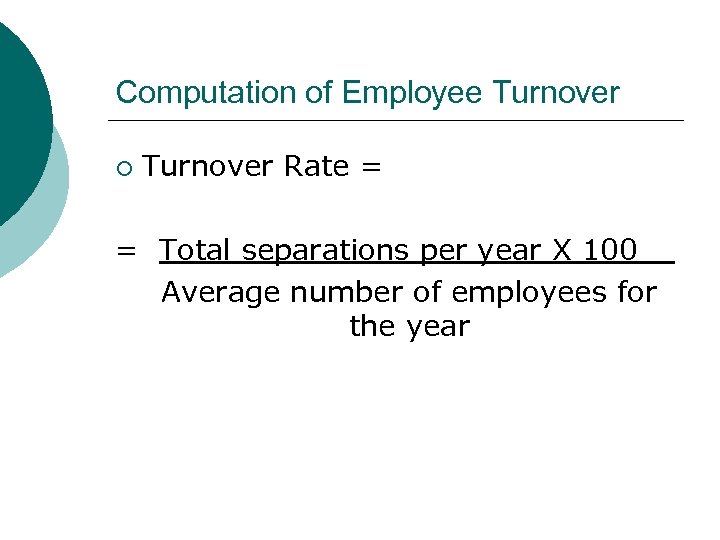
Computation of Employee Turnover ¡ Turnover Rate = = Total separations per year X 100__ Average number of employees for the year
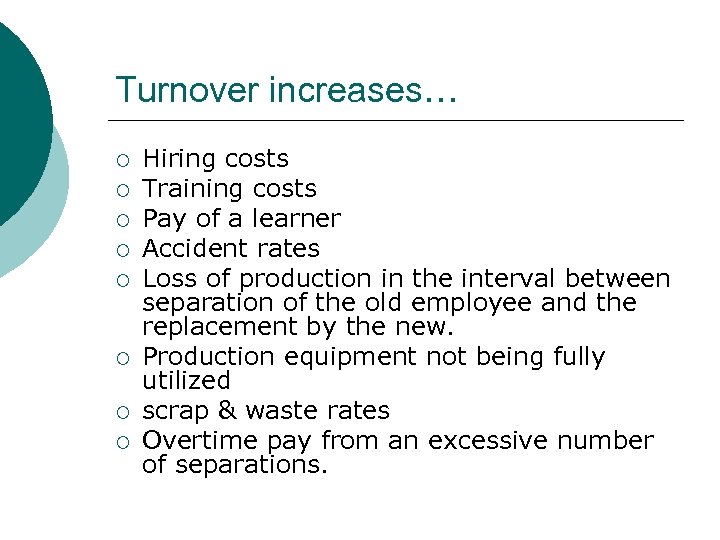
Turnover increases… ¡ ¡ ¡ ¡ Hiring costs Training costs Pay of a learner Accident rates Loss of production in the interval between separation of the old employee and the replacement by the new. Production equipment not being fully utilized scrap & waste rates Overtime pay from an excessive number of separations.
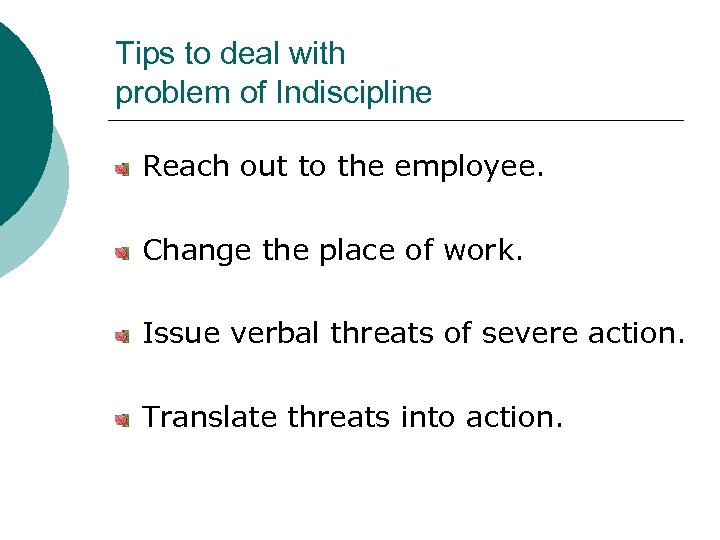
Tips to deal with problem of Indiscipline Reach out to the employee. Change the place of work. Issue verbal threats of severe action. Translate threats into action.
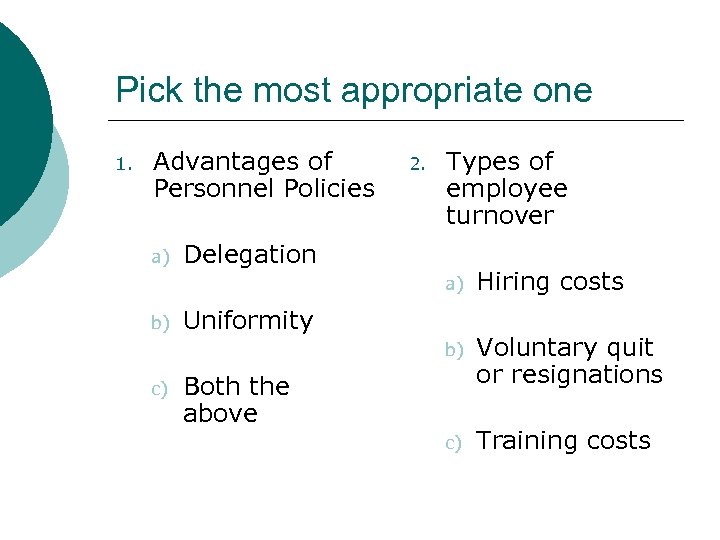
Pick the most appropriate one 1. Advantages of Personnel Policies a) 2. Types of employee turnover Delegation a) b) b) c) Hiring costs Voluntary quit or resignations c) Training costs Uniformity Both the above
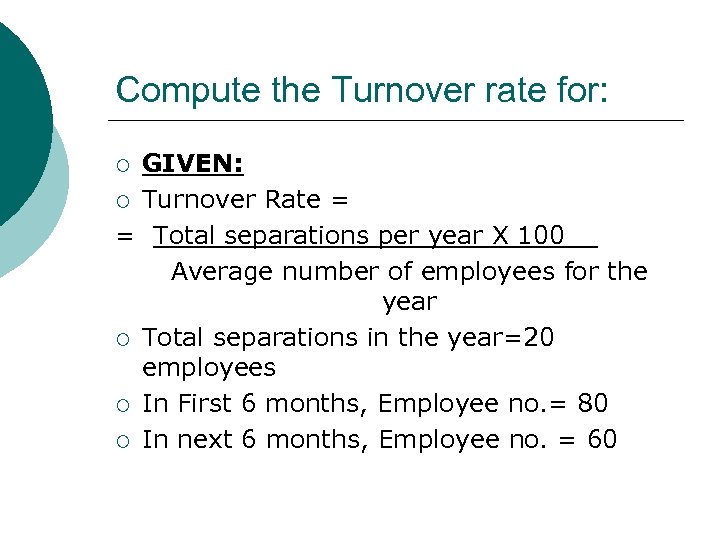
Compute the Turnover rate for: GIVEN: ¡ Turnover Rate = = Total separations per year X 100__ Average number of employees for the year ¡ Total separations in the year=20 employees ¡ In First 6 months, Employee no. = 80 ¡ In next 6 months, Employee no. = 60 ¡
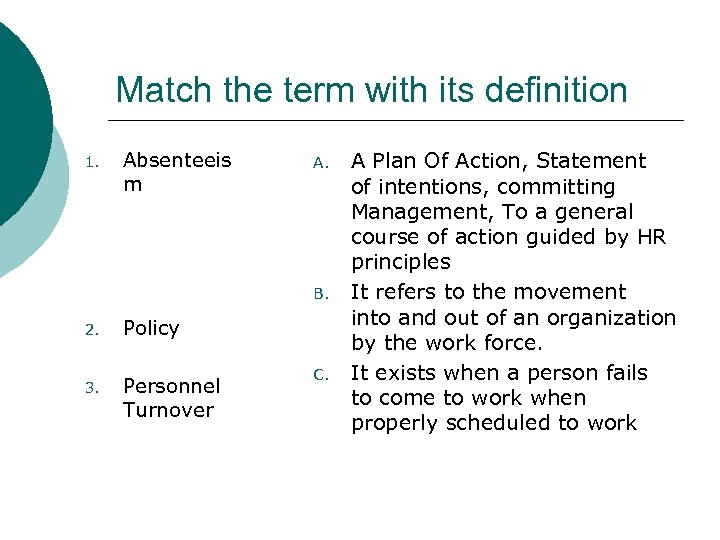
Match the term with its definition 1. Absenteeis m A. B. 2. Policy 3. Personnel Turnover C. A Plan Of Action, Statement of intentions, committing Management, To a general course of action guided by HR principles It refers to the movement into and out of an organization by the work force. It exists when a person fails to come to work when properly scheduled to work
Activity ¡ What steps do you propose to take in case of a lay off caused by l l l ¡ Seasonal fluctuations in demand Corporate restructuring Breakdown of machinery & equipment. Make assumptions wherever necessary

Thank You
Скачать презентацию PERSONNEL MANAGEMENT — IES MCRC Bandra Personnel
fb2722033d398f0a64e031a1aeb7e3e9.ppt