


 Скачать презентацию Personality Tests as Tools for Managers Applications of
34627b716ae7ebe3fe31a66318de5f78.ppt
- Количество слайдов: 19
 Personality Tests as Tools for Managers: Applications of the Myers-Briggs Type Indicator (MBTI) © 2001 Brian J. Sanker
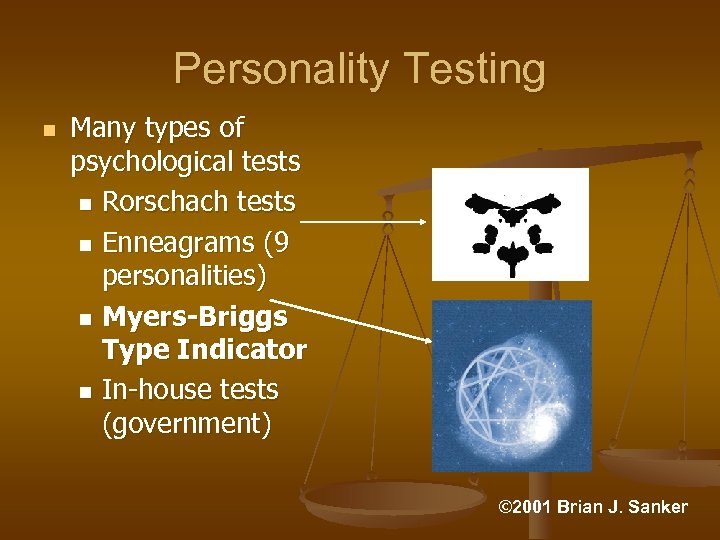 Personality Testing n Many types of psychological tests n Rorschach tests n Enneagrams (9 personalities) n Myers-Briggs Type Indicator n In-house tests (government) © 2001 Brian J. Sanker
 Carl Jung and “Typing” n Carl Jung, in his book Psychological Types, theorized that there were dichotomies in personalities: n Extraversion/Introversion n n Sensing/i. Ntuition n n (decisions are based on logic or emotions) Judgment/Perception n n (perception based on the facts or on “your gut instinct”) Thinking/Feeling n n (world around you/inner world) (absolutes vs. relatives) Behavior was not random, but based on different compositions of these eight temperaments. © 2001 Brian J. Sanker
 Myers-Briggs, Jung, and “Typing” n Isabel Briggs-Myers, along with her mother, Katharine Briggs, developed the MBTI in response to World War II. n “Isabel Myers sought a way to help by finding a means for people to understand rather than destroy each other. ” -from the Center for Applications of Psychological Type n n Tested over 20 years on thousands of medical students and schoolchildren Presented to APA in 1964. © 2001 Brian J. Sanker
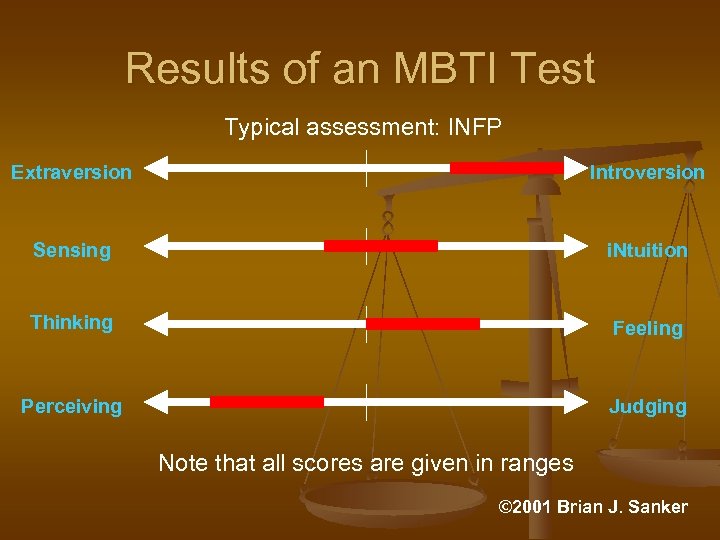 Results of an MBTI Test Typical assessment: INFP Extraversion Introversion Sensing i. Ntuition Thinking Feeling Perceiving Judging Note that all scores are given in ranges © 2001 Brian J. Sanker
 MBTI n n n Owned by the Center for Applications of Psychological Type since 1975 (co-founded by Myers) Each year over 2 million people* take the MBTI, mainly through workshops or as part of company recruitment. Why is this such a successful tool? *source: Center for Applications of Psychological Type © 2001 Brian J. Sanker
 Primary Uses of the MBTI n n n n Team dynamics Communication Leadership styles Conflict Resolution Career and life planning issues Learning and teaching styles Note: Not used to limit, label, or evaluate someone © 2001 Brian J. Sanker
 Team Dynamics n Extravert vs. Introvert. In small meetings, extraverts are talkative and expressive, to the point that they lose focus. Introverts are quieter and will state plainly the answer. n n Introvert: “Why are we still discussing this? You gave the answer 5 minutes ago. ” Group dominated by: n n Judging: On time, if not before Perceiving: Whenever it gets done © 2001 Brian J. Sanker
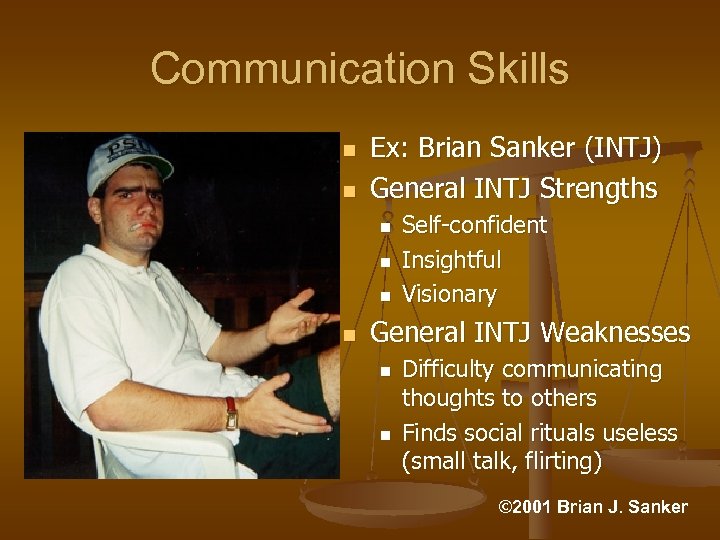 Communication Skills n n Ex: Brian Sanker (INTJ) General INTJ Strengths n n Self-confident Insightful Visionary General INTJ Weaknesses n n Difficulty communicating thoughts to others Finds social rituals useless (small talk, flirting) © 2001 Brian J. Sanker
 Leadership Styles n Fitzgerald and Kirby (1997) postulate that organizational trends are thus: n n Workplace is expected to become increasingly diverse Companies want to understand emerging global markets as well as better serving and qualifying niche markets. Reduced staff require better motivation and recognition of skills to achieve high productivity Companies are responsible and affected more so by external forces than before and company leadership must adapt to survive. © 2001 Brian J. Sanker
 Leadership Styles n n SP Manager: excellent troubleshooters. Companies acquiring troubled companies send the SP in with full authority to “fix it. ” SJ Manager: excellent at running the organization. Dependable leaders. Follows Standard Operating Procedure. NF Manager: Charismatic, personal investment in projects, very people-oriented. NT Manager: Visionary leaders. Always sees the possibilities of the situation. © 2001 Brian J. Sanker
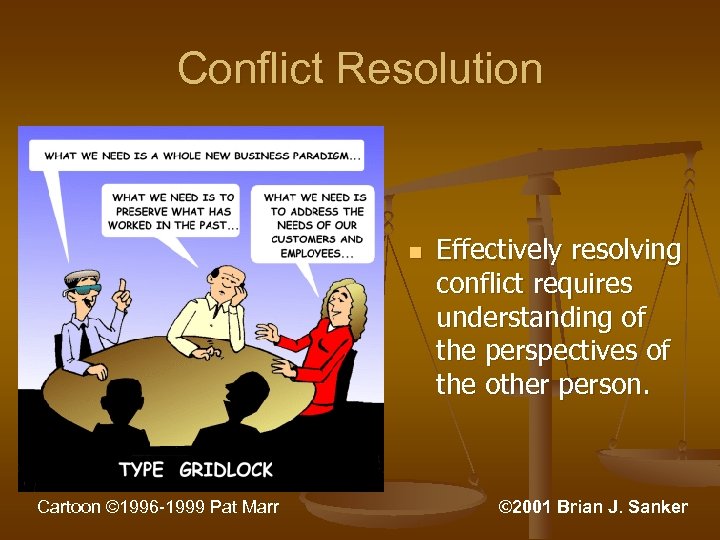 Conflict Resolution n Cartoon © 1996 -1999 Pat Marr Effectively resolving conflict requires understanding of the perspectives of the other person. © 2001 Brian J. Sanker
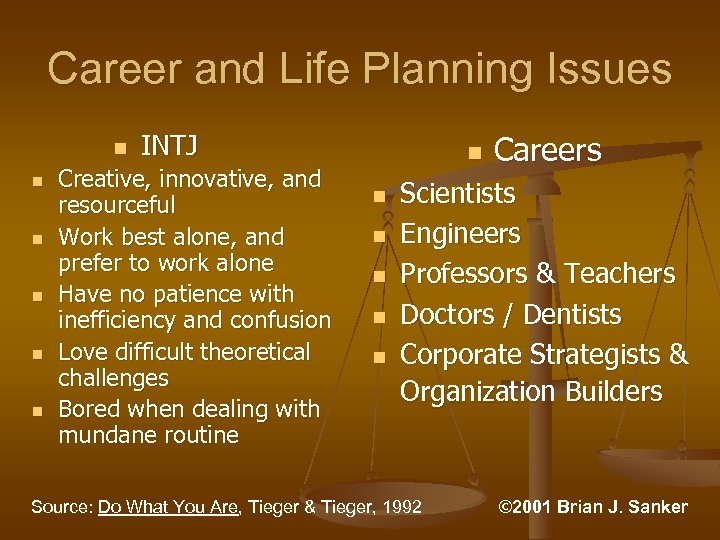 Career and Life Planning Issues n n n INTJ Creative, innovative, and resourceful Work best alone, and prefer to work alone Have no patience with inefficiency and confusion Love difficult theoretical challenges Bored when dealing with mundane routine n n n Careers Scientists Engineers Professors & Teachers Doctors / Dentists Corporate Strategists & Organization Builders Source: Do What You Are, Tieger & Tieger, 1992 © 2001 Brian J. Sanker
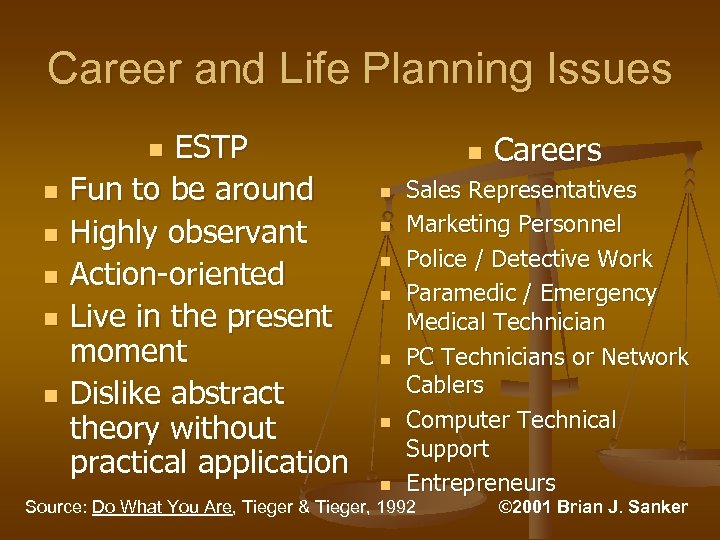 Career and Life Planning Issues ESTP Fun to be around Highly observant Action-oriented Live in the present moment Dislike abstract theory without practical application n n n Careers Sales Representatives Marketing Personnel Police / Detective Work Paramedic / Emergency Medical Technician PC Technicians or Network Cablers Computer Technical Support Entrepreneurs Source: Do What You Are, Tieger & Tieger, 1992 © 2001 Brian J. Sanker
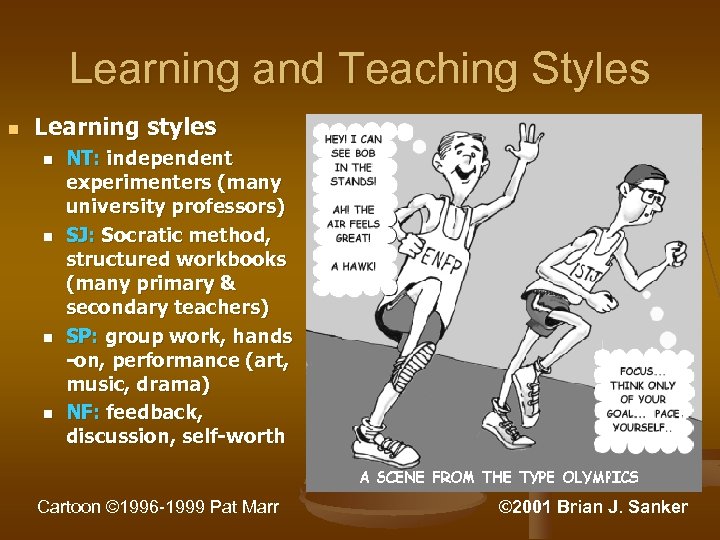 Learning and Teaching Styles n Learning styles n n NT: independent experimenters (many university professors) SJ: Socratic method, structured workbooks (many primary & secondary teachers) SP: group work, hands -on, performance (art, music, drama) NF: feedback, discussion, self-worth Cartoon © 1996 -1999 Pat Marr © 2001 Brian J. Sanker
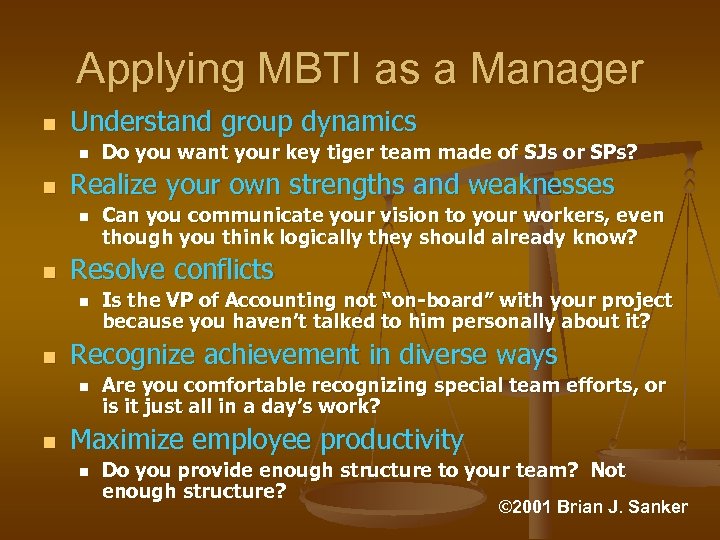 Applying MBTI as a Manager n Understand group dynamics n n Realize your own strengths and weaknesses n n Is the VP of Accounting not “on-board” with your project because you haven’t talked to him personally about it? Recognize achievement in diverse ways n n Can you communicate your vision to your workers, even though you think logically they should already know? Resolve conflicts n n Do you want your key tiger team made of SJs or SPs? Are you comfortable recognizing special team efforts, or is it just all in a day’s work? Maximize employee productivity n Do you provide enough structure to your team? Not enough structure? © 2001 Brian J. Sanker
 Summary n n n MBTI is one of many standardized methods for determining basic personality types and traits. All personality tests reveal to a manager the diversity of their peer group and workers. This awareness of different needs allows a manager to refine areas of communication and management style. © 2001 Brian J. Sanker
 Critical Thinking Questions n n n Why is the MBTI not a good tool to evaluate employee performance? Will each decision or action a person makes fit into their four-letter type? Can someone be a full extravert or completely intuitive? Should a team composition be determined solely on MBTI typing? Can MBTI types become a self-fulfilling prophecy, like a horoscope? © 2001 Brian J. Sanker
 Sources and Works Cited Barron-Tieger, Barbara, and Paul D. Tieger. Do What You Are. Boston: Little, Brown and Company, 1992. Bates, Marilyn, and David Keirsey. Please Understand Me. Del Mar, CA: Prometheus Nemesis Book Company, 1984. Center for Applications of Psychological Type. 20 Oct. 2001