


 Скачать презентацию PERSONALITY Personality At the end of this
cb3c434e8d9a9690311f97199b26c648.ppt
- Количество слайдов: 23
 PERSONALITY
 Personality At the end of this session, you should understand: • • The nature of personality The different approaches to personality theory and their relevance to consumer behaviour The self-concept and its influence on consumer behaviour The concept of brand personality and its importance in marketing Copyright 2005 Mc. Graw-Hill Australia Pty Ltd PPTs t/a Consumer Behaviour by Karen Webb Slides prepared by Sarah Fletcher and Morena Dobrowolski 2
 Personality - defined • The characteristic patterns of behaviour and thought that are a reflection of a consumer’s psychological systems Copyright 2005 Mc. Graw-Hill Australia Pty Ltd PPTs t/a Consumer Behaviour by Karen Webb Slides prepared by Sarah Fletcher and Morena Dobrowolski 3
 Compare these advertisements See EXHIBIT 7. 1 and EXHIBIT 7. 2, page 191. Power. Point slides supplied on the Instructor Resource CD to accompany Consumer Behaviour include advertisement images. Copyright 2005 Mc. Graw-Hill Australia Pty Ltd PPTs t/a Consumer Behaviour by Karen Webb Slides prepared by Sarah Fletcher and Morena Dobrowolski 4
 Personality theories • The following are approaches to personality theory: – Psychoanalytical theory – Social/environment theories – Trait theory – Self concept theory Copyright 2005 Mc. Graw-Hill Australia Pty Ltd PPTs t/a Consumer Behaviour by Karen Webb Slides prepared by Sarah Fletcher and Morena Dobrowolski 5
 Psychoanalytic personality theory • Based on the idea that adult behaviour is a reflection of childhood experiences • Sigmund Freud believed that unconscious thoughts controlled the conscious mind and this plays a significant role in developing our personalities • This is very much linked to the concepts of human motivation and drives (Chapter 8) Copyright 2005 Mc. Graw-Hill Australia Pty Ltd PPTs t/a Consumer Behaviour by Karen Webb Slides prepared by Sarah Fletcher and Morena Dobrowolski 6
 Psychoanalytic personality theory • Five key stages of childhood development that Freud believed influenced personality development: – – – Oral Anal Phallic Latent Genital Copyright 2005 Mc. Graw-Hill Australia Pty Ltd PPTs t/a Consumer Behaviour by Karen Webb Slides prepared by Sarah Fletcher and Morena Dobrowolski 7
 Psychoanalytic personality theory • Freud proposed that personality is made up of three parts: – Id < – Superego < – Our primitive instincts or drives Our urge to ‘do what is right’ – achieving perfection Ego < The ‘balance’ between the id and the superego Copyright 2005 Mc. Graw-Hill Australia Pty Ltd PPTs t/a Consumer Behaviour by Karen Webb Slides prepared by Sarah Fletcher and Morena Dobrowolski 8
 Which do these ads appeal to? See EXHIBIT 7. 3 Paradise biscuits , page 194. See EXHIBIT 7. 4 Advanced VO 5 Leave-in Anti-Frizz Conditioner, page 194. See EXHIBIT 7. 5 Heart Foundation, page 196. Power. Point slides supplied on the Instructor Resource CD to accompany Consumer Behaviour include advertisement images. Copyright 2005 Mc. Graw-Hill Australia Pty Ltd PPTs t/a Consumer Behaviour by Karen Webb Slides prepared by Sarah Fletcher and Morena Dobrowolski 9
 Psychoanalytic personality theory • Application of Freud’s ideas in marketing: – Appeal to underlying motivations and drives, e. g. : < < – Underlying sexual connotations in ads Show glamorous people using the product - appealing to social acceptance of the product rather than its practical uses Communicate message that anxiety may be reduced with the use of a particular product/service Copyright 2005 Mc. Graw-Hill Australia Pty Ltd PPTs t/a Consumer Behaviour by Karen Webb Slides prepared by Sarah Fletcher and Morena Dobrowolski 10
 Psychoanalytic personality theory • Neo-Freudians – Those who further developed Freud’s ideas but presented new ways of looking at personality – Many consider that although the unconscious mind is important, other factors such as the conscious mind and external factors are also important influences on personality – One of the best known Neo-Freudians is Carl Jung Copyright 2005 Mc. Graw-Hill Australia Pty Ltd PPTs t/a Consumer Behaviour by Karen Webb Slides prepared by Sarah Fletcher and Morena Dobrowolski 11
 Social/environment theories of personality Jungian personality types • • Carl Jung believed that individuals engage in constant adaptation and creative development, based on the environment Suggested there are three components of personality: – The ego < – The personal unconscious < – • Where information is buried or stored day to day but can be remembered when there is a trigger The collective unconscious < • Our current conscious thoughts Comprises memory traces from an individual’s ancestral past Believed the ‘self’ came from a a mix of the conscious and unconscious Formed four classifications of psychological function – personality types Copyright 2005 Mc. Graw-Hill Australia Pty Ltd PPTs t/a Consumer Behaviour by Karen Webb Slides prepared by Sarah Fletcher and Morena Dobrowolski 12
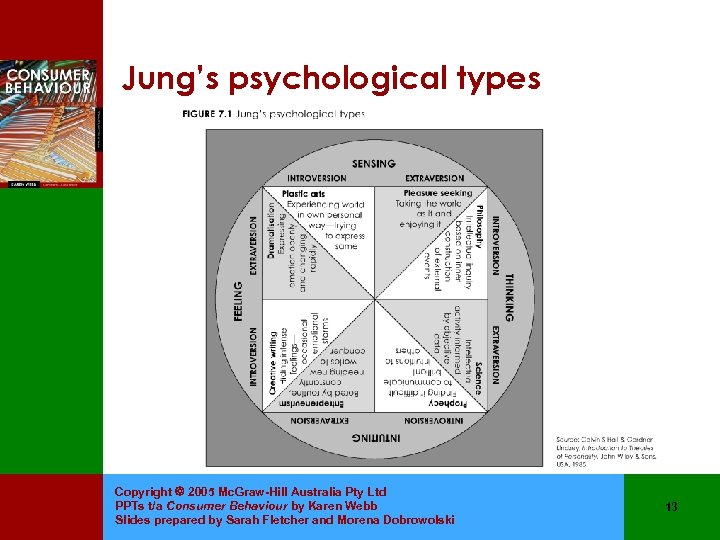 Jung’s psychological types Copyright 2005 Mc. Graw-Hill Australia Pty Ltd PPTs t/a Consumer Behaviour by Karen Webb Slides prepared by Sarah Fletcher and Morena Dobrowolski 13
 Other contributors to personality theory Erikson • • • Considered ego to be a major motivating force in human development and personality The stronger your selfidentity, the more confident and assertive you are Implications for marketing are that people are more likely to buy brands that reflect their self image See EXHIBIT 7. 6 Advertisements reflect the expression of a consumer’s identity, page 200. Power. Point slides supplied on the Instructor Resource CD to accompany Consumer Behaviour include advertisement images. Copyright 2005 Mc. Graw-Hill Australia Pty Ltd PPTs t/a Consumer Behaviour by Karen Webb Slides prepared by Sarah Fletcher and Morena Dobrowolski 14
 Other contributors to personality theory Alfred Adler • Believed that people are born with an inbuilt sense of inferiority • We strive for something better - express our superiority • We are influenced by heredity, the environment and intrinsic factors Copyright 2005 Mc. Graw-Hill Australia Pty Ltd PPTs t/a Consumer Behaviour by Karen Webb Slides prepared by Sarah Fletcher and Morena Dobrowolski 15
 Other contributors to personality theory Karen Horney’s basic anxiety theory • • • Argued that sociocultural factors could explain personality differences, not just basic gender differences She believed that basic anxiety leads to conflict and an intense need for approval and affection Marketers commonly appeal to needs for greater self-improvement and social standing Copyright 2005 Mc. Graw-Hill Australia Pty Ltd PPTs t/a Consumer Behaviour by Karen Webb Slides prepared by Sarah Fletcher and Morena Dobrowolski See EXHIBIT 7. 7 Peugeot makes you feel superior, page 201. Power. Point slides supplied on the Instructor Resource CD to accompany Consumer Behaviour include advertisement images. 16
 Trait theories of personality • A trait is a personality characteristic, e. g. outgoing or shy • Trait theories attempt to identify and categorise personality characteristics • Marketers can use this information to identify characteristics of a certain market segment Copyright 2005 Mc. Graw-Hill Australia Pty Ltd PPTs t/a Consumer Behaviour by Karen Webb Slides prepared by Sarah Fletcher and Morena Dobrowolski 17
 The ‘big five’ personality traits • Openness to experience – Interest in new things • Conscientiousness – How methodical you are • Extroversion/introversion – Degree of sociability • Agreeableness – Extent of a person’s social ‘likeability’ • Neuroticism – Perceived emotional stability Copyright 2005 Mc. Graw-Hill Australia Pty Ltd PPTs t/a Consumer Behaviour by Karen Webb Slides prepared by Sarah Fletcher and Morena Dobrowolski 18
 Self-concept theory • Based on the set of attitudes a person holds about themselves and is made up of self-images and the evaluation of these images • Self-concept is made up of two elements Self-image – Self-esteem – • Our self-concept can vary across situations Copyright 2005 Mc. Graw-Hill Australia Pty Ltd PPTs t/a Consumer Behaviour by Karen Webb Slides prepared by Sarah Fletcher and Morena Dobrowolski 19
 Self-image and buying behaviour • The different aspects of self-image that influence buying behaviour include: – Real self < – Ideal self < – How we perceive ourselves How we think we are perceived by others Social self < How others see us • Consumers purchase products that reflect their sense of self Copyright 2005 Mc. Graw-Hill Australia Pty Ltd PPTs t/a Consumer Behaviour by Karen Webb Slides prepared by Sarah Fletcher and Morena Dobrowolski 20
 Self-image and fashion • A consumer’s choice of fashion is a reflection of their personality - it is an outward presentation of their self image • Highly materialistic consumers are more likely to engage in indulgent purchasing behaviour – Their physical and material possessions convey ‘status, success and prestige’ Copyright 2005 Mc. Graw-Hill Australia Pty Ltd PPTs t/a Consumer Behaviour by Karen Webb Slides prepared by Sarah Fletcher and Morena Dobrowolski 21
 Brand personality • • • Brands are often perceived as having a distinct personality Positioning is a technique to market a product so that it occupies a unique position within a consumer’s mindset Appeals used within advertisements and other promotional materials help establish this uniqueness See EXHIBIT 7. 13 Different brands have different personalities. In the tea category, Dilmah is unique, page 213. Power. Point slides supplied on the Instructor Resource CD to accompany Consumer Behaviour include advertisement images. Copyright 2005 Mc. Graw-Hill Australia Pty Ltd PPTs t/a Consumer Behaviour by Karen Webb Slides prepared by Sarah Fletcher and Morena Dobrowolski 22
 Marketing application of personality theories • Using personality tests to gather information about consumers personality types, e. g. : – Myers-Briggs-type personality type indicator test – Thematic Apperception Test (TAT) < Helps determine personality themes as well as unconscious motivations Copyright 2005 Mc. Graw-Hill Australia Pty Ltd PPTs t/a Consumer Behaviour by Karen Webb Slides prepared by Sarah Fletcher and Morena Dobrowolski 23