


 Скачать презентацию Personality Assessment from Handwriting Aaron Dancygier Jayson Diaz
aba402516770a0fdce1b4954312f7449.ppt
- Количество слайдов: 15
 Personality Assessment from Handwriting Aaron Dancygier Jayson Diaz Sunday Olatunbosun Stacy Bryan
 LZ scale Components in Personality Assesment Thea Lewinson and Joseph Zubin provided a method to quantify the rhythm movement in writing. The four dimensions that make up this rhythm scale are: Width, Height, Depth, and Form. These four components determine the following dimensions of personality: The rational The social-emotional The instinctual 2
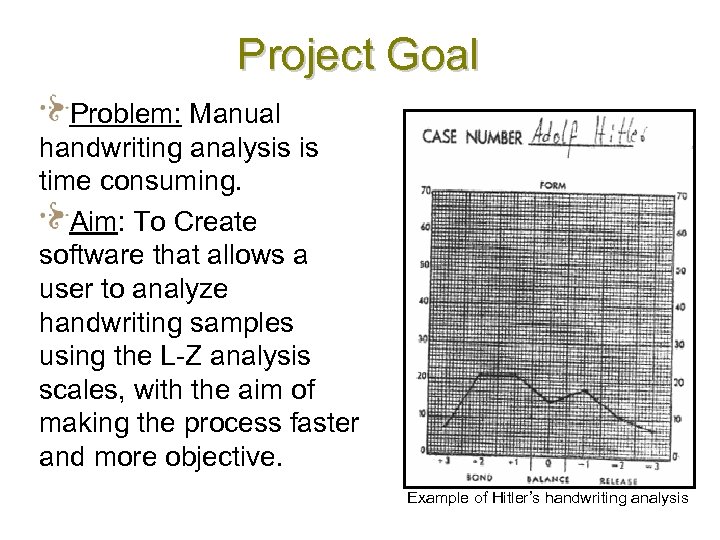 Project Goal Problem: Manual handwriting analysis is time consuming. Aim: To Create software that allows a user to analyze handwriting samples using the L-Z analysis scales, with the aim of making the process faster and more objective. Example of Hitler’s handwriting analysis
 Program Requirements Load a scanned handwritten document to the computer screen Allow users to segment paragraphs, lines, words, and characters by using segmenting tools Computer-assisted tools for computation of 1 or more LZ scales. Push scale results into LZ Table and give user flexibility to override results with their own data
 Computer-Assisted Analysis tool The combination of a program’s automated analysis, with the input of an expert graphologist. This approach has the advantage of significantly reducing the time required to analyze a given handwriting sample, but still keeps the control in the hands of the user. This increase in power coupled with a higher level of objectivity, provides the user with a comprehensive tool to carry out handwriting analysis that is repeatable. 5
 High Level Goals In the creation of this application several key goals were defined. Simplicity of design A logically laid out dashboard that allows the user to organize and segment handwriting samples for analysis A sequential checkpoint driven analysis tool to guide the user through the process of analysis. Creation of a general management tool, for user profiles. 6
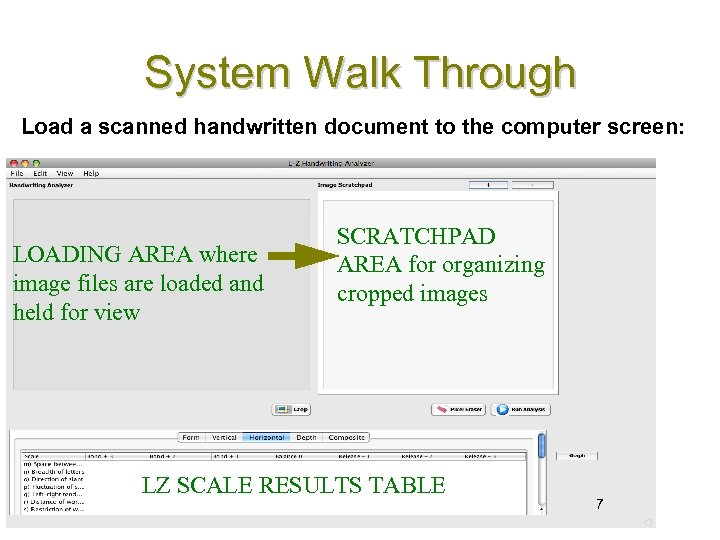 System Walk Through Load a scanned handwritten document to the computer screen: LOADING AREA where image files are loaded and held for view SCRATCHPAD AREA for organizing cropped images LZ SCALE RESULTS TABLE 7
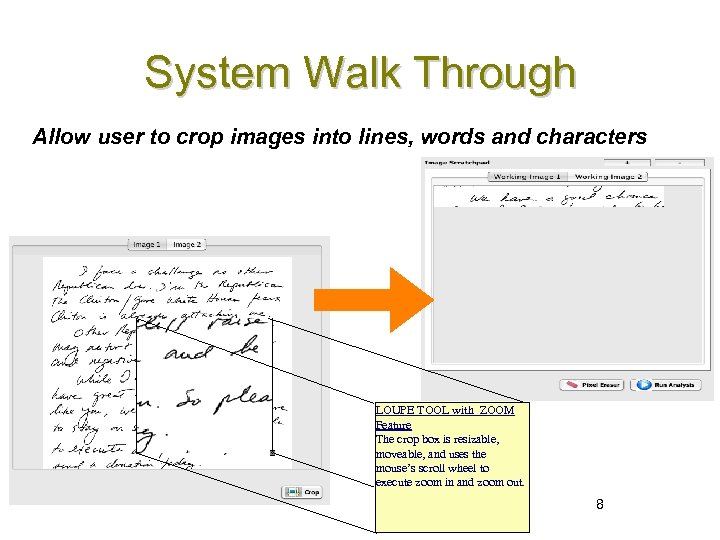 System Walk Through Allow user to crop images into lines, words and characters LOUPE TOOL with ZOOM Feature The crop box is resizable, moveable, and uses the mouse’s scroll wheel to execute zoom in and zoom out. 8
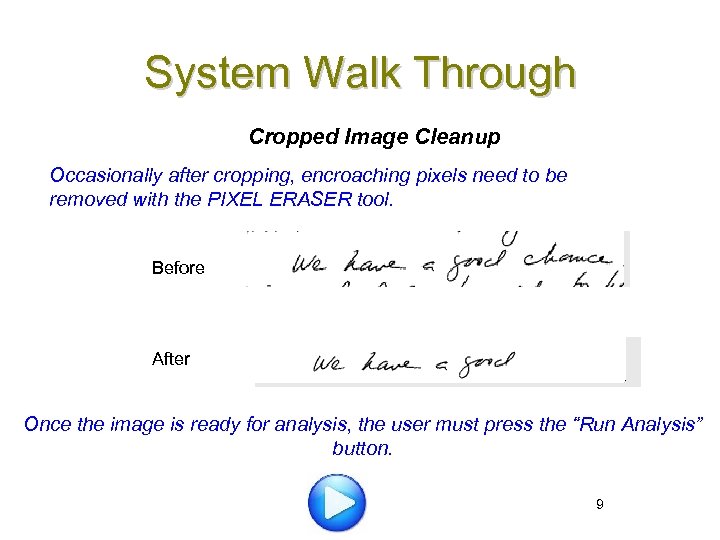 System Walk Through Cropped Image Cleanup Occasionally after cropping, encroaching pixels need to be removed with the PIXEL ERASER tool. Before After Once the image is ready for analysis, the user must press the “Run Analysis” button. 9
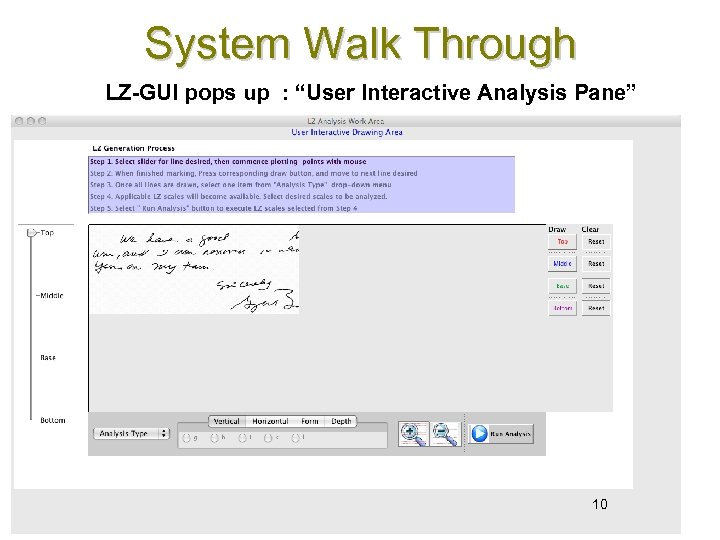 System Walk Through LZ-GUI pops up : “User Interactive Analysis Pane” 10
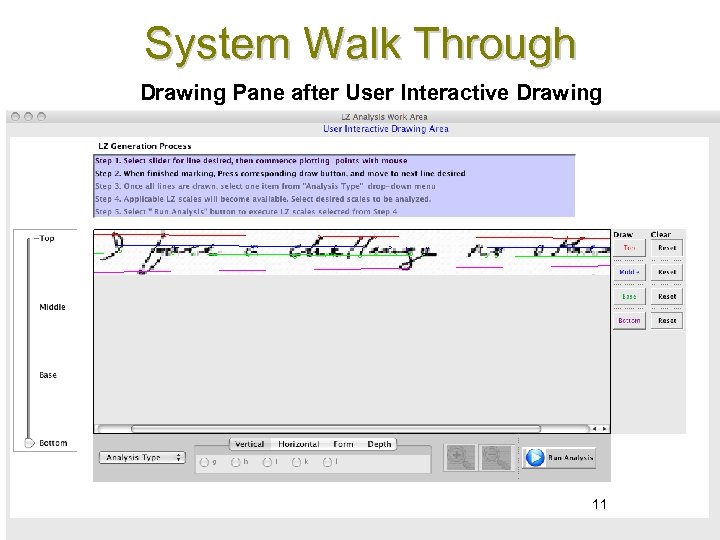 System Walk Through Drawing Pane after User Interactive Drawing 11
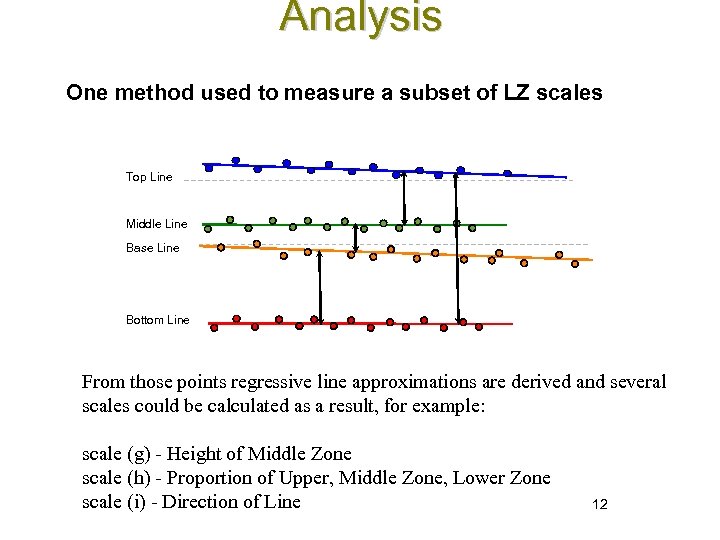 Analysis One method used to measure a subset of LZ scales Top Line Middle Line Base Line Bottom Line From those points regressive line approximations are derived and several scales could be calculated as a result, for example: scale (g) - Height of Middle Zone scale (h) - Proportion of Upper, Middle Zone, Lower Zone scale (i) - Direction of Line 12
 Scales Implemented Vertical Component g - Height of Middle Zone h - Proportion of Upper, Middle Zone & Lower Zone i - Direction of Line Horizontal Component n - Breadth of Letters o - Direction of Slant 13
 Future Enhancements Implementing the remaining L-Z scales. Further attempt to automate as many of the scales as possible. Finish version one of administration system to manage saved profiles and organize them based on analysis results. Extending application to be able to take input from a writing tablet. Verification of algorithms used to compute scales. Receive direct input from one or more graphologists. Multiple user logins with different access levels. 14
 Conclusion • We managed to implement an alpha version of the analysis software that automated two of the scales and assisted in the analysis of three others. • We feel there is much work to be done. Many of the remaining scales can be quantified either through automation or computer assistance. • The end goal should be to automate as much of the process as possible, through a pattern recognition classification system. • Essentially more objectivity needs to be applied in the handwriting analysis process to make analysis repeatable. 15