


 Скачать презентацию Personal Financial Management for AIS CCS Officers
43e5827c7c5a8903255ae91deb1ac7ef.ppt
- Количество слайдов: 40
 Personal Financial Management for AIS / CCS Officers Presented by P. Sharath Kumar, LLB, CFE, CFAP, FCA. Chartered Accountant e-mail : info@sarathcas. in
 In This Session • • Personal Financial Management Income & Expenditure Investment & Tax Planning CCS (Conduct) Rules, 1964 - Financial issues 13(1)(e) Of Prevention of Corruption Act, 1988 Annual Property Returns/IT Returns How to safeguard your hard earned money & how you are being cheated by Financial Institutions & Others without your knowledge PAN Card Application 2
 Personal Financial Management • Effective Utilization of available resources for attaining objectives. • Objectives – Become financially comfortable and enjoy good living & enough savings for basic comforts, children’s education – Retirement Planning – Decent financial goals and devote your life to honorable public service – All or combination of above 3
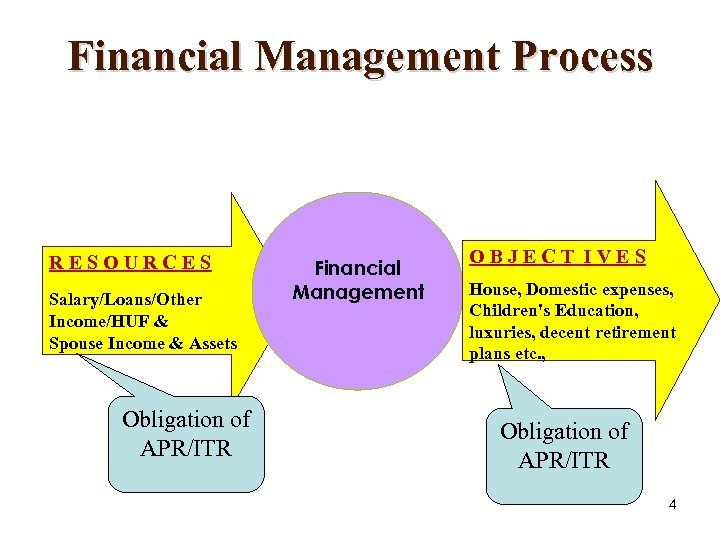 Financial Management Process R E S O U R C E S Salary/Loans/Other Income/HUF & Spouse Income & Assets Obligation of APR/ITR Financial Management O B J E C T I V E S House, Domestic expenses, Children's Education, luxuries, decent retirement plans etc. , Obligation of APR/ITR 4
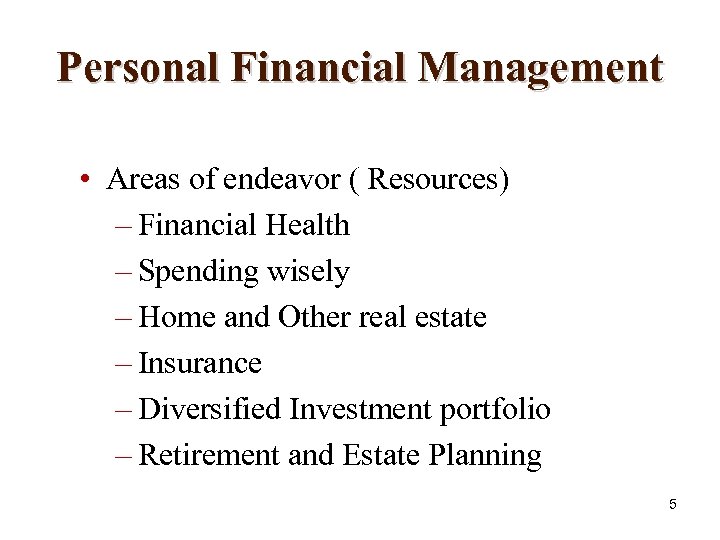 Personal Financial Management • Areas of endeavor ( Resources) – Financial Health – Spending wisely – Home and Other real estate – Insurance – Diversified Investment portfolio – Retirement and Estate Planning 5
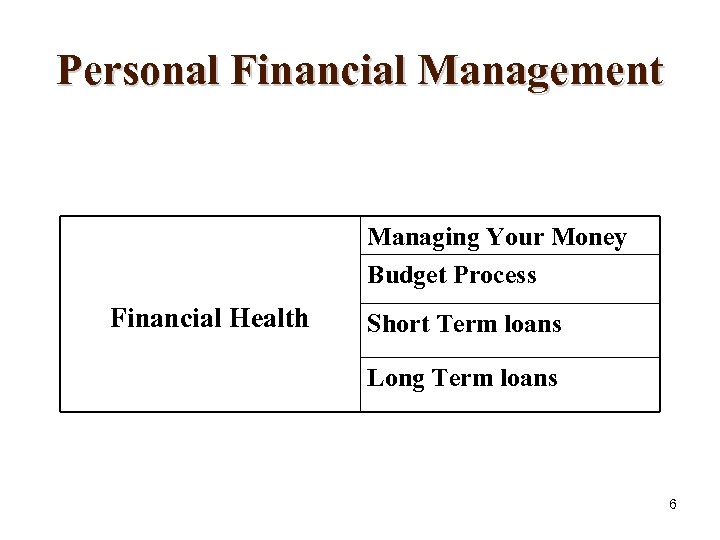 Personal Financial Management Managing Your Money Budget Process Financial Health Short Term loans Long Term loans 6
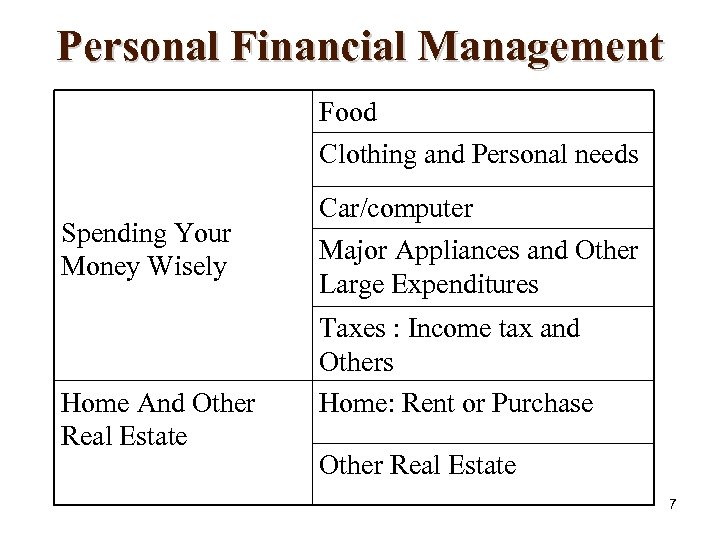 Personal Financial Management Food Clothing and Personal needs Spending Your Money Wisely Home And Other Real Estate Car/computer Major Appliances and Other Large Expenditures Taxes : Income tax and Others Home: Rent or Purchase Other Real Estate 7
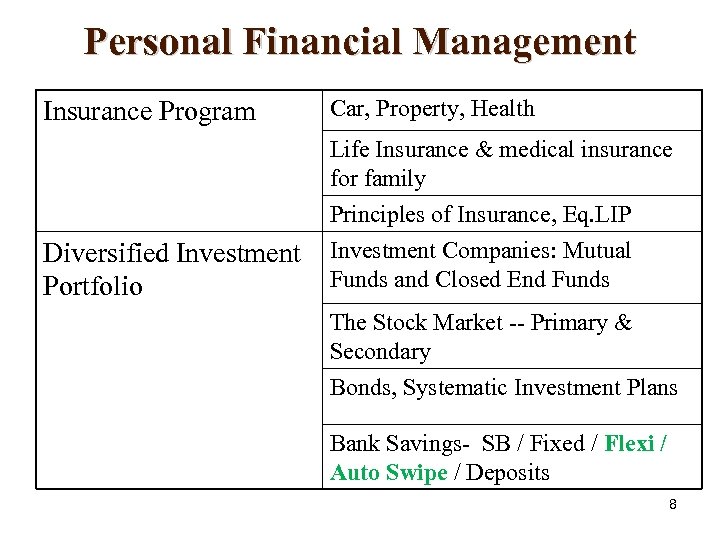 Personal Financial Management Insurance Program Car, Property, Health Life Insurance & medical insurance for family Principles of Insurance, Eq. LIP Diversified Investment Companies: Mutual Funds and Closed End Funds Portfolio The Stock Market -- Primary & Secondary Bonds, Systematic Investment Plans Bank Savings- SB / Fixed / Flexi / Auto Swipe / Deposits 8
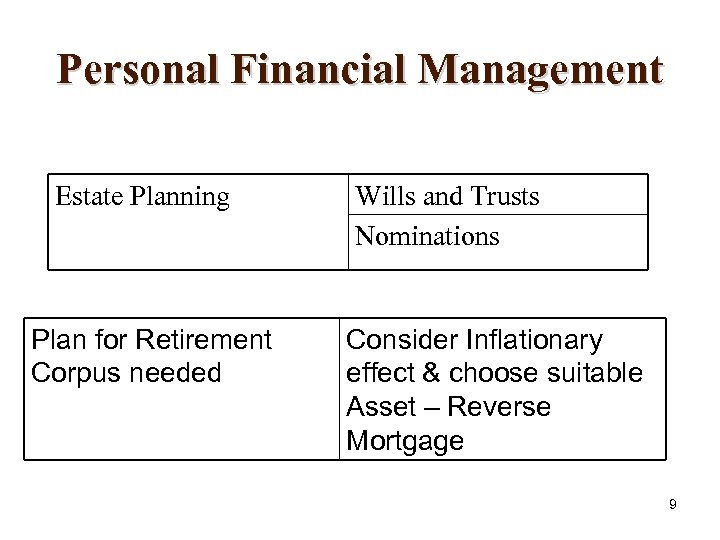 Personal Financial Management Estate Planning Plan for Retirement Corpus needed Wills and Trusts Nominations Consider Inflationary effect & choose suitable Asset – Reverse Mortgage 9
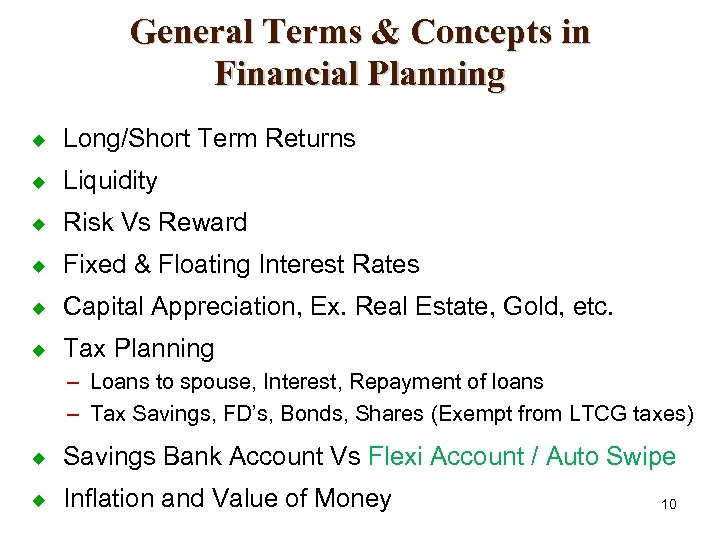 General Terms & Concepts in Financial Planning ¿ Long/Short Term Returns ¿ Liquidity ¿ Risk Vs Reward ¿ Fixed & Floating Interest Rates ¿ Capital Appreciation, Ex. Real Estate, Gold, etc. ¿ Tax Planning – Loans to spouse, Interest, Repayment of loans – Tax Savings, FD’s, Bonds, Shares (Exempt from LTCG taxes) ¿ Savings Bank Account Vs Flexi Account / Auto Swipe ¿ Inflation and Value of Money 10
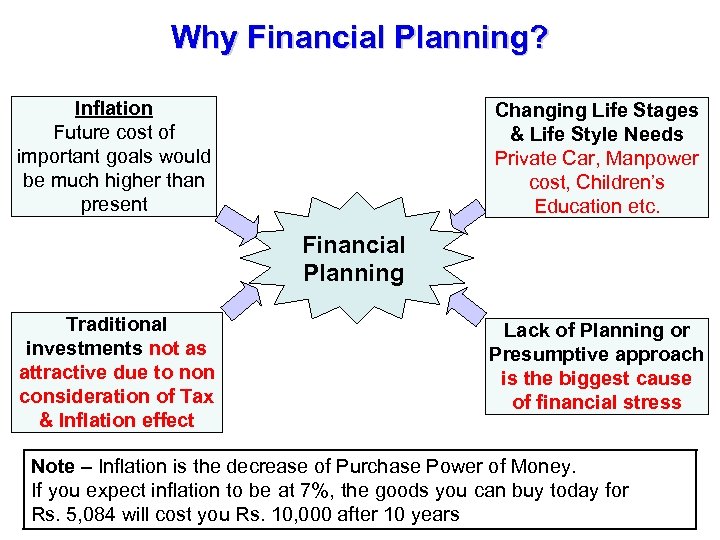 Why Financial Planning? Inflation Future cost of important goals would be much higher than present Changing Life Stages & Life Style Needs Private Car, Manpower cost, Children’s Education etc. Financial Planning Traditional investments not as attractive due to non consideration of Tax & Inflation effect Lack of Planning or Presumptive approach is the biggest cause of financial stress Note – Inflation is the decrease of Purchase Power of Money. If you expect inflation to be at 7%, the goods you can buy today for 11 Rs. 5, 084 will cost you Rs. 10, 000 after 10 years
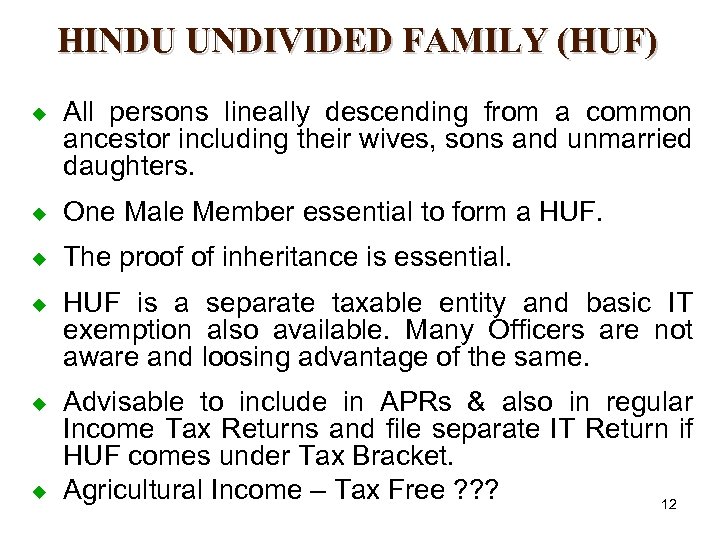 HINDU UNDIVIDED FAMILY (HUF) ¿ All persons lineally descending from a common ancestor including their wives, sons and unmarried daughters. ¿ One Male Member essential to form a HUF. ¿ The proof of inheritance is essential. ¿ ¿ ¿ HUF is a separate taxable entity and basic IT exemption also available. Many Officers are not aware and loosing advantage of the same. Advisable to include in APRs & also in regular Income Tax Returns and file separate IT Return if HUF comes under Tax Bracket. Agricultural Income – Tax Free ? ? ? 12
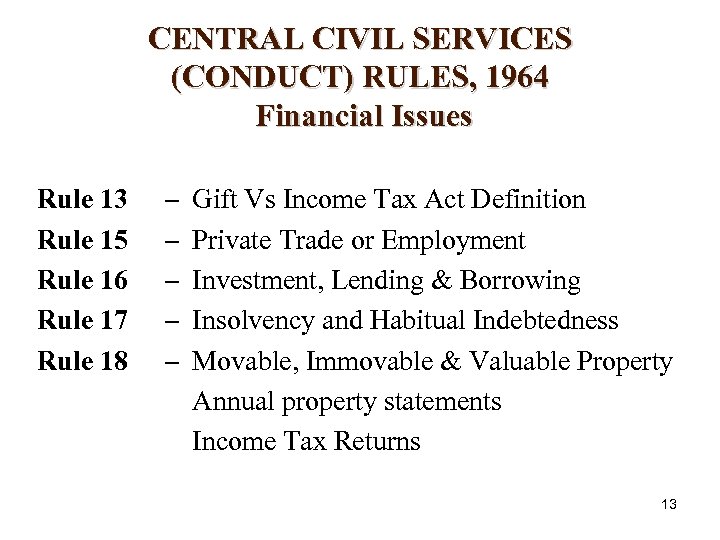 CENTRAL CIVIL SERVICES (CONDUCT) RULES, 1964 Financial Issues Rule 13 Rule 15 Rule 16 Rule 17 Rule 18 – Gift Vs Income Tax Act Definition – Private Trade or Employment – Investment, Lending & Borrowing – Insolvency and Habitual Indebtedness – Movable, Immovable & Valuable Property Annual property statements Income Tax Returns 13
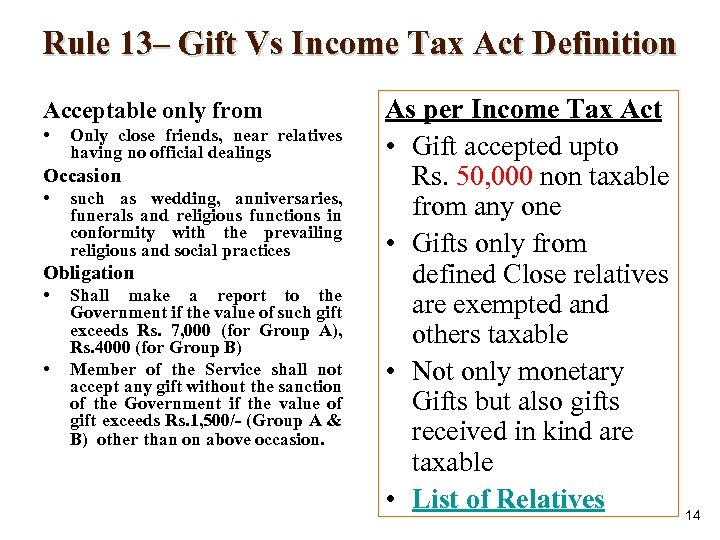 Rule 13– Gift Vs Income Tax Act Definition Acceptable only from • Only close friends, near relatives having no official dealings Occasion • such as wedding, anniversaries, funerals and religious functions in conformity with the prevailing religious and social practices Obligation • • Shall make a report to the Government if the value of such gift exceeds Rs. 7, 000 (for Group A), Rs. 4000 (for Group B) Member of the Service shall not accept any gift without the sanction of the Government if the value of gift exceeds Rs. 1, 500/- (Group A & B) other than on above occasion. As per Income Tax Act • Gift accepted upto Rs. 50, 000 non taxable from any one • Gifts only from defined Close relatives are exempted and others taxable • Not only monetary Gifts but also gifts received in kind are taxable • List of Relatives 14
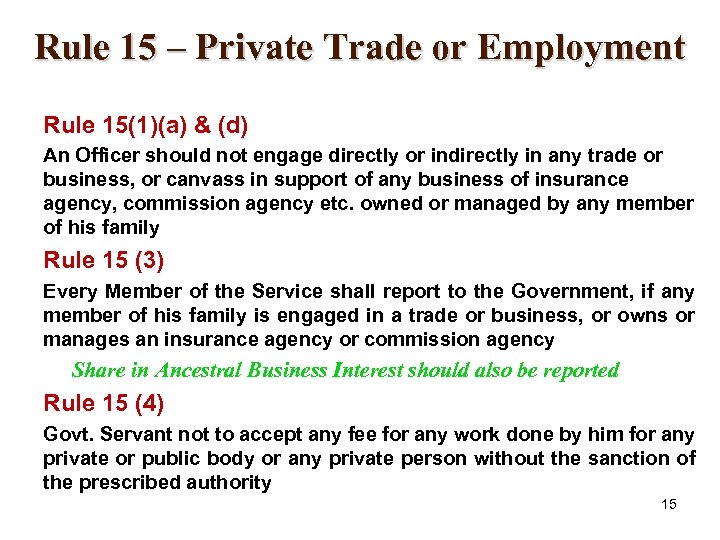 Rule 15 – Private Trade or Employment Rule 15(1)(a) & (d) An Officer should not engage directly or indirectly in any trade or business, or canvass in support of any business of insurance agency, commission agency etc. owned or managed by any member of his family Rule 15 (3) Every Member of the Service shall report to the Government, if any member of his family is engaged in a trade or business, or owns or manages an insurance agency or commission agency Share in Ancestral Business Interest should also be reported Rule 15 (4) Govt. Servant not to accept any fee for any work done by him for any private or public body or any private person without the sanction of the prescribed authority 15
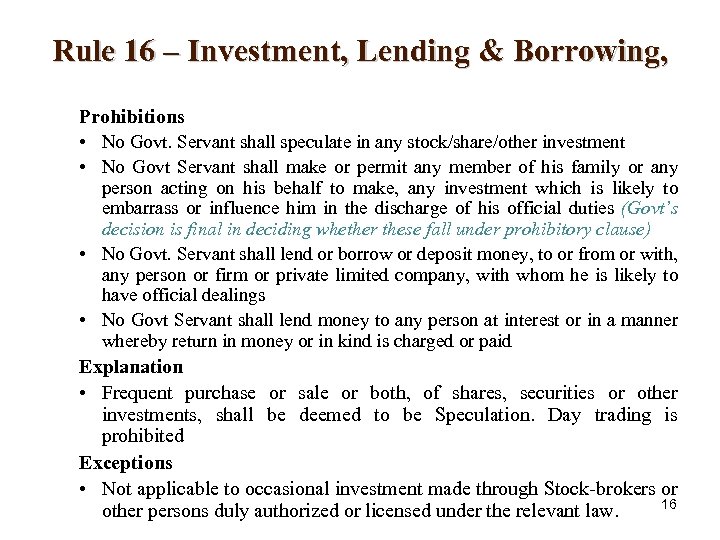 Rule 16 – Investment, Lending & Borrowing, Prohibitions • No Govt. Servant shall speculate in any stock/share/other investment • No Govt Servant shall make or permit any member of his family or any person acting on his behalf to make, any investment which is likely to embarrass or influence him in the discharge of his official duties (Govt’s decision is final in deciding whether these fall under prohibitory clause) • No Govt. Servant shall lend or borrow or deposit money, to or from or with, any person or firm or private limited company, with whom he is likely to have official dealings • No Govt Servant shall lend money to any person at interest or in a manner whereby return in money or in kind is charged or paid Explanation • Frequent purchase or sale or both, of shares, securities or other investments, shall be deemed to be Speculation. Day trading is prohibited Exceptions • Not applicable to occasional investment made through Stock-brokers or 16 other persons duly authorized or licensed under the relevant law.
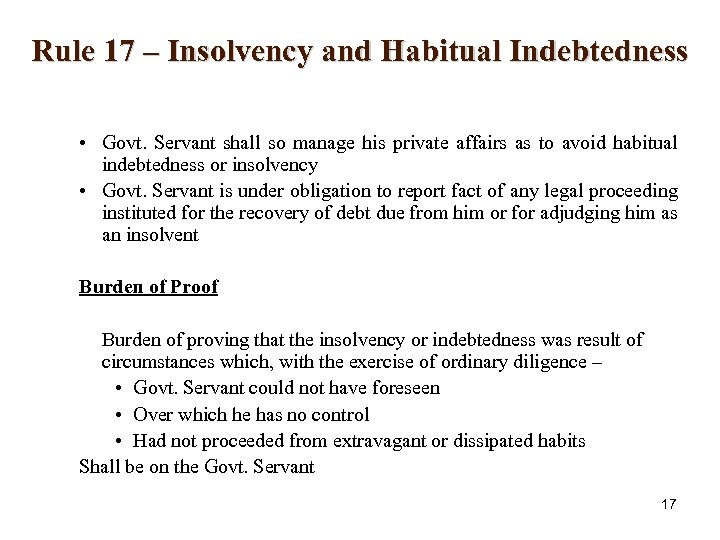 Rule 17 – Insolvency and Habitual Indebtedness • Govt. Servant shall so manage his private affairs as to avoid habitual indebtedness or insolvency • Govt. Servant is under obligation to report fact of any legal proceeding instituted for the recovery of debt due from him or for adjudging him as an insolvent Burden of Proof Burden of proving that the insolvency or indebtedness was result of circumstances which, with the exercise of ordinary diligence – • Govt. Servant could not have foreseen • Over which he has no control • Had not proceeded from extravagant or dissipated habits Shall be on the Govt. Servant 17
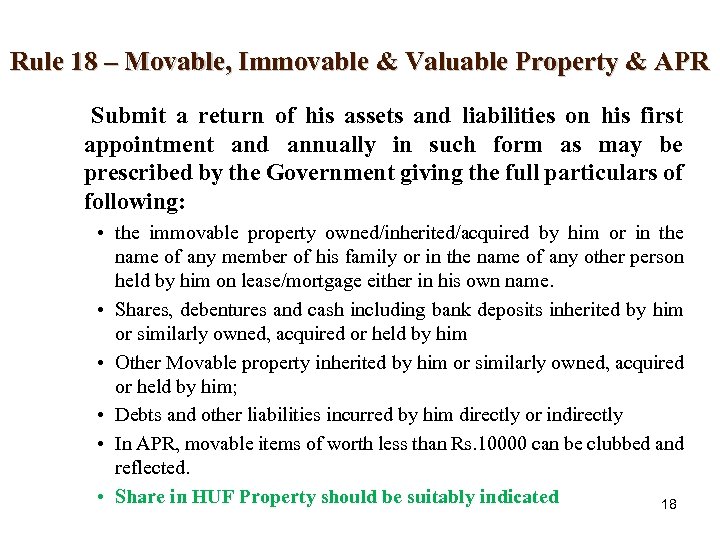 Rule 18 – Movable, Immovable & Valuable Property & APR Submit a return of his assets and liabilities on his first appointment and annually in such form as may be prescribed by the Government giving the full particulars of following: • the immovable property owned/inherited/acquired by him or in the name of any member of his family or in the name of any other person held by him on lease/mortgage either in his own name. • Shares, debentures and cash including bank deposits inherited by him or similarly owned, acquired or held by him • Other Movable property inherited by him or similarly owned, acquired or held by him; • Debts and other liabilities incurred by him directly or indirectly • In APR, movable items of worth less than Rs. 10000 can be clubbed and reflected. • Share in HUF Property should be suitably indicated 18
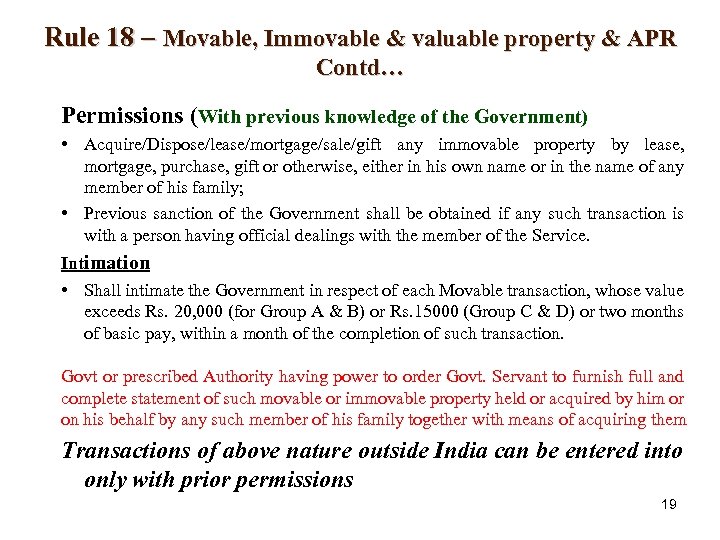 Rule 18 – Movable, Immovable & valuable property & APR Contd… Permissions (With previous knowledge of the Government) • Acquire/Dispose/lease/mortgage/sale/gift any immovable property by lease, mortgage, purchase, gift or otherwise, either in his own name or in the name of any member of his family; • Previous sanction of the Government shall be obtained if any such transaction is with a person having official dealings with the member of the Service. Intimation • Shall intimate the Government in respect of each Movable transaction, whose value exceeds Rs. 20, 000 (for Group A & B) or Rs. 15000 (Group C & D) or two months of basic pay, within a month of the completion of such transaction. Govt or prescribed Authority having power to order Govt. Servant to furnish full and complete statement of such movable or immovable property held or acquired by him or on his behalf by any such member of his family together with means of acquiring them Transactions of above nature outside India can be entered into only with prior permissions 19
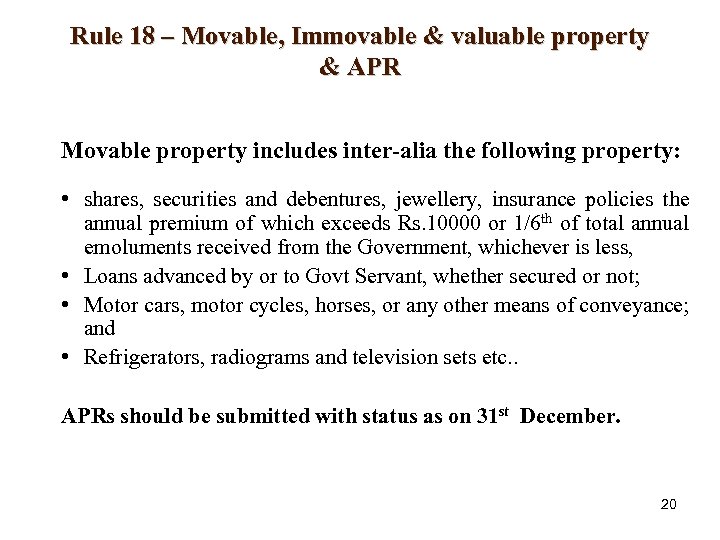 Rule 18 – Movable, Immovable & valuable property & APR Movable property includes inter-alia the following property: • shares, securities and debentures, jewellery, insurance policies the annual premium of which exceeds Rs. 10000 or 1/6 th of total annual emoluments received from the Government, whichever is less, • Loans advanced by or to Govt Servant, whether secured or not; • Motor cars, motor cycles, horses, or any other means of conveyance; and • Refrigerators, radiograms and television sets etc. . APRs should be submitted with status as on 31 st December. 20
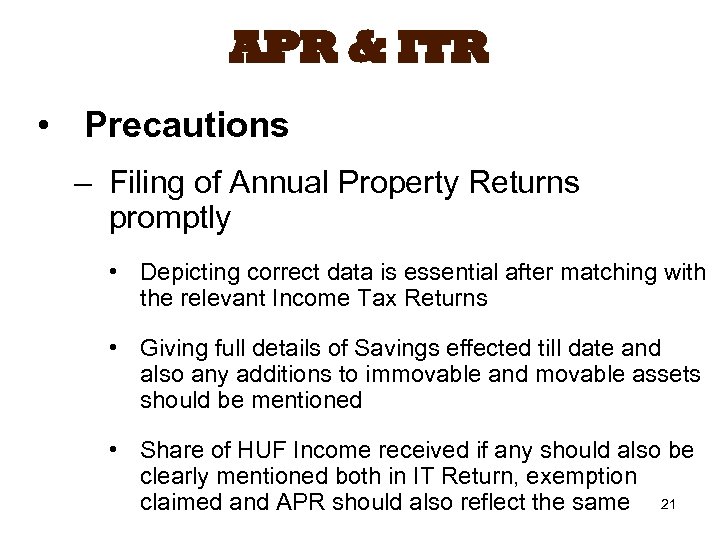 APR & ITR • Precautions – Filing of Annual Property Returns promptly • Depicting correct data is essential after matching with the relevant Income Tax Returns • Giving full details of Savings effected till date and also any additions to immovable and movable assets should be mentioned • Share of HUF Income received if any should also be clearly mentioned both in IT Return, exemption claimed and APR should also reflect the same 21
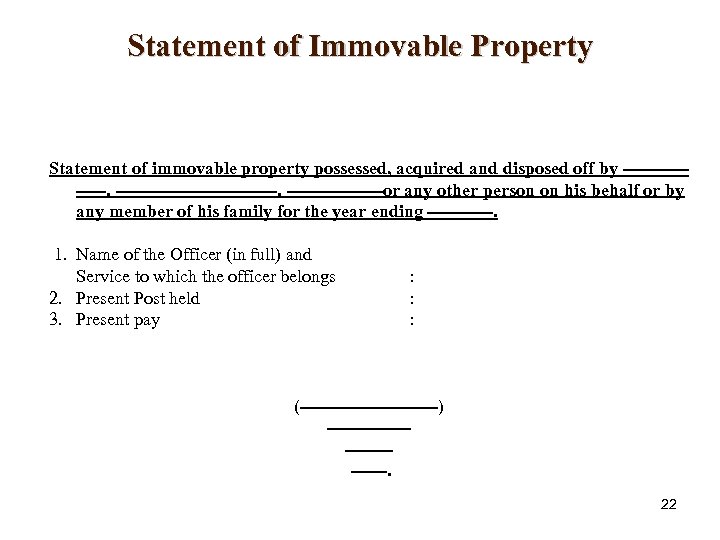 Statement of Immovable Property Statement of immovable property possessed, acquired and disposed off by ----------------or any other person on his behalf or by any member of his family for the year ending ------. 1. Name of the Officer (in full) and Service to which the officer belongs : 2. Present Post held : 3. Present pay : (------------) -------------. 22
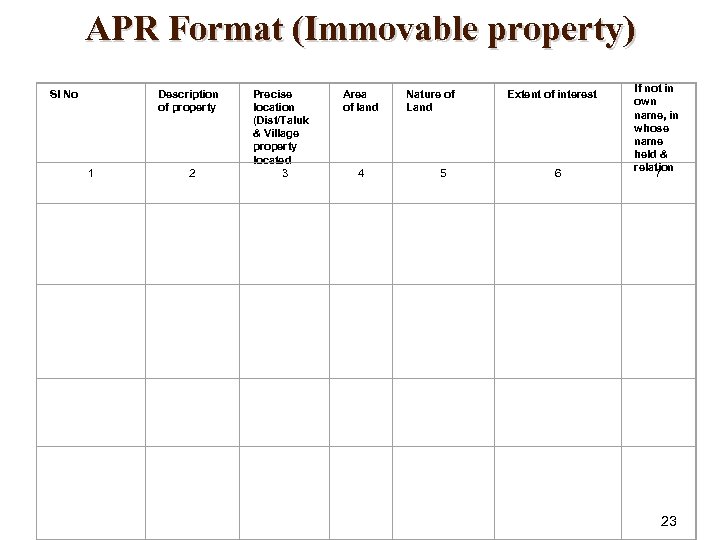 APR Format (Immovable property) Sl No Description of property 1 2 Precise location (Dist/Taluk & Village property located 3 Area of land Nature of Land 4 Extent of interest 5 6 If not in own name, in whose name held & relation 7 23
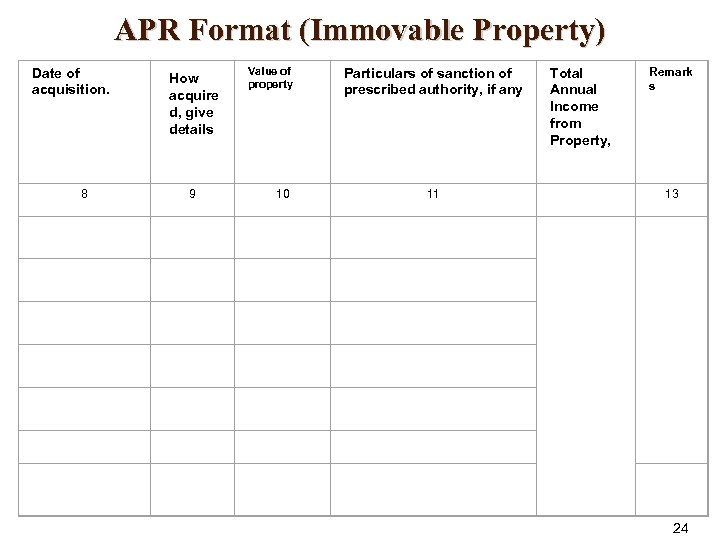 APR Format (Immovable Property) Date of acquisition. How acquire d, give details 8 Value of property 9 Particulars of sanction of prescribed authority, if any 10 Total Annual Income from Property, 11 13 Remark s 24
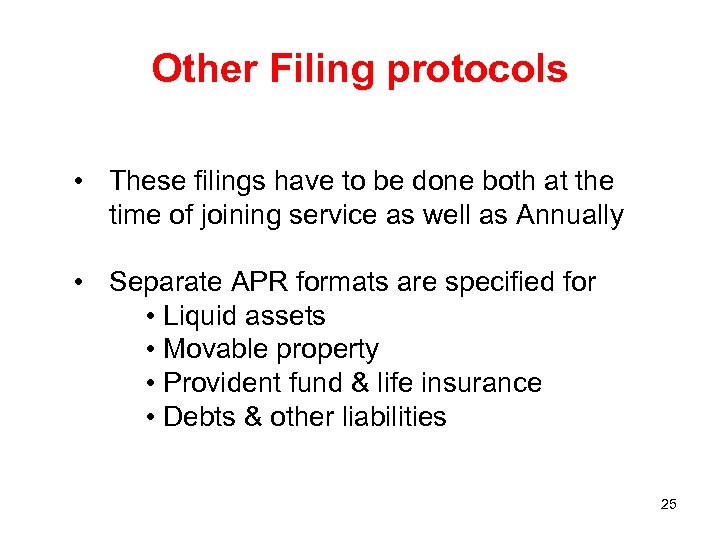 Other Filing protocols • These filings have to be done both at the time of joining service as well as Annually • Separate APR formats are specified for • Liquid assets • Movable property • Provident fund & life insurance • Debts & other liabilities 25
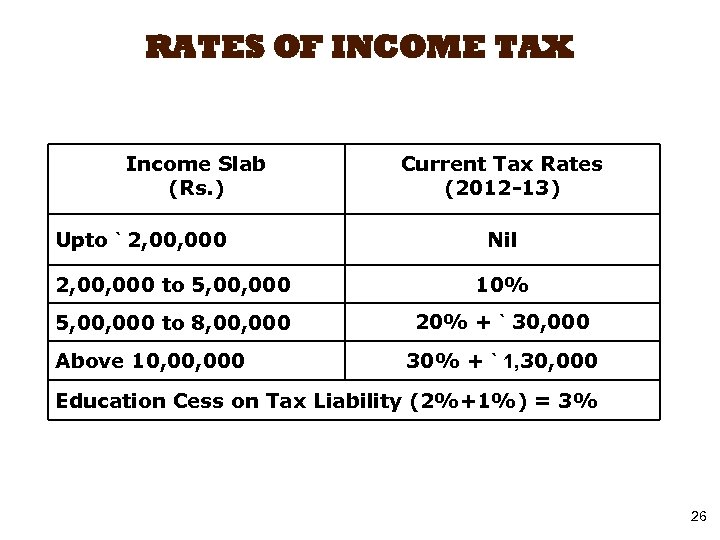 RATES OF INCOME TAX Income Slab (Rs. ) Upto ` 2, 000 Current Tax Rates (2012 -13) Nil 2, 000 to 5, 000 10% 5, 000 to 8, 000 20% + ` 30, 000 Above 10, 000 30% + ` 1, 30, 000 Education Cess on Tax Liability (2%+1%) = 3% 26
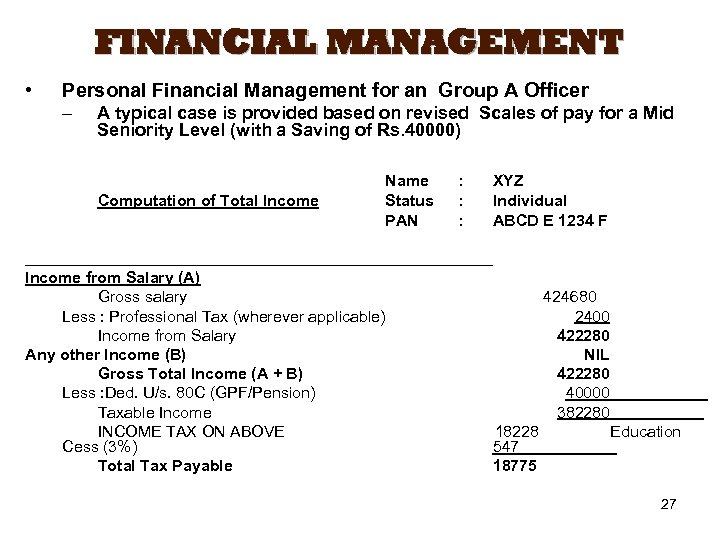 FINANCIAL MANAGEMENT • Personal Financial Management for an Group A Officer – A typical case is provided based on revised Scales of pay for a Mid Seniority Level (with a Saving of Rs. 40000) Computation of Total Income Name : Status : PAN : Income from Salary (A) Gross salary Less : Professional Tax (wherever applicable) Income from Salary Any other Income (B) Gross Total Income (A + B) Less : Ded. U/s. 80 C (GPF/Pension) Taxable Income INCOME TAX ON ABOVE Cess (3%) Total Tax Payable XYZ Individual ABCD E 1234 F 424680 2400 422280 NIL 422280 40000 382280 18228 Education 547 18775 27
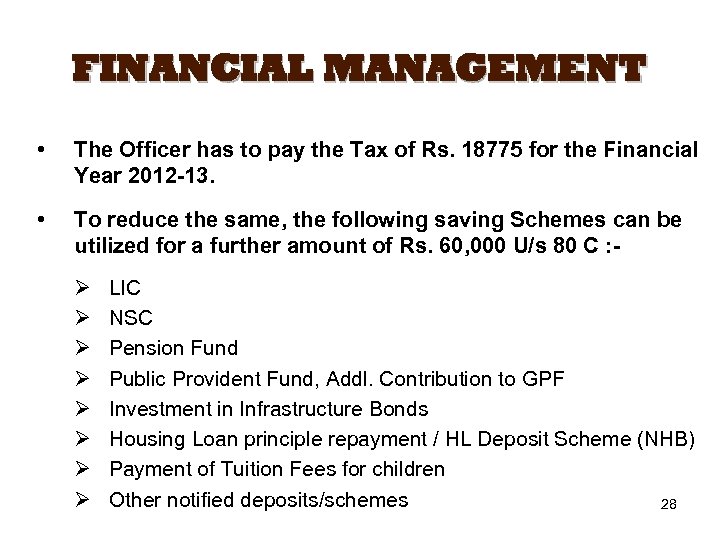 FINANCIAL MANAGEMENT • The Officer has to pay the Tax of Rs. 18775 for the Financial Year 2012 -13. • To reduce the same, the following saving Schemes can be utilized for a further amount of Rs. 60, 000 U/s 80 C : - Ø Ø Ø Ø LIC NSC Pension Fund Public Provident Fund, Addl. Contribution to GPF Investment in Infrastructure Bonds Housing Loan principle repayment / HL Deposit Scheme (NHB) Payment of Tuition Fees for children Other notified deposits/schemes 28
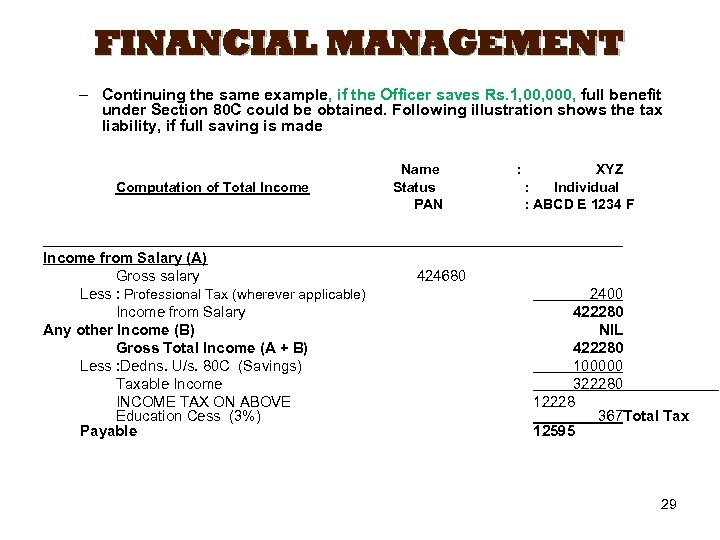 FINANCIAL MANAGEMENT – Continuing the same example, if the Officer saves Rs. 1, 000, full benefit under Section 80 C could be obtained. Following illustration shows the tax liability, if full saving is made Computation of Total Income Name Status PAN Income from Salary (A) Gross salary 424680 Less : Professional Tax (wherever applicable) Income from Salary Any other Income (B) Gross Total Income (A + B) Less : Dedns. U/s. 80 C (Savings) Taxable Income INCOME TAX ON ABOVE Education Cess (3%) Payable : XYZ : Individual : ABCD E 1234 F 2400 422280 NIL 422280 100000 322280 12228 367 Total Tax 12595 29
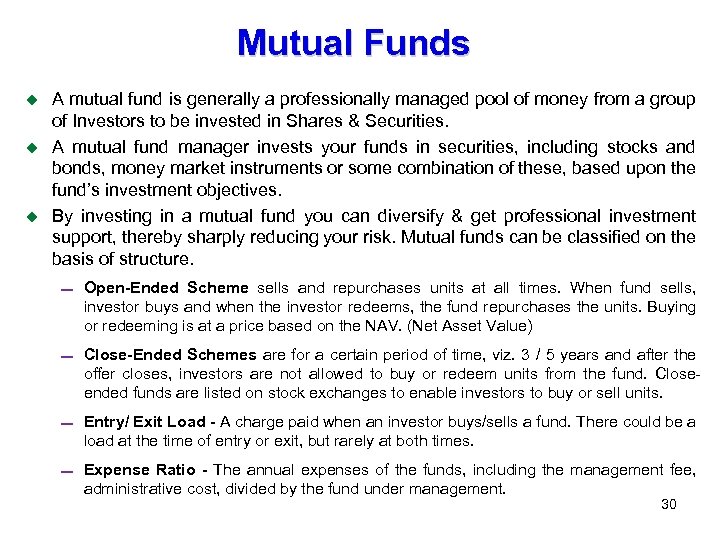 Mutual Funds A mutual fund is generally a professionally managed pool of money from a group of Investors to be invested in Shares & Securities. A mutual fund manager invests your funds in securities, including stocks and bonds, money market instruments or some combination of these, based upon the fund’s investment objectives. By investing in a mutual fund you can diversify & get professional investment support, thereby sharply reducing your risk. Mutual funds can be classified on the basis of structure. ▬ Open-Ended Scheme sells and repurchases units at all times. When fund sells, investor buys and when the investor redeems, the fund repurchases the units. Buying or redeeming is at a price based on the NAV. (Net Asset Value) ▬ Close-Ended Schemes are for a certain period of time, viz. 3 / 5 years and after the offer closes, investors are not allowed to buy or redeem units from the fund. Closeended funds are listed on stock exchanges to enable investors to buy or sell units. ▬ Entry/ Exit Load - A charge paid when an investor buys/sells a fund. There could be a load at the time of entry or exit, but rarely at both times. ▬ Expense Ratio - The annual expenses of the funds, including the management fee, administrative cost, divided by the fund under management. 30
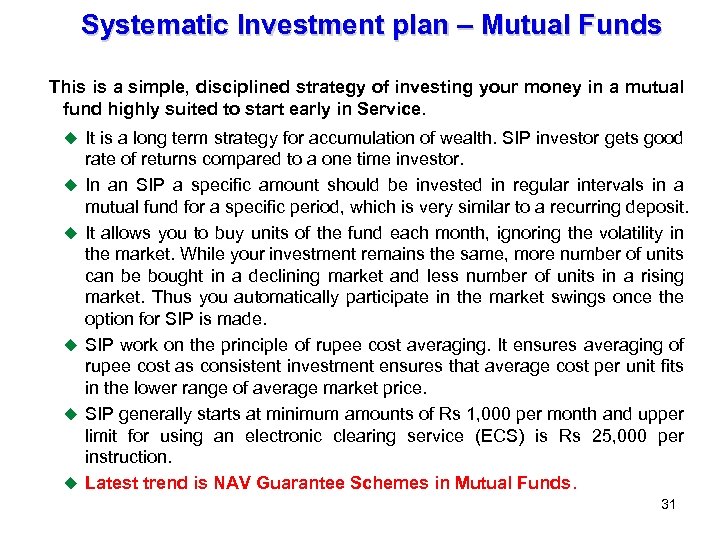 Systematic Investment plan – Mutual Funds This is a simple, disciplined strategy of investing your money in a mutual fund highly suited to start early in Service. It is a long term strategy for accumulation of wealth. SIP investor gets good rate of returns compared to a one time investor. In an SIP a specific amount should be invested in regular intervals in a mutual fund for a specific period, which is very similar to a recurring deposit. It allows you to buy units of the fund each month, ignoring the volatility in the market. While your investment remains the same, more number of units can be bought in a declining market and less number of units in a rising market. Thus you automatically participate in the market swings once the option for SIP is made. SIP work on the principle of rupee cost averaging. It ensures averaging of rupee cost as consistent investment ensures that average cost per unit fits in the lower range of average market price. SIP generally starts at minimum amounts of Rs 1, 000 per month and upper limit for using an electronic clearing service (ECS) is Rs 25, 000 per instruction. Latest trend is NAV Guarantee Schemes in Mutual Funds. 31
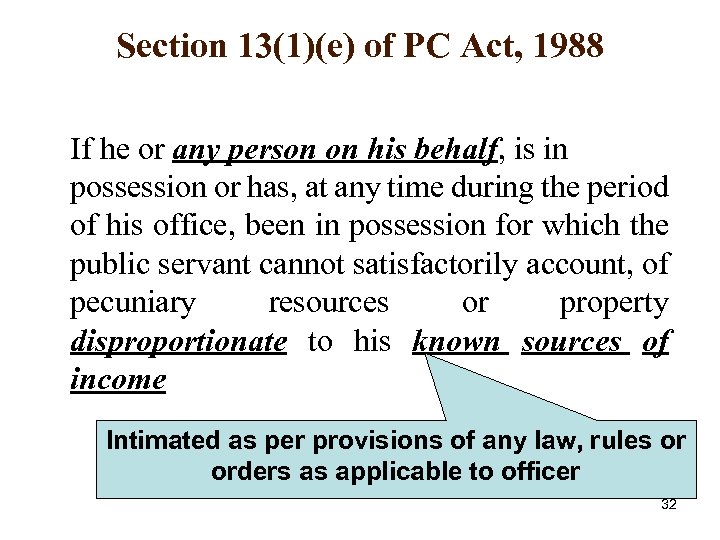 Section 13(1)(e) of PC Act, 1988 If he or any person on his behalf, is in possession or has, at any time during the period of his office, been in possession for which the public servant cannot satisfactorily account, of pecuniary resources or property disproportionate to his known sources of income Intimated as per provisions of any law, rules or orders as applicable to officer 32
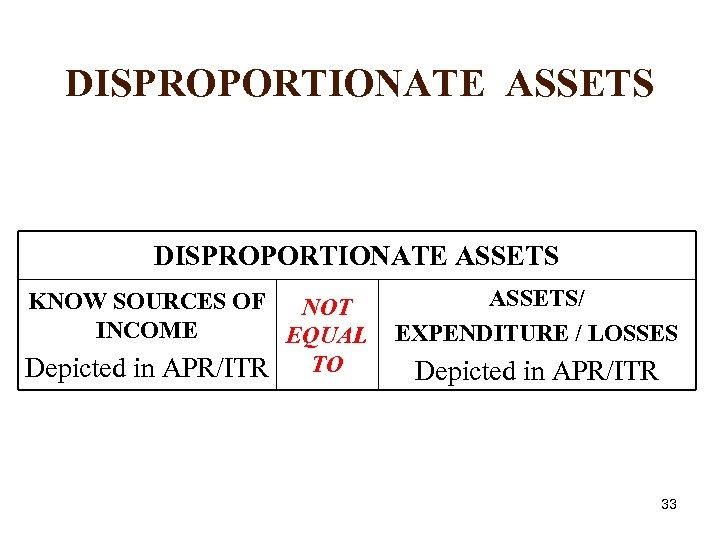 DISPROPORTIONATE ASSETS KNOW SOURCES OF NOT INCOME EQUAL TO Depicted in APR/ITR ASSETS/ EXPENDITURE / LOSSES Depicted in APR/ITR 33
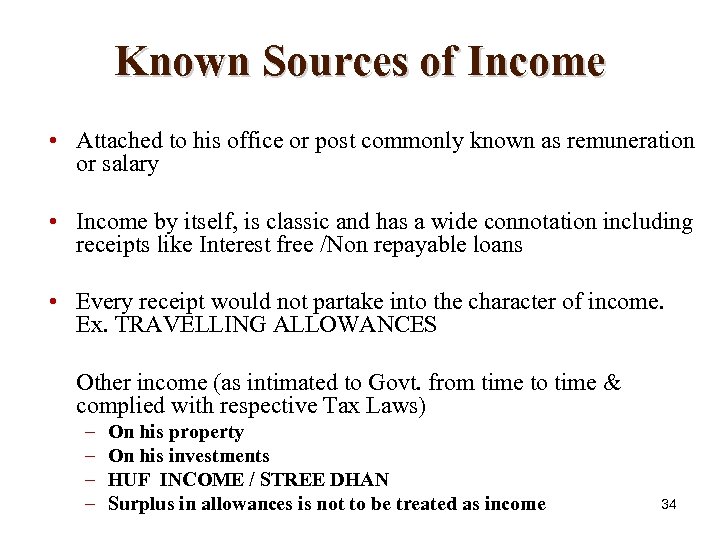 Known Sources of Income • Attached to his office or post commonly known as remuneration or salary • Income by itself, is classic and has a wide connotation including receipts like Interest free /Non repayable loans • Every receipt would not partake into the character of income. Ex. TRAVELLING ALLOWANCES Other income (as intimated to Govt. from time to time & complied with respective Tax Laws) – – On his property On his investments HUF INCOME / STREE DHAN Surplus in allowances is not to be treated as income 34
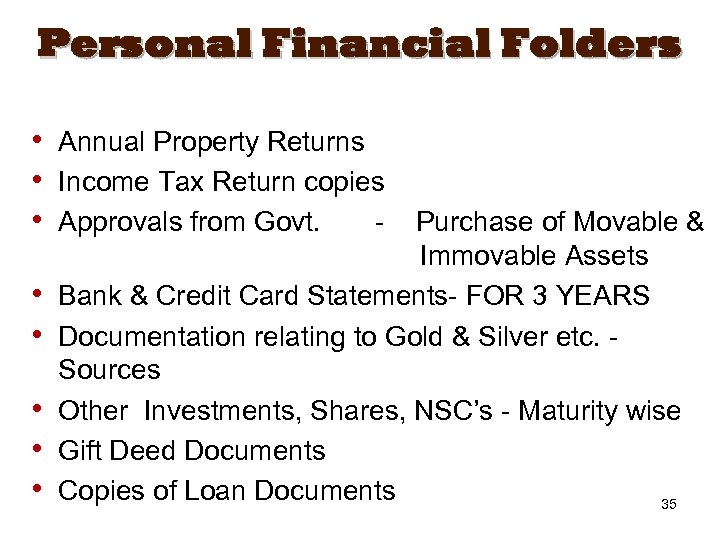 Personal Financial Folders • Annual Property Returns • Income Tax Return copies • Approvals from Govt. - Purchase of Movable & • • • Immovable Assets Bank & Credit Card Statements- FOR 3 YEARS Documentation relating to Gold & Silver etc. - Sources Other Investments, Shares, NSC’s - Maturity wise Gift Deed Documents Copies of Loan Documents 35
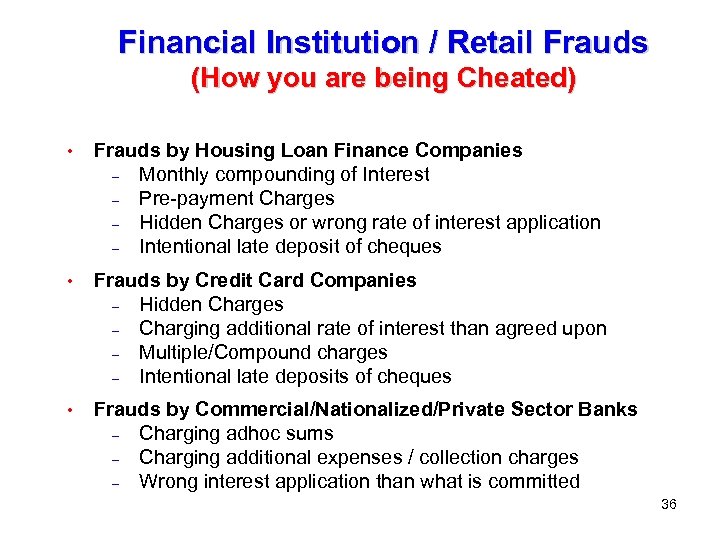 Financial Institution / Retail Frauds (How you are being Cheated) • Frauds by Housing Loan Finance Companies – Monthly compounding of Interest – Pre-payment Charges – Hidden Charges or wrong rate of interest application – Intentional late deposit of cheques • Frauds by Credit Card Companies – Hidden Charges – Charging additional rate of interest than agreed upon – Multiple/Compound charges – Intentional late deposits of cheques • Frauds by Commercial/Nationalized/Private Sector Banks – Charging adhoc sums – Charging additional expenses / collection charges – Wrong interest application than what is committed 36
 ITRs & PAN < PAN is essential under Income Tax Act. < Failure to possess the same and drawing salary attracts a penalty of Rs. 10, 000 each, for both the Receiver & Pay Drawing Officer. The following are the details required for obtaining PAN Card - § § § 1 No. Colour Passport Size Photo Identity Proof Address Proof A Gazetted Officer’s Certificate in Lieu of above Proof Filling up of the Prescribed Form in Black Ink only with Personal Details Pay a Fees of Rs. 96/- Every officer must submit to the Pay Drawing Officer either savings details or give indication for deduction of suitable tax in a phased manner. 37
 Spare two hours every month to monitor your financial status and review decisions Maintain personal financial folders to keep track of your investments including maturity details Do your home work because you have to take the exams, but of course you can avail tuitions Compare your APRs and Income Tax Returns because the due dates for both are different and file them regularly before due dates Don’t go by presumptive approach that everything is alright Comply with Service Conduct Rules very strictly You are welcome to email me your personal queries Any Questions/Clarifications ? ? 38
 THANK YOU P. SHARATH KUMAR, LLB, CFE, CFAP, FCA. Chartered Accountant e-mail - sarathcas@yahoo. com 39
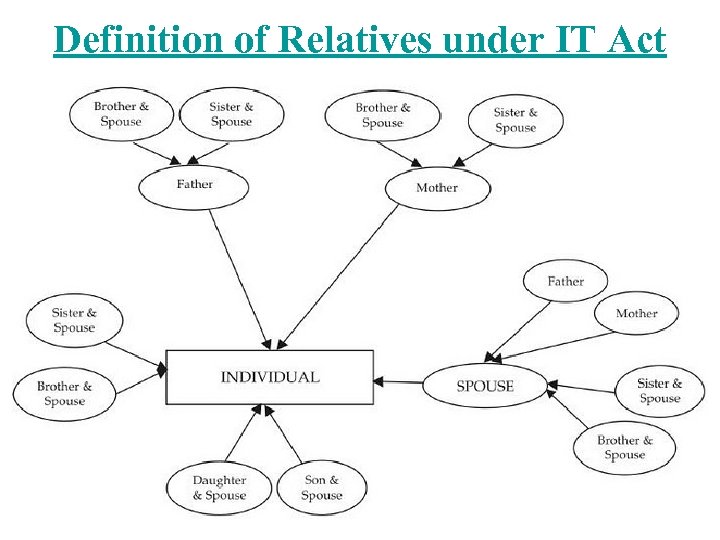 Definition of Relatives under IT Act 40