


 Скачать презентацию PERSONAL FINANCE Unit 1 Saving and Investing
4955cf1e794a3225420865bc59a45a2d.ppt
- Количество слайдов: 40
 PERSONAL FINANCE Unit 1: Saving and Investing
 Chapter 1: Savings
 Savings Money Facts: • 70% of people live paycheck to paycheck. • Only 41% of Americans save regularly. • Half of American households live on less than $46, 326 a year. • 19% of people who make over $100, 000 live paycheck to paycheck!
 Savings The Seven Baby Steps (These are the steps you should take to reach financial peace!) • 1. $1, 000 in an emergency fund (or $500 if you make less than $20, 000/yr. ) • 2. Pay off all debt except the house utilizing the debt snowball (focus on one debt at a time beginning with smallest debt to gain momentum).
 Savings • 3. 3 – 6 months expenses in savings. • 4. Invest 15% of your household income into retirement plans. • 5. College funding. • 6. Pay off your home early. • 7. Build wealth and give! • (These steps are meant to be achieved one at a time, in order. )
 Savings • Saving must become a priority, but always pay yourself first. • The United States has a negative savings rate. • This means that we have more debt than we have savings! • Money is amoral, meaning it is neither good nor bad.
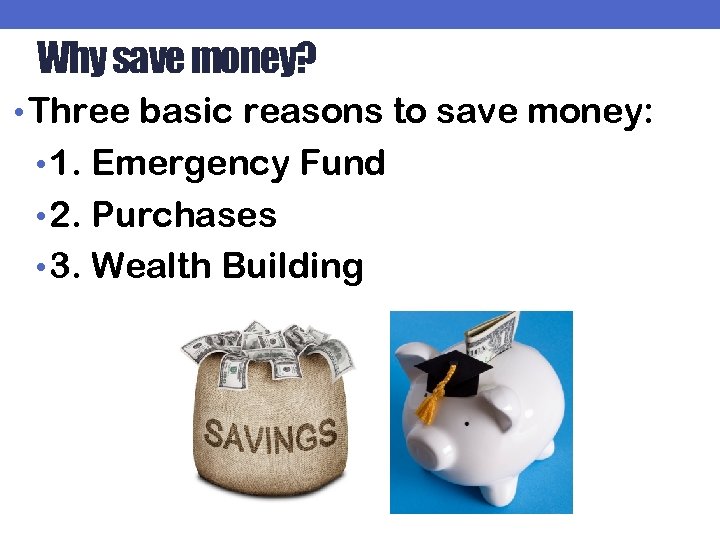 Why save money? • Three basic reasons to save money: • 1. Emergency Fund • 2. Purchases • 3. Wealth Building
 Why Save Money? • 1. Emergency Funds • Murphy’s Law: Anything that can go wrong, will go wrong! • Emergencies will happen, so plan on it. • A great place to keep your emergency fund is in a Money Market account from a mutual fund company. • You will earn a higher interest rate, which means more money.
 Why Save Money? • Money Market: Returns a higher interest rates than a savings account, but also requires more of a minimum deposit. • Do not use your emergency fund for purchases. • Purchases are the second thing you save money for.
 Why Save Money? 2. Purchases • Instead of borrowing to purchase, pay cash. • Borrowing money will mean you have to pay an interest on the money, which means you pay more in the long run. • When you pay cash, you can usually negotiate a lower price.
 Why Save Money? 3. Wealth Building • Building wealth takes time and discipline. • Part of building wealth is investing your savings. • Interest is the key to investing. This is the percent of your money you will receive in return for allowing someone to hold your money.
 Savings Investing • Interest: a fee paid to you by the entity holding your money. Usually a percentage of the money you allow them to hold. • Ex. Invest $1000 at 10% interest. • 10% of $1000 is $100, so at the end of the year, you will have $1, 100. • (Secret of how rich get richer!)
 Savings • Compound Interest: interest paid on interest previously earned. • Ex. You now have $1, 100 after one year. At the end of the next year you will have… • $1, 100 x 10% = $110 • So you will now have $1, 210. • Year 3: $1, 210 x 10% = $121 • So after year 3, you have $1, 331…
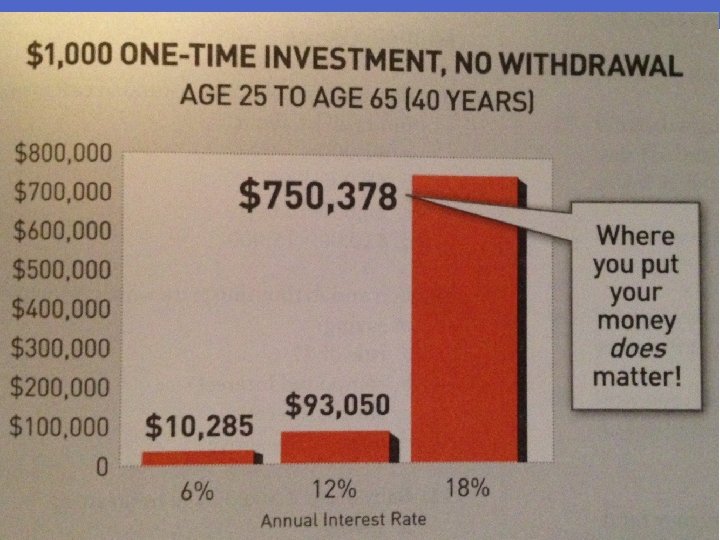
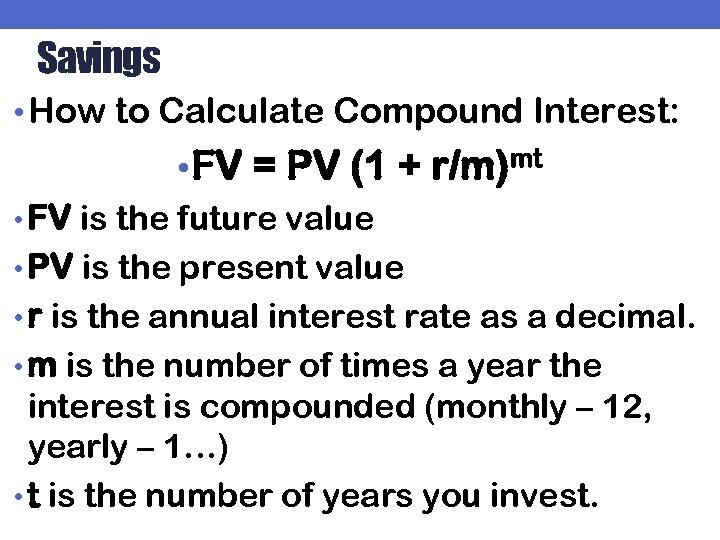 Savings • How to Calculate Compound Interest: • FV = PV (1 + r/m)mt • FV is the future value • PV is the present value • r is the annual interest rate as a decimal. • m is the number of times a year the interest is compounded (monthly – 12, yearly – 1…) • t is the number of years you invest.
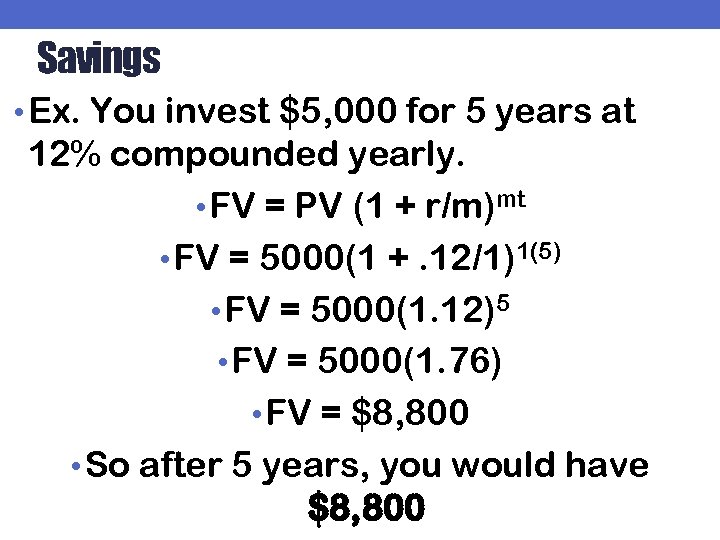 Savings • Ex. You invest $5, 000 for 5 years at 12% compounded yearly. • FV = PV (1 + r/m)mt • FV = 5000(1 +. 12/1)1(5) • FV = 5000(1. 12)5 • FV = 5000(1. 76) • FV = $8, 800 • So after 5 years, you would have $8, 800
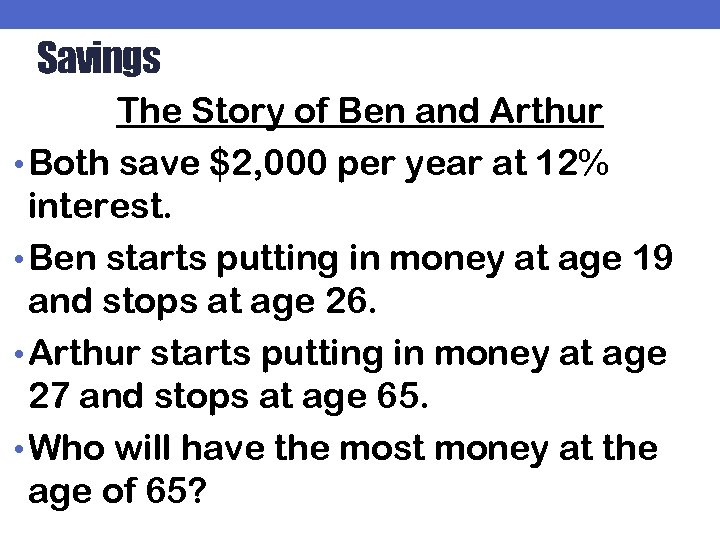 Savings The Story of Ben and Arthur • Both save $2, 000 per year at 12% interest. • Ben starts putting in money at age 19 and stops at age 26. • Arthur starts putting in money at age 27 and stops at age 65. • Who will have the most money at the age of 65?
 Chapter 2: Investment Options
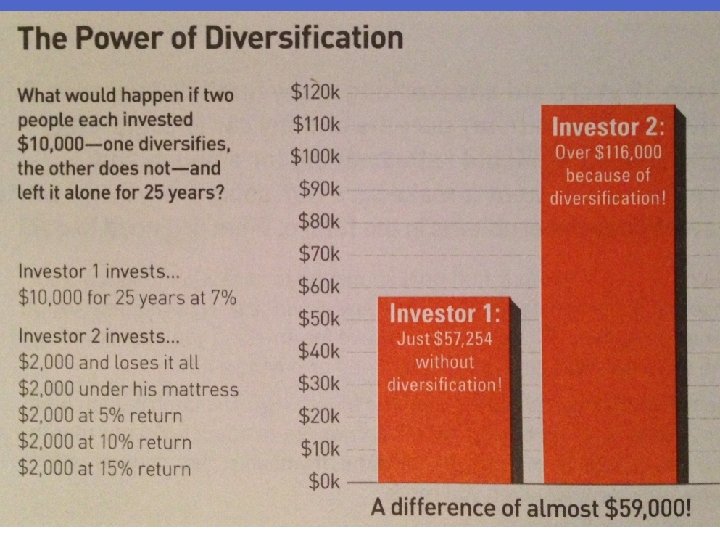
 Investment Options • KISS: Keep It Simple Stupid! • Don’t put money in anything you don’t understand, and investing does not have to be complex. • Diversification: to spread around your investment dollars among several different things to lower risk. • When you have all of your money in one place, the risk is higher.
 Investment Options • With almost all investments, as the risk goes up, so does the potential return. • Liquidity: how quickly you can turn the investment into cash. • With more liquidity, the return on investment is less. • Savings accounts are very liquid, so the interest rates are usually lower.
 Investment Options • Types of Investments: • 1. Money Markets • 2. Single Stocks • 3. Bonds • 4. Mutual Funds • 5. Real Estate • 6. Annuities
 Investment Options • 1. Money Markets • CD (Certificate of Deposit), usually bought at a bank. • Money market mutual funds are low risk. • Some have check writing privileges. • Great investment for emergency funds. • Very liquid.
 Investment Options • 2. Single Stocks • Extremely high degree of risk. • When you buy stock, you are buying a small piece of ownership in the company. • Your return comes as the company increases in value or pays you some of the profits (dividends).
 Investment Options • 3. Bonds • A bond is a debt by which the company owes you money. • Your return is the fluctuation in price and the interest rate paid. • It is like an I. O. U. where the company borrows money from you and pays you interest on the money they borrow.
 Investment Options • 4. Mutual Funds • Investors pool their money to invest. • Portfolio managers manage the pool of money or fund. • Your return comes as the value of the fund is increased. • Mutual funds are good long-term investments.
 Investment Options • 5. Real Estate • Least liquid investment! • You should have lots of cash before using real estate as an investment. • Buy property and hold it until it increases in value and then sell it at a higher price. • Risky because of the fluctuations in the price of properties.
 Investment Options • 6. Annuities • Annuities are savings accounts with an insurance company. • You pay regularly into an account over a long period of time and receive the return at a later point in time. • Mostly used to save for retirement. • Lower risk
 Building wealth takes time. There are very few people who get rich quickly! If you do, give me some money!
 Chapter 3: Wealth Building and College Savings
 Wealth Building and College Savings • Average graduate of a four year college has student loan debt of $19, 237. • Graduate students: $114, 000 • 46% of Americans have less than $10, 000 saved for retirement. • 13% of teens know what a 401(k) is. • 29% of teens know how to pay for college.
 Wealth Building and College Savings • Lottery Stories! • William Post won $16. 2 million! • His former girlfriend sued him and won part of his winnings. • His brother was arrested for hiring a hit man to kill him for his money. • His other sibling harassed him to invest in businesses and they failed. • After 1 year, he was $1 million in debt!
 Wealth Building and College Savings • Suzanne Mullins won $4. 2 million • Borrowed $200, 000 using her lottery winnings as collateral. • Stopped making payments on the loan. • Company sued her and won. • Today she has no assets.
 Wealth Building and College Savings • William Hurt won $3. 1 million. • He spent his money on a divorce and crack cocaine. • Two years later, he was broke and facing murder charges.
 Wealth Building and College Savings • Baby Step #4: Invest 15% of your household income into Roth IRAs and pre-tax retirement plans. • Federal Deposit Insurance Corporation (FDIC) – government is responsible for insuring or guaranteeing deposits in banks and savings institutions. • Created in 1933 to restore confidence in banks after thousands of them failed
 Wealth Building and College Savings • The Federal Reserve (The Fed) – Central banking system of the United States and has four main duties: • 1. Controls the supply of money. • 2. Supervises and regulates banks. • 3. Maintains the stability of the financial system. • 4. Provides financial services to banks.
 Wealth Building and College Savings • Individual Retirement Arrangement (IRA) – provides tax advantages for retirement savings in the United States. • Roth IRA – After tax IRA that grows tax free. • It provides you with money, tax-free, in retirement, if you follow certain rules. • Tax free money is the best money!
 Wealth Building and College Savings • 401(k), 403(b), & 457 Retirement Plans • You have money deducted from your paycheck before or after taxes toward retirement. • Compounds interests with delayed taxation. • Employers sometimes match your contributions.
 Wealth Building and College Savings • If you leave a job, rollover your retirement plan to an IRA when you leave so you continue saving for retirement. • Never borrow from your retirement plan. • Summary: Invest for your retirement as soon as you can!
 Wealth Building and College Savings College Funding • Save for your children’s education using tax-favored plans. • Educational Savings Accounts (ESA) – You can save $2, 000 per year for 18 years. • You would invest a total of $36, 000, but at 12% growth, your child would have $126, 000 for college – TAX FREE!