 Скачать презентацию Personal Finance Basics 1 FOR MILITARY PERSONNEL Lt
72712103d43b43bd42263e259a673ea9.ppt
- Количество слайдов: 70



Personal Finance Basics 1 FOR MILITARY PERSONNEL Lt. Col. M. Hensen, 3 d MLG
Disclaimers 2 No such thing as one-size fits all solutions Take the time to educate yourself further Knowledge truly is power in finances Simple ideas/solutions – but not always actually easy to do
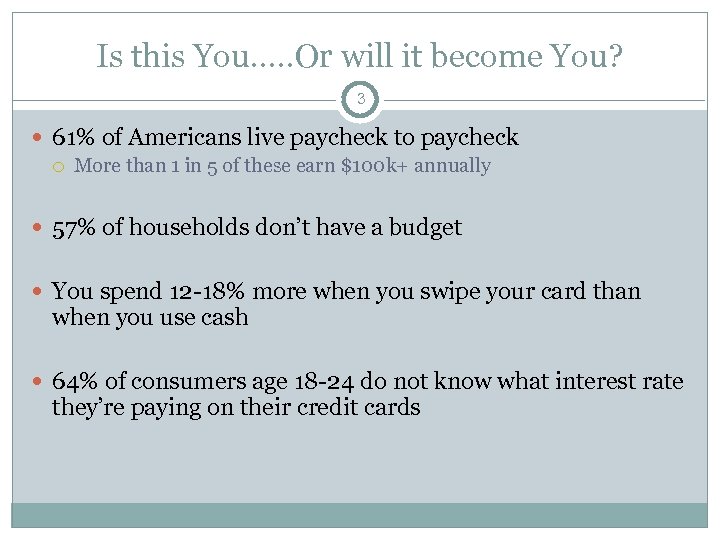
Is this You…. . Or will it become You? 3 61% of Americans live paycheck to paycheck More than 1 in 5 of these earn $100 k+ annually 57% of households don’t have a budget You spend 12 -18% more when you swipe your card than when you use cash 64% of consumers age 18 -24 do not know what interest rate they’re paying on their credit cards
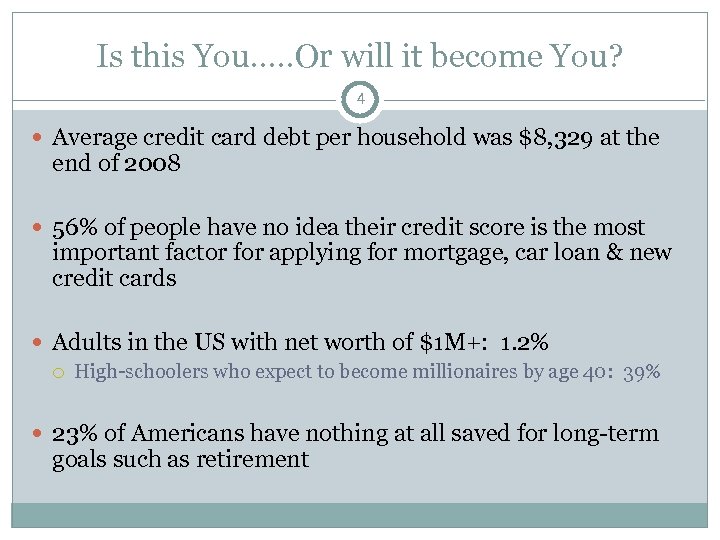
Is this You…. . Or will it become You? 4 Average credit card debt per household was $8, 329 at the end of 2008 56% of people have no idea their credit score is the most important factor for applying for mortgage, car loan & new credit cards Adults in the US with net worth of $1 M+: 1. 2% High-schoolers who expect to become millionaires by age 40: 39% 23% of Americans have nothing at all saved for long-term goals such as retirement
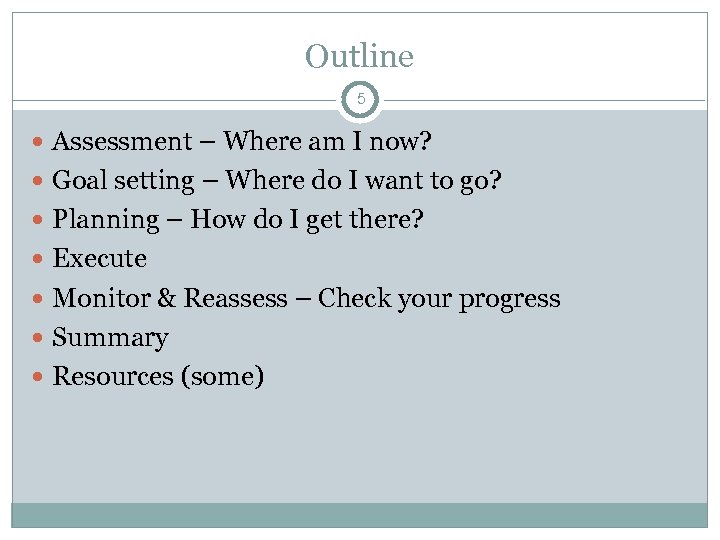
Outline 5 Assessment – Where am I now? Goal setting – Where do I want to go? Planning – How do I get there? Execute Monitor & Reassess – Check your progress Summary Resources (some)
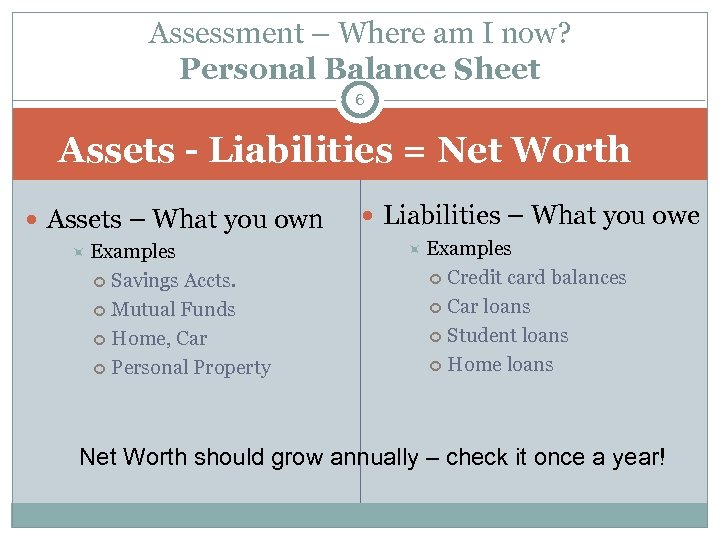
Assessment – Where am I now? Personal Balance Sheet 6 Assets - Liabilities = Net Worth Assets – What you own Examples Savings Accts. Mutual Funds Home, Car Personal Property Liabilities – What you owe Examples Credit card balances Car loans Student loans Home loans Net Worth should grow annually – check it once a year!
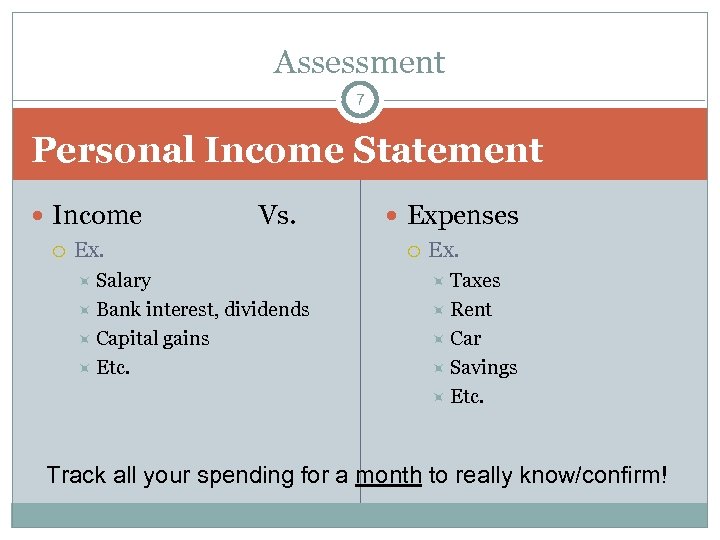
Assessment 7 Personal Income Statement Income Vs. Ex. Expenses Ex. Salary Taxes Bank Rent interest, dividends Capital gains Etc. Car Savings Etc. Track all your spending for a month to really know/confirm!
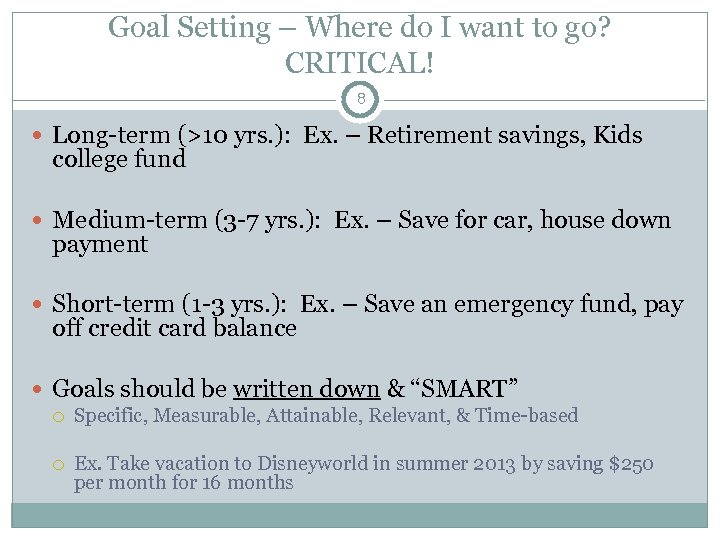
Goal Setting – Where do I want to go? CRITICAL! 8 Long-term (>10 yrs. ): Ex. – Retirement savings, Kids college fund Medium-term (3 -7 yrs. ): Ex. – Save for car, house down payment Short-term (1 -3 yrs. ): Ex. – Save an emergency fund, pay off credit card balance Goals should be written down & “SMART” Specific, Measurable, Attainable, Relevant, & Time-based Ex. Take vacation to Disneyworld in summer 2013 by saving $250 per month for 16 months
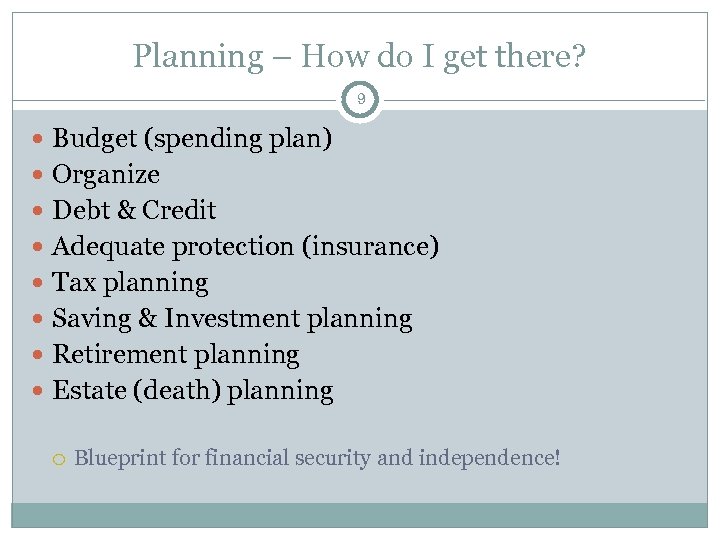
Planning – How do I get there? 9 Budget (spending plan) Organize Debt & Credit Adequate protection (insurance) Tax planning Saving & Investment planning Retirement planning Estate (death) planning Blueprint for financial security and independence!
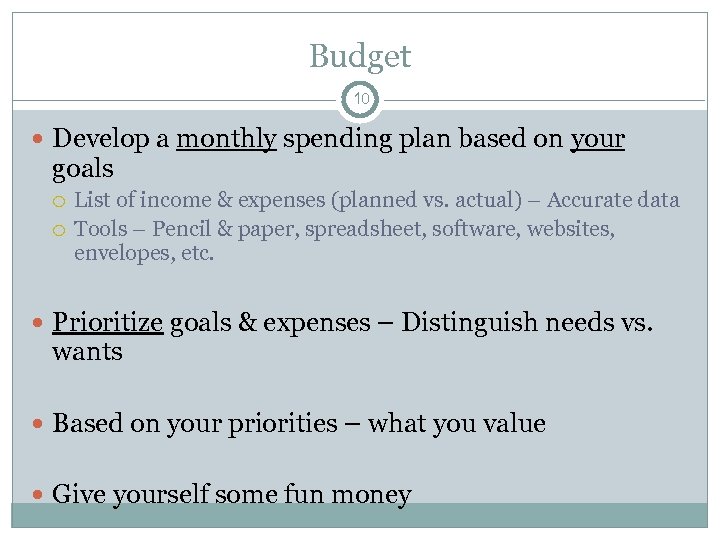
Budget 10 Develop a monthly spending plan based on your goals List of income & expenses (planned vs. actual) – Accurate data Tools – Pencil & paper, spreadsheet, software, websites, envelopes, etc. Prioritize goals & expenses – Distinguish needs vs. wants Based on your priorities – what you value Give yourself some fun money
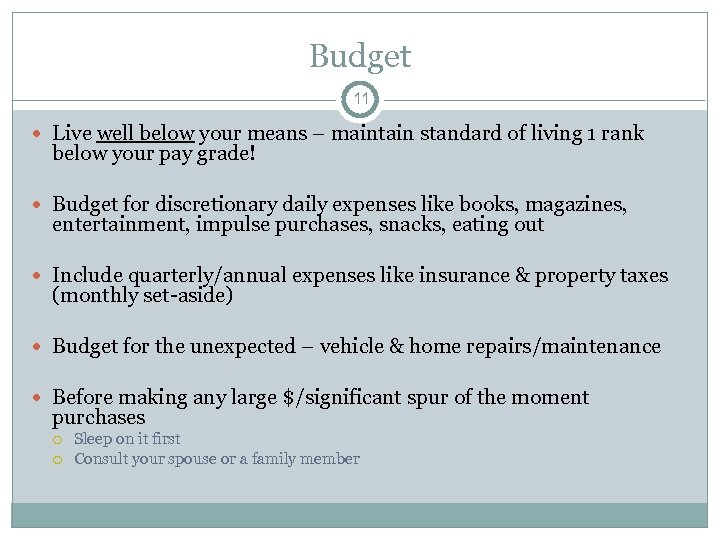
Budget 11 Live well below your means – maintain standard of living 1 rank below your pay grade! Budget for discretionary daily expenses like books, magazines, entertainment, impulse purchases, snacks, eating out Include quarterly/annual expenses like insurance & property taxes (monthly set-aside) Budget for the unexpected – vehicle & home repairs/maintenance Before making any large $/significant spur of the moment purchases Sleep on it first Consult your spouse or a family member
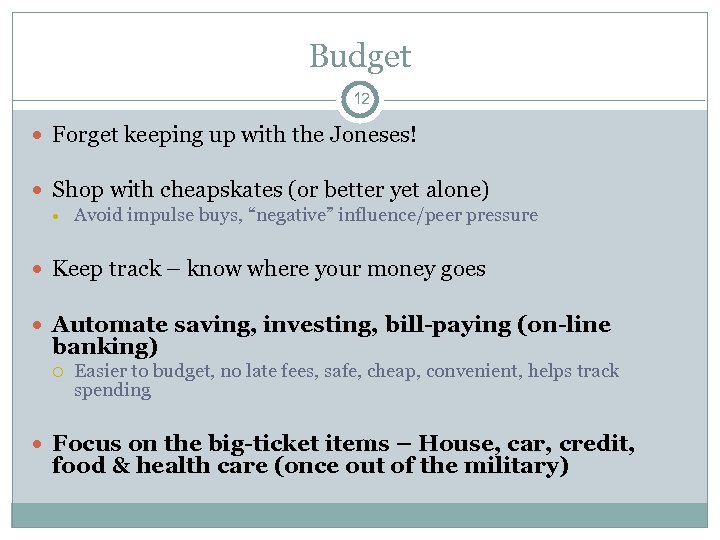
Budget 12 Forget keeping up with the Joneses! Shop with cheapskates (or better yet alone) Avoid impulse buys, “negative” influence/peer pressure Keep track – know where your money goes Automate saving, investing, bill-paying (on-line banking) Easier to budget, no late fees, safe, cheap, convenient, helps track spending Focus on the big-ticket items – House, car, credit, food & health care (once out of the military)
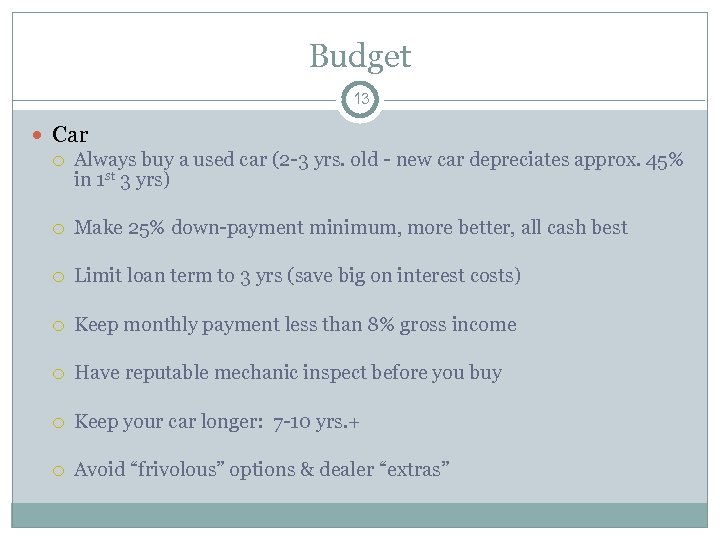
Budget 13 Car Always buy a used car (2 -3 yrs. old - new car depreciates approx. 45% in 1 st 3 yrs) Make 25% down-payment minimum, more better, all cash best Limit loan term to 3 yrs (save big on interest costs) Keep monthly payment less than 8% gross income Have reputable mechanic inspect before you buy Keep your car longer: 7 -10 yrs. + Avoid “frivolous” options & dealer “extras”
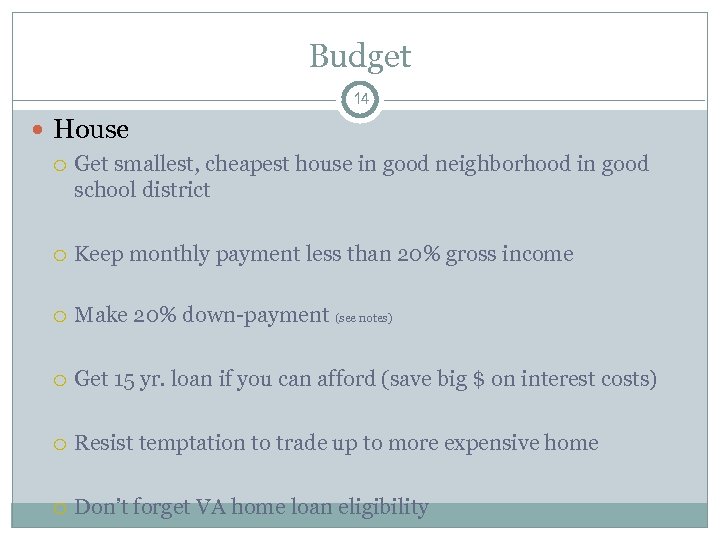
Budget 14 House Get smallest, cheapest house in good neighborhood in good school district Keep monthly payment less than 20% gross income Make 20% down-payment (see notes) Get 15 yr. loan if you can afford (save big $ on interest costs) Resist temptation to trade up to more expensive home Don’t forget VA home loan eligibility
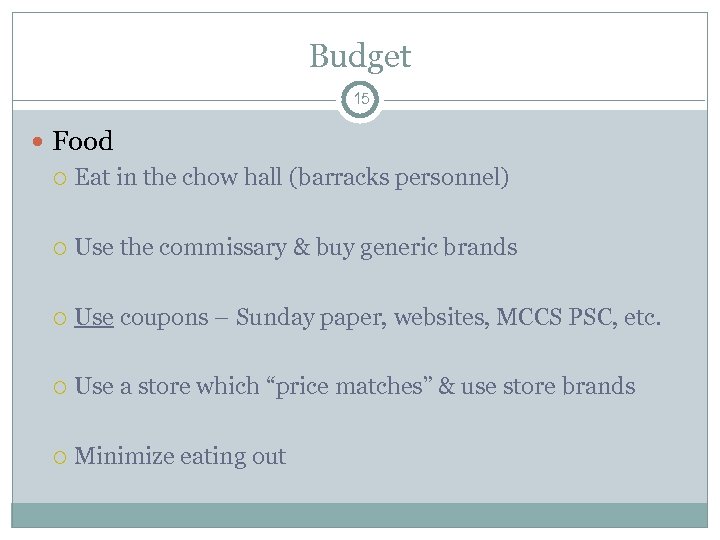
Budget 15 Food Eat in the chow hall (barracks personnel) Use the commissary & buy generic brands Use coupons – Sunday paper, websites, MCCS PSC, etc. Use a store which “price matches” & use store brands Minimize eating out
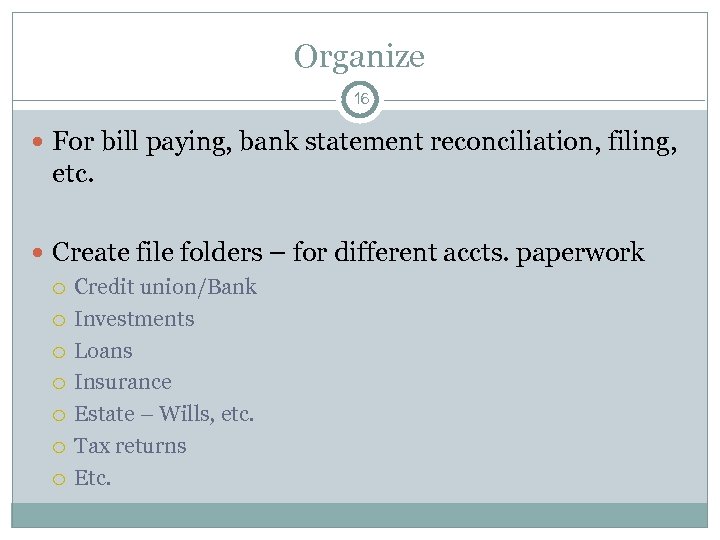
Organize 16 For bill paying, bank statement reconciliation, filing, etc. Create file folders – for different accts. paperwork Credit union/Bank Investments Loans Insurance Estate – Wills, etc. Tax returns Etc.
Organize 17 Create monthly bill summary List bills in date order to be paid (prevent missing one) Set-up “in-baskets” (bills) – if not automated (recommended) 1) 1 -15 th, 16 th-31 st 2) Folder – Bills paid, Tax receipts Balance your checkbook monthly! Check for fraudulent activity Consider consolidating accounts Credit card Bank accounts Investment accounts Simplify
Debt & Credit 18 Debt – Avoid it! Except for assets that increase in value Student loans (investing in yourself, your job) Home mortgage Borrow to invest in yourself/home – yes Borrow to consume – no Keep non-home debt less than 8% of gross income (preferably zero)
Debt & Credit 19 Debt Paying off debt (if you have “bad” debt), i. e. credit card balances, other “consumption” loans Highest interest rate card/loan first Pay maxed out credit card first - if you need a loan soon Avoid credit score decrease Don’t pay lowest-rate debt first unless Multiple, significant bills And you NEED confidence, momentum
Debt & Credit 20 Credit Have a savings and checking account Establish a “line of credit” on your checking account (alternate emergency fund) and “overdraft” protection as well Use cash for most daily spending (vice cards – credit or debit) Psychologically harder to spend it (& may save you interest $)
Debt & Credit 21 Credit Use a rewards credit card to help build credit record/credit score But pay it off in full monthly (otherwise get low-rate card) For cell phone bill for example Look for no annual fee card with at least 21 day grace period Stay under 30% of your credit card limit, preferably under 10% (debt to credit ratio) Don’t close credit card accounts – just cut up the card (decreases credit score) Use credit card occasionally to prevent closure (& score decrease)
Debt & Credit 22 Credit report (history) and credit score (prediction of whether you’ll pay) Get a credit report at least annually – annualcreditreport. com (free) Credit score affects: Applying for a job (reliability) Renting an apartment (including deposit amount) Making deposits on utilities, cell phones (lower score = higher deposit) Credit card, Car, Home & Student loan interest rates (lower score = higher rates) Car & Home insurance rates (score predictor of likelihood of filing claims) Credit score measure of how responsible you are!
Debt & Credit 23 FICO Credit Score: 300 -850 (>760 Excellent, <660 Low) Components: 35% - Payment History (Pay on time!) 30% - Amount owed (Keep under 10% of card limit) 15% - Length of credit (Longer better) 10% - New credit (Number of applications and time since applied) 10% - Type of credit (Variety, installment loans better than revolving/credit accounts) Check credit score well before taking out any large loans (i. e. house, car) Get off credit card solicitation lists 888 -567 -8688, or Optoutprescreen. com
Adequate Protection (Insurance) 24 General Property (Home/Renters, Car) Liability Death Disability Health Long-term care (LTC)
Insurance - General 25 Insurance is about risk management Insure against catastrophic losses, i. e. death, serious illness, damage to house, car accident Higher deductible = lower premiums Part of emergency fund can cover deductible as required Self-insure or insurance contract If you can’t afford to replace it, insure it
Property Insurance 26 Car Insurance – Main necessary components Bodily injury liability – to others Property damage liability – to others Collision – Fix own vehicle (from accident) Comprehensive – Fix own vehicle (from fire, theft, vandalism, etc. – Know specifics & limitations) Uninsured motorists – Your medical – many states require
Property Insurance 27 Car Insurance Check discounts for: Safety equipment Multi-policy (i. e. car, home insurance with same company) Driver education class Good student Cancel collision & comprehensive when amount annual premiums >10% of car’s value Get recommendations from others Shop around!
Property Insurance 28 Home Insurance Property & Liability coverage Replacement cost coverage better than Actual cash value (which is minus depreciation) Guaranteed or Extended Replacement cost even better Ensure adequate coverage for “possessions”
Property Insurance 29 Home Insurance Check discounts for: Multi-policy Smoke detectors Fire extinguishers Sprinkler systems Burglar alarm systems Shop around!
Liability Insurance 30 Car & Home insurance provides some protection (for you and your assets) As your net worth/assets increase (above limits in car/home policies) consider “umbrella” policy Helps address any lawsuits!
Life Insurance 31 Replace income if you die (main purpose) Who depends on your income? If no one, maybe just enough for funeral expenses If spouse/dependents, determine needs: Funeral & final expenses Mortgage balance Other debts/one-time expenses College needs Income (annual) needs – For how long? SGLI alone may not adequately address above Consider/deduct investments appropriately
Life Insurance 32 Think Term insurance – pure insurance Other life insurance (like Whole life) includes investment component Ensure no war clause in any policy
Disability & Health Insurance 33 Military basically provides disability coverage & Tricare provides for health coverage
Long-Term Care (LTC – nursing home) Insurance 34 Start thinking about in your 40 s/50 s Think about self-insuring if enough assets (>$1. 5 M) Otherwise consider some LTC insurance since 60% of those over 65 will require LTC at some point
Tax Planning 35 Adjust withholding (W-4) to claim more allowances to get bigger paychecks (to minimize refunds) Reduce income (Adjusted Gross Income – AGI) Thrift Savings Plan (TSP) contributions Traditional IRA contributions Student loan interest paid Etc.
Tax Planning 36 Take/increase deductions (If “itemized” deductions > standard deduction) Mortgage interest State & local taxes Gifts to charity Real estate taxes Personal property taxes (vehicle registr. ) Etc.
Tax Planning 37 Take applicable tax credits Earned income credit (EIC) – income limits College expenses (American Opportunity, Lifetime Learning) Child tax credit – income limits Child care tax credit Retirement Savings Contribution Credit – income limits Postpone deductions if higher tax rate next year
Tax Planning 38 Investments – Tax diversification – Paying taxes now vs. later Ex. Roth IRA – Pay taxes now Regular TSP – Pay taxes later
Saving & Investment Planning 39 Saving Save 20% of gross income (before taxes) – Pay yourself first! 10% short-term & medium-term goals (& college costs) 10% retirement Time is your ally – or your enemy (procrastinating)
Saving & Investment Planning 40 Saving Short-term savings – should be easily accessible Credit union/bank account Money Market Fund (MMF) Start with emergency fund - $1 -2 K minimum (ex. for car repairs) If family/dependents – save 3 mos. living expenses
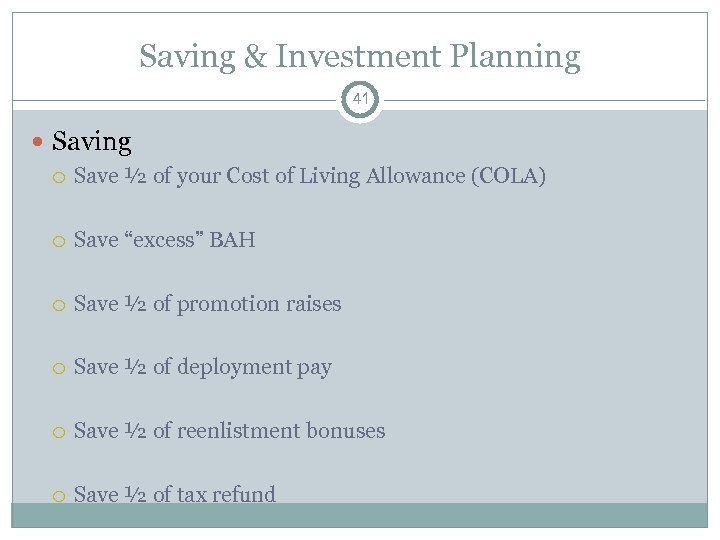
Saving & Investment Planning 41 Saving Save ½ of your Cost of Living Allowance (COLA) Save “excess” BAH Save ½ of promotion raises Save ½ of deployment pay Save ½ of reenlistment bonuses Save ½ of tax refund
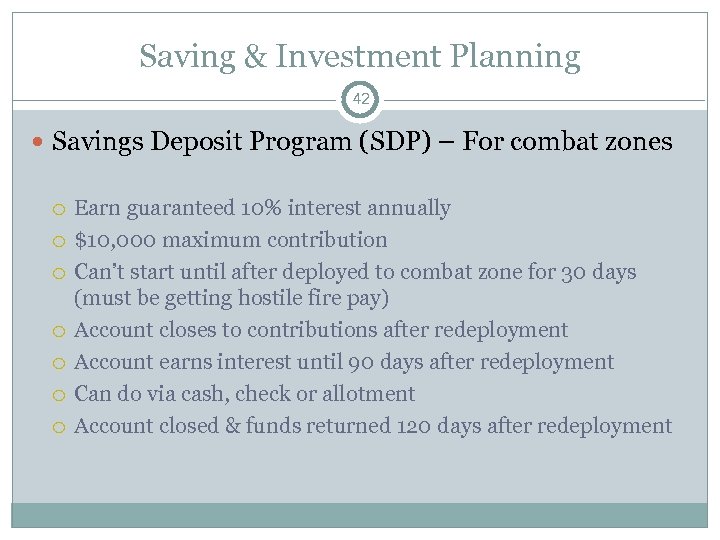
Saving & Investment Planning 42 Savings Deposit Program (SDP) – For combat zones Earn guaranteed 10% interest annually $10, 000 maximum contribution Can’t start until after deployed to combat zone for 30 days (must be getting hostile fire pay) Account closes to contributions after redeployment Account earns interest until 90 days after redeployment Can do via cash, check or allotment Account closed & funds returned 120 days after redeployment
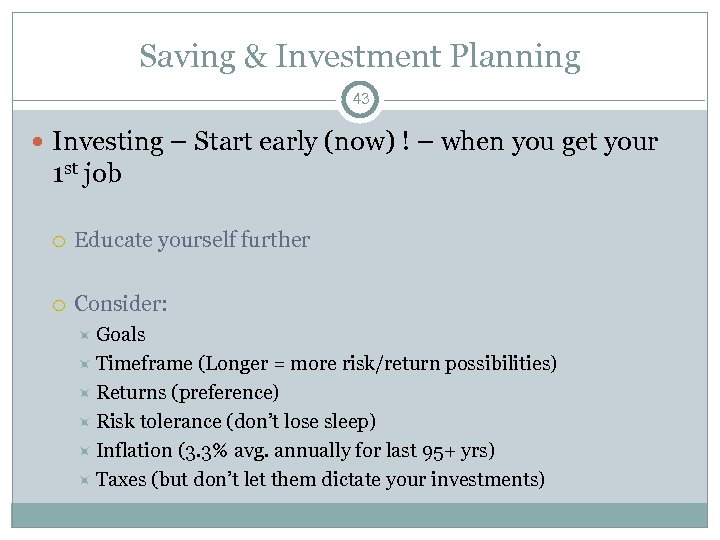
Saving & Investment Planning 43 Investing – Start early (now) ! – when you get your 1 st job Educate yourself further Consider: Goals Timeframe (Longer = more risk/return possibilities) Returns (preference) Risk tolerance (don’t lose sleep) Inflation (3. 3% avg. annually for last 95+ yrs) Taxes (but don’t let them dictate your investments)
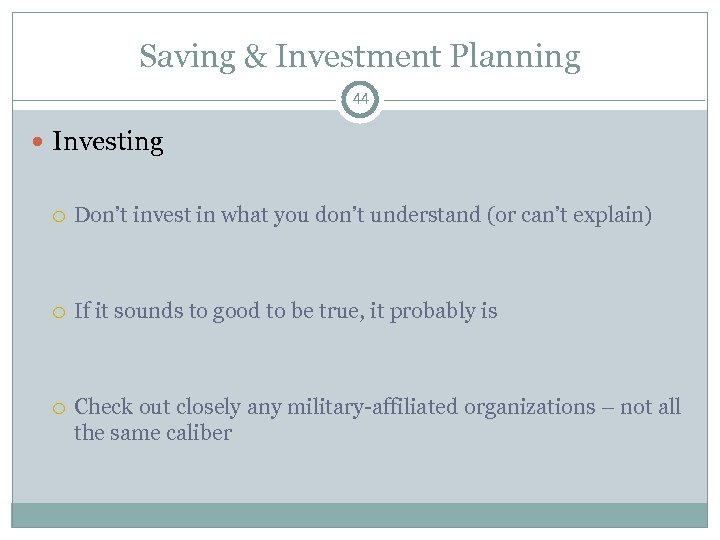
Saving & Investment Planning 44 Investing Don’t invest in what you don’t understand (or can’t explain) If it sounds to good to be true, it probably is Check out closely any military-affiliated organizations – not all the same caliber
Saving & Investment Planning 45 Investing Allocate investments across primary asset classes Stocks – Ownership of a company (via shares) Bonds – Lending money to an organiz. (commercial/govt. for specific period at fixed interest rate) Cash Other – Commodities (i. e. gold, oil), real estate, etc.
Saving & Investment Planning 46 Investing Diversify fully within asset classes Ex. Stocks – Small, Medium, Large, Growth, Value, Foreign companies, etc. Bonds – Corporate, Government, Mortgage-backed, etc.
Saving & Investment Planning 47 Investing Mutual Funds – Collection of stocks and/or bonds Index funds – Fund which tracks a particular market index (i. e. Dow Jones Industrial Average - DJIA, S&P 500) Actively managed funds Load funds – Fund with sales charges or commission (avoid) No-Load funds – Funds with no sales charges/commission Exchange-Traded Funds (ETF) – Similar to index fund, but trade like a stock on an exchange (price changes throughout day)
Saving & Investment Planning 48 Investing Select investments rationally (vice emotionally) For mutual funds, consider: Fund’s objective (Capital appreciation, income, both) Long-term performance (5 yrs. +) Manager tenure (longer better) Low expenses Low portfolio turnover (less taxes) Volatility/risk
Saving & Investment Planning 49 Investing Boring is usually better! ETFs/Index Funds (outperform majority of actively managed funds) ETFs – Use only company which doesn’t charge commissions
Saving & Investment Planning 50 Investing Reduce expenses & control/diversify taxation Minimum Taxable goal: <1% expenses for stock funds, . 5% for bond funds accounts – For index funds & ETFs Tax-sheltered accounts – For taxable bonds, actively managed stock mutual funds, & commodity funds (generate more taxes) Automate investments (monthly) – Dollar cost average
Saving & Investment Planning 51 Investing Short-term goals (1 -3 yrs. ) High interest savings accts. Money Market Account (MMA) – Credit unions, banks Money Market Fund (MMF) – Mutual fund companies, brokerages Certificates of Deposit (CDs) – Short-term
Saving & Investment Planning 52 Investing Medium term goals (3 -7 yrs. ) Bond index funds Treasury notes Corporate (short-term) Mortgage backed
Saving & Investment Planning 53 Investing Long-term goals (College for kids) New Post-9/11 G. I. Bill – Transfer Eligibility “ 529” College Savings Plans – State-sponsored Age-based plan Normally limited number of stock/bond mutual fund choices Investments grow tax deferred Withdrawals for college tax-free Some states offer tax deduction for contributions or income exemption on withdrawals Donor controls $, not beneficiary High $ contribution limits
Retirement Planning 54 Individual Retirement Accounts (IRAs) – Savings acct. with tax breaks “Basket” for stocks, bonds, mutual funds, CDs, etc.
Retirement Planning 55 Roth IRA $5 K contribution limit annually (2012) – With after tax $ +$1 K if 50+ No required minimum distributions (RMD) at 70 ½ - heirs can inherit tax-free Withdraw contributions tax-free and earnings tax-free (after 59 ½) Income limits ($110 K/$173 K – 2012) – but can contribute to traditional IRA then convert to Roth IRA
Retirement Planning 56 Roth IRA – Consider low cost ETF or index mutual fund Lifecycle (Target-date retirement) funds Automatically rebalances asset allocation over time – from more stocks to less stocks, & less bonds to more bonds Automate monthly investments
Retirement Planning 57 Maximize Roth IRA first, then TSP If you expect your tax bracket to increase by the time you retire & withdraw funds OR Use traditional IRA (vice Roth), then TSP If you qualify for deduction (income limits $58 K/92 K - 2012) & you NEED financial boost now
Retirement Planning 58 Thrift Savings Plan (TSP) Government retirement savings plan (401 K-like) Defined contribution plan (vs. defined benefit plan like military pension) Before tax contribution & tax deferred investment earnings Taxed as ordinary income when withdrawn (higher tax rates) Ultra-low expenses $17, 000 contribution limit (2012) - +$5, 500 if 50+
Retirement Planning 59 Thrift Savings Plan (TSP) Think “L” (Lifecycle) funds Automatically rebalances asset allocation over time – from more stocks to less stocks, & less bonds to more bonds L 2050 Fund – Starts at 90% stocks, 10% bonds • By 2050, has 20% stocks, 80% bonds
Retirement Planning 60 Roth TSP coming – in June 2012 Like Roth 401 K Contribute after-tax funds $17 K maximum contribution (2012) Tax-free earnings after 59 ½ Must begin required minimum distributions at 70 ½ Save 10% in retirement (long-term) accts. total – Use low cost ETF/index funds if & when IRA & TSP maxed out
Retirement Planning 61 *Saving & investing $200/month at 7% interest rate
Retirement Planning 62 Keep your hands off retirement $ until retirement! Forfeit $ growth potential & compounding Premature taxes 10% withdrawal penalty (some exceptions) By age 40 (if not before) start working to determine potential monthly retirement expenses One benchmark - Retire with 20 times annual expenses that are NOT covered by pension or social security
Estate Planning 63 Disposing of assets after death/other matters Will – Get one (if don’t already have) – include guardian designation for kids Durable (financial) Power of Attorney (POA) – Someone to manage your financial affairs if you’re incapacitated
Estate Planning 64 Disposing of assets after death/other matters Medical POA – Someone to make health care decisions if you’re incapacitated Living Will – Decide on artificial measures (life support, etc) to sustain life when near death GO TO LSSS!
Execute (the plan)! 65 Implement your plan! Willpower & Stamina Discipline Patience Perseverance Assistance – if/when required Read, do some research Just do it!
Monitor/Reassess 66 Review at least annually! Adjust as necessary based on: Financial situation changes Goal changes Personal situation changes (marriage, children, etc. ) Tax law changes Review asset protection Measure investment performance Review income tax reductions Retirement plan re-examination
Summary 67 Determine your starting point Decide on your goals Develop a budget Get organized Avoid debt Use credit responsibly Insure yourself & your assets adequately Minimize taxes Save 20% of your gross income Invest wisely Maximize contributions to IRA, TSP & other tax efficient investments Get your estate documents in order
Resources (some) 68 Books Your Money or Your Life (Vicki Robin & Joe Dominguez) All Your Worth: The Ultimate Lifetime Money Plan (Elizabeth Warren & Amelia Tyagi) The Four Pillars of Investing (William Bernstein) Personal Finance Magazines Money Kiplinger Personal Finance Smart. Money MCCS Personal Financial Managers (PFMs)
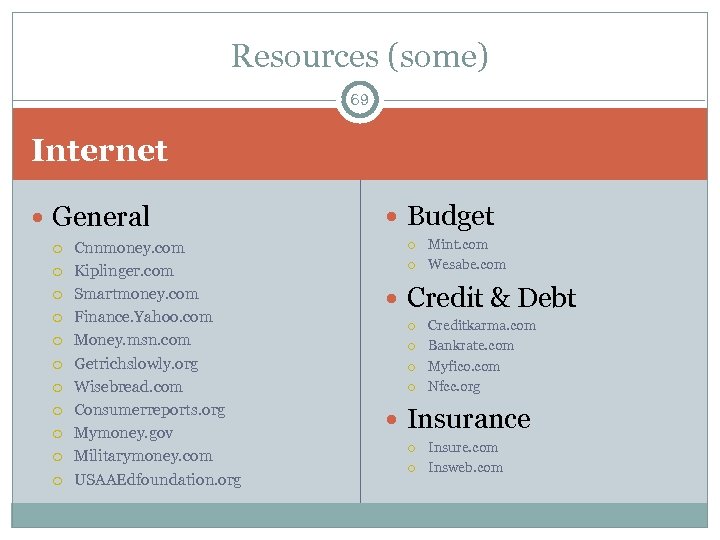
Resources (some) 69 Internet General Cnnmoney. com Kiplinger. com Smartmoney. com Finance. Yahoo. com Money. msn. com Getrichslowly. org Wisebread. com Consumerreports. org Mymoney. gov Militarymoney. com USAAEdfoundation. org Budget Mint. com Wesabe. com Credit & Debt Creditkarma. com Bankrate. com Myfico. com Nfcc. org Insurance Insure. com Insweb. com
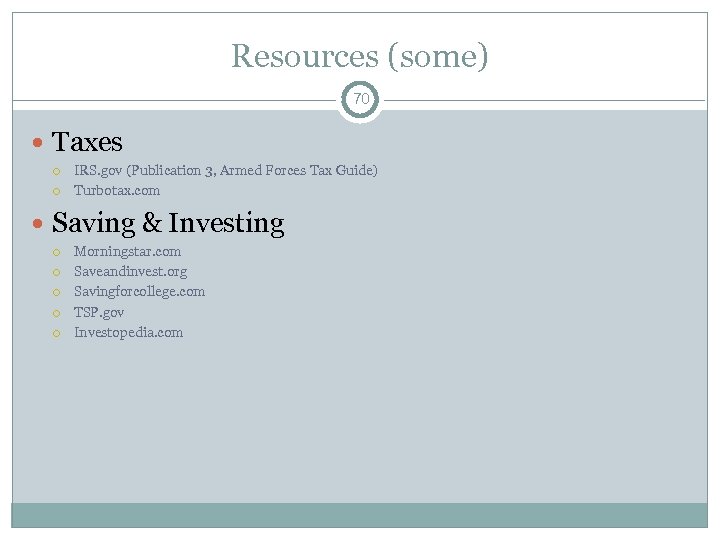
Resources (some) 70 Taxes IRS. gov (Publication 3, Armed Forces Tax Guide) Turbotax. com Saving & Investing Morningstar. com Saveandinvest. org Savingforcollege. com TSP. gov Investopedia. com
Скачать презентацию Personal Finance Basics 1 FOR MILITARY PERSONNEL Lt
72712103d43b43bd42263e259a673ea9.ppt