


 Скачать презентацию Personal Finance Another Perspective The Auto Decision Updated
b9aa5ff15873bfd5b56628c94dceebe5.ppt
- Количество слайдов: 88
 Personal Finance: Another Perspective The Auto Decision Updated 2017 -01 -31 1
 Objectives A. Understand the principles of effective car ownership B. Understand key issues of car ownership C. Understand how to buy or lease a new vehicle D. Understand the lease versus buy decision E. Understand how to buy a used car F. Understand how to develop an effective auto strategy 2
 Your Personal Financial Plan • Section XV: Your Auto Decision Plan • What is your current transportation strategy? (use auto template TT 01 -15 Auto Home Mission Strategy) • What auto(s) are you currently driving? • What expenses and fees are you paying, including gas, maintenance, repair and insurance? • Action Plan: • What is your auto strategy? • This may include: how often you will get a new vehicle, new versus used, cash versus debt, negotiation strategies, strategies for warranties, how long you will keep the vehicles, etc.
 A. Understand the Principles of Effective Car Ownership • What is the purpose of autos? • Most important reasons • It’s a means of transportation • You have saved for it • It may be used in your work • It is within your budget and you can afford it • Less important reasons • It’s fun to drive • It’s fast • It makes a statement about your lifestyle (as if you care)
 Principles of Auto Ownership (continued) • What are the principles of effective ownership? 1. Understand yourself, your goals, vision, values and budget 2. Understand the vehicle purpose. Is it a tool to achieve other goals or a goal in itself? 3. Make your vehicle fit your budget, and not vice versa 4. Understand minimize costs, for purchase, fuel, repair, taxes, insurance, depreciation, and resale • Get “good” help to buy, insure, and maintain your vehicle (oil changes, tires, maintenance, etc. ) to minimize costs • Pay cash (if possible) and set a goal from here on out to always pay cash for your vehicles 5. Be a wise steward over your resources. This means to minimize all costs over the car’s effective life
 Principles of Auto Ownership (continued) • What additional things should you know/do before buying/leasing a vehicle? • Do your homework. Make sure it is what you want • Find what the seller paid for the vehicle. Find the invoice price if new and Blue Book/NADA if used • Start negotiations from invoice/conservative blue book price. Start low and work up • Remember there are better times to buy than others. Best are the end of month, quarter, and year-end • Realize everything is negotiable. This includes options, extended warranties, etc. —a car is a commodity
 B. Understand Key Issues in Auto Decisions • There a number of important topics to understand before we discuss buying or leasing new or used vehicles. These include: 1. Choosing a vehicle • Goals and Budget • Safety Reports • Automobile Reports • Insurance 2. Before You Go Looking • New/Used Vehicle Prices • Holdback • Warranties • Service Contracts • Lemon Laws 3. After You Have Found It • Vehicle History • Checked by a Mechanic • Maintenance records
 1. Choosing a Vehicle: Your Goals and Your Budget • Know your goals and your budget • Have you written down your goals? • Are you living on a budget? • If you are planning to finance the vehicle (not recommended), are there sufficient funds to cover the costs and still attain your other goals • Are you putting aside money each month to purchase another vehicle in the future
 Vehicle Ratings and Safety • Pick a vehicle that is safe for your family • Where do you find information on vehicle safety and ratings? • There a number of good sites. A good place to start is the National Highway Traffic Safety Administration site at www. nhtsa. gov, safer cars at www. safercar. gov, and the Insurance Institute for Highway Safety at www. iihs. org • You get information on safety ratings, crash tests and other important information about specific vehicles
 Total Automobile Costs • Pick a vehicle with a strong safety and repair record • If the vehicle has a reliable record, there is a better chance you will not have unforeseen expenses • Where do you find safety and repair information? • You can find good information at Consumer Reports on new and used vehicles at www. consumerreports. org. • There is a lot of great information at this source on vehicles and ratings
 Insurance • Pick a vehicle that is inexpensive to insure and drive • Which vehicles are more expensive to insure? • The Insurance Services Office (ISO) rates each vehicle on its loss history, with a number between 3 and 27. • The higher the number, the more expensive the coverage • Sports cars, high performance cars, and even SUV’s are more expensive to insure • Which vehicles are more expensive to drive? • Check the miles per gallon in the city and highway
 2. Before You Go Looking: New versus Used Prices • Your choice of new versus used vehicles will depend on three areas: • Goals, preferences, and available budget • New Vehicles • Advantages • New vehicle and all that goes with it • Lower maintenance costs • Car may last longer (it is not used) • Disadvantages • Higher initial vehicle costs • Higher insurance costs • May limit other goals if spend too much
 New versus Used Decision (continued) • Used Vehicles • Advantages • Lower initial vehicle costs • Lower insurance costs • May provide additional resources for other goals due to lower costs • Disadvantages • Higher maintenance costs • Will likely have to replace it sooner than new car
 New Vehicle Prices • Know what the dealer paid for the vehicle • Where can you get reliable estimates for new vehicle prices? • There a number of automobile websites where you can get great estimates of what the dealer paid from the manufacturer, i. e. , www. edmunds. com, www. autosite. com, or www. kbb. com. • Put in the manufacturer, model, and options and you can get the invoice price • Negotiations should begin at the invoice price
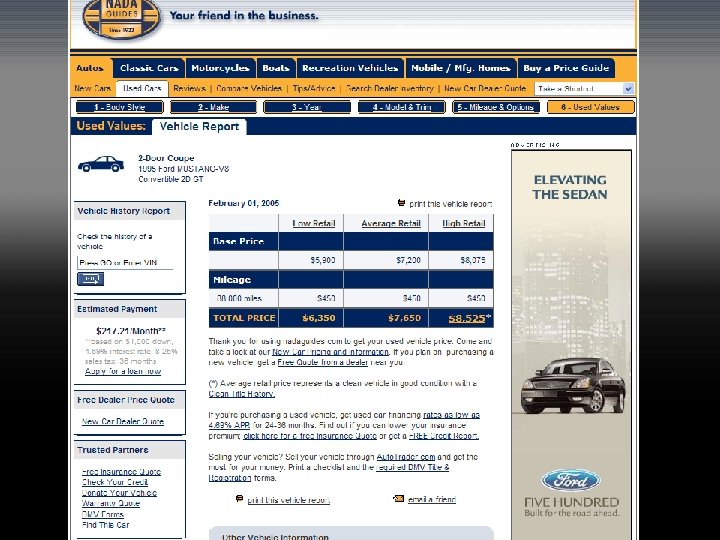
 Used Vehicle Prices • Know the price range for the used vehicle you are looking at (good to excellent condition) • Where do you find information on used car prices? • You can generally find the same information on used cars, just as you do new cars. Key sources include www. edmunds. com, www. autosite. com, www. kbb. com, www. nada. com or www. vehix. com. • Know which guides are used in your area, i. e. Nada versus Kelly Blue Book
 Holdback • Know the dealer Holdback • What is a holdback? • The holdback is a rebate to the dealer to compensate the dealer for holding the vehicle on his lot. Information on holdback is found at many different sources, including: http: //www. edmunds. com/advice/incentives/hol dback/ • Why is this important? • It is important for you to realize that even when the dealer sells a vehicle at this cost, he is still making money
 Warranties • Know the warranty and period • What are warranties? • Warranties are assurances that goods are as promised and that any problems will be resolved • What are full warranties? • Full warranties are contracts that require: • 1. Product will be fixed at no cost to the buyer within a specified time • 2. Owner will not have to undertake unreasonable tasks to return the product • 3. Defective product will be replaced or money returned if it cannot be fixed
 Service Contracts • Know available service contracts and providers • What are service contracts? • Agreements between the contract seller (dealer, manufacturer, etc. ) to provide free (or with a deductible) repair services to covered components specified length of time or mileage after the original warranties are over. What should you be concerned about? • Contract terms: Items covered (power-train), length of coverage (i. e. , 5 years), and mileage Contract seller: Who stands behind it. Generally service contracts from the manufacturer are better as you can get service nation-wide
 Lemon Laws (Consumer Protection) • Know your rights as a consumer • What are lemon laws? • Laws established to protect the consumer in case the vehicle purchased is a “lemon” • How do you know if you have a lemon? • You are still having problems, and you have made: • 4 attempts to fix the problem, and • The car was out of service at least 30 days during the first 12 months or 12, 000 miles • Take the car back and either get another car or your money back
 3. After You Have Found It: Vehicle History • Get a vehicle history report • What is a vehicle history report? • It is a record of each and every time the vehicle was registered with a different owner in the records of the state • How can you get a copy of a vehicle history? • You can go to www. carfax. com. By putting in the Vehicle Identification Number (VIN), you can get a report as to the ownership and location of a vehicles history.
 Inspection by a Good Mechanic • Get the vehicle checked by a qualified mechanic • How do you get it checked? • Take it to a qualified mechanic, preferably from a dealer for a major checkup • While it may cost between $80 -250, it will be worth it if they find problems
 Service Records • Review the service records of the vehicle • How do you check service records? • Sellers should have a copy of all service performed on the vehicle • Consumers should keep a record of all service performed • Dealers, oil change places, etc. , often have records of when service was performed • Vehicles which have good service records were likely better taken care of than those without, and as such, command a higher premium
 C. Understand how to Buy or Lease a New Vehicle • General Guidelines (the process): 1. Know the terminology 2. Narrow your choices and pick your vehicle 3. Determine your total price and negotiate for it 4. Determine how to finance the purchase (lease or buy) 5. Enjoy your purchase and keep it well maintained
 1. Know the Terminology • MSRP • Manufacturers hoped for price • Capitalized cost • Your agreed to or negotiated cost • Capitalized cost reduction • Any reductions in cap. cost, such as rebates, down payment, dealer incentives, trade-in, etc. • Net capitalized cost (also called adjusted capitalized cost) • Capitalized cost less capitalized cost reduction • Residual value • Expected value of the vehicle at term end • Lease term • The number of months the vehicle is leased
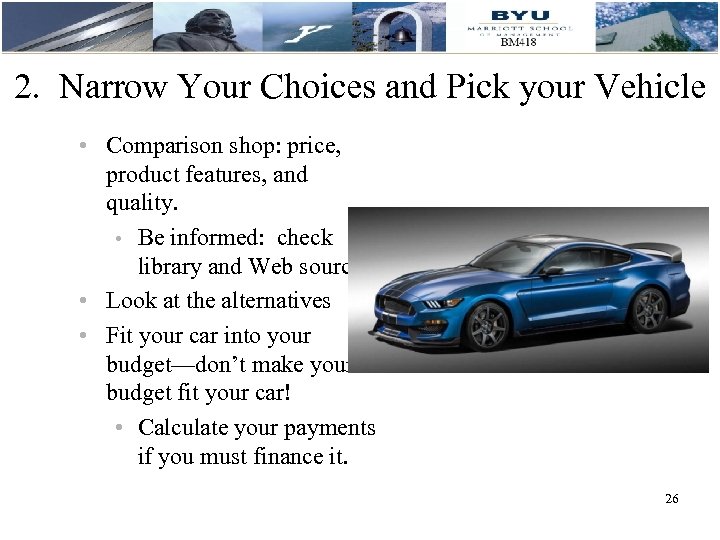 2. Narrow Your Choices and Pick your Vehicle • Comparison shop: price, product features, and quality. • Be informed: check library and Web sources. • Look at the alternatives • Fit your car into your budget—don’t make your budget fit your car! • Calculate your payments if you must finance it. 26
 Narrow and Pick (continued) • Do your comparison shopping (via the internet or other publications) • • • Compare price Compare features Compare quality • Determine what is available in your price range. • Test-drive the exact vehicle you are considering.
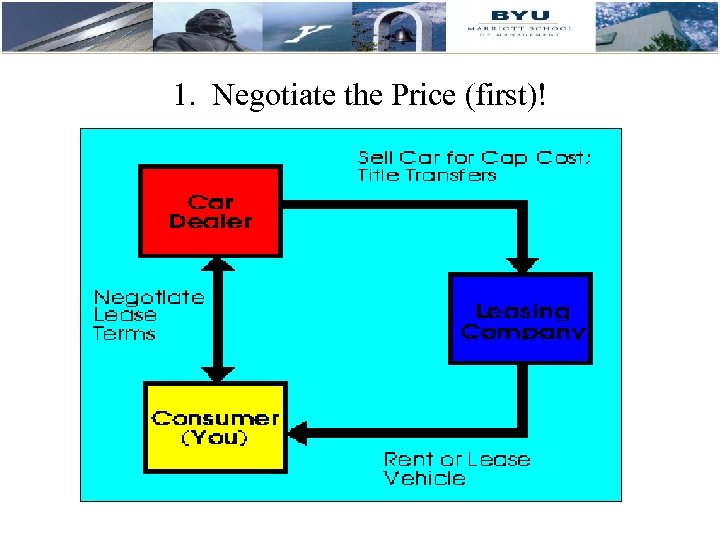
 3. Determine your Total Price and Negotiate for It (Capitalized Cost) • Before you begin negotiations • Determine how much you can spend • Identify the car(s) you are interested in • Do your homework and find the dealer’s cost plus any: • Rebates • Holdback from manufacturer • Total markup • MSRP & dealer invoice üwww. autosite. com, www. edmund. com
 Negotiating (continued) • Start negotiations at dealers invoice • If they won’t share it, go someplace that will! • Both the major dealers in the area were willing to share their invoices • Often invoice plus $100 -500 will work • Dealer inventory often impacts difference between invoice and MSRP (demand & supply) • Date often affects dealers willingness to deal • End of month and end of year are particularly good times to buy • Tell them that you will not force them to take your money!
 4. Make Your Purchase (buy or lease) • Here is where the lease versus buy decision comes into play • With buying • Determine the term of the loan and find the most attractive rate • Go with dealership financing only if they can beat the best rate other places • Ideally, get approved for the financing before you go shopping for the vehicle 30
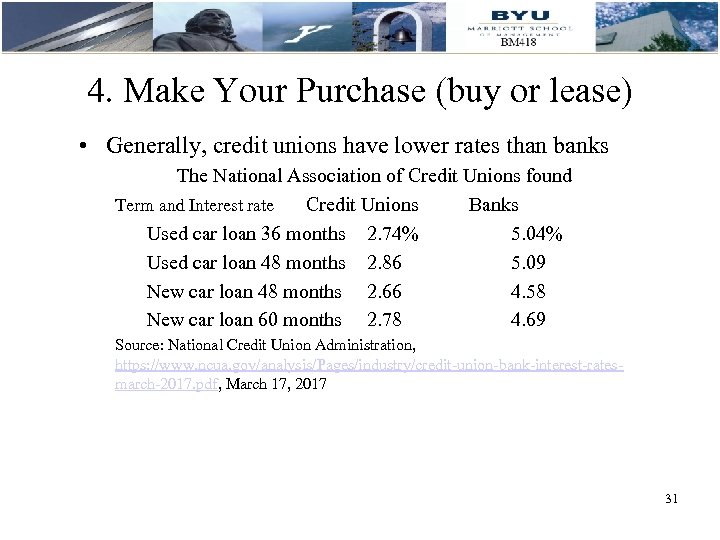 4. Make Your Purchase (buy or lease) • Generally, credit unions have lower rates than banks The National Association of Credit Unions found Term and Interest rate Credit Unions Banks Used car loan 36 months 2. 74% 5. 04% Used car loan 48 months 2. 86 5. 09 New car loan 48 months 2. 66 4. 58 New car loan 60 months 2. 78 4. 69 Source: National Credit Union Administration, https: //www. ncua. gov/analysis/Pages/industry/credit-union-bank-interest-ratesmarch-2017. pdf, March 17, 2017 31
 5. Maintain Your Purchase • Read the owner’s manual and perform regular maintenance • Particularly do oil changes every 3 -5, 000 miles • Don’t ignore warning signals. • You do at your peril! • Choose a good garage; check training and experience 32
 Questions • Any questions on general guidelines on buying a new vehicle?
 D. Understand the Challenges of Leasing and How to Calculate Lease Costs • 10 Challenges of leasing: • • • 1. Generally costs more due to higher finance costs 2. Once in the habit, payments go on forever 3. Fixed allotment of miles, costs to go over 4. Must maintain vehicle in good condition 5. At the end of contract you do not own the car 6. There are lots of extra fees 7. Dealerships make a lot of money off you 8. Leasing profits may be hidden 9. Early termination penalties and fees 10. Other leasing risks
 1. Negotiate the Price (first)!
 2. Select the Lease Term (the Schedule) Table 1: 36
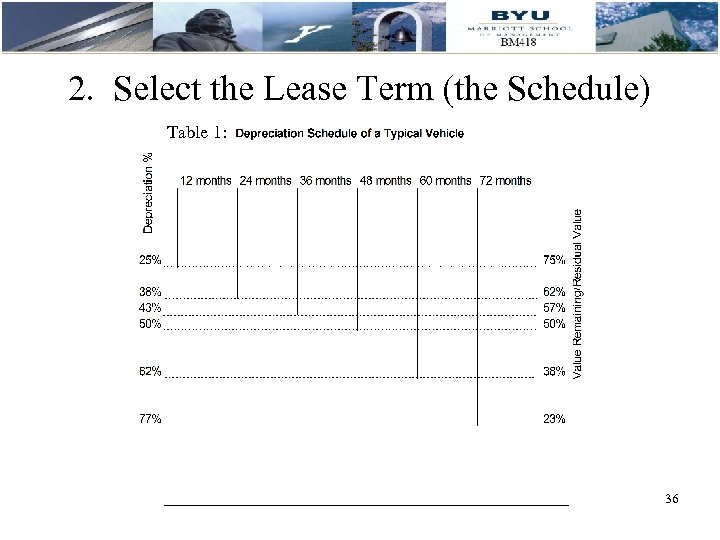
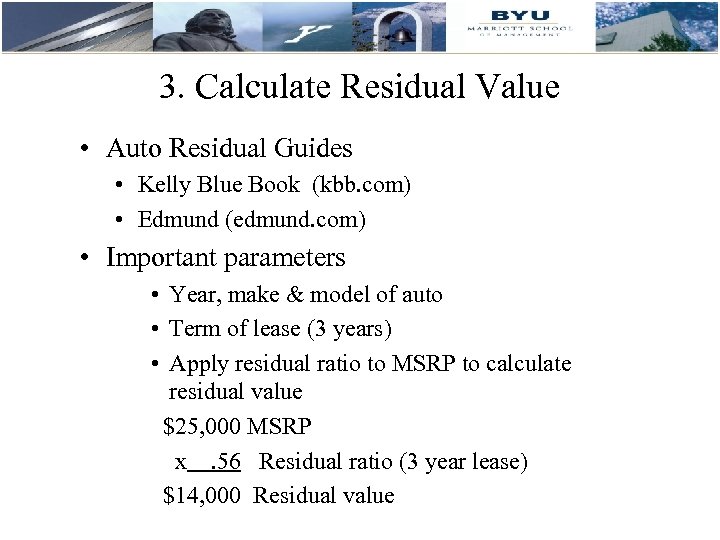 3. Calculate Residual Value • Auto Residual Guides • Kelly Blue Book (kbb. com) • Edmund (edmund. com) • Important parameters • Year, make & model of auto • Term of lease (3 years) • Apply residual ratio to MSRP to calculate residual value $25, 000 MSRP x . 56 Residual ratio (3 year lease) $14, 000 Residual value
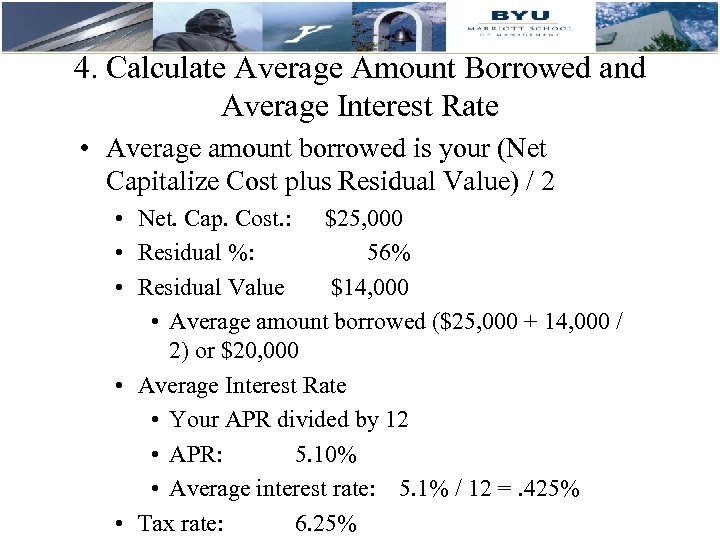 4. Calculate Average Amount Borrowed and Average Interest Rate • Average amount borrowed is your (Net Capitalize Cost plus Residual Value) / 2 • Net. Cap. Cost. : $25, 000 • Residual %: 56% • Residual Value $14, 000 • Average amount borrowed ($25, 000 + 14, 000 / 2) or $20, 000 • Average Interest Rate • Your APR divided by 12 • APR: 5. 10% • Average interest rate: 5. 1% / 12 =. 425% • Tax rate: 6. 25%
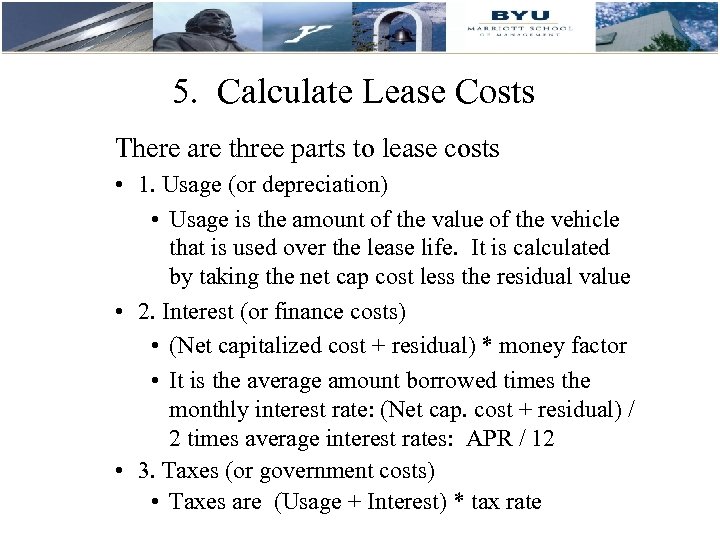 5. Calculate Lease Costs There are three parts to lease costs • 1. Usage (or depreciation) • Usage is the amount of the value of the vehicle that is used over the lease life. It is calculated by taking the net cap cost less the residual value • 2. Interest (or finance costs) • (Net capitalized cost + residual) * money factor • It is the average amount borrowed times the monthly interest rate: (Net cap. cost + residual) / 2 times average interest rates: APR / 12 • 3. Taxes (or government costs) • Taxes are (Usage + Interest) * tax rate
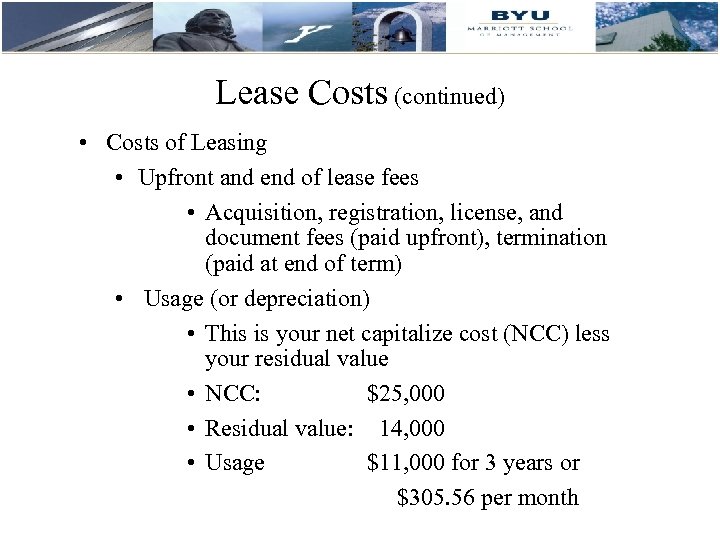 Lease Costs (continued) • Costs of Leasing • Upfront and end of lease fees • Acquisition, registration, license, and document fees (paid upfront), termination (paid at end of term) • Usage (or depreciation) • This is your net capitalize cost (NCC) less your residual value • NCC: $25, 000 • Residual value: 14, 000 • Usage $11, 000 for 3 years or $305. 56 per month
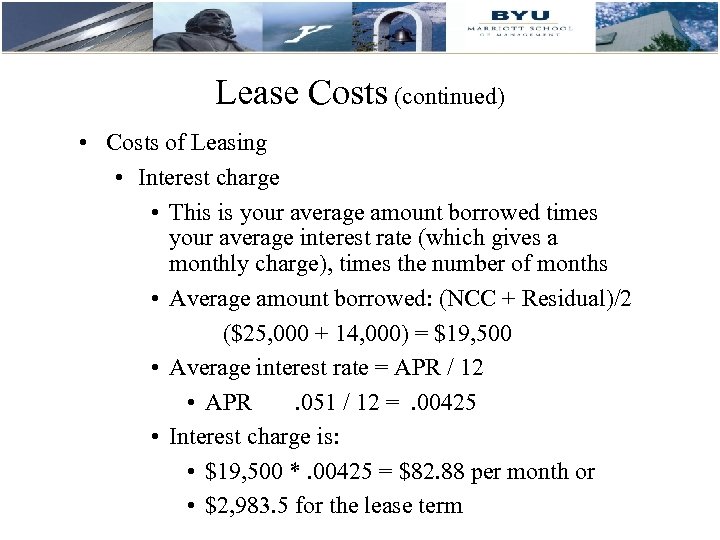 Lease Costs (continued) • Costs of Leasing • Interest charge • This is your average amount borrowed times your average interest rate (which gives a monthly charge), times the number of months • Average amount borrowed: (NCC + Residual)/2 ($25, 000 + 14, 000) = $19, 500 • Average interest rate = APR / 12 • APR. 051 / 12 = . 00425 • Interest charge is: • $19, 500 *. 00425 = $82. 88 per month or • $2, 983. 5 for the lease term
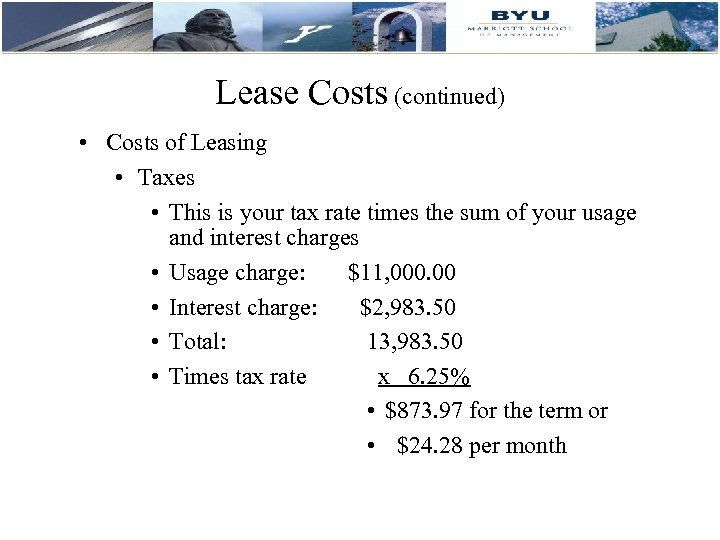 Lease Costs (continued) • Costs of Leasing • Taxes • This is your tax rate times the sum of your usage and interest charges • Usage charge: $11, 000. 00 • Interest charge: $2, 983. 50 • Total: 13, 983. 50 • Times tax rate x 6. 25% • $873. 97 for the term or • $24. 28 per month
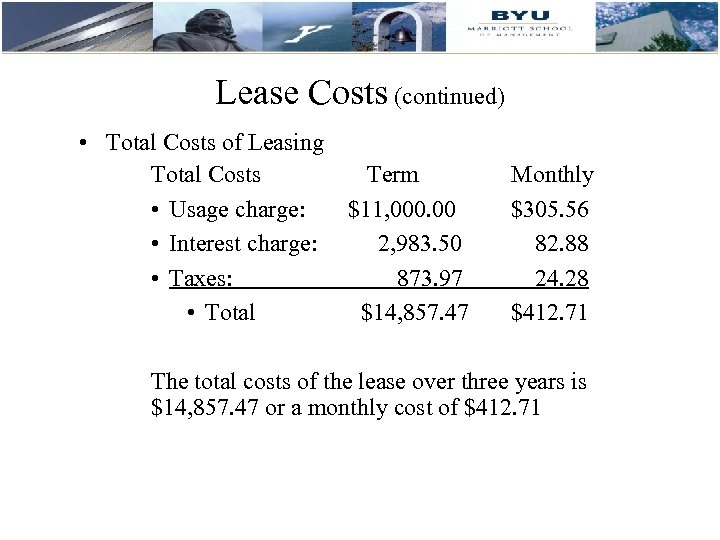 Lease Costs (continued) • Total Costs of Leasing Total Costs Term Monthly • Usage charge: $11, 000. 00 $305. 56 • Interest charge: 2, 983. 50 82. 88 • Taxes: 873. 97 24. 28 • Total $14, 857. 47 $412. 71 The total costs of the lease over three years is $14, 857. 47 or a monthly cost of $412. 71
 Questions • Any questions on the challenges of leasing and calculating lease costs?
 D. Buying A Used Automobile • Key questions to ask on buying a used car: • 1. Can I afford this car? • Will it fit into my monthly budget? Is it a need? • 2. Does it meet my current driving needs? • What type of driving you do? Shop for a car that meets your driving patterns • 3. Will it meet my future needs? • Consider how you will feel about this car a year or two from now. Will your family be growing? • 4. Does it meet my preferences? • Gas mileage, sedan/SUV/truck, 2 -door/4 -door, safety?
 Getting the Best Deal • The cost of a vehicle is based on its reliability, performance and popularity • • Of course you want a car that is reliable and performs well. But do you want the same used car everyone else wants? • If so, you will pay a premium for it. In some cases, the only difference is the nameplate • Check reliability at consumerreports. com Check your needs versus wants!
 If You Must Finance the Car • I do not recommend financing a vehicle! • This is not a preferred method—don’t borrow • But if you must: • Get your financing approved beforehand from a credit union or other financial institution • Do not use in-house financing unless you get special deals (0% financing) or unless it is very competitive • Make sure you read the fine print completely!
 Getting Used Car Financing • If you must borrow, there are several different lenders available for funding a dealership used car loan • Banks and credit unions • This is generally the cheapest form of borrowing (after parents) • Banks will typically only finance a car that is less than five years old • Auto Dealerships. • Dealerships will consistently have the worst interest rates because they are selling you their services
 Financing a Used Car (continued) • When looking for a lender, it is also important to consider the maximum length of the loan • • The good news is that most banks have 60 -month programs for late used models However, the older the vehicle, the less likely it will sustain for a full 60 months • In general, the older the vehicle, the shorter the loan length. An older vehicle is not good collateral for a loan.
 Sources of Used Cars • The three most common places from which you can buy used cars are the following: • • • 1. Private parties • Generally the most reasonable prices, but no warranty 2. New car dealerships • Some may be backed by warranties 3. Used car lots • Run by rental car agencies. • Sometimes no haggle buying, competitive prices, and perhaps the factory warranty may still be in effect
 Locating Good Used Cars • Do your research -- leave no stone unturned • • • Ask friends, relatives (you will know more about history of vehicle) • Watch for cars with “For Sale” signs Watch newspaper classifieds, bulletin boards, etc. • Generally, closer is better Use Internet sites: • Auto. Trader. com • Classifieds 2000. com • Usedcars. com
 1. Call Before You Go See a Car • Create and use a form when calling-- ask key questions. Verify the: • The price in the ad (ask again as they may have lowered the price since the date published) • Number of miles • Number of owners • How often oil was changed (ask for receipts) • What is the blue book or recommended price • It it doesn’t fit your criteria or the seller seems uneasy answering questions, skip the visit and keep looking!
 Ask and Verify Key Information • • To verify previous owners • Use www. Carfax. com • $20 for a two month subscription • Check out every potential vehicle as to previous owners and locations via its VIN. To verify current value • Use Edmunds. com, KBB. com (Kelley Blue Book), or superpages. com • Agree as to the quality of the vehicle, i. e. excellent, good, etc. before you come to visit so you can verify a fair price
 2. Go see “The Car” • Note your first impressions • • Does the car appear to be well cared for? Examine for rust. Beware of newly painted cars, as this may be a cover-up for more serious damage Are there considerable dents, mismatched paint areas, or poorly fitting parts? Make sure there are no ripples in door panels, as this indicates previous accidents Check for body filler. Use a refrigerator magnet on suspicious spots to test for auto-body filler Look inside the car for wear and tear on the seats and pedals. Make sure it is consistent with the mileage on the odometer
 Check Out the Car in Person • Check the underside and tires • • • Look underneath for evidence of fluid leaks such as coolant (greenish), oil (black), transmission fluid (pink), or gasoline (identified by smell) Take a look at the tires. A tread that’s uneven to one side is a sign of poor alignment or balance Tires must be same size. Insist on a spare, jack, and lug wrench with the deal Check CV joint boots on either end of front axles. These are expensive to replace With 4 -wheel drive vehicles, make sure all 4 tires are the same brand, size, and type
 Check Out the Car (continued) • Check under the hood • • Look for mismatched bolts or offset paint. This may mean a front-end accident Look at the underside of the hood. A sprayed black film on the underside usually means oil leaks Examine the engine belt for wear. Use judgment as if it breaks, you will have to pay to repair it Look for leaks and other things out of place
 Check Out the Car (continued) • Perform gauge and listening tests • • Make sure no emergency gauge lights are on when the engine is running Does the car start right away? Listen for unusual noises Wipe the inner surface of the tailpipe with a rag: white or gray dust is normal. Thick, greasy soot means the car burns a lot of oil—this can be serious Most of you are not mechanics, but look for potential problems anyway
 Check Out the Car (continued) • Check the oil, brake, and transmission fluid • • Are levels ok? Take out the transmission dip stick. Does the fluid smell burned? Does it look like they just changed all the fluids? It may indicate that there is a problem Check the oil level. A low level may indicate either a leak or an owner who didn’t care much or know much about the car
 Check Out the Car (continued) • Check the shock absorbers and lights • Bounce the car up and down at each corner. (when you release it, you should not feel it bounce back more than twice) • Test all lights: brake lights, headlights, reverse lights, turn signals, etc.
 Check Out the Car (continued) • Check for play (the amount that a part can move before it engages) • • • Check for play in the steering wheel, clutch, and brakes Hold brake pedal down as far as possible for 45 seconds. If they don’t hold firm, there may be a leak Push the top of one rear tire toward the car. If it moves too much, there may be bearing problems
 3. Go for a Test Ride • Take it for a drive personally • • How does it feel? How does it fit? Evaluate the acceleration from a stop. Does it hesitate or accelerate as it should? Check engine noise, passing acceleration, hillclimbing power, braking, cornering, suspension, seat comfort Check for rattles and squeaks, interior controls, and the audio system. Play the radio, tape deck, CD player, etc.
 4. Take the Car to a Qualified Mechanic • Get a more complete inspection • • • Choose a mechanic who regularly works on these cars, generally from the dealer. Other mechanics may be only guessing as to problems • Dealers may also have the car history on their computers Have mechanic do a compression check and check for oil and fluid leaks For automatic transmissions, take the car to a transmission specialists to check out the transmission
 5. Negotiate the Deal • Notes on negotiating for a used car • • • 1. Let the sellers know you have the cash in hand. Cash does wonders for an agreement 2. Know the fair value for the car beforehand 3. Negotiate politely! • If the price is too high, have a persuasive argument to support it • a. It needs some work • b. The body or paint doesn't justify the price • c. You have seen lower prices elsewhere in the market
 Negotiate the Deal (continued) • If you just want to test their price: • • a. The car isn't exactly what you are looking for, but for a lower price you might be interested • b. The car is worth the price, but you can only afford a lower price (budgetary constraints) Make an opening offer that is low, but in the ballpark • Expect to spend an hour negotiating • Don’t be afraid to walk out if you are not getting anywhere • You don’t have to buy this car!
 Tips for Negotiating • Important Tips • • • 1. Only enter into negotiations with a salesperson you feel comfortable with and who can deal 2. Decide ahead of time how high you will go and walk out when you reach this price 3. Leave if you get tired or hungry -- don't be hurried into a decision 4. Don't be distracted by pitches for related items 5. Expect a “closer” to try to improve the deal before you reach a final price
 Closing the Deal: At a Dealership • • • The financing and insurance person will probably try to sell you a number of additional items. • Most (if not all) of these you don’t need! Review the contract thoroughly: • Ask questions about anything that dramatically increases the price. You will also be asked to provide proof of insurance before you drive away in your used car. Finally, you should inspect the car before you take possession of it • If any work is required or promised by the dealer, get it in writing in a "Due Bill. "
 Closing the Deal: Private Sale • • • Before money changes hands, make sure you will be able to register the car in your name • No registration means no deal Request the title (sometimes called the "pink slip") and have it signed over to you. • No title means no deal • One way to deal with the seller still owing money on the car is to conclude the sale at the bank where the title is held Once all of the paperwork is complete • Relax and begin enjoying your new purchase: a good used car
 6. Finance the Used Car (not recommended) • If necessary, finalize the financing from your bank or credit union • Make sure you understand exactly what you are getting into before you sign • Once you sign, you have committed yourself • Try not to get into the habit of buying cars on credit
 Funding a Person-to-Person Car Loan • There is currently only a few ways to fund a person-to -person used car loan. One is with a company called People First. • If you apply online, approval is in an hour. They then Fed. Ex you a blank check. • Regardless of which lender is chosen, it is important to know your credit score before attempting to get a loan. • If you know you have good credit, a dealer will be unable to insist that you need a higher interest rate because of your “poor” credit, and you will have greater freedom in choosing a lender with a lower interest rate
 7. Take Care of Your Car • Change the oil every 3 -5, 000 miles • • Wash and clean it often Get the recommended tune ups and care Rotate the tires every 5, 000 miles Drive it and take care of it like you want your car to last 200, 000 miles—it may!
 Addendum • Note: even if you do all the above listed things in buying a used car, there is still the chance that you will have more expenses than you had considered. • That is one of the risks of buying a used car • However, the closer you adhere to the process explained, the less likely you will have major problems in the future
 Useful Auto Websites Carfax Carfax. com Intellichoice Intelli. Choice. com Edmunds Edmunds. com Kelly Blue Book kbb. com Consumer Reports Consumerreports. org
 Questions • Any questions on the process of buying a used car?
 E. How to develop an Auto Strategy • What happens if you don’t think through the auto decision and have a strategy? • You borrow the money, so instead of earning interest you pay it • You get in the habit of buying/leasing a car on credit, so you pay interest for the rest of your life and find it difficult to fund your other important goals • It’s not in your budget or is more than you planned, so it relegates more important goals to a lesser position • You buy a new car too often, and so you pay too much for expensive depreciation, insurance and other costs
 Auto/Toy Strategy (continued) • What should your auto strategy include? • It can include a number of different areas, depending on your vision for these vehicles, your goals, and your tactical plans to achieve your vision and goals. Examples include: • Budget: Ensure the auto fits the budget, not the budget fits the auto; Budget for all costs, including purchase, fuel, maintenance, and insurance before you buy • Vehicle age: Keep your cars for 10 years or 200, 000 miles whichever comes first; buy new vehicles 1 -2 years old with less than 24, 000 miles, then buy 100, 000 extended warranty at $150 over invoice; spouse gets newer vehicle • Maintenance: Be diligent in oil changes every 3 -5, 000 miles and do the recommended maintenance • Financing: Pay cash for all vehicles; save a specific amount each month for purchase of your next vehicle
 Auto/Toy Strategy (continued) • Auto strategy example • Vision: Autos will be used for transportation; we will pay cash and take good care of them. We will keep them an extended period of time, thereby reducing overall costs. • Goal: We will buy used vehicles, keep them 10 years or 200, 000 miles, and do all recommended maintenance • Plan: We will carefully buy 1 -2 year old vehicles with < 24, 000 miles once the major depreciation is over, will do all recommended maintenance, and will set aside money each month for the purchase of our next vehicles • Constraints: We will buy a new vehicle only after we have a $1 mn net worth; and spouse gets the newer and safer car • Communication: Spouse and family will help with the process of selecting, maintaining, and cleaning the vehicles
 Auto/Toy Strategy (continued) • What are toys? • Toys are adult vehicles that are not necessary for transportation yet still may be important for individual and family recreation • These include boats, motorcycles, all terrain vehicles (ATVs), side by sides (Sx. Ss), jet skis, bikes, trailers, RVs, etc. • What happens when you don’t have an effective toy strategy? • You can spend significant amounts of resources on things that are not consistent with your personal and family goals and at the wrong time in your financial life
 Auto/Toy Strategy (continued) • What should your toy strategy include? • These could include different things, such as: • Age: Purchase good toys with available parts and keep all toys for 20 years • Maintenance: Do all required maintenance so toys will last--expect toys to last; include gas, oil, maintenance and insurance in family budget • Goal Priority: Pay cash for all toys, and only after saving 20% for your other goals • Usage: Don’t allow others to use toys unless they take good care of them so they will last your required age.
 Auto/Toy Strategy (continued) • Toy strategy example • Vision: Toys will be used for new experiences and to bring our family closer together. We will pay cash for good toys that are budgeted for and will take good care of them. We will keep them an extended period of time • Goal: Our first toys will be bikes, then tents and camping equipment, then later perhaps a small ATV for the kids. As our net worth increases, we may purchase a trailer, and move to larger ATVs consistent with our budget and savings • Plan: We will carefully buy good equipment, keep it 20 years, do all recommended maintenance, and will stay within annual budgeted amounts for toys, fuel, maintenance and insurance. • Constraints: We will buy toys only if we are reaching our savings goals. • Communication: Spouse and family will help with the process of selecting, maintaining, and cleaning the toys
 Review of Objectives A. Do you understand how a car fits into your financial plan? B. Do you understand the process of how to buy or lease a vehicle? C. Do you know how to make the lease versus buy decision? D. Do you know how to buy a used car? E. Do you know how to put together an auto/toy strategy? 80
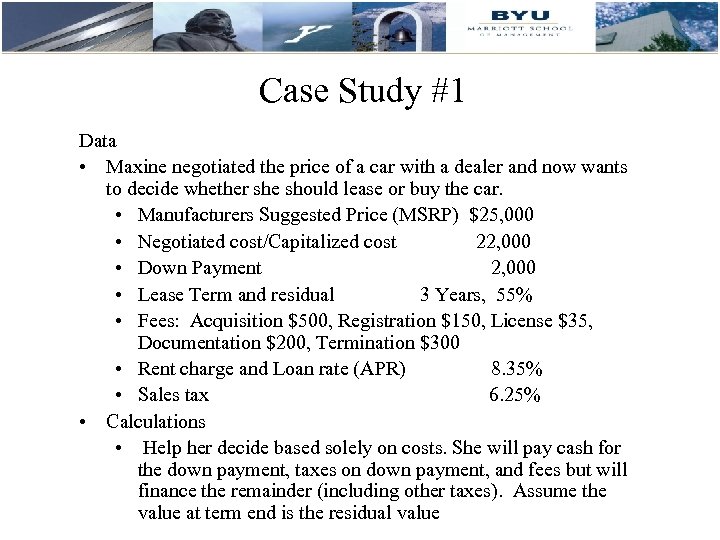 Case Study #1 Data • Maxine negotiated the price of a car with a dealer and now wants to decide whether she should lease or buy the car. • Manufacturers Suggested Price (MSRP) $25, 000 • Negotiated cost/Capitalized cost 22, 000 • Down Payment 2, 000 • Lease Term and residual 3 Years, 55% • Fees: Acquisition $500, Registration $150, License $35, Documentation $200, Termination $300 • Rent charge and Loan rate (APR) 8. 35% • Sales tax 6. 25% • Calculations • Help her decide based solely on costs. She will pay cash for the down payment, taxes on down payment, and fees but will finance the remainder (including other taxes). Assume the value at term end is the residual value
 MSRP 25, 000, Negotiated/Capitalized Cost 22, 000, Down Payment 2, 000, Lease Term and residual 3 Years and 55%, Fees: Acquisition $500, Registration $150, License $35, Documentation $200, Termination $300, Rent charge and Loan rate 8. 35%, and Sales tax 6. 25%.
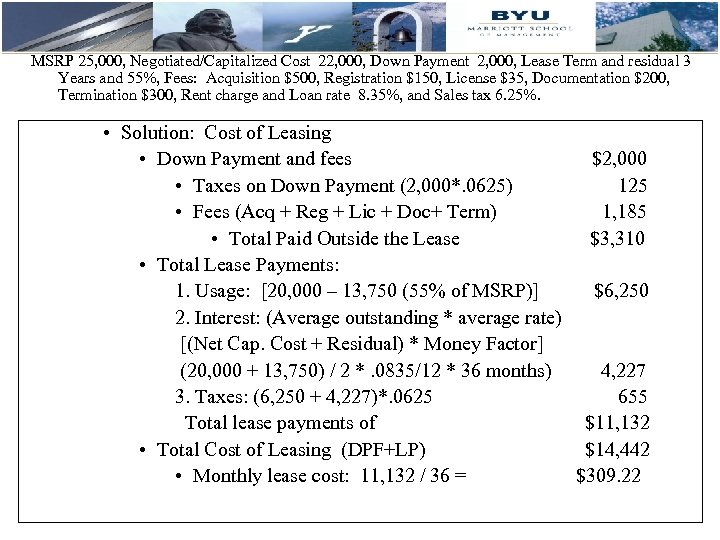 MSRP 25, 000, Negotiated/Capitalized Cost 22, 000, Down Payment 2, 000, Lease Term and residual 3 Years and 55%, Fees: Acquisition $500, Registration $150, License $35, Documentation $200, Termination $300, Rent charge and Loan rate 8. 35%, and Sales tax 6. 25%. • Solution: Cost of Leasing • Down Payment and fees $2, 000 • Taxes on Down Payment (2, 000*. 0625) 125 • Fees (Acq + Reg + Lic + Doc+ Term) 1, 185 • Total Paid Outside the Lease $3, 310 • Total Lease Payments: 1. Usage: [20, 000 – 13, 750 (55% of MSRP)] $6, 250 2. Interest: (Average outstanding * average rate) [(Net Cap. Cost + Residual) * Money Factor] (20, 000 + 13, 750) / 2 *. 0835/12 * 36 months) 4, 227 3. Taxes: (6, 250 + 4, 227)*. 0625 655 Total lease payments of $11, 132 • Total Cost of Leasing (DPF+LP) $14, 442 • Monthly lease cost: 11, 132 / 36 = $309. 22
 MSRP 25, 000, Negotiated/Capitalized Cost 22, 000, Down Payment 2, 000, Lease Term and residual 3 Years and 55%, Fees: Acquisition $500, Registration $150, License $35, Documentation $200, Termination $300, Rent charge and Loan rate 8. 35%, and Sales tax 6. 25%.
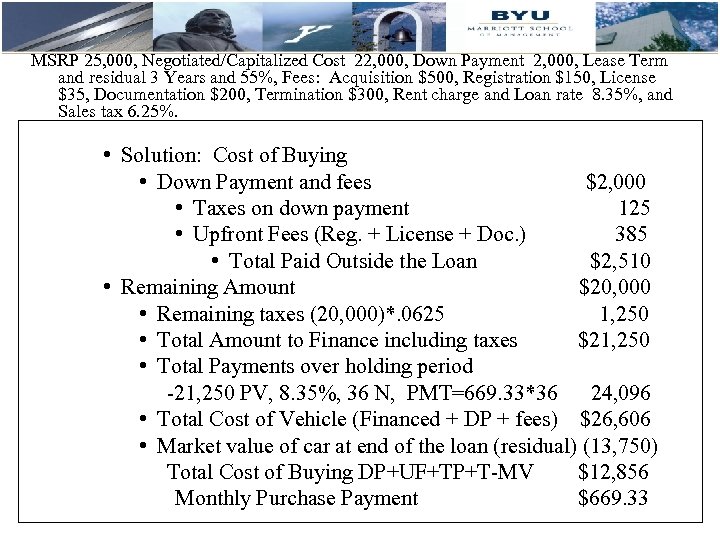 MSRP 25, 000, Negotiated/Capitalized Cost 22, 000, Down Payment 2, 000, Lease Term and residual 3 Years and 55%, Fees: Acquisition $500, Registration $150, License $35, Documentation $200, Termination $300, Rent charge and Loan rate 8. 35%, and Sales tax 6. 25%. • Solution: Cost of Buying • Down Payment and fees $2, 000 • Taxes on down payment 125 • Upfront Fees (Reg. + License + Doc. ) 385 • Total Paid Outside the Loan $2, 510 • Remaining Amount $20, 000 • Remaining taxes (20, 000)*. 0625 1, 250 • Total Amount to Finance including taxes $21, 250 • Total Payments over holding period -21, 250 PV, 8. 35%, 36 N, PMT=669. 33*36 24, 096 • Total Cost of Vehicle (Financed + DP + fees) $26, 606 • Market value of car at end of the loan (residual) (13, 750) Total Cost of Buying DP+UF+TP+T-MV $12, 856 Monthly Purchase Payment $669. 33
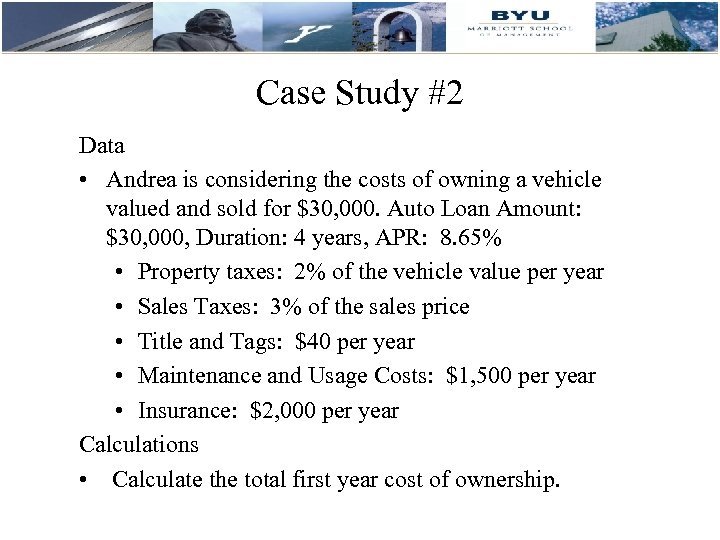 Case Study #2 Data • Andrea is considering the costs of owning a vehicle valued and sold for $30, 000. Auto Loan Amount: $30, 000, Duration: 4 years, APR: 8. 65% • Property taxes: 2% of the vehicle value per year • Sales Taxes: 3% of the sales price • Title and Tags: $40 per year • Maintenance and Usage Costs: $1, 500 per year • Insurance: $2, 000 per year Calculations • Calculate the total first year cost of ownership.
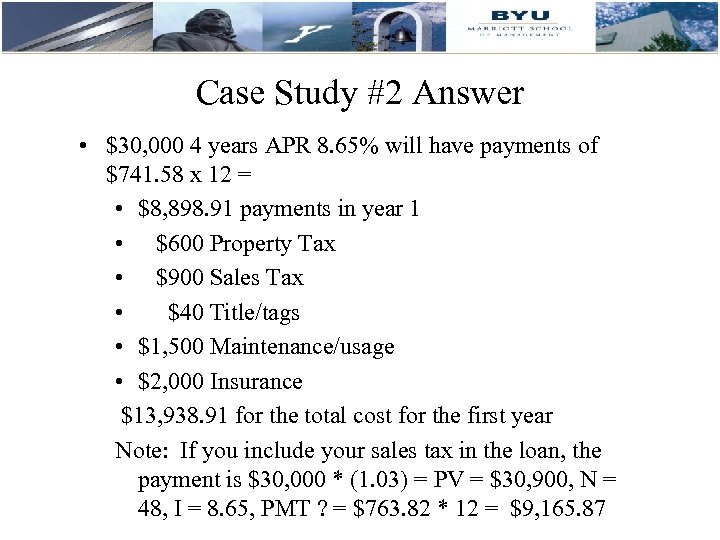 Case Study #2 Answer • $30, 000 4 years APR 8. 65% will have payments of $741. 58 x 12 = • $8, 898. 91 payments in year 1 • $600 Property Tax • $900 Sales Tax • $40 Title/tags • $1, 500 Maintenance/usage • $2, 000 Insurance $13, 938. 91 for the total cost for the first year Note: If you include your sales tax in the loan, the payment is $30, 000 * (1. 03) = PV = $30, 900, N = 48, I = 8. 65, PMT ? = $763. 82 * 12 = $9, 165. 87
 Suggestions from Students • To be added