


 Скачать презентацию Personal Finance Another Perspective Investments 9 Portfolio Evaluation
6d99e284797fb069e45e21b3bbfefb56.ppt
- Количество слайдов: 53
 Personal Finance: Another Perspective Investments 9: Portfolio Evaluation, Rebalancing, and Reporting Updated 2017 -03 -14 1
 Objectives A. Understand portfolio rebalancing B. Understand the importance of portfolio management and performance evaluation C. Understand risk-adjusted performance measures D. Understand how to perform attribution analysis 22
 Investment Plan Assignments Investments 9: Portfolio Rebalancing and Reporting 1. Determine the type of rebalancing you will likely use and how often you will rebalance, and include it in your investment plan under section IV. B. 2 of your Investment Plan. 2. Think through the new money/donations addendum, and how you will utilize it to minimize taxes and transactions costs in rebalancing 3. Determine how often you will monitor and report on your portfolio, and include it in IV. A. 1. 4. Determine how you will communicate portfolio results and include it in section IV. C. 33
 Investment Plan Assignments Investments 10: Behavioral Finance 1. There are no required assignments for your Investment Plan from this section 2. Listen and try to determine principles and ways Behavioral Finance can help you to be a better investor 44
 A. Understand Portfolio Rebalancing • What is portfolio rebalancing? • The process of bringing portfolios back in line into given target asset allocation percentages • What causes the need to rebalance? • Changes occur due to: • Changes in asset class performance • Changes in investor objectives or risk • Introduction of new capital • Introduction of new asset classes 55
 Portfolio Rebalancing (continued) • Why is this rebalancing so critical? • There are competing principles: • Minimize transactions costs and taxes • Minimize tracking error at your risk level • What is tracking error? • It is the return that is lost or gained from your actual portfolio being different from your target portfolio • What are the different ways of rebalancing? • There are many different ways. The most used are: • Periodic-based (or calendar-based) • Percent-range-based (or volatility-based) 66
 Portfolio Rebalancing (continued) • Periodic-based rebalancing • Specify a time period, i. e. bi-annually, etc. After each time period, rebalance the portfolio back to your original asset allocation targets • Advantages • Most simple of the methods • Longer periods have lower transactions and tax costs (but higher tracking error costs) • Disadvantages • Independent of market performance • Performance will depend on relative timing of large market moves and rebalancing 77
 Portfolio Rebalancing (continued) • Percent-range-based rebalancing • Rebalance the portfolio every time actual holdings are +/-5% (or +/-10%) from target ratios. Rebalance whenever you are outside this range • Advantages • Easy to implement • Wider ranges will reduce transactions costs (at the expense of higher tracking error) • Asset performance will trigger rebalancing • Disadvantages • Setting an effective range is difficult • Assets with higher target ranges and volatility will generate the most rebalances 88
 Portfolio Rebalancing (continued) • “NMD” (New Money / Donations) Addendum • Since you pay yourself monthly and are very careful in your selection of assets, you can combine the previous strategies with a “New Money / Donation” strategy to effectively rebalance • New Money. Rebalance as determined previously. But use monthly new money to purchase “underweight” assets, so you do not sell and incur taxable events. This works in both taxable and retirement accounts • In addition, this strategy helps you to buy “low, ” as you are generally purchasing underperforming asset classes 99
 Portfolio Rebalancing (continued) • NMD Addendum (continued) • Donations. In taxable accounts, rebalance your portfolio using appreciated assets for your charitable contributions (see Learning Tool 8) • Donate “appreciated” assets for your charitable contributions • Use the money you would have spent on contributions to purchase underweight assets • This way you eliminate your capital gains taxes for the contributed assets, and you get the full benefit of the deduction for your taxes, i. e. , you sell “high” without tax consequences 10 10
 Portfolio Rebalancing (continued) • Which are the best methods? • Generally, for most investors with fewer investable assets, the easiest is likely to be most useable • Generally, a combination of periodic-based or percent-range-based rebalancing is most useful with the NMD addendum • Review the portfolio annually, but only rebalance when you are +/- 5% to +/-10% (or some range) beyond your targets. Then rebalance back to your targets • Remember, the goal is to minimize transactions costs, taxes, and tracking error costs 11 11
 Questions • Any questions on portfolio rebalancing? 12 12
 B. Understand the Importance of Portfolio Management and Evaluation • What is portfolio management? • The development, construction, and management of a portfolio of financial assets to attain an investor’s specific goals • What is performance evaluation? • The process of evaluating a portfolio’s performance with the goal of understanding the key sources of return • Why are these two topics so important? • Both are complicated subjects and both are critical to investing 13 13
 Management and Evaluation (continued) • What is “active” portfolio management? • The process of using publicly available data to actively manage a portfolio in an effort to: • Beat the benchmark after all transactions costs, taxes, management, and other fees • However, you must do this consistently year -after-year, and not just from luck • Why is “active” management such a hot topic? • Management fees for mutual funds which can consistently outperform their benchmarks are 5 -25 times higher than those on passive management (19 basis points versus 250 basis points) 14 14
 Management and Evaluation (continued) • What is “passive” portfolio management? • The process of buying a diversified portfolio which represents a broad market index (or benchmark) without any attempt to outperform the market or pick stocks • Why is “passive” management such a hot topic? • Most active managers fail to outperform their benchmarks, especially after costs and taxes • Investors have realized that if you can’t beat them, join them, so they buy low-cost passive funds which meet their benchmarks consistently and minimize taxes 15 15
 Management and Evaluation (continued) • What factors lead to above-benchmark or excess returns? • 1. Superior asset allocation • Shifting assets between a poor-performing asset class and a better performing asset class, i. e. between large cap to international or small cap • 2. Superior stock selection • Picking sectors, industries, or companies within a specified benchmark which, as a whole, outperform the return on the specified benchmark 16 16
 Management and Evaluation (continued) • What is superior asset allocation? • The process where the investor gains a higher return than the benchmark from adjusting the investment portfolio for movements in the market • The investor shifts among stocks, bonds and other asset classes based on their expectations for returns from each of the asset classes • What are the results? • Done well, superior asset allocation yields higher returns with lower risk. • Done poorly, it yields lower returns, higher transactions costs, and higher taxes 17 17
 Management and Evaluation (continued) • What is superior stock selection? • The process where the investor builds an investment portfolio which earns returns in excess of the benchmark through buying or selling undervalued stocks, sectors or industries • The investor shifts among the various securities of the index in an attempt to buy the securities with the highest growth potential • What are the results? • Done well, superior selection yields higher returns with lower risk. • Done poorly, it yields lower returns, high transactions costs, and high taxes 18 18
 Management and Evaluation (continued) • What is portfolio evaluation? • The process of monitoring financial asset performance, comparing asset performance to the relevant benchmarks, and determining how well the fund is meeting its objectives. • If the assets are underperforming benchmarks, the investor may sell underperforming assets and purchase other assets which would more closely align asset performance with benchmarks 19 19
 Management and Evaluation (continued) • Why monitor performance? • Unless you monitor performance, you will not know how you are doing in working toward accomplishing your objectives • You need to know how every asset you own is performing, and performing versus its benchmark, so you can determine how well you are moving toward your goals 20 20
 Management and Evaluation (continued) • How do you evaluate performance? • Calculate: • 1. The period return on each owned asset • 2. The period index return for each benchmark • 3. The difference between the asset return and benchmark return • 4. The weight of each asset or portfolio in the overall portfolio • 5. The overall portfolio return • With this information, you can know how each asset is performing versus its benchmark, and how well the portfolio is moving toward its objectives 21 21
 Management and Evaluation (continued) • What is portfolio reporting? • The process of reviewing portfolio performance with the necessary participants, i. e. your spouse • If you are managing your portfolio, you should report performance to your spouse at least monthly or quarterly • If others are helping you manage your portfolio, they should report performance to you and your spouse at least quarterly as well. • Be careful not to do too much buying and selling, as these incur transactions costs and taxes 22 22
 Questions • Any questions on the importance of portfolio management and evaluation? 23 23
 C. Calculate Risk-adjusted Performance • How do you determine whether a portfolio manager is generating excess returns (i. e. , returns above the manager’s benchmark)? • Is it only returns? • Should you also be concerned about risk? • It is not just returns that matters—they must be adjusted for risk. • There a number of recognized performance measures available: • Sharp Index • Treynor Measure • Jensen’s Measure 24 24
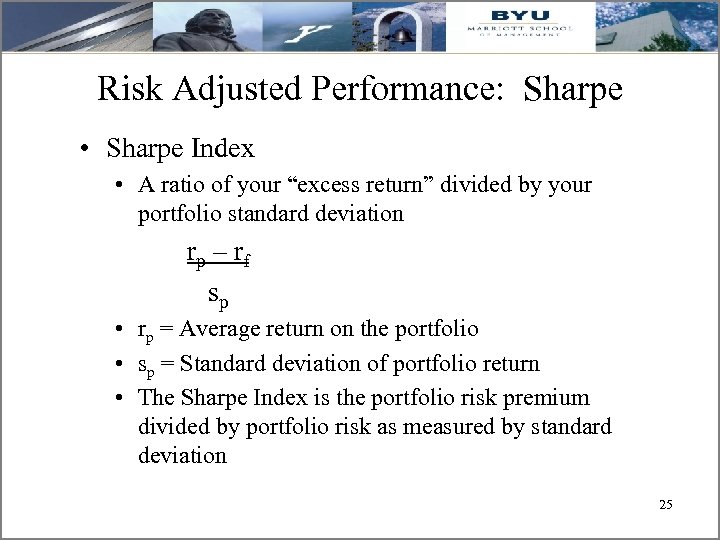 Risk Adjusted Performance: Sharpe • Sharpe Index • A ratio of your “excess return” divided by your portfolio standard deviation rp – rf sp • rp = Average return on the portfolio • sp = Standard deviation of portfolio return • The Sharpe Index is the portfolio risk premium divided by portfolio risk as measured by standard deviation 25 25
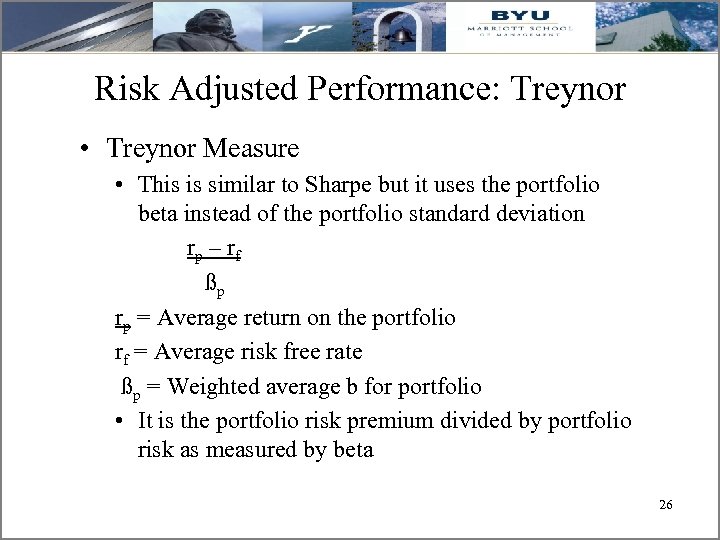 Risk Adjusted Performance: Treynor • Treynor Measure • This is similar to Sharpe but it uses the portfolio beta instead of the portfolio standard deviation rp – rf ßp rp = Average return on the portfolio rf = Average risk free rate ßp = Weighted average b for portfolio • It is the portfolio risk premium divided by portfolio risk as measured by beta 26 26
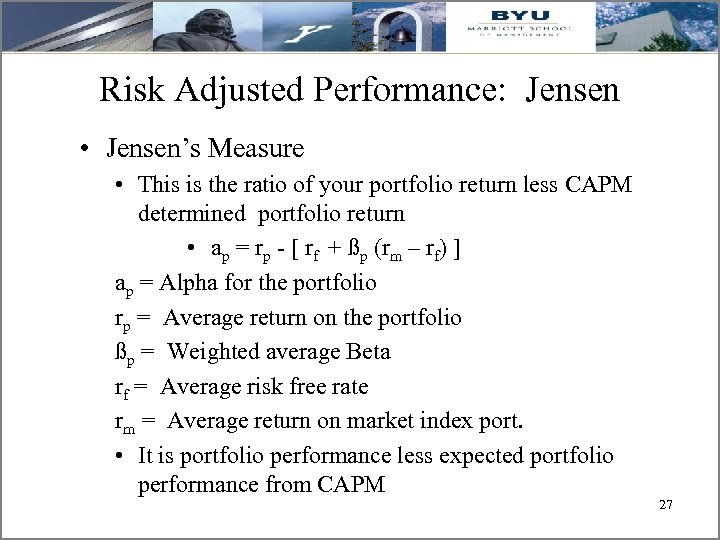 Risk Adjusted Performance: Jensen • Jensen’s Measure • This is the ratio of your portfolio return less CAPM determined portfolio return • ap = rp - [ rf + ßp (rm – rf) ] ap = Alpha for the portfolio rp = Average return on the portfolio ßp = Weighted average Beta rf = Average risk free rate rm = Average return on market index port. • It is portfolio performance less expected portfolio performance from CAPM 27 27
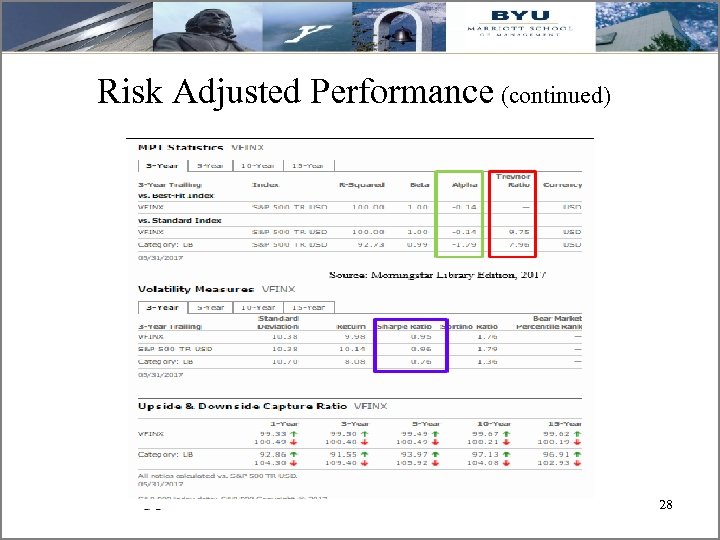 Risk Adjusted Performance (continued) 28 28
 Risk Adjusted Performance (continued) • Which measure is most appropriate? Are there some general guidelines? • Generally, if the portfolio represents the entire investment for an individual, the Sharpe Index compared to the Sharpe Index for the market is best • If many alternatives are possible, or if this is only part of the overall portfolio, use the Treynor measure versus the Treynor measure for the market, or the Jensen’s a alpha • Of these two, the Treynor measure is more complete because it adjusts for risk 29 29
 Risk Adjusted Performance (continued) • Are their limitations of risk adjustment measures? • Yes, very much so. The assumptions underlying measures limit their usefulness • Know the key assumptions and be careful! • When the portfolio is being actively managed, basic stability requirements are not met • Be careful when portfolios are actively managed • Practitioners often use benchmark portfolio comparisons and comparisons to other managers to measure performance • This is largely because they are easier 30 30
 Risk Adjusted Performance (continued) • What about style analysis? • Another way of obtaining abnormal returns is chasing style • Growth versus value—what’s hot? • You can decompose returns by attributing allocation to style • Style tilts and rotation are important active portfolio strategies • Style analysis has become increasingly popular in the industry 31 31
 Questions • Any questions on risk-adjusted performance measures? 32 32
 D. Understand How to Perform Portfolio Attribution (this is optional) • What is portfolio attribution? • The process of separating out portfolio returns into their related components, generally attributable to asset allocation and securities selection • What is the importance of these components? • These components are related to elements of portfolio performance, to see what you do well • What are examples of some of these components? • Broad asset allocation • Industry Security Choice Currency 33 33
 Portfolio Attribution (continued) • How do you determine portfolio attribution? • 1. Set up a weighted ‘benchmark’ which includes all your chosen asset classes • Use your chosen benchmark for each asset class, and use your target asset allocation weights from your Investment Plan • 2. Calculate your returns for each of your asset classes • Calculated returns for each asset class • Calculate a weighted return for your overall portfolio 34 34
 Portfolio Attribution (continued) • 4. Compare your portfolio returns in each asset class to the benchmark returns of each index • Use Teaching Tool 17: Portfolio Attribution Spreadsheet • 5. Calculate your attribution and make decisions accordingly 35 35
 Portfolio Attribution (continued) • Why is it important to attribute performance to the portfolio’s components? • It can explain the difference in return based on component weights or selection • It can summarize the performance differences into appropriate categories • It can help you know how you are doing • What happens if you don’t perform portfolio attribution? • You will not know why you are performing as you are • You will not know how to improve 36 36
 Portfolio Attribution (continued) • What do you do if your actively managed funds continue to underperform? • Watch them carefully. Underperformance for a month or quarter is understandable, but over 12 -36 months it should be positive • If not, find another fund or index the asset class performance • How long does it take to determine whether an active manager is good or not? • Generally, 12 -36 months 37 37
 Questions • Any questions on portfolio attribution? 38 38
 Review of Objectives • A. Do you understand the different types and uses of indexes? • B. Do you understand the Importance of Portfolio Management and Performance Evaluation? • C. Do you understand portfolio rebalancing? • D. Do you understand risk-adjusted performance measures? • E. Do you understand how to perform attribution analysis? 39 39
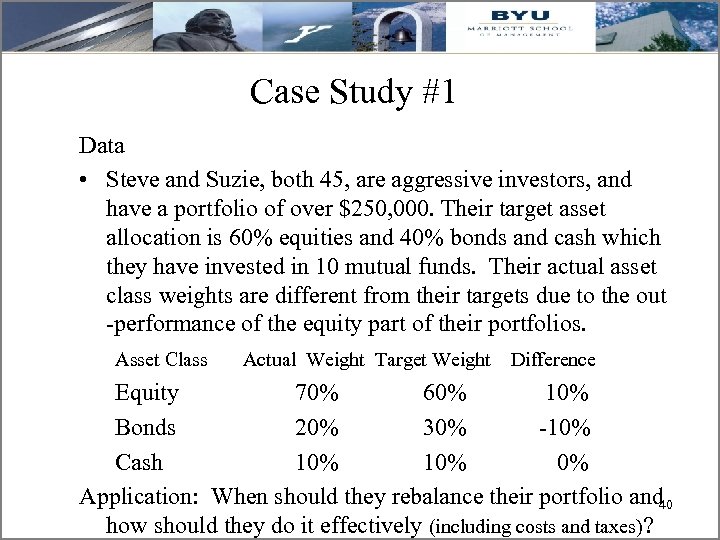 Case Study #1 Data • Steve and Suzie, both 45, are aggressive investors, and have a portfolio of over $250, 000. Their target asset allocation is 60% equities and 40% bonds and cash which they have invested in 10 mutual funds. Their actual asset class weights are different from their targets due to the out -performance of the equity part of their portfolios. Asset Class Actual Weight Target Weight Difference Equity 70% 60% 10% Bonds 20% 30% -10% Cash 10% 0% Application: When should they rebalance their portfolio and 40 40 how should they do it effectively (including costs and taxes)?
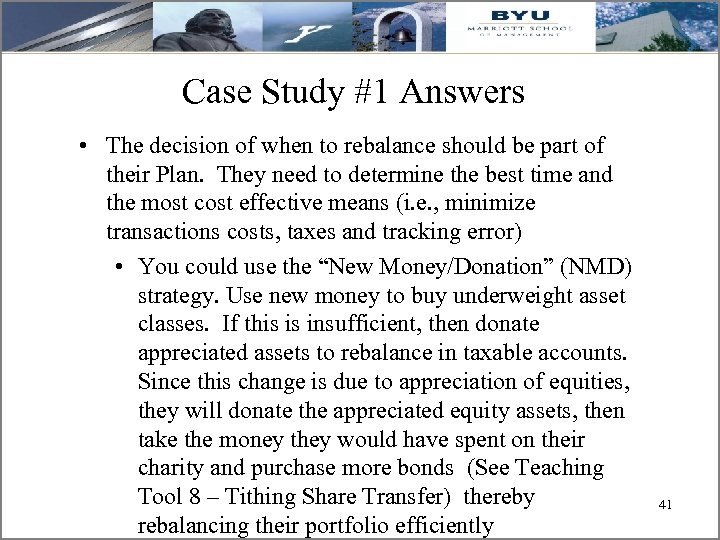 Case Study #1 Answers • The decision of when to rebalance should be part of their Plan. They need to determine the best time and the most cost effective means (i. e. , minimize transactions costs, taxes and tracking error) • You could use the “New Money/Donation” (NMD) strategy. Use new money to buy underweight asset classes. If this is insufficient, then donate appreciated assets to rebalance in taxable accounts. Since this change is due to appreciation of equities, they will donate the appreciated equity assets, then take the money they would have spent on their charity and purchase more bonds (See Teaching Tool 8 – Tithing Share Transfer) thereby rebalancing their portfolio efficiently 41 41
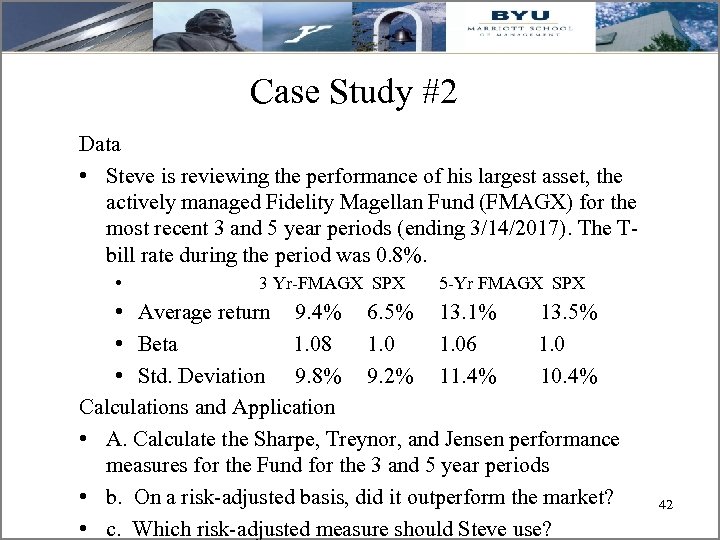 Case Study #2 Data • Steve is reviewing the performance of his largest asset, the actively managed Fidelity Magellan Fund (FMAGX) for the most recent 3 and 5 year periods (ending 3/14/2017). The Tbill rate during the period was 0. 8%. • 3 Yr-FMAGX SPX 5 -Yr FMAGX SPX • Average return 9. 4% 6. 5% 13. 1% 13. 5% • Beta 1. 08 1. 06 1. 0 • Std. Deviation 9. 8% 9. 2% 11. 4% 10. 4% Calculations and Application • A. Calculate the Sharpe, Treynor, and Jensen performance measures for the Fund for the 3 and 5 year periods • b. On a risk-adjusted basis, did it outperform the market? • c. Which risk-adjusted measure should Steve use? 42 42
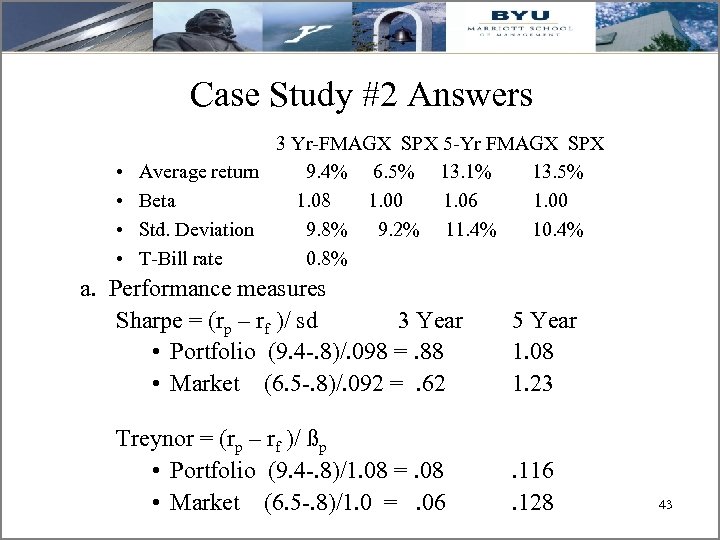 Case Study #2 Answers • • 3 Yr-FMAGX SPX 5 -Yr FMAGX SPX Average return 9. 4% 6. 5% 13. 1% 13. 5% Beta 1. 08 1. 00 1. 06 1. 00 Std. Deviation 9. 8% 9. 2% 11. 4% 10. 4% T-Bill rate 0. 8% a. Performance measures Sharpe = (rp – rf )/ sd 3 Year • Portfolio (9. 4 -. 8)/. 098 =. 88 • Market (6. 5 -. 8)/. 092 =. 62 Treynor = (rp – rf )/ ßp • Portfolio (9. 4 -. 8)/1. 08 =. 08 • Market (6. 5 -. 8)/1. 0 =. 06 5 Year 1. 08 1. 23 . 116. 128 43 43
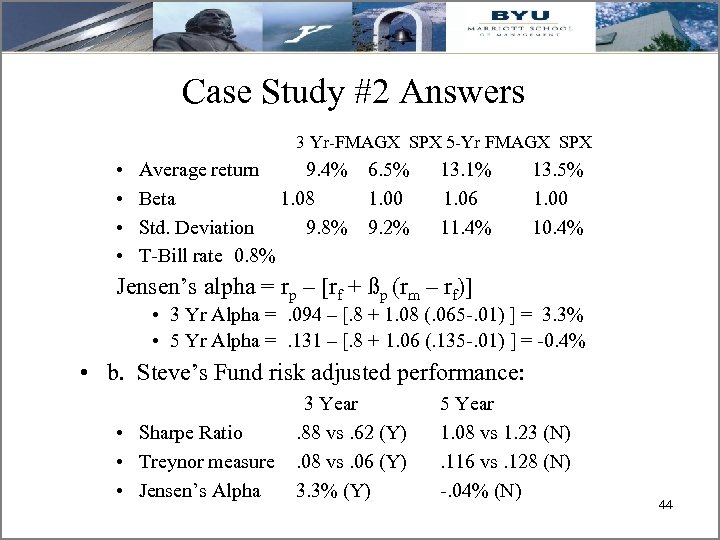 Case Study #2 Answers 3 Yr-FMAGX SPX 5 -Yr FMAGX SPX • • Average return 9. 4% Beta 1. 08 Std. Deviation 9. 8% T-Bill rate 0. 8% 6. 5% 1. 00 9. 2% 13. 1% 1. 06 11. 4% 13. 5% 1. 00 10. 4% Jensen’s alpha = rp – [rf + ßp (rm – rf)] • 3 Yr Alpha =. 094 – [. 8 + 1. 08 (. 065 -. 01) ] = 3. 3% • 5 Yr Alpha =. 131 – [. 8 + 1. 06 (. 135 -. 01) ] = -0. 4% • b. Steve’s Fund risk adjusted performance: • Sharpe Ratio • Treynor measure • Jensen’s Alpha 3 Year. 88 vs. 62 (Y). 08 vs. 06 (Y) 3. 3% (Y) 5 Year 1. 08 vs 1. 23 (N). 116 vs. 128 (N) -. 04% (N) 44 44
 Case Study #2 Answers • c. Which measure is most appropriate? • Generally, if the portfolio represents the entire investment for an individual, the Sharpe Index compared to the Sharpe Index for the market is best. This is not the case here. • If many alternatives are possible, or if this is only part of the overall portfolio, use the Treynor measure versus the Treynor measure for the market, or the Jensen’s alpha • Of these two, the Treynor measure is more complete because it adjusts better for risk 45 45
 Case Study #3 Data • You have five mutual funds in your portfolio, an emergency bond fund (VIPSX), a large cap index fund (SWPPX), a small cap fund (FSCRX), an emerging markets fund (SSEMX), and a REIT (VGSIX). How have they done versus their benchmarks (or categories) over the past three years? Calculations • Using the data from www. finance. yahoo. com, type in the ticker and go to the Risk tab for each fund. Look at their 3 year performance versus their categories (as a proxy for the market). Use this hyperlink for Yahoo Finance Risk tabs. Did they outperform their benchmarks? • Did these funds outperform over the past three years on a riskadjusted basis? • Use https: //finance. yahoo. com/q/rk? bypass=true&s=vfinx%20 Risk<r=1 and replace the Fund ticker vfinx with your fund ticker 46 46
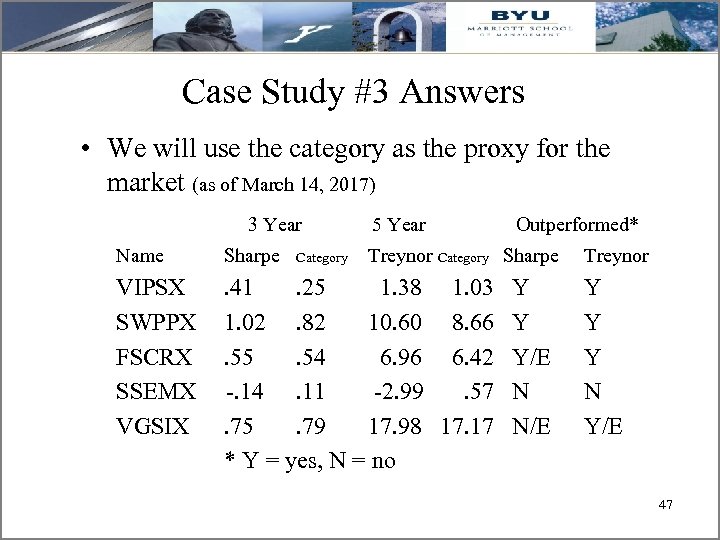 Case Study #3 Answers • We will use the category as the proxy for the market (as of March 14, 2017) 3 Year 5 Year Name Sharpe VIPSX SWPPX FSCRX SSEMX VGSIX . 41. 25 1. 38 1. 03 1. 02. 82 10. 60 8. 66. 55. 54 6. 96 6. 42 -. 14. 11 -2. 99. 57. 75. 79 17. 98 17. 17 * Y = yes, N = no Category Outperformed* Treynor Category Sharpe Y Y Y/E N N/E Treynor Y Y Y N Y/E 47 47
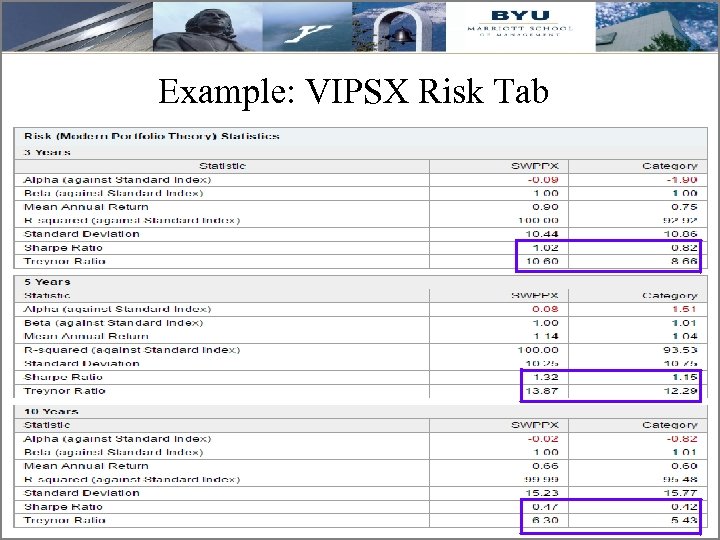 Example: VIPSX Risk Tab 48 48
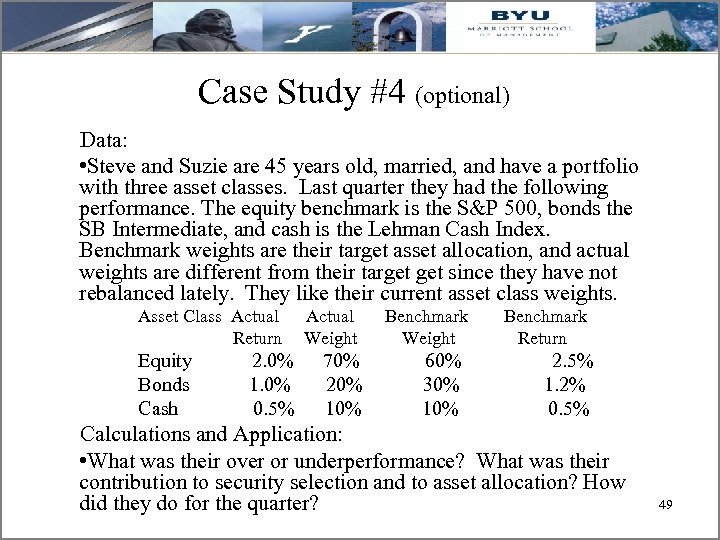 Case Study #4 (optional) Data: • Steve and Suzie are 45 years old, married, and have a portfolio with three asset classes. Last quarter they had the following performance. The equity benchmark is the S&P 500, bonds the SB Intermediate, and cash is the Lehman Cash Index. Benchmark weights are their target asset allocation, and actual weights are different from their target since they have not rebalanced lately. They like their current asset class weights. Asset Class Actual Return Equity Bonds Cash 2. 0% 1. 0% 0. 5% Actual Weight 70% 20% 10% Benchmark Weight 60% 30% 10% Benchmark Return 2. 5% 1. 2% 0. 5% Calculations and Application: • What was their over or underperformance? What was their contribution to security selection and to asset allocation? How did they do for the quarter? 49 49
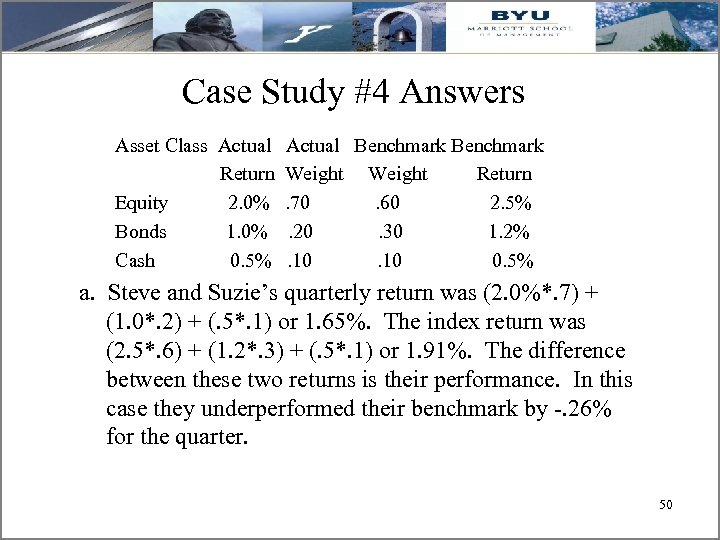 Case Study #4 Answers Asset Class Actual Return Equity 2. 0% Bonds 1. 0% Cash 0. 5% Actual Benchmark Weight Return. 70. 60 2. 5%. 20. 30 1. 2%. 10 0. 5% a. Steve and Suzie’s quarterly return was (2. 0%*. 7) + (1. 0*. 2) + (. 5*. 1) or 1. 65%. The index return was (2. 5*. 6) + (1. 2*. 3) + (. 5*. 1) or 1. 91%. The difference between these two returns is their performance. In this case they underperformed their benchmark by -. 26% for the quarter. 50 50
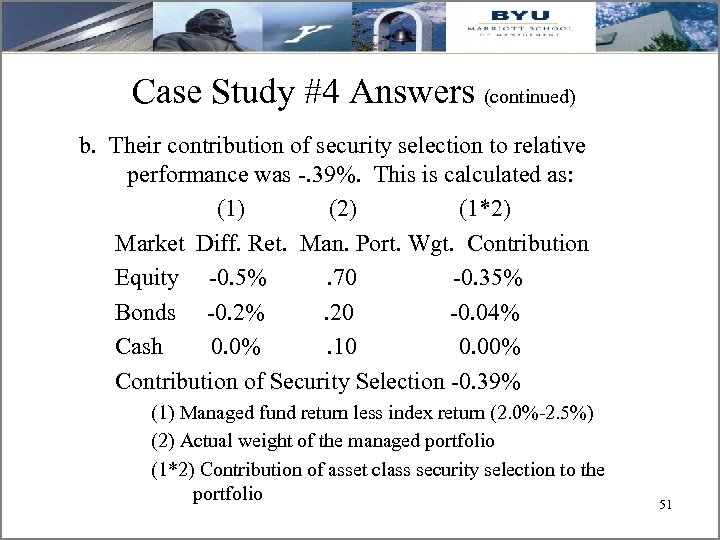 Case Study #4 Answers (continued) b. Their contribution of security selection to relative performance was -. 39%. This is calculated as: (1) (2) (1*2) Market Diff. Ret. Man. Port. Wgt. Contribution Equity -0. 5%. 70 -0. 35% Bonds -0. 2%. 20 -0. 04% Cash 0. 0%. 10 0. 00% Contribution of Security Selection -0. 39% (1) Managed fund return less index return (2. 0%-2. 5%) (2) Actual weight of the managed portfolio (1*2) Contribution of asset class security selection to the portfolio 51 51
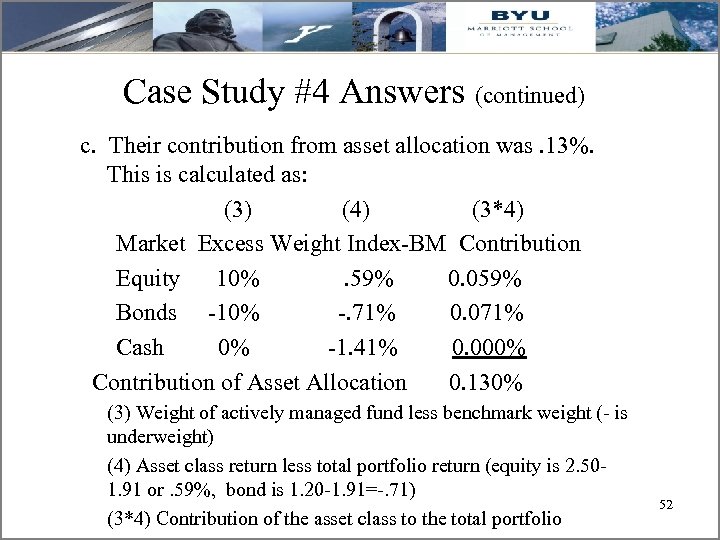 Case Study #4 Answers (continued) c. Their contribution from asset allocation was. 13%. This is calculated as: (3) (4) (3*4) Market Excess Weight Index-BM Contribution Equity 10%. 59% 0. 059% Bonds -10% -. 71% 0. 071% Cash 0% -1. 41% 0. 000% Contribution of Asset Allocation 0. 130% (3) Weight of actively managed fund less benchmark weight (- is underweight) (4) Asset class return less total portfolio return (equity is 2. 501. 91 or. 59%, bond is 1. 20 -1. 91=-. 71) (3*4) Contribution of the asset class to the total portfolio 52 52
 Case Study #4 Answers (continued) • Overall comments: Steve and Suzie’s actively managed portfolio under performed the benchmark by. 26% or 26 basis points (1. 65%-1. 91%). This underperformance was a combination of a -. 39% contribution to security selection and a. 13% contribution from asset allocation. While they did well overweighting (versus their asset allocation targets) the asset classes that performed well, they didn’t do as well picking the assets in those asset classes. • If this performance continued for 24 -36 months, they should consider indexing the stock selection decision, i. e. buy index funds, and keep doing what they are doing with the asset class decision. 53 53