 Скачать презентацию Personal Finance Another Perspective Estate Planning 1 Basics
e7909ece66c2a930e1d960dcf06129a0.ppt
- Количество слайдов: 87



Personal Finance: Another Perspective Estate Planning 1: Basics 1
Objectives A. Understand the principles of proper estate planning B. Understand the importance of Estate Planning and the goals of Estate Planning C. Understand the estate planning process D. Understand how trusts can be used to your advantage in Estate Planning E. Understand the importance of Wills and Probate Planning 2

Your Personal Financial Plan ü Section XIV: Estate Planning • What is your current estate planning strategy? • Action Plan: • What estate planning strategies should you use as your assets grow? Note: for most of you this will be a very short section of two sentences: “My assets are less than the current $5. 1 million minimum. As the size of my financial assets increase, I will begin to implement my estate planning strategy which includes utilizing specific types of trusts. ” 3
Your Personal Financial Plan ü Section XV: Wills • Includes your holographic will (and the holographic will of your spouse if married--follow TT 01 E) • If you have an existing will, you can include that in the place of the holographic will. It should not, however, be a “fill in the blank” will • Include a copy of TT 14: Utah Advanced Health Care Directive • I would like this to be filled out and included in this section on Wills 4
A. Understand the Principles of Estate Planning ü Following are a few principles of proper estate planning • 1. Understand yourself, your goals, your budget, and your needs • 2. Start early and get very qualified legal help • 3. Understand the applicable laws • 4. Remember the key principles of finance: ownership, stewardship, agency, and accountability 5
B. Understand the importance of Estate Planning and the Estate Planning Process ü What is the importance of estate planning? • You can take care of those you love even after you die • Your wealth will go to those you want it to go to, so you can achieve your personal goals even after you are gone • You can reduce significantly the taxes paid to Uncle Sam by proper planning 6
Estate Planning (continued) ü Brigham Young said: • A fool can earn money; but it takes a wise man to save and dispose of it to his own advantage (Discourses of Brigham Young, sel. John A. Widtsoe, Salt Lake City: Deseret Book Co. , 1954, p. 292). ü From the Family Guidebook it states: • Estate planning is the way we manage our major financial resources and properties to “dispose of it to [our] own advantage. ” This kind of planning, begun early in life, can help provide financial security for a family throughout several generations (Family Guidebook, “Preparing for Emergencies, ” Ensign, Dec. 1990, 59). 7
Estate Planning (continued) ü What are the objectives of Estate Planning? • 1. Live life fully • 2. Pass on property to others according to your desires and consistent with your values and goals • 3. Provide for guardianship of children who are still minors • 4. Avoid probate if desired, or use probate strategically • 5. Decrease or eliminate taxes 8
Estate Planning (continued) ü In addition, estate planning should: • 1. Dispose of your property as you wish • Distribute property as you desire • Appoint power of attorney in case of your physical or mental impairment • 2. Provide for your dependents • Select guardians for minors • 3. Minimize estate and inheritance taxes • Minimize settlement costs, including legal and accounting fees 9
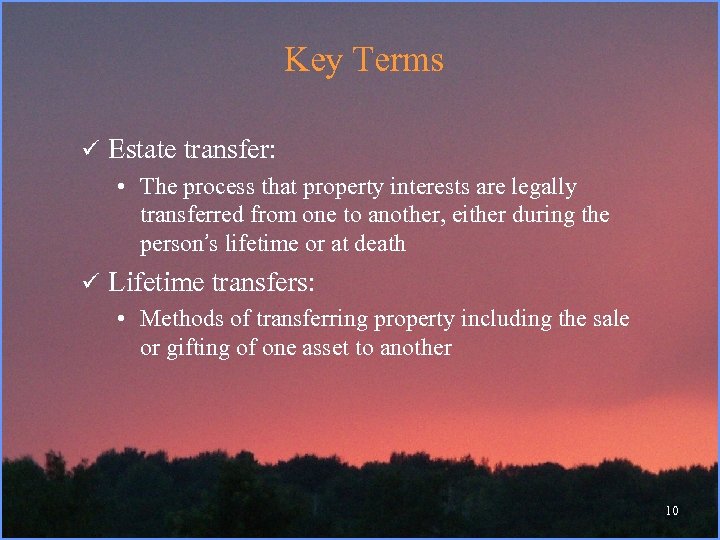
Key Terms ü Estate transfer: • The process that property interests are legally transferred from one to another, either during the person’s lifetime or at death ü Lifetime transfers: • Methods of transferring property including the sale or gifting of one asset to another 10
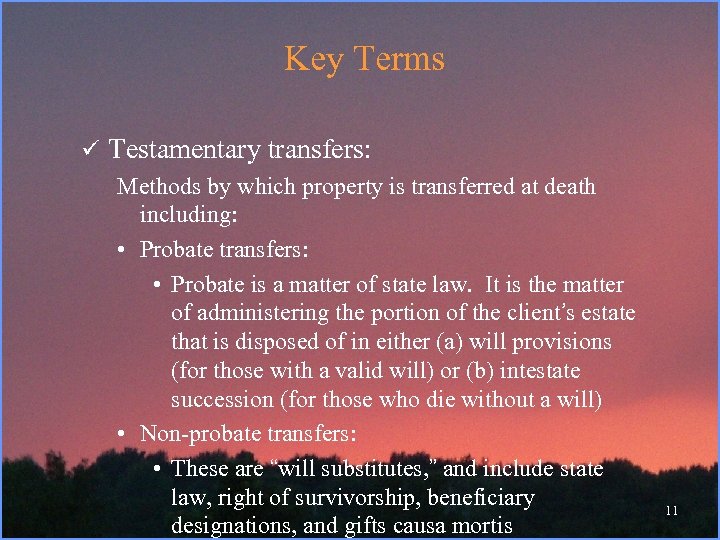
Key Terms ü Testamentary transfers: Methods by which property is transferred at death including: • Probate transfers: • Probate is a matter of state law. It is the matter of administering the portion of the client’s estate that is disposed of in either (a) will provisions (for those with a valid will) or (b) intestate succession (for those who die without a will) • Non-probate transfers: • These are “will substitutes, ” and include state law, right of survivorship, beneficiary designations, and gifts causa mortis 11
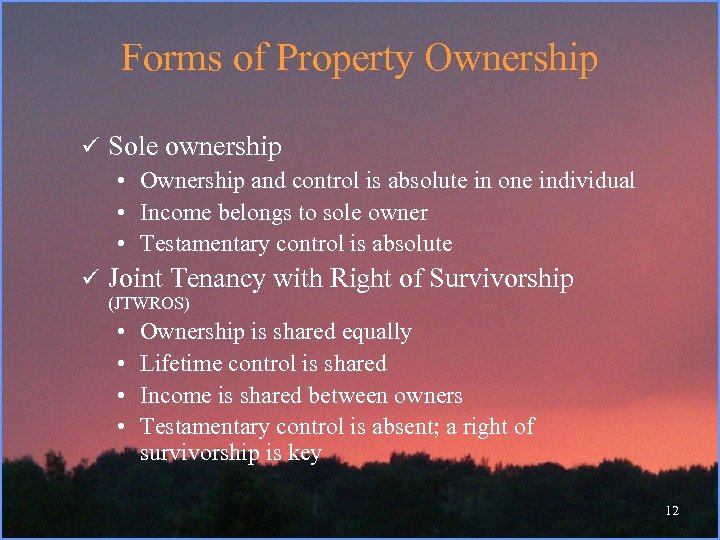
Forms of Property Ownership ü Sole ownership • Ownership and control is absolute in one individual • Income belongs to sole owner • Testamentary control is absolute ü Joint Tenancy with Right of Survivorship (JTWROS) • • Ownership is shared equally Lifetime control is shared Income is shared between owners Testamentary control is absent; a right of survivorship is key 12
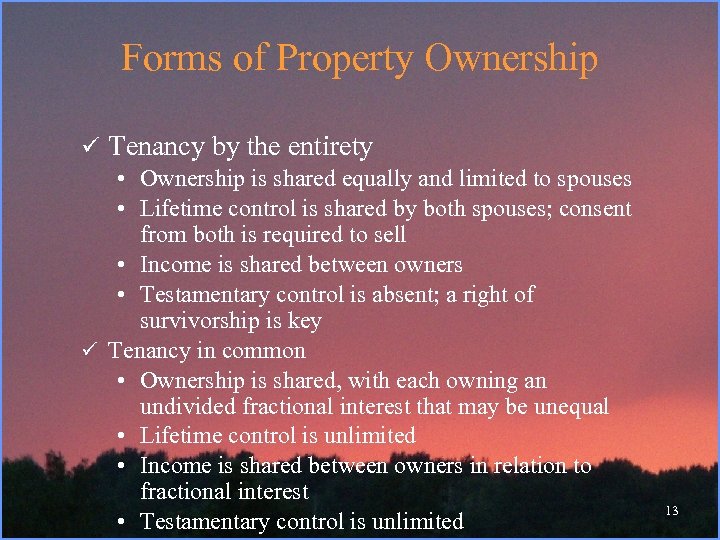
Forms of Property Ownership ü Tenancy by the entirety • Ownership is shared equally and limited to spouses • Lifetime control is shared by both spouses; consent from both is required to sell • Income is shared between owners • Testamentary control is absent; a right of survivorship is key ü Tenancy in common • Ownership is shared, with each owning an undivided fractional interest that may be unequal • Lifetime control is unlimited • Income is shared between owners in relation to fractional interest • Testamentary control is unlimited 13
Forms of Property Ownership ü Community Property • Ownership is equal and only between spouses • Lifetime control is shared by both spouses; consent from both is required to sell • Income is shared between owners • Testamentary control in the one-half interest is unlimited unless property has right of survivorship feature (applicable in some states) 14
C. Understand the Estate Planning Process ü What is the Estate Planning Process? • Step 1: Determine what your estate is worth. • Estate net worth = value of estate’s assets –value of estate’s liabilities • Step 2: Choose heirs and decide what they receive. • Set this up to help attain your long-term goals • Step 3: Determine the cash needs of the estate and your estate taxes • Liquid assets are needed to help pay estate taxes • Step 4: Select and implement planning techniques. • Prepare well beforehand you will do well afterwards 15
Step 1: Determine What your Estate is Worth ü Calculate the Value of the Gross Estate • This is the value of all your assets, including life insurance, pensions, investments, and any real or personal property ü Calculate Your Taxable Estate • This is equal to the gross value of your estate, less estimated funeral and administrative expenses, debts, liabilities, taxes and any marital or charitable deductions ü Calculate Your Gift-Adjusted Taxable Estate • This is equal to your taxable estate plus any taxable lifetime gifts (cumulative total of all gifts over the annual limit) 16
Step 2: Choose Your Heirs and Decide What They Will Receive ü This is an individual decision • Do it well • Remember your long-term goals for you and your family. Use your financial resources (your blessings) to help achieve your personal goals • Keep the long-term in mind: • Treasure these things up in your hearts, and let the solemnities of the eternity rest on your minds (D&C 43: 34). 17
Step 3: Determine the Cash Needs and Calculate your Estate Taxes ü Determine the cash needs of the estate • Ensure you have sufficient liquid assets to pay the necessary estate taxes, which can be high ü Calculate Your Estimated Estate Taxes • Estate taxes are equal to the gift-adjusted taxable estate multiplied by the appropriate tax rate. • To determine the net tax owed, calculate the total tax owed and subtract the unified gift and estate tax credit. ü Ensure you have adequate liquidity for your heirs 18
Step 4: Select and Implement Your Estate Planning Techniques ü Prepare well beforehand you will do well afterwards • Get qualified legal help to determine and implement the best estate planning vehicles ü Remember that none of these vehicles are useful until they are funded. • Set them up and then fund them properly 19
Four Key Taxes on Estates ü 1. Estate Taxes • $5. 12 million tax-free transfer threshold was the limit for 2012. It will go back to 2000 levels in 2013 if laws are not enacted to make cuts permanent, which is unlikely • Tax rates of 41% to 48%, determined by exact value, will be assessed on estates valued over the tax-free transfer threshold. Top rates declined from 48% in 2004 to 45% in 2010, and are at 35% in 2012 • Special treatment for small business and family farm owners 20
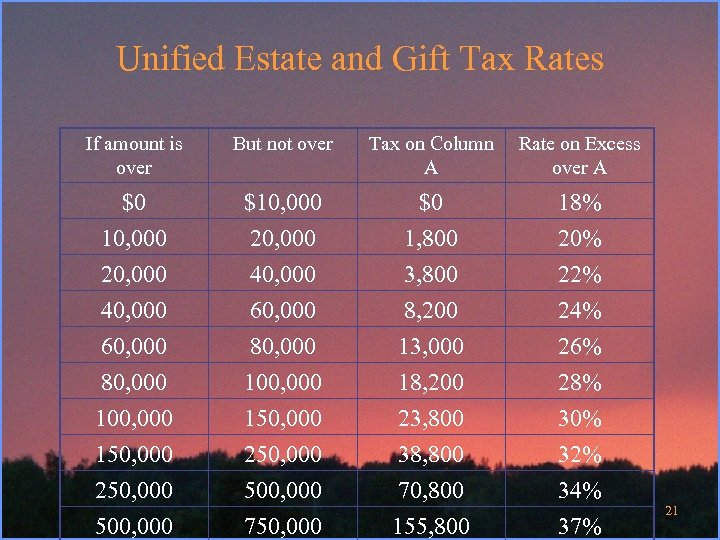
Unified Estate and Gift Tax Rates If amount is over But not over Tax on Column Rate on Excess A over A $0 $10, 000 $0 18% 10, 000 20, 000 1, 800 20% 20, 000 40, 000 3, 800 22% 40, 000 60, 000 8, 200 24% 60, 000 80, 000 13, 000 26% 80, 000 100, 000 18, 200 28% 100, 000 150, 000 23, 800 30% 150, 000 250, 000 38, 800 32% 250, 000 500, 000 70, 800 34% 500, 000 750, 000 155, 800 37% 21
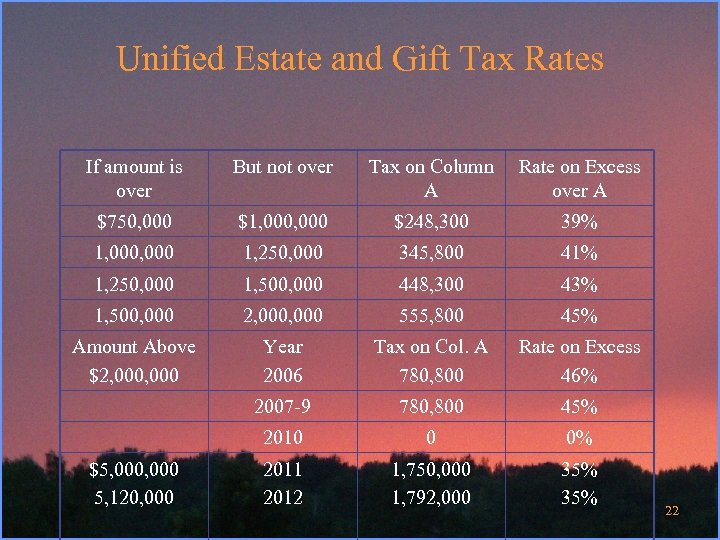
Unified Estate and Gift Tax Rates If amount is over But not over $750, 000 $1, 000 $248, 300 39% 1, 000 1, 250, 000 345, 800 41% 1, 250, 000 1, 500, 000 448, 300 43% 1, 500, 000 2, 000 555, 800 45% Amount Above $2, 000 Year 2006 Tax on Col. A 780, 800 Rate on Excess 46% 2007 -9 780, 800 45% 2010 0 0% 2011 2012 1, 750, 000 1, 792, 000 35% $5, 000 5, 120, 000 Tax on Column Rate on Excess A over A 22
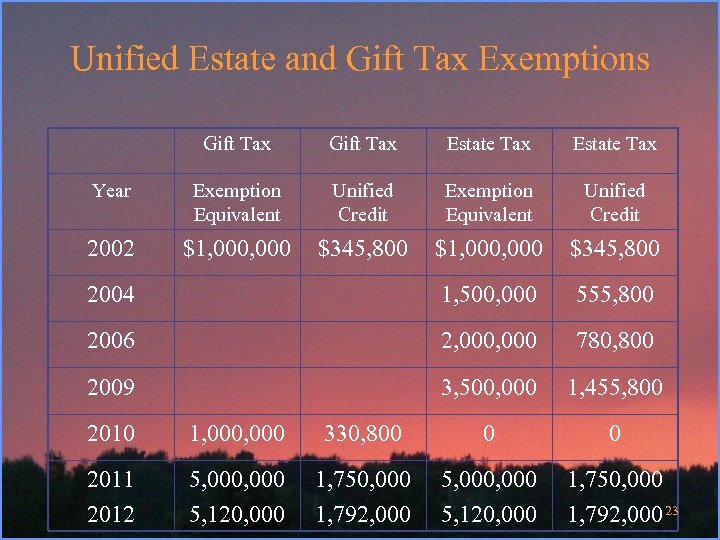
Unified Estate and Gift Tax Exemptions Gift Tax Estate Tax Year Exemption Equivalent Unified Credit 2002 $1, 000, 000 $345, 800 2004 1, 500, 000 555, 800 2006 2, 000 780, 800 2009 3, 500, 000 1, 455, 800 0 2010 1, 000 330, 800 0 2011 2012 5, 000, 000 5, 120, 000 1, 750, 000 1, 792, 000 23
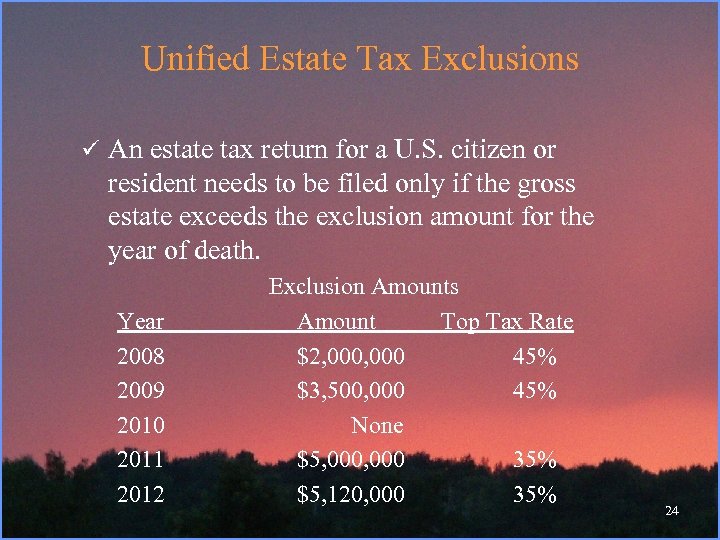
Unified Estate Tax Exclusions ü An estate tax return for a U. S. citizen or resident needs to be filed only if the gross estate exceeds the exclusion amount for the year of death. Year 2008 2009 2010 2011 2012 Exclusion Amounts Amount Top Tax Rate $2, 000 45% $3, 500, 000 45% None $5, 000 35% $5, 120, 000 35% 24
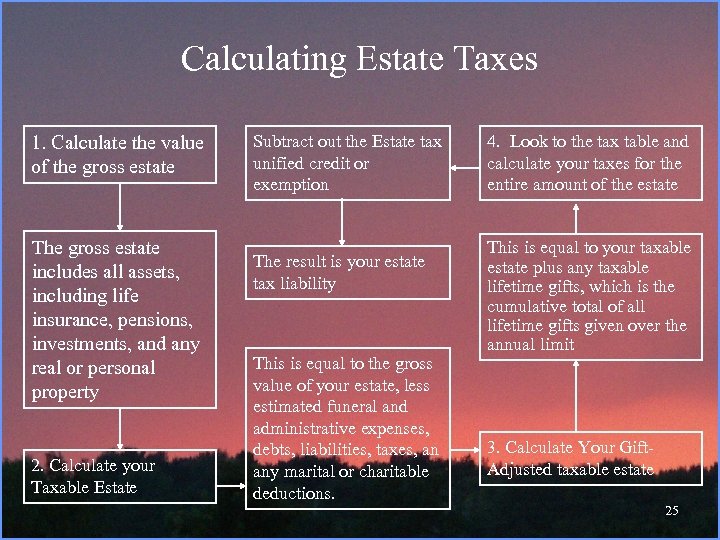
Calculating Estate Taxes 1. Calculate the value of the gross estate The gross estate includes all assets, including life insurance, pensions, investments, and any real or personal property 2. Calculate your Taxable Estate Subtract out the Estate tax unified credit or exemption The result is your estate tax liability This is equal to the gross value of your estate, less estimated funeral and administrative expenses, debts, liabilities, taxes, an any marital or charitable deductions. 4. Look to the tax table and calculate your taxes for the entire amount of the estate This is equal to your taxable estate plus any taxable lifetime gifts, which is the cumulative total of all lifetime gifts given over the annual limit 3. Calculate Your Gift. Adjusted taxable estate 25
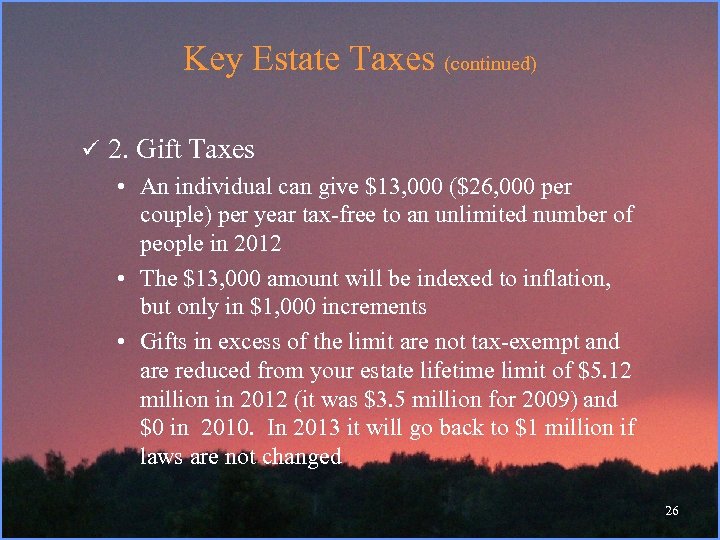
Key Estate Taxes (continued) ü 2. Gift Taxes • An individual can give $13, 000 ($26, 000 per couple) per year tax-free to an unlimited number of people in 2012 • The $13, 000 amount will be indexed to inflation, but only in $1, 000 increments • Gifts in excess of the limit are not tax-exempt and are reduced from your estate lifetime limit of $5. 12 million in 2012 (it was $3. 5 million for 2009) and $0 in 2010. In 2013 it will go back to $1 million if laws are not changed 26
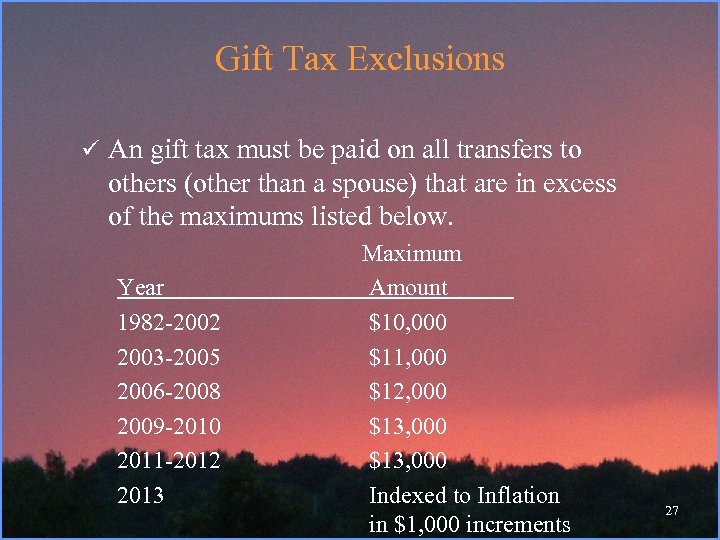
Gift Tax Exclusions ü An gift tax must be paid on all transfers to others (other than a spouse) that are in excess of the maximums listed below. Year 1982 -2002 2003 -2005 2006 -2008 2009 -2010 2011 -2012 2013 Maximum Amount $10, 000 $11, 000 $12, 000 $13, 000 Indexed to Inflation in $1, 000 increments 27
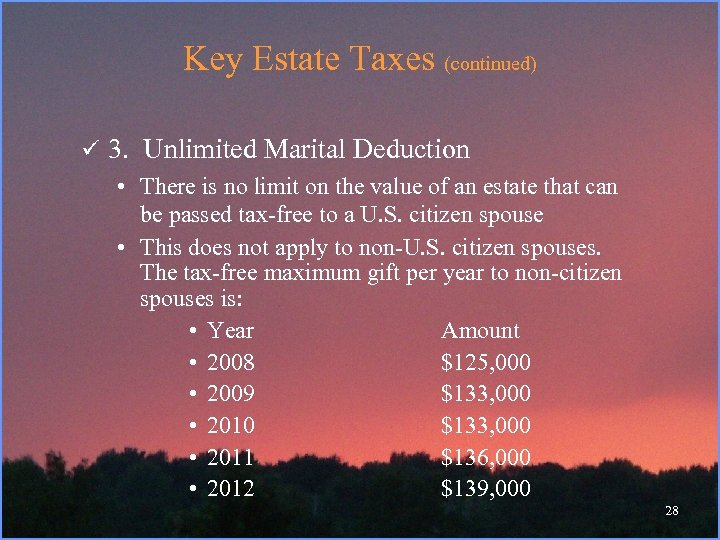
Key Estate Taxes (continued) ü 3. Unlimited Marital Deduction • There is no limit on the value of an estate that can be passed tax-free to a U. S. citizen spouse • This does not apply to non-U. S. citizen spouses. The tax-free maximum gift per year to non-citizen spouses is: • Year Amount • 2008 $125, 000 • 2009 $133, 000 • 2010 $133, 000 • 2011 $136, 000 • 2012 $139, 000 28
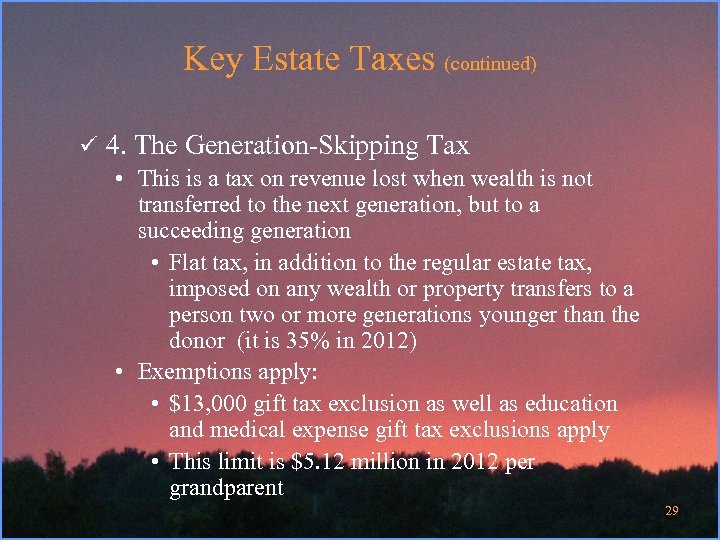
Key Estate Taxes (continued) ü 4. The Generation-Skipping Tax • This is a tax on revenue lost when wealth is not transferred to the next generation, but to a succeeding generation • Flat tax, in addition to the regular estate tax, imposed on any wealth or property transfers to a person two or more generations younger than the donor (it is 35% in 2012) • Exemptions apply: • $13, 000 gift tax exclusion as well as education and medical expense gift tax exclusions apply • This limit is $5. 12 million in 2012 per grandparent 29
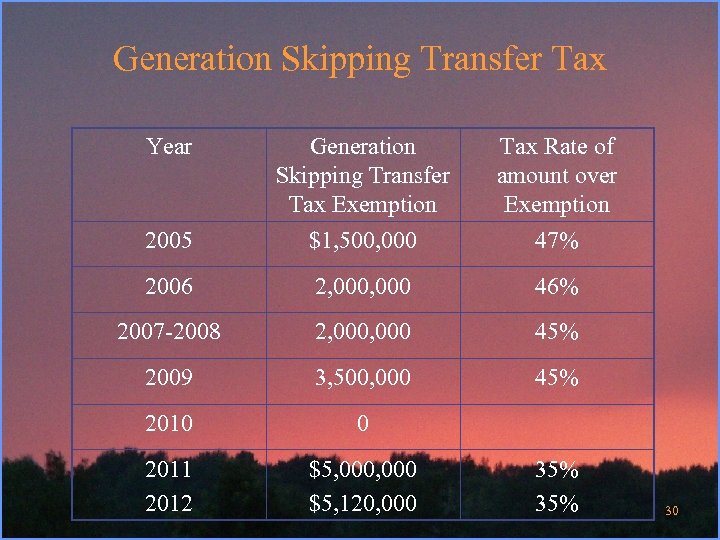
Generation Skipping Transfer Tax Year Generation Skipping Transfer Tax Exemption Tax Rate of amount over Exemption 2005 $1, 500, 000 47% 2006 2, 000 46% 2007 -2008 2, 000 45% 2009 3, 500, 000 45% 2010 0 2011 2012 $5, 000 $5, 120, 000 35% 30
Estate Planning Any questions on estate planning? 31
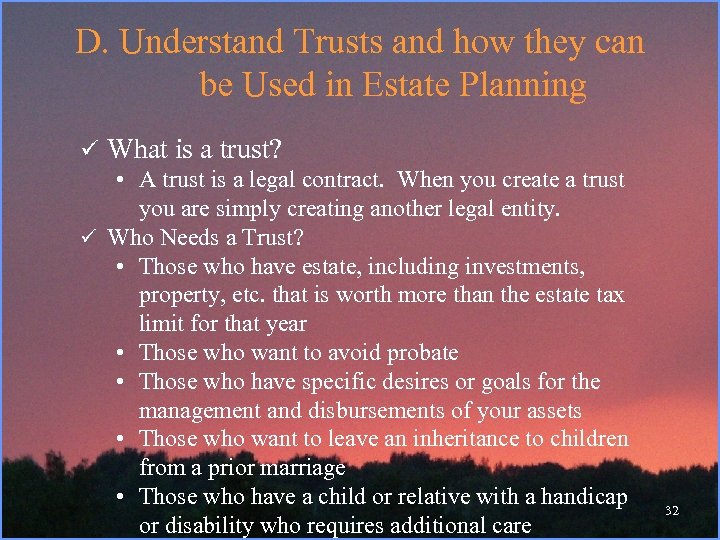
D. Understand Trusts and how they can be Used in Estate Planning ü What is a trust? • A trust is a legal contract. When you create a trust you are simply creating another legal entity. ü Who Needs a Trust? • Those who have estate, including investments, property, etc. that is worth more than the estate tax limit for that year • Those who want to avoid probate • Those who have specific desires or goals for the management and disbursements of your assets • Those who want to leave an inheritance to children from a prior marriage • Those who have a child or relative with a handicap or disability who requires additional care 32
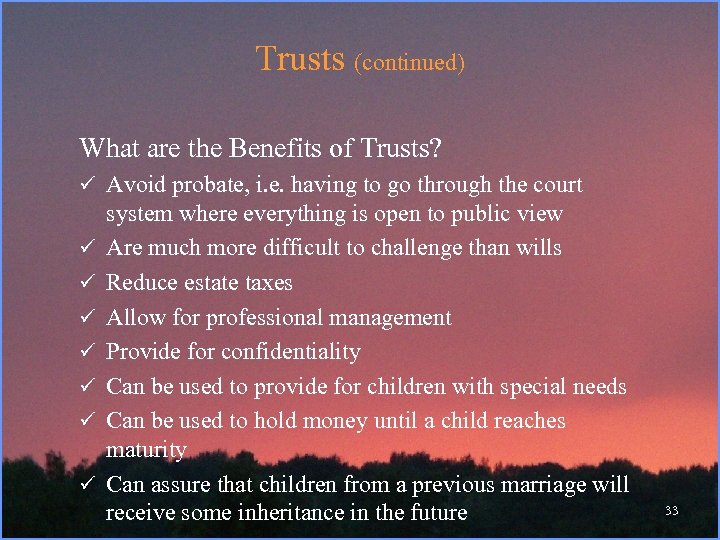
Trusts (continued) What are the Benefits of Trusts? ü Avoid probate, i. e. having to go through the court ü ü ü ü system where everything is open to public view Are much more difficult to challenge than wills Reduce estate taxes Allow for professional management Provide for confidentiality Can be used to provide for children with special needs Can be used to hold money until a child reaches maturity Can assure that children from a previous marriage will receive some inheritance in the future 33
Trusts (continued) ü What types of assets can trusts hold? • Real property: home, properties, real estate, land, out of state property, liability and title insurance, property taxes, transfer tax, rental real estate • Financial assets: credit cards, notes you owe, mortgages, loans, checking, savings, pay-on-death accounts, certificates of deposit, credit union accounts, safe deposit boxes, stocks, bonds, mutual funds, savings bonds • Real assets: boats, automobiles, motorcycles, recreational vehicles other vehicles • Insurance: life insurance, self-provided insurance • Businesses: sole proprietorships, limited partnerships, closelyheld corporation, subchapter S corporation, corporations, limited liability companies, general partnership interests, • Other assets: personal untitled property, copyrights, patents, royalties, oil and gas interests, club memberships, foreign assets. 34
Trusts (continued) ü What information do you need for a trust? • Grantor – the person who created the trust • Trustee – the person who will manage the trust • Successor Trustee – the person to succeeds the trustee should the trustee not be able to manage the trust • Beneficiaries – the recipients of the trust’s earnings or assets • Children’s Trusts – trusts for underage children • Guardian – the person who raises children • Children’s Trustee – the person who manages the children’s assets 35
Trusts (continued) ü What are the different types of trusts? • 1. Living Trust: • Assets placed in trust while you are still living • You can take them out and move them according to what you want to do • 2. Testamentary Trust: • Assets are placed in trust after you die • The trust is created after probate according to your will 36
1. Living Trusts ü What is a Revocable Living Trust? • It is the most common type of living trust. It is a trust which allows for unlimited control by the trust’s owner, because the owner retains title to all the assets in the trust. ü What are the advantages? • They do not pass through probate. • They provide greater ease and privacy of distribution upon death. ü What are their disadvantages • They do not provide any tax advantages. 37
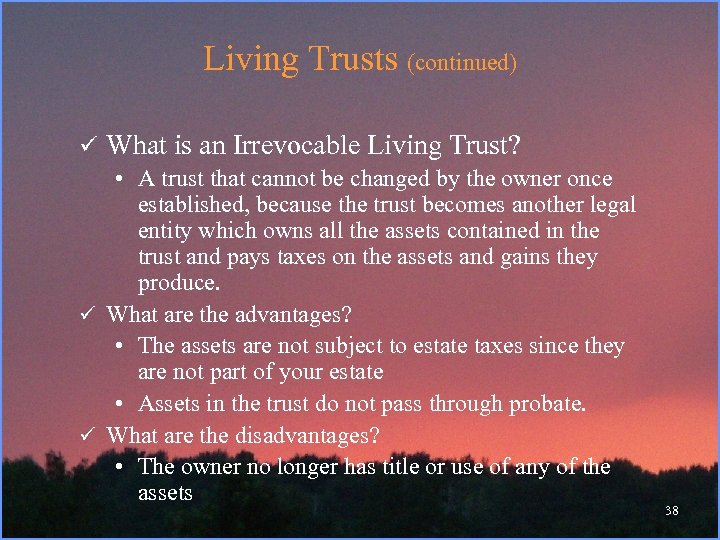
Living Trusts (continued) ü What is an Irrevocable Living Trust? • A trust that cannot be changed by the owner once established, because the trust becomes another legal entity which owns all the assets contained in the trust and pays taxes on the assets and gains they produce. ü What are the advantages? • The assets are not subject to estate taxes since they are not part of your estate • Assets in the trust do not pass through probate. ü What are the disadvantages? • The owner no longer has title or use of any of the assets 38
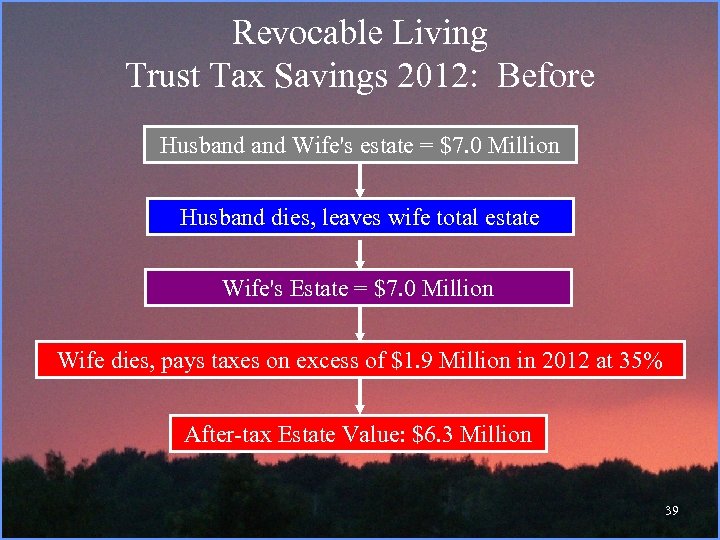
Revocable Living Trust Tax Savings 2012: Before Husband Wife's estate = $7. 0 Million Husband dies, leaves wife total estate Wife's Estate = $7. 0 Million Wife dies, pays taxes on excess of $1. 9 Million in 2012 at 35% After-tax Estate Value: $6. 3 Million 39
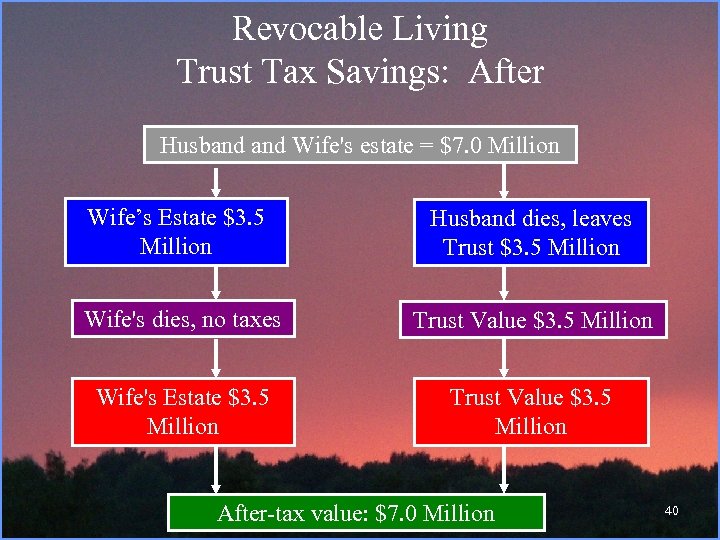
Revocable Living Trust Tax Savings: After Husband Wife's estate = $7. 0 Million Wife’s Estate $3. 5 Million Husband dies, leaves Trust $3. 5 Million Wife's dies, no taxes Trust Value $3. 5 Million Wife's Estate $3. 5 Million Trust Value $3. 5 Million After-tax value: $7. 0 Million 40
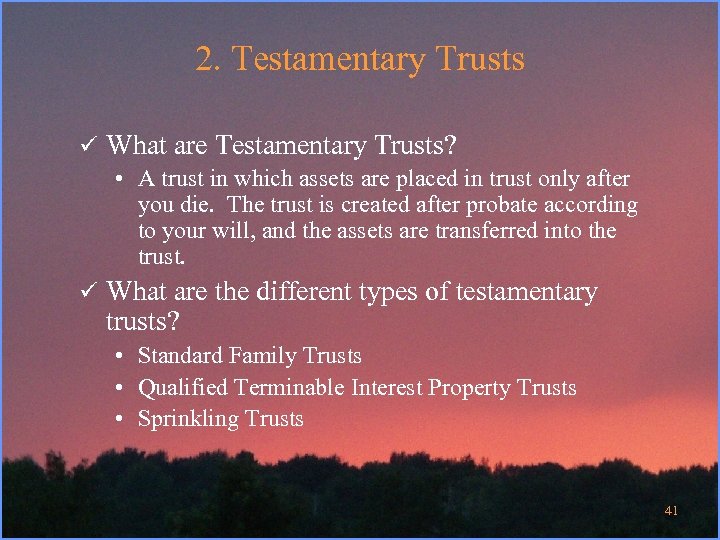
2. Testamentary Trusts ü What are Testamentary Trusts? • A trust in which assets are placed in trust only after you die. The trust is created after probate according to your will, and the assets are transferred into the trust. ü What are the different types of testamentary trusts? • Standard Family Trusts • Qualified Terminable Interest Property Trusts • Sprinkling Trusts 41
Testamentary Trusts (continued) ü What are Standard Family Trusts? • Standard Family trusts are testamentary trusts which hold the assets of the first spouse to die until the second spouse dies. • The spouse has access to income from the trust, or the trust principal, if necessary. • They reduce the estate of the second spouse so that the estate taxes can be reduced. 42
Testamentary Trusts (continued) ü What is a Q-TIP (Qualified Terminable Interest Property) Trust? • A Q-TIP Trust is a testamentary trust which provides a means of passing income to the surviving spouse without turning over control of the assets. • These trusts ensure that assets will be passed to your children upon the death of the surviving spouse. 43
Testamentary Trusts (continued) ü What is a Sprinkling Trust? • A Sprinkling Trust is a testamentary trust that distributes assets on a needs basis rather than according to some preset plan to a designated group of beneficiaries. 44
How do I set up a Trust? ü Consult with a qualified estate planning lawyer • Do your homework to make sure they are good ü Transfer assets to the trustee of the trust • A trust is worthless until there has been a transfer of asset 45
How much does a Trust cost? ü Costs will vary from lawyer to lawyer, but should include: • Reviewing your assets and their present title • Discussing your estate plan • Asking questions regarding your goals • Preparing your trust • Supervising the execution of the trust 46
What Cautions Should I Take? ü Consult with a lawyer or financial planner who is not trying to sell any products • Insist on identification and a description of qualifications, education, etc. in estate planning. ü Ask for time to consider your decision • Report high-pressure tactics, misrepresentations or fraud immediately ü Ask for a copy of any documents you sign • Know your cancellation rights ü Be wary of home solicitors who insist on receiving confidential and detailed information • Call the Better Business Bureau if you have 47
Questions ü Any questions on Trusts? 48
E. Understand the Importance of Wills and Probate Planning ü What is a will? • A will is a legal document which states how the state should distribute your assets upon your death. ü What happens if you don’t have a will? • If someone dies without a will, the legal term is called intestate. In this case, the state will determine, based on specific state laws, what assets will go to which people, regardless of the intentions of the deceased. 49
Wills and Probate (continued) ü Why Do You Need a Will? • So state law will not dictate the: • Distribution of your assets • Custody of your children • Care for those under your responsibility with special needs • To avoid a court-appointed administrator and its associated costs 50
Wills and Probate (continued) • Key Terms: • Will • A legal document that transfers an estate after death • Beneficiaries • The people who receive your property • Executor or personal representative • The person who is responsible for carrying out the provisions of the will • Guardian • The person who cares for minor children and manages their property 51
Wills and Probate (continued) ü What is Probate? • Probate is the process of distributing an estate's assets after death ü What are the purposes of the probate process? • Appoint an executor, if one is not named • Validate the will • Allow for challenges to the will • Oversee the distribution of assets • File a court report and close the estate 52
Wills and Probate (continued) ü What are the disadvantages of the probate process? • There are numerous costs and fees – legal fees, executor fees, court fees – that can run to 1% to 8% of the estate value • The process can be quite slow, especially if there are challenges to the will or tax problems 53
Wills and Probate (continued) ü The Basics of Writing a Will • Wills can be handwritten, computer generated, or oral • The safest way is to have a will drawn up by a lawyer • Most wills (holographic wills excepted) must be signed, witnessed by 2 or more people, and notarized 54
Wills and Probate (continued) ü The Basics of Writing a Will (continued) • Wills should be stored in a safe place; however, a safety deposit box is not always a good place because it may be sealed upon your death. • Note: Always tell someone you trust where your will is so it can be found upon your death. 55
Wills and Probate (continued) ü Requirements of a Valid Will • Mental competence • Under no undue influence from another person • Will must conform to the state laws 56
Updating or Changing Your Will – The Codicil ü The Codicil • Institutes minor changes in the original will • Must be signed, witnessed, and attached to the original will • Note: If the changes are major then a new will should be drafted. 57
Other Estate -- Planning Documents ü Durable power of attorney • Provides for someone to act on your behalf in the event you should become mentally or physically incapacitated. • This document is separate from the will and goes into effect before death. This document should be very specific as to which legal powers it transfers. 58
Other Estate -- Planning Documents ü Living will • It is a legal document that details your end-of-life wishes for health care • It is used when you are still alive but unable to make health care decisions for yourself • A living will states your wishes regarding medical treatment in the event of a terminal illness or injury ü Health care proxy • A health care proxy designates someone to make health care decisions should you be unable to do so for yourself. 59
Ways to Avoid Probate ü Joint ownership • Tenancy by the entirety • Joint tenancy with the right of survivorship • Tenancy in common – the will controls distribution of deceased’s share • Community property -- state law and will control distribution of the property 60
Ways to Avoid Probate (continued) ü Gifts • Exception for life insurance policies • Unlimited gift tax exclusion on payments made for medical and educational expenses • Charities ü Naming beneficiaries in contracts ü Trusts • • Living -- take effect before death Testamentary -- take effect upon death 61
Questions ü Any questions about wills? 62
A Last Word on Estate Planning ü Write a will • Even though you may have few assets, it is critical for your children ü Do it now! • Depending on estate size and other needs, get professional help with estate planning. ü Tell someone the location of your estate planning documents. 63
What Should You Do for 2012? ü If your estate is worth less than $5, 120, 000 you have no estate tax problems. • Just write your will • Even though Congress has not done something, in 2013 it will revert back to this level ü If you’re married and your estate value is above $10, 240, 000, to avoid taxes: • Take advantage of the tax-free estate transfer • Consider a standard family trust 64
What Should You Do for 2012 (continued) ü If you’re single and have an estate of over $5, 120, 000 or are married have an estate over $10, 240, 000: • Make sure you have sufficient to achieve all your goals should you live longer than expected • Make sure you have sufficient for all your possible medical and other concerns ü Remember, your first goal is to take care of yourself and your spouse. Then worry about your kids’ inheritance • Once these conditions are met, reduce the estate value: • Spend wisely, give money away, or give away life insurance 65
Wills and the Probate Process ü Any questions? 66
Summary ü The estate planning process consists of • 1. Determining what your estate is worth. • 2. Choosing your heirs and deciding what they receive. • 3. Determining the cash needs and estate taxes of the estate. • 4. Selecting and implementing your estate planning techniques to maximize goals and minimize taxes 67
Summary (continued) ü Other estate planning documents • Durable power of attorney • Living will • Letter of last instruction ü Types of trusts • Living trusts -- take effect before death • Testamentary trusts -- take effect upon death 68
Review of Objectives A. Do you understand the importance of Estate Planning and the Process? B. Do you understand how trusts can be used to your advantage? C. Do you understand the importance of Wills and Probate Planning? 69
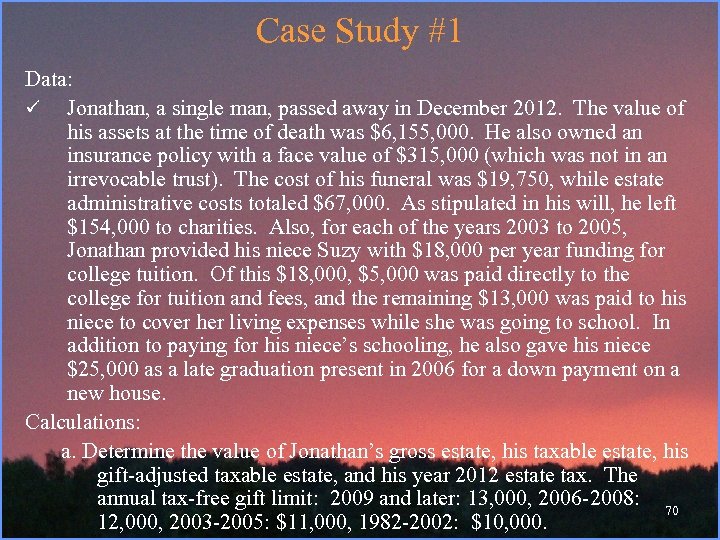
Case Study #1 Data: ü Jonathan, a single man, passed away in December 2012. The value of his assets at the time of death was $6, 155, 000. He also owned an insurance policy with a face value of $315, 000 (which was not in an irrevocable trust). The cost of his funeral was $19, 750, while estate administrative costs totaled $67, 000. As stipulated in his will, he left $154, 000 to charities. Also, for each of the years 2003 to 2005, Jonathan provided his niece Suzy with $18, 000 per year funding for college tuition. Of this $18, 000, $5, 000 was paid directly to the college for tuition and fees, and the remaining $13, 000 was paid to his niece to cover her living expenses while she was going to school. In addition to paying for his niece’s schooling, he also gave his niece $25, 000 as a late graduation present in 2006 for a down payment on a new house. Calculations: a. Determine the value of Jonathan’s gross estate, his taxable estate, his gift-adjusted taxable estate, and his year 2012 estate tax. The annual tax-free gift limit: 2009 and later: 13, 000, 2006 -2008: 70 12, 000, 2003 -2005: $11, 000, 1982 -2002: $10, 000.
Assets: $6, 155, 000 Insurance policy: $315, 000 Funeral cost: $19, 750 Estate administrative costs: $67, 000. Charities: $154, 000 Each of the past 3 years (20032005): $18, 000 per year funding for college tuition, of this, $5, 000 paid directly to the college 2006 graduation present: $25, 000 71
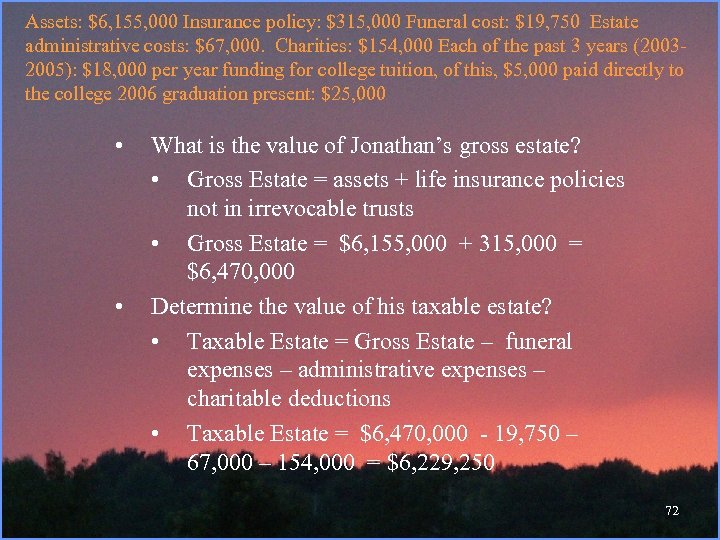
Assets: $6, 155, 000 Insurance policy: $315, 000 Funeral cost: $19, 750 Estate administrative costs: $67, 000. Charities: $154, 000 Each of the past 3 years (20032005): $18, 000 per year funding for college tuition, of this, $5, 000 paid directly to the college 2006 graduation present: $25, 000 • • What is the value of Jonathan’s gross estate? • Gross Estate = assets + life insurance policies not in irrevocable trusts • Gross Estate = $6, 155, 000 + 315, 000 = $6, 470, 000 Determine the value of his taxable estate? • Taxable Estate = Gross Estate – funeral expenses – administrative expenses – charitable deductions • Taxable Estate = $6, 470, 000 - 19, 750 – 67, 000 – 154, 000 = $6, 229, 250 72
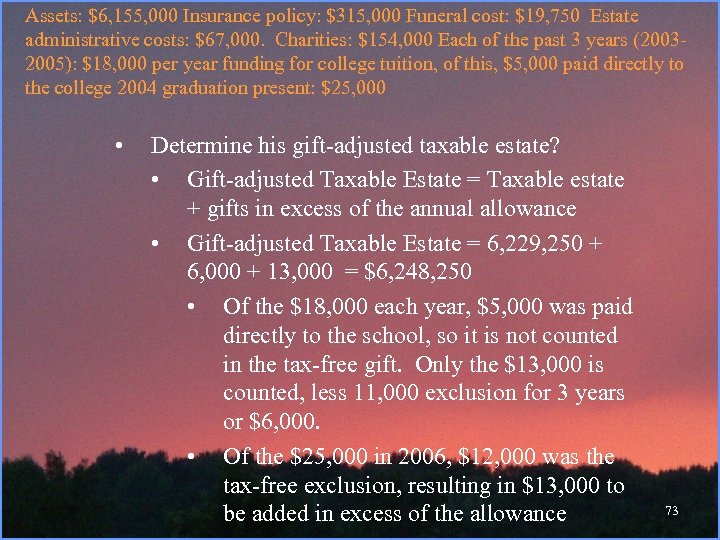
Assets: $6, 155, 000 Insurance policy: $315, 000 Funeral cost: $19, 750 Estate administrative costs: $67, 000. Charities: $154, 000 Each of the past 3 years (20032005): $18, 000 per year funding for college tuition, of this, $5, 000 paid directly to the college 2004 graduation present: $25, 000 • Determine his gift-adjusted taxable estate? • Gift-adjusted Taxable Estate = Taxable estate + gifts in excess of the annual allowance • Gift-adjusted Taxable Estate = 6, 229, 250 + 6, 000 + 13, 000 = $6, 248, 250 • Of the $18, 000 each year, $5, 000 was paid directly to the school, so it is not counted in the tax-free gift. Only the $13, 000 is counted, less 11, 000 exclusion for 3 years or $6, 000. • Of the $25, 000 in 2006, $12, 000 was the tax-free exclusion, resulting in $13, 000 to be added in excess of the allowance 73
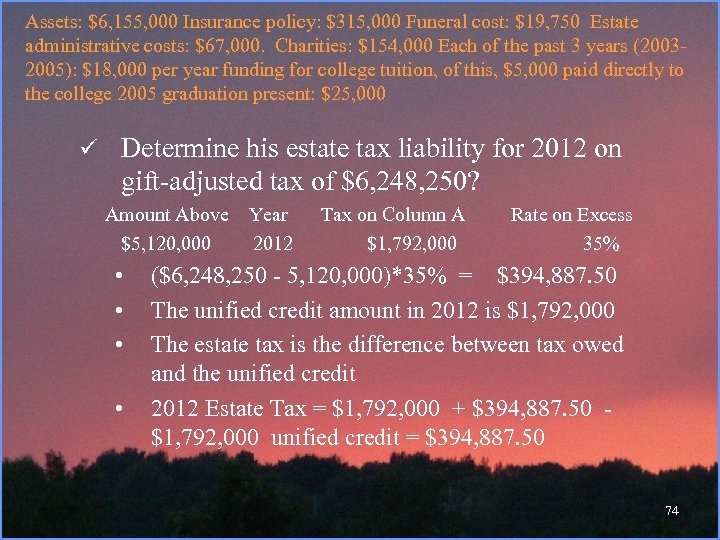
Assets: $6, 155, 000 Insurance policy: $315, 000 Funeral cost: $19, 750 Estate administrative costs: $67, 000. Charities: $154, 000 Each of the past 3 years (20032005): $18, 000 per year funding for college tuition, of this, $5, 000 paid directly to the college 2005 graduation present: $25, 000 ü Determine his estate tax liability for 2012 on gift-adjusted tax of $6, 248, 250? Amount Above Year $5, 120, 000 2012 • • Tax on Column A Rate on Excess $1, 792, 000 35% ($6, 248, 250 - 5, 120, 000)*35% = $394, 887. 50 The unified credit amount in 2012 is $1, 792, 000 The estate tax is the difference between tax owed and the unified credit 2012 Estate Tax = $1, 792, 000 + $394, 887. 50 - $1, 792, 000 unified credit = $394, 887. 50 74
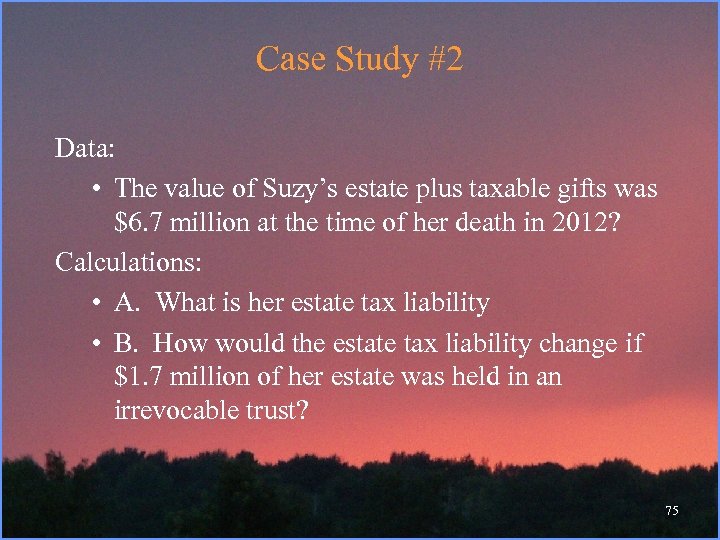
Case Study #2 Data: • The value of Suzy’s estate plus taxable gifts was $6. 7 million at the time of her death in 2012? Calculations: • A. What is her estate tax liability • B. How would the estate tax liability change if $1. 7 million of her estate was held in an irrevocable trust? 75
The value of Suzy’s estate plus taxable gifts was $6. 7 million at the time of her death in 2012? A. What is her estate tax liability B. How would the estate tax liability change if $1. 7 million of her estate were held in an irrevocable trust? 76
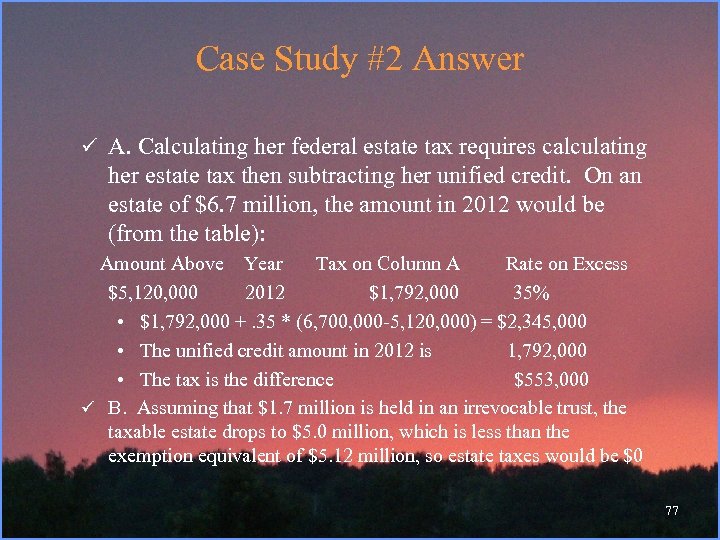
Case Study #2 Answer ü A. Calculating her federal estate tax requires calculating her estate tax then subtracting her unified credit. On an estate of $6. 7 million, the amount in 2012 would be (from the table): Amount Above Year Tax on Column A Rate on Excess $5, 120, 000 2012 $1, 792, 000 35% • $1, 792, 000 +. 35 * (6, 700, 000 -5, 120, 000) = $2, 345, 000 • The unified credit amount in 2012 is 1, 792, 000 • The tax is the difference $553, 000 ü B. Assuming that $1. 7 million is held in an irrevocable trust, the taxable estate drops to $5. 0 million, which is less than the exemption equivalent of $5. 12 million, so estate taxes would be $0 77
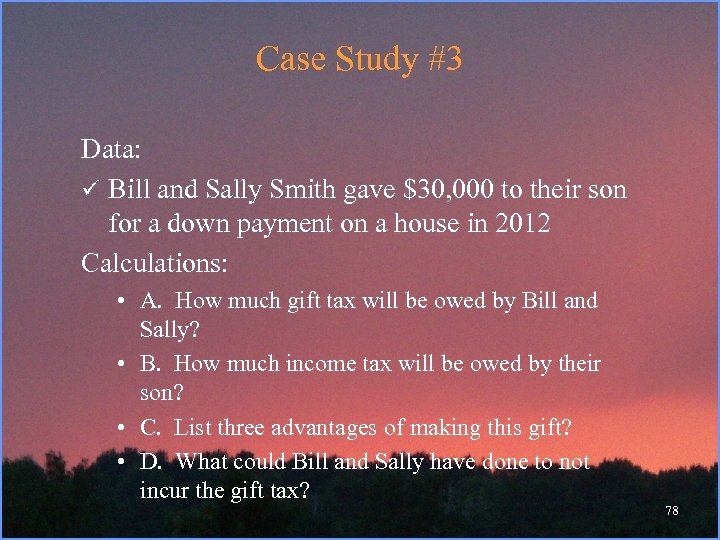
Case Study #3 Data: ü Bill and Sally Smith gave $30, 000 to their son for a down payment on a house in 2012 Calculations: • A. How much gift tax will be owed by Bill and Sally? • B. How much income tax will be owed by their son? • C. List three advantages of making this gift? • D. What could Bill and Sally have done to not incur the gift tax? 78
Bill and Sally Smith gave $30, 000 to their son for a down payment on a house. A. . How much gift tax will be owed by Bill and Sally? B. How much income tax will be owed by their son? C. List three advantages of making this gift? D. What could they have done? 79
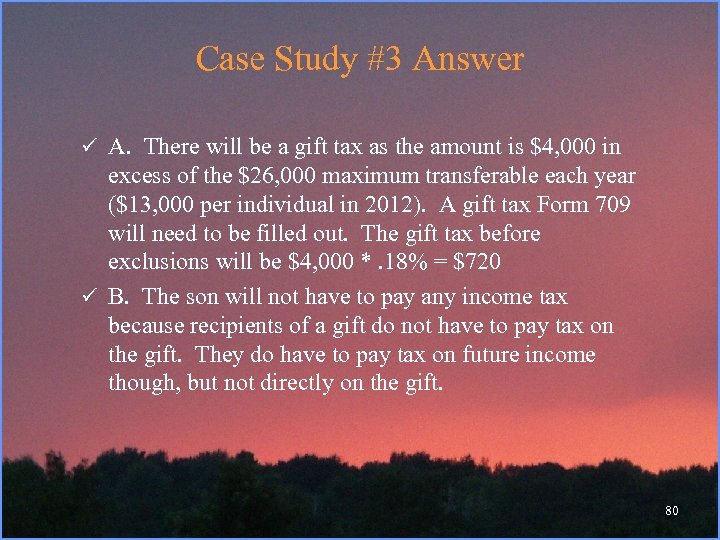
Case Study #3 Answer ü A. There will be a gift tax as the amount is $4, 000 in excess of the $26, 000 maximum transferable each year ($13, 000 per individual in 2012). A gift tax Form 709 will need to be filled out. The gift tax before exclusions will be $4, 000 *. 18% = $720 ü B. The son will not have to pay any income tax because recipients of a gift do not have to pay tax on the gift. They do have to pay tax on future income though, but not directly on the gift. 80
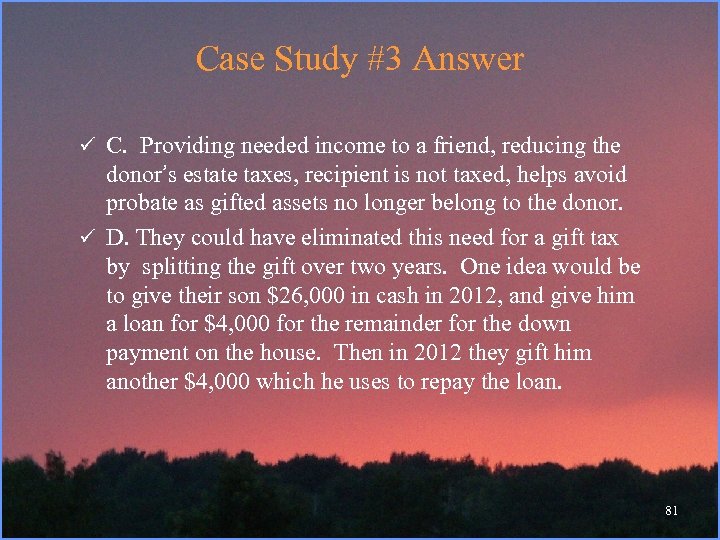
Case Study #3 Answer ü C. Providing needed income to a friend, reducing the donor’s estate taxes, recipient is not taxed, helps avoid probate as gifted assets no longer belong to the donor. ü D. They could have eliminated this need for a gift tax by splitting the gift over two years. One idea would be to give their son $26, 000 in cash in 2012, and give him a loan for $4, 000 for the remainder for the down payment on the house. Then in 2012 they gift him another $4, 000 which he uses to repay the loan. 81
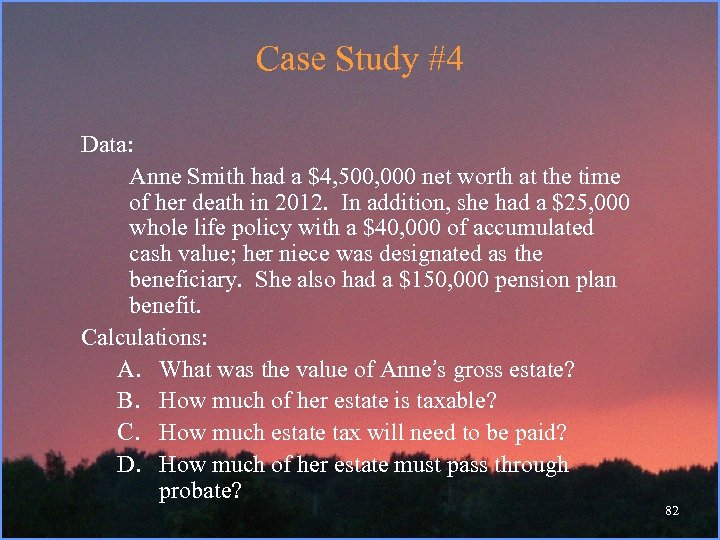
Case Study #4 Data: Anne Smith had a $4, 500, 000 net worth at the time of her death in 2012. In addition, she had a $25, 000 whole life policy with a $40, 000 of accumulated cash value; her niece was designated as the beneficiary. She also had a $150, 000 pension plan benefit. Calculations: A. What was the value of Anne’s gross estate? B. How much of her estate is taxable? C. How much estate tax will need to be paid? D. How much of her estate must pass through probate? 82
Anne Smith had a $4, 500, 000 net worth at death in 2012. In addition, she had a $250, 000 whole life policy with a $40, 000 of accumulated cash value; her niece was designated as the beneficiary. She also had a $150, 000 pension plan benefit. A. What was the value of Anne’s gross estate? B. How much of her estate is taxable? C. How much estate tax will need to be paid? D. How much of her estate must pass through probate? 83
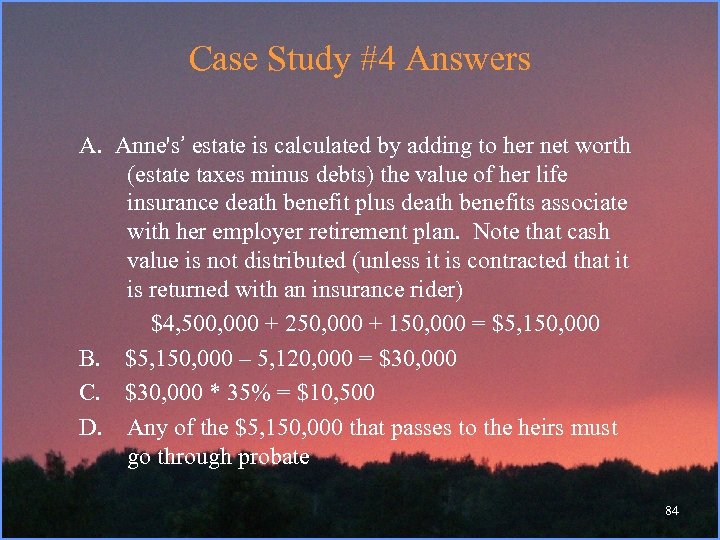
Case Study #4 Answers A. Anne's’ estate is calculated by adding to her net worth (estate taxes minus debts) the value of her life insurance death benefit plus death benefits associate with her employer retirement plan. Note that cash value is not distributed (unless it is contracted that it is returned with an insurance rider) $4, 500, 000 + 250, 000 + 150, 000 = $5, 150, 000 B. $5, 150, 000 – 5, 120, 000 = $30, 000 C. $30, 000 * 35% = $10, 500 D. Any of the $5, 150, 000 that passes to the heirs must go through probate 84
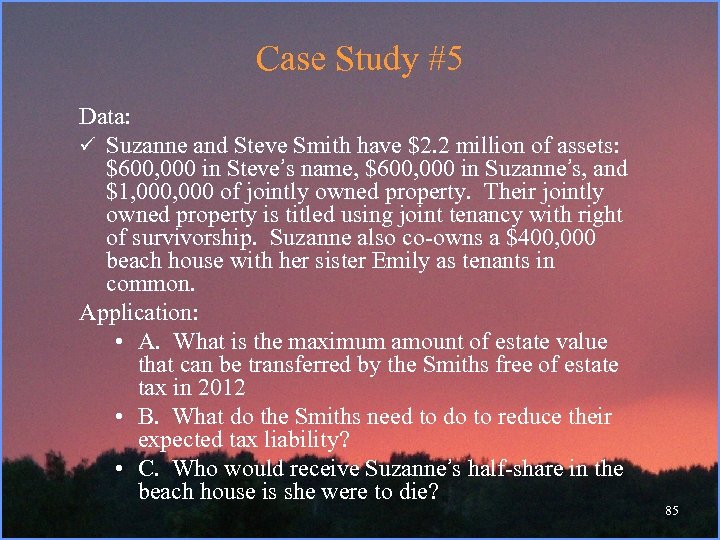
Case Study #5 Data: ü Suzanne and Steve Smith have $2. 2 million of assets: $600, 000 in Steve’s name, $600, 000 in Suzanne’s, and $1, 000 of jointly owned property. Their jointly owned property is titled using joint tenancy with right of survivorship. Suzanne also co-owns a $400, 000 beach house with her sister Emily as tenants in common. Application: • A. What is the maximum amount of estate value that can be transferred by the Smiths free of estate tax in 2012 • B. What do the Smiths need to do to reduce their expected tax liability? • C. Who would receive Suzanne’s half-share in the beach house is she were to die? 85
S and S have $2. 2 million of assets: $600, 000 in Steve’s name, $600, 000 in Suzanne’s, and $1, 000 of jointly owned property with joint tenancy with right of survivorship. Suzanne also co-owns a $400, 000 beach house with her sister Emily as tenants in common. A. What is the maximum amount of estate value that can be transferred by the Smiths free of estate tax. B. What do the Smiths need to do to reduce their expected tax liability? C. Who would receive Suzanne’s half-share in the beach house is she were to die? 86
Case Study #5 Answers ü A. The Smiths could jointly transfer a total of $10, 240, 000 before incurring federal estate tax in 2011. ü B. The Smiths should re-title their ownership of the property and put it in a trust to take advantage of taxes. In this way they can take advantage of a standard family trust and gift giving. ü C. Suzanne’s half share of the beach house would go to whoever she names in her will. If she dies in testate, state law will determine how her share in the beach house is transferred. 87
Скачать презентацию Personal Finance Another Perspective Estate Planning 1 Basics
e7909ece66c2a930e1d960dcf06129a0.ppt