


 Скачать презентацию PERSONAL COMMUNICATION SYSTEMS 3 G IMT 2000 Ian
2d7bf8b5d579df2ca81a47bc6ca5ab4d.ppt
- Количество слайдов: 37
 PERSONAL COMMUNICATION SYSTEMS: 3 G (IMT 2000) Ian F. Akyildiz Broadband & Wireless Networking Laboratory School of Electrical and Computer Engineering Georgia Institute of Technology Tel: 404 -894 -5141; Fax: 404 -894 -7883 Email: ian@ece. gatech. edu Web: http: //www. ece. gatech. edu/research/labs/bwn
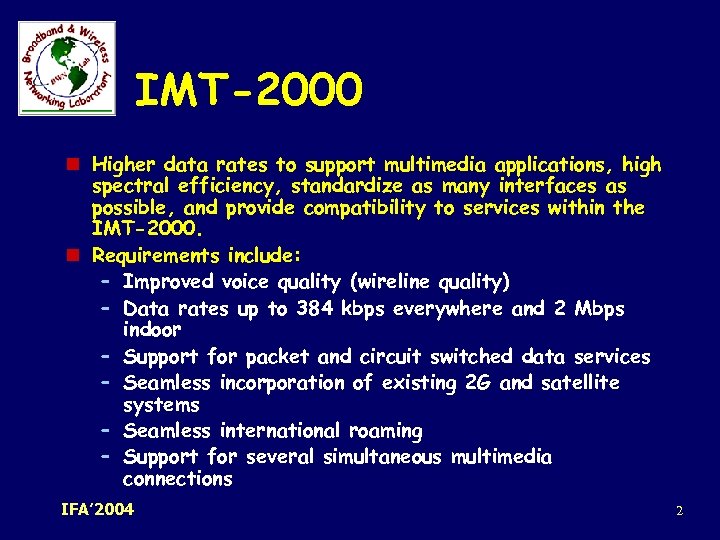 IMT-2000 n Higher data rates to support multimedia applications, high spectral efficiency, standardize as many interfaces as possible, and provide compatibility to services within the IMT-2000. n Requirements include: – Improved voice quality (wireline quality) – Data rates up to 384 kbps everywhere and 2 Mbps indoor – Support for packet and circuit switched data services – Seamless incorporation of existing 2 G and satellite systems – Seamless international roaming – Support for several simultaneous multimedia connections IFA’ 2004 2
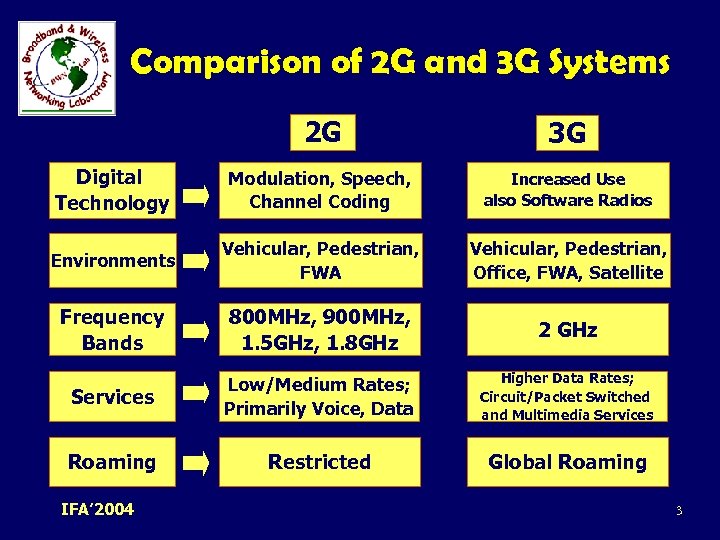 Comparison of 2 G and 3 G Systems 2 G 3 G Digital Technology Modulation, Speech, Channel Coding Increased Use also Software Radios Environments Vehicular, Pedestrian, FWA Vehicular, Pedestrian, Office, FWA, Satellite Frequency Bands 800 MHz, 900 MHz, 1. 5 GHz, 1. 8 GHz 2 GHz Services Low/Medium Rates; Primarily Voice, Data Higher Data Rates; Circuit/Packet Switched and Multimedia Services Roaming Restricted Global Roaming IFA’ 2004 3
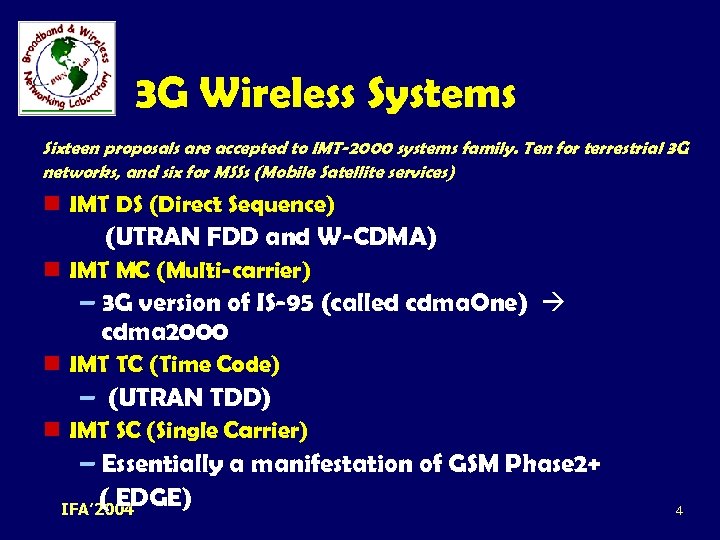 3 G Wireless Systems Sixteen proposals are accepted to IMT-2000 systems family. Ten for terrestrial 3 G networks, and six for MSSs (Mobile Satellite services) n IMT DS (Direct Sequence) (UTRAN FDD and W-CDMA) n IMT MC (Multi-carrier) – 3 G version of IS-95 (called cdma. One) cdma 2000 n IMT TC (Time Code) – (UTRAN TDD) n IMT SC (Single Carrier) – Essentially a manifestation of GSM Phase 2+ ( EDGE) IFA’ 2004 4
 Proposals for 3 G Standards The most important IMT-2000 Systems IMT-DS and IMT-MC n W-CDMA (IMT-DS & TC): – – Developed by the 3 G Partnership Project (3 GPP) UTRA TDD and UTRA-FDD Backers Ericsson, Nokia, NTT Do. Co. Mo. Korea TTA II is similar to W-CDMA n cdma 2000 (IMT-MC): – Compatible with IS-95 – Further developed by the 3 G Partnership Project Number 2 (3 GPP 2) – Backers Qualcomm, Lucent, and Motorola. – Korea TTA I is similar to cdma 2000 IFA’ 2004 5
 3 G ARCHITECTURE n Hierarchical Cell Structure n Global Roaming n Radio Spectrum IFA’ 2004 6
 Key Features & Objectives of 3 G n Global System (all existing systems & terminal types) n Worldwide market place & Off-the-shelf compatible equipment n Worldwide common frequency band & roaming n Audio, video and data services including packet Data & multimedia Services n High service quality n Flexible radio bearers IFA’ 2004 7
 Key Features & Objectives of 3 G n Bandwidth-On-Demand Capabilities (low rate paging messages high rate video or file transfer) n Asymmetrical channels n Improved security n Distributed & coherent network management n Compatibility of services within IMT 2000 n Scalable IFA’ 2004 8
 Objectives of 3 G l High-quality speech using low bit rates l Advanced addressing mechanisms l Virtual home environment for service l Seamless indoor, outdoor and far door l Dual mode/band of operation of GSM/UMTS in one network l Roaming between GSM and UMTS networks IFA’ 2004 9
 UMTS n UMTS (Universal Mobile Telecommunications System) is the European version of a 3 rd Generation (3 G) mobile communication system. – It is proposed by 3 GPP (3 rd generation partnership project). – It includes two parts: UTRAN (Universal Terrestrial Radio Access Network) and the Core network inherited from GSM (Global System for Mobile Communications). n UMTS is a wideband, circuit- and packet-based transmission systems of text, digitized voice, video, and multimedia with data rates up to 2 Mbps (possibly higher). IFA’ 2004 10
 UMTS Services and Their Relationship to the Internets Service Category Session Type Protocols Internet Elements Location-based info- and entertainment WWW HTTP, WML, ISP, portal, c. HTML, x. HTML servers Intranet access (mobile VPN), mobile office, mobile commerce All typestransparent tunnel IP, higher layers transparent ISP, firewall server, corporate portal Internet access All typestransparent tunnel IP, higher layers transparent ISP, portal Multimedia messaging SMS, e-mail, downloading SMTP, SMS, IP ISP, email, SMSserver Audio, video, download File transfer, streaming ISP, portal, database server IFA’ 2004 Voice, real-time MP 3, MPEG-4, FTP, IP-based SIP Interactive/dialo SIP Media gateway 11
 Data rate and Spectrum n Maximum data rate and maximum speed for different hierarchical layer – Macrolayer: 144 kbps with max. speed of 500 km/h. – Microlayer: 384 kbps with max speed of 120 km/h – Picolayer: 2 Mbps with 10 km/h n Bit Error Rate (BER) – Real-time applications: 10 -3 to 10 -7 with maximum constant delay: 20 ms to 300 ms – No real-time applications: 10 -5 to 10 -8 with maximum delay >= 150 ms. n Spectrum: 1900 MHz-2025 MHz, and 2110 -2200 MHz – FDD (macro- and micro- cells: uplink is from 1920 MHz to 1980 MHz, downlink is from 2110 MHz to 2170 MHz – TDD (pico- cells: not divided by use of different frequency carriers (not suitable for large prop delays). IFA’ 2004 12
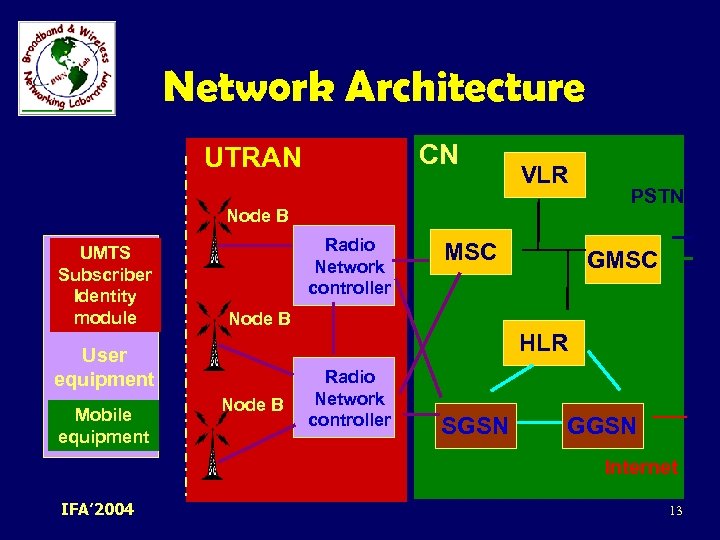 Network Architecture CN UTRAN VLR Node B UMTS Subscriber Identity module Radio Network controller GMSC ISDN Node B HLR User equipment Mobile equipment MSC PSTN Node B Radio Network controller SGSN GGSN Internet IFA’ 2004 13
 Radio Network Controller (RNC) n One RNC controls one or more Node Bs. n It may be connected via Iu interface to an MSC (Iu. CS), or to an SGSN via Iu (Iu. PS). n The interface between RNCs (Iur) is logical interface, and a direct physical connection does not necessarily exist. n An RNC is comparable to a base station controller (BSC) in GSM networks. IFA’ 2004 14
 RNC Functions n n n n n Iub (Node B and RNC) transport resources management Control of Node B logical O&M resources System information management and scheduling Traffic management of common channels Soft handover Power control for uplink and downlink Admission control Traffic management of shared channels Macro diversity combining/splitting of data streams transferred over several Node Bs. IFA’ 2004 15
 Node B n Node B is the UMTS equivalent of a base station transceiver. It may support one or more cells, although in general only one cell one Node B. n It is a logical terminal and the base station is often used for physical entity. n Functions – – – Mapping of Node B logical resources onto hardware resources Uplink power control Reporting of uplink interference measurements and downlink power information – Contains the air interface physical layer, it has to perform many functions such as RF processing, modulations, coding, and so on. IFA’ 2004 16
 WCDMA Air Interface n In UMTS, the UTRAN is used to keep the mobility management (MM) and connection management (CM) layers independent of the air interface radio technology n This idea is realized as the concepts of access stratum (AS) and nonaccess stratum (NAS) – AS: functional entity that includes radio access protocols between the user equipment (UE) and the UTRAN (terminate here). – NAS: includes core network (CN) protocols between the UE and the CN itself. n The NAS protocols can be kept the same, thus, the GSM’s MM and CM resources are used almost unchanged in 3 G NAS. IFA’ 2004 17
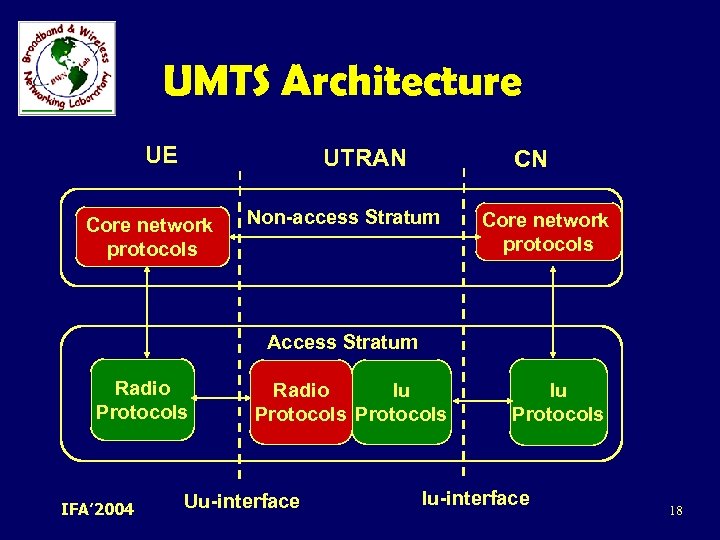 UMTS Architecture UE UTRAN Core network protocols CN Non-access Stratum Core network protocols Access Stratum Radio Protocols IFA’ 2004 Radio lu Protocols Uu-interface lu Protocols Iu-interface 18
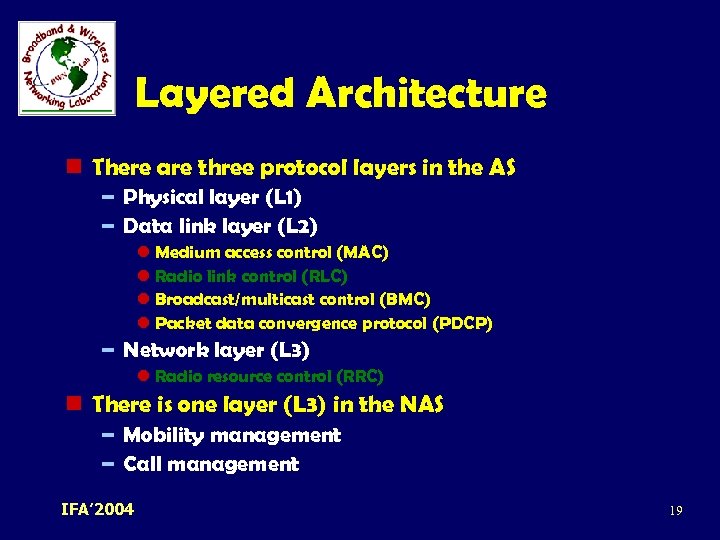 Layered Architecture n There are three protocol layers in the AS – Physical layer (L 1) – Data link layer (L 2) l Medium access control (MAC) l Radio link control (RLC) l Broadcast/multicast control (BMC) l Packet data convergence protocol (PDCP) – Network layer (L 3) l Radio resource control (RRC) n There is one layer (L 3) in the NAS – Mobility management – Call management IFA’ 2004 19
 RLC Services These functions are provided to upper layers: n Segmentation and reassembly of higher-layer PDUs (Protocol Data Unit) into/from smaller RLC payload units n Padding n Transfer of user data n Error corrections n In-sequence delivery of higher-layer PDUs n Ciphering n Sequence number check IFA’ 2004 20
 RLC Functions These functions (for itself) are supported by the RLC: n Segmentation and reassembly of higher-layer PDUs (Protocol Data Unit) into/from smaller RLC payload units n Padding n Transfer of user data n Error corrections n In-sequence delivery of higher-layer PDUs n Flow control n Ciphering n Sequence number check IFA’ 2004 21
 RRC Services n General control: this is an information broadcast service. The information transferred in unacknowledged, and it is broadcast to all mobiles within a certain area. n Notification: This includes paging and notification broadcast services. – The paging services broadcasts paging information in a certain geographical area, but it is addressed to a specific UE or UEs. – The notification broadcast service is defined to provide information broadcast to all UEs in a cell or cells. n Dedicated control: This service includes the establishment and release of a connection and transfer of messages using this connection. IFA’ 2004 22
 RRC Functions These functions (for itself) are supported by the RRC: n n n Initial cell selection and cell reselection Broadcast of information Reception of paging and notification messages Establishment, maintenance, and release of RRC connections Establishment, reconfiguration, and release of radio bearers Assignment, reconfiguration, and release of radio resources for the RRC connection Handover Measurement control Power control Security mode control Qo. S control IFA’ 2004 23
 Transport Channels in UTRAN n Common Transport Channel Types – Random Access Channel (RACH) – ODMA (Opportunity Driven Multiple Access) Random Access Channel (ORACH) – Common Packet Channel (CPCH) – Forward Access Channel (FACH) – Downlink Shared Channel (DSCH) – Uplink Shared Channel (USCH) – Broadcast Channel (BCH) – Paging Channel (PCH) n Dedicated Transport Channel Types – Dedicated Channel (DCH) – Fast Uplink Signaling Channel (FAUSCH) – ODMA Dedicated Channel (ODCH) IFA’ 2004 24
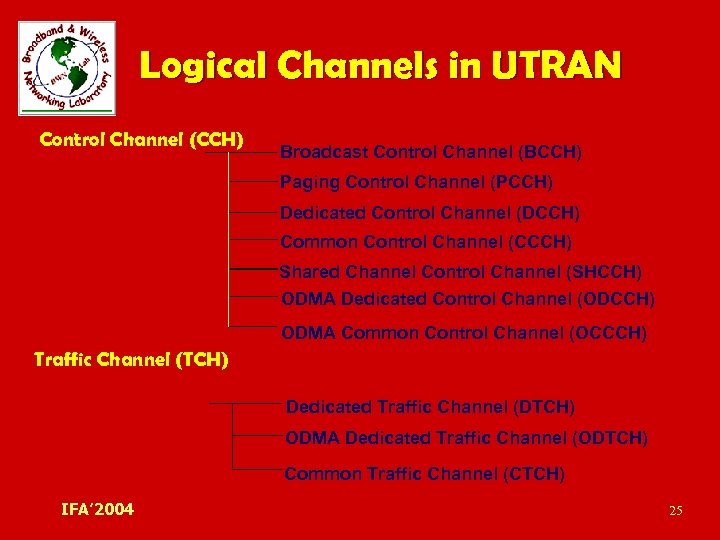 Logical Channels in UTRAN Control Channel (CCH) Broadcast Control Channel (BCCH) Paging Control Channel (PCCH) Dedicated Control Channel (DCCH) Common Control Channel (CCCH) Shared Channel Control Channel (SHCCH) ODMA Dedicated Control Channel (ODCCH) ODMA Common Control Channel (OCCCH) Traffic Channel (TCH) Dedicated Traffic Channel (DTCH) ODMA Dedicated Traffic Channel (ODTCH) Common Traffic Channel (CTCH) IFA’ 2004 25
 Quality of Services Classes n The UMTS allows the UEs to negotiate the Qo. S parameters for a radio bearer (RB). n Negotiation – The procedure is always initiated by the application in the UE. – It sends a request defining the resources it needs – The network checks whether it can provide the requested resources. – It can either grant the requested resources, offer a small amount of resources, or reject the request. – The UE can either accept or reject the modified offer. – It is also possible to renegotiate these parameters if the application requirements change or resource status change. IFA’ 2004 26
 Qo. S Classes (2) n There are four types of Qo. S classes – Conversational real-time class such as voice traffic – Interactive class (best-effort) such as web browsing – Streaming real-time class such as streaming video – Background class (best-effort) such as emails. IFA’ 2004 27
 Conversational Real-Time Services n Bidirectional and more or less symmetric n Technically the most challenging class – Very short delay is acceptable – Traditional retransmission protocols (ARQ) cannot be easily used. Instead, forward-error-correction (FEC) must be used. – Small delay requirements means also that buffers cannot be used in receiving end to smooth the variations in delay (jitter). n Some errors are acceptable because people cannot sense small errors in voice or video information. IFA’ 2004 28
 Interactive Services n A user requests data from a remote server, and the response contains the requested data. – Web browsing, e-shopping, and database inquires. n Difference between conversational and interactive services – The data traffic in the conversational class is symmetric, whereas in the interactive class, the traffic is highly asymmetric. – Timing requirements are not quite so strict with interactive services (up to 4 seconds) as they are for conversational services (a few hundred of ms). – Interactive services do not tolerate any more transmission errors than conversational services. n With the relaxation of delay requirements, the goal of less errors is easier to achieve with interactive services. IFA’ 2004 29
 Streaming Services n Typically includes video and audio applications. n Differences from interactive services: – The data transferring is almost totally one-way and continuous: highly asymmetric. – There are some strict delay variation requirements for the data, which are presented to the user, whereas delay variation is not really a problem with interactive services. – The requirements for maximum delay could be as long as 10 seconds. – The only data traffic in the opposite direction ( usually in the uplink) consists of a few control signals like starting and stopping. – The incoming data packets are buffered to smooth delay variation. n This class is provided through packet-switched networks. IFA’ 2004 30
 Background Services n These services do not have precise delay requirements at all (fax and SMS). n However, it may use timers to make sure that the data transfer has not stalled altogether. n The data should be error free, but it is especially easy to achieve in this case. Because there are no time constraints. n Retransmission protocol will be used, but it must also be efficient. n Delay variation is not considered with background services. The data are presented to the user only after the whole file has been received correctly. n The bandwidth requirement is not large in either direction. IFA’ 2004 31
 RRC Connection Procedures n The UTRAN separates the concepts of a radio connection from a radio bearer (RB). – A radio connection is created first, and then the network can create one or more RBs independently of the radio connection. – An RB can also exist without a dedicated radio connection. In this case, the RB uses the common channels. n An RRC connection implies that a radio connection exists, but this connection can use either dedicated or common resources. – An RRC connection is a logical concept, and radio connection is a physical concept. – The physical entity implements and enables the logical concepts. – A dedicated connection allocates the resource exclusively to one user, so common channels should be used whenever possible. IFA’ 2004 32
 RRC Establishment/Release n RRC connection establishment – It is always initiated by the UE, even with a mobileterminated call (e. g. , paging). – The UE initiates this procedure, but the UTRAN controls it. It may decide that no radio resources can be allocated for the UE, and respond with an RRC connection reject message. n Signaling connection establishment – The RRC connection establishment procedure is used by the higher layer; that is, by the NAS. – All higher-layer signaling messages, including the initial messages are relayed through the radio interface. n RRC connection release – The normal procedure is finished through a dedicated channel (DCH). The PDU here are sent in unacknowledged mode. IFA’ 2004 33
 Radio Bearer Procedures n Radio connection and an RB are two separate concepts in UMTS. – Radio connection is a static concept. It is established once, and survives until it is released. There is only one radio connection per terminal. – The RB defines what kind of properties this radio connection has. There may be several RBs on one radio connection, each having different capabilities for data transfer. The capabilities are based on the Qo. S parameters. – The RBs are dynamic and can be reconfigured. IFA’ 2004 34
 Radio Bearer Procedures (2) – It is possible to have an RB without a dedicated radio connection l. Circuit-switched bearers or bearers using rt services need dedicated radio channels to meet their strict delay requirements. l. Packet-switched bearers or bearers using nrt services, often do not need a permanent association to a dedicated radio resource. IFA’ 2004 35
 Radio Bearer establishment Radio Bearer release n An RB establishment is always initiated by the UTRAN. This because each RB uses some radio resources, and only the network knows what kind of resources it can grant to a UE. n At the RRC level, the signaling is simple: the UTRAN sends a radio bearer setup message, and the UE responds with a radio bearer setup complete. n Interlayer signaling can be quite different depending on the requested Qo. S parameter and whethere is already a suitable physical channel in place. n When an RB is released, the physical channel can be modified or released together depending on whether it can be “reused” after the RB release. IFA’ 2004 36
 Control of Requested Qo. S n The UTRAN air interface is very flexible, which allows for the dynamic allocation of system resources. n In the connected mode, the UE may be required to perform traffic volume measurements in its MAC layer. If the UE suspects that the present configuration is not the optimal one, it sends a measurement report to the network. n The network can trigger a channel-reconfiguration procedure. – Increased data – Decreased data IFA’ 2004 37