 Скачать презентацию Permutations and Combinations CS 202 Epp section 6
2cbda159db3f08fae33b1eda9e57e332.ppt
- Количество слайдов: 57



Permutations and Combinations CS 202 Epp section 6. 4 1
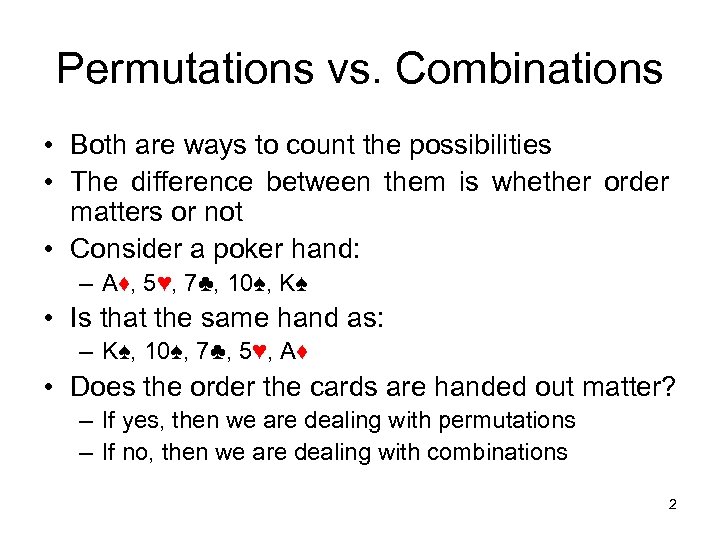
Permutations vs. Combinations • Both are ways to count the possibilities • The difference between them is whether order matters or not • Consider a poker hand: – A♦, 5♥, 7♣, 10♠, K♠ • Is that the same hand as: – K♠, 10♠, 7♣, 5♥, A♦ • Does the order the cards are handed out matter? – If yes, then we are dealing with permutations – If no, then we are dealing with combinations 2
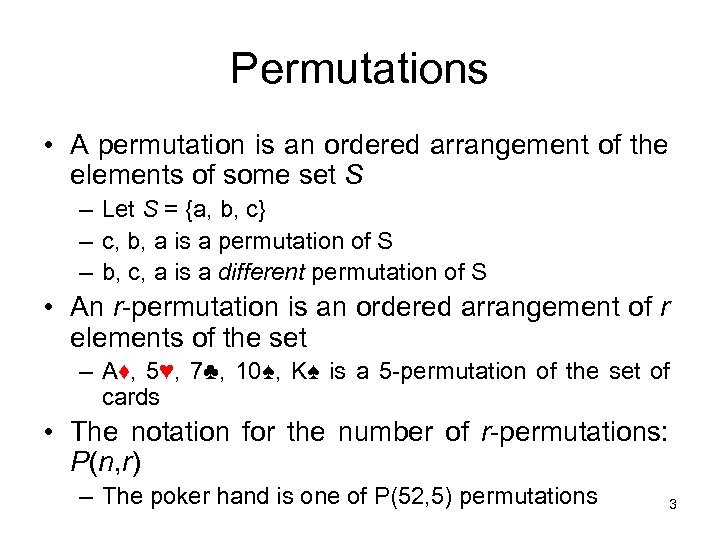
Permutations • A permutation is an ordered arrangement of the elements of some set S – Let S = {a, b, c} – c, b, a is a permutation of S – b, c, a is a different permutation of S • An r-permutation is an ordered arrangement of r elements of the set – A♦, 5♥, 7♣, 10♠, K♠ is a 5 -permutation of the set of cards • The notation for the number of r-permutations: P(n, r) – The poker hand is one of P(52, 5) permutations 3
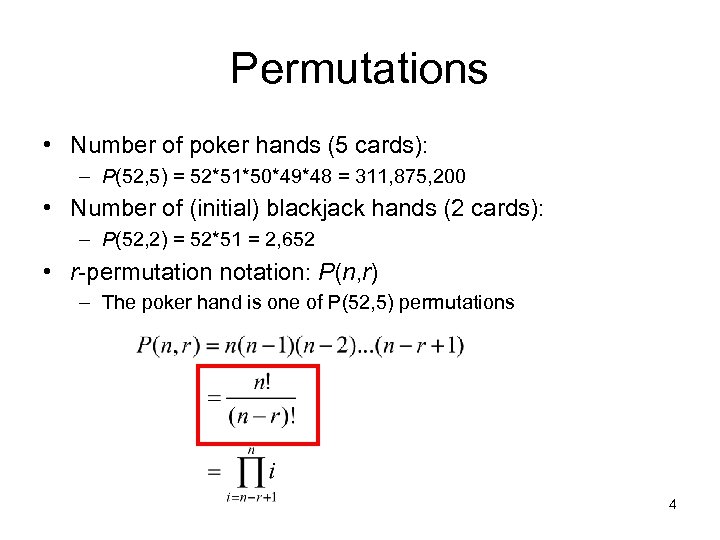
Permutations • Number of poker hands (5 cards): – P(52, 5) = 52*51*50*49*48 = 311, 875, 200 • Number of (initial) blackjack hands (2 cards): – P(52, 2) = 52*51 = 2, 652 • r-permutation notation: P(n, r) – The poker hand is one of P(52, 5) permutations 4
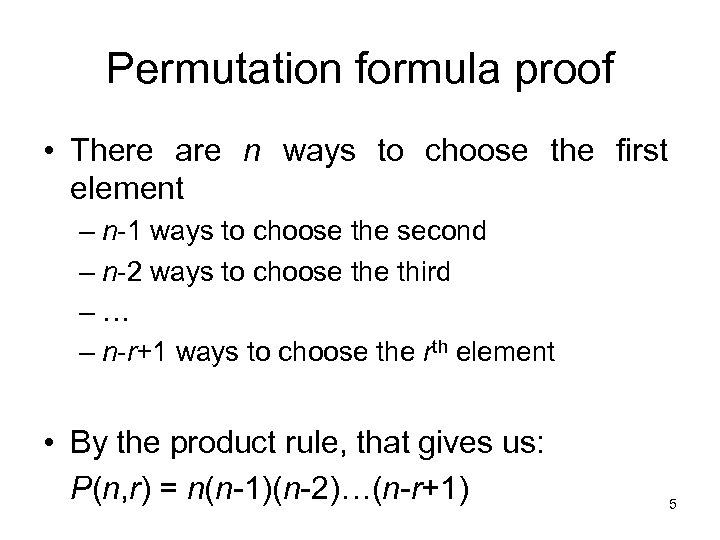
Permutation formula proof • There are n ways to choose the first element – n-1 ways to choose the second – n-2 ways to choose third –… – n-r+1 ways to choose the rth element • By the product rule, that gives us: P(n, r) = n(n-1)(n-2)…(n-r+1) 5
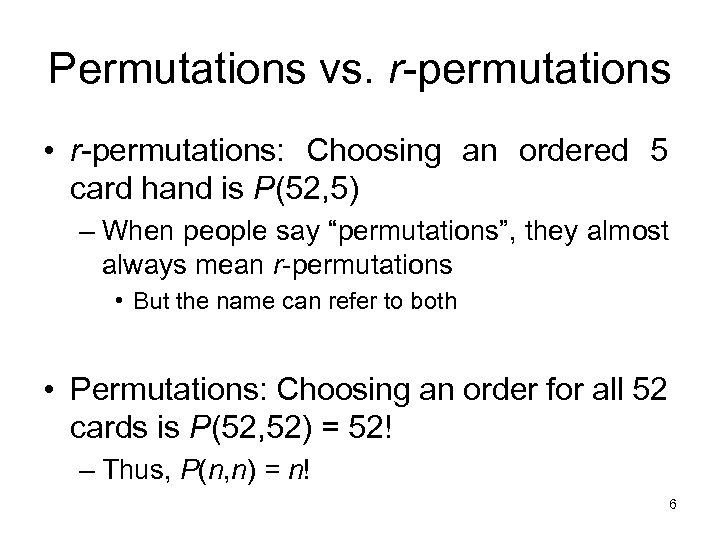
Permutations vs. r-permutations • r-permutations: Choosing an ordered 5 card hand is P(52, 5) – When people say “permutations”, they almost always mean r-permutations • But the name can refer to both • Permutations: Choosing an order for all 52 cards is P(52, 52) = 52! – Thus, P(n, n) = n! 6
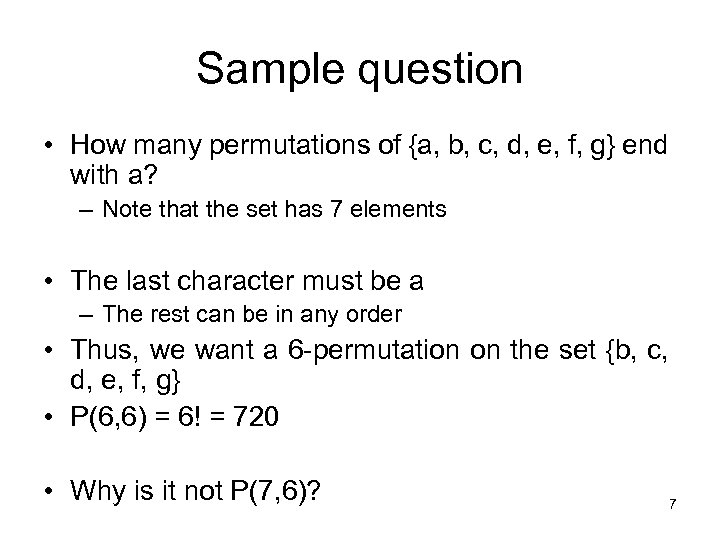
Sample question • How many permutations of {a, b, c, d, e, f, g} end with a? – Note that the set has 7 elements • The last character must be a – The rest can be in any order • Thus, we want a 6 -permutation on the set {b, c, d, e, f, g} • P(6, 6) = 6! = 720 • Why is it not P(7, 6)? 7
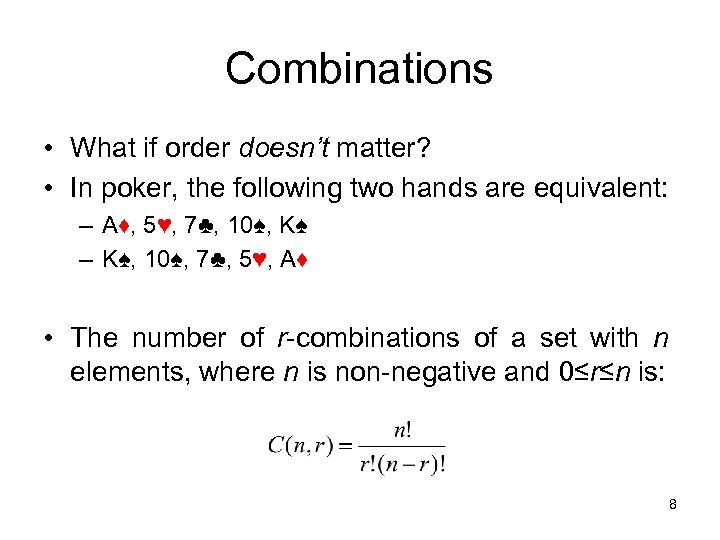
Combinations • What if order doesn’t matter? • In poker, the following two hands are equivalent: – A♦, 5♥, 7♣, 10♠, K♠ – K♠, 10♠, 7♣, 5♥, A♦ • The number of r-combinations of a set with n elements, where n is non-negative and 0≤r≤n is: 8
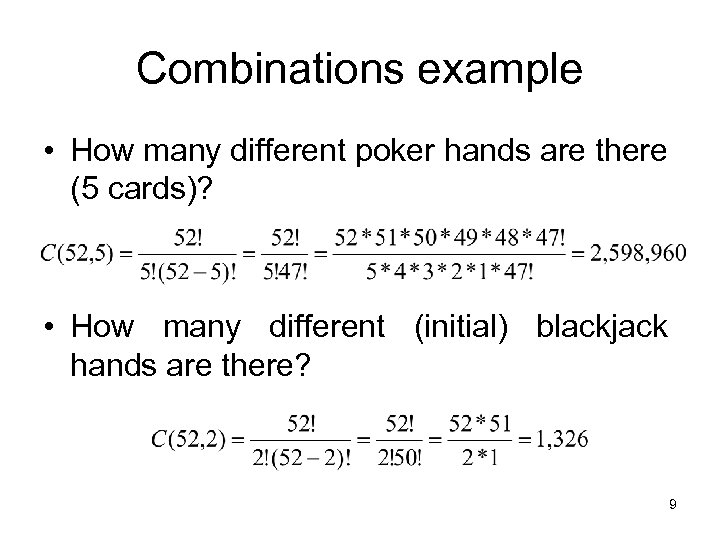
Combinations example • How many different poker hands are there (5 cards)? • How many different (initial) blackjack hands are there? 9
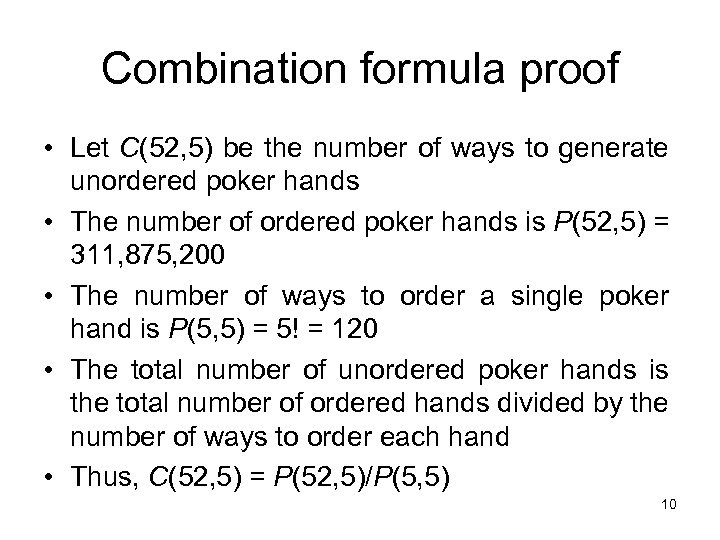
Combination formula proof • Let C(52, 5) be the number of ways to generate unordered poker hands • The number of ordered poker hands is P(52, 5) = 311, 875, 200 • The number of ways to order a single poker hand is P(5, 5) = 5! = 120 • The total number of unordered poker hands is the total number of ordered hands divided by the number of ways to order each hand • Thus, C(52, 5) = P(52, 5)/P(5, 5) 10
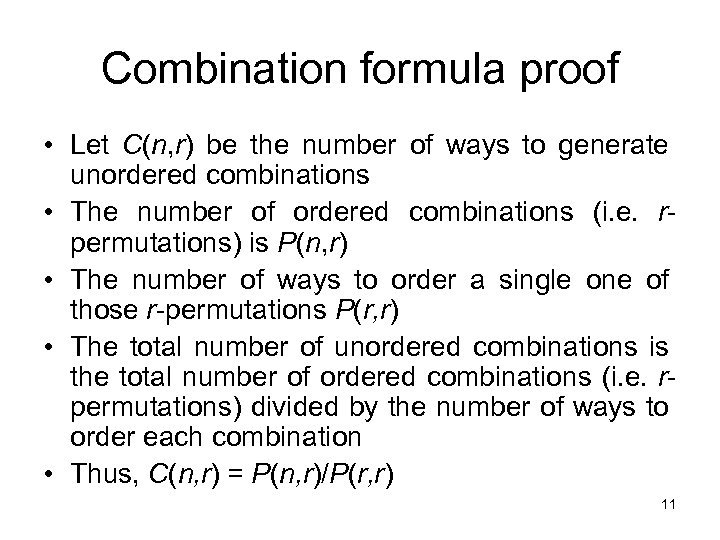
Combination formula proof • Let C(n, r) be the number of ways to generate unordered combinations • The number of ordered combinations (i. e. rpermutations) is P(n, r) • The number of ways to order a single one of those r-permutations P(r, r) • The total number of unordered combinations is the total number of ordered combinations (i. e. rpermutations) divided by the number of ways to order each combination • Thus, C(n, r) = P(n, r)/P(r, r) 11
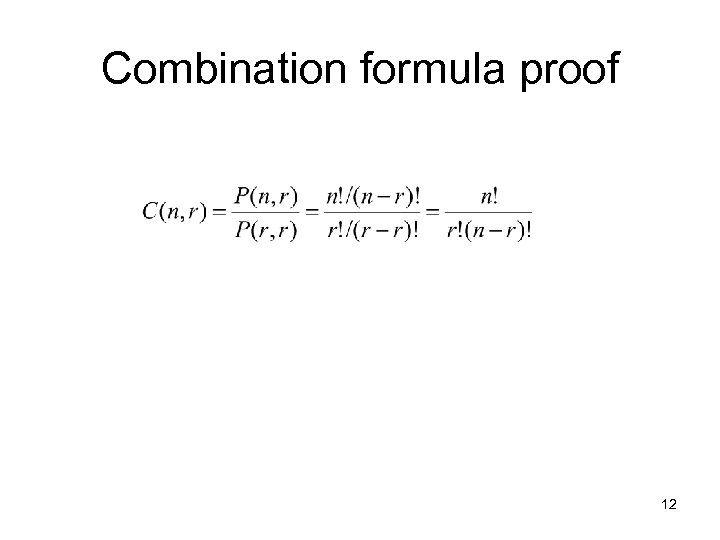
Combination formula proof 12
Poker 13
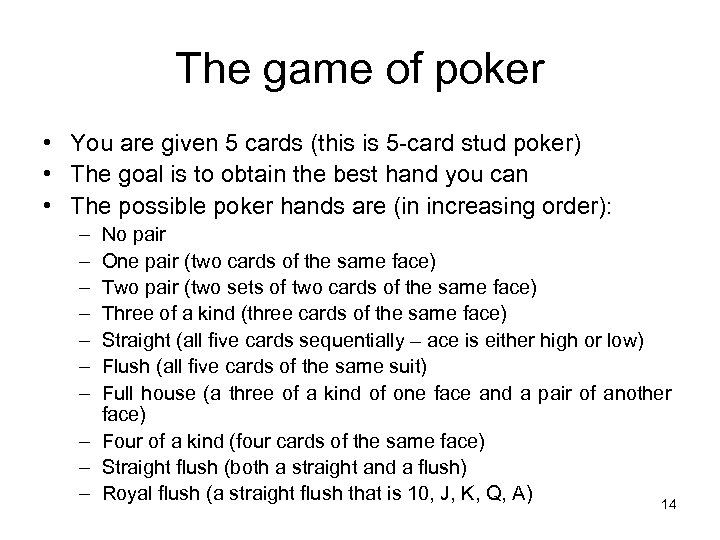
The game of poker • You are given 5 cards (this is 5 -card stud poker) • The goal is to obtain the best hand you can • The possible poker hands are (in increasing order): – – – – No pair One pair (two cards of the same face) Two pair (two sets of two cards of the same face) Three of a kind (three cards of the same face) Straight (all five cards sequentially – ace is either high or low) Flush (all five cards of the same suit) Full house (a three of a kind of one face and a pair of another face) – Four of a kind (four cards of the same face) – Straight flush (both a straight and a flush) – Royal flush (a straight flush that is 10, J, K, Q, A) 14
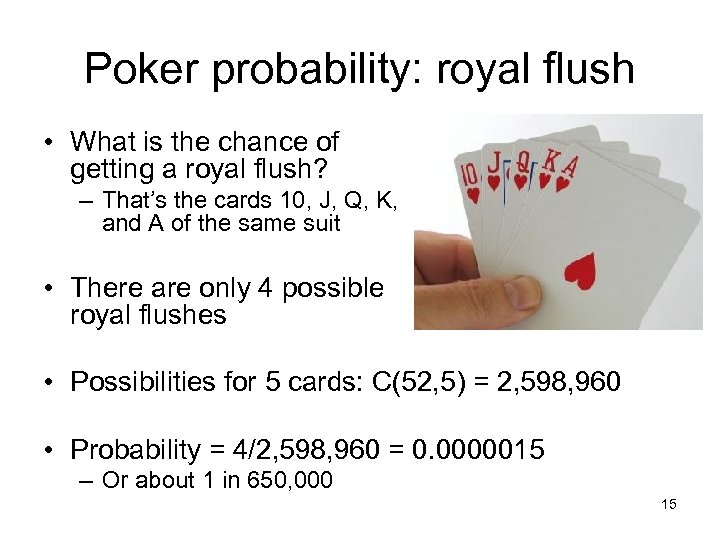
Poker probability: royal flush • What is the chance of getting a royal flush? – That’s the cards 10, J, Q, K, and A of the same suit • There are only 4 possible royal flushes • Possibilities for 5 cards: C(52, 5) = 2, 598, 960 • Probability = 4/2, 598, 960 = 0. 0000015 – Or about 1 in 650, 000 15
Poker probability: four of a kind • What is the chance of getting 4 of a kind when dealt 5 cards? – Possibilities for 5 cards: C(52, 5) = 2, 598, 960 • Possible hands that have four of a kind: – There are 13 possible four of a kind hands – The fifth card can be any of the remaining 48 cards – Thus, total possibilities is 13*48 = 624 • Probability = 624/2, 598, 960 = 0. 00024 – Or 1 in 4165 16
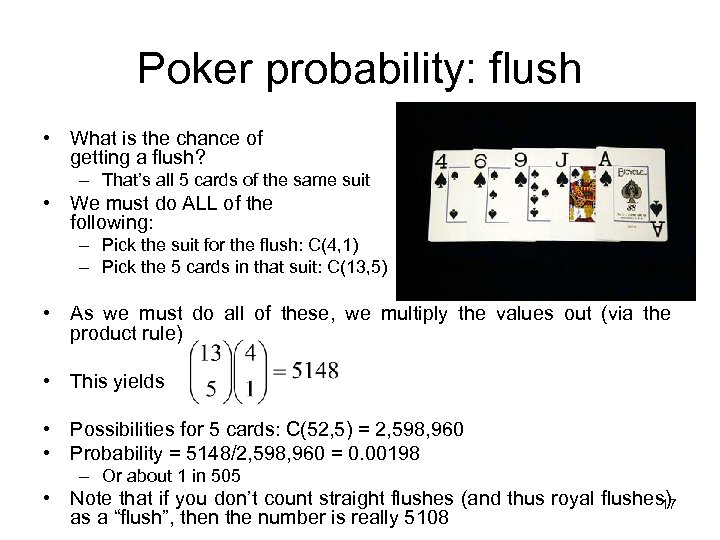
Poker probability: flush • What is the chance of getting a flush? – That’s all 5 cards of the same suit • We must do ALL of the following: – Pick the suit for the flush: C(4, 1) – Pick the 5 cards in that suit: C(13, 5) • As we must do all of these, we multiply the values out (via the product rule) • This yields • Possibilities for 5 cards: C(52, 5) = 2, 598, 960 • Probability = 5148/2, 598, 960 = 0. 00198 – Or about 1 in 505 • Note that if you don’t count straight flushes (and thus royal flushes) 17 as a “flush”, then the number is really 5108
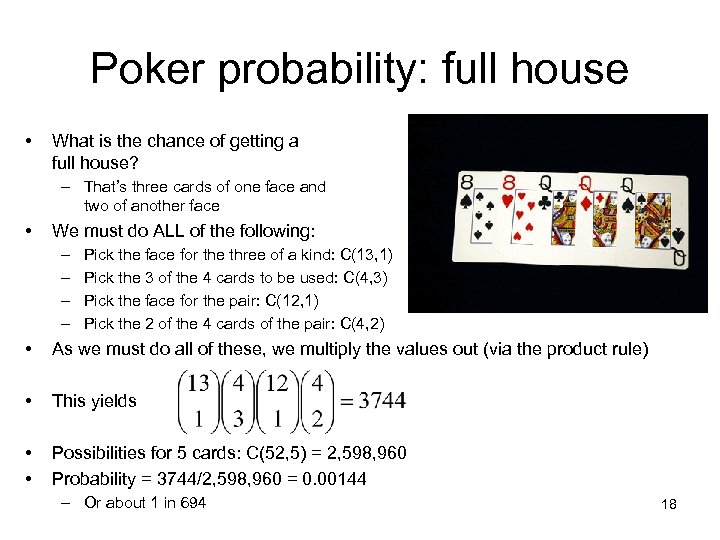
Poker probability: full house • What is the chance of getting a full house? – That’s three cards of one face and two of another face • We must do ALL of the following: – – Pick the face for the three of a kind: C(13, 1) Pick the 3 of the 4 cards to be used: C(4, 3) Pick the face for the pair: C(12, 1) Pick the 2 of the 4 cards of the pair: C(4, 2) • As we must do all of these, we multiply the values out (via the product rule) • This yields • • Possibilities for 5 cards: C(52, 5) = 2, 598, 960 Probability = 3744/2, 598, 960 = 0. 00144 – Or about 1 in 694 18
Inclusion-exclusion principle • The possible poker hands are (in increasing order): – Nothing – One pair – Two pair – – – – Three of a kind Straight Flush Full house Four of a kind Straight flush Royal flush cannot include two pair, three of a kind, four of a kind, or full house cannot include four of a kind or full house cannot include straight flush or royal flush cannot include royal flush 19
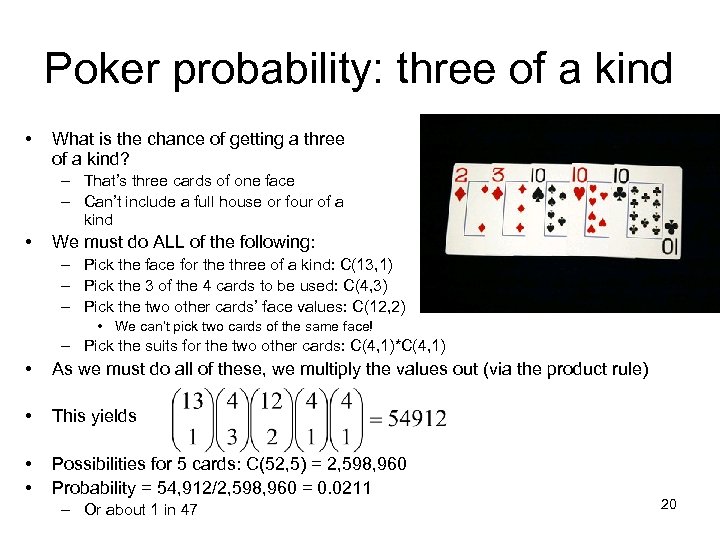
Poker probability: three of a kind • What is the chance of getting a three of a kind? – That’s three cards of one face – Can’t include a full house or four of a kind • We must do ALL of the following: – Pick the face for the three of a kind: C(13, 1) – Pick the 3 of the 4 cards to be used: C(4, 3) – Pick the two other cards’ face values: C(12, 2) • We can’t pick two cards of the same face! – Pick the suits for the two other cards: C(4, 1)*C(4, 1) • As we must do all of these, we multiply the values out (via the product rule) • This yields • • Possibilities for 5 cards: C(52, 5) = 2, 598, 960 Probability = 54, 912/2, 598, 960 = 0. 0211 – Or about 1 in 47 20
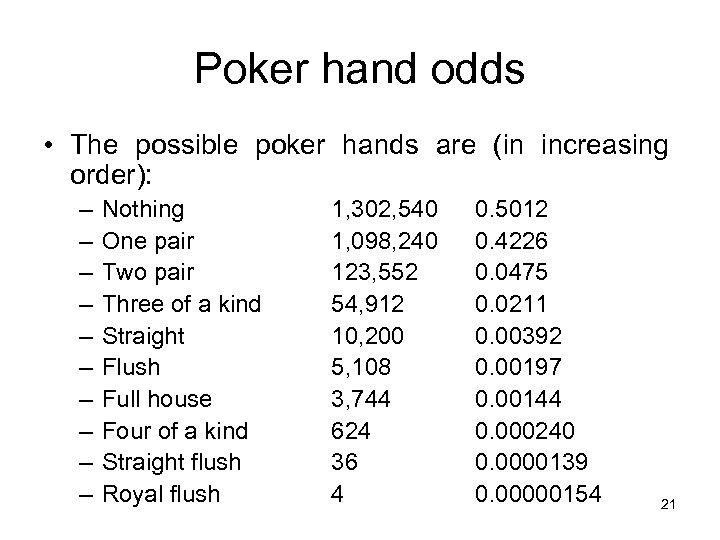
Poker hand odds • The possible poker hands are (in increasing order): – – – – – Nothing One pair Two pair Three of a kind Straight Flush Full house Four of a kind Straight flush Royal flush 1, 302, 540 1, 098, 240 123, 552 54, 912 10, 200 5, 108 3, 744 624 36 4 0. 5012 0. 4226 0. 0475 0. 0211 0. 00392 0. 00197 0. 00144 0. 000240 0. 0000139 0. 00000154 21
Back to theory again 22
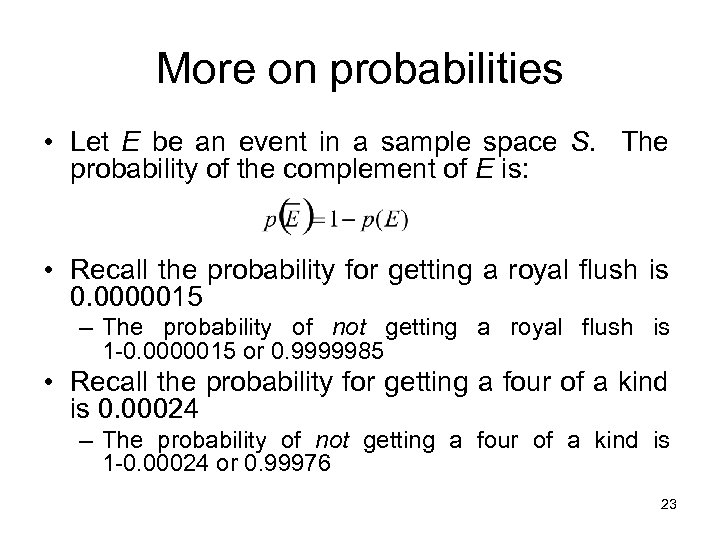
More on probabilities • Let E be an event in a sample space S. The probability of the complement of E is: • Recall the probability for getting a royal flush is 0. 0000015 – The probability of not getting a royal flush is 1 -0. 0000015 or 0. 9999985 • Recall the probability for getting a four of a kind is 0. 00024 – The probability of not getting a four of a kind is 1 -0. 00024 or 0. 99976 23
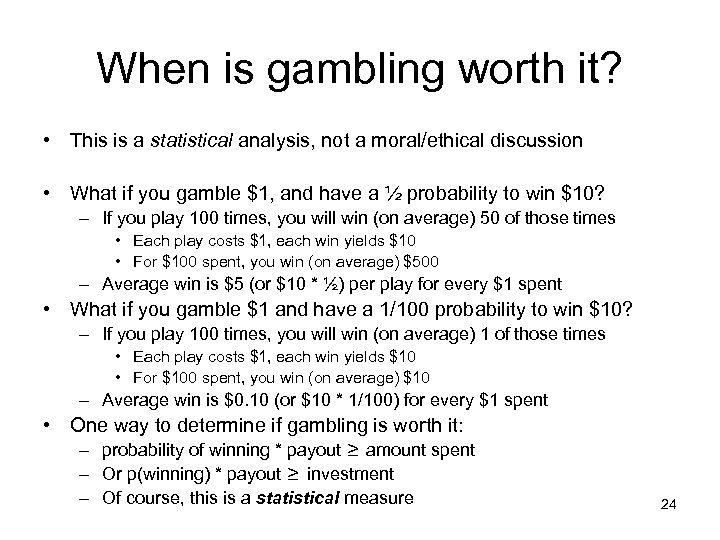
When is gambling worth it? • This is a statistical analysis, not a moral/ethical discussion • What if you gamble $1, and have a ½ probability to win $10? – If you play 100 times, you will win (on average) 50 of those times • Each play costs $1, each win yields $10 • For $100 spent, you win (on average) $500 – Average win is $5 (or $10 * ½) per play for every $1 spent • What if you gamble $1 and have a 1/100 probability to win $10? – If you play 100 times, you will win (on average) 1 of those times • Each play costs $1, each win yields $10 • For $100 spent, you win (on average) $10 – Average win is $0. 10 (or $10 * 1/100) for every $1 spent • One way to determine if gambling is worth it: – probability of winning * payout ≥ amount spent – Or p(winning) * payout ≥ investment – Of course, this is a statistical measure 24
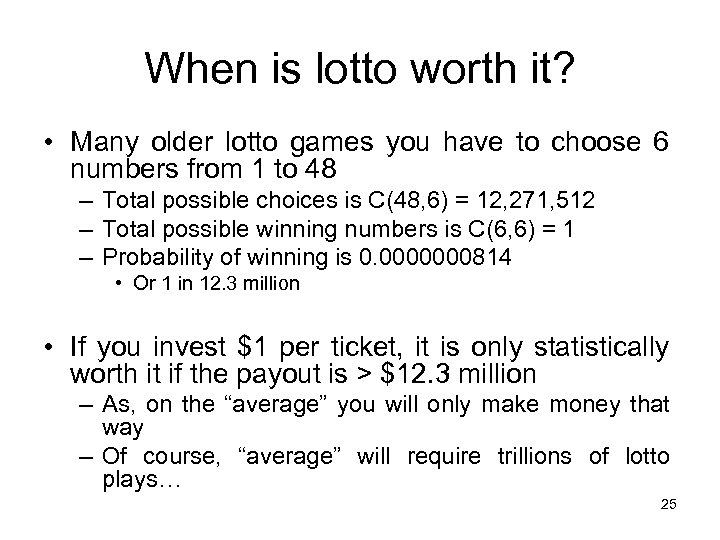
When is lotto worth it? • Many older lotto games you have to choose 6 numbers from 1 to 48 – Total possible choices is C(48, 6) = 12, 271, 512 – Total possible winning numbers is C(6, 6) = 1 – Probability of winning is 0. 0000000814 • Or 1 in 12. 3 million • If you invest $1 per ticket, it is only statistically worth it if the payout is > $12. 3 million – As, on the “average” you will only make money that way – Of course, “average” will require trillions of lotto plays… 25
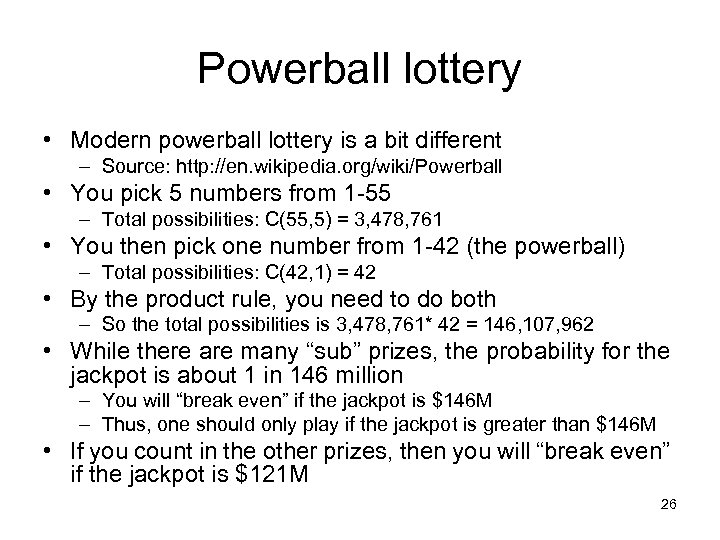
Powerball lottery • Modern powerball lottery is a bit different – Source: http: //en. wikipedia. org/wiki/Powerball • You pick 5 numbers from 1 -55 – Total possibilities: C(55, 5) = 3, 478, 761 • You then pick one number from 1 -42 (the powerball) – Total possibilities: C(42, 1) = 42 • By the product rule, you need to do both – So the total possibilities is 3, 478, 761* 42 = 146, 107, 962 • While there are many “sub” prizes, the probability for the jackpot is about 1 in 146 million – You will “break even” if the jackpot is $146 M – Thus, one should only play if the jackpot is greater than $146 M • If you count in the other prizes, then you will “break even” if the jackpot is $121 M 26

Blackjack 27
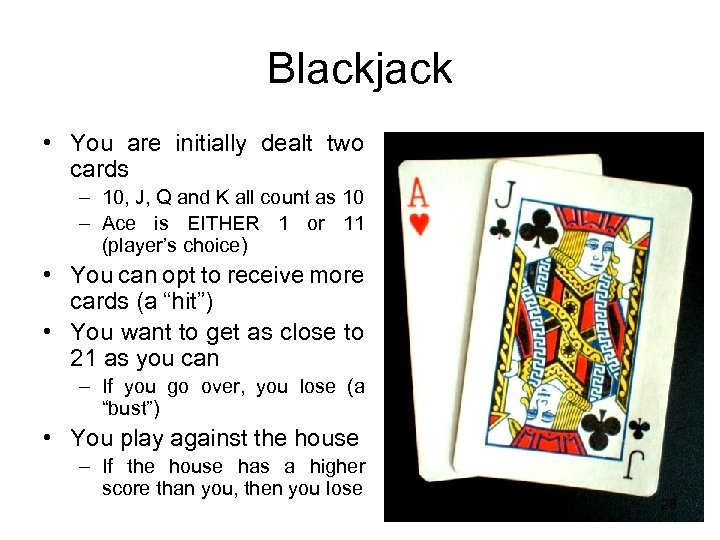
Blackjack • You are initially dealt two cards – 10, J, Q and K all count as 10 – Ace is EITHER 1 or 11 (player’s choice) • You can opt to receive more cards (a “hit”) • You want to get as close to 21 as you can – If you go over, you lose (a “bust”) • You play against the house – If the house has a higher score than you, then you lose 28
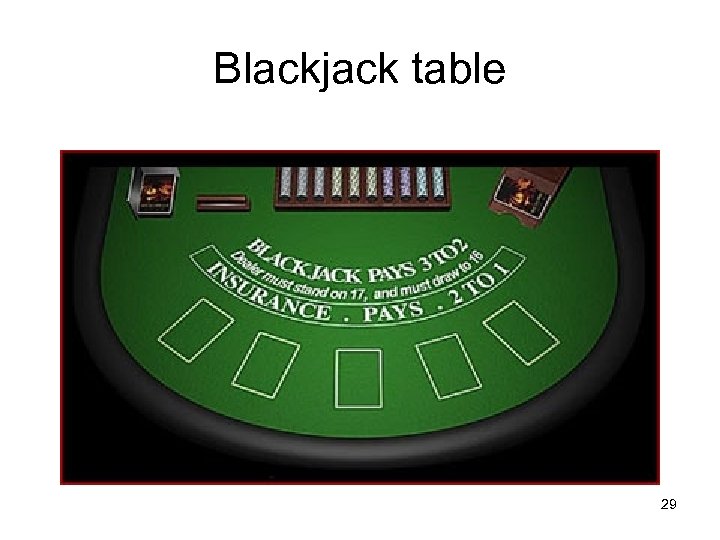
Blackjack table 29
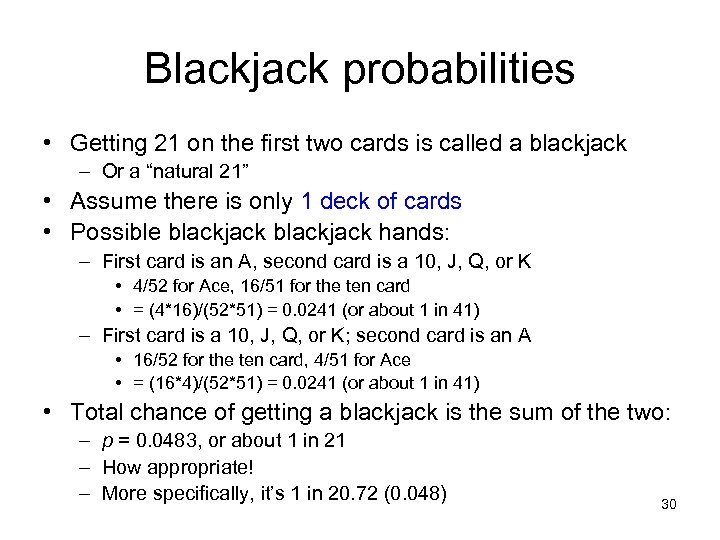
Blackjack probabilities • Getting 21 on the first two cards is called a blackjack – Or a “natural 21” • Assume there is only 1 deck of cards • Possible blackjack hands: – First card is an A, second card is a 10, J, Q, or K • 4/52 for Ace, 16/51 for the ten card • = (4*16)/(52*51) = 0. 0241 (or about 1 in 41) – First card is a 10, J, Q, or K; second card is an A • 16/52 for the ten card, 4/51 for Ace • = (16*4)/(52*51) = 0. 0241 (or about 1 in 41) • Total chance of getting a blackjack is the sum of the two: – p = 0. 0483, or about 1 in 21 – How appropriate! – More specifically, it’s 1 in 20. 72 (0. 048) 30
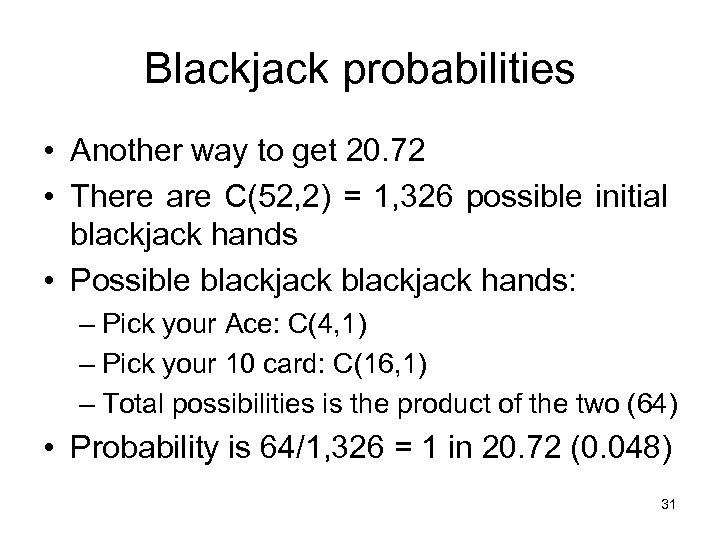
Blackjack probabilities • Another way to get 20. 72 • There are C(52, 2) = 1, 326 possible initial blackjack hands • Possible blackjack hands: – Pick your Ace: C(4, 1) – Pick your 10 card: C(16, 1) – Total possibilities is the product of the two (64) • Probability is 64/1, 326 = 1 in 20. 72 (0. 048) 31
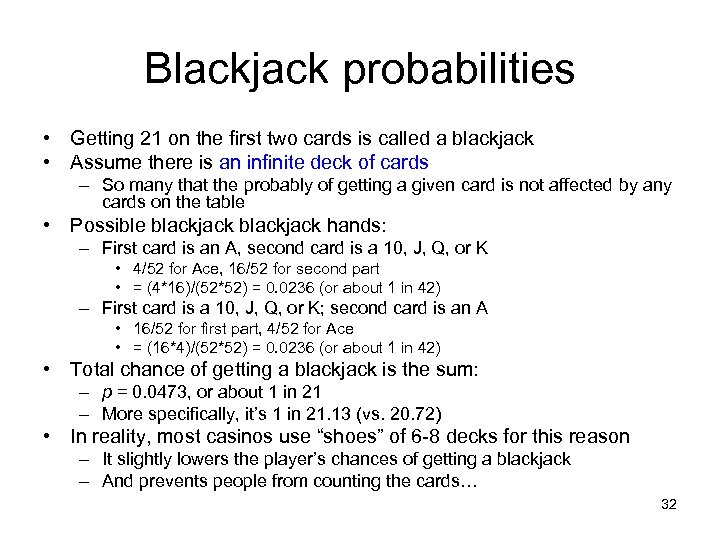
Blackjack probabilities • Getting 21 on the first two cards is called a blackjack • Assume there is an infinite deck of cards – So many that the probably of getting a given card is not affected by any cards on the table • Possible blackjack hands: – First card is an A, second card is a 10, J, Q, or K • 4/52 for Ace, 16/52 for second part • = (4*16)/(52*52) = 0. 0236 (or about 1 in 42) – First card is a 10, J, Q, or K; second card is an A • 16/52 for first part, 4/52 for Ace • = (16*4)/(52*52) = 0. 0236 (or about 1 in 42) • Total chance of getting a blackjack is the sum: – p = 0. 0473, or about 1 in 21 – More specifically, it’s 1 in 21. 13 (vs. 20. 72) • In reality, most casinos use “shoes” of 6 -8 decks for this reason – It slightly lowers the player’s chances of getting a blackjack – And prevents people from counting the cards… 32
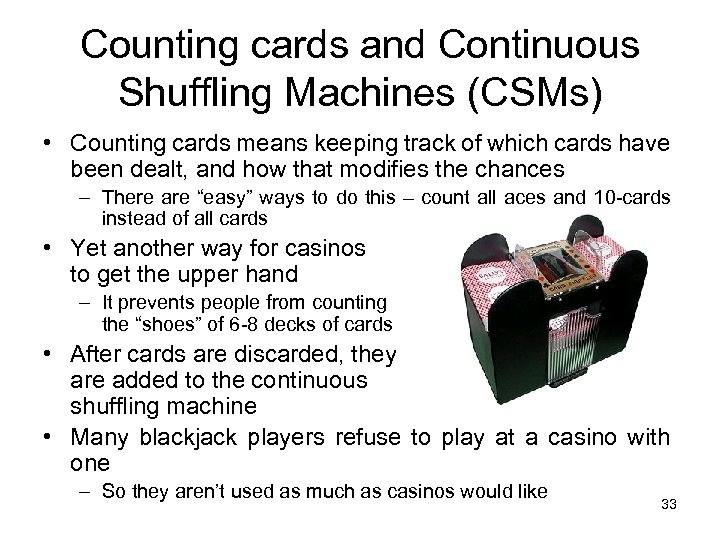
Counting cards and Continuous Shuffling Machines (CSMs) • Counting cards means keeping track of which cards have been dealt, and how that modifies the chances – There are “easy” ways to do this – count all aces and 10 -cards instead of all cards • Yet another way for casinos to get the upper hand – It prevents people from counting the “shoes” of 6 -8 decks of cards • After cards are discarded, they are added to the continuous shuffling machine • Many blackjack players refuse to play at a casino with one – So they aren’t used as much as casinos would like 33
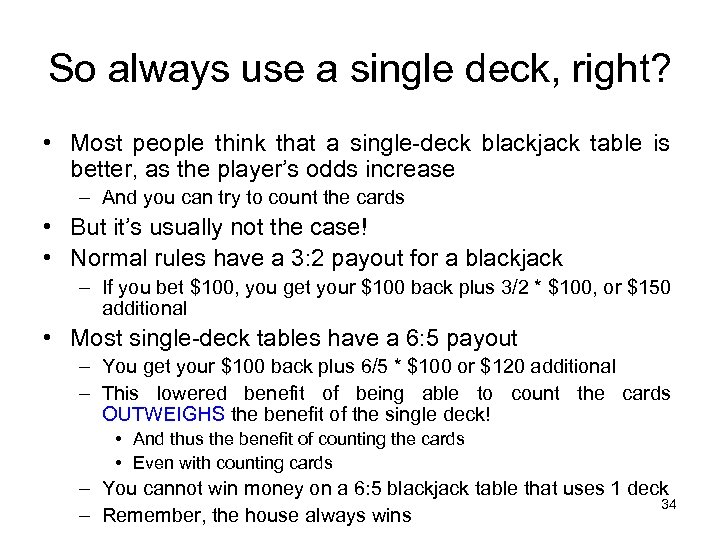
So always use a single deck, right? • Most people think that a single-deck blackjack table is better, as the player’s odds increase – And you can try to count the cards • But it’s usually not the case! • Normal rules have a 3: 2 payout for a blackjack – If you bet $100, you get your $100 back plus 3/2 * $100, or $150 additional • Most single-deck tables have a 6: 5 payout – You get your $100 back plus 6/5 * $100 or $120 additional – This lowered benefit of being able to count the cards OUTWEIGHS the benefit of the single deck! • And thus the benefit of counting the cards • Even with counting cards – You cannot win money on a 6: 5 blackjack table that uses 1 deck 34 – Remember, the house always wins
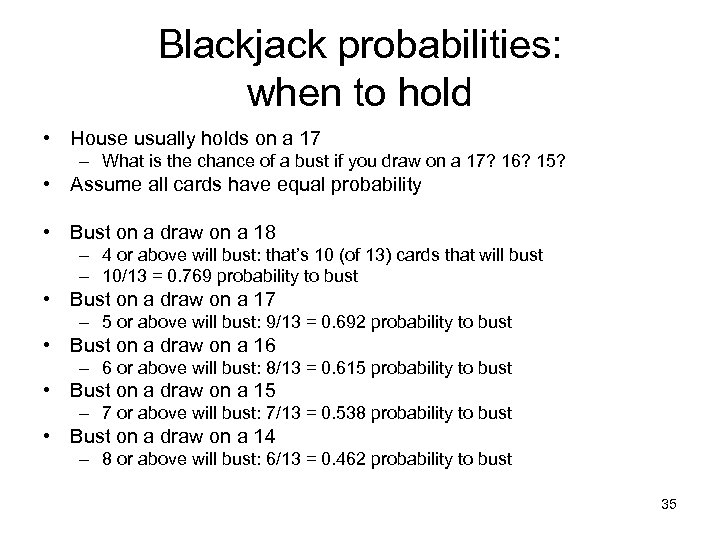
Blackjack probabilities: when to hold • House usually holds on a 17 – What is the chance of a bust if you draw on a 17? 16? 15? • Assume all cards have equal probability • Bust on a draw on a 18 – 4 or above will bust: that’s 10 (of 13) cards that will bust – 10/13 = 0. 769 probability to bust • Bust on a draw on a 17 – 5 or above will bust: 9/13 = 0. 692 probability to bust • Bust on a draw on a 16 – 6 or above will bust: 8/13 = 0. 615 probability to bust • Bust on a draw on a 15 – 7 or above will bust: 7/13 = 0. 538 probability to bust • Bust on a draw on a 14 – 8 or above will bust: 6/13 = 0. 462 probability to bust 35
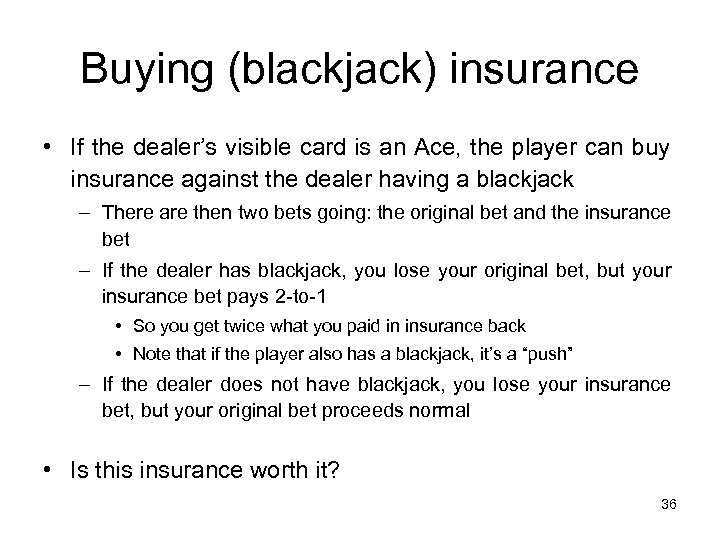
Buying (blackjack) insurance • If the dealer’s visible card is an Ace, the player can buy insurance against the dealer having a blackjack – There are then two bets going: the original bet and the insurance bet – If the dealer has blackjack, you lose your original bet, but your insurance bet pays 2 -to-1 • So you get twice what you paid in insurance back • Note that if the player also has a blackjack, it’s a “push” – If the dealer does not have blackjack, you lose your insurance bet, but your original bet proceeds normal • Is this insurance worth it? 36
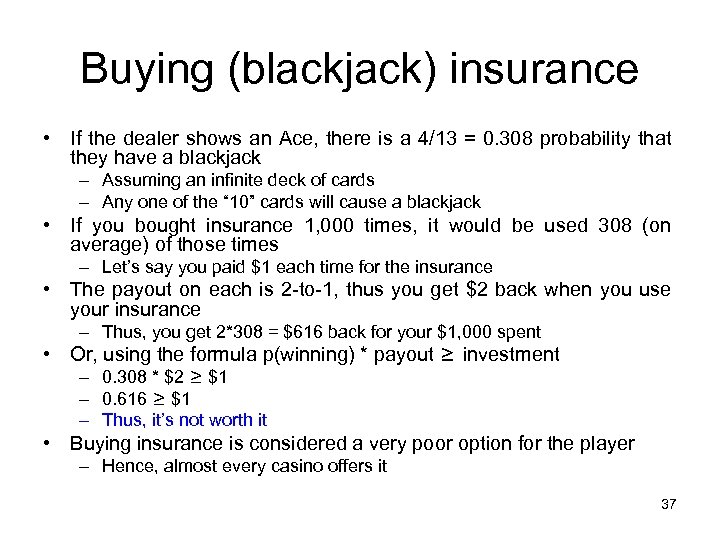
Buying (blackjack) insurance • If the dealer shows an Ace, there is a 4/13 = 0. 308 probability that they have a blackjack – Assuming an infinite deck of cards – Any one of the “ 10” cards will cause a blackjack • If you bought insurance 1, 000 times, it would be used 308 (on average) of those times – Let’s say you paid $1 each time for the insurance • The payout on each is 2 -to-1, thus you get $2 back when you use your insurance – Thus, you get 2*308 = $616 back for your $1, 000 spent • Or, using the formula p(winning) * payout ≥ investment – 0. 308 * $2 ≥ $1 – 0. 616 ≥ $1 – Thus, it’s not worth it • Buying insurance is considered a very poor option for the player – Hence, almost every casino offers it 37
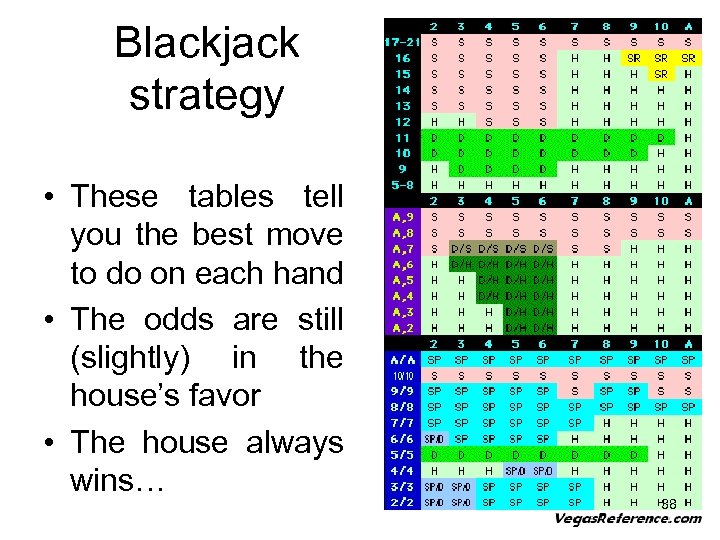
Blackjack strategy • These tables tell you the best move to do on each hand • The odds are still (slightly) in the house’s favor • The house always wins… 38
Why counting cards doesn’t work well… • If you make two or three mistakes an hour, you lose any advantage – And, in fact, cause a disadvantage! • You lose lots of money learning to count cards • Then, once you can do so, you are banned from the casinos 39
So why is Blackjack so popular? • Although the casino has the upper hand, the odds are much closer to 50 -50 than with other games – Notable exceptions are games that you are not playing against the house – i. e. , poker • You pay a fixed amount per hand 40
Roulette 41
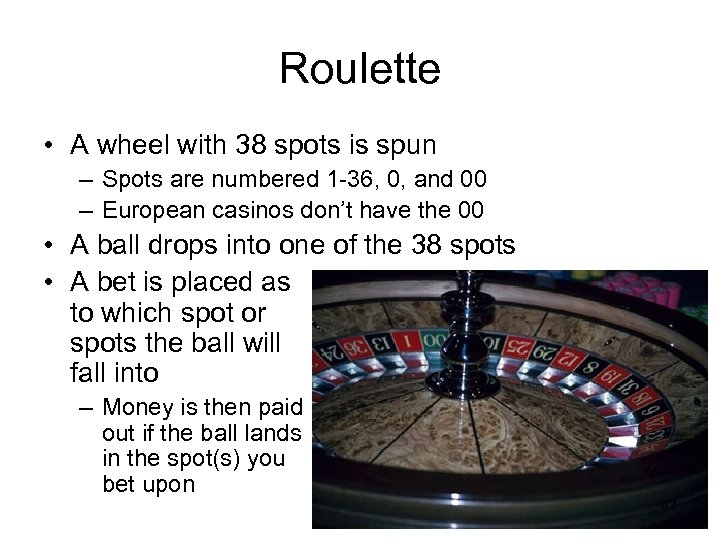
Roulette • A wheel with 38 spots is spun – Spots are numbered 1 -36, 0, and 00 – European casinos don’t have the 00 • A ball drops into one of the 38 spots • A bet is placed as to which spot or spots the ball will fall into – Money is then paid out if the ball lands in the spot(s) you bet upon 42
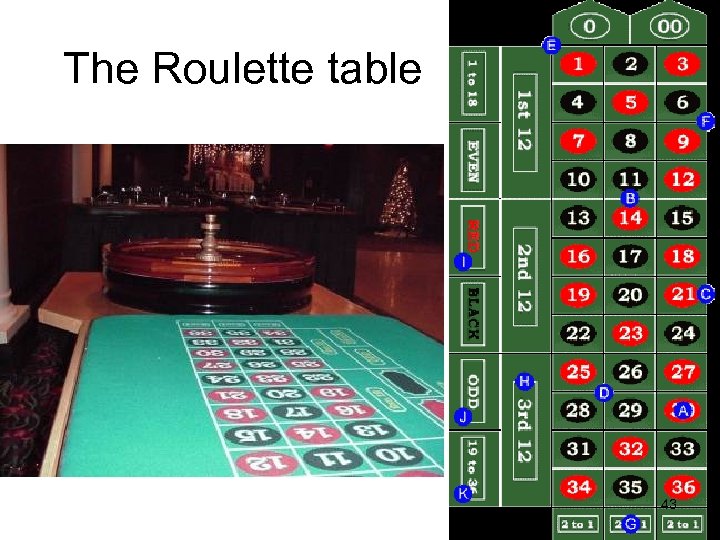
The Roulette table 43
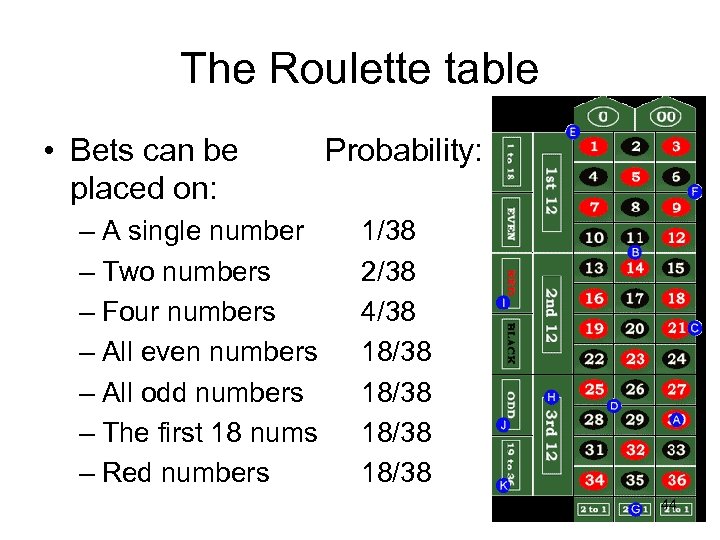
The Roulette table • Bets can be placed on: – A single number – Two numbers – Four numbers – All even numbers – All odd numbers – The first 18 nums – Red numbers Probability: 1/38 2/38 4/38 18/38 44
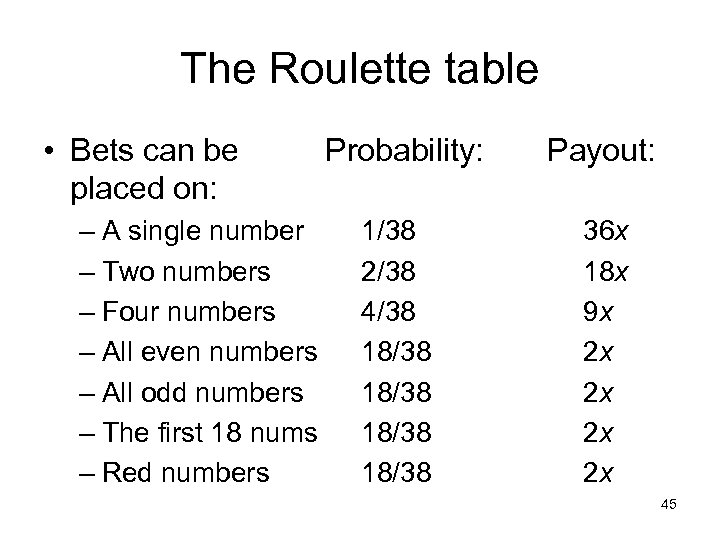
The Roulette table • Bets can be placed on: – A single number – Two numbers – Four numbers – All even numbers – All odd numbers – The first 18 nums – Red numbers Probability: Payout: 1/38 2/38 4/38 18/38 36 x 18 x 9 x 2 x 2 x 45
Roulette • It has been proven that no advantageous strategies exist • Including: – Learning the wheel’s biases • Casino’s regularly balance their Roulette wheels – Using lasers (yes, lasers) to check the wheel’s spin • What casino will let you set up a laser inside to beat the house? 46
Roulette • It has been proven that no advantageous strategies exist • Including: – Martingale betting strategy • Where you double your bet each time (thus making up for all previous losses) • It still won’t work! • You can’t double your money forever – It could easily take 50 times to finally win – If you start with $1, then you must put in $1*250 = $1, 125, 899, 906, 842, 624 to win this way! – That’s 1 quadrillion • See http: //en. wikipedia. org/wiki/Martingale_(roulette_system) for more info 47
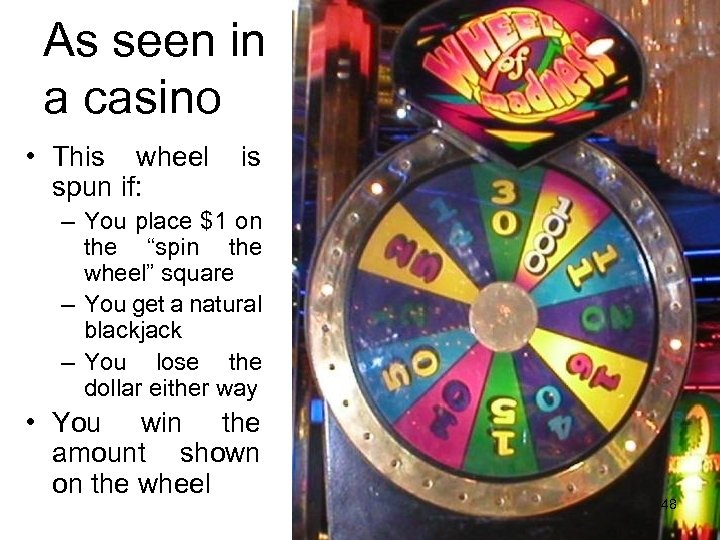
As seen in a casino • This wheel spun if: is – You place $1 on the “spin the wheel” square – You get a natural blackjack – You lose the dollar either way • You win the amount shown on the wheel 48
Is it worth it to place $1 on the square? • The amounts on the wheel are: – 30, 1000, 11, 20, 16, 40, 15, 10, 50, 12, 25, 14 – Average is $103. 58 • Chance of a natural blackjack: – p = 0. 0473, or 1 in 21. 13 • So use the formula: – – p(winning) * payout ≥ investment 0. 0473 * $103. 58 ≥ $1 $4. 90 ≥ $1 But the house always wins! So what happened? 49
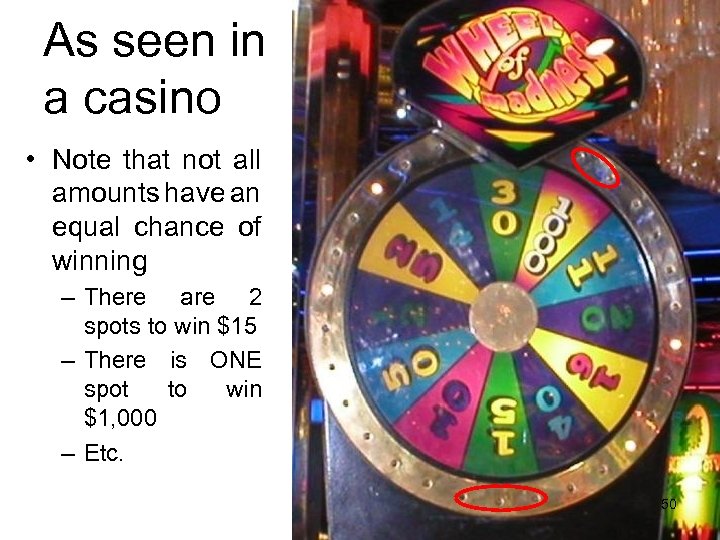
As seen in a casino • Note that not all amounts have an equal chance of winning – There are 2 spots to win $15 – There is ONE spot to win $1, 000 – Etc. 50
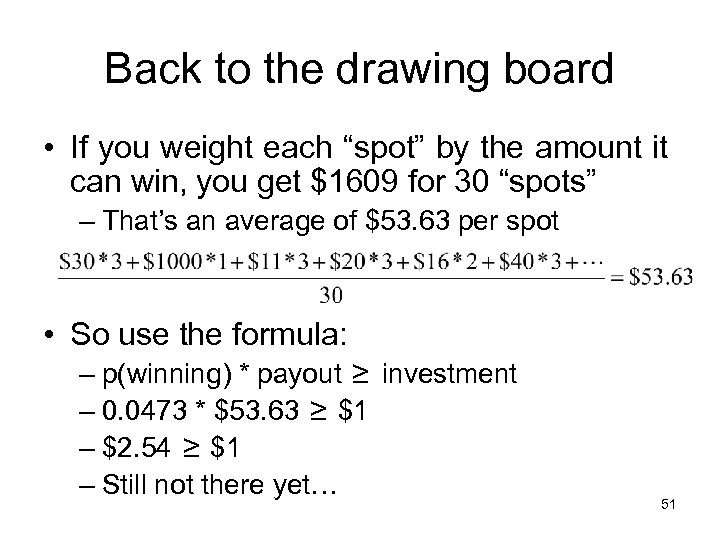
Back to the drawing board • If you weight each “spot” by the amount it can win, you get $1609 for 30 “spots” – That’s an average of $53. 63 per spot • So use the formula: – p(winning) * payout ≥ investment – 0. 0473 * $53. 63 ≥ $1 – $2. 54 ≥ $1 – Still not there yet… 51
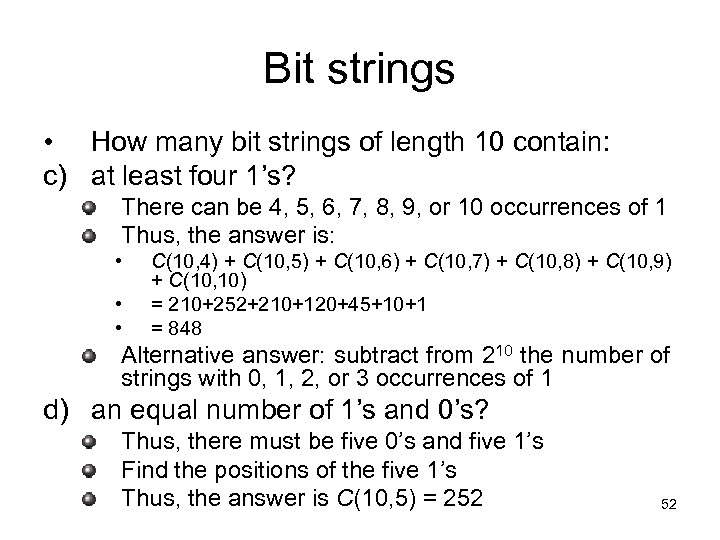
Bit strings • How many bit strings of length 10 contain: c) at least four 1’s? There can be 4, 5, 6, 7, 8, 9, or 10 occurrences of 1 Thus, the answer is: • • • C(10, 4) + C(10, 5) + C(10, 6) + C(10, 7) + C(10, 8) + C(10, 9) + C(10, 10) = 210+252+210+120+45+10+1 = 848 Alternative answer: subtract from 210 the number of strings with 0, 1, 2, or 3 occurrences of 1 d) an equal number of 1’s and 0’s? Thus, there must be five 0’s and five 1’s Find the positions of the five 1’s Thus, the answer is C(10, 5) = 252 52
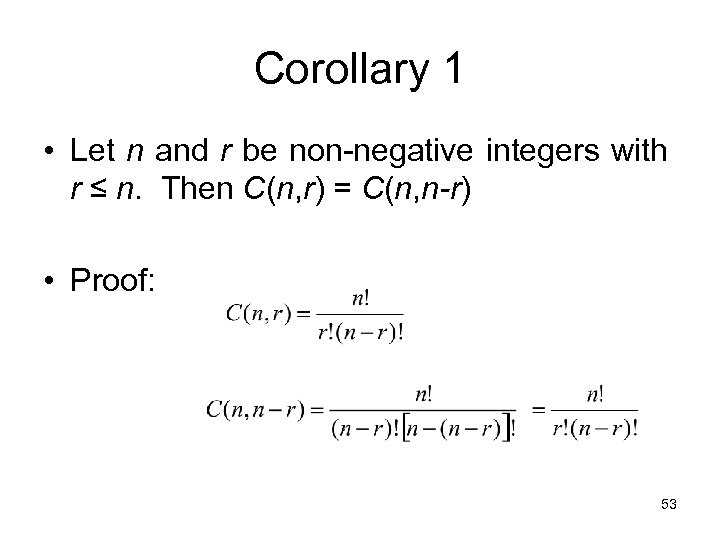
Corollary 1 • Let n and r be non-negative integers with r ≤ n. Then C(n, r) = C(n, n-r) • Proof: 53
Corollary example • There are C(52, 5) ways to pick a 5 -card poker hand • There are C(52, 47) ways to pick a 47 -card hand • P(52, 5) = 2, 598, 960 = P(52, 47) • When dealing 47 cards, you are picking 5 cards to not deal – As opposed to picking 5 card to deal – Again, the order the cards are dealt in does matter 54
Combinatorial proof • A combinatorial proof is a proof that uses counting arguments to prove a theorem – Rather than some other method such as algebraic techniques • Essentially, show that both sides of the proof manage to count the same objects • Most of the questions in this section are phrased as, “find out how many possibilities there are if …” – Instead, we could phrase each question as a theorem: – “Prove there are x possibilities if …” – The same answer could be modified to be a combinatorial proof to theorem 55
Circular seatings • How many ways are there to sit 6 people around a circular table, where seatings are considered to be the same if they can be obtained from each other by rotating the table? • First, place the first person in the north-most chair – Only one possibility • Then place the other 5 people – There are P(5, 5) = 5! = 120 ways to do that • By the product rule, we get 1*120 =120 • • Alternative means to answer this: There are P(6, 6)=720 ways to seat the 6 people around the table For each seating, there are 6 “rotations” of the seating Thus, the final answer is 720/6 = 120 56
Horse races • How many ways are there for 4 horses to finish if ties are allowed? – Note that order does matter! • Solution by cases – No ties • The number of permutations is P(4, 4) = 4! = 24 – Two horses tie • There are C(4, 2) = 6 ways to choose the two horses that tie • There are P(3, 3) = 6 ways for the “groups” to finish – A “group” is either a single horse or the two tying horses • By the product rule, there are 6*6 = 36 possibilities for this case – Two groups of two horses tie • There are C(4, 2) = 6 ways to choose the two winning horses • The other two horses tie for second place – Three horses tie with each other • There are C(4, 3) = 4 ways to choose the two horses that tie • There are P(2, 2) = 2 ways for the “groups” to finish • By the product rule, there are 4*2 = 8 possibilities for this case – All four horses tie • There is only one combination for this – By the sum rule, the total is 24+36+6+8+1 = 75 57
Скачать презентацию Permutations and Combinations CS 202 Epp section 6
2cbda159db3f08fae33b1eda9e57e332.ppt