


 Скачать презентацию Permanency Placement Version 2 3 June 2014
e7df20c842315a849c57fd03df13e225.ppt
- Количество слайдов: 111
 Permanency & Placement Version 2. 3, June 2014 Day 1 1
 Goals for the Training In this training we will cover: p The rules and regulations governing permanency and placement p The importance of permanency p Cultural differences in permanency & placement p The emotional and developmental consequences of placement p Placement decision making 2
 Learning Objectives p Review the Learning Objectives p Identify your priorities p Establish the learning priorities of the group 3
 Activity: What’s in it for Me? p What do I hope to learn in this training? 4
 Training Evaluation Testing, testing… 5
 What is Permanency? p Permanence p Legal Permanency Options p Emotional Permanency p Concurrent Planning 6
 Youth Permanency Essentials p Lifelong p Skills p Youth connections for living interdependently involvement 7
 History of Child Welfare Placement Complete the time line of events from 1854 to 2011 8
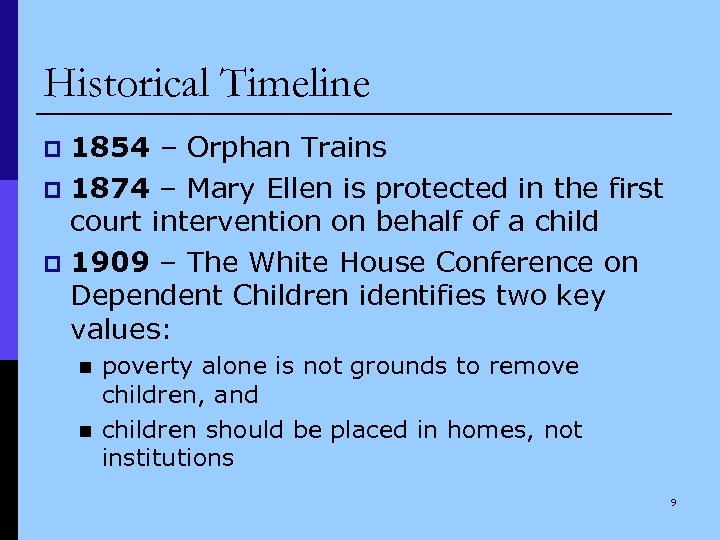 Historical Timeline 1854 – Orphan Trains p 1874 – Mary Ellen is protected in the first court intervention on behalf of a child p 1909 – The White House Conference on Dependent Children identifies two key values: p n n poverty alone is not grounds to remove children, and children should be placed in homes, not institutions 9
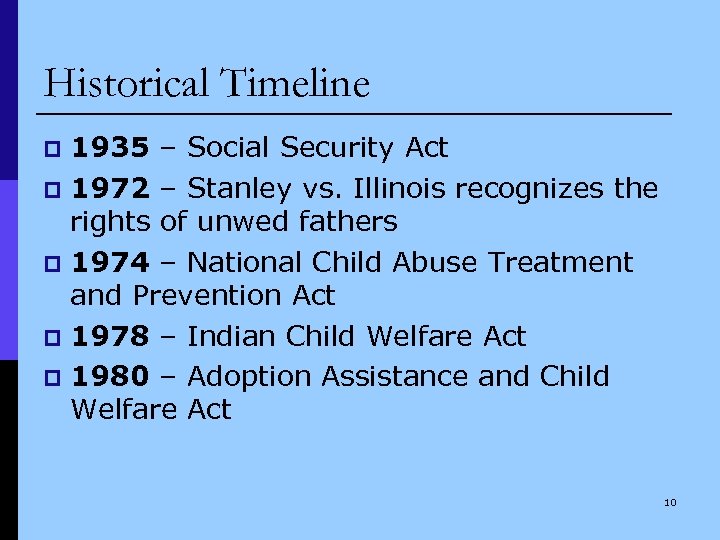 Historical Timeline 1935 – Social Security Act p 1972 – Stanley vs. Illinois recognizes the rights of unwed fathers p 1974 – National Child Abuse Treatment and Prevention Act p 1978 – Indian Child Welfare Act p 1980 – Adoption Assistance and Child Welfare Act p 10
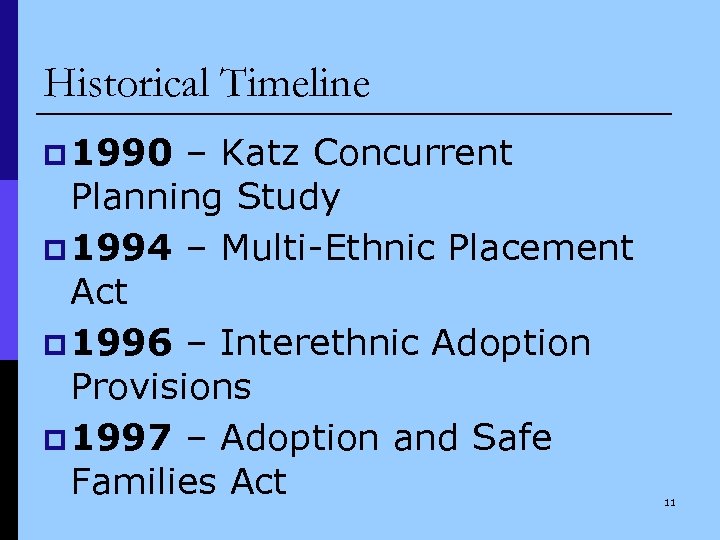 Historical Timeline p 1990 – Katz Concurrent Planning Study p 1994 – Multi-Ethnic Placement Act p 1996 – Interethnic Adoption Provisions p 1997 – Adoption and Safe Families Act 11
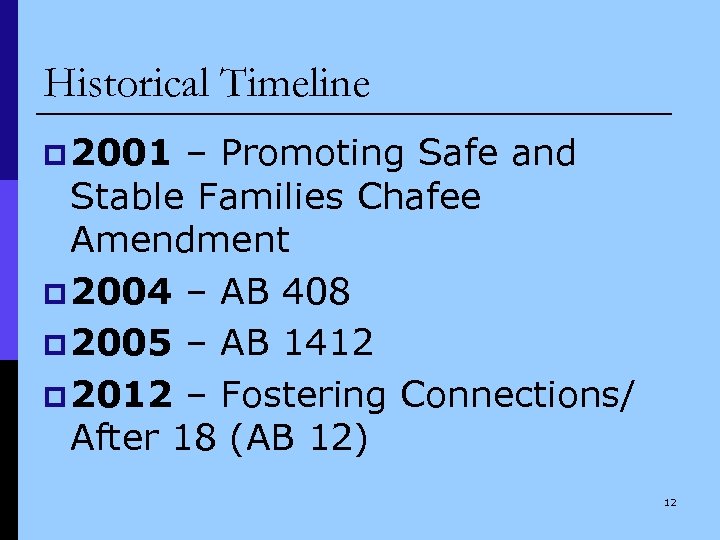 Historical Timeline p 2001 – Promoting Safe and Stable Families Chafee Amendment p 2004 – AB 408 p 2005 – AB 1412 p 2012 – Fostering Connections/ After 18 (AB 12) 12
 How far have we come? p What are the key positive developments? p Were you surprised by the timing of the events? p Where do we need to focus our change efforts? 13
 Laws and Policies Matching Game p Wait for all tables to receive the cards and instructions before turning the cards over p Match the card with the name of the law to the card with a longer explanation of the same law 14
 Foster Children’s Bill of Rights Enacted in 2001 and listed in WIC 16001. 9 WIC requires the bill of rights be explained to every school-age child Any facility licensed to care for six or more children in must post the bill of rights 15
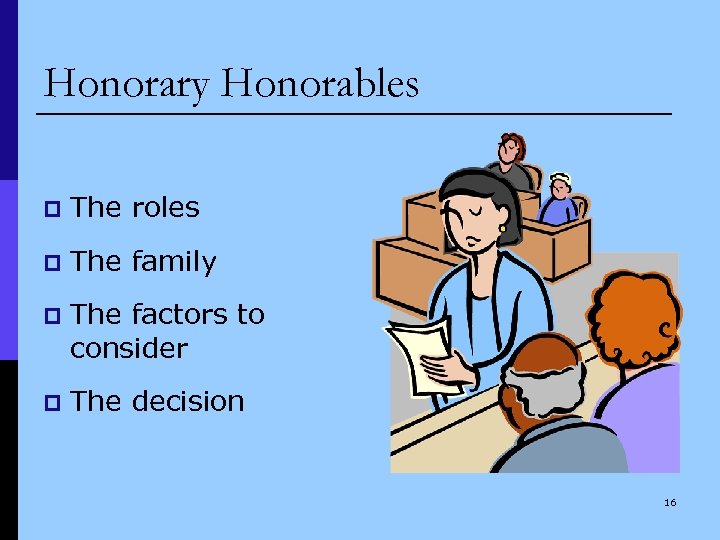 Honorary Honorables p The roles p The family p The factors to consider p The decision 16
 Family Before the Court p The Washington Jackson children: n La. Trecee Washington, 6 n Joe Jackson, 6 p The adults in the home: n Rhonda Washington, 25 n Dale Jackson, 25 17
 Key Considerations p Cause for removal based on WIC 300 p Reasonable efforts (from the Adoption Assistance and Child Welfare Act) p Remember ASFA time limits 18
 Key Considerations p Right WIC) to reunification services (ASFA, p Visitation p Foster (WIC) care drift 19
 Key Considerations p Best interest of the child p Ensuring placement decisions consider the child’s developmental needs 20
 Key Considerations p Non-custodial p Placement (ICPC) p Same-race parents (WIC 361) in another state placements (MEPA) 21
 Key Considerations p Tribal sovereignty and tribal connections (ICWA) p Active efforts (ICWA) p Tribal Customary Adoption (AC 1325) p Sibling visits (WIC) p School placement (AB 490) 22
 Key Considerations p Intersection of n n n ASFA ICWA MEPA Working collaboratively with tribes p Conflicting guidelines p AB 408 p Caregiver selection p SAFETY p 23
 Make a recommendation p What factors need to be considered? p How are you going to engage the parents? p How would you engage extended kin? p What are the educational needs of the children? p What is your recommendation? 24
 Remember to consider p Concurrent planning for permanency n Plan A and Plan B should be established at the same time 25
 Permanency in California - Quiz Take your best guess! How do your experiences compare with the statewide data? 26
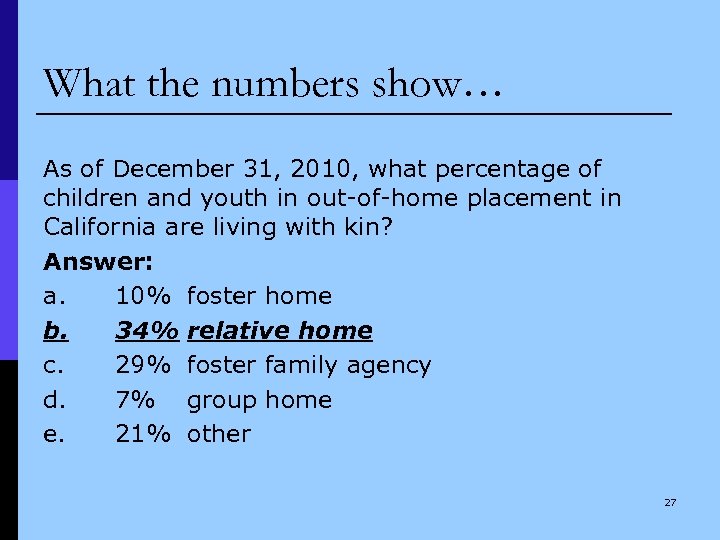 What the numbers show… As of December 31, 2010, what percentage of children and youth in out-of-home placement in California are living with kin? Answer: a. 10% foster home b. 34% relative home c. 29% foster family agency d. 7% group home e. 21% other 27
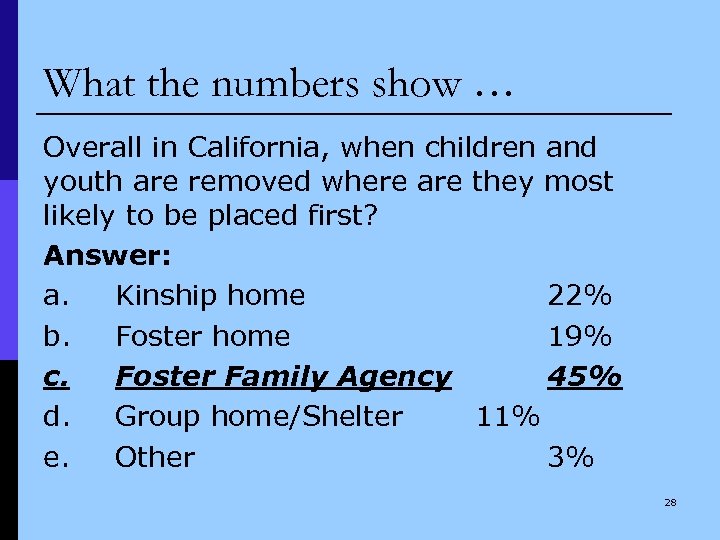 What the numbers show … Overall in California, when children and youth are removed where are they most likely to be placed first? Answer: a. Kinship home 22% b. Foster home 19% c. Foster Family Agency 45% d. Group home/Shelter 11% e. Other 3% 28
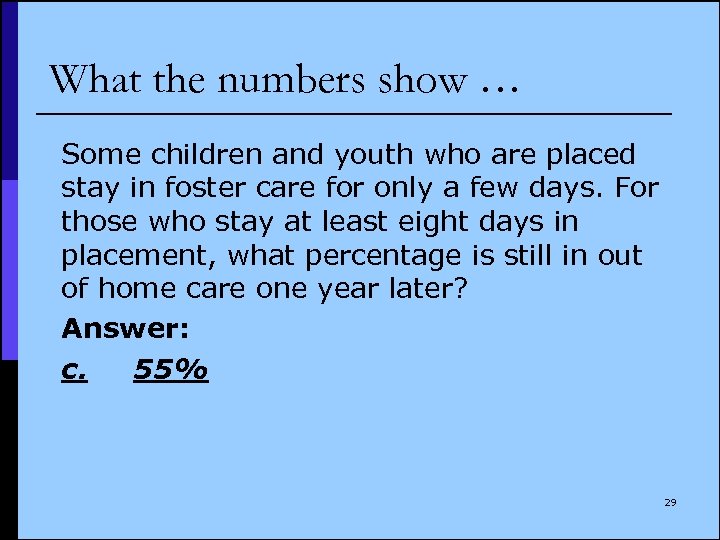 What the numbers show … Some children and youth who are placed stay in foster care for only a few days. For those who stay at least eight days in placement, what percentage is still in out of home care one year later? Answer: c. 55% 29
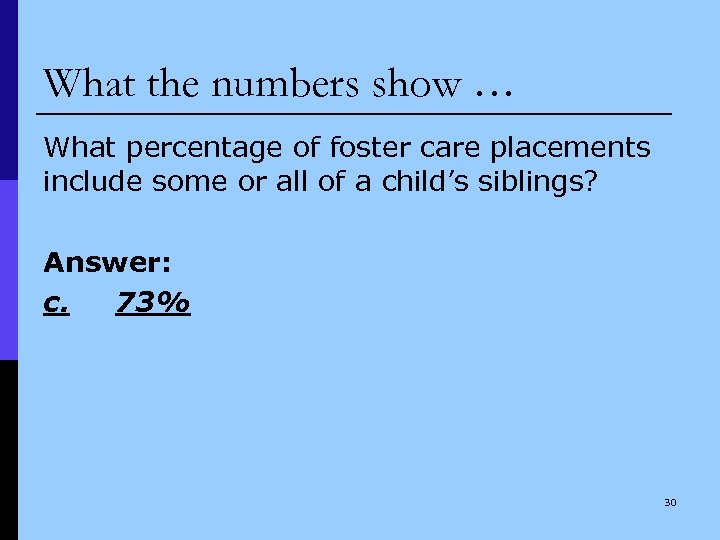 What the numbers show … What percentage of foster care placements include some or all of a child’s siblings? Answer: c. 73% 30
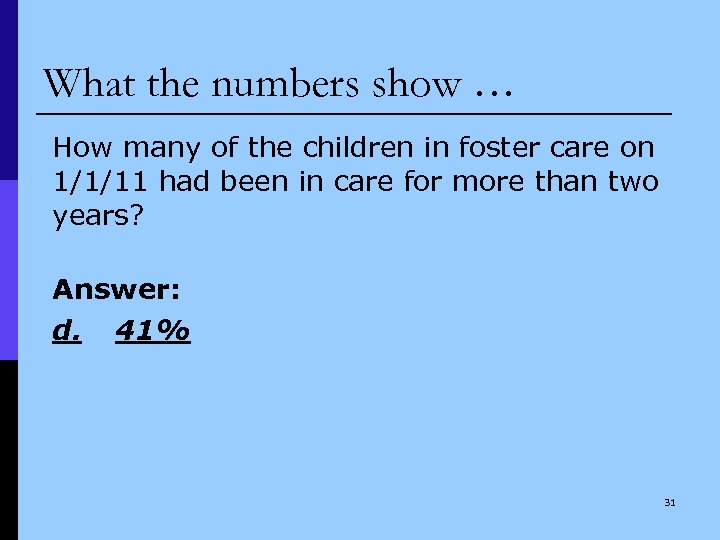 What the numbers show … How many of the children in foster care on 1/1/11 had been in care for more than two years? Answer: d. 41% 31
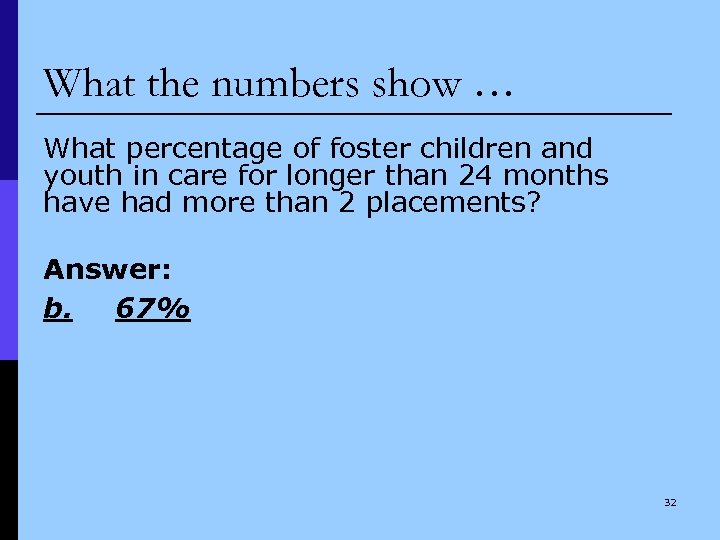 What the numbers show … What percentage of foster children and youth in care for longer than 24 months have had more than 2 placements? Answer: b. 67% 32
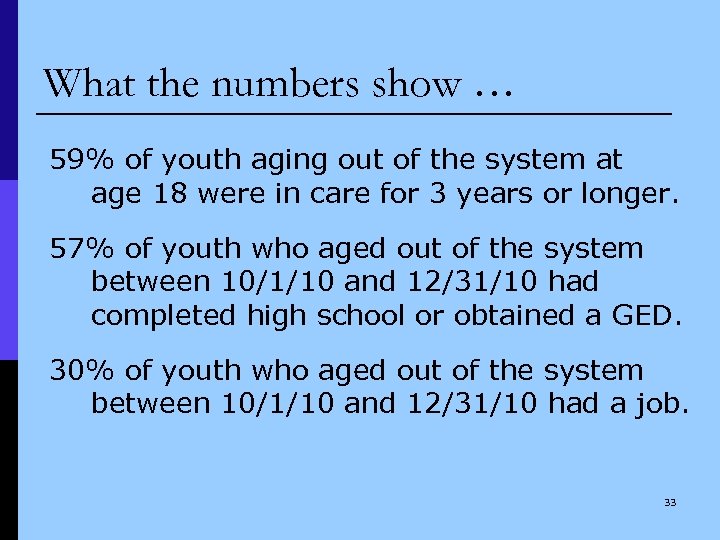 What the numbers show … 59% of youth aging out of the system at age 18 were in care for 3 years or longer. 57% of youth who aged out of the system between 10/1/10 and 12/31/10 had completed high school or obtained a GED. 30% of youth who aged out of the system between 10/1/10 and 12/31/10 had a job. 33
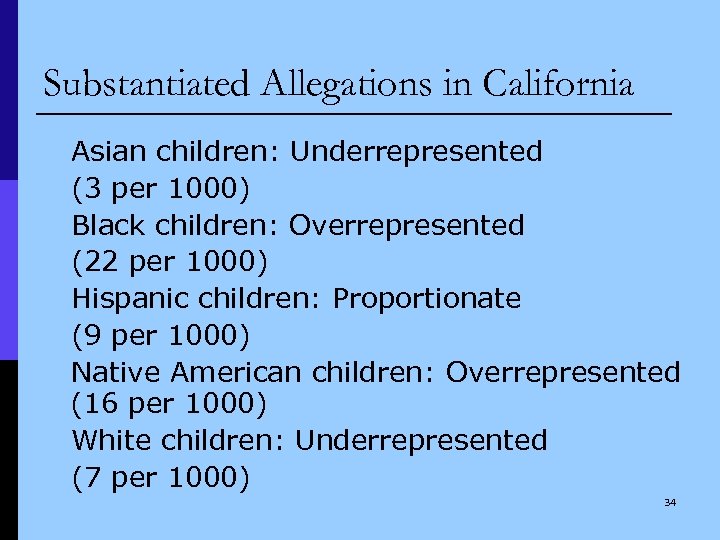 Substantiated Allegations in California Asian children: Underrepresented (3 per 1000) Black children: Overrepresented (22 per 1000) Hispanic children: Proportionate (9 per 1000) Native American children: Overrepresented (16 per 1000) White children: Underrepresented (7 per 1000) 34
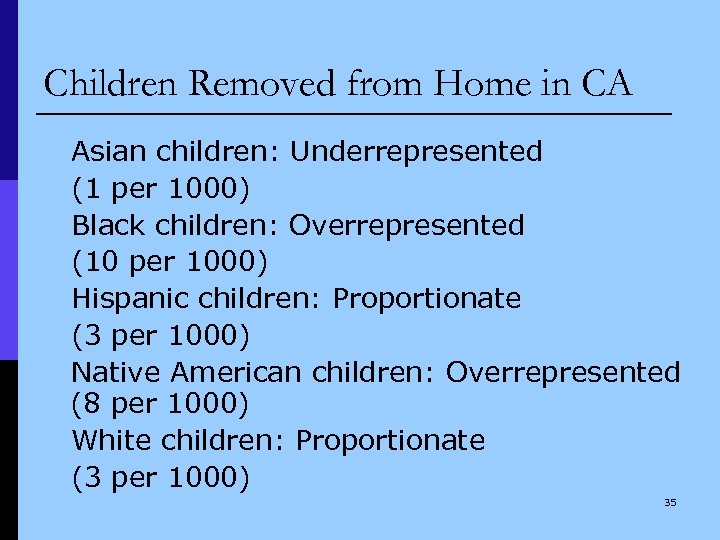 Children Removed from Home in CA Asian children: Underrepresented (1 per 1000) Black children: Overrepresented (10 per 1000) Hispanic children: Proportionate (3 per 1000) Native American children: Overrepresented (8 per 1000) White children: Proportionate (3 per 1000) 35
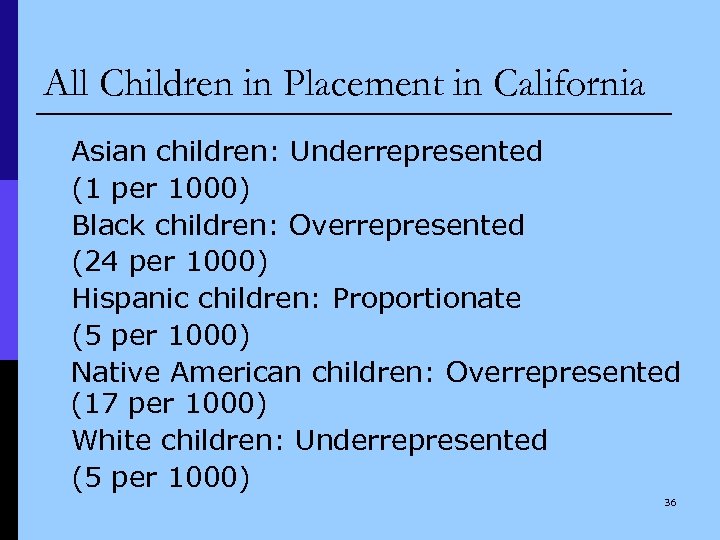 All Children in Placement in California Asian children: Underrepresented (1 per 1000) Black children: Overrepresented (24 per 1000) Hispanic children: Proportionate (5 per 1000) Native American children: Overrepresented (17 per 1000) White children: Underrepresented (5 per 1000) 36
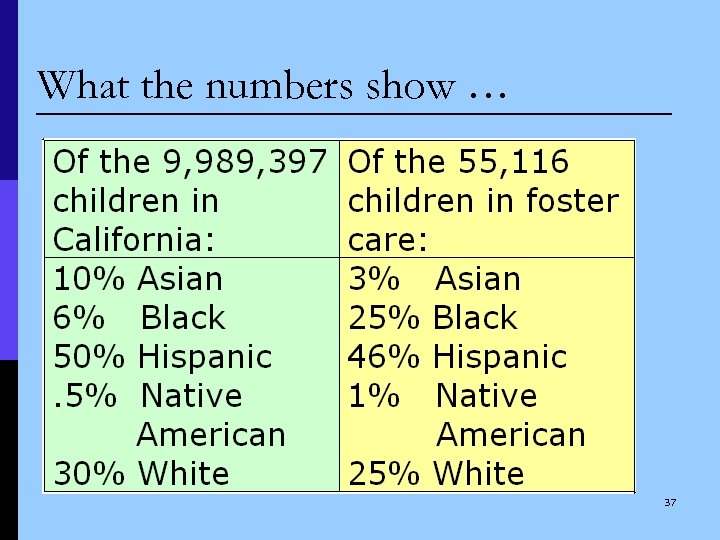 What the numbers show … 37
 How did you do? p What surprised you? p What bothered you? 38
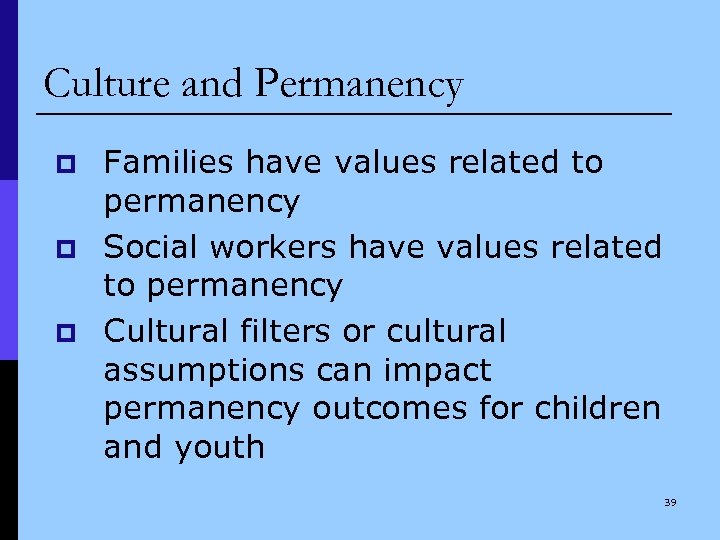 Culture and Permanency p p p Families have values related to permanency Social workers have values related to permanency Cultural filters or cultural assumptions can impact permanency outcomes for children and youth 39
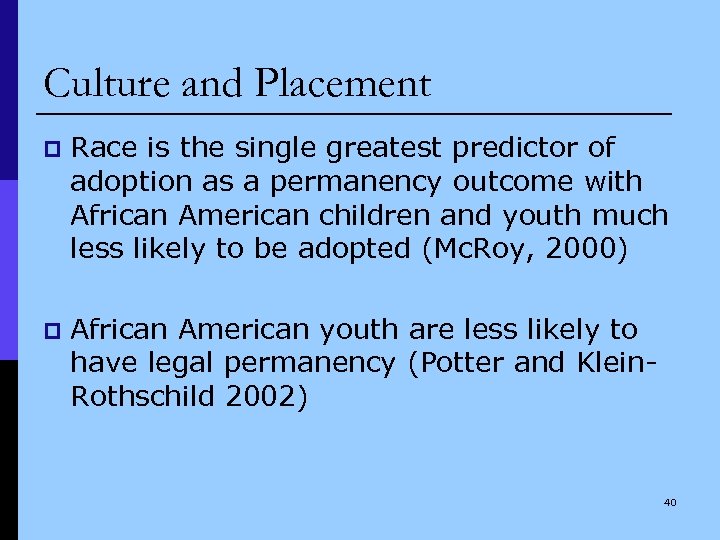 Culture and Placement p Race is the single greatest predictor of adoption as a permanency outcome with African American children and youth much less likely to be adopted (Mc. Roy, 2000) p African American youth are less likely to have legal permanency (Potter and Klein. Rothschild 2002) 40
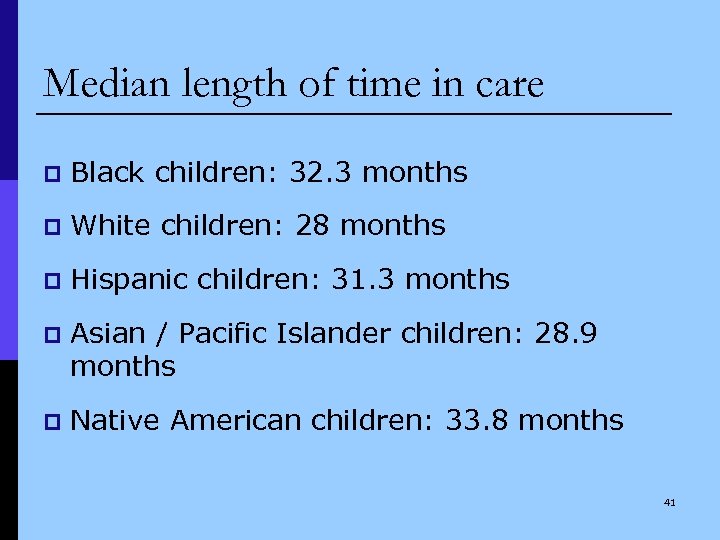 Median length of time in care p Black children: 32. 3 months p White children: 28 months p Hispanic children: 31. 3 months p Asian / Pacific Islander children: 28. 9 months p Native American children: 33. 8 months 41
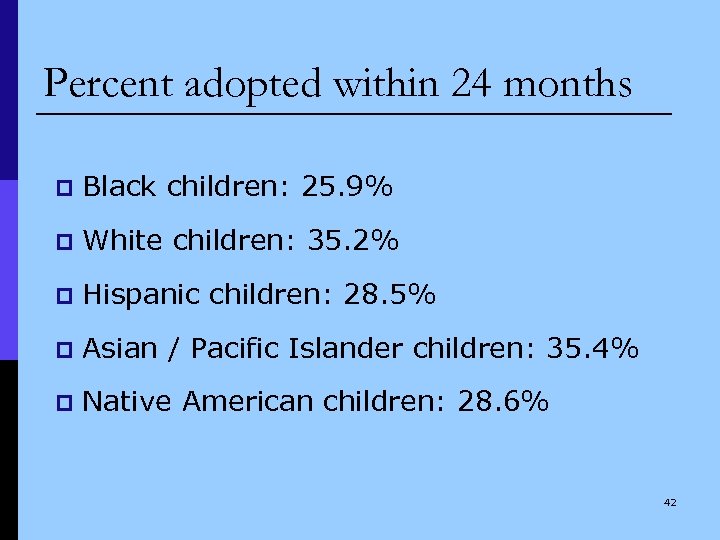 Percent adopted within 24 months p Black children: 25. 9% p White children: 35. 2% p Hispanic children: 28. 5% p Asian / Pacific Islander children: 35. 4% p Native American children: 28. 6% 42
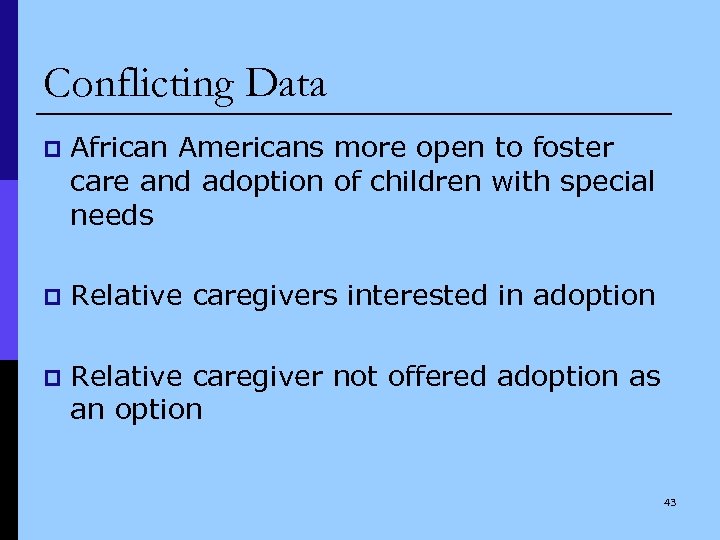 Conflicting Data p African Americans more open to foster care and adoption of children with special needs p Relative caregivers interested in adoption p Relative caregiver not offered adoption as an option 43
 Key Message: Now that you know about this, what are you going to do about it? 44
 Video Multiple Transitions: A Child’s Point of View about Foster Care and Adoption 45
 Attachment Helps Children Attain full intellectual potential p Develop a conscience p Trust others p Become self-reliant p Better cope with stress, frustration and jealousy p Overcome common fears and worries p Increase feelings of self worth p Fahlberg, 1991 46
 Healthy Attachment p For infants and preschoolers n n n Exploration of surroundings* Relaxed and happy demeanor Looking at others when communicating* Showing a response to separation* Demonstrating typical fears *May vary by culture 47
 Implications of Separation p For infants and preschoolers n Distress at loss of trusted caregivers n Belief that the change is permanent n Belief that the separation is a punishment n Feeling powerless 48
 Healthy Attachment p For school age children n n n Healthy self-esteem Pride in accomplishments Willingness to try new things* Establishing eye contact* Reacting positively to parent Positive peer interactions *May vary by culture 49
 Implications of Separation p For school age children n n Anxiety Guilt Confusion about cultural differences in the foster home Fear about siblings placed in other foster homes Loneliness, isolation loss of friends 50
 Healthy Attachment p For adolescents n n n Awareness of personal strengths and weaknesses Awareness of parents’ values Involved in interests outside home* Satisfactory school performance Future goals Positive peer interactions *May vary by culture 51
 Implications of Separation p For adolescents n Stress overload, crisis n Guilt and anxiety about the separation n Depression n Difficulty developing autonomy 52
 Implications of Separation Feelings of anger and rage p Behaviors such as opposition, hypersensitivity, emotional outbursts, property destruction, aggression, lying, stealing, tantrums, or withdrawal p Physical symptoms such as abdominal pain, headaches, insomnia, extreme fatigue, binge eating or lack of appetite p 53
 Stages of Grief and Loss Denial p Anger p Blame p Bargaining p Depression p Adaptation / Adjustment p 54
 Faith’s Story p The impact of placement on the sibling relationship (the longest relationship most people will have in their lives) 55
 What could we do differently? What is your reaction to Faith’s Story? p What impact did this have on Faith? p What has she done to cope with the impact? p What does this say to you about what CWS, the courts, and others should do when children need to be placed? p 56
 Activity An Unplanned Move 57
 Don’t worry 58
 Key Message Social worker actions can reduce placement trauma for children and youth. 59
 Taking it home…. . 60
 Permanency & Placement Version 2. 3, June 2014 Day 2 61
 Activity Crisis Management 62
 What is crisis? p Loss of control p Feelings of fear p Sudden changes p Feelings of desperation p Inability to focus 63
 Components of Crisis p Stressor p Coping skills p Perception 64
 Decrease Placement Trauma Encourage the child to express feelings & ask questions p Arrange a visit before the child leaves home p Develop a list of people the child trusts p Bring familiar comfort items with the child p Build a relationship between the parent & foster parent p Arrange for services to treat the abuse or neglect and the trauma of placement p 65
 Cross Cultural Placement Discuss the cultural differences (include things like religion, clothes, food, hair) p Empathize with feelings of being different p Help the foster parent & child make a plan p Facilitate a conversation between the foster parent and birth parent p Talk to the family about the child’s typical expression of sadness p 66
 Encourage Attachment p For infants and young children n p Respond quickly to physical needs Interact frequently Express affection For older children and adolescents n n Share excitement over accomplishments Participate in outside activities Express affection Plan activities to do together 67
 Placement Protocol Facilitate a meeting between the foster family and the biological family p Provide details about the child to the foster parent p Provide culturally specific information p Prepare the child for the transition to placement p 68
 Activity Placement Needs of Children at Different Developmental Levels 69
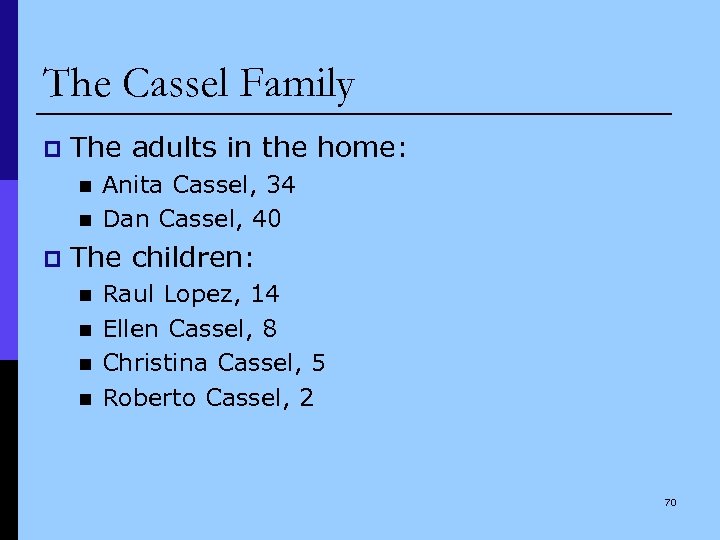 The Cassel Family p The adults in the home: n n p Anita Cassel, 34 Dan Cassel, 40 The children: n n Raul Lopez, 14 Ellen Cassel, 8 Christina Cassel, 5 Roberto Cassel, 2 70
 Activity Cassel Family Placement Considerations: Child’s Needs Ideas to Ease the Transition 71
 Your Ideas p Roberto p Ellen p Christina p Raul 72
 Concurrent planning means p considering all reasonable options for permanency at the earliest possible point following a child's entry into foster care, and p simultaneously pursuing those that will best serve the child's needs. 73
 Start the conversation p Prepare a brief introductory statement (your 2 minute pitch) p Acknowledge that the subject is difficult p Engage the family to work with you 74
 Full disclosure includes p p p p The rights of the parents The safety concerns and the MSLC The planning process (safety plan, case plan, concurrent permanency planning) Family strengths and resources Potential outcomes of the child welfare intervention The timelines for reunification Relinquishment The importance of permanency and placement stability for children 75
 For Successful Full Disclosure p Start with a discussion of strengths p Focus the middle portion of the meeting on the more difficult information p Close the meeting with a return to a more positive tone From the NRCFCPP Concurrent Planning Training 76
 Full Disclosure = Engagement Applicable skills: p Partializing p Open-ended questions p Strengths finding p Mutual respect p Empathy From the NRCFCPP Concurrent Planning Training 77
 Key Message: Parents have a right to full disclosure and a right to participate in the permanency planning process. 78
 Activity p Concurrent Planning Full Disclosure Role Play 79
 Overcoming Full Disclosure Barriers p Stress the benefits of permanency p Acknowledge strengths p Establish a frequent and constructive visitation plan 80
 Helping Parents to Help Kids p Making the placement process easier for parents allows them to focus on making the process easier for the kids p How can we make the process easier for parents? 81
 Participatory Planning Increases family involvement and ownership of processes and outcomes p Ensures that all involved have the same information p Helps identify services and supports p Builds on natural supports already available within the family p 82
 Teaming p Start with strengths p Use straight talk p Involve family and community p Build partnerships with foster parents and relative caregivers 83
 Icebreakers p Facilitate a better relationship between birth parents and foster parents p Open communication for sharing information about the child p Decrease tension and feelings of divided loyalty for children 84
 Decisions for the Cassel Family p Placement p Pros options and cons p Critical factors p Placement recommendation p Concurrent planning goal 85
 Placement Decisions p Raul will be placed with Jesus’ family p Christina and Roberto will be placed with their mother’s sister, Maria p Ellen will be placed with her grandparents, Dan and Monica Cassel 86
 Permanency Assessment p The SDM reunification assessment includes a reassessment of risk, an assessment of the visitation plan, and a safety assessment. p The CAT Continuing Services Assessment includes a reunification readiness section addressing safety, risk and protective capacity. 87
 Substantial Probability of Reunification p Consistent and regular contact and visitation p Significant progress in resolving problems that led to the initial removal p The capacity and ability both to complete the objectives of the treatment plan within the time limit and to meet the child’s needs if the time is extended 88
 Assessment of Substitute Caregivers p Important considerations: n n n n Childs strengths and needs Culture and language Child’s immediate and ongoing needs Level of care Siblings Permanency Visitation Caregiver’s ability to keep child safe and support case plan efforts 89
 Caregivers and Permanency p Willingness n Previous is linked to: experiences n Expectations n Relationship 90
 Explaining Permanency Options p Reunification – the first permanency priority p Adoption – the legal transfer of all parenting rights and responsibilities to a new parent p Legal guardianship – court appointment of a person to provide for a child until adulthood p Long term foster care – a temporary placement which may end at any time 91
 Caregivers and Permanency p Ability is linked to: n Criminal history n Substance abuse n Mental health n Child welfare history n Use of physical punishment 92
 Factors Linked to Placement Stability Foster parent / birth parent contact in the foster home p Foster parent intention to adopt p Foster parent knowledge of child development p Foster parent access to support systems p Foster parent use of non-physical discipline p Foster parent use of positive reinforcement p Close monitoring and supervision p 93
 Your Role in Placement Stability p Increased social worker presence in the foster home leads to better placement stability p Why? 94
 Is There a Permanent Connection? Would the youth be asked to leave the house for mistakes or behavior? p Does the youth go on family vacations? p Is the same amount of money devoted to the youth as to other children in family? p Is the youth included in inheritance? p In all ways, is the youth treated as a member of the family? p 95
 Key Message: It is very important to address the emotional connection between youth and foster parents / relative caregivers. 96
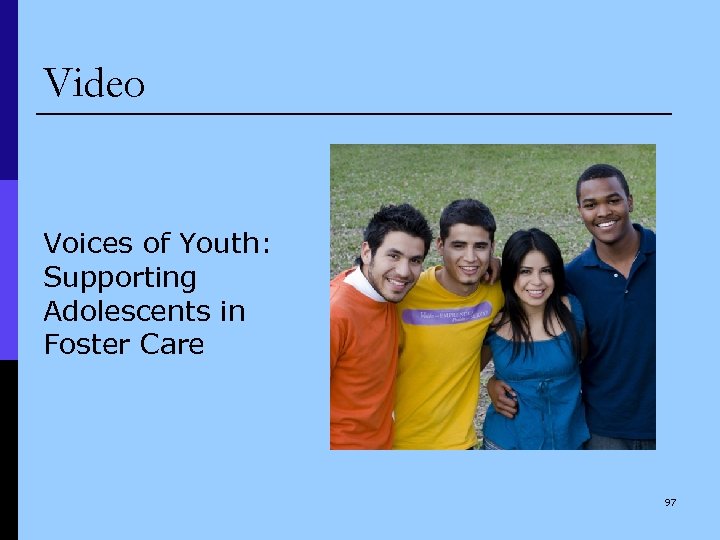 Video Voices of Youth: Supporting Adolescents in Foster Care 97
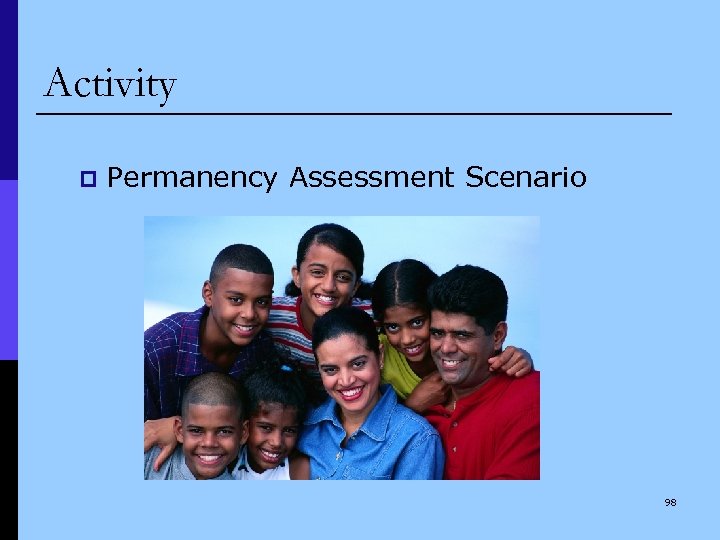 Activity p Permanency Assessment Scenario 98
 Key Message: Visitation is the most important factor related to reunification 99
 Activity Cassel Children Visitation Plan Link to this case plan objective: p Mr. Cassel will use rewards, praise and timeouts to address his children’s positive and negative behavior. 100
 Visitation Observation Assess visits to inform decisions about reunification p Develop a written visitation plan p Observe visits p Document visitation activities p 101
 Key Message: Talk to youth frequently about permanency, important people in the youth’s life and facilitating emotional connections 102
 Activity p Talking to Youth about Permanency 103
 Concurrent planning means p considering all reasonable options for permanency at the earliest possible point following a child's entry into foster care, and p simultaneously pursuing those that will best serve the child's needs. 104
 Activity Concurrent Planning Role Play Part 2 p Be sure to include n n n Full disclosure Information about permanency options Engagement techniques Acknowledgement of the feelings Support for the foster parent’s role 105
 Activity Supporting Placement Stability p Be sure to include n n n Ongoing contact with birth families Treatment to address grief and loss Assistance with accessing services Parenting training to assist caregivers A Life book for the child Purposeful and frequent social worker visits 106
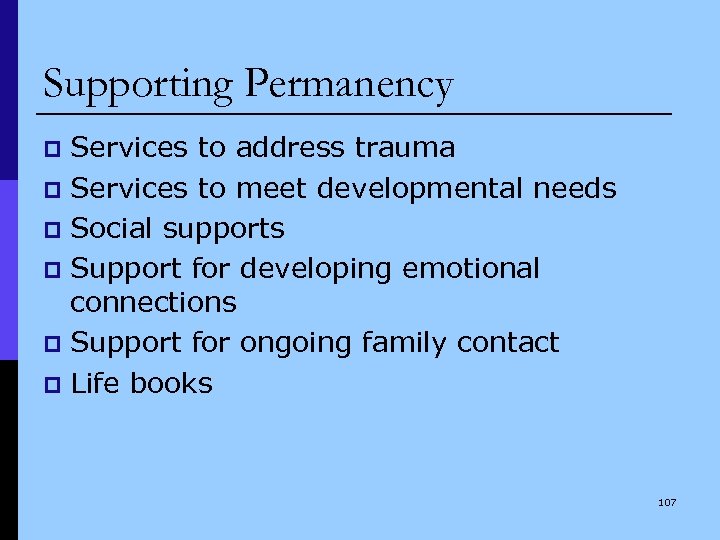 Supporting Permanency Services to address trauma p Services to meet developmental needs p Social supports p Support for developing emotional connections p Support for ongoing family contact p Life books p 107
 Making Permanency Decisions p What factors should be considered in making permanency decisions for the Cassel family? 108
 Taking it home…. . 109
 My Action Plan 110
 Training Evaluation Testing, testing… 111