


 Скачать презентацию Perkins 101 Career and Technical Education Carl D
abc2ae5613cee0c6b5ec9500badba9d0.ppt
- Количество слайдов: 32
 Perkins 101 Career and Technical Education Carl D Perkins Act of 2006
 Topics What is Perkins IV? Minnesota’s Five CTE Goal Areas A New Consortium Structure CTE Program Requirements Accountability and Data Requirements What is the CTE Levy? What are Programs of Study? Assessing Technical Skill Attainment under Perkins IV
 Perkins IV: The Carl D. Perkins Career and Technical Education Act of 2006 (Public Law 109 -270) Ø Direction and funding to support continuous improvement in career and technical education (CTE) at secondary and postsecondary Ø Accountability for results and program improvement at all levels Ø Increased coordination within the CTE system Ø Stronger academic and technical integration Ø Connections between secondary and postsecondary education Ø Links to business and industry
 Carl D Perkins Act 2006 Themes in the law are reflected in Minnesota’s CTE Goals 1. Designing & Implementing Programs of Study 2. Effectively Utilize Employer, Community, and Education Partnerships 3. Improve Service to Special Populations 4. Provide a Continuum of Service Provisions for Enabling Student Transitions 5. Sustain the Consortium of Secondary and Postsecondary Institutions
 Goal 1: Designing & Implementing Programs of Study in all areas where applicable Involvement of teachers, faculty, counselors, administration Professional Development Inclusion of Adult Learners (Fast. Track Program) Opportunities for Early College Credit Improvement of Academic and Technical Skills of CTE learners Assessment of the Programs using valid and reliable assessments All Aspects of the Industry
 Goal 2: Effectively Utilize Employer, Community, and Education Partnerships All Aspects of the Industry through Work-Based Learning Opportunities Program Advisory Committees identifying High Skill, High Wage, and High Demand Occupations Collaboration with other government or non-profit agencies Advisory Committees provide continuous improvement with joint secondary and postsecondary involvement Transition opportunities for high school and adult students
 Goal 3: Improve Service to Special Populations Access to Programs of Study that are Nontraditional by gender Strategies and outcomes to overcome barriers for special populations High Skill, High Wage, and High Demand Occupations that lead to self-sufficiency Connect local, regional, and state-wide initiatives that support special populations Non-discrimination policy Consistent expectations for all learners
 Goal 4: Provide a Continuum of Service Provisions for Enabling Student Transitions Flexibility in scheduling Flexibility in formats Student services Brokering services Implement early college credit opportunities Transition adult learners into the workforce Enrollment, retention, and completion for military veterans, underemployed, and unemployed adults
 Goal 5: Sustain the Consortium of Secondary and Postsecondary Institutions Self-assessment of consortium systems and operations including fiscal and administration Shared responsibility for collaboration and accountability Collaboration between the consortium and stakeholders Use of data for evaluation of student success and continuous improvement Collaborative budget development Promotion of consortium CTE vision
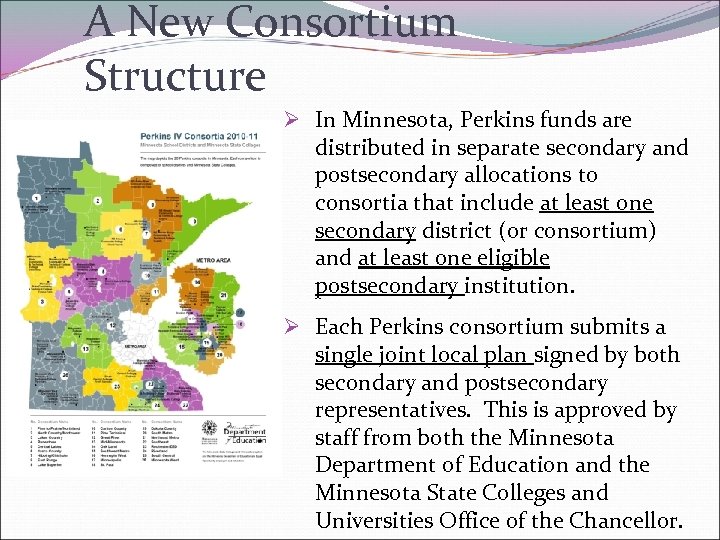 A New Consortium Structure Ø In Minnesota, Perkins funds are distributed in separate secondary and postsecondary allocations to consortia that include at least one secondary district (or consortium) and at least one eligible postsecondary institution. Ø Each Perkins consortium submits a single joint local plan signed by both secondary and postsecondary representatives. This is approved by staff from both the Minnesota Department of Education and the Minnesota State Colleges and Universities Office of the Chancellor.
 CTE: Secondary and Postsecondary Requirements • • • Program Approval Secondary Teacher Licensure College Faculty and Instructor Credentialing
 Secondary CTE Program Approval Minnesota Rules 3505 All CTE programs MUST have a program approval on file with MDE (second document) http: //education. state. mn. us/MDE/Academic_Excellen ce/Career_Technical_Education/Forms_Resources/inde x. html 5 year cycle (Due 12/1) 2009 -10 Southwest MN 2010 -11 Southeast MN 2011 -12 West Metro 2012 -13 Northern MN 2013 -14 Central MN & East Metro
 Postsecondary Program Approval • Minnesota State Colleges and Universities Board of Trustees--Policies and Procedures Related to Academic Programs www. mnscu. edu/board/policy/336. html • Only programs approved by the chancellor as recorded in the academic program inventory may be offered by system colleges and universities.
 Secondary CTE Licensure Minnesota Rules 3505 All CTE teachers utilizing Federal (Perkins) and Local Levy Dollars MUST hold a valid CTE license http: //education. state. mn. us/MDE/Academic_Excelle nce/Career_Technical_Education/Forms_Resources/i ndex. html (Table C - Table of Programs and Licenses) Common Course Catalogue (new for FY 11)
 College Faculty Credentialing Policy 3. 32/Procedure 3. 32. 1 http: //ww. mnscu. edu/board/policy/332. html http: //www. mnscu. edu/board procedure/332 p 1. html Career, technical and professional credential fields minimum qualifications - Educational requirement Teaching and learning competency Occupational experience State and/or national industry licensure and certification Program accreditation requirement
 Data (CTE Required under Perkins IV) Secondary collects data electronically for 6 indicators and 4 sub indicators: 1 S 1 Academic Attainment Reading (MCA 10) 1 S 1 A Academic Attainment (BST) 1 S 2 Academic Attainment Mathematics (MCA 11) 2 S 1 Technical Skill Attainment (FY 10 end of Proxy measure) 3 S 1 Completion 4 S 1 NCLB Graduation 5 S 1 Placement and Retention 6 S 1 Participation of Nontraditional Students 6 S 2 Completion of Nontraditional Students
 Data (CTE Required under Perkins IV) Postsecondary collects data primarily using the system-wide Integrated Student Record System (ISRS). Perkins data are stored in a data warehouse table accessed using Hyperion/BRIO. 5 indicators and 1 sub indicator: 1 P 1 2 P 1 3 P 1 4 P 1 5 P 2 Technical Skill Attainment Credential, Certification, or Degree Student Retention or Transfer Student Placement Nontraditional Participation Nontraditional Completion
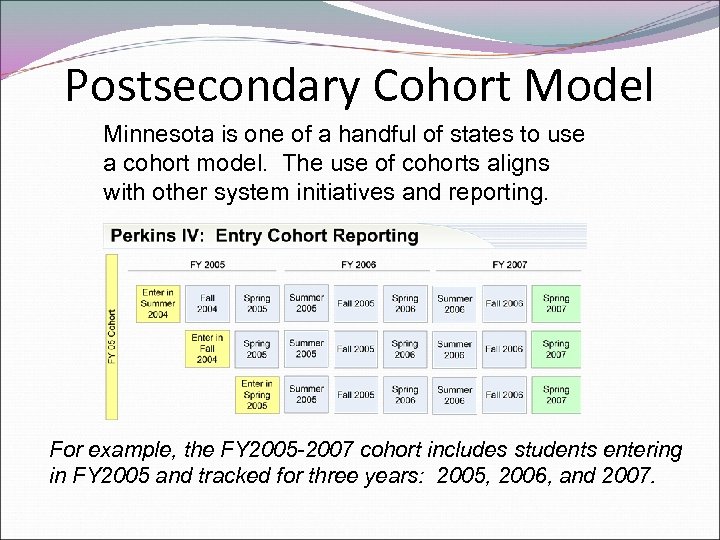 Postsecondary Cohort Model Minnesota is one of a handful of states to use a cohort model. The use of cohorts aligns with other system initiatives and reporting. For example, the FY 2005 -2007 cohort includes students entering in FY 2005 and tracked for three years: 2005, 2006, and 2007.
 Secondary: CTE Levy The CTE Levy is a permissive levy that does not require a public vote. This levy is a set amount depending on the population of the enrollment district and is approved by the local school board. The Levy can only be used for approved CTE programs where there is an appropriately licensed CTE teacher.
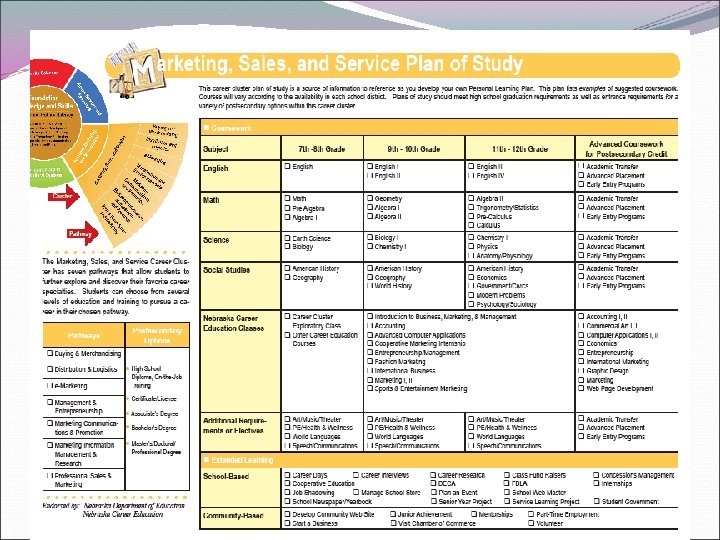
 PROGRAMS OF STUDY NEW FOR PERKINS IV The focus is on new and innovative programs with career ready skills for all students in high wage, high demand, high skilled occupations.
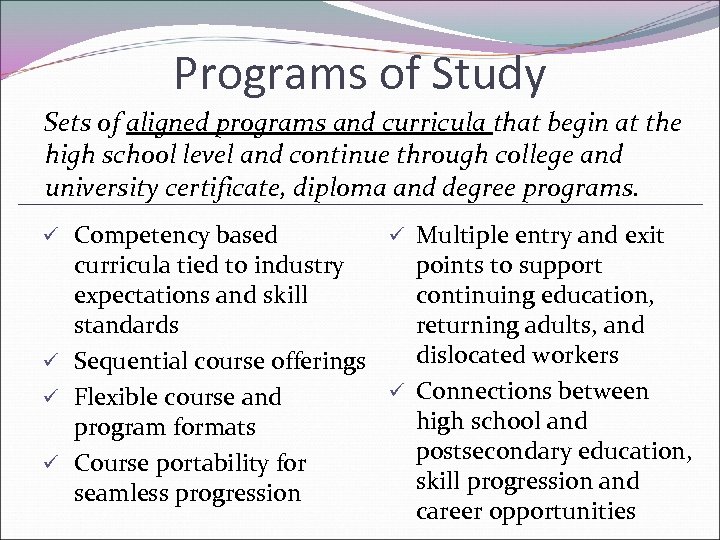 Programs of Study Sets of aligned programs and curricula that begin at the high school level and continue through college and university certificate, diploma and degree programs. ü Competency based ü Multiple entry and exit curricula tied to industry points to support expectations and skill continuing education, standards returning adults, and dislocated workers ü Sequential course offerings ü Connections between ü Flexible course and high school and program formats postsecondary education, ü Course portability for skill progression and seamless progression career opportunities
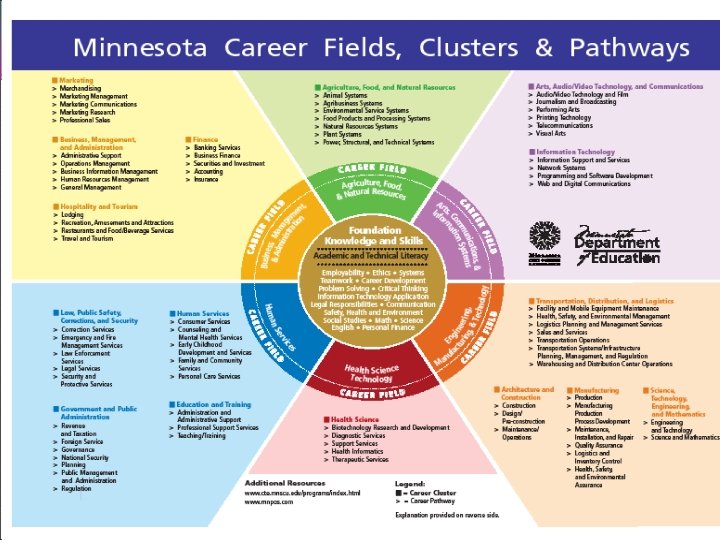
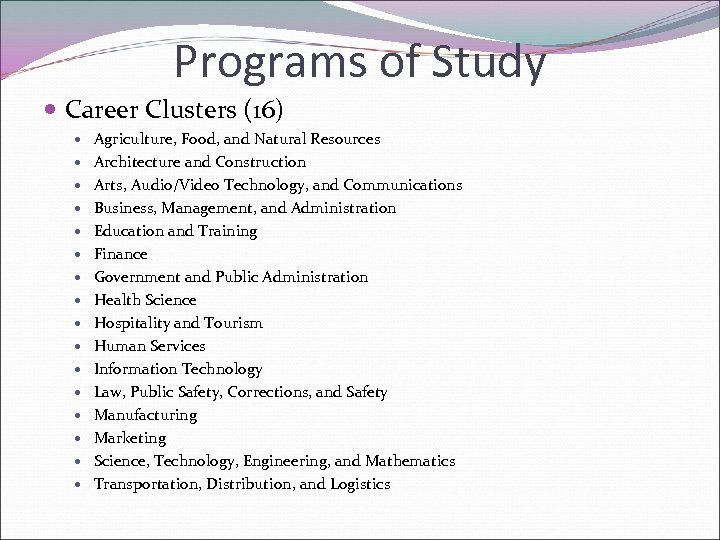 Programs of Study Career Clusters (16) Agriculture, Food, and Natural Resources Architecture and Construction Arts, Audio/Video Technology, and Communications Business, Management, and Administration Education and Training Finance Government and Public Administration Health Science Hospitality and Tourism Human Services Information Technology Law, Public Safety, Corrections, and Safety Manufacturing Marketing Science, Technology, Engineering, and Mathematics Transportation, Distribution, and Logistics
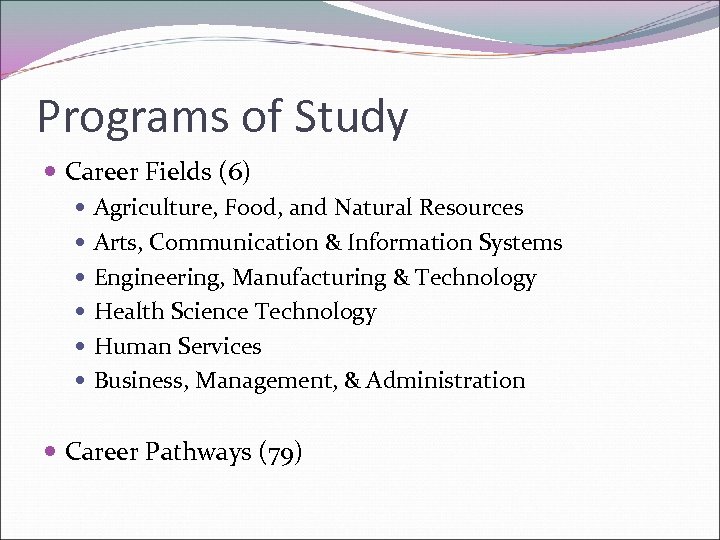 Programs of Study Career Fields (6) Agriculture, Food, and Natural Resources Arts, Communication & Information Systems Engineering, Manufacturing & Technology Health Science Technology Human Services Business, Management, & Administration Career Pathways (79)
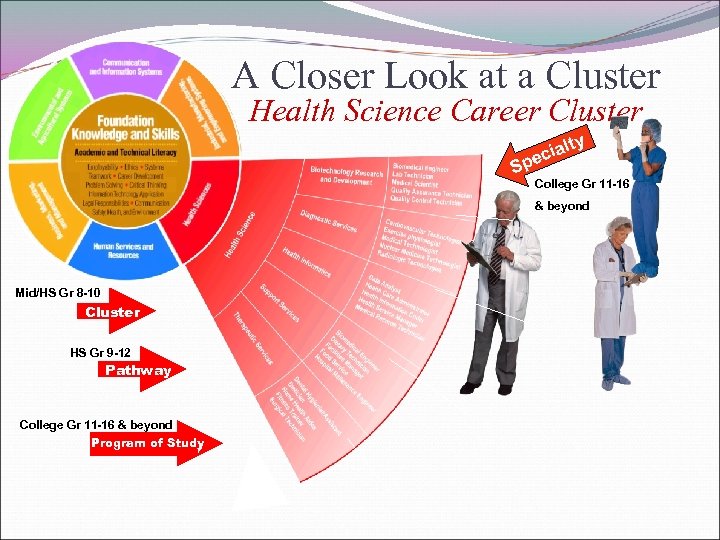 A Closer Look at a Cluster Health Science Career Cluster y lt cia Spe College Gr 11 -16 & beyond Mid/HS Gr 8 -10 Cluster HS Gr 9 -12 Pathway College Gr 11 -16 & beyond Program of Study Specialty
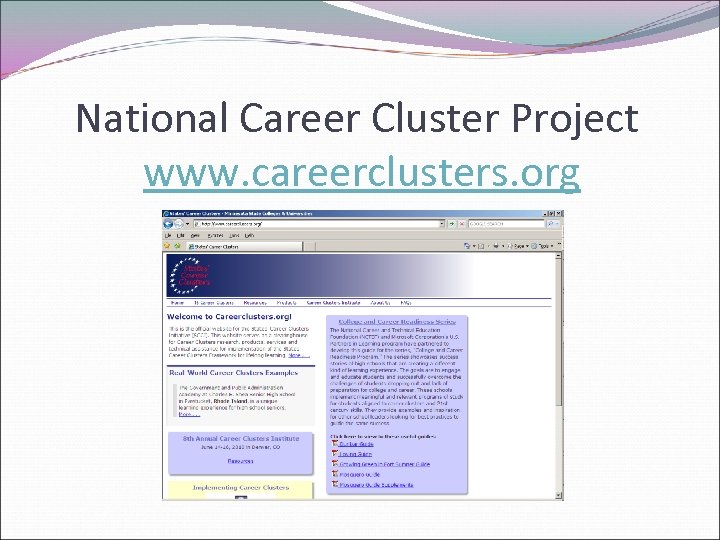 National Career Cluster Project www. careerclusters. org
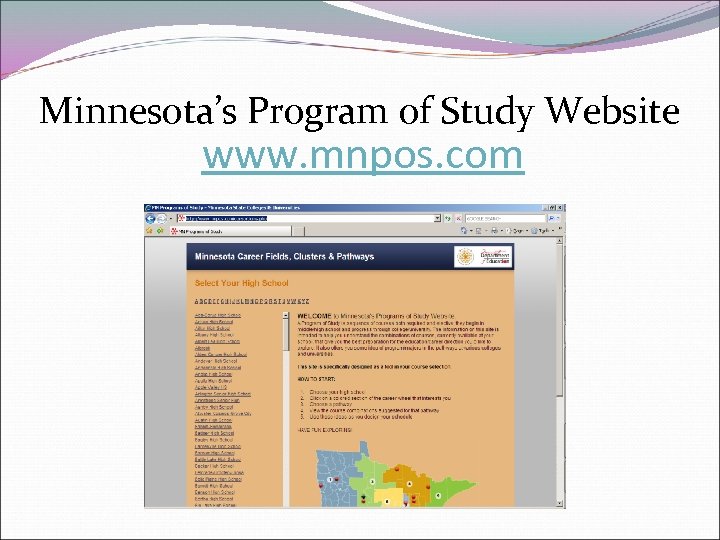 Minnesota’s Program of Study Website www. mnpos. com
 (2 S 1/1 P 1) Technical Skill Attainment Required under Perkins IV Minnesota Phase in 2011 Accounting Law Enforcement Services Network Systems Plant Systems Therapeutic Services Minnesota Phase in completed by 2013
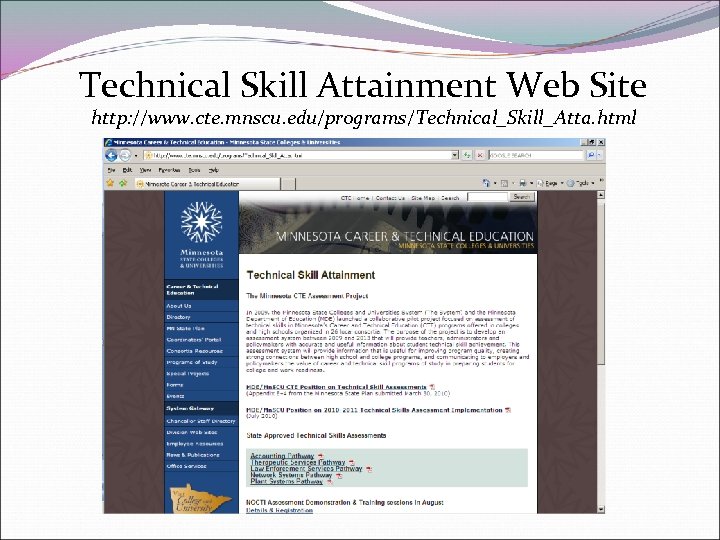 Technical Skill Attainment Web Site http: //www. cte. mnscu. edu/programs/Technical_Skill_Atta. html
 Web Sites MDE: http: //education. state. mn. us/MDE/Academic_Excellence /Career_Technical_Education/Forms_Resources/index. html Mn. SCU http: //www. cte. mnscu. edu/ National Professional Association Web Sites
 ? ? ? Questions ? ? ? Susan Carter Senior Research Associate Minnesota State Colleges and Universities Office of the Chancellor 30 Seventh Street, Suite 350 St Paul MN 55101 -7804 susan. carter@so. mnscu. edu 651 201 -1859 Marlys J. Bucher, Ph. D. Secondary Perkins Coordinator CTE Assessment and Evaluation Specialist Minnesota Department of Education 1500 Highway 36 West Roseville MN 55113 -4266 marlys. bucher@state. mn. us 651 582 -8315