


 Скачать презентацию Perioperative Evaluation and Management with Geriatric Considerations Theresa
7baa8a3f74cec8f32eb2793684740d59.ppt
- Количество слайдов: 53
 Perioperative Evaluation and Management with Geriatric Considerations Theresa King, M. D University of Kansas School of Medicine Department of Internal Medicine. Hospitalist
 REVIEW: § General Perioperative Principles § Cardiac § Pulmonary § Endocrine § Medication Issues § Geriatric Considerations
 PERIOPERATIVE CONSULTATION § We do not “clear” patients for surgery! § We determine individual patient risks and make recommendations to reduce those risks. “Evaluation and optimization. ” § No surgery or procedure is without riskimpossible to predict outcomes.
 PATIENT HISTORY and PHYSICAL § § § § § HPI PMH PSH Medications Allergies SH, FH ROS Physical Exam Lab, Radiology, etc.
 Past Surgical History § § § § “The past predicts the future”. Problems with anesthesia? Problems with bleeding? DVT’s/PE’s? Intra-operative CVA or MI? ICU? On Ventilator? Associated organ failure? Sepsis?
 Review of Systems § Specific questions should include: § Dyspnea? Wheezing? Cough? § Anginal symptoms? § Ankle or generalized swelling? § Abnormal bleeding?
 SOCIAL HISTORY- TOBACCO § Recent large meta-analysis: no suggestion, either from any single study or from combinations of studies, that quitting smoking shortly before surgery (within 8 weeks)increases postoperative complications. § Stopping Smoking Shortly Before Surgery and Postoperative Complications: A Systematic Review and Meta-analysis, Katie Myers, MSc, CPsychol; Peter Hajek, Ph. D; Charles Hinds, FRCP, FRCA; Hayden Mc. Robbie, MBCh. B, Ph. D , Arch Intern Med. 2011; 171(11): 983 -989. doi: 10. 1001/archinternmed. 2011. 97. § Encourage cessation at any time before surgery.
 SOCIAL HISTORY- ALCOHOL § Associated nutritional deficiencies § History of withdrawal issues including DT’s
 FAMILY HISTORY § Specifically, problems with bleeding, anesthesia and DVT/PE. § CAD Hx, including age of onset
 CARDIAC ASSESSMENT § Multiple risk stratification tools exist. § In assessment documentation, cite which guidelines were used.
 2009 ACCF/AHA Focused Update on Perioperative Beta Blockade Incorporated Into the ACC/AHA 2007 Guidelines on Perioperative Cardiovascular Evaluation and Care for Noncardiac Surgery (Journal of the American College of Cardiology, available at http: //content. onlinejacc. org/cgi/content/full/j. jacc. 2009. 07. 010)
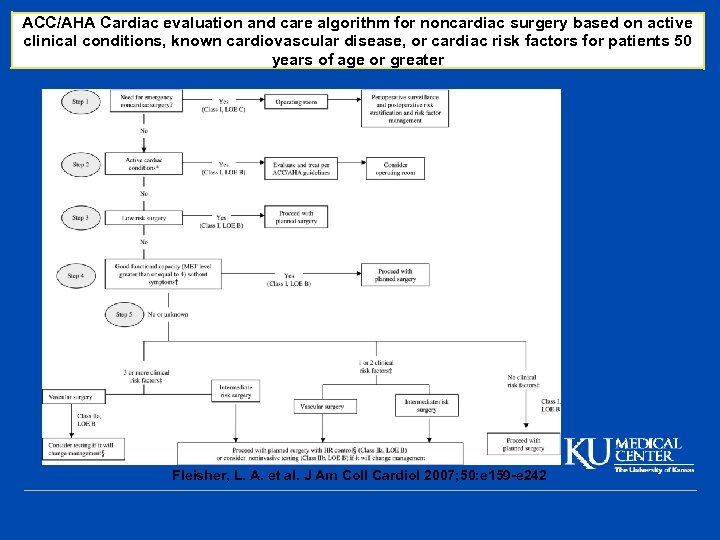 ACC/AHA Cardiac evaluation and care algorithm for noncardiac surgery based on active clinical conditions, known cardiovascular disease, or cardiac risk factors for patients 50 years of age or greater Fleisher, L. A. et al. J Am Coll Cardiol 2007; 50: e 159 -e 242
 STEP 1: URGENCY of SURGERY § Is it emergent, urgent, semi-urgent or elective?
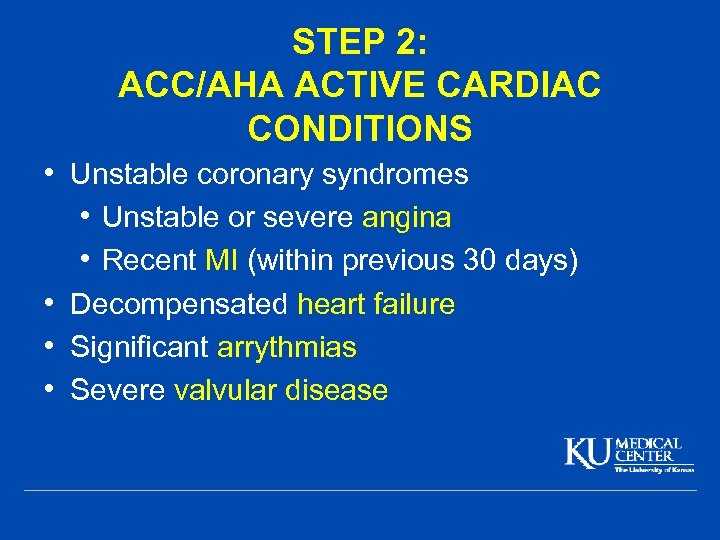 STEP 2: ACC/AHA ACTIVE CARDIAC CONDITIONS • Unstable coronary syndromes • Unstable or severe angina • Recent MI (within previous 30 days) • Decompensated heart failure • Significant arrythmias • Severe valvular disease
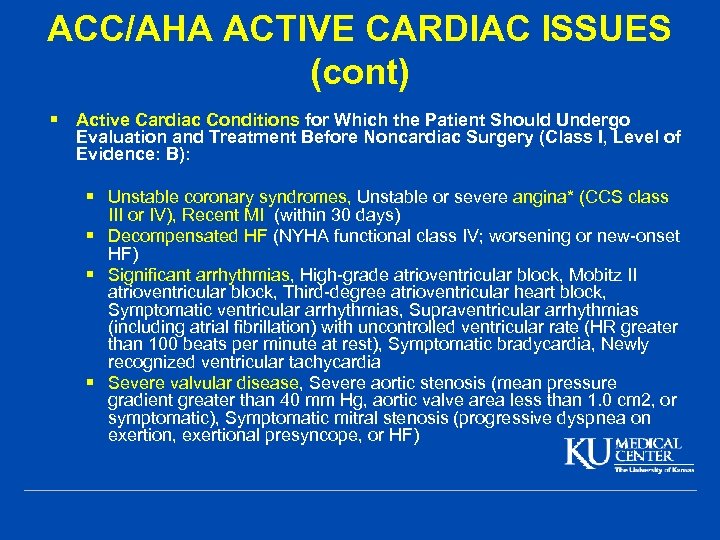 ACC/AHA ACTIVE CARDIAC ISSUES (cont) § Active Cardiac Conditions for Which the Patient Should Undergo Evaluation and Treatment Before Noncardiac Surgery (Class I, Level of Evidence: B): § Unstable coronary syndromes, Unstable or severe angina* (CCS class III or IV), Recent MI (within 30 days) § Decompensated HF (NYHA functional class IV; worsening or new-onset HF) § Significant arrhythmias, High-grade atrioventricular block, Mobitz II atrioventricular block, Third-degree atrioventricular heart block, Symptomatic ventricular arrhythmias, Supraventricular arrhythmias (including atrial fibrillation) with uncontrolled ventricular rate (HR greater than 100 beats per minute at rest), Symptomatic bradycardia, Newly recognized ventricular tachycardia § Severe valvular disease, Severe aortic stenosis (mean pressure gradient greater than 40 mm Hg, aortic valve area less than 1. 0 cm 2, or symptomatic), Symptomatic mitral stenosis (progressive dyspnea on exertion, exertional presyncope, or HF)
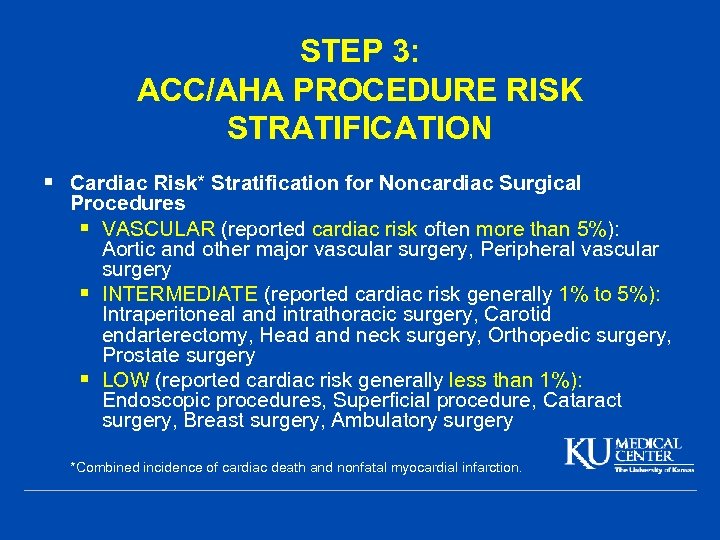 STEP 3: ACC/AHA PROCEDURE RISK STRATIFICATION § Cardiac Risk* Stratification for Noncardiac Surgical Procedures § VASCULAR (reported cardiac risk often more than 5%): Aortic and other major vascular surgery, Peripheral vascular surgery § INTERMEDIATE (reported cardiac risk generally 1% to 5%): Intraperitoneal and intrathoracic surgery, Carotid endarterectomy, Head and neck surgery, Orthopedic surgery, Prostate surgery § LOW (reported cardiac risk generally less than 1%): Endoscopic procedures, Superficial procedure, Cataract surgery, Breast surgery, Ambulatory surgery *Combined incidence of cardiac death and nonfatal myocardial infarction.
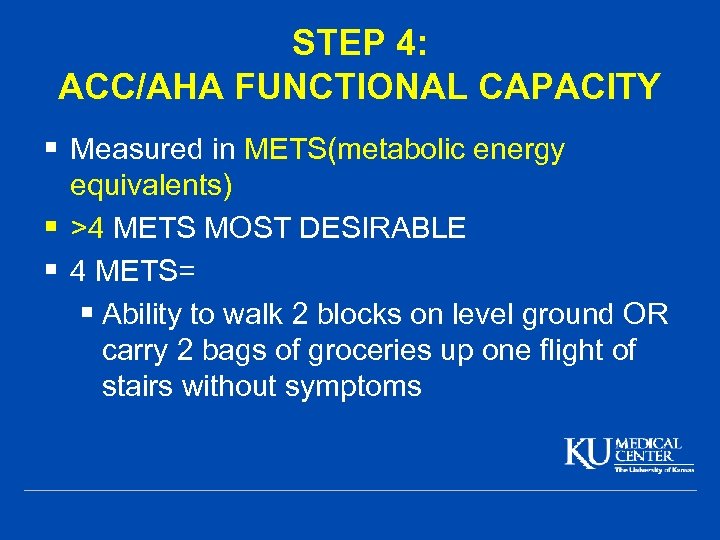 STEP 4: ACC/AHA FUNCTIONAL CAPACITY § Measured in METS(metabolic energy equivalents) § >4 METS MOST DESIRABLE § 4 METS= § Ability to walk 2 blocks on level ground OR carry 2 bags of groceries up one flight of stairs without symptoms
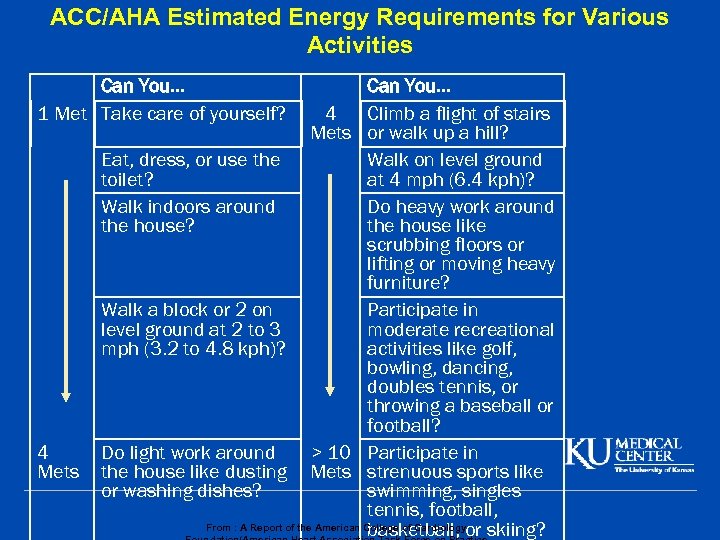 ACC/AHA Estimated Energy Requirements for Various Activities Can You… 1 Met Take care of yourself? 4 Mets Can You… 4 Climb a flight of stairs Mets or walk up a hill? Eat, dress, or use the Walk on level ground toilet? at 4 mph (6. 4 kph)? Walk indoors around Do heavy work around the house? the house like scrubbing floors or lifting or moving heavy furniture? Walk a block or 2 on Participate in level ground at 2 to 3 moderate recreational mph (3. 2 to 4. 8 kph)? activities like golf, bowling, dancing, doubles tennis, or throwing a baseball or football? Do light work around > 10 Participate in the house like dusting Mets strenuous sports like or washing dishes? swimming, singles tennis, football, From : A Report of the American College of Cardiologyor skiing? basketball,
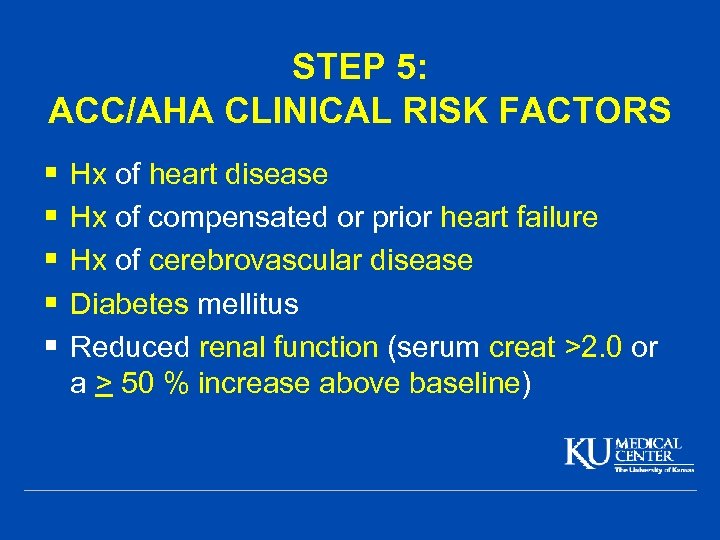 STEP 5: ACC/AHA CLINICAL RISK FACTORS § § § Hx of heart disease Hx of compensated or prior heart failure Hx of cerebrovascular disease Diabetes mellitus Reduced renal function (serum creat >2. 0 or a > 50 % increase above baseline)
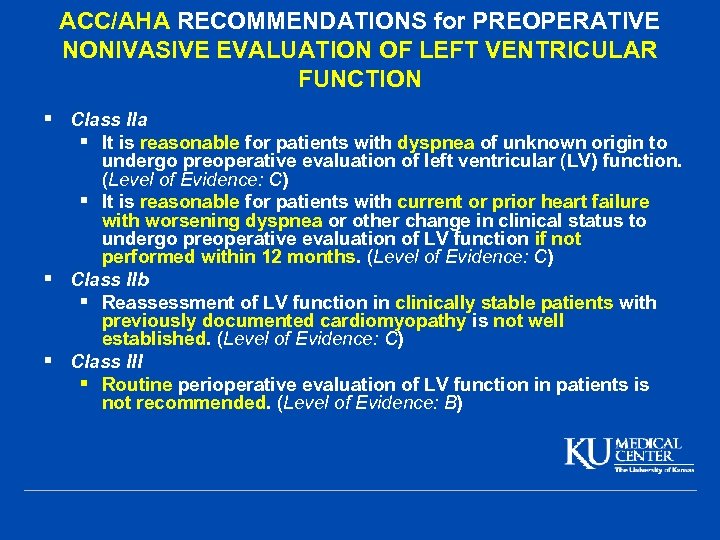 ACC/AHA RECOMMENDATIONS for PREOPERATIVE NONIVASIVE EVALUATION OF LEFT VENTRICULAR FUNCTION § Class IIa § It is reasonable for patients with dyspnea of unknown origin to undergo preoperative evaluation of left ventricular (LV) function. (Level of Evidence: C) § It is reasonable for patients with current or prior heart failure with worsening dyspnea or other change in clinical status to undergo preoperative evaluation of LV function if not performed within 12 months. (Level of Evidence: C) § Class IIb § Reassessment of LV function in clinically stable patients with previously documented cardiomyopathy is not well established. (Level of Evidence: C) § Class III § Routine perioperative evaluation of LV function in patients is not recommended. (Level of Evidence: B)
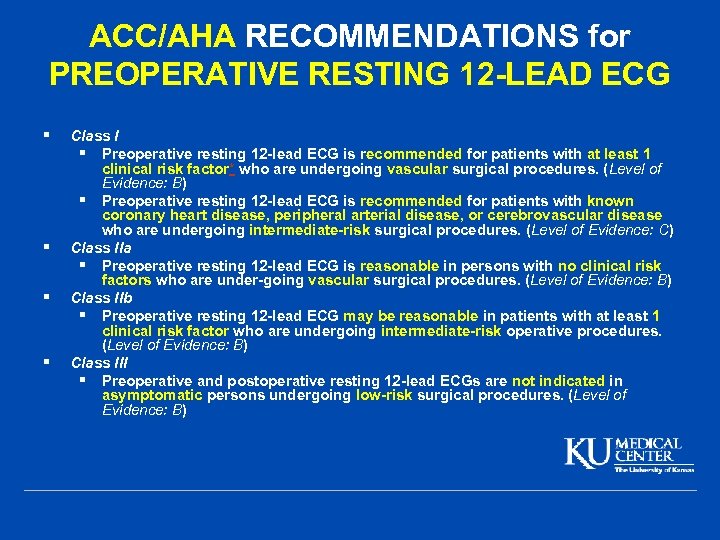 ACC/AHA RECOMMENDATIONS for PREOPERATIVE RESTING 12 -LEAD ECG § § Class I § Preoperative resting 12 -lead ECG is recommended for patients with at least 1 clinical risk factor* who are undergoing vascular surgical procedures. (Level of Evidence: B) § Preoperative resting 12 -lead ECG is recommended for patients with known coronary heart disease, peripheral arterial disease, or cerebrovascular disease who are undergoing intermediate-risk surgical procedures. (Level of Evidence: C) Class IIa § Preoperative resting 12 -lead ECG is reasonable in persons with no clinical risk factors who are under-going vascular surgical procedures. (Level of Evidence: B) Class IIb § Preoperative resting 12 -lead ECG may be reasonable in patients with at least 1 clinical risk factor who are undergoing intermediate-risk operative procedures. (Level of Evidence: B) Class III § Preoperative and postoperative resting 12 -lead ECGs are not indicated in asymptomatic persons undergoing low-risk surgical procedures. (Level of Evidence: B)
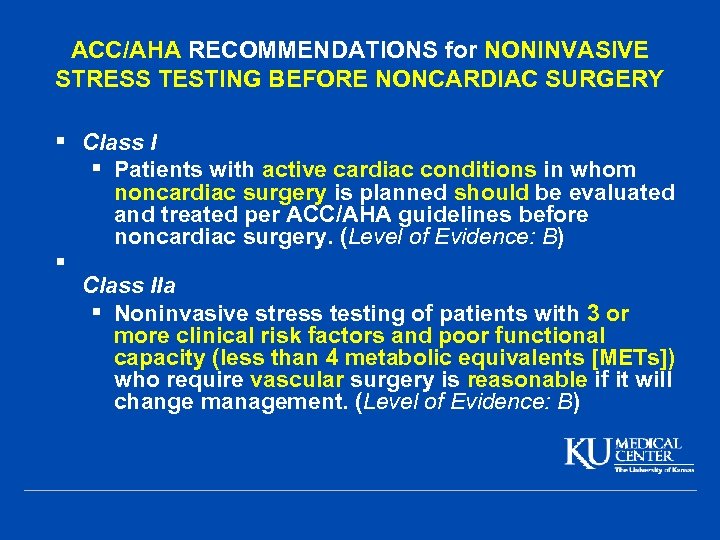 ACC/AHA RECOMMENDATIONS for NONINVASIVE STRESS TESTING BEFORE NONCARDIAC SURGERY § Class I § Patients with active cardiac conditions in whom § noncardiac surgery is planned should be evaluated and treated per ACC/AHA guidelines before noncardiac surgery. (Level of Evidence: B) Class IIa § Noninvasive stress testing of patients with 3 or more clinical risk factors and poor functional capacity (less than 4 metabolic equivalents [METs]) who require vascular surgery is reasonable if it will change management. (Level of Evidence: B)
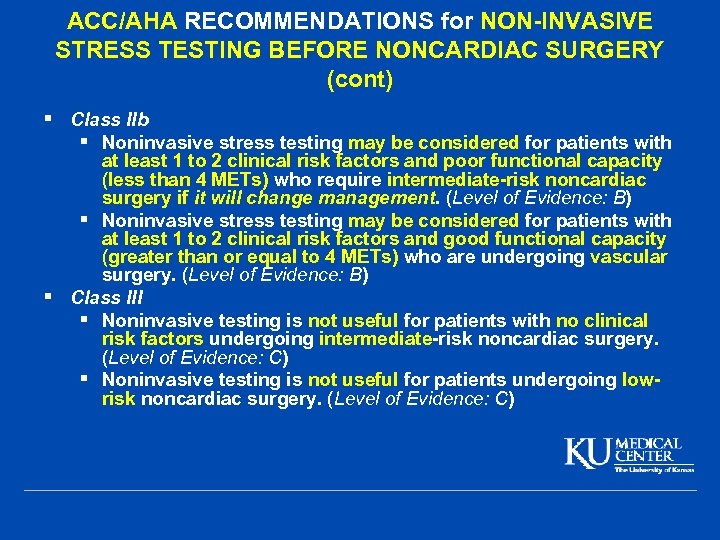 ACC/AHA RECOMMENDATIONS for NON-INVASIVE STRESS TESTING BEFORE NONCARDIAC SURGERY (cont) § Class IIb § Noninvasive stress testing may be considered for patients with at least 1 to 2 clinical risk factors and poor functional capacity (less than 4 METs) who require intermediate-risk noncardiac surgery if it will change management. (Level of Evidence: B) § Noninvasive stress testing may be considered for patients with at least 1 to 2 clinical risk factors and good functional capacity (greater than or equal to 4 METs) who are undergoing vascular surgery. (Level of Evidence: B) § Class III § Noninvasive testing is not useful for patients with no clinical risk factors undergoing intermediate-risk noncardiac surgery. (Level of Evidence: C) § Noninvasive testing is not useful for patients undergoing lowrisk noncardiac surgery. (Level of Evidence: C)
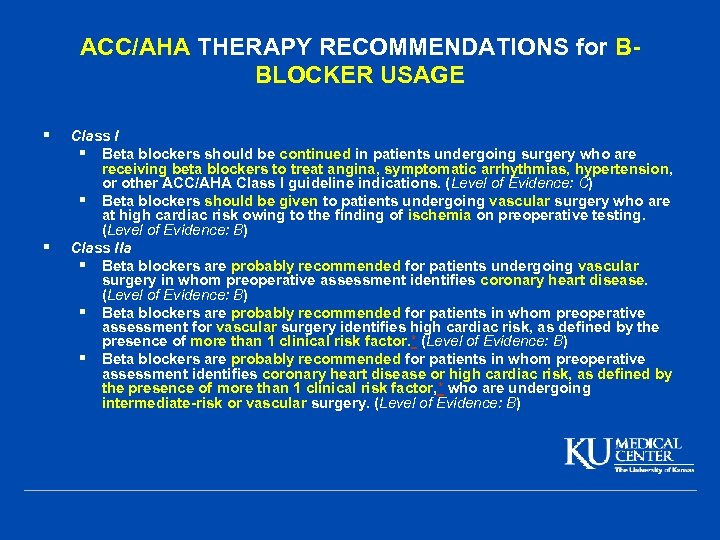 ACC/AHA THERAPY RECOMMENDATIONS for BBLOCKER USAGE § § Class I § Beta blockers should be continued in patients undergoing surgery who are receiving beta blockers to treat angina, symptomatic arrhythmias, hypertension, or other ACC/AHA Class I guideline indications. (Level of Evidence: C) § Beta blockers should be given to patients undergoing vascular surgery who are at high cardiac risk owing to the finding of ischemia on preoperative testing. (Level of Evidence: B) Class IIa § Beta blockers are probably recommended for patients undergoing vascular surgery in whom preoperative assessment identifies coronary heart disease. (Level of Evidence: B) § Beta blockers are probably recommended for patients in whom preoperative assessment for vascular surgery identifies high cardiac risk, as defined by the presence of more than 1 clinical risk factor. * (Level of Evidence: B) § Beta blockers are probably recommended for patients in whom preoperative assessment identifies coronary heart disease or high cardiac risk, as defined by the presence of more than 1 clinical risk factor, * who are undergoing intermediate-risk or vascular surgery. (Level of Evidence: B)
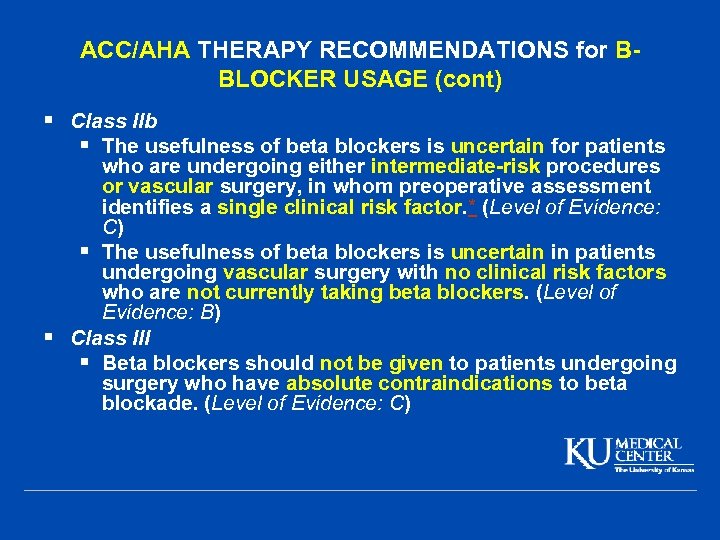 ACC/AHA THERAPY RECOMMENDATIONS for BBLOCKER USAGE (cont) § Class IIb § The usefulness of beta blockers is uncertain for patients who are undergoing either intermediate-risk procedures or vascular surgery, in whom preoperative assessment identifies a single clinical risk factor. * (Level of Evidence: C) § The usefulness of beta blockers is uncertain in patients undergoing vascular surgery with no clinical risk factors who are not currently taking beta blockers. (Level of Evidence: B) § Class III § Beta blockers should not be given to patients undergoing surgery who have absolute contraindications to beta blockade. (Level of Evidence: C)
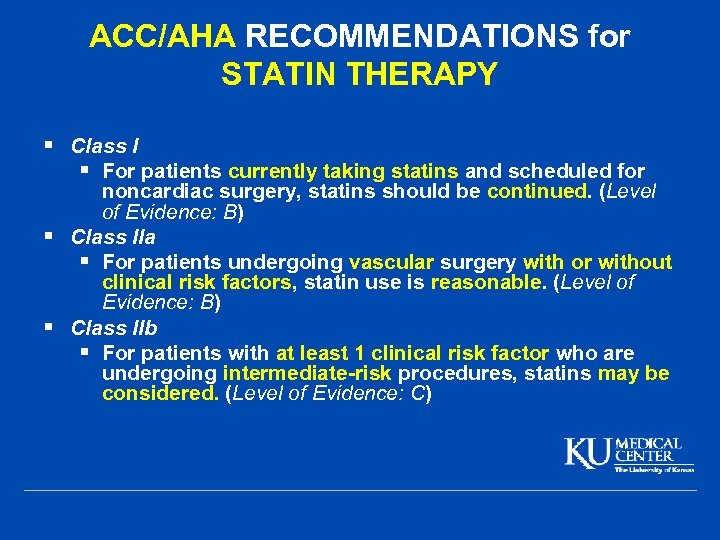 ACC/AHA RECOMMENDATIONS for STATIN THERAPY § Class I § For patients currently taking statins and scheduled for noncardiac surgery, statins should be continued. (Level of Evidence: B) § Class IIa § For patients undergoing vascular surgery with or without clinical risk factors, statin use is reasonable. (Level of Evidence: B) § Class IIb § For patients with at least 1 clinical risk factor who are undergoing intermediate-risk procedures, statins may be considered. (Level of Evidence: C)
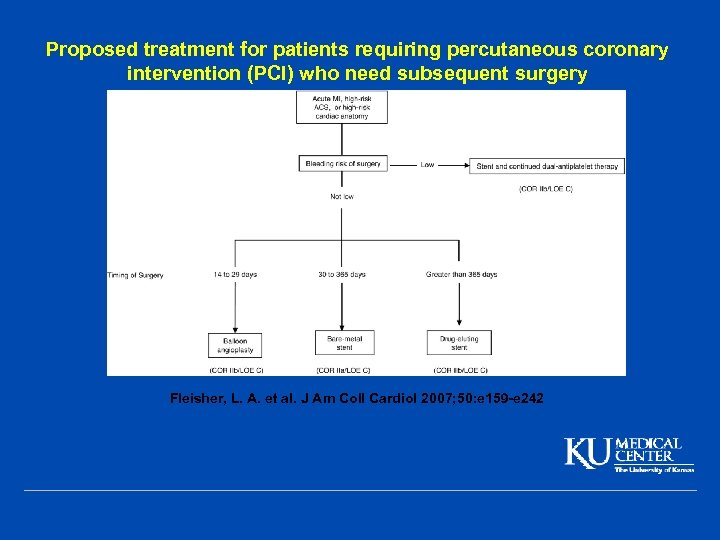 Proposed treatment for patients requiring percutaneous coronary intervention (PCI) who need subsequent surgery Fleisher, L. A. et al. J Am Coll Cardiol 2007; 50: e 159 -e 242
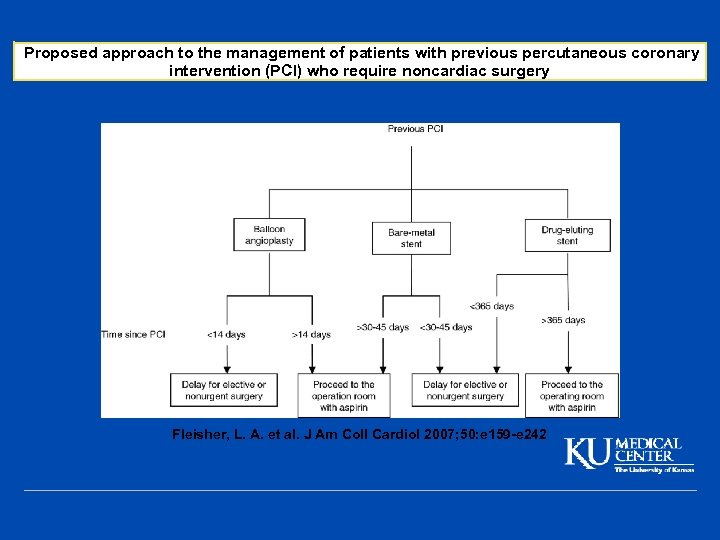 Proposed approach to the management of patients with previous percutaneous coronary intervention (PCI) who require noncardiac surgery Fleisher, L. A. et al. J Am Coll Cardiol 2007; 50: e 159 -e 242
 ASSESSMENT DOCUMENTATION EXAMPLE § “ Per ACC/AHA guidelines, no further cardiac risk stratification is indicated in this patient undergoing a semi-urgent, intermediate risk surgery with no active cardiac conditions who has a good functional status (METS > 4) and no clinical risk factors. ”
 PULMONARY RECOMMENDATIONS
 PREOPERATIVE § Consider using a course of preoperative corticosteroids for patients with COPD or asthma who are not optimized § Consider delaying elective surgery if respiratory infection present § Consider antibiotics for patients with infected sputum § Patient education regarding lung expansion maneuvers
 INTRAOPERATIVE § Encourage shorter procedures, when possible, to minimize duration of anesthesia § Encourage use of epidural or spinal anesthesia instead of general, if appropriate § Encourage use of regional anesthesia in very high risk patients
 POSTOPERATIVE § Deep breathing exercises or incentive spirometry § REMIND PATIENTS THAT BREATHS MUST BE VERY SLOW AND DEEP TO BE MAXIMALLY EFFECTIVE! § Consider using epidural analgesia for pain instead of IV opioids, if appropriate, to minimize respiratory depression
 ENDOCRINE- DIABETES MELLITUS § Recommendation for general hospitalized patients § Preprandial glucose goal of <140 § Peak postprandial goal of <180 § In ICU patients § Glucose goal of 140 -180 § Referenced from the American Association of Clinical Endocrinologists and American Diabetes Association Consensus Statement on Inpatient Glycemic Control. Endocr Pract. 2009; 15: 1– 17
 ENDOCRINE- DM (cont. ) § Insulin gtt may be used § Type I diabetics should never be without basal insulin § Hold oral agents until patient eating after surgery § Reduce last Lantus insulin dose before surgery by half OR reduce am NPH dose by half § Hold metformin if likely patient will require IV contrast administration
 ENDOCRINE- ADRENAL INSUFFICIENCY § Suppression of the hypothalamic-pituitaryadrenal (HPA) axis should be suspected in patients: § on equivalent of 20 mg/d or more of prednisone for 3 or more weeks
 ENDOCRINE- ADRENAL INSUFFICIENCY (cont) § For minor procedures or surgery under local anesthesia, give usual am steroid dose § For moderate surgical stress (ex, cholecystectomy, total joint replacement), give usual am dose. Give 50 mg hydrocortisone IV just prior to procedure and 25 mg q 8 hrs for 24 hrs, then resume usual home regimen.
 ENDOCRINE- ADRENAL INSUFFICIENCY (cont. ) § For major surgical stress (ex, open heart surgery), give usual am dose. Give 100 mg of IV hydrocortisone before induction of anesthesia, then 50 mg q 8 hr for 24 hours. Taper dose by half each day down to maintenance level.
 When in doubt about the appropriate perioperative management of a specific medical condition, contact a sub-specialist for recommendations.
 MEDICATIONS Perioperative medication management is complex and should be discussed with the surgeon and anesthesiologist, considering risk vs. benefit issues.
 MISCELLANEOUS § § § Early ambulation DVT prophylaxis!!!!!!! Pain control- concurrent bowel regimen PPI w steroids Avoid fluid overload and possible associated respiratory failure
 GERIATRIC CONSIDERATIONS § § § § Delirium Cognitive Dysfunction Nutrition Pain Physical Therapy Hydration and Volume Status Medications Discharge Planning
 GERIATRIC STATISTICS § People aged 65 years and older comprise 13% of the population but 36% of acute care admissions. § Almost 25% of patients age 65 years or older are discharged to another institution. § Almost 15% of patients admitted from home are discharged to a nursing home. Geriatrics Review Syllabus Sixth Edition, Chapter 13 Hospital Care, Chapter 14 Perioperative Care
 DELIRIUM § Defined by fluctuation in awareness, memory, attention, thinking and consciousness § Develops in ~30% of hospitalized elderly patients § Major predictors include presence of dementia at baseline, age > 70 years, history of ETOH abuse, dehydration (BUN: creatinine >/= 18: 1), severe physical or sensory impairment, severe illness
 DELIRIUM (cont) § Anticholinergic medications and those with similar properties (some anti-histamines such as diphenhydramine) § Avoid chemical and physical restraints, unless patient severely agitated or at risk of harming self or others.
 COGNITIVE DYSFUNCTION § May last weeks to months § Not always obvious § Different from “emergence delirium” (immediately follows surgery and often associated with anesthesia medications wearing off) § Common. Three months after surgery > 10% continue to have it. § Cause not well understood.
 NUTRITION § Nutritional supplementation can improve mortality and morbidity (ex. , decrease pressure ulcers) § Especially target patients who are undernourished at baseline
 PAIN § Epidural pain control may be preferable, if appropriate § PCA (patient-controlled analgesia) use may lead to better control and decreased opioid use
 PHYSICAL THERAPY § Early PT following hip fracture surgery in elderly not shown to lower mortality BUT improves other outcomes such as fewer days of pain and less pain as well as better mobility at 2 months postop.
 HYDRATION and VOLUME STATUS § Dehydration is risk factor for delirium § Modify IV fluid type and rate based on individual factors, such as presence of CHF
 MEDICATIONS § Accurate medication reconciliation is vital at transitions of care. § Administer pneumococcal and influenza vaccinations per guidelines. § Avoid medications from Beers Criteria for Potentially Inappropriate Medication Use in Older Adults medication list. § http: //www. americangeriatrics. org/files/docum ents/beers/2012 Beers. Criteria_JAGS. pdf
 § DISCHARGE PLANNING STARTS AT THE TIME OF ADMISSION and is exceedingly important in the geriatric population!
 SOURCES § § § 2009 ACCF/AHA Focused Update on Perioperative Beta Blockade Incorporated Into the ACC/AHA 2007 Guidelines on Perioperative Cardiovascular Evaluation and Care for Noncardiac Surgery, Journal of the American College of Cardiology, available at http: //content. onlinejacc. org/cgi/content/full/j. jacc. 2009. 07. 010 American Association of Clinical Endocrinologists and American Diabetes Association Consensus Statement on Inpatient Glycemic Control. Endocr Pract. 2009; 15: 1– 17 Perioperative Evaluation. Yale Office-based Medicine Curriculum, Eighth Edition, Volume 2, 2013. Hamrahian AH, Roman SR, Milan S. The surgical patient taking glucocorticoids. In: Up. To. Date, Post TW (Ed), Up. To. Date. (Assesses on March 20, 2014. ) Geriatrics Review Syllabus Sixth Edition, Chapter 13 Hospital Care, Chapter 14 Perioperative Care, Chapter 32 Delirium Palmer RM. Perioperative Care of the Elderly Patient: An Update. Cleveland Clinic Journal of Medicine. 2009; 76(4): S 16 -S 21