Скачать презентацию Period 41 Unit 5 Comparisons I Grammar Comparatives
93ebe4512d5d598dc01c58d7e1e995d8.ppt
- Количество слайдов: 59
 Period 41 Unit 5: Comparisons I. Grammar: Comparatives and superlatives II. (So sánh hơn và so sánh hơn nhất)
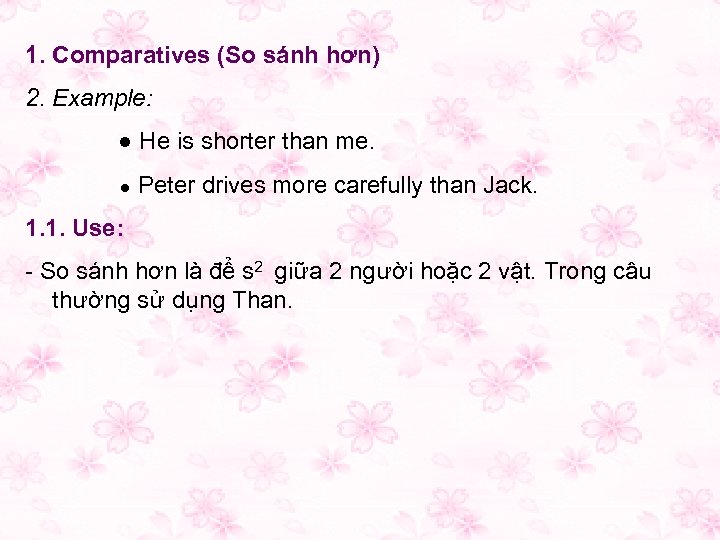 1. Comparatives (So sánh hơn) 2. Example: ● He is shorter than me. ● Peter drives more carefully than Jack. 1. 1. Use: - So sánh hơn là để s 2 giữa 2 người hoặc 2 vật. Trong câu thường sử dụng Than.
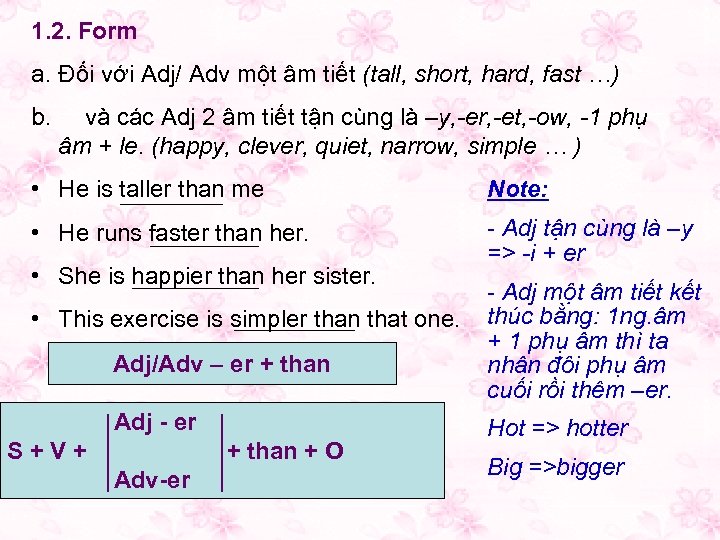 1. 2. Form a. Đối với Adj/ Adv một âm tiết (tall, short, hard, fast …) b. và các Adj 2 âm tiết tận cùng là –y, -er, -et, -ow, -1 phụ âm + le. (happy, clever, quiet, narrow, simple … ) • He is taller than me Note: • He runs faster than her. - Adj tận cùng là –y => -i + er • She is happier than her sister. • This exercise is simpler than that one. Adj/Adv – er + than Adj - er S+V+ + than + O Adv-er - Adj một âm tiết kết thúc bằng: 1 ng. âm + 1 phụ âm thì ta nhân đôi phụ âm cuối rồi thêm –er. Hot => hotter Big =>bigger
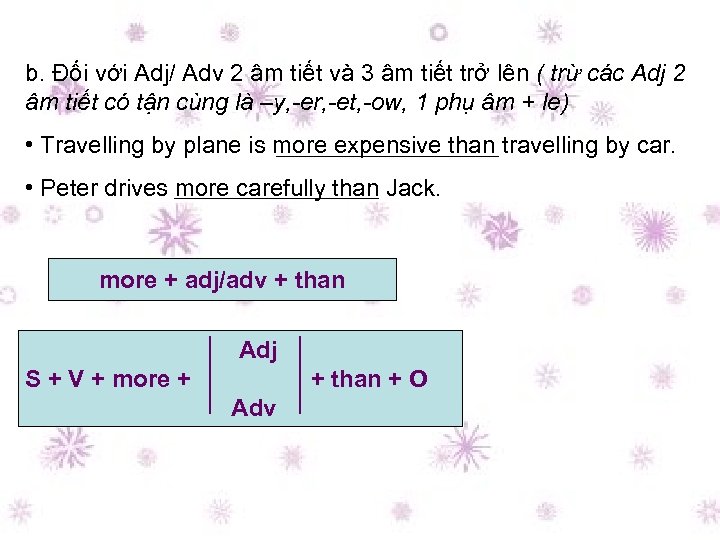 b. Đối với Adj/ Adv 2 âm tiết và 3 âm tiết trở lên ( trừ các Adj 2 âm tiết có tận cùng là –y, -er, -et, -ow, 1 phụ âm + le) • Travelling by plane is more expensive than travelling by car. • Peter drives more carefully than Jack. more + adj/adv + than Adj S + V + more + + than + O Adv
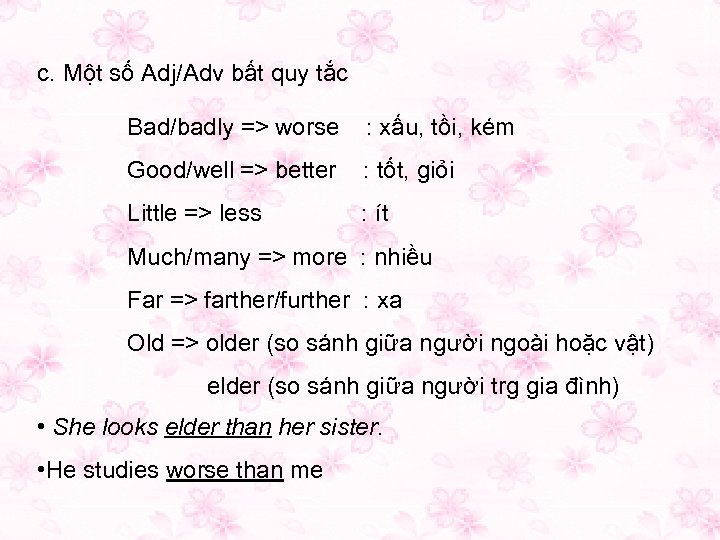 c. Một số Adj/Adv bất quy tắc Bad/badly => worse : xấu, tồi, kém Good/well => better : tốt, giỏi Little => less : ít Much/many => more : nhiều Far => farther/further : xa Old => older (so sánh giữa người ngoài hoặc vật) elder (so sánh giữa người trg gia đình) • She looks elder than her sister. • He studies worse than me
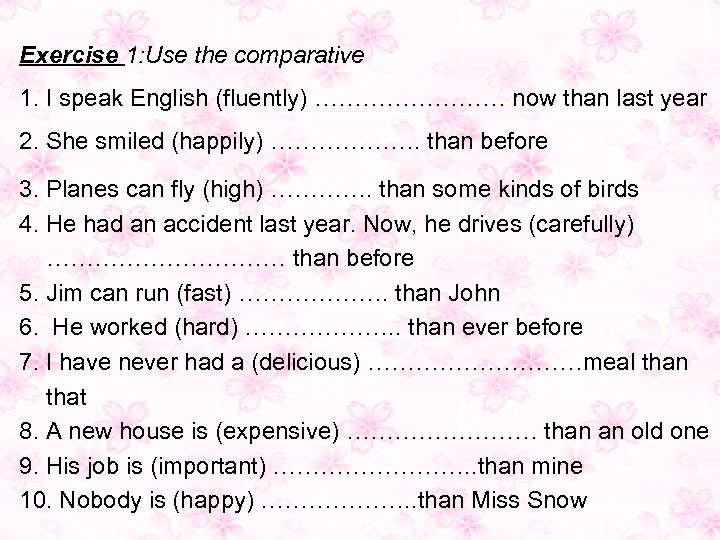 Exercise 1: Use the comparative 1. I speak English (fluently) ………… now than last year 2. She smiled (happily) ………………. than before 3. Planes can fly (high) …………. than some kinds of birds 4. He had an accident last year. Now, he drives (carefully) …………… than before 5. Jim can run (fast) ………………. than John 6. He worked (hard) ………………. . than ever before 7. I have never had a (delicious) ……………meal than that 8. A new house is (expensive) ………… than an old one 9. His job is (important) …………. . than mine 10. Nobody is (happy) ………………. . than Miss Snow
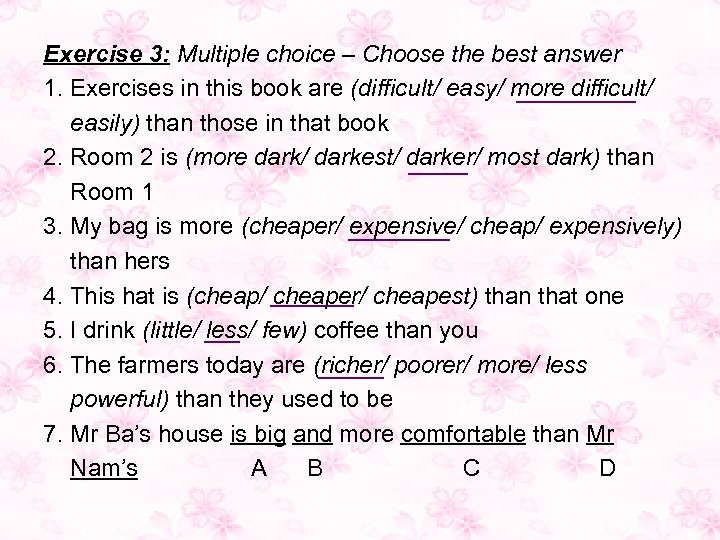 Exercise 3: Multiple choice – Choose the best answer 1. Exercises in this book are (difficult/ easy/ more difficult/ easily) than those in that book 2. Room 2 is (more dark/ darkest/ darker/ most dark) than Room 1 3. My bag is more (cheaper/ expensive/ cheap/ expensively) than hers 4. This hat is (cheap/ cheaper/ cheapest) than that one 5. I drink (little/ less/ few) coffee than you 6. The farmers today are (richer/ poorer/ more/ less powerful) than they used to be 7. Mr Ba’s house is big and more comfortable than Mr Nam’s A B C D
 Period 43 , 44 Unit 5: Comparisons (cont) I. Grammar: Comparatives and superlatives 1. Comparatives 2. Superlatives
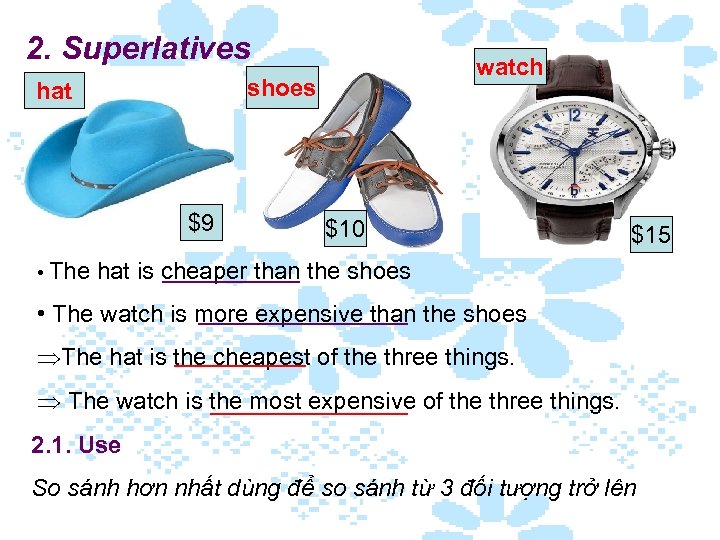 2. Superlatives shoes hat $9 • The watch $10 $15 hat is cheaper than the shoes • The watch is more expensive than the shoes ÞThe hat is the cheapest of the three things. Þ The watch is the most expensive of the three things. 2. 1. Use So sánh hơn nhất dùng để so sánh từ 3 đối tượng trở lên
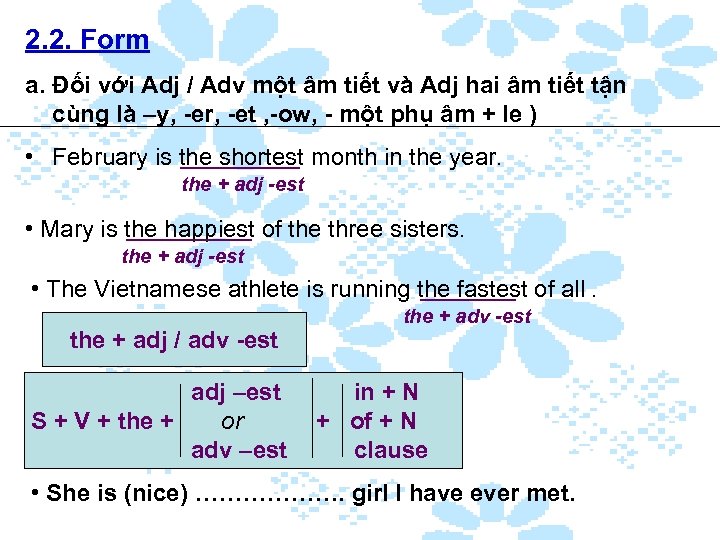 2. 2. Form a. Đối với Adj / Adv một âm tiết và Adj hai âm tiết tận cùng là –y, -er, -et , -ow, - một phụ âm + le ) • February is the shortest month in the year. the + adj -est • Mary is the happiest of the three sisters. the + adj -est • The Vietnamese athlete is running the fastest of all. the + adj / adv -est adj –est S + V + the + or adv –est the + adv -est in + N + of + N clause • She is (nice) ………………. girl I have ever met.
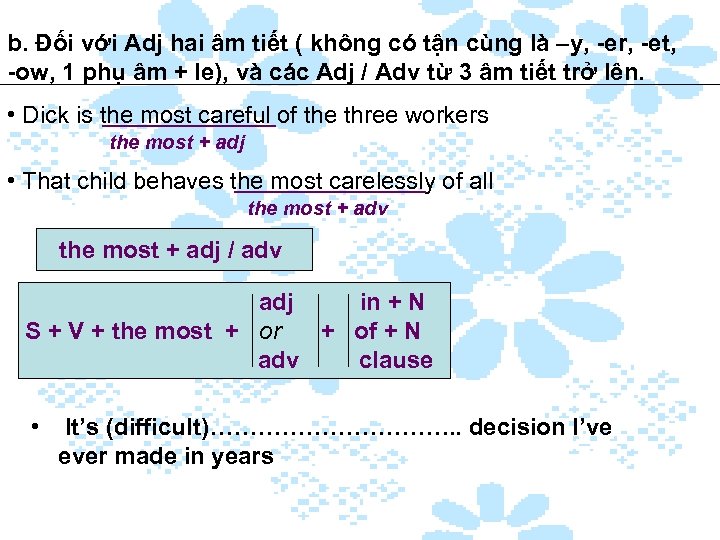 b. Đối với Adj hai âm tiết ( không có tận cùng là –y, -er, -et, -ow, 1 phụ âm + le), và các Adj / Adv từ 3 âm tiết trở lên. • Dick is the most careful of the three workers the most + adj • That child behaves the most carelessly of all the most + adv the most + adj / adv adj in + N S + V + the most + or + of + N adv clause • It’s (difficult)……………. . decision I’ve ever made in years
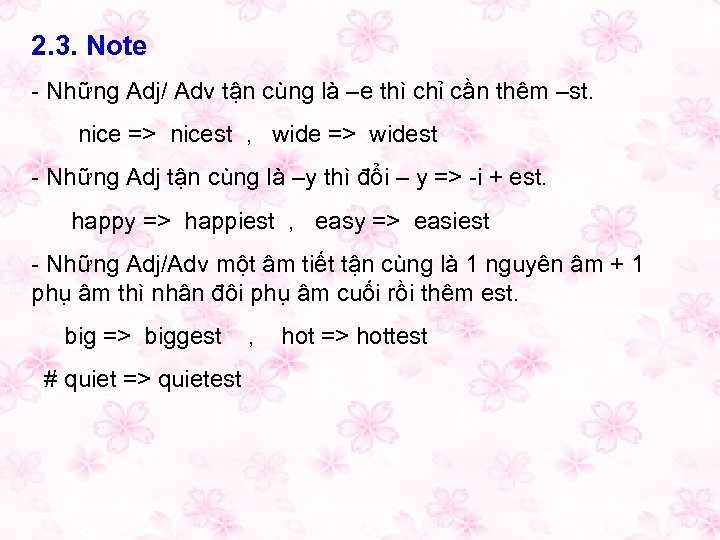 2. 3. Note - Những Adj/ Adv tận cùng là –e thì chỉ cần thêm –st. nice => nicest , wide => widest - Những Adj tận cùng là –y thì đổi – y => -i + est. happy => happiest , easy => easiest - Những Adj/Adv một âm tiết tận cùng là 1 nguyên âm + 1 phụ âm thì nhân đôi phụ âm cuối rồi thêm est. big => biggest # quiet => quietest , hot => hottest
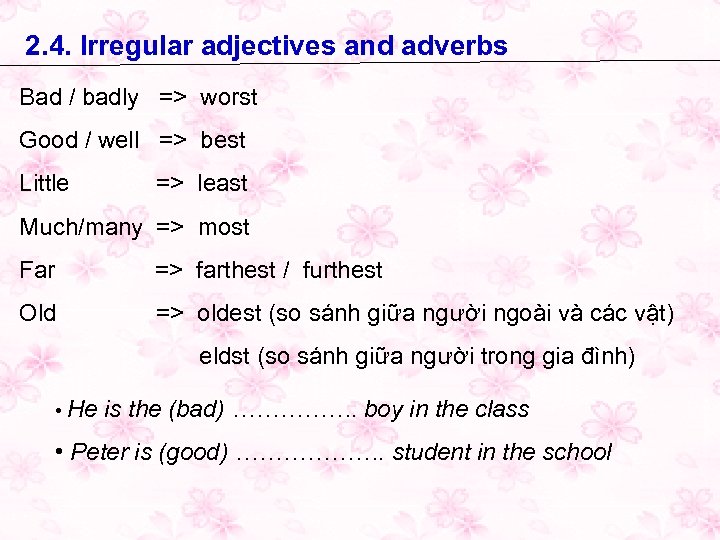 2. 4. Irregular adjectives and adverbs Bad / badly => worst Good / well => best Little => least Much/many => most Far => farthest / furthest Old => oldest (so sánh giữa người ngoài và các vật) eldst (so sánh giữa người trong gia đình) • He is the (bad) ……………. boy in the class • Peter is (good) ………………. student in the school
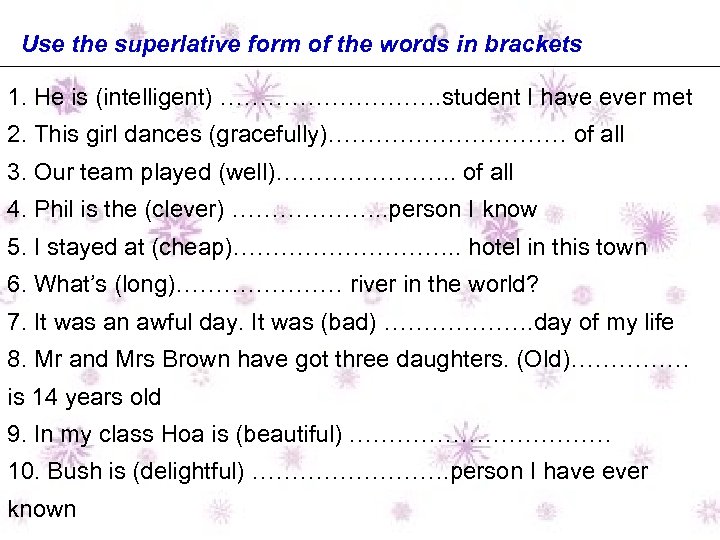 Use the superlative form of the words in brackets 1. He is (intelligent) ……………. student I have ever met 2. This girl dances (gracefully)…………… of all 3. Our team played (well)…………………. . of all 4. Phil is the (clever) ………………. . person I know 5. I stayed at (cheap)……………. . hotel in this town 6. What’s (long)………………… river in the world? 7. It was an awful day. It was (bad) ………………. day of my life 8. Mr and Mrs Brown have got three daughters. (Old)…………… is 14 years old 9. In my class Hoa is (beautiful) ……………… 10. Bush is (delightful) …………. person I have ever known t
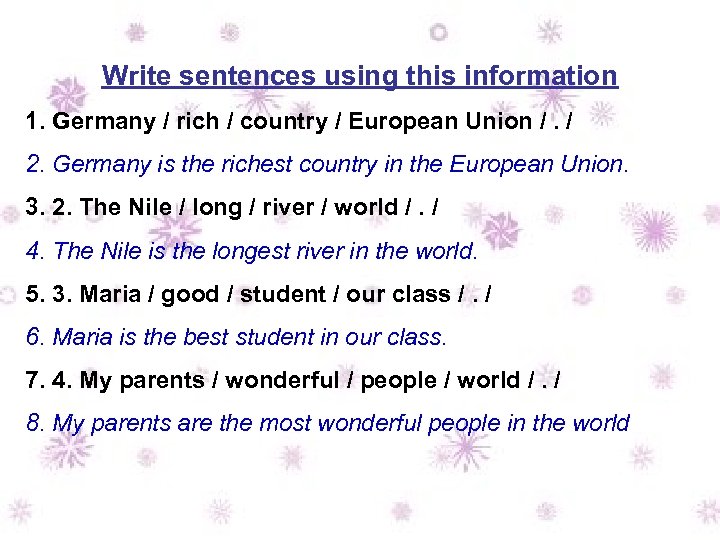 Write sentences using this information 1. Germany / rich / country / European Union /. / 2. Germany is the richest country in the European Union. 3. 2. The Nile / long / river / world /. / 4. The Nile is the longest river in the world. 5. 3. Maria / good / student / our class /. / 6. Maria is the best student in our class. 7. 4. My parents / wonderful / people / world /. / 8. My parents are the most wonderful people in the world
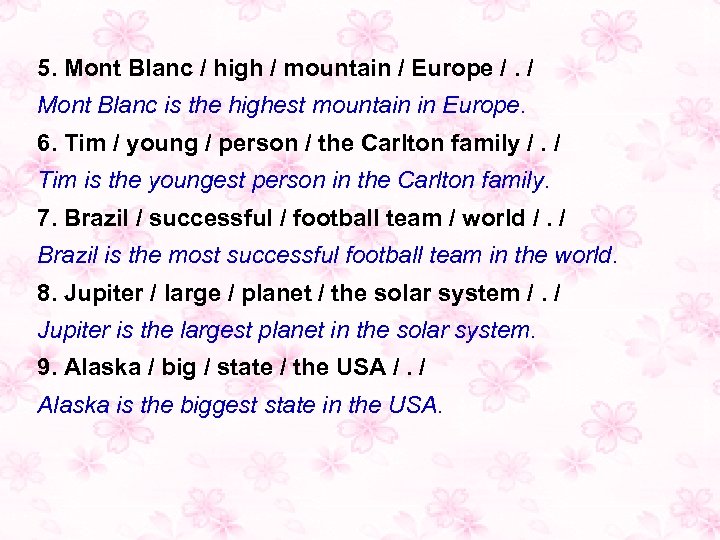 5. Mont Blanc / high / mountain / Europe /. / Mont Blanc is the highest mountain in Europe. 6. Tim / young / person / the Carlton family /. / Tim is the youngest person in the Carlton family. 7. Brazil / successful / football team / world /. / Brazil is the most successful football team in the world. 8. Jupiter / large / planet / the solar system /. / Jupiter is the largest planet in the solar system. 9. Alaska / big / state / the USA /. / Alaska is the biggest state in the USA.
 3. Practice Task 1: Look at the quiz. Complete the sentences with the words 1. Lead / iron / gold 2. The earth / sun / venus 3. Christianity / Islam / Buddhism 4. Canada / China / Russia 5. A jet engine / A diesel engine / A rocket engine 6. Rio de Janeiro / Cairo / Singapore
 Task 2: Here are some more general knowledge questions - Complete them, putting the adjectives in brackets in the comparative or superlatives - Answer the questions with a partner Task 3: Complete the text with the comparative or superlative of the adjectives in brackets.
 Period 45 , 46 Unit 5: Comparisons(cont)
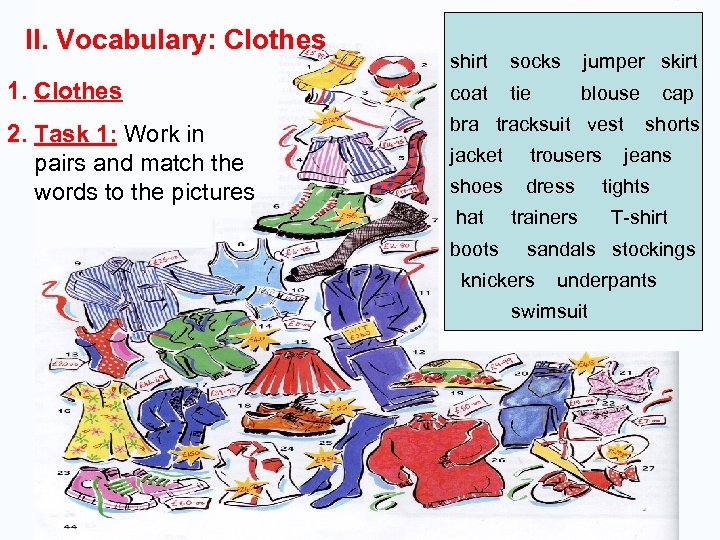 II. Vocabulary: Clothes shirt socks jumper skirt 1. Clothes coat tie blouse 2. Task 1: Work in pairs and match the words to the pictures bra tracksuit vest jacket trousers shoes dress hat boots trainers cap shorts jeans tights T-shirt sandals stockings knickers underpants swimsuit
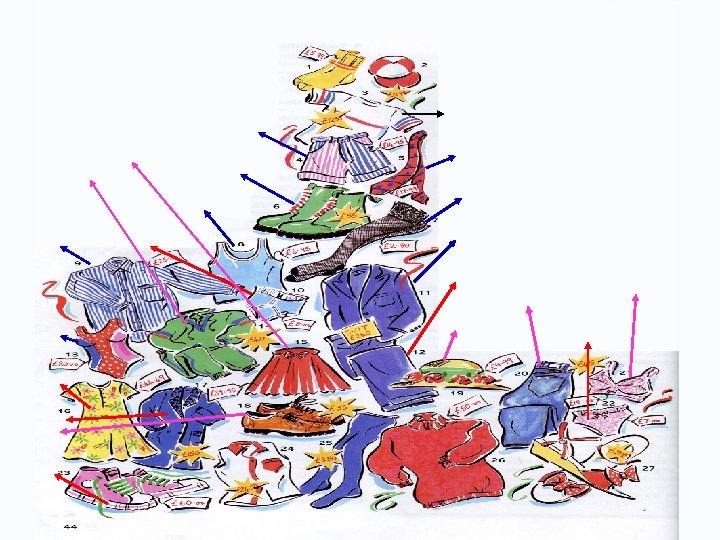
 Task 2: Work in group. Organize the words into these categories: Things that you wear: - on your head - above your waist - below your waist - on your feet
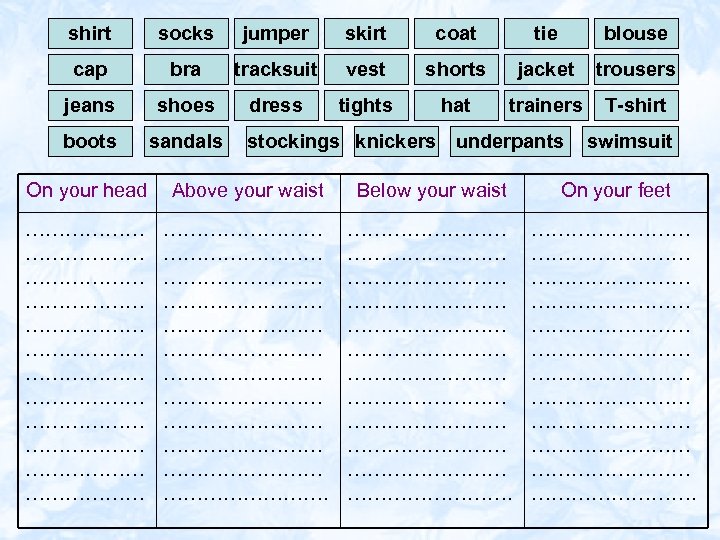 shirt socks jumper skirt coat tie blouse cap bra tracksuit vest shorts jacket trousers jeans shoes dress tights hat trainers T-shirt boots sandals stockings knickers underpants swimsuit On your head Above your waist Below your waist On your feet ……………… ……………… ……………… …………………… …………………… …………………… …………………… …………………… …………………….
 2. Language focus: Clothes with plural names A: Do you like this shirt? A: Do you like these jeans? B: Yes, how much is it? B: Yes, how much are they? A: It’s £ 25. A: They’re £ 45. Clothes with plural names: jeans, socks, shorts, shoes, tights, trainers, boots, sandals, stockings, knickers, underpants. ► Tên một số loại quần áo có hình thức số nhiều đi kèm với mạo từ số nhiều (these, those, some, any…) và động từ chia ở số nhiều. ► Khi muốn nói đến số lượng của các loại quần áo này ta sử dùng “a pair/pairs of” ( pair : cặp , đôi) a pair of jeans / two pairs of jeans a pair of shoes / three pairs of shoes
 Period 47 , 48 Unit 5: Comparisons (cont) IV. Reading: Eye to eye
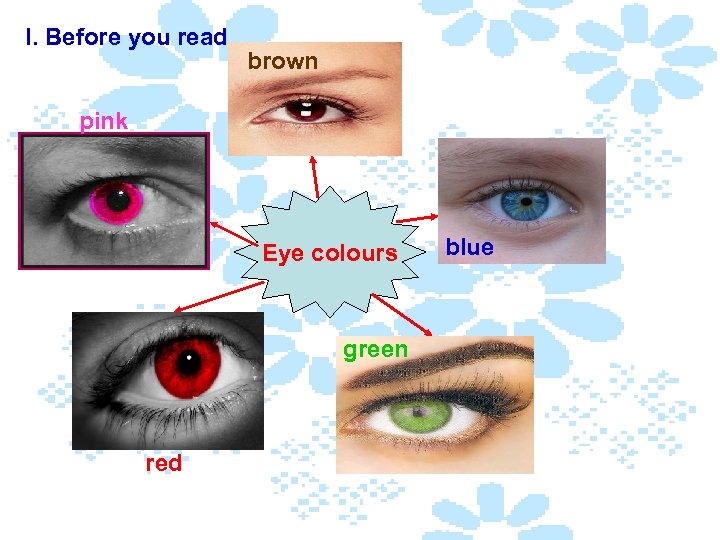 I. Before you read brown pink Eye colours green red blue
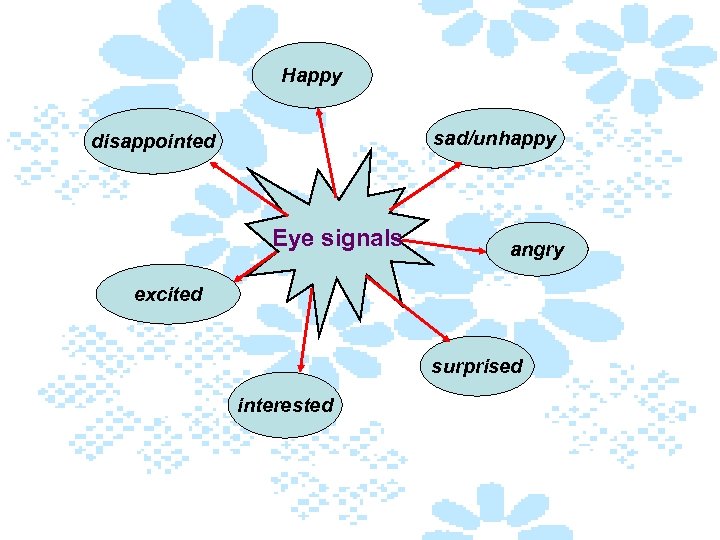 Happy sad/unhappy disappointed Eye signals angry excited surprised interested
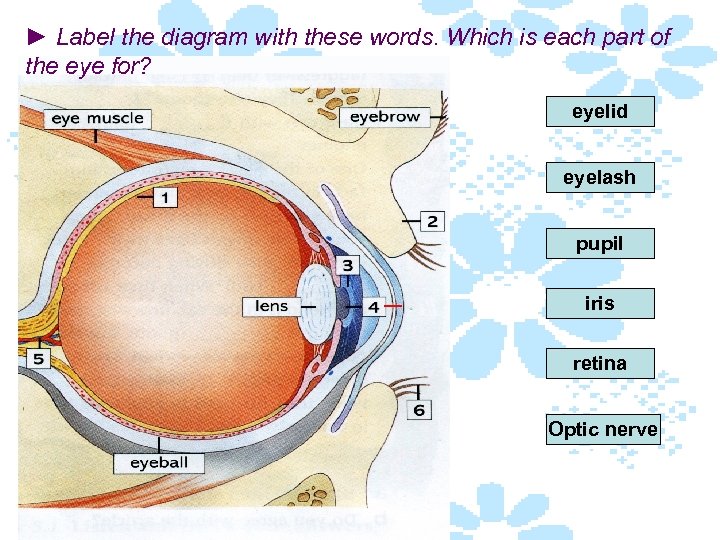 ► Label the diagram with these words. Which is each part of the eye for? eyelid eyelash pupil iris retina Optic nerve
![2. While you read a. New-words Para 1 basic [’beisik] (adj) Cơ bản, thiết](https://present5.com/presentation/93ebe4512d5d598dc01c58d7e1e995d8/image-29.jpg "2. While you read a. New-words Para 1 basic [’beisik] (adj) Cơ bản, thiết") 2. While you read a. New-words Para 1 basic [’beisik] (adj) Cơ bản, thiết yếu albino [ӕl’bi: nəʊ] (n) Người bệnh tạng rare [reə] (adj) Hiếm sensitive [’sensitiv] (adj) Nhạy cảm Para 2 flexible [’fleksəbl] (adj) Linh hoạt, linh động Para 3 sense [sens] (n) Giác quan unconcious [˄n’kɒnʃəs] (adj) K ý thức được, k nhận biết đc dilate [dai’leit] (v) Làm rãn, mở rộng wink [wiŋk] (v) Nháy mắt mysterious [mis’tiəriəs] (adj) Huyền bí, bí ẩn hide [haid] (v) Giấu, che giấu
2. While you read a. New-words Para 1 basic [’beisik] (adj) Cơ bản, thiết yếu albino [ӕl’bi: nəʊ] (n) Người bệnh tạng rare [reə] (adj) Hiếm sensitive [’sensitiv] (adj) Nhạy cảm Para 2 flexible [’fleksəbl] (adj) Linh hoạt, linh động Para 3 sense [sens] (n) Giác quan unconcious [˄n’kɒnʃəs] (adj) K ý thức được, k nhận biết đc dilate [dai’leit] (v) Làm rãn, mở rộng wink [wiŋk] (v) Nháy mắt mysterious [mis’tiəriəs] (adj) Huyền bí, bí ẩn hide [haid] (v) Giấu, che giấu
![Para 4 proportion [prə’pɔ: ʃn] (n) Tỷ lệ eye shadow [ai ‘ʃӕdəʊ] (n) Phấn](https://present5.com/presentation/93ebe4512d5d598dc01c58d7e1e995d8/image-30.jpg "Para 4 proportion [prə’pɔ: ʃn] (n) Tỷ lệ eye shadow [ai ‘ʃӕdəʊ] (n) Phấn") Para 4 proportion [prə’pɔ: ʃn] (n) Tỷ lệ eye shadow [ai ‘ʃӕdəʊ] (n) Phấn mắt dramatic [drə’mӕtik] (adj) Gây ấn tượng mạnh Para 5 especially [is'pe∫əli] (adv) Đặc biệt là intimate [’intimət] (adj) Thân mật gaze [geiz] (v) Nhìn chằm delicate [’delikət] (adj) Thanh nhã, thanh tú
Para 4 proportion [prə’pɔ: ʃn] (n) Tỷ lệ eye shadow [ai ‘ʃӕdəʊ] (n) Phấn mắt dramatic [drə’mӕtik] (adj) Gây ấn tượng mạnh Para 5 especially [is'pe∫əli] (adv) Đặc biệt là intimate [’intimət] (adj) Thân mật gaze [geiz] (v) Nhìn chằm delicate [’delikət] (adj) Thanh nhã, thanh tú
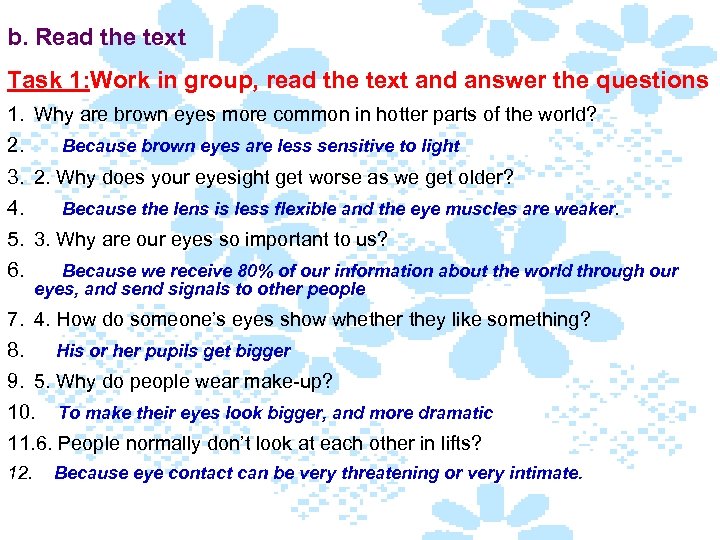 b. Read the text Task 1: Work in group, read the text and answer the questions 1. Why are brown eyes more common in hotter parts of the world? 2. Because brown eyes are less sensitive to light 3. 2. Why does your eyesight get worse as we get older? 4. Because the lens is less flexible and the eye muscles are weaker. 5. 3. Why are our eyes so important to us? 6. Because we receive 80% of our information about the world through our eyes, and send signals to other people 7. 4. How do someone’s eyes show whether they like something? 8. His or her pupils get bigger 9. 5. Why do people wear make-up? 10. To make their eyes look bigger, and more dramatic 11. 6. People normally don’t look at each other in lifts? 12. Because eye contact can be very threatening or very intimate.
 Group 1, 4, 6, 8, Para 1, 2 (answer the questions 1+2) Group 2, 5, 7, 11 : Para 3 (answer the questions 3+4) Group 3, 12, 10, 9: Para 4, 5 (answer the questions 5+6)
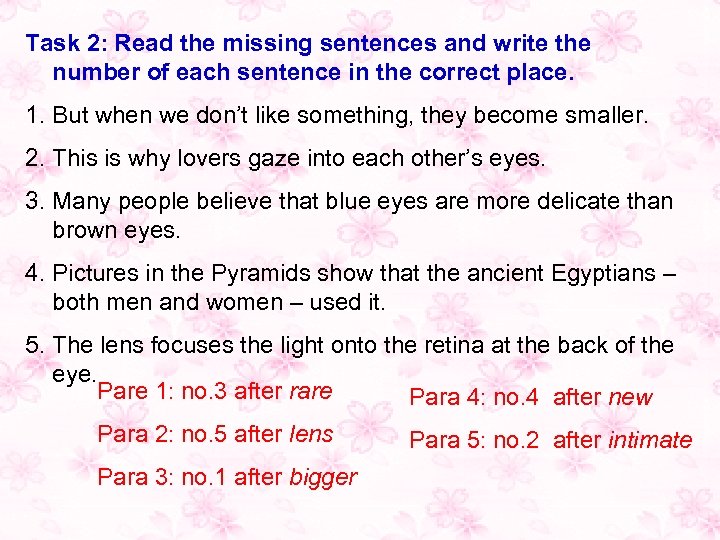 Task 2: Read the missing sentences and write the number of each sentence in the correct place. 1. But when we don’t like something, they become smaller. 2. This is why lovers gaze into each other’s eyes. 3. Many people believe that blue eyes are more delicate than brown eyes. 4. Pictures in the Pyramids show that the ancient Egyptians – both men and women – used it. 5. The lens focuses the light onto the retina at the back of the eye. Pare 1: no. 3 after rare Para 4: no. 4 after new Para 2: no. 5 after lens Para 3: no. 1 after bigger Para 5: no. 2 after intimate
 Period 49 , 50 Unit 5: Comparisons (cont) IV. Reading: Eye to eye
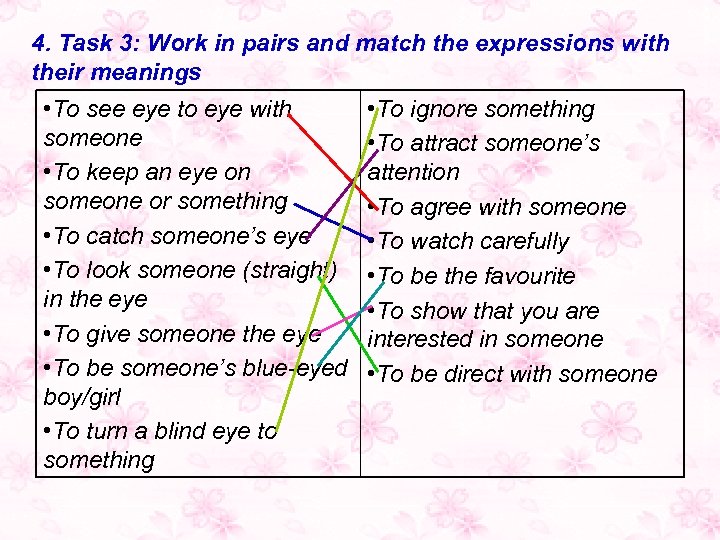 4. Task 3: Work in pairs and match the expressions with their meanings • To see eye to eye with someone • To keep an eye on someone or something • To catch someone’s eye • To look someone (straight) in the eye • To give someone the eye • To be someone’s blue-eyed boy/girl • To turn a blind eye to something • To ignore something • To attract someone’s attention • To agree with someone • To watch carefully • To be the favourite • To show that you are interested in someone • To be direct with someone
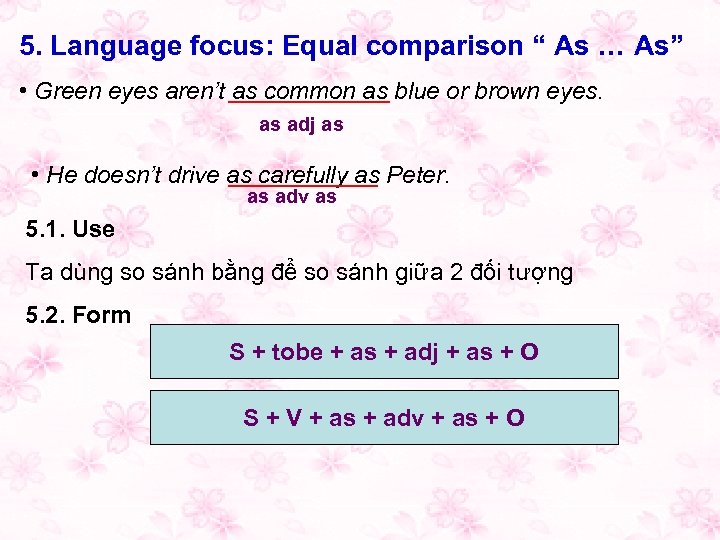 5. Language focus: Equal comparison “ As … As” • Green eyes aren’t as common as blue or brown eyes. as adj as • He doesn’t drive as carefully as Peter. as adv as 5. 1. Use Ta dùng so sánh bằng để so sánh giữa 2 đối tượng 5. 2. Form S + tobe + as + adj + as + O S + V + as + adv + as + O
 Write sentences using this information and as … 1. Brown eyes/ sensitive to light / blue eyes. 2. Brown eyes are as sensitive to light as blue eyes 3. 2. In hot countries blue eyes/ common/ brown eyes 4. In hot countries blue eyes aren’t as common as brown eyes 5. 3. Whole eye/ big / table tennis ball 6. The whole eye is as big as a table tennis ball 7. 4. Small eyes/ attractive / large eyes 8. Small eyes aren’t as attractive as large eyes
 5. women’s eyebrows / thick / men’s Women’s eyebrows aren’t as thick as men’s 6. Lens in an old person’s eye / flexible / a young person’s The lens in an old person’s eye isn’t as flexible as a young person’s 7. Eye make-up / old/ history. Eye make-up isn’t as old as history 8. Our ears/ important / our eyes Our ears aren’t as important as our eyes
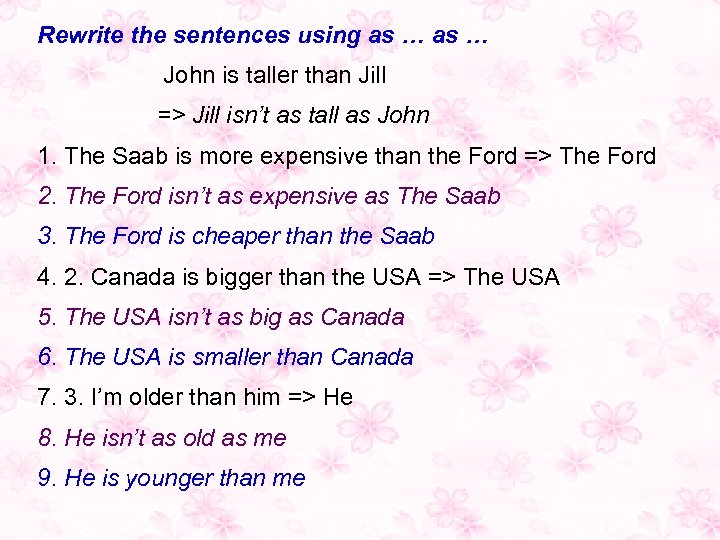 Rewrite the sentences using as … John is taller than Jill => Jill isn’t as tall as John 1. The Saab is more expensive than the Ford => The Ford 2. The Ford isn’t as expensive as The Saab 3. The Ford is cheaper than the Saab 4. 2. Canada is bigger than the USA => The USA 5. The USA isn’t as big as Canada 6. The USA is smaller than Canada 7. 3. I’m older than him => He 8. He isn’t as old as me 9. He is younger than me
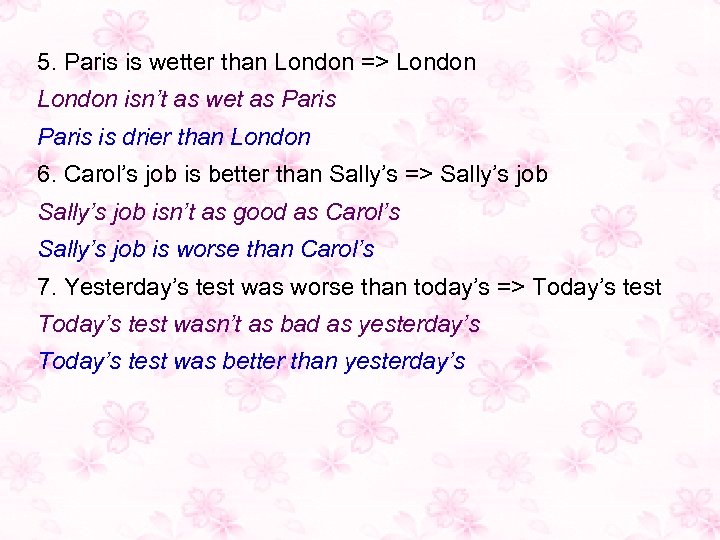 5. Paris is wetter than London => London isn’t as wet as Paris is drier than London 6. Carol’s job is better than Sally’s => Sally’s job isn’t as good as Carol’s Sally’s job is worse than Carol’s 7. Yesterday’s test was worse than today’s => Today’s test wasn’t as bad as yesterday’s Today’s test was better than yesterday’s
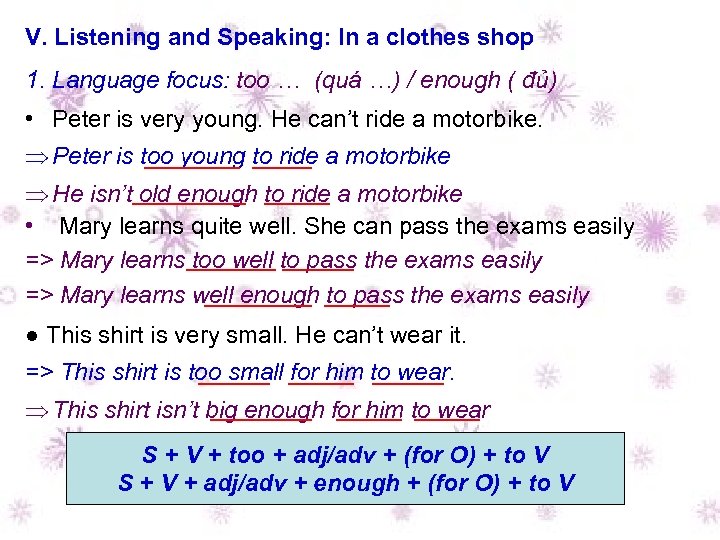 V. Listening and Speaking: In a clothes shop 1. Language focus: too … (quá …) / enough ( đủ) • Peter is very young. He can’t ride a motorbike. Þ Peter is too young to ride a motorbike Þ He isn’t old enough to ride a motorbike • Mary learns quite well. She can pass the exams easily => Mary learns too well to pass the exams easily => Mary learns well enough to pass the exams easily ● This shirt is very small. He can’t wear it. => This shirt is too small for him to wear. Þ This shirt isn’t big enough for him to wear S + V + too + adj/adv + (for O) + to V S + V + adj/adv + enough + (for O) + to V
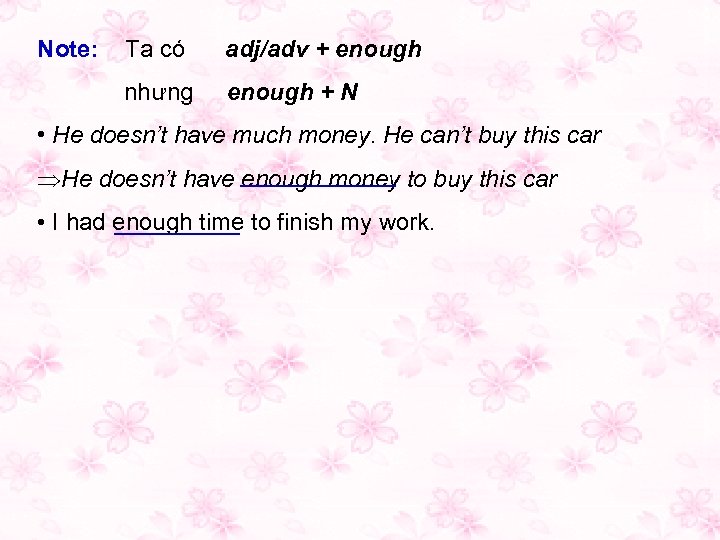 Note: Ta có adj/adv + enough nhưng enough + N • He doesn’t have much money. He can’t buy this car ÞHe doesn’t have enough money to buy this car • I had enough time to finish my work.
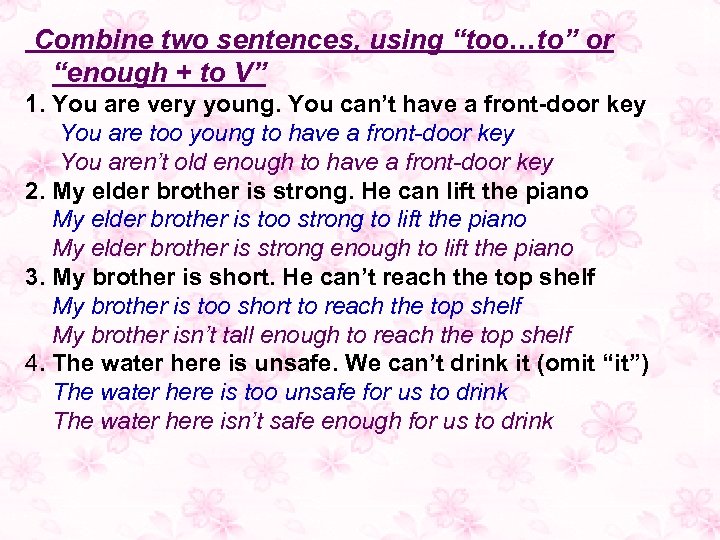 Combine two sentences, using “too…to” or “enough + to V” 1. You are very young. You can’t have a front-door key You are too young to have a front-door key You aren’t old enough to have a front-door key 2. My elder brother is strong. He can lift the piano My elder brother is too strong to lift the piano My elder brother is strong enough to lift the piano 3. My brother is short. He can’t reach the top shelf My brother is too short to reach the top shelf My brother isn’t tall enough to reach the top shelf 4. The water here is unsafe. We can’t drink it (omit “it”) The water here is too unsafe for us to drink The water here isn’t safe enough for us to drink
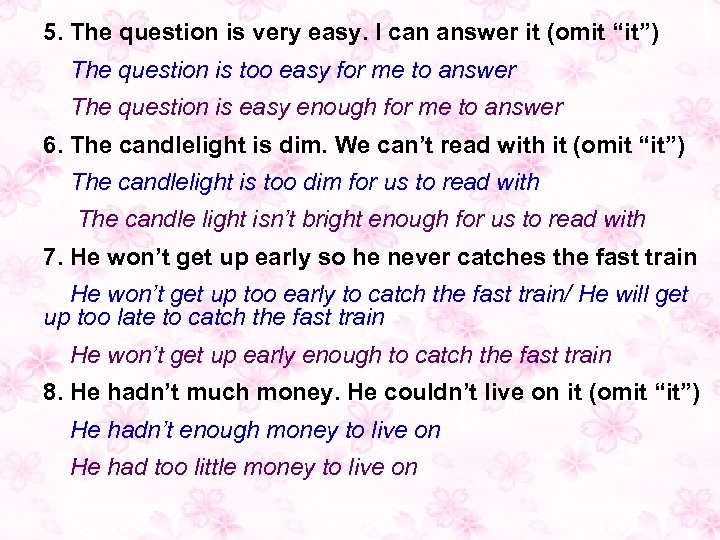 5. The question is very easy. I can answer it (omit “it”) The question is too easy for me to answer The question is easy enough for me to answer 6. The candlelight is dim. We can’t read with it (omit “it”) The candlelight is too dim for us to read with The candle light isn’t bright enough for us to read with 7. He won’t get up early so he never catches the fast train He won’t get up too early to catch the fast train/ He will get up too late to catch the fast train He won’t get up early enough to catch the fast train 8. He hadn’t much money. He couldn’t live on it (omit “it”) He hadn’t enough money to live on He had too little money to live on

 Period 51 , 52 Unit 6: People and Places I. Grammar : The past continuous tense
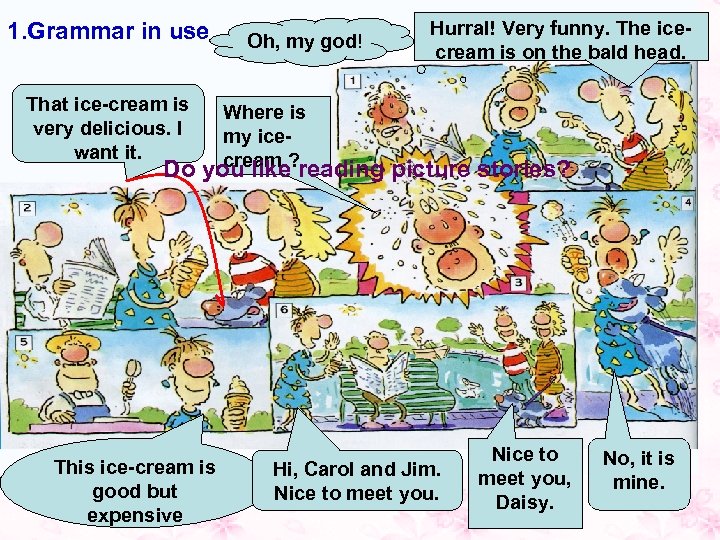 1. Grammar in use That ice-cream is very delicious. I want it. Do Oh, my god! Where is my icecream you like? reading This ice-cream is good but expensive Hurral! Very funny. The icecream is on the bald head. picture stories? Hi, Carol and Jim. Nice to meet you, Daisy. No, it is mine.
 Task 1: The pictures are in the wrong order. Work in pairs and decide the correct order.
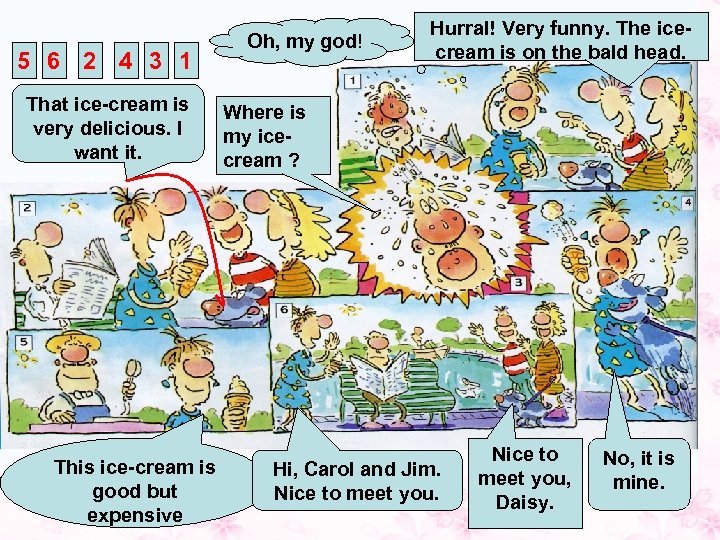 5 6 2 4 3 1 That ice-cream is very delicious. I want it. This ice-cream is good but expensive Oh, my god! Hurral! Very funny. The icecream is on the bald head. Where is my icecream ? Hi, Carol and Jim. Nice to meet you, Daisy. No, it is mine.
![Task 2: Read the story • New words: embarrass [ im’ bӕrəs] (v) Lúng](https://present5.com/presentation/93ebe4512d5d598dc01c58d7e1e995d8/image-50.jpg "Task 2: Read the story • New words: embarrass [ im’ bӕrəs] (v) Lúng") Task 2: Read the story • New words: embarrass [ im’ bӕrəs] (v) Lúng túng, bối rối incident [‘insidənt] (n) Sự việc bất ngờ jump [ʤ˄mp] (v) Nhảy lên suddenly [‘s˄dnli] (adv) Đột nhiên pull [pʊl] (v) Lôi, kéo, giật do any harm [du: ‘eni ha: m] Làm hại in hysterics [ his’teriks] Cười không kìm lại được, cười nghiêng ngả
Task 2: Read the story • New words: embarrass [ im’ bӕrəs] (v) Lúng túng, bối rối incident [‘insidənt] (n) Sự việc bất ngờ jump [ʤ˄mp] (v) Nhảy lên suddenly [‘s˄dnli] (adv) Đột nhiên pull [pʊl] (v) Lôi, kéo, giật do any harm [du: ‘eni ha: m] Làm hại in hysterics [ his’teriks] Cười không kìm lại được, cười nghiêng ngả
 ► Work in group, read the text.
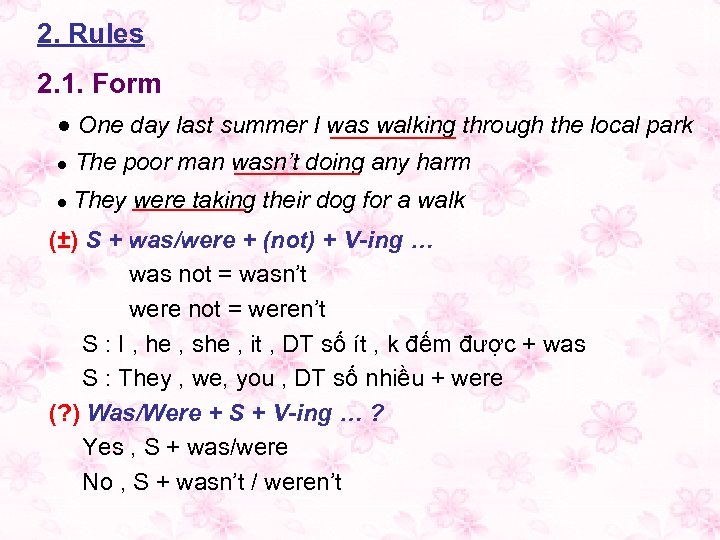 2. Rules 2. 1. Form ● One day last summer I was walking through the local park ● The poor man wasn’t doing any harm ● They were taking their dog for a walk (±) S + was/were + (not) + V-ing … was not = wasn’t were not = weren’t S : I , he , she , it , DT số ít , k đếm được + was S : They , we, you , DT số nhiều + were (? ) Was/Were + S + V-ing … ? Yes , S + was/were No , S + wasn’t / weren’t
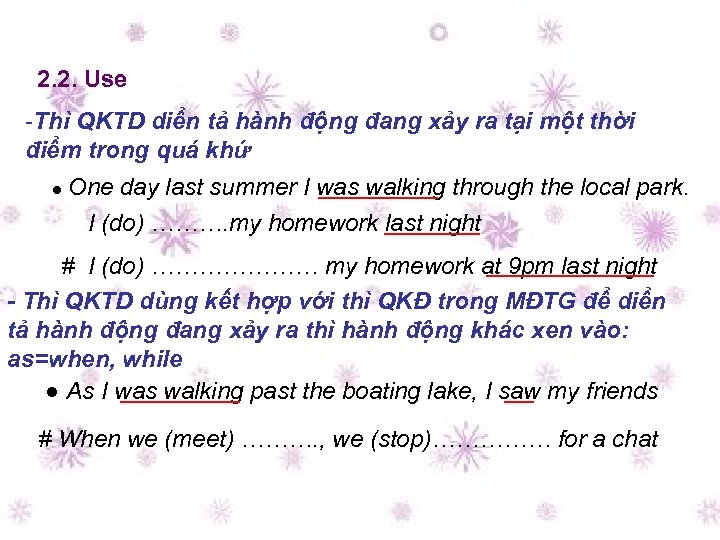 2. 2. Use -Thì QKTD diển tả hành động đang xảy ra tại một thời điểm trong quá khứ ● One day last summer I was walking through the local park. I (do) ………. my homework last night # I (do) ………………… my homework at 9 pm last night - Thì QKTD dùng kết hợp với thì QKĐ trong MĐTG để diển tả hành động đang xảy ra thì hành động khác xen vào: as=when, while ● As I was walking past the boating lake, I saw my friends # When we (meet) ………. , we (stop)…………… for a chat
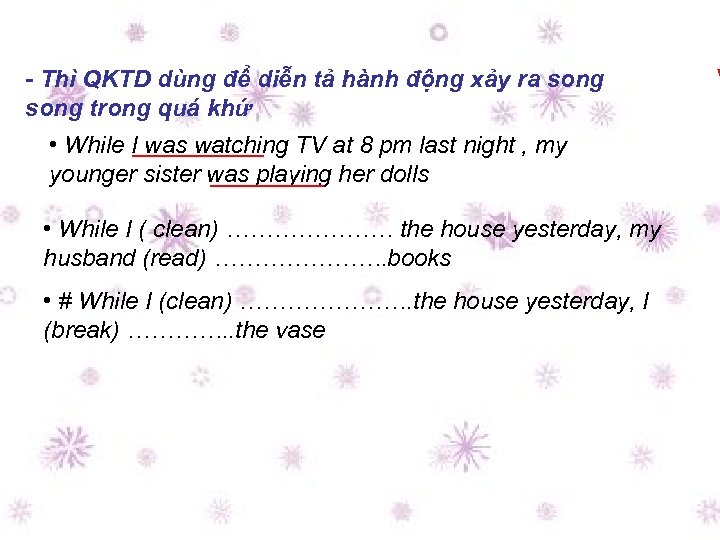 - Thì QKTD dùng để diễn tả hành động xảy ra song trong quá khứ • While I was watching TV at 8 pm last night , my younger sister was playing her dolls • While I ( clean) ………………… the house yesterday, my husband (read) …………………. books • # While I (clean) …………………. the house yesterday, I (break) …………. . the vase w
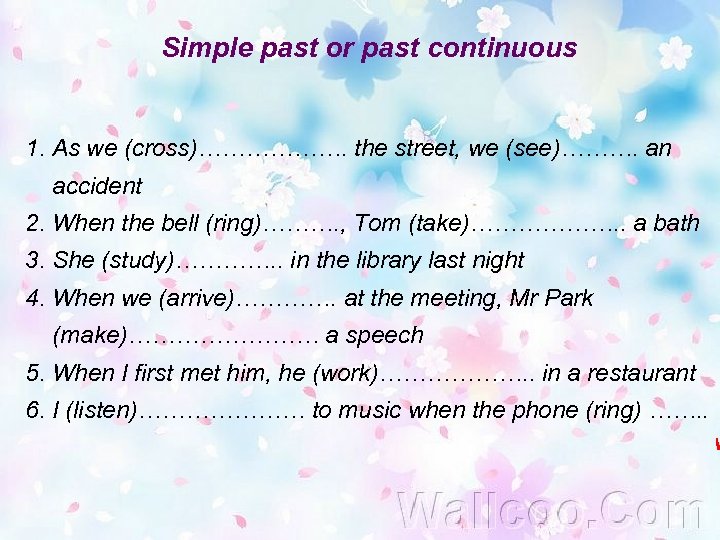 Simple past or past continuous 1. As we (cross)………………. the street, we (see)………. an accident 2. When the bell (ring)………. , Tom (take)………………. . a bath 3. She (study)…………. . in the library last night 4. When we (arrive)…………. at the meeting, Mr Park (make)………… a speech 5. When I first met him, he (work)………………. . in a restaurant 6. I (listen)………………… to music when the phone (ring) ……. . w
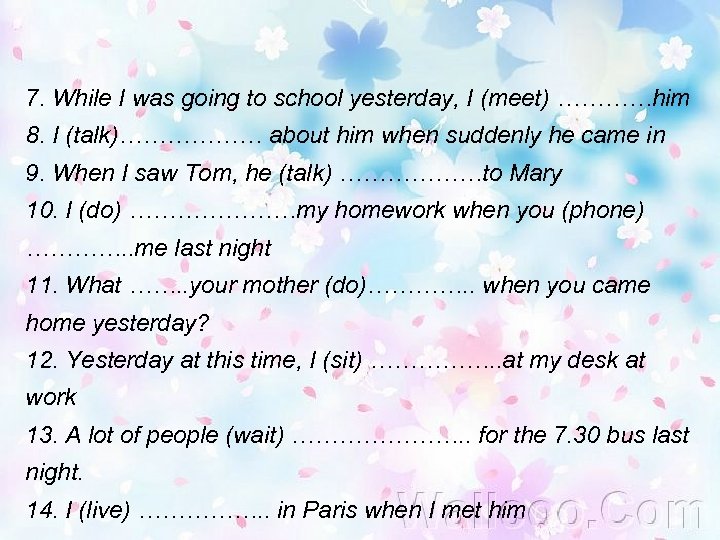 7. While I was going to school yesterday, I (meet) …………him 8. I (talk)……………… about him when suddenly he came in 9. When I saw Tom, he (talk) ………………to Mary 10. I (do) …………………my homework when you (phone) …………. . me last night 11. What ……. . your mother (do)…………. . when you came home yesterday? 12. Yesterday at this time, I (sit) ……………. . at my desk at work 13. A lot of people (wait) …………………. . for the 7. 30 bus last night. 14. I (live) ……………. . in Paris when I met him
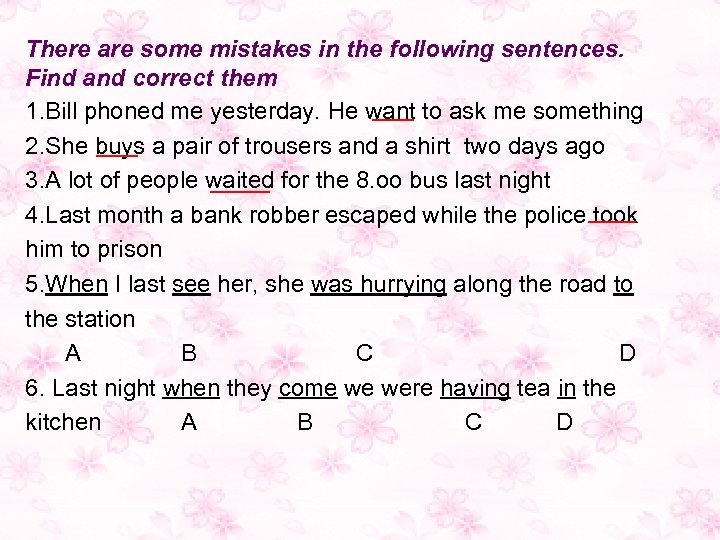 There are some mistakes in the following sentences. Find and correct them 1. Bill phoned me yesterday. He want to ask me something 2. She buys a pair of trousers and a shirt two days ago 3. A lot of people waited for the 8. oo bus last night 4. Last month a bank robber escaped while the police took him to prison 5. When I last see her, she was hurrying along the road to the station A B C D 6. Last night when they come we were having tea in the kitchen A B C D