


 Скачать презентацию Period 4 ish Review Era of Good
1ee145f199a9707ad18ffab5562df7e0.ppt
- Количество слайдов: 106
 Period 4 (ish) Review
 Era of Good Feelings (1817 -1825)
 James Monroe elected President in 1816 n n n Continued the Virginia dynasty (4 of 5 initial presidents Virginian; 32 of first 36 yrs) Death of Federalist party "Era of Good Feelings"
 "Era of Good Feelings" NOT REALLY n n n Crystallizing sectionalism Tariff issue Internal improvements Bank of U. S. (BUS) Sale of public lands Republican party enjoying 1 -party rule began developing factions eventually leading to 2 nd Party System in the 1830 s. ¨ Clay, Calhoun, Jackson, John Quincy Adams
 Monroe's presidency oversaw two major events Panic of 1819 n Missouri Compromise of 1820 n
 Panic of 1819 n n Economic panic and depression set in 1819 Causes of 1819 panic: ¨ ¨ n n Over speculation on frontier lands by banks (especially BUS) Inflation from 1812 war + economic drop-off after war Significant deficit in balance of trade with Britain BUS forced "wildcat" western banks to foreclose on western farms Resulted in calls for reform and pressure for increased democracy. Monroe reelected in 1820 with all but one electoral vote (nearly unanimous) -- Only president in history to be elected after a major panic.
 The Growing West n New states' characteristics No long-established history of states' rights ¨ More than other regions, depended on federal gov't where it had secured most of its land. ¨ Melting pot of a wide diversity of peoples immigrating from the east. ¨ n 9 frontier states joined the union bet. 1791 & 1819 Most had been admitted alternately free and slave. ¨ Maintaining a sectional balance in Congress was a supreme goal. ¨
 The Growing West n Reasons for explosive westward expansion ¨ Westward movement ¨ Cheap lands in the Ohio territory ¨ Land exhaustion ¨ Speculators accepted small down payments & made purchase of land easier. ¨ Economic distress of embargo years stimulated migration west. ¨ Crushing of Indians during the war cleared much of the frontier. ¨ Transportation Revolution improved land routes to Ohio Valley.
 The Growing West n West still remained weak in population and influence ¨ Forced to ally itself with other sections ¨ Demanded land reform & cheap transportation.
 Missouri Compromise of 1820 n n Missouri asked Congress to enter the union in 1819 ¨ Tallmadge Amendment Missouri Compromise of 1820 Henry Clay played a key role in mediating a compromise Provisions: ¨ Congress agreed to admit Missouri as a slave state. ¨ Maine was admitted as a free-soil state. ¨ Future slavery prohibited north of 36 -30' line, the southern border of Missouri. ¨ Compromise was largely accepted by both sides ¨ South got Missouri ¨ North won concession that it could forbid slavery in the remaining territories above 36 -30 line
 Time Lines: fill in area from 18141845 Growth: Democracy Grows: n 1819: Indian n 1815: Battle of New Civilization Act is Orleans passed n 1816: Monroe n 1824 Monroe Elected President proposes the removal n 1817: Rush-Bagot of all Indians to lands Treaty W. of Mississippi n 1819: Mc. Culloch v. n 1831: Cherokee Maryland, and Adams Nation v. Georgia: -Onis Treaty Fight Monroe legally n 1820: Missouri n 1831: Trail of Tears Compromise, Monroe n 1835: Seminole War re-elected n 1845: Irish n 1823: Monroe immigration: Potato Doctrine (limit foreign Famine intervention) Review At Home Expansion and Reform: n 1825: House elects JQ Adams n 1827: Creek Indians cede their western Georgia lands to U. S. n 1828: Jackson becomes presiden construction of Baltimore and Ohio begins. n 1830: Webster Hayne Debates ove nullification and meaning of “Union n 1831: Liberator begins publication n 1832: Jackson vetoes rechartering BUS 2 n 1836: Republic of Texas established, Specie Circular: only gold or silver is acceptable for payment of land n 1838: Underground railroad. n 1839: Depression until 1843. n 1844: Polk elected president
 n Most reforms are driven by evangelical religion ¨Women are prominent ¨Major issues
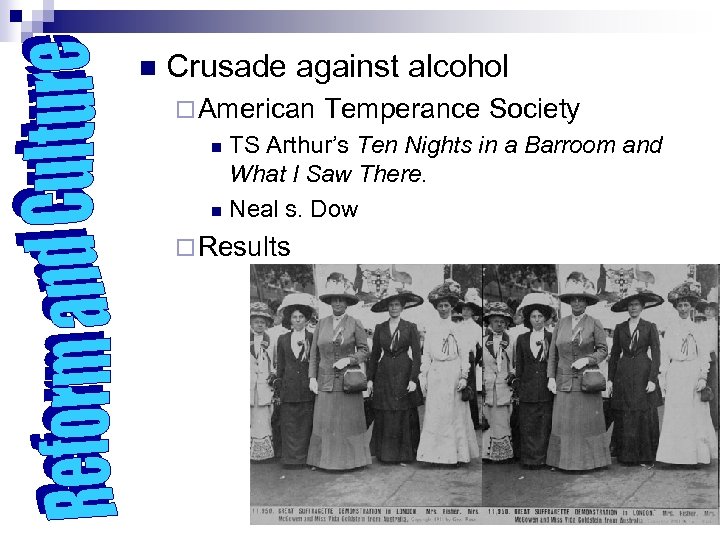 n Crusade against alcohol ¨ American Temperance Society TS Arthur’s Ten Nights in a Barroom and What I Saw There. n Neal s. Dow n ¨ Results
 n Women’s Rights ¨ “Republican Motherhood” ¨ Lucretia Mott ¨ Elizabeth Cady Stanton ¨ Susan B. Anthony ¨ Angelina Grimke ¨ Sara Grimke ¨ Lucy Stone ¨ Amelia Bloomer ¨ Margaret Fuller ¨ Seneca Falls Convention (1848)
 n Public Education ¨ Horace Mann ¨ Noah Webster ¨ William H. Mc. Guffey ¨ Emma Willard ¨ Oberlin College ¨ Lyceums
 n American Peace Society ¨ Dorothea Dix n Wilderness Utopias ¨ New Harmony ¨ Brook Farm n Nathaniel Hawthorne a resident ¨ Oneida Colony ¨ Shakers ¨ Mormons
 n Changing American Family ¨ Most women left their jobs upon marriage and became homemakers ¨ “Cult of domesticity” ¨ Godey’s Lady’s Book ¨ Catharine Beecher n Frontier experience uniquely American ¨ Alexis de Toqueville’s Democracy in America
 Democracy on the Frontier n Artistic Achievements n ¨ Thomas Jefferson ¨ Gilbert Stuart (1755 -1828) ¨ Charles Willson Peale ¨ Hudson River School of Art ¨ Stephen Foster
 n Literature ¨ The Knickerbockers Group ¨ Washington Irving (1783 -1859) ¨ James Fenimore Cooper (1789 -1851) ¨ William Cullen Bryant (1794 -1878) ¨ Transcendentalism ¨ Ralph Waldo Emerson (1803 -1882) ¨ Henry David Thoreau (1817 -1862) ¨ Walden: Or Life in the Woods (1854) ¨ Walt Whitman (1819 -1892) ¨ Margaret Fuller “The Dial” ¨ Henry Wadsworth Longfellow (1807 - 1882)
 n Individualists and Dissenters ¨ Edgar Allan Poe (1809 -1849) ¨ Nathaniel Hawthorne ¨ Herman Melville (1819 -1891) n Journalism ¨ Horace Greeley n Science ¨ John J. Audubon (1785 -1851)
 Election called “The Revolution of 1828” n Andrew Jackson (“Old Hickory”) the man… n Jacksonian Democracy n ¨ Increase of manhood suffrage ¨ Ends of the caucus ¨ Spoils System ¨ Martin Van Buren ¨ “Albany Regency” ¨ Consequences of the spoils system
 n Cabinet Crisis ¨ Jackson’s six-member cabinet was mediocre ¨ “Kitchen Cabinet” ¨ Webster-Hayne Debate ¨ Senator Robert Hayne “Tariff of Abominations” 1828 n Daniel Webster n Jefferson Day Toast – 1830 n Peggy Eaton Affair n Tariff Controversy of 1832 n Calhoun resigned in 1832 ¨ “Concurrent majority” plan ¨
 n Nullification Controversy of 1832 ¨ Tariff of 1832 ¨ Compromise Tariff of 1833 ¨ Force Bill n Election of 1832 ¨ Henry Clay (National Republican) vs. Jackson – “Old Hickory” (Democrat) ¨ Anti-Masonic party became the first 3 rd party ¨ National nominating conventions
 n MAIN AIM: Divorce government from the economy ¨ End of the Bank of the United States (BUS) ¨ Jackson vetoed BUS’s charter in 1832 ¨ Nicholas Biddle ¨ “Pet banks” scheme ¨ Specie Circular ¨ General Incorporation Laws ¨ Charles River Bridge decision ¨ Maysville Road Veto
 n Transplanting Native American Tribes ¨ Indian Removal Act (1830) ¨ Bureau of Indian Affairs n Cherokee ¨ Cherokee Nation v. Georgia (1831) ¨ Worcester v. Georgia (1832) ¨ Trail of Tears ¨ Black Hawk War (1832) Seminoles in Florida n Second Seminole War (1835 -1842) n
 n The Birth of Texas ¨ Stephen Austin ¨ Santa Anna ¨ Sam Houston ¨ Jackson’s dilemma n Election of 1836 ¨ Birth of the Whigs n “King Andrew I” n William Henry Harrison n Martin Van Buren n n Jackson’s Legacy Van Buren’s Presidency ¨ Caroline Incident ¨ “Aroostook War” ¨ Creole Incident
 n Panic of 1837 ¨ Causes ¨ Results ¨ Whigs Proposals shot down by Van Buren ¨ Treasury Bill of 1840 (Divorce Bill) n n Independent Treasury System Election of 1840 ¨ Van Buren Re-nominated by Democrats ¨ “Log Cabin and Hard Cider”
 n William Henry Harrison ¨ Whig ¨ VP – John Tyler ¨ Secretary of State: Daniel Webster ¨ Election of 1840
 Anti-Jackson Democrat n Secretary of State: Daniel Webster n Tyler vs. Congress n Webster-Ashburton Treaty (1842) n Clay’s Bill for 3 rd BUS n Canadian Border 45 th Parallell n
 The Rise of "King Cotton" Prior to 1793, the Southern economy was weak n Eli Whitney’s Cotton Gin (1793) n Trade n ¨ Cotton exported to England; $ from sale of cotton used to buy northern goods ¨ For a time, prosperity of both North and South rested on slave labor ¨ Cotton accounted for 50% of all American exports after 1840.
 The Three South's: Border South: Delaware, Maryland, Kentucky, & Missouri n n n Plantations scarcer; cotton cultivation almost nonexistent; Tobacco main slave crop (as in Middle South); More grain production (as in Middle South) 1850, Slaves = 17% of population. ; Avg. 5 slaves per slaveholder 1850, over 21% of Border South’s blacks free; 46% of South’s free blacks 22% of white families owned slaves Of all who owned more than 20 slaves in South: 6%; Ultra-wealthy = 1% Produced over 50% of South’s industrial products
 The Three South's: Middle South: Virginia, North Carolina, Tennessee, and Arkansas. n n n Each state had one section resembling more the Border South and another resembling the Lower South. Unionists would prevail after Lincoln elected; Disunionists would prevail after war began Many plantations in eastern Virginia and western Tennessee 1850, slaves = 30% of population; Avg. 8 slaves per slaveholder 36% of white families owned slaves Of all who owned more than 20 slaves in South: 32%; Ultra-wealthy = 14%
 The Three South’s: Lower South: South Carolina, Florida, Georgia, Alabama, Mississippi, Louisiana, Texas n n n n Plantations prevalent; cotton was king; grew 95% of Dixie’s cotton & almost all of its sugar, rice, and indigo Disunionists (secessionists) would prevail after Lincoln was elected 1850, slaves = 47% of population; Avg. 12 slaves per slaveholder Less than 2% of blacks free; only 15% of South’s free blacks 43% of white families owned slaves Of all who owned more than 20 slaves in South: 62%; Ultra-wealthy = 85% Produced less than 20% of South’s industrial products
 Slaves and the slave system (the "Peculiar Institution") Economic structure of South was monopolistic, dominated by wealthy plantation owners n Plantation system n ¨ Risky : Slaves might die of disease, injure themselves, or run away. ¨ One-crop economy ¨ Repelled large-scale European immigration
 Slaves and the slave system (the "Peculiar Institution") n Plantation slavery ¨ Nearly 4 million slaves by 1860; quadrupled in number since 1800 ¨ Slaves seen as valuable assets and primary source of wealth ¨ Punishment often brutal to send a message to other slaves not to defy master’s authority ¨ Life in the newly emerging western areas particularly harsh (LA, TX, MS, AL) ¨ Afro-American slave culture developed
 Slaves and the slave system (the "Peculiar Institution") Burdens of slavery ¨ Slaves deprived of dignity and sense of responsibility that free people have, suffered cruel physical and psychological treatment, and were ultimately convinced that they were inferior and deserved their lot in life. ¨ Denied an education since; seen as dangerous to give slaves ideas of freedom ¨ Slaves often insidiously sabotaged their master’s system ¨ Many attempted to escape
 Slaves and the slave system (the "Peculiar Institution") Slave Revolts - Stono Rebellion, 1739 - Gabriel Prosser, 1800 - Denmark Vesey, a mulatto in Charleston, devised the largest revolt ever in 1822. - Nat Turner’s revolt -- 1831 Southern white paranoia
 The White Majority By 1860, only 1/4 of white southerners owned slaves or belonged to slaveowning families n 75% of white southerners owned no slaves at all. n Mountain whites n
 Free Blacks Numbered about 250, 000 in the South by 1860 n Discrimination in the South n Discrimination in the North n
 Early Abolitionism Definition: Abolitionism: Movement in the North that demanded the immediate end of slavery n First abolitionist movements began around the time of the Revolution esp. Quakers n American colonization Society n
 Early Abolitionism Abolitionists in the 1830 s n Second Great Awakening convinced abolitionists of the sin of slavery. n Abolitionists inspired that Britain emancipated their slaves in the West Indies in 1833 n
 Radical Abolitionism William Lloyd Garrison n American Anti-Slavery Society n ¨ Theodore Dwight Weld ¨ Wendell Phillips ¨ Angelina and Sarah Grimke ¨ Arthur and Lewis Tappan - wealthy New York silk merchants. n *** Organization would eventually split along gender lines; women’s rights issues***
 Radical Abolitionism David Walker n Sojourner Truth n Elijah Lovejoy n Martin Delaney n Frederick Douglass n
 Pro-slavery whites responded by launching a massive defense of slavery as a positive good. • • • Slavery supported by the Bible (Genesis) and Aristotle (slavery existed in ancient Greece). It was good for barbarous Africans who were civilized and Christianized Master-slave relationships resembled those of a "family. " George Fitzhugh -- most famous of pro-slavery apologists’ “Gag resolution"
 Abolitionist impact in the North n n Abolitionists, esp. Garrison, were unpopular in many parts of the North. Many mob outbursts in response to extreme abolitionists Ambitious politicians avoided abolitionists (e. g. , Lincoln) – abolitionism was political suicide By 1850, abolitionism had a deep effect on the Northern psyche.
 Popular Sovereignty and the Mexican Cession n Intense debate over what to do with the Mexican Cession. Wilmot Proviso: New territory should be free of slavery ¨ Issue threatened to split both Whigs and Democrats along sectional lines ¨ n "Popular Sovereignty" Lewis Cass, 1812 War vet, became Democratic candidate for president in 1848 ¨ Definition: Sovereign people of a territory, under general principles of the Constitution, should determine themselves the status of slavery. ¨ Supported by many because it kept in line with democratic tradition of self-determination. ¨ Fatal flaw: It could spread the "peculiar institution" to new territories. ¨
 Election of 1848 Whigs nominated Zachary Taylor, "Hero of Buena Vista" n Free-Soil party n ¨ Coalition of northern antislavery Whig, Democrat, and Liberty Party men in the North distrusting Cass & Taylor n Result: Taylor 163, Cass 127, Van Buren 0 ¨ Free-Soilers won no states and did not actually affect the outcome of the election.
 California Statehood Gold discovered in 1848 at Sutter’s Mill; prospectors in 1848 known as "fortyeighters“ n 1849 -- Masses of adventurers flocked to northern California. n Gold essentially paved the way for rapid economic growth in California n CA drafted a Constitution in 1849 that excluded slavery and asked Congress for admission n
 Sectional Balance in 1850 n South Had presidency, majority in the cabinet, and a majority in the Supreme Court ¨ Equal number of states in Senate thus strong veto power ¨ n Yet, South deeply worried ¨ ¨ ¨ n In 1850, 15 free and 15 slave states CA would tip the balance in the Senate and set a free-state precedent in the southwest New Mexico and Utah territories seemed leaning toward free status. Texas claimed vast area east of Rio Grande (part of NM CO, KA & OK) and threatened to seize Santa Fe. Southerners angered by Northern demands for abolition of slavery in Wash. DC. Extremely angered over loss of runaway slaves, many assisted by North. When CA applied, southern "fire-eaters" threatened secession
 Underground Railroad and the Fugitive Slave issue n n Consisted of informal chain of antislavery homes which hundreds of slaves were aided by black & white abolitionists in their escape to free soil Canada. Harriet Tubman ("Moses") (ex-slave from Maryland who escaped to Canada) Jerry Loguen: Led hundreds of slaves to their freedom Prigg v. Pennsylvania, 1842 Political. significance: by 1850 southerners demanded a new more stringent fugitiveslave law
 Compromise of 1850 n Sunset of the "Great Triumvirate" ¨ Clay initiated his 3 rd great compromise ¨ Calhoun (dying of TB) rejected Clay’s position as not being adequate safeguards. ¨ Webster supported Clay’s compromise (famous "7 th of March speech" of 1850) ¨ Meanwhile, William H. Seward (nicknamed "Higher Law" Seward by his adversaries)
 "Compromise of 1850" n n n California admitted as a free state ‘ Abolition of the slave trade in District of Columbia Popular sovereignty in remainder of Mexican Cession: New Mexico and Utah territories. More stringent Fugitive Slave Law (than 1793) Texas to receive $10 million from federal gov’t as compensation for its surrendering of disputed territory to New Mexico.
 Result North got better deal. n Fugitive Slave Law became the single most important frictional issue between north and south in the 1850 s. n Compromise of 1850 won the Civil War for the North n
 Election of 1852 Democrats nominated Franklin Pierce (from NH) n Whigs nominated General Winfield Scott ("Old Fuss & Feathers") but party fatally split n Result: Pierce d. Scott 254 - 42 n Significance: Marked effective end of Whig party; complete death 2 years later n Significance of Whig party: Webster & Clay had kept idea of Union alive (both died in 1852) n
 Expansionism under President Pierce War in Nicaragua seemed inevitable; Britain challenged Monroe Doctrine n Clayton-Bulwer Treaty (1850): Neither U. S. or Britain would fortify or secure exclusive control over any future isthmian waterway. n America looks toward Asia n
 Expansionism under President Pierce n Cuba ¨ Polk had offered Spain $100 million for Cuba; Spain categorically refused. ¨ 1850 -51 -- two expeditions by private southern adventurers into Cuba failed. ¨ 1854, Spain seized U. S. steamer Black Warrior on a technicality. ¨ Ostend Manifesto n n Secret document whereby U. S. would offer $120 million for Cuba and if Spain U. S. would take it by force. News leaked out and angry northern free-soilers forced Pierce to abandon it.
 Gadsden Purchase (1853) U. S. concerned that CA & Oregon inaccessible by land & sea routes too tough n Debate: Should transcontinental railroad route run through the North or South? n Result n ¨ South boosted its claim to railroad ¨ North now tried to quickly organize Nebraska territory but the South opposed it.
 The Kansas-Nebraska Act (1854) n Stephen Douglas proposed carving Nebraska Territory into 2: Nebraska, Kansas ¨ ¨ ¨ n Slavery issue would be based on popular sovereignty His main motive was to give Illinois the eastern terminus for the proposed Pacific railroad. Kansas would presumably become slave; Nebraska free 36 -30 line prohibited slavery north of it; Kansas above it. Southerners fully supported it and pushed Pierce to support KS -NB Act Douglas successfully rammed the bill through Congress; great orator of his generation
 The Kansas-Nebraska Act (1854) n Kansas-Nebraska Act passed in 1854 ¨ Northern reaction ¨ Southern reaction ¨ Effectively wrecked the Compromises of 1820 & 1850 n Birth of the Republican party ¨ Republican party formed in response to the Kansas-Nebraska Act.
 Antislavery literature Harriet Beecher Stowe: Uncle Tom’s Cabin (1852) n Hinton R. Helper: The Impending Crisis of the South (1857) n
 "Bleeding Kansas" n New England Emigrant Aid Company: Sent 2, 000 into Kansas to prevent slavery from taking hold and to make a profit. n Southerners infuriated by apparent northern betrayal -- attempts to abolitionize Kansas. n 1855 election in Kansas for first territorial legislature 1856, a gang of proslavery raiders shot up and burned part of free-soil Lawrence, Kansas.
 The Caning of Charles Sumner n n Sumner a leading abolitionist Senator from Massachusetts, gave speech "Crime Against Kansas" where he lashed out at southern pro-slaveryites and insulted a S. C. Senator S. C. Congressman Preston Brooks retaliated by hitting Sumner over the head 30 times or more with an 11 -oz gold-headed cane. The House of Reps could not find enough votes (122 to 95 -- 2/3 needed) to expel Brooks but he resigned nonetheless, and was unanimously reelected by S. C. Sumner came to symbolize for the North the evils of the slavery system (along with bleeding Kansas issue)
 Pottawatomie Massacre -- John Brown & followers, in May 1856, hacked 5 men to pieces with broadswords in response to attack on Lawrence (and the caning of Sumner) n Civil war in Kansas ensued from 1856 and merged with Civil War of 1861 -1865 n
 Lecompton Constitution (1857) n n Kansas had enough people to apply for statehood on popular sovereignty basis. Southerners, still in power since 1855, devised a tricky document ¨ People were not allowed to vote for or against constitution as a whole but voted for the constitution. with or w/o slavery. ¨ If people voted no on slavery, rights of slaveholders already in KS protected n n Infuriated free-soilers boycotted the polls Slaveryites approved constitution with slavery late in 1857.
 Election of 1856 n n James Buchanan chosen as Democratic nominee over Pierce (seen as too weak) and Douglas (who alienated the southern wing of the party after denouncing Lecompton constitution. ) Republicans nominated Captain John C. Ferment "Pathfinder of the West" American Party ("know-nothing") Nativist in orientation Buchanan d. Fremont 174 to 114; Fillmore 8.
 The Dred Scott Decision (March 6, 1857) Dried Scott had lived with his master for 5 years in Illinois and Wisconsin Territory. n 80 -year-old Marylander Chief Justice Roger B. Taney wrote the 55 page opinion. n Decision n Impact n
 Financial Crash of 1857 n n Not as bad as Panic of 1837 but probably the worst psychologically in 19 th c. Causes Influx of California gold into economy inflated currency. ¨ Crimean War over stimulated growing of grain ¨ Speculation in land railroads backfired. ¨ n Results ¨ ¨ ¨ Over 5, 000 businesses failed within a year. Unemployment widespread Renewed demand for free farms of 160 acres from public domain land. Demand for higher tariff rates Republicans had two major issues for 1860: higher tariffs & Homestead Act
 Lincoln-Douglas Debates (1858) – Senate seat in Illinois Lincoln’s nomination speech: "A house divided cannot stand. I believe this government cannot endure; permanently half slave and half free. n Lincoln challenged Douglas to a series of seven joint debates n Freeport debate most famous -- Freeport Doctrine n
 John Brown attacks Harper’s Ferry n n n Brown’s scheme: invade the South secretly with a few followers and lead slaves to rise, give them arms, and establish a kind of black free state. October, 1859 -- Seized the arsenal at Harper’s Ferry Brown and his followers were hanged after a brief but legal trial. Brown became a martyr in the North Effects of Harper’s Ferry were ominous in southern eyes.
 Nominating Conventions of 1860 n Democratic party split in two Met first in South Carolina with Douglas as leading candidate of northern wing ¨ Next convention in Baltimore nominated Douglas while the Democratic party split in two ¨ Southern Democratic Party nominated John C. Breckinridge: ¨ n n Constitutional Union Party nominated John Bell of Tennessee Republicans nominate Abraham Lincoln Seward the front-runner but perceived as too radical for victory in general election. ¨ Republican platform (broadly based) ¨ Southern secessionists warned that the election of Lincoln would split the Union. ¨
 Presidential election of 1860 n Lincoln elected president with only 40% of the vote; most sectional election in history. ¨ Lincoln won all Northern states except NJ and MO (180 electoral votes to 123) ¨ Breckinridge won all the Deep South states plus AK, MD, and DE ¨ Bell won Border States of VA KY and mid-slave state of TN ¨ Douglas won only MO and NJ but finished 2 nd in popular votes n South still had control of both Houses of Congress and a 5 -4 majority on Supreme Court
 Southern states secede from the Union n Four days after the election of Lincoln, the "Black Republican", South Carolina legislature unanimously called for a special convention in Charleston. ¨ n Within six weeks, six other states seceded (MS, FL, AL, GA, LA, TX) all during Buchanan’s "lame-duck" period. ¨ n December, 1860, 170 South Carolina unanimously voted to secede from the other states. Four others seceded in April, 1861, after beginning of Civil War (VA, AK, NC, TN) as they refused to fight their fellow southerners and agree to Lincoln’s call for volunteers. Confederate States of America formed in Montgomery Alabama meeting. ¨ Jefferson Davis chosen as president of provisional government to be located at Richmond, VA (after Fort Sumter)
 Southern states secede from the Union n President Buchanan did little to prevent southern secession. ¨ Claimed the Constitution did not give him authority to stop secession with force. ¨ More significantly, northern army was small and weak and scattered on the frontier. ¨ Many of his advisors pro-southern ¨ Northern sentiment predominantly for peaceful reconciliation rather than war ¨ Ironically, Lincoln continued Buchanan’s vacillating policy when he became president. ¨ Buchanan’s serendipitous wait-and-see policy probably helped save the Union.
 Reasons for southern secession 1. 2. 3. 4. 5. 6. Alarmed at the political balance tipping in favor of the North Horrified at victory of the sectional Republican party which appeared to threaten their rights as a slaveholding minority. Angry over free-soil criticism and abolitionism, and northern interference such as the Underground Railroad and John Brown’s raid. Many southerners felt secession would be unopposed Opportunity to end generations of dependence to the North. Morally they were in the right
 Crittenden amendments -- final attempt at compromise Proposed by Senator John J. Crittenden of Kentucky (heir to political throne of Clay) n Designed to appease the South n Provisions n Rejected by Lincoln; all hope of compromise was gone. n
 EXTRA STUFF
 n Name four major Rebellions in early American History…
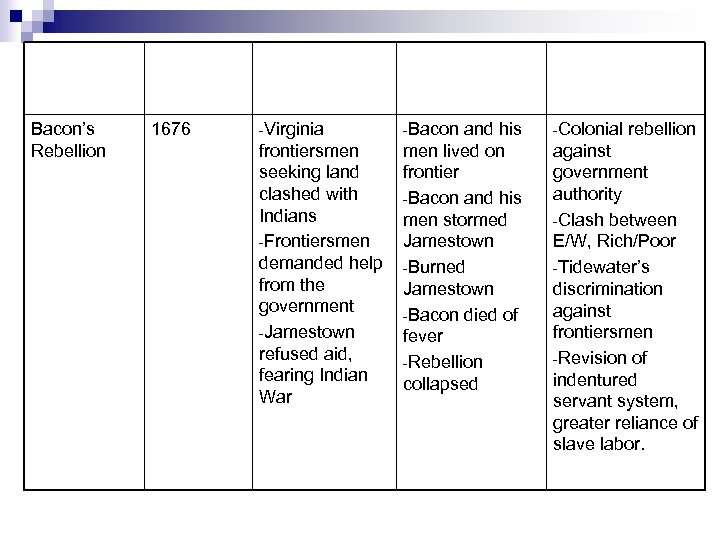 EVENT Bacon’s Rebellion DATE 1676 CAUSE EVENTS SIGNIFICANCE -Virginia -Bacon and his -Colonial rebellion frontiersmen seeking land clashed with Indians -Frontiersmen demanded help from the government -Jamestown refused aid, fearing Indian War men lived on frontier -Bacon and his men stormed Jamestown -Burned Jamestown -Bacon died of fever -Rebellion collapsed against government authority -Clash between E/W, Rich/Poor -Tidewater’s discrimination against frontiersmen -Revision of indentured servant system, greater reliance of slave labor.
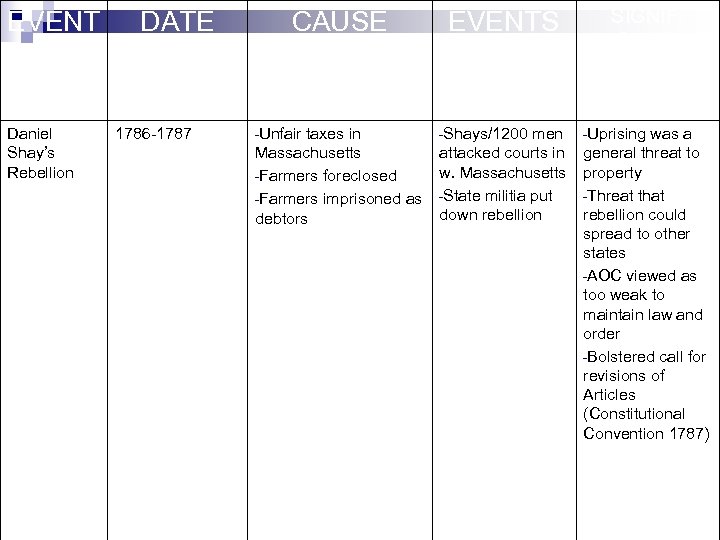 EVENT Daniel Shay’s Rebellion DATE 1786 -1787 CAUSE -Unfair taxes in EVENTS -Shays/1200 men SIGNIFICANCE -Uprising was a Massachusetts attacked courts in general threat to w. Massachusetts property -Farmers foreclosed -Threat that -Farmers imprisoned as -State militia put down rebellion could debtors spread to other states -AOC viewed as too weak to maintain law and order -Bolstered call for revisions of Articles (Constitutional Convention 1787)
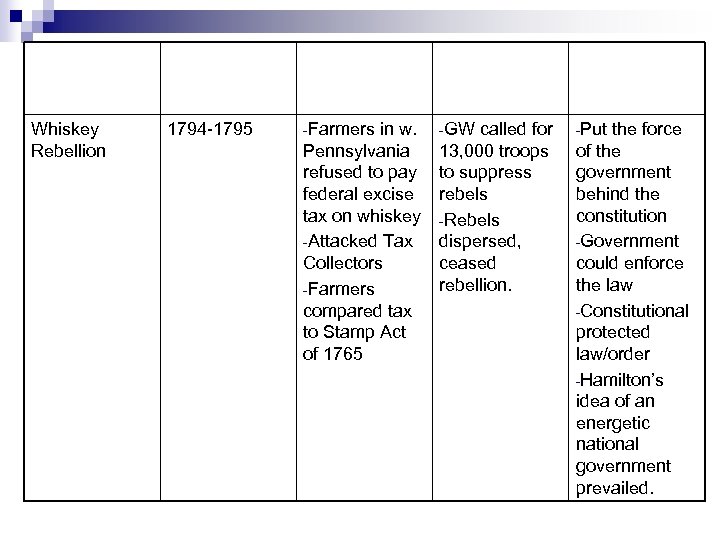 EVENT Whiskey Rebellion DATE 1794 -1795 SIGNIFICANCE CAUSE EVENTS -Farmers in w. -GW called for -Put the force Pennsylvania refused to pay federal excise tax on whiskey -Attacked Tax Collectors -Farmers compared tax to Stamp Act of 1765 13, 000 troops to suppress rebels -Rebels dispersed, ceased rebellion. of the government behind the constitution -Government could enforce the law -Constitutional protected law/order -Hamilton’s idea of an energetic national government prevailed.
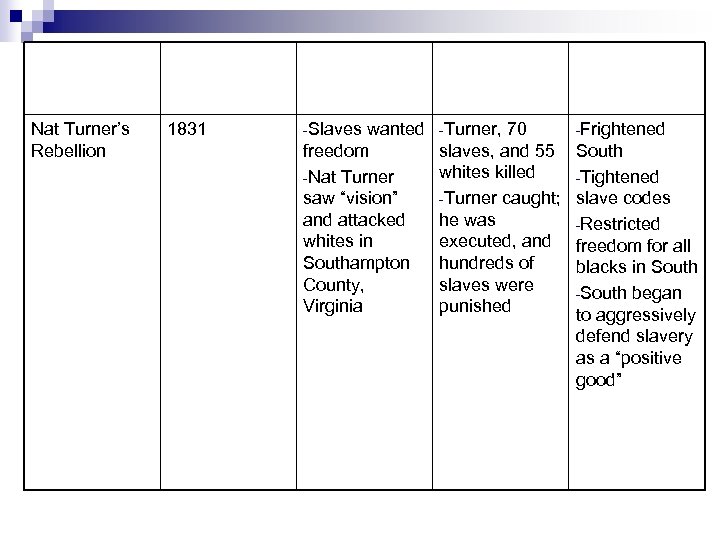 EVENT Nat Turner’s Rebellion DATE 1831 CAUSE EVENTS SIGNIFICANCE -Slaves wanted -Turner, 70 -Frightened freedom -Nat Turner saw “vision” and attacked whites in Southampton County, Virginia South -Tightened slave codes -Restricted freedom for all blacks in South -South began to aggressively defend slavery as a “positive good” slaves, and 55 whites killed -Turner caught; he was executed, and hundreds of slaves were punished
 What are some area acquisitions that were made with the intent to strengthen, unite, and enlarge the nation? n Between 1783 -1853 n Think about Manifest Destiny n What land area was acquired, and with what means of acquisition? n
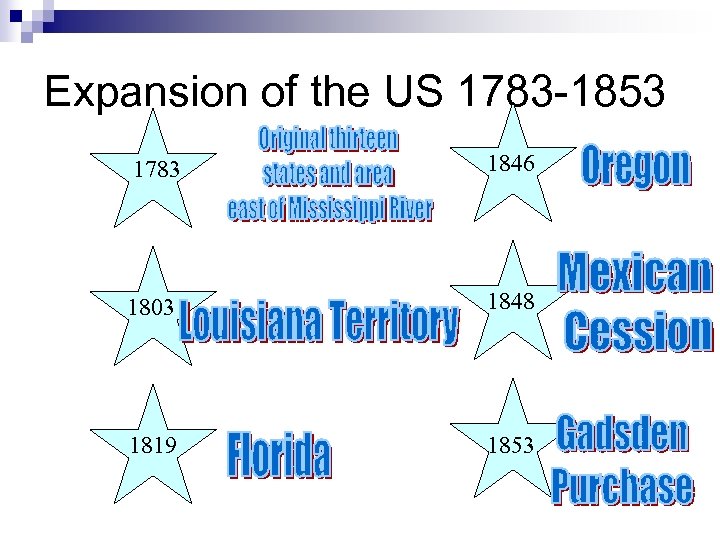 Expansion of the US 1783 -1853 1783 1846 1803 1848 1819 1853
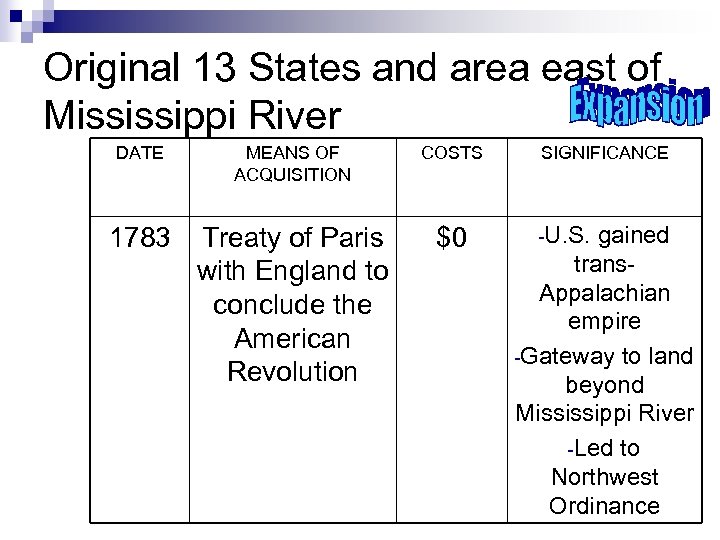 Original 13 States and area east of Mississippi River DATE MEANS OF ACQUISITION COSTS SIGNIFICANCE 1783 Treaty of Paris with England to conclude the American Revolution $0 -U. S. gained trans. Appalachian empire -Gateway to land beyond Mississippi River -Led to Northwest Ordinance
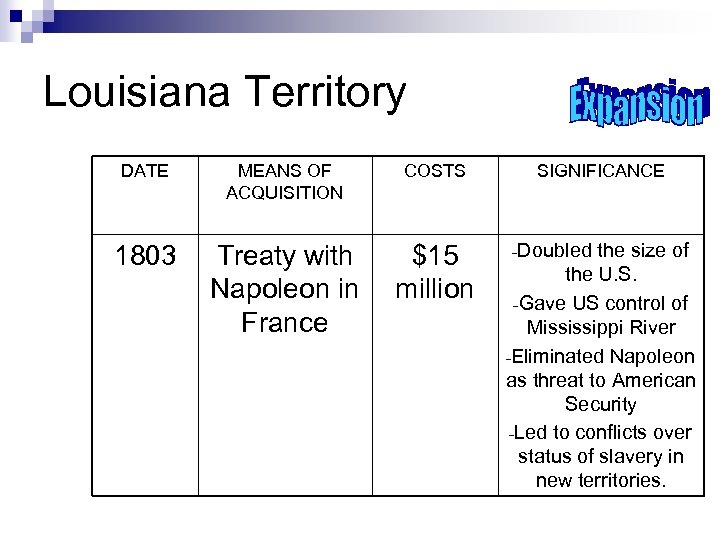 Louisiana Territory DATE 1803 MEANS OF ACQUISITION COSTS Treaty with $15 Napoleon in million France SIGNIFICANCE -Doubled the size of the U. S. -Gave US control of Mississippi River -Eliminated Napoleon as threat to American Security -Led to conflicts over status of slavery in new territories.
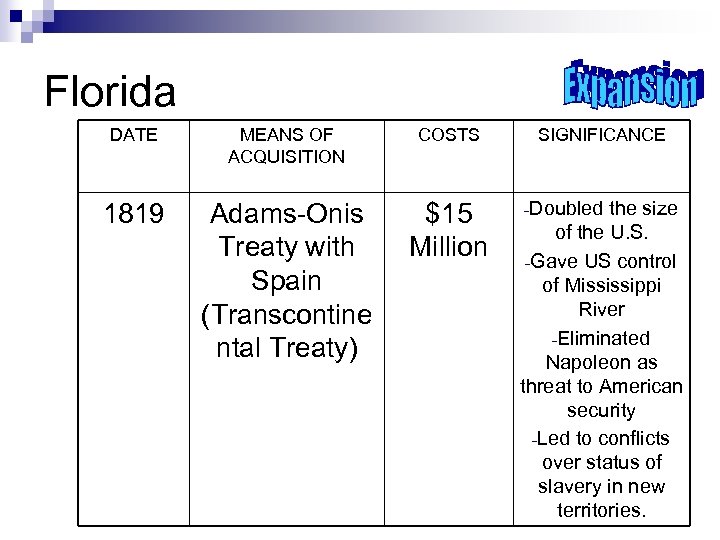 Florida DATE MEANS OF ACQUISITION COSTS SIGNIFICANCE 1819 Adams-Onis Treaty with Spain (Transcontine ntal Treaty) $15 Million -Doubled the size of the U. S. -Gave US control of Mississippi River -Eliminated Napoleon as threat to American security -Led to conflicts over status of slavery in new territories.
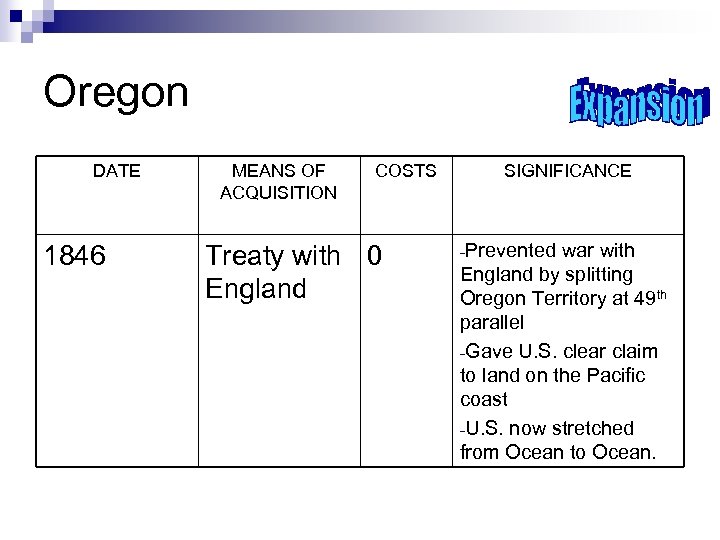 Oregon DATE 1846 MEANS OF ACQUISITION COSTS Treaty with 0 England SIGNIFICANCE -Prevented war with England by splitting Oregon Territory at 49 th parallel -Gave U. S. clear claim to land on the Pacific coast -U. S. now stretched from Ocean to Ocean.
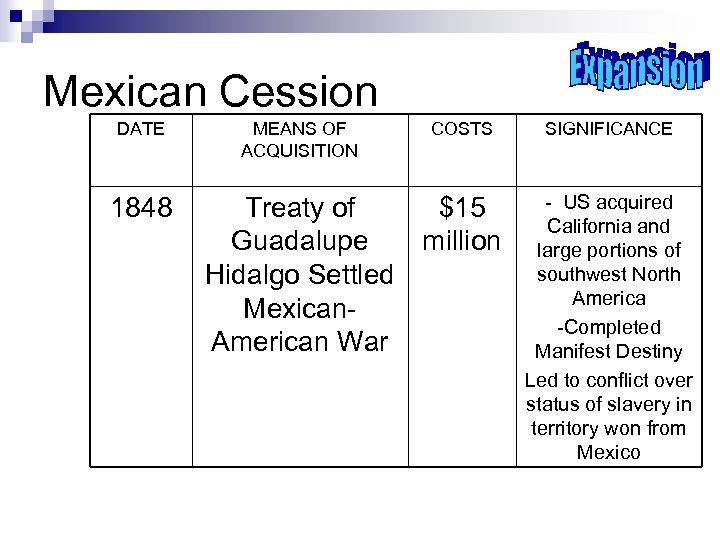 Mexican Cession DATE 1848 MEANS OF ACQUISITION COSTS Treaty of $15 Guadalupe million Hidalgo Settled Mexican. American War SIGNIFICANCE - US acquired California and large portions of southwest North America -Completed Manifest Destiny Led to conflict over status of slavery in territory won from Mexico
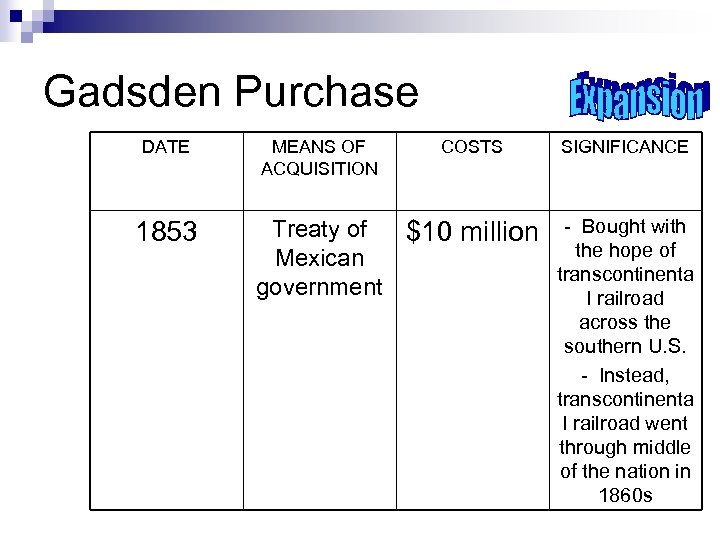 Gadsden Purchase DATE 1853 MEANS OF ACQUISITION COSTS SIGNIFICANCE Treaty of $10 million - Bought with the hope of Mexican transcontinenta government l railroad across the southern U. S. - Instead, transcontinenta l railroad went through middle of the nation in 1860 s
 WHAT ARE SOME OF THE MAJOR TREATIES IN US HISTORY? n THINK BETWEEN 1794 -1919. n
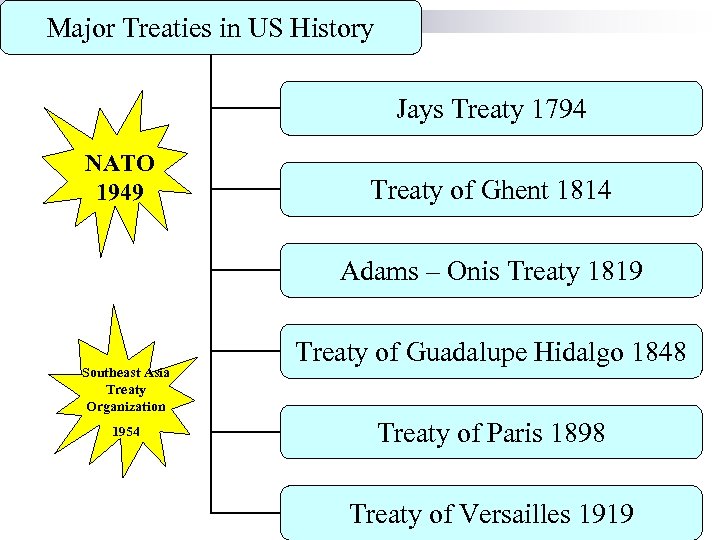 Major Treaties in US History Jays Treaty 1794 NATO 1949 Treaty of Ghent 1814 Adams – Onis Treaty 1819 Southeast Asia Treaty Organization 1954 Treaty of Guadalupe Hidalgo 1848 Treaty of Paris 1898 Treaty of Versailles 1919
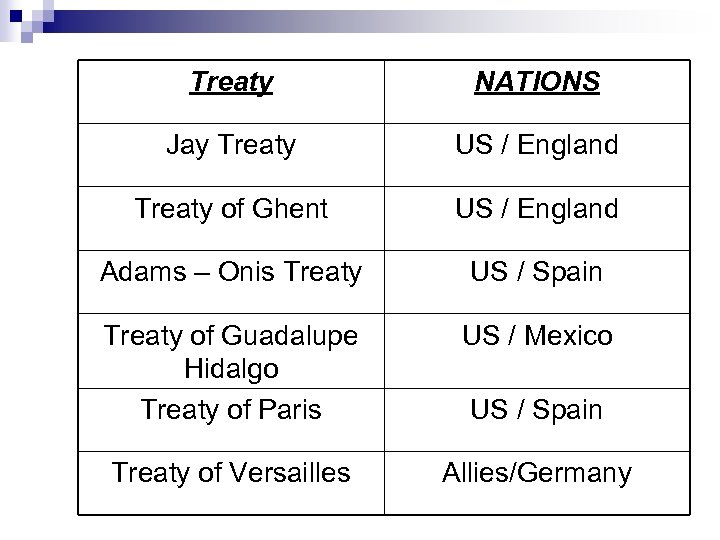 Treaty NATIONS Jay Treaty US / England Treaty of Ghent US / England Adams – Onis Treaty US / Spain Treaty of Guadalupe Hidalgo Treaty of Paris US / Mexico Treaty of Versailles Allies/Germany US / Spain
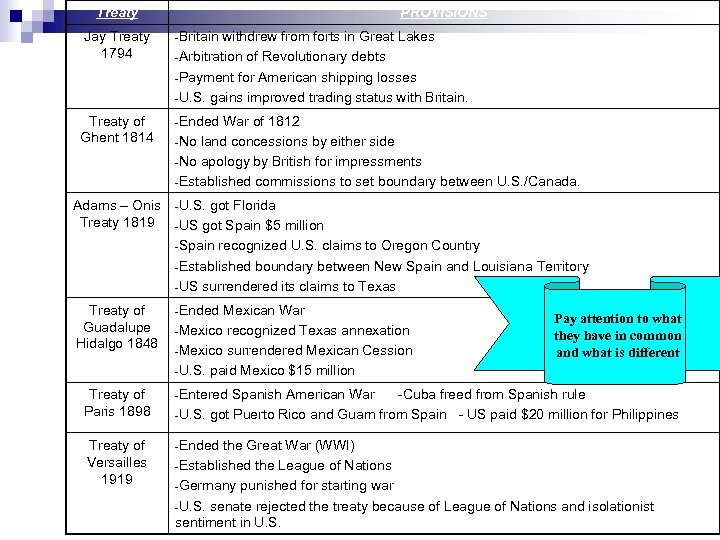 Treaty Jay Treaty 1794 PROVISIONS -Britain withdrew from forts in Great Lakes -Arbitration of Revolutionary debts -Payment for American shipping losses -U. S. gains improved trading status with Britain. Treaty of Ghent 1814 -Ended War of 1812 -No land concessions by either side -No apology by British for impressments -Established commissions to set boundary between U. S. /Canada. Adams – Onis Treaty 1819 -U. S. got Florida -US got Spain $5 million -Spain recognized U. S. claims to Oregon Country -Established boundary between New Spain and Louisiana Territory -US surrendered its claims to Texas Treaty of Guadalupe Hidalgo 1848 -Ended Mexican War -Mexico recognized Texas annexation -Mexico surrendered Mexican Cession Pay attention to what they have in common and what is different -U. S. paid Mexico $15 million Treaty of Paris 1898 -Entered Spanish American War -Cuba freed from Spanish rule Treaty of Versailles 1919 -Ended the Great War (WWI) -U. S. got Puerto Rico and Guam from Spain - US paid $20 million for Philippines -Established the League of Nations -Germany punished for starting war -U. S. senate rejected the treaty because of League of Nations and isolationist sentiment in U. S.
 n What are the major differences between BUS 1 and BUS 2
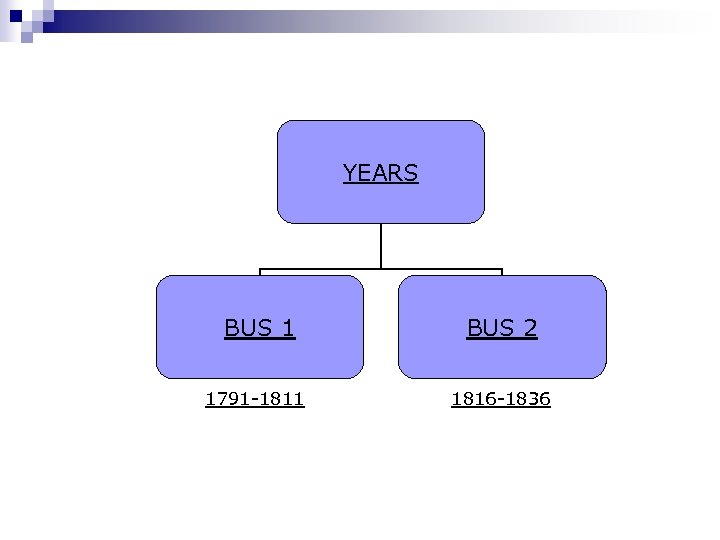 YEARS BUS 1 BUS 2 1791 -1811 1816 -1836
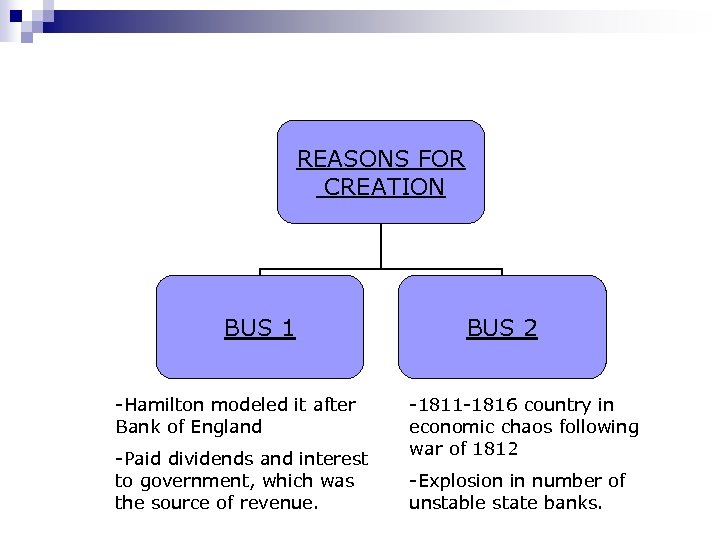 REASONS FOR CREATION BUS 1 -Hamilton modeled it after Bank of England -Paid dividends and interest to government, which was the source of revenue. BUS 2 -1811 -1816 country in economic chaos following war of 1812 -Explosion in number of unstable state banks.
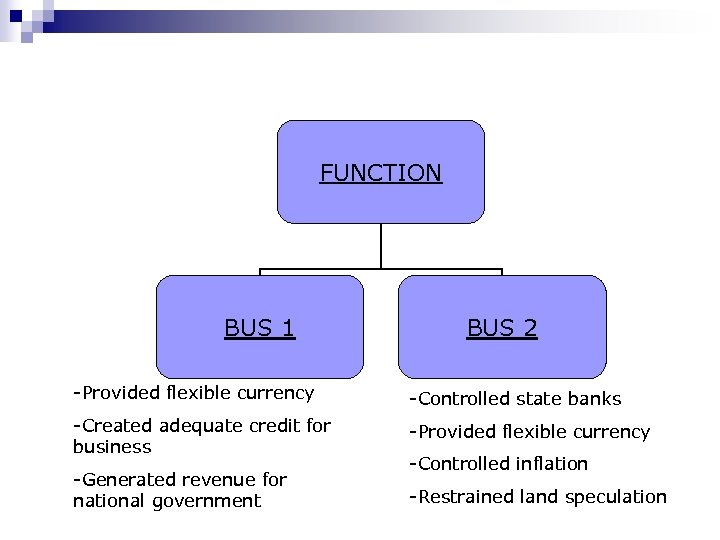 FUNCTION BUS 1 BUS 2 -Provided flexible currency -Controlled state banks -Created adequate credit for business -Provided flexible currency -Generated revenue for national government -Restrained land speculation -Controlled inflation
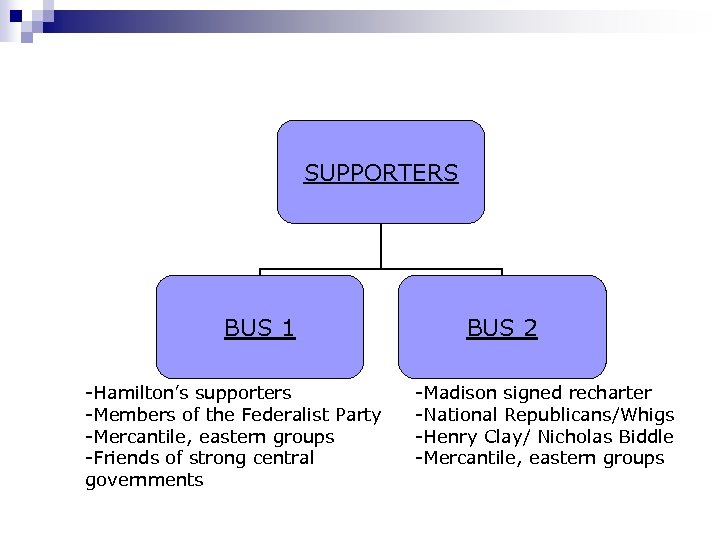 SUPPORTERS BUS 1 -Hamilton’s supporters -Members of the Federalist Party -Mercantile, eastern groups -Friends of strong central governments BUS 2 -Madison signed recharter -National Republicans/Whigs -Henry Clay/ Nicholas Biddle -Mercantile, eastern groups
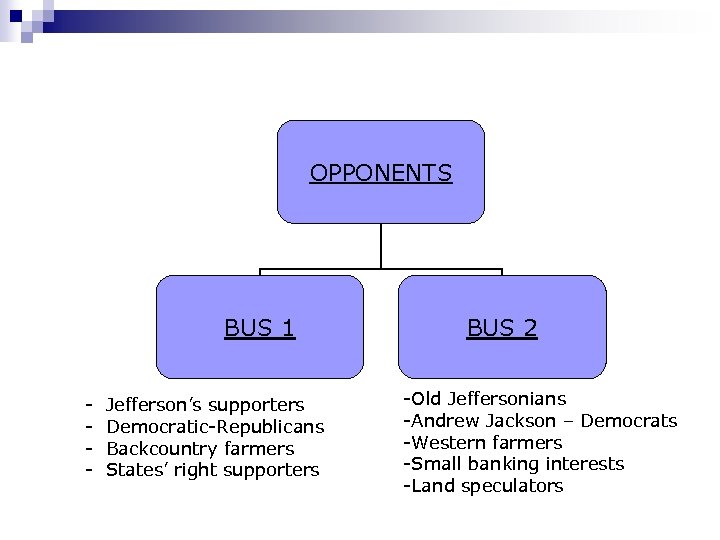 OPPONENTS BUS 1 - Jefferson’s supporters Democratic-Republicans Backcountry farmers States’ right supporters BUS 2 -Old Jeffersonians -Andrew Jackson – Democrats -Western farmers -Small banking interests -Land speculators
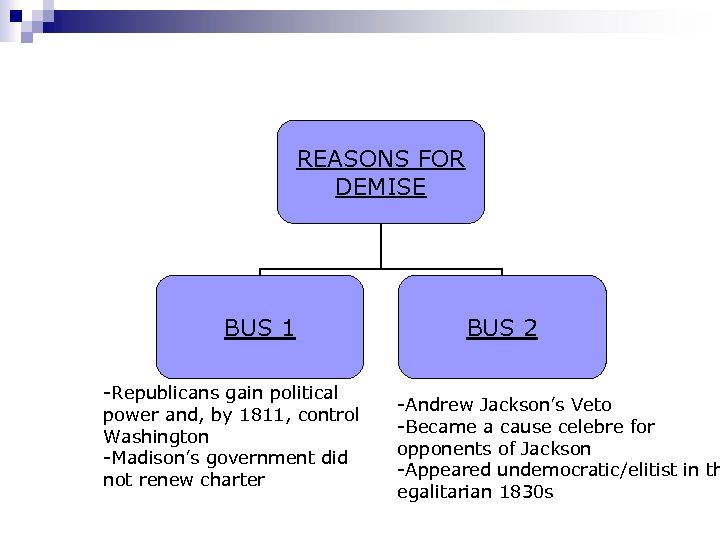 REASONS FOR DEMISE BUS 1 -Republicans gain political power and, by 1811, control Washington -Madison’s government did not renew charter BUS 2 -Andrew Jackson’s Veto -Became a cause celebre for opponents of Jackson -Appeared undemocratic/elitist in th egalitarian 1830 s
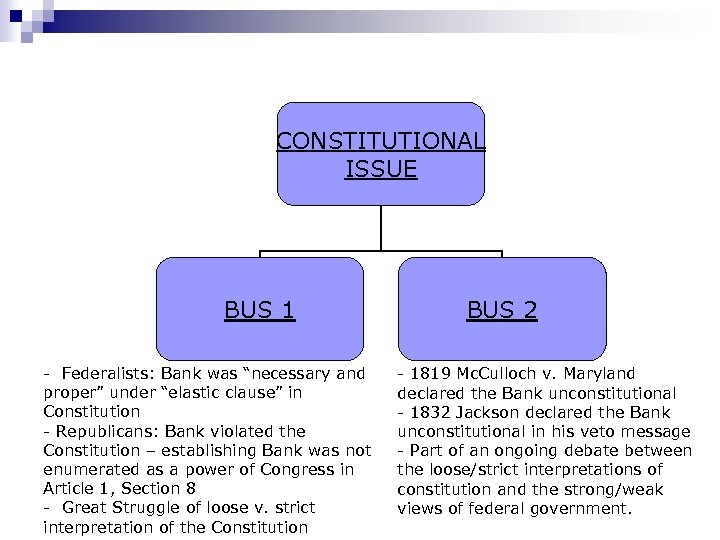 CONSTITUTIONAL ISSUE BUS 1 - Federalists: Bank was “necessary and proper” under “elastic clause” in Constitution - Republicans: Bank violated the Constitution – establishing Bank was not enumerated as a power of Congress in Article 1, Section 8 - Great Struggle of loose v. strict interpretation of the Constitution BUS 2 - 1819 Mc. Culloch v. Maryland declared the Bank unconstitutional - 1832 Jackson declared the Bank unconstitutional in his veto message - Part of an ongoing debate between the loose/strict interpretations of constitution and the strong/weak views of federal government.
 QUESTIONS
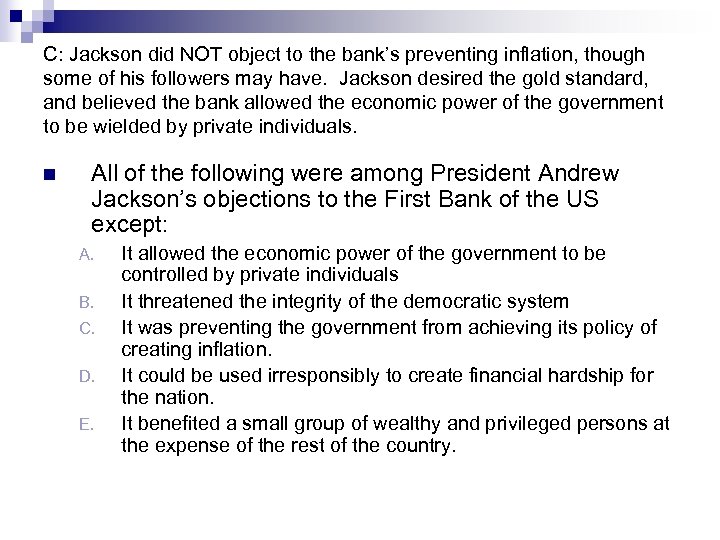 C: Jackson did NOT object to the bank’s preventing inflation, though some of his followers may have. Jackson desired the gold standard, and believed the bank allowed the economic power of the government to be wielded by private individuals. n All of the following were among President Andrew Jackson’s objections to the First Bank of the US except: A. B. C. D. E. It allowed the economic power of the government to be controlled by private individuals It threatened the integrity of the democratic system It was preventing the government from achieving its policy of creating inflation. It could be used irresponsibly to create financial hardship for the nation. It benefited a small group of wealthy and privileged persons at the expense of the rest of the country.
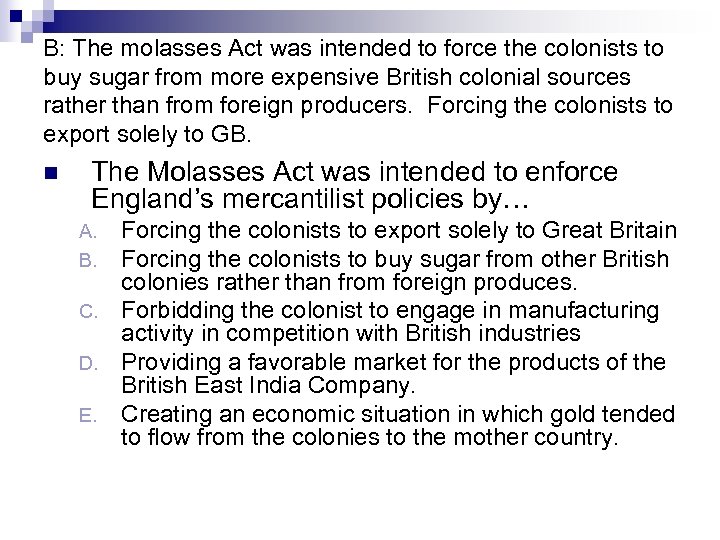 B: The molasses Act was intended to force the colonists to buy sugar from more expensive British colonial sources rather than from foreign producers. Forcing the colonists to export solely to GB. n The Molasses Act was intended to enforce England’s mercantilist policies by… Forcing the colonists to export solely to Great Britain Forcing the colonists to buy sugar from other British colonies rather than from foreign produces. C. Forbidding the colonist to engage in manufacturing activity in competition with British industries D. Providing a favorable market for the products of the British East India Company. E. Creating an economic situation in which gold tended to flow from the colonies to the mother country. A. B.
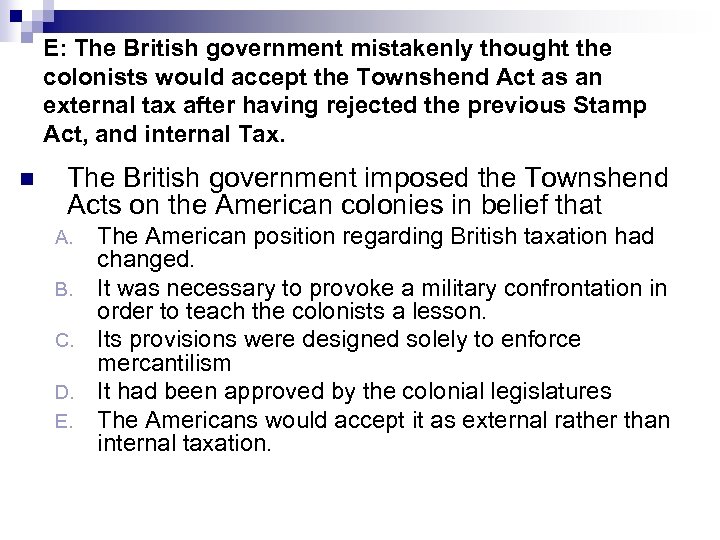 E: The British government mistakenly thought the colonists would accept the Townshend Act as an external tax after having rejected the previous Stamp Act, and internal Tax. n The British government imposed the Townshend Acts on the American colonies in belief that A. B. C. D. E. The American position regarding British taxation had changed. It was necessary to provoke a military confrontation in order to teach the colonists a lesson. Its provisions were designed solely to enforce mercantilism It had been approved by the colonial legislatures The Americans would accept it as external rather than internal taxation.
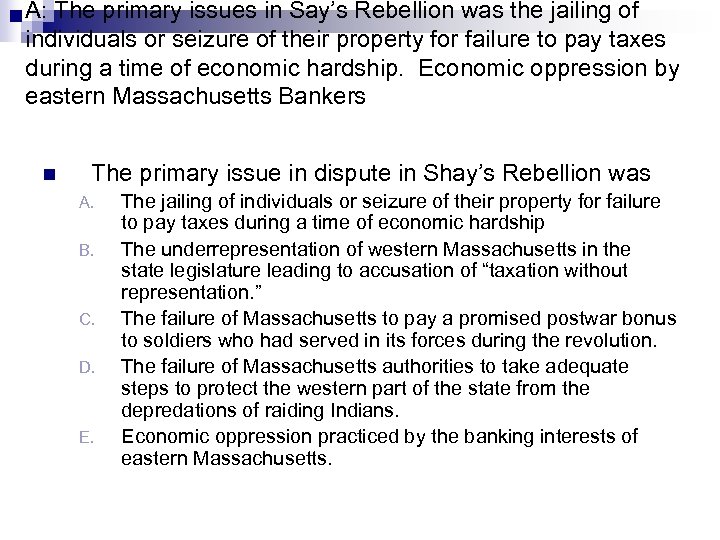 A: The primary issues in Say’s Rebellion was the jailing of individuals or seizure of their property for failure to pay taxes during a time of economic hardship. Economic oppression by eastern Massachusetts Bankers n The primary issue in dispute in Shay’s Rebellion was A. B. C. D. E. The jailing of individuals or seizure of their property for failure to pay taxes during a time of economic hardship The underrepresentation of western Massachusetts in the state legislature leading to accusation of “taxation without representation. ” The failure of Massachusetts to pay a promised postwar bonus to soldiers who had served in its forces during the revolution. The failure of Massachusetts authorities to take adequate steps to protect the western part of the state from the depredations of raiding Indians. Economic oppression practiced by the banking interests of eastern Massachusetts.