 Скачать презентацию Period 4 Grammar Modal Verbs The first
4db0e2b48c459c8cd59cba87a618b8af.ppt
- Количество слайдов: 40



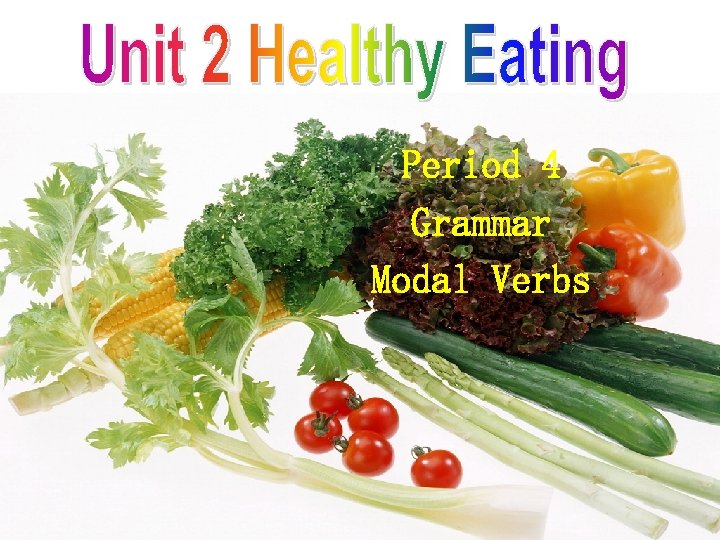
Period 4 Grammar Modal Verbs
The first wealth is health. 健康是人生第一财富。 A light heart lives long. 豁达者长寿。 Early to bed and early to rise makes a man healthy , wealthy and wise. 早睡早起会使人健康、富有和聪明。 Without health no pleasure can be tasted by man. 没有健康就没有乐趣。 Good health is over wealth. 健康是最大的财富。
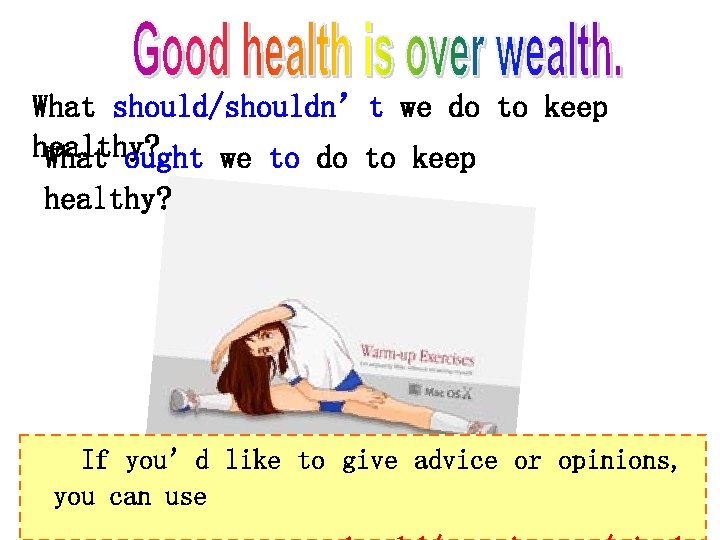
What should/shouldn’t we do to keep healthy? What ought we to do to keep healthy? If you’d like to give advice or opinions, you can use
Good habits can help us to keep healthy and bad ones can cause diseases. There is a serious disease called H 1 N 1 flu these days. It spreads easily among people in spring and autumn. The flu is a serious disease, but we don’t have to be afraid of it. We can do something to prevent it. But how? • We ought to keep the air fresh all the • We ought to keep away from crowded place • We’d better drink more water every day.
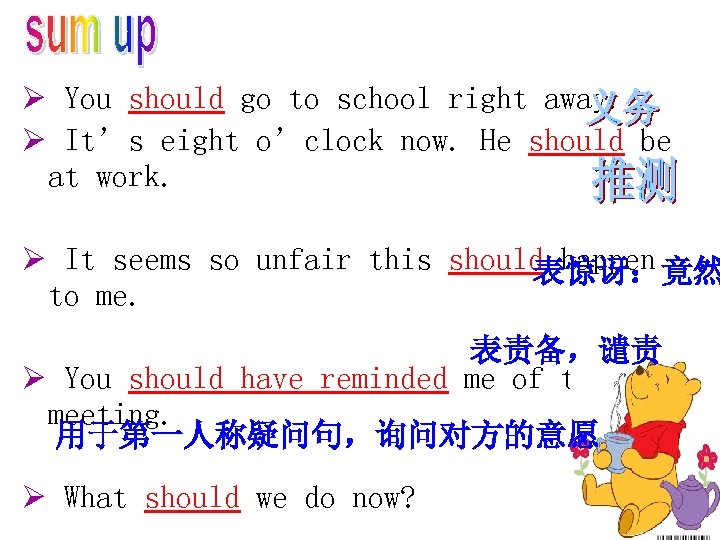
Ø You should go to school right away. Ø It’s eight o’clock now. He should be at work. Ø It seems so unfair this should happen 表惊讶:竟然 to me. 表责备,谴责 Ø You should have reminded me of the meeting. 用于第一人称疑问句,询问对方的意愿 Ø What should we do now?
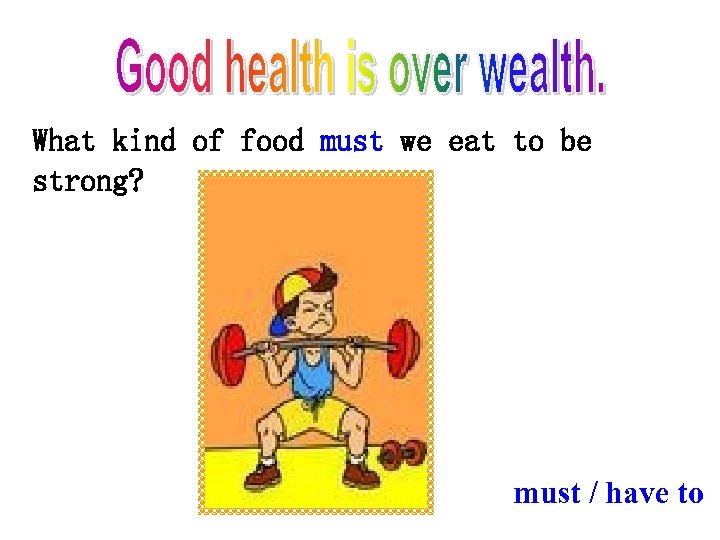
What kind of food must we eat to be strong? must / have to
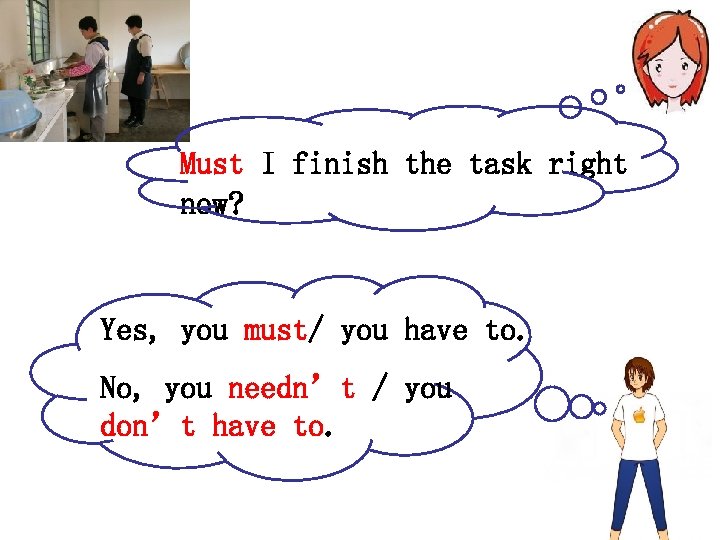
Must I finish the task right now? Yes, you must/ you have to. No, you needn’t / you don’t have to.
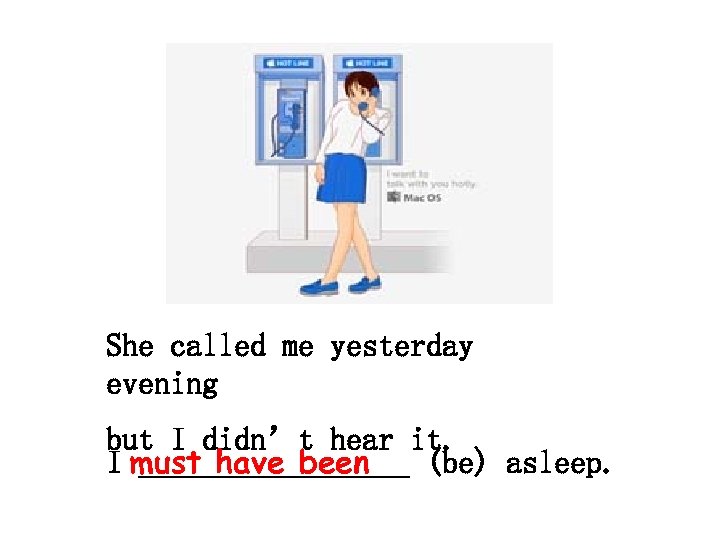
She called me yesterday evening but I didn’t hear it. I must have been _________ (be) asleep.
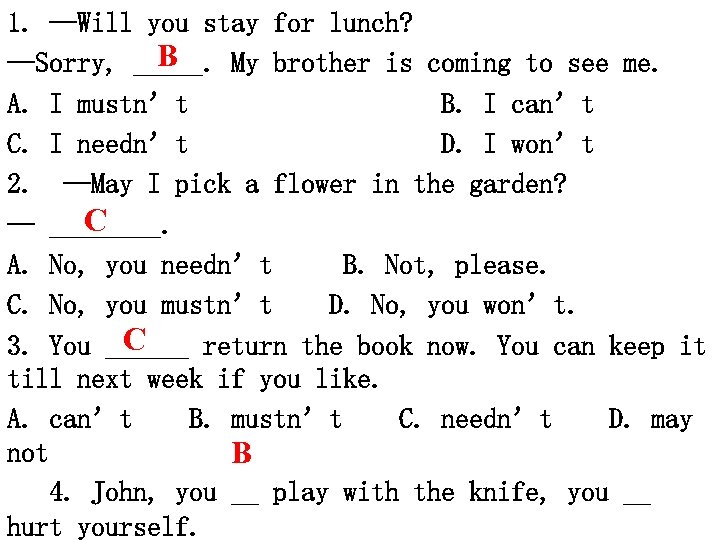
1. --Will you stay for lunch? B --Sorry, _____. My brother is coming to see me. A. I mustn’t B. I can’t C. I needn’t D. I won’t 2. --May I pick a flower in the garden? C -- ____. A. No, you needn’t B. Not, please. C. No, you mustn’t D. No, you won’t. C 3. You ______ return the book now. You can keep it till next week if you like. A. can’t B. mustn’t C. needn’t D. may not B 4. John, you __ play with the knife, you __ hurt yourself.
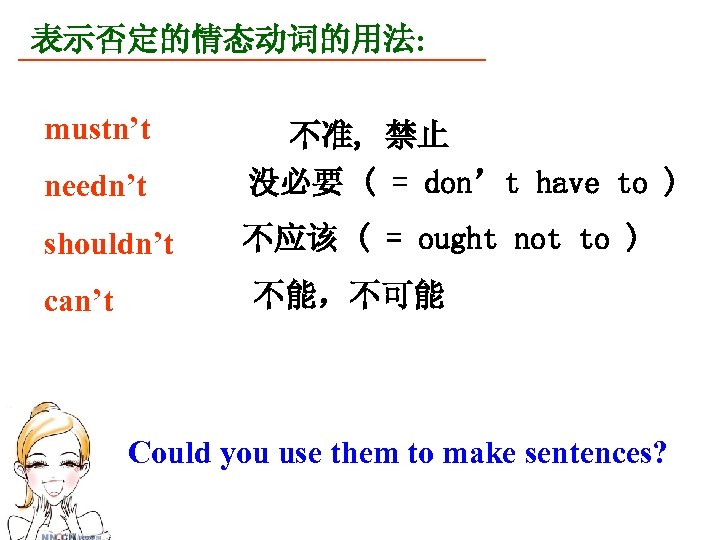
表示否定的情态动词的用法: mustn’t needn’t 不准, 禁止 没必要 ( = don’t have to ) shouldn’t 不应该 ( = ought not to ) can’t 不能,不可能 Could you use them to make sentences?
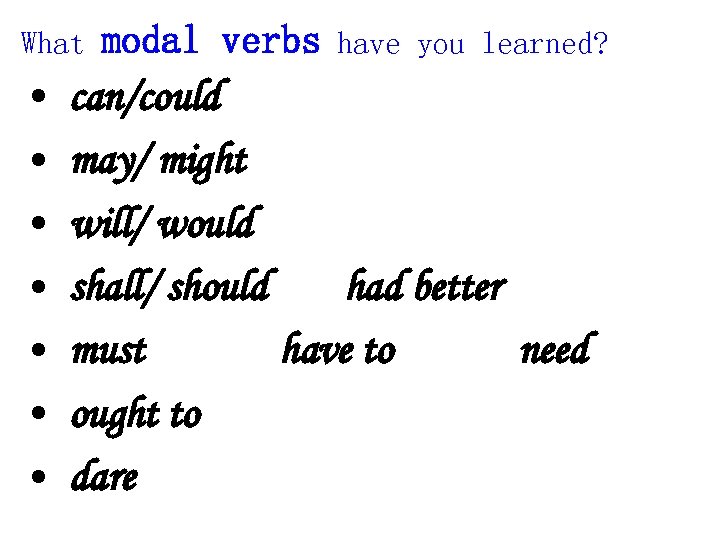
What • • modal verbs have you learned? can/could may/ might will/ would shall/ should had better must have to need ought to dare
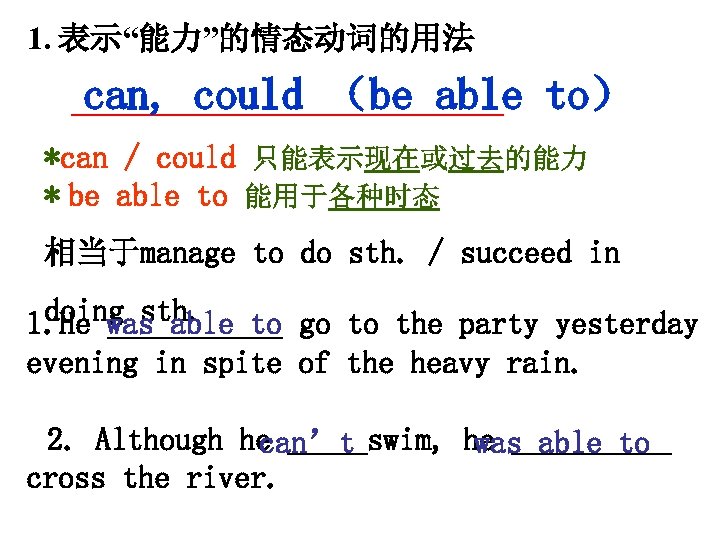
1. 表示“能力”的情态动词的用法 can, could (be able to) *can / could 只能表示现在或过去的能力 * be able to 能用于各种时态 相当于manage to do sth. / succeed in doing sth. 1. He was able to go to the party yesterday ______ evening in spite of the heavy rain. 2. Although he _____swim, he _____ can’t was able to cross the river.
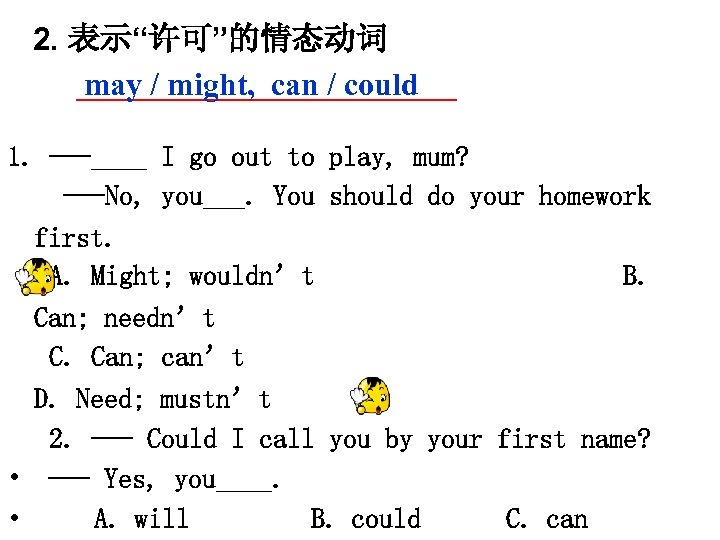
2. 表示“许可”的情态动词 may / might, can / could 1. ---____ I go out to play, mum? ---No, you___. You should do your homework first. A. Might; wouldn’t B. Can; needn’t C. Can; can’t D. Need; mustn’t 2. --- Could I call you by your first name? • --- Yes, you____. • A. will B. could C. can
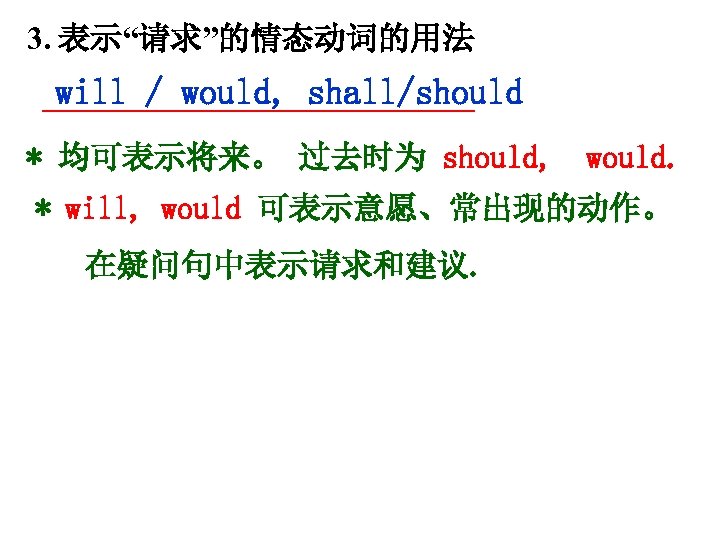
3. 表示“请求”的情态动词的用法 will / would, shall/should * 均可表示将来。 过去时为 should, would. * will, would 可表示意愿、常出现的动作。 在疑问句中表示请求和建议.
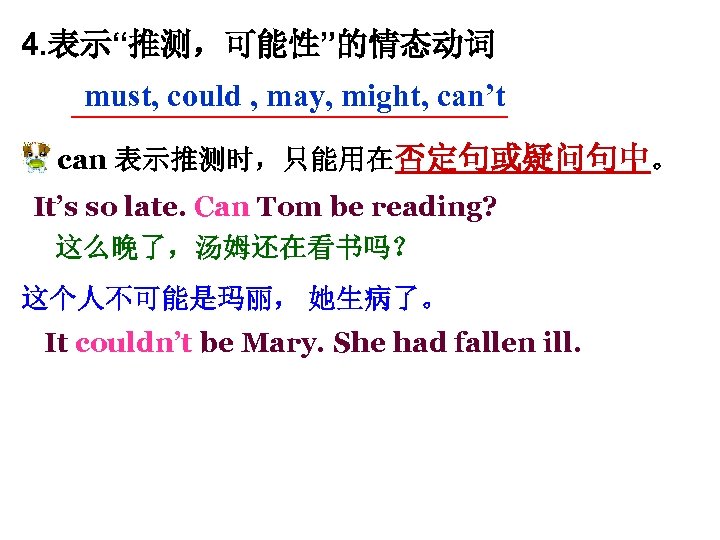
4. 表示“推测,可能性”的情态动词 must, could , may, might, can’t can 表示推测时,只能用在否定句或疑问句中。 It’s so late. Can Tom be reading? 这么晚了,汤姆还在看书吗? 这个人不可能是玛丽, 她生病了。 It couldn’t be Mary. She had fallen ill.
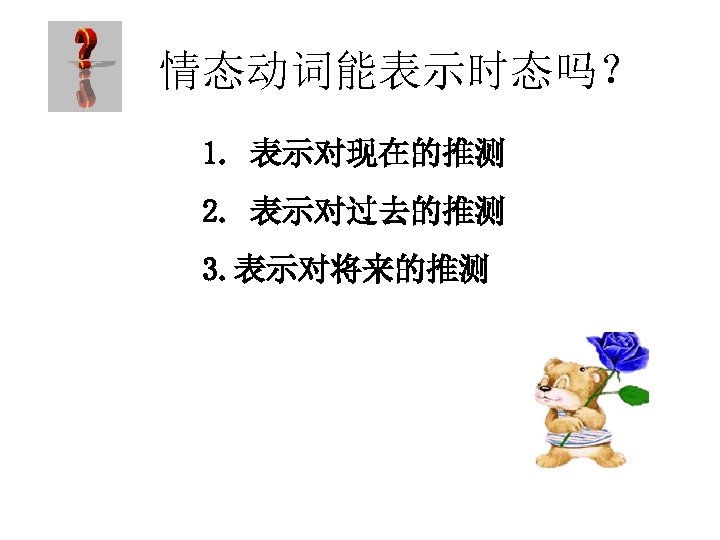
情态动词能表示时态吗? 1. 表示对现在的推测 2. 表示对过去的推测 3. 表示对将来的推测
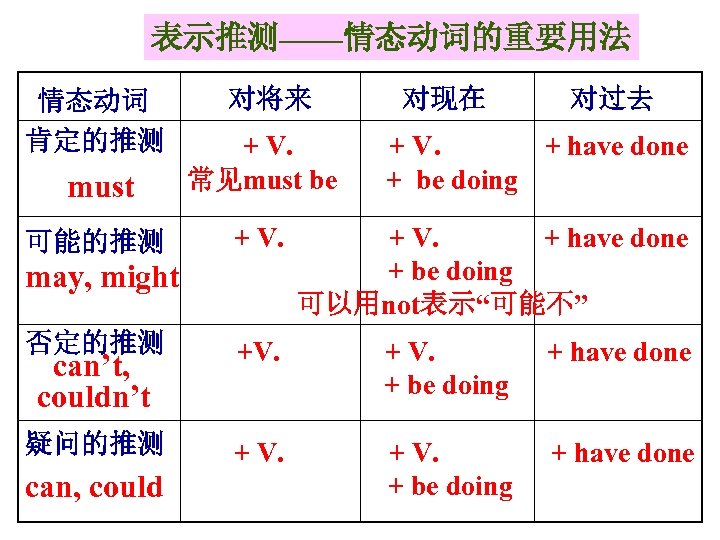
表示推测——情态动词的重要用法 情态动词 肯定的推测 对将来 must + V. 常见must be 可能的推测 + V. may, might 对现在 对过去 + V. + have done + be doing 可以用not表示“可能不” 否定的推测 can’t, couldn’t +V. + V. + be doing + have done 疑问的推测 + V. + be doing + have done can, could
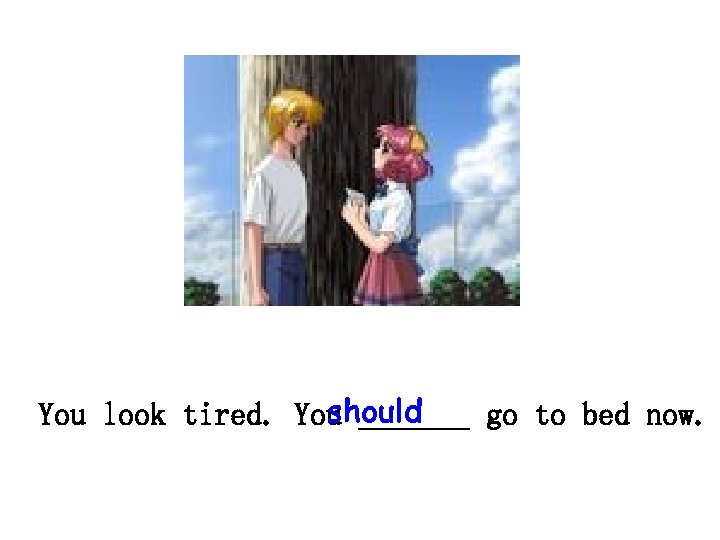
should You look tired. You _______ go to bed now.
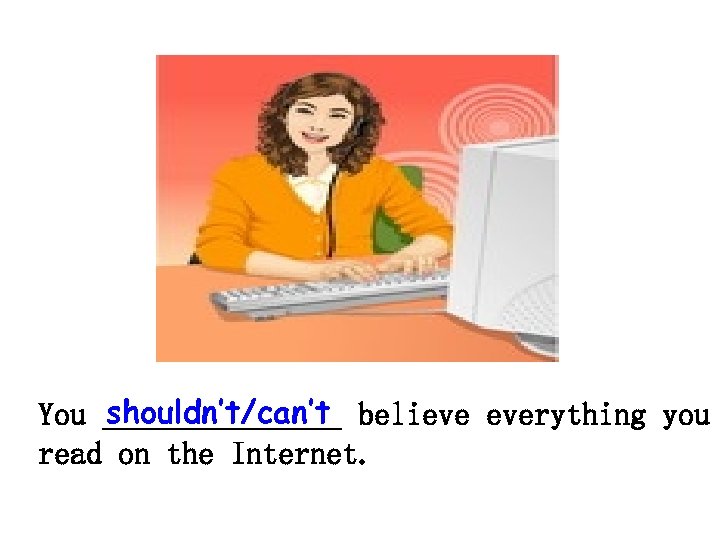
shouldn’t/can’t You ________ believe everything you read on the Internet.
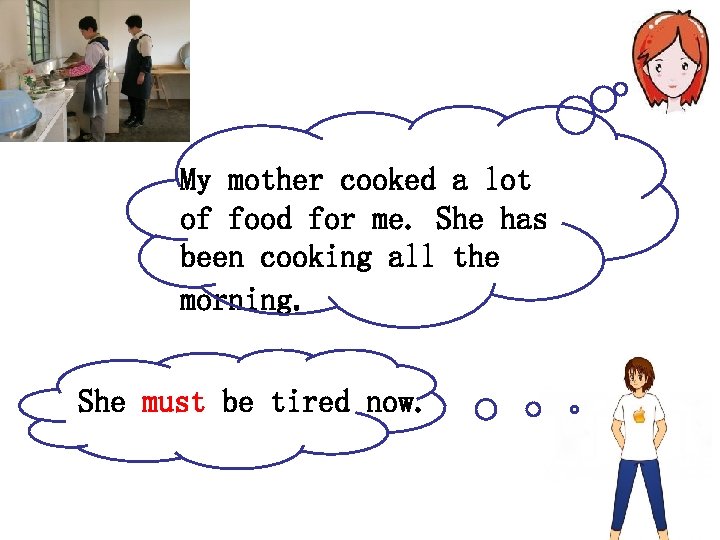
My mother cooked a lot of food for me. She has been cooking all the morning. She must be tired now.
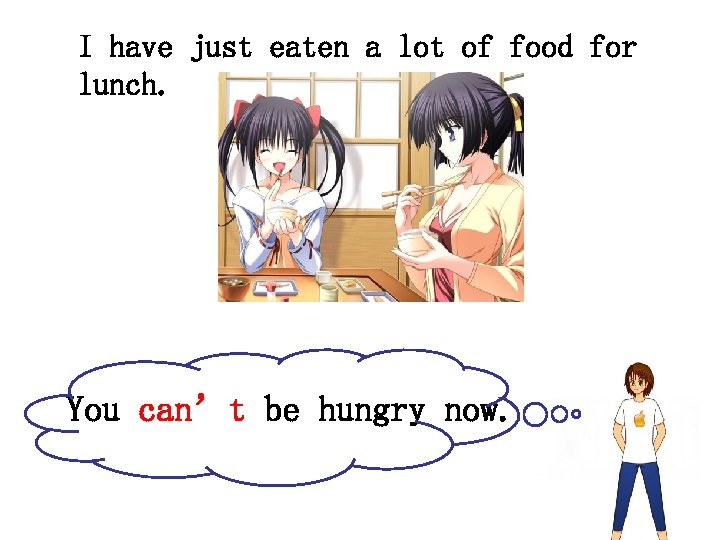
I have just eaten a lot of food for lunch. You can’t be hungry now.
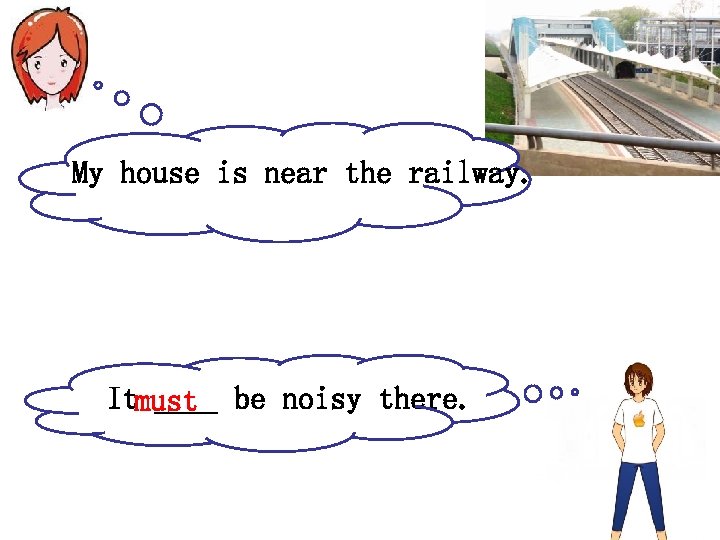
My house is near the railway. Itmust be noisy there. ____
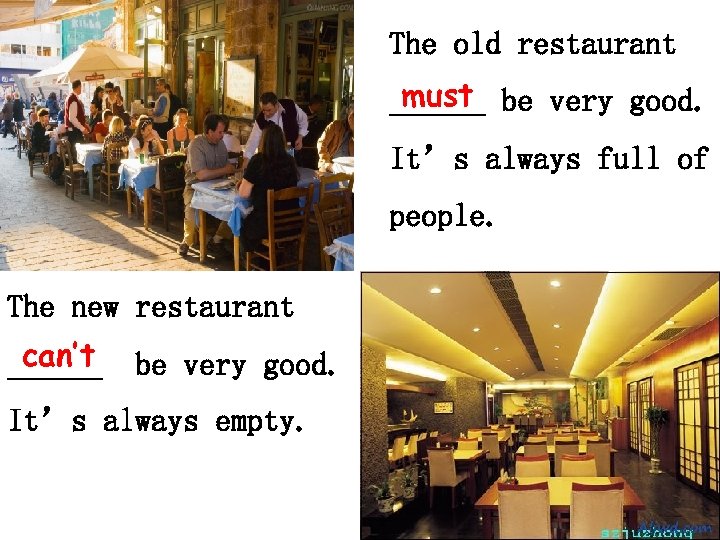
The old restaurant must ______ be very good. It’s always full of people. The new restaurant can’t ______ be very good. It’s always empty.
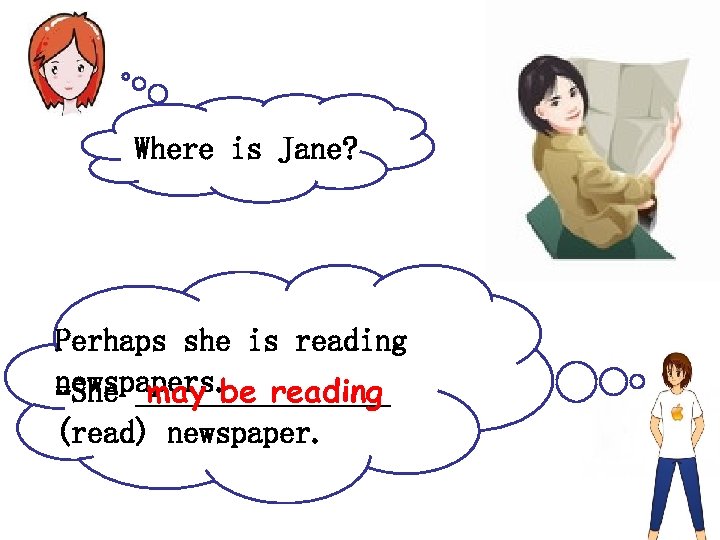
Where is Jane? Perhaps she is reading newspapers. reading may be =She ________ (read) newspaper.
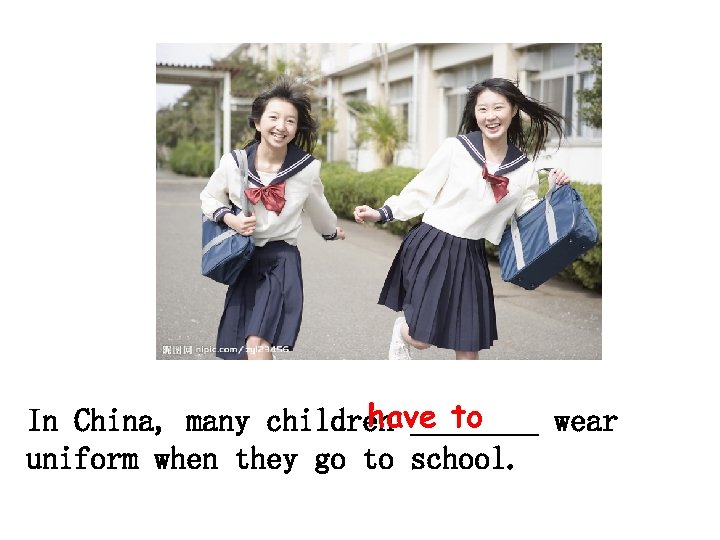
have to In China, many children ____ wear uniform when they go to school.
Don’t tell anybody what I said. must ______ You keep it a secret.
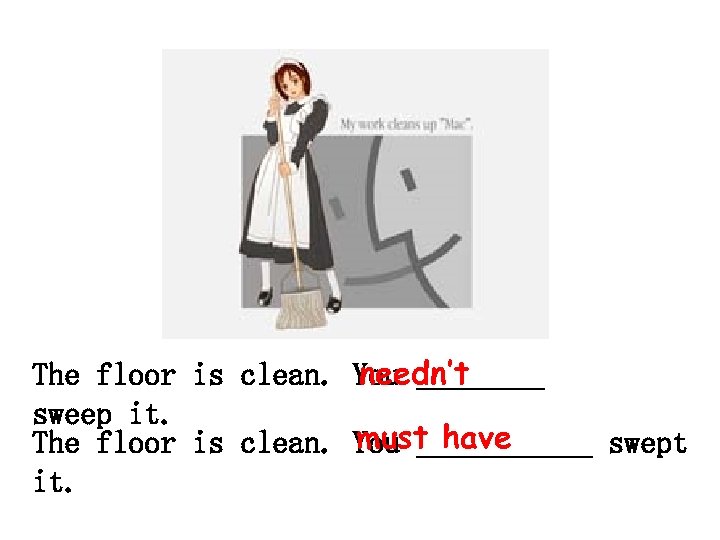
The floor is clean. sweep it. The floor is clean. it. needn’t You ____ must have You ______ swept
I promised I would be on time. I couldn’t be late. _____
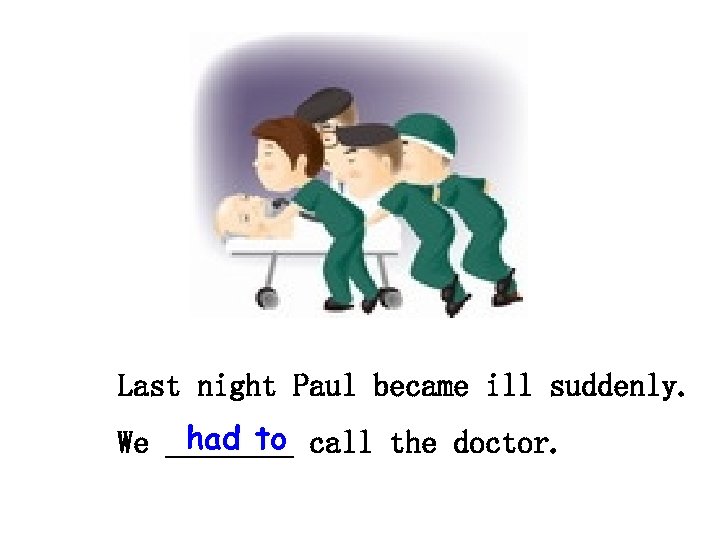
Last night Paul became ill suddenly. had to We ____ call the doctor.
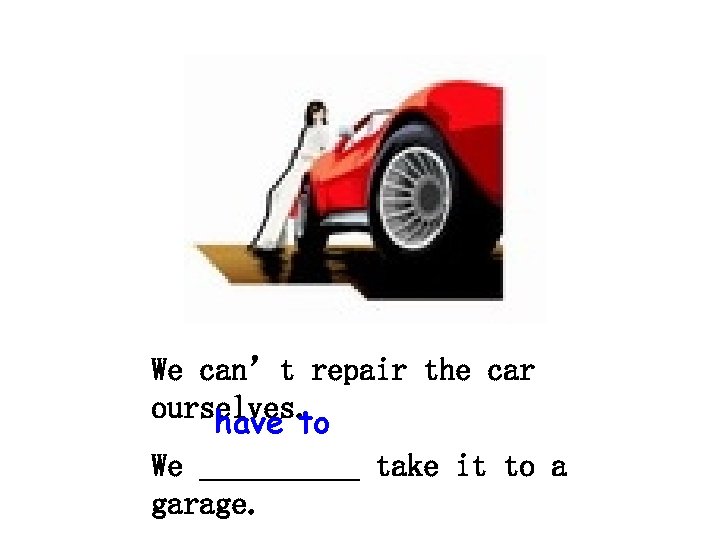
We can’t repair the car ourselves. have to We _____ take it to a garage.
I can manage the shopping alone. You needn’t _____ come with me.
That is an important book. must You ______ keep it well.
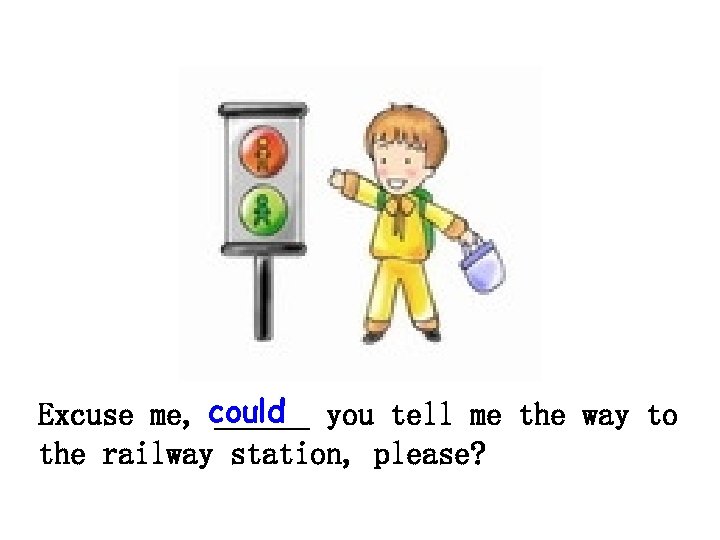
Excuse me, could you tell me the way to ______ the railway station, please?
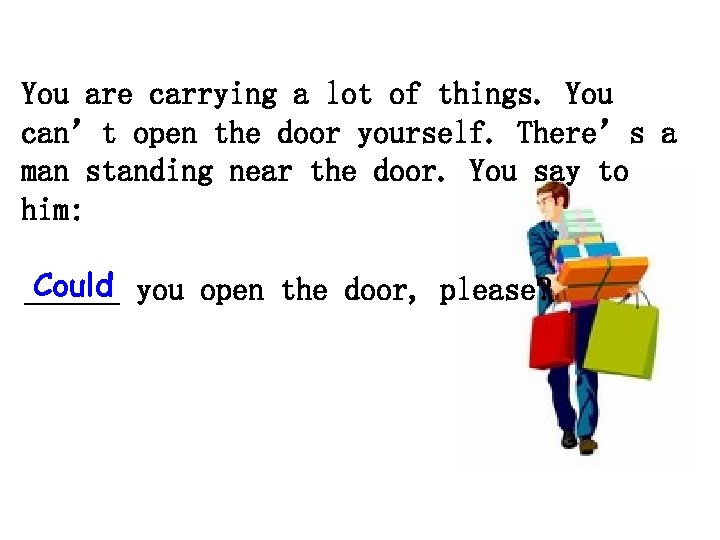
You are carrying a lot of things. You can’t open the door yourself. There’s a man standing near the door. You say to him: Could ______ you open the door, please?
Would you like a cup of ______ coffee?
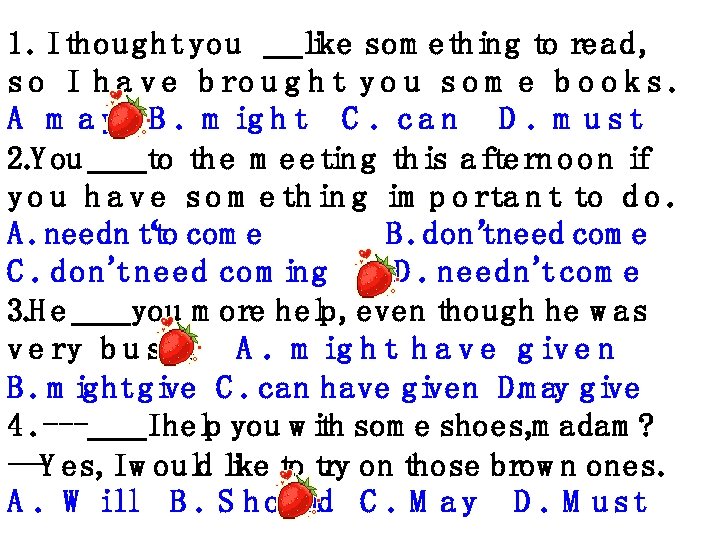
1. I thought you i som ethi to read, lke ng s o I h a v e b ro u g h t y o u s o m e b o o k s. A m a y B. m ig h t C. c a n D. m u s t 2. ou th e m e e tin g th is a fte rn o o n if Y to y o u h a v e s o m e th in g im p o rta n t to d o. A. needn‘o com e tt B. don’ tneed com e C. don' need com i t ng D. needn' com e t 3. e H you m ore hel even t p, hough he w as v e ry b u s y. A. m ig h t h a v e g iv e n B. m i gi C. can have gi ght ve ven D. ay gi m ve 4. --- hel you w ih som e shoes, adam ? I p t m ---Y es, I w oul lke t t on t d i o ry hose brow n ones. A. W ill B. S h o u ld C. M a y D. M u st
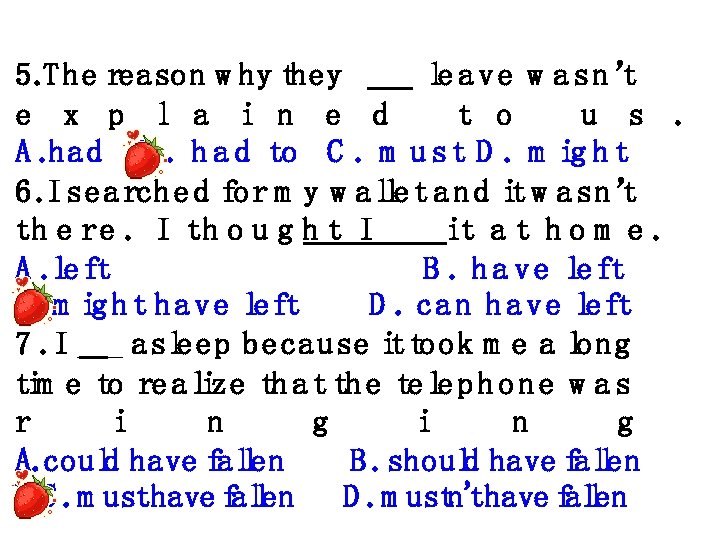
5. he reason w hy t T hey le a ve w a sn ’ t e x p l a i n e d t o u s. A. had B. h a d to C. m u s t D. m ig h t 6. I se a rch e d fo r m y w a l e t a n d i w a sn ’ l t t th e re. I th o u g h t I at hom e. it A. le ft B. h a v e le ft C. m ig h t h a ve le ft D. ca n h a ve le ft 7. I ___ asl eep because i took m e a l t ong tim e to re a lize th a t th e te le p h o n e w a s r i n g A. coul have f l B. shoul have f l d alen B. . m usthave f l C alen D. m ust thave f l n' alen
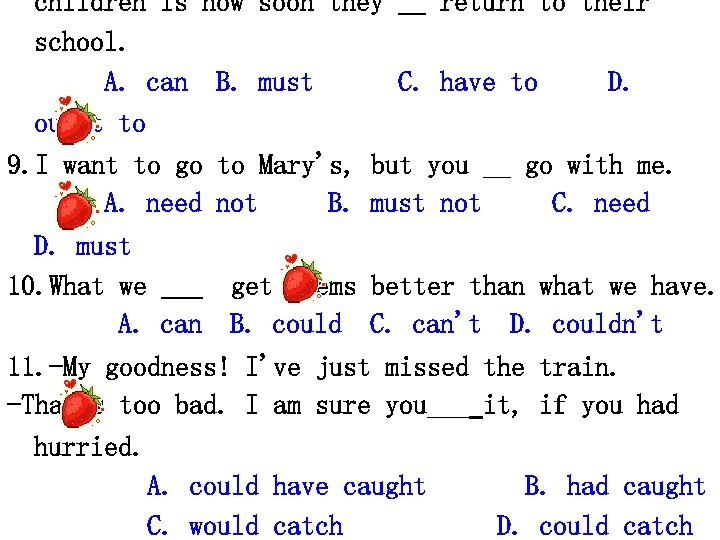
children is how soon they __ return to their school. A. can B. must C. have to D. ought to 9. I want to go to Mary's, but you __ go with me. A. need not B. must not C. need D. must 10. What we ___ get seems better than what we have. A. can B. could C. can't D. couldn't 11. -My goodness! I've just missed the train. -That's too bad. I am sure you___ it, if you had hurried. A. could have caught C. would catch B. had caught D. could catch
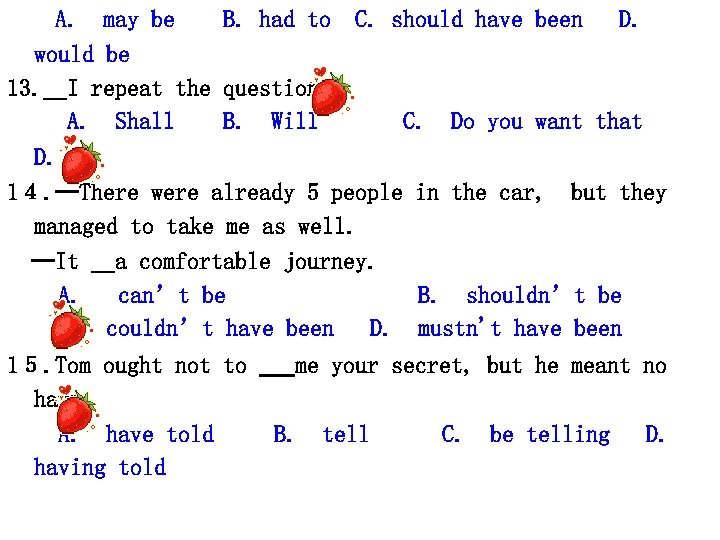
A. may be B. had to C. should have been D. would be 13. __I repeat the question? A. Shall B. Will C. Do you want that D. Do 14. ─There were already 5 people in the car, but they managed to take me as well. ─It a comfortable journey. A. can’t be B. shouldn’t be C. couldn’t have been D. mustn't have been 15. Tom ought not to _me your secret, but he meant no harm. A. have told B. tell C. be telling D. having told
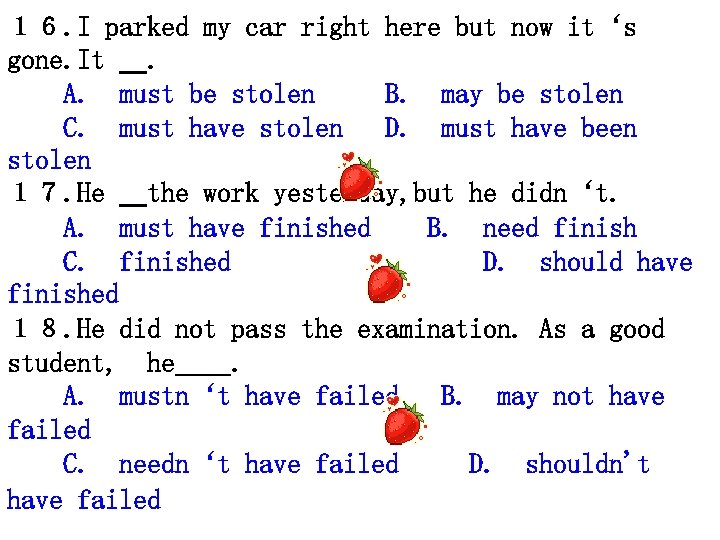
16. I parked my car right here but now it‘s gone. It . A. must be stolen B. may be stolen C. must have stolen D. must have been stolen 17. He the work yesterday, but he didn‘t. A. must have finished B. need finish C. finished D. should have finished 18. He did not pass the examination. As a good student, he . A. mustn‘t have failed B. may not have failed C. needn‘t have failed D. shouldn't have failed
Скачать презентацию Period 4 Grammar Modal Verbs The first
4db0e2b48c459c8cd59cba87a618b8af.ppt