 Скачать презентацию Performance Reliability and Operational Issues for High Performance
5ee89db7f49f15e661fa663b4682057a.ppt
- Количество слайдов: 31




Performance, Reliability, and Operational Issues for High Performance NAS Matthew O’Keefe, Alvarri okeefe@alvarri. com CMG Meeting February 2008
Cray’s Storage Strategy Background – Broad range of HPC requirements – big file I/O, small file I/O, scalability across multiple dimensions, data management, heterogeneous access… – Rate of improvement in I/O performance lags significantly behind Moore’s Law n Direction – Move away from “one solution fits all” approach – Use cluster file system for supercomputer scratch space and focus on high performance – Use scalable NAS, combined with data management tools and new hardware technologies for shared and managed storage n
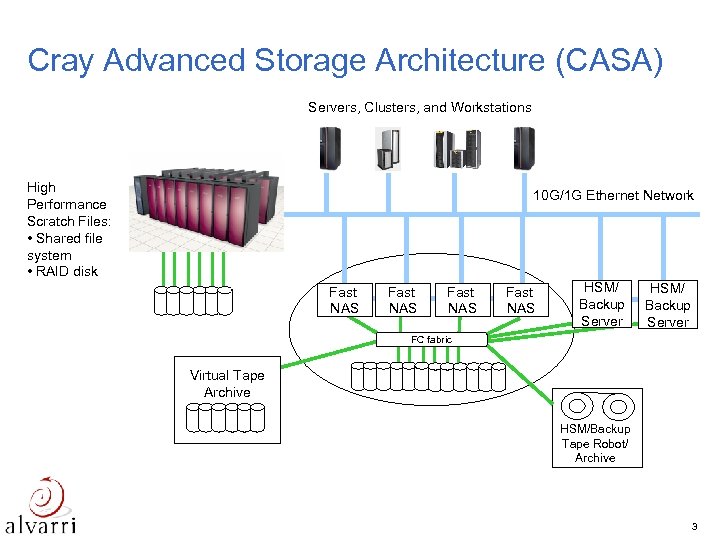
Cray Advanced Storage Architecture (CASA) Servers, Clusters, and Workstations High Performance Scratch Files: • Shared file system • RAID disk 10 G/1 G Ethernet Network Fast NAS HSM/ Backup Server FC fabric Virtual Tape Archive HSM/Backup Tape Robot/ Archive 3
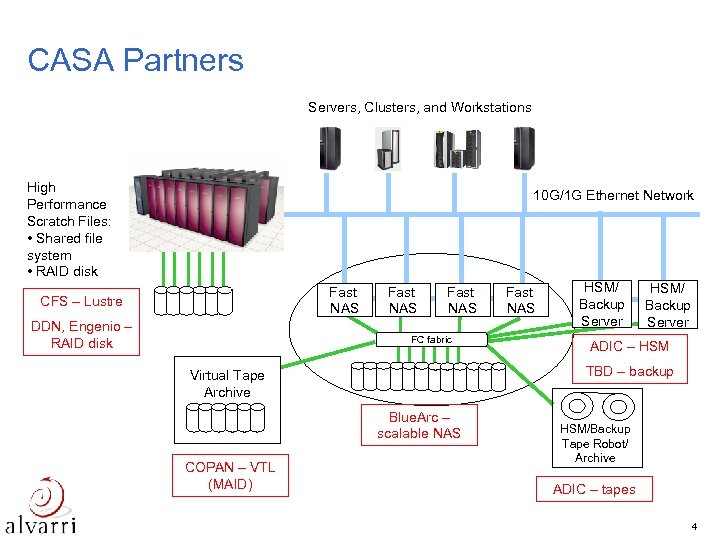
CASA Partners Servers, Clusters, and Workstations High Performance Scratch Files: • Shared file system • RAID disk 10 G/1 G Ethernet Network Fast NAS CFS – Lustre DDN, Engenio – RAID disk Fast NAS FC fabric HSM/ Backup Server ADIC – HSM TBD – backup Virtual Tape Archive Blue. Arc – scalable NAS COPAN – VTL (MAID) Fast NAS HSM/Backup Tape Robot/ Archive ADIC – tapes 4
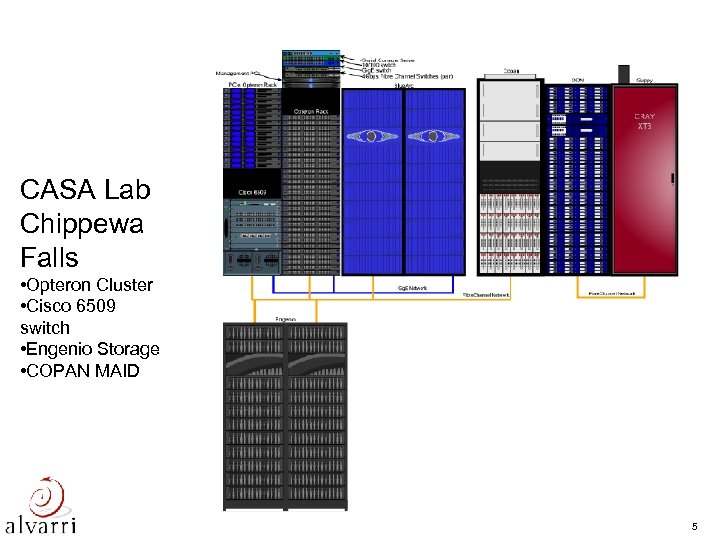
CASA Lab Chippewa Falls • Opteron Cluster • Cisco 6509 switch • Engenio Storage • COPAN MAID 5
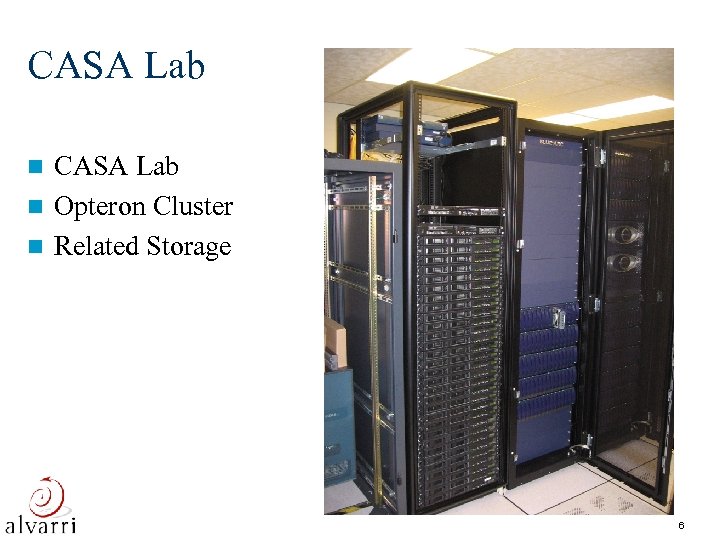
CASA Lab n Opteron Cluster n Related Storage n 6
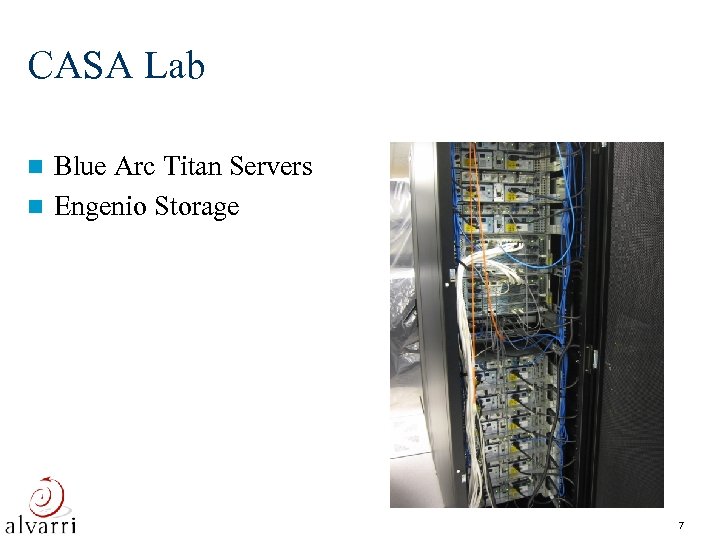
CASA Lab Blue Arc Titan Servers n Engenio Storage n 7
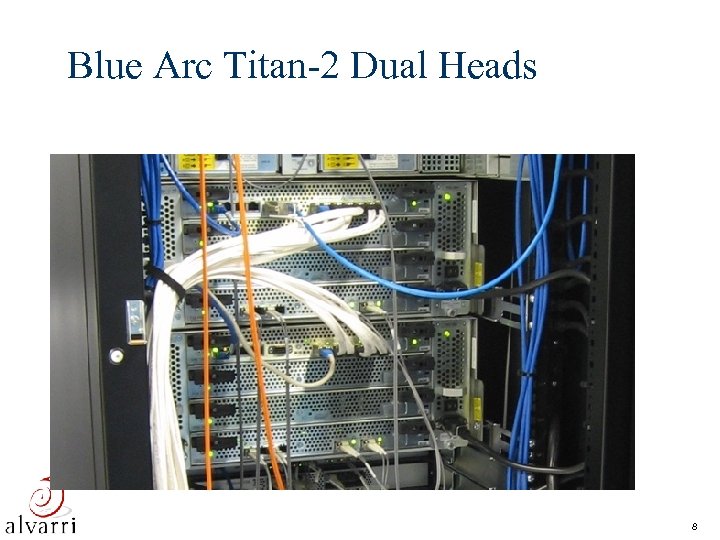
Blue Arc Titan-2 Dual Heads 8
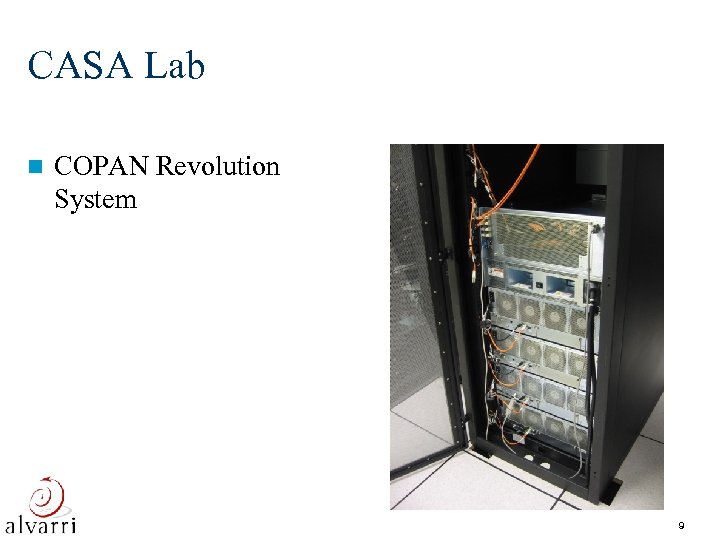
CASA Lab n COPAN Revolution System 9
How will this help? n Use a cluster file system for big file (bandwidth) I/O for scalable systems – Focus on performance for applications n Use commercial NAS products to provide solid storage for home directories and shared files – Vendors looking at NFS performance, scalability n Use new technologies – nearline disk, virtual tape – in addition to or instead of physical tape for backup and data migration – Higher reliability and performance 10
Major HPC Storage Issue n Too many HPC RFPs (esp for supercomputers) treat storage as secondary consideration – Storage “requirements” are incomplete or illdefined • Only performance requirement and/or benchmark is maximum aggregate bandwidth – No small files, no IOPS, metadata ops • Requires “HSM” or “backup” with insufficient details • No real reliability requirements – Selection criteria don’t give credit for a better storage solution • Vendor judged on whether storage requirements are met or not 11
Why NFS? n NFS is the basis of the NAS storage market (but CIFS important as well) – Highly successful, adopted by all storage vendors – Full ecosystem of data management and administration tools proven in commercial markets – Value propositions – ease of install and use, interoperability n NAS vendors are now focusing on scaling NAS – Various technical approaches for increasing client and storage scalability n Major weakness – performance – Some NAS vendors have been focusing on this – We see opportunities for improving this 12
CASA Lab Benchmarking n CASA Lab in Chippewa Falls provides testbed to benchmark, configure and test CASA components – Opteron cluster (30 nodes) running Suse Linux – Cisco 6509 switch – Blue. Arc Titan — dual-heads, 6 x 1 Gigabit Ethernet on each head – Dual-fabric Brocade SAN with 4 FC controllers and 1 SATA controller – Small Cray XT 3 13
Test and Benchmarking Methodology n Used Bringsel tool (J. Kaitschuck — see CUG paper) – Measure reliability, uniformity, scalability and performance – Creates large, symmetric directory trees, varying file sizes, access patterns, block sizes – Allows testing of the operational behavior of a storage system: behavior under load, reliability, uniformity of performance n Executed nearly 30 separate tests – Increasing complexity of access patterns and file distributions – Goal was to observe system performance across varying workloads 14
Quick Summary of Benchmarking Results A total of over 400 TB of data has been written without data corruption or access failures There have been no major hardware failures since testing began in August 2006 – predictable and relatively uniform. with some exceptions, the Blue. Arc aggregate performance generally scales with the number of clients March 18 Cray Technical Review 15
Summary (continued) Recovery from injected faults was fast and relatively transparent to clients n 32 test cases have been prepared, about 28 of varying length have been run, all file checksums to date have been valid Early SLES 9 NFS client problems under load, detected and corrected via kernel patch; this led to the use of this patch at Cray’s AWE customer site, who experienced the same problem
Sequential Write Performance: Varying Block Size 17
Large File Writes: 8 K Blocks 18
Large File, Random Writes, Variable Sized Blocks: Performance Approaches 500 MB/second for Single Head 19
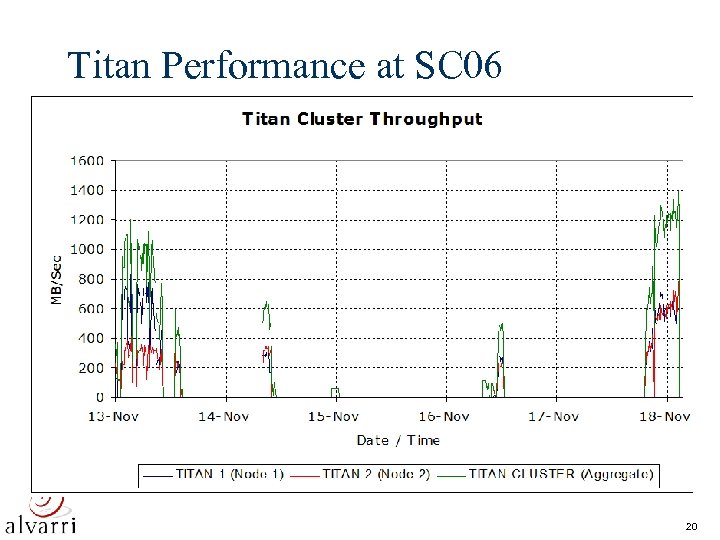
Titan Performance at SC 06 20
Summary of Results n Performance generally uniform for given load Very small block size combined with random access performed poorly with SLES 9 client – Much improved performance with SLES 10 client n Like cluster file systems, NFS performance sensitive to client behavior – SLES 9 Linux NFS client failed under Bringsel load – Tests completed with SLES 10 client n Cisco link aggregation reduces performance by 30% at low node counts – Static assignment of nodes to Ethernet links increases performance – This effect goes away for 100 s of NFS clients n 21
Summary of Results n Blue. Arc SAN backend provides performance baseline n The Titan NAS heads cannot deliver more performance than these storage arrays make available – Need sufficient storage (spindles, array controllers) to meet IOPS and bandwidth goals – Stripe storage for each Titan head across multiple controllers to achieve best performance n Test your NFS client with your anticipated workload against your NFS server infrastructure to set baseline performance 22
Summary n n n Blue. Arc NAS storage meets Cray goals for CASA Performance tuning is a continual effort Next big push: efficient protocols and transfers between NFS server tier and Cray platforms i. SCSI deployments for providing network disks for login, network, and SIO nodes Export SAN infrastructure from Blue. Arc to rest of data center Storage Tiers: fast FC block storage, Blue. Arc FC and SATA, MAID 23
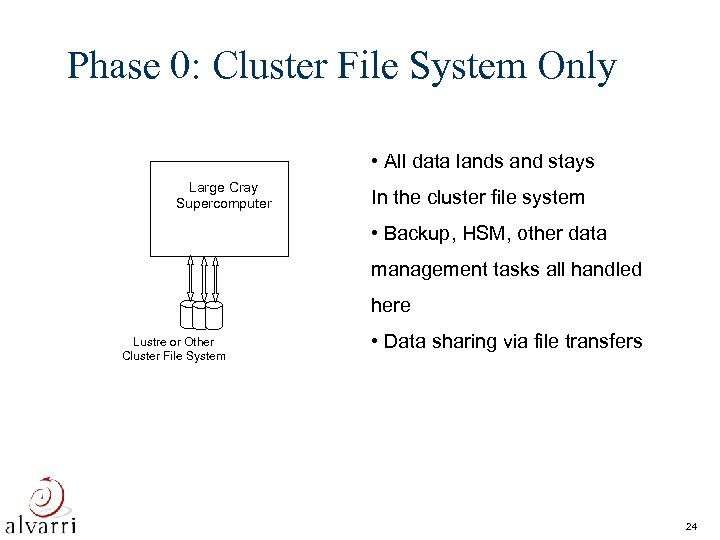
Phase 0: Cluster File System Only • All data lands and stays Large Cray Supercomputer In the cluster file system • Backup, HSM, other data management tasks all handled here Lustre or Other Cluster File System • Data sharing via file transfers 24
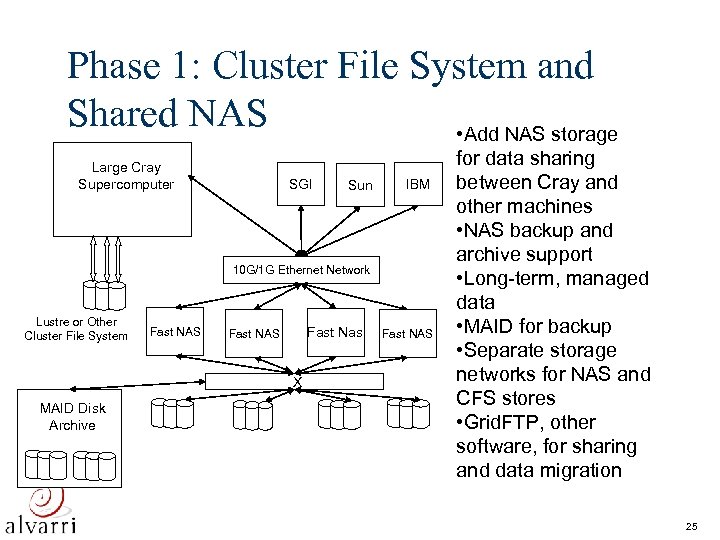
Phase 1: Cluster File System and Shared NAS • Add NAS storage Large Cray Supercomputer SGI Sun IBM 10 G/1 G Ethernet Network Lustre or Other Cluster File System Fast NAS Fast Nas Fast NAS X MAID Disk Archive Fast NAS for data sharing between Cray and other machines • NAS backup and archive support • Long-term, managed data • MAID for backup • Separate storage networks for NAS and CFS stores • Grid. FTP, other software, for sharing and data migration 25
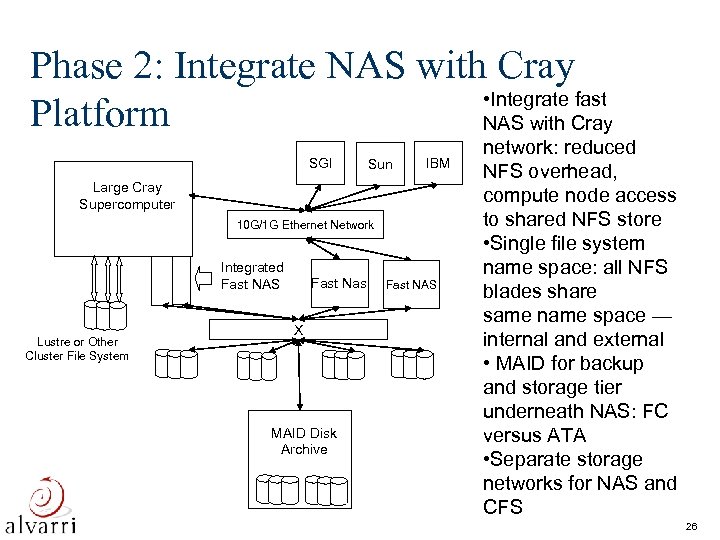
Phase 2: Integrate NAS with Cray • Integrate fast Platform NAS with Cray SGI Sun IBM Large Cray Supercomputer 10 G/1 G Ethernet Network Integrated Fast NAS Lustre or Other Cluster File System Fast Nas X MAID Disk Archive Fast NAS network: reduced NFS overhead, compute node access to shared NFS store • Single file system name space: all NFS blades share same name space — internal and external • MAID for backup and storage tier underneath NAS: FC versus ATA • Separate storage networks for NAS and CFS 26
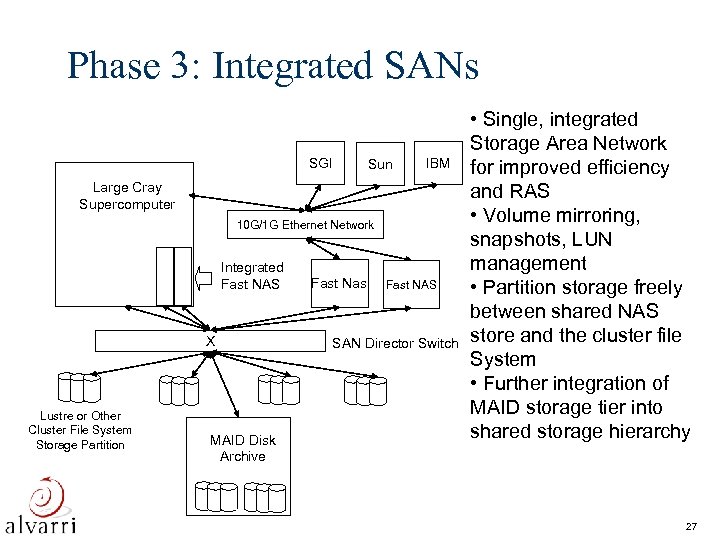
Phase 3: Integrated SANs SGI Sun IBM Large Cray Supercomputer 10 G/1 G Ethernet Network Integrated Fast NAS X Lustre or Other Cluster File System Storage Partition MAID Disk Archive Fast Nas Fast NAS SAN Director Switch • Single, integrated Storage Area Network for improved efficiency and RAS • Volume mirroring, snapshots, LUN management • Partition storage freely between shared NAS store and the cluster file System • Further integration of MAID storage tier into shared storage hierarchy 27
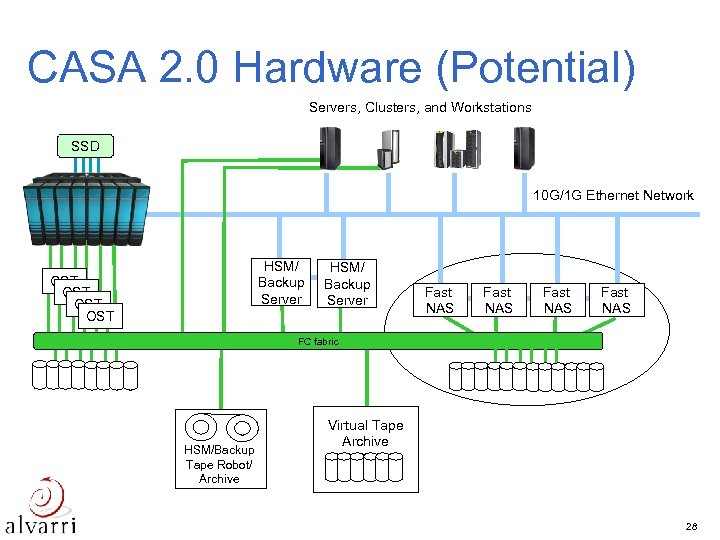
CASA 2. 0 Hardware (Potential) Servers, Clusters, and Workstations SSD 10 G/1 G Ethernet Network HSM/ Backup Server OST OST HSM/ Backup Server Fast NAS FC fabric HSM/Backup Tape Robot/ Archive Virtual Tape Archive 28
Questions? Comments? March 18 Cray Technical Review 29
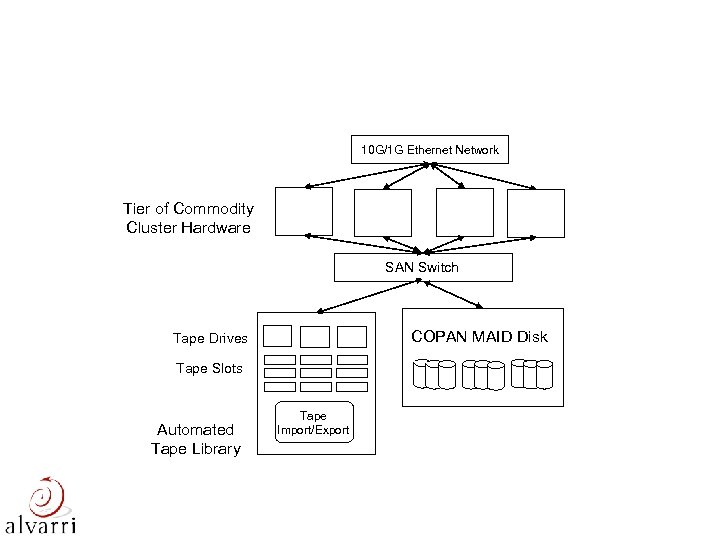
10 G/1 G Ethernet Network Tier of Commodity Cluster Hardware SAN Switch COPAN MAID Disk Tape Drives Tape Slots Automated Tape Library Tape Import/Export
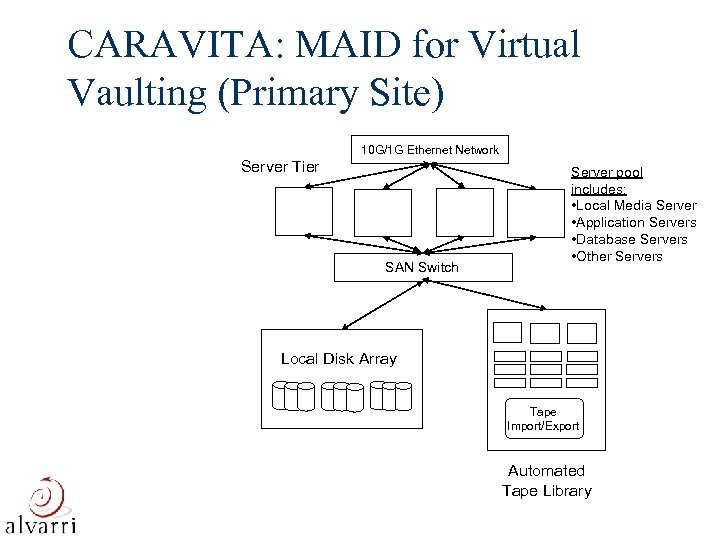
CARAVITA: MAID for Virtual Vaulting (Primary Site) 10 G/1 G Ethernet Network Server Tier SAN Switch Server pool includes: • Local Media Server • Application Servers • Database Servers • Other Servers Local Disk Array Tape Import/Export Automated Tape Library
Скачать презентацию Performance Reliability and Operational Issues for High Performance
5ee89db7f49f15e661fa663b4682057a.ppt